Why do ordinary citizens prefer to live in a democracy? When do these citizens support a democratic political system that does not perform to their satisfaction? Why do these ‘critical citizens’ remain supportive of a malfunctioning democracy? For the past decade, political scientists have proposed and tested a variety of theoretical models to address these and related questions regarding citizen orientations to democracy (Bratton, Mattes, and Gyimah-Boadi, Reference Bratton, Mattes and Gyimah-Boadi2005; Camp, Reference Camp2001; Colton, Reference Colton2000; Dalton, Reference Dalton2004; Evans and Whitefield, Reference Evans and Whitefield1995; Gibson, Reference Gibson2004; Haerpfer, Reference Haerpfer2001; Klingemann and Fuchs, Reference Klingemann and Fuchs1995; Linz and Stepan, Reference Linz and Stepan1996; McDonough et al., Reference McDonough, Barnes and Pina1998; Norris, Reference Norris1999; Pharr and Putnam, Reference Pharr and Putnam2000; Rose et al., Reference Rose, Mishler and Haerpfer1998; Shin, Reference Shin1999). The most eloquent and unassuming of these models originated with Winston Churchill, who asserted in 1947 that ‘democracy is the worst form of government, except all those other forms that have been tried from time to time’ (quoted in Rose et al., Reference Rose, Mishler and Haerpfer1998: 11).
Churchill's noteworthy rationale for supporting democracy acknowledged that it may perform badly but not as badly as undemocratic forms of government. In his conceptualization, democracy need not attain political ideals including freedom, equality, and justice, as set forth in the works of political philosophers and theorists from John Locke through Thomas Jefferson to Robert Dahl (for a review of this literature, see Mueller, Reference Mueller1999 and Powell Jr., Reference Powell, Almond, Chodorow and Pearce1982). It need not even establish the ‘kinder and gentler’ form of government that many ordinary citizens of new democratic states and their political leaders have sought to establish since the current wave of global democratization began three decades ago (Lijphart, Reference Lijphart1999). Churchillian democracy is merely a lesser evil, a conceptualization that directly challenges long-accepted idealistic and positive assertions in the theoretical literature about democracy, assertions that are widely endorsed by the mass citizenry of third-wave democracies (Camp, Reference Camp2001; Chu et al., Reference Chu, Diamond, Nathan and Shin2008; Gibson et al., Reference Gibson, Duch and Tedin1992; Mattes and Bratton, Reference Mattes and Bratton2007; Miller et al., Reference Miller, Hesli and Reisinger1997; Shin, Reference Shin1999).
Moreover, the Churchillian notion that democracy constitutes a lesser evil directly challenges a growing body of literature on democratic consolidation. For the consolidation of nascent democratic rule to take root, the existing literature emphasizes the critical role of mass public support (Diamond, Reference Diamond1999; Linz and Stepan, Reference Linz and Stepan1996). This literature implicitly assumes that when citizens affirm democracy as ‘the only game in town’, they also view it positively as the best form of government. Rejecting this prevailing wisdom that new democracy becomes consolidated only when most people accept it positively as the best form of government, the Churchillian notion of democracy offers a counterpoint that could reshape the study of democratic consolidation.
To assess Churchill's epigram about democracy, citizens must compare their own experiences of political life under democratic and undemocratic systems. The recent surge in democratic transitions in the various regions of the world, therefore, offers opportunities to assess empirically this notion of democracy. To date, tests of this proposition were made without determining whether citizens of new democracies had personally experienced the occurrence of democratic regime change. The tests also occurred exclusively within the context of post-Communist countries in Eastern and Central Europe (Rose et al., Reference Rose, Mishler and Haerpfer1998; Shin and Wells, Reference Shin and Wells2001). Consequently, little is known about the validity of this lesser-evil notion for recognizing popular perceptions of democracy in other regions in democratic transition.
To fill this gap in the literature, this study examines the 2001–2003 East Asia Barometer (EAB hereafter) survey data collected in East Asia's five new democracies: Korea, Mongolia, the Philippines, Taiwan, and Thailand.Footnote 1 We use the data to ask and answer a series of empirical questions about democracy as a lesser evil. First, what proportion of the mass public in each of the East Asian countries perceive their newly formed democratic systems to be a lesser evil than the regime they knew prior to their recent transition to democracy? Do those who perceive the current political system as a lesser evil embrace democracy as the preferred form of government?
This article has six sections. In the section that immediately follows, we review the previous scholarly endeavors to test the Churchillian notion of democracy. In the second section, we explicate the notion of a lesser evil as a concept and distinguish it from other types of regime perceptions. In the next section, we introduce a measurement of the Churchillian lesser-evil notion of democracy. In the following two sections, we present the results of univariate and bivariate analyses of the EAB surveys. The sixth and final section summarizes the key findings of our research and discusses their implications for the future study of democratic regime change.
Previous research
Over the past decade, a great deal of survey research has investigated the sources and consequences of various perceptions and understandings of democracy. In Europe, Richard Rose has conducted New Democracies and Europe Barometers on a regular basis. Jose Montero has conducted several waves of national sample surveys in Spain, Portugal, Italy, and Greece. Marta Lagos has conducted annual Latino Barometer surveys in 15 Latin American countries and Spain. In Africa, Michael Bratton and Robert Mattes have launched the Afrobarometer surveys. In addition, James Gibson and many other individual scholars in Asia, Europe, and the United States have conducted numerous surveys on new democracies. As useful as these previous studies are in evaluating support for democracy in particular contexts, their utility in explicating and testing the Churchillian notion of a lesser evil is limited in two key ways.
First, most of these studies assume that democracy is the noblest form of government. They were designed to uncover popular conceptions of democracy as a series of political ideals, not as political realities (Gibson et al., Reference Gibson, Duch and Tedin1992; Miller et al., Reference Miller, Hesli and Reisinger1997; Shin, Reference Shin1999; Simon, Reference Simon1994). Instead of examining the reactions of citizens in new democracies to various real regimes, these studies mostly tapped into the values that citizens attach to the democratic ideal. Using such idealistic conceptions, it is problematic to infer realistic assessments of democratic regimes in action. It is reasonable to expect a wide gulf between people's expectstions and their actual experiences (Mueller, Reference Mueller1999; Rose and Mishler, Reference Rose and Mishler1996; Rose et al., Reference Rose, Shin, Munro and Norris1999).
Second, the bulk of the existing survey research was gathered using an absolute perspective that does not involve any comparisons with alternative forms of government (Anderson and Guillory, Reference Anderson and Guillory1997; Cusack, Reference Cusak1999; Fuchs et al., Reference Fuchs, Guidorossi, Svensson, Klingemann and Fuch1995; Klingemann, Reference Klingemann and Norris1999). Characterizing experiences within the current democratic system as satisfying or unsatisfying, for example, provides no basis to infer whether a democracy performs better or worse than any of its undemocratic predecessors.
To date, only a very limited number of surveys have asked respondents to compare their perceptions of the democratic and undemocratic regimes they have experienced (Bratton et al., Reference Bratton, Mattes and Gyimah-Boadi2005; Chu et al., Reference Chu, Diamond, Nathan and Shin2008; Rose et al., Reference Rose, Mishler and Haerpfer1998). While it is possible for any analysis using these surveys to determine which political system, democratic or undemocratic, is seen as performing better, it is not possible to use these surveys to determine whether the current democratic system is preferable to its undemocratic predecessor in a positive sense or in a negative sense. These surveys merely indicate the extent to which the former is more or less preferable to the latter without revealing whether citizens view either form favorably.
To test the notion that people will support a dissatisfying democratic regime so long as they perceive its alternative as worse, researchers must uncover citizens’ absolute assessments of both the past and present regimes. Or they must uncover not only whether they feel satisfied or dissatisfied with the current democratic regime but also how they feel about it in comparison with the past authoritarian regime. In their New Democracies Barometer surveys, Richard Rose and his associates (Reference Rose, Mishler and Haerpfer1998) got close to performing this test when they asked citizens of post-communist Europe to make separate assessments of the Communist and post-Communist systems. The researchers compared individual respondents’ separate ratings of each system to estimate the proportion of the people who chose the post-Communist regime over the Communist regime. More than half the mass public in Central and Eastern Europe were found to prefer the former to the latter (Rose and Mishler, Reference Rose and Mishler1996: 36). This finding was interpreted as support for the Churchillian notion of democracy as a lesser evil.
In testing this notion, however, the researchers mistakenly inferred that being relatively preferable was the same as being a lesser evil, but to be a lesser evil, the government must be preferred while also being viewed in a negative light. A positive regime cannot be evil. Furthermore, the researchers assumed that citizens recognized a transition from an authoritarian past to a democratic present, but what if citizens did not recognize this transition? Then they should not be considered adherents of the Churchillian notion of democracy as done in the Rose study.
Conceptualization
Our review of the existing literature suggests that the Churchillian notion of democracy as a lesser evil is a complex concept that necessitates much more than a description of one political entity. It requires the evaluation and comparison of divergent political systems, democratic and undemocratic. In making a comparative evaluation of those systems, it emphasizes the frequent failures of those systems to satisfy the citizenry and prescribes a negative perspective to the systems’ evaluation. Conceptually, therefore, the Churchillan notion constitutes a framework for a comparative evaluation of the failings of democratic and undemocratic political systems.
Empirically, this notion rejects the popular view that democracy is an ideal form of government. Instead, it holds that democracy, like undemocratic alternatives, is a bad or undesirable form of political system. It holds further that democracy is merely less undesirable as a political system than its undemocratic alternatives. Being a system of government that does not dissatisfy its people as much as a previous undemocratic system of government did, democracy is appraised as a lesser evil.
In the eyes of ordinary people, therefore, democracy becomes a lesser evil only when they perceive and assess the past and present regimes in three particular ways. First, they perceive the past regime as an authoritarian regime and the current regime as a democracy and thus recognize the occurrence of democratic regime change. Second, they assess both regimes negatively, expressing dissatisfaction with the regimes’ performances. Third, they assess the current democratic regime less negatively or to be less undesirable than the past authoritarian regime.
In short, the notion of democracy as a lesser evil embodies two new noteworthy ideas, which contrast sharply with those underlying the prevailing paradigm that emphasizes positive conceptions of democracy among the mass public as a cultural foundation for the consolidation of nascent democracies. Conceptually, this notion offers a tool for empirical observation by focusing on democracy-in-action rather than democracy-in-principle. Specifically, it offers a realistic perspective that allows for accurately determining how individual citizens of newly democratizing countries perceive and understand their regimes, even when they have no knowledge of democratic theory and little experience in democratic politics. Theoretically, this vantage point offers an alternative explanation of why ‘critical’ citizens continue to support a new democratic system, even when it fails to perform to their satisfaction (Dalton, Reference Dalton and Norris1999; Klingmann, Reference Klingemann and Norris1999).
Measurement
Do East Asians actually perceive their political systems as a lesser evil, consistent with Churchill's characterization from more than half a century ago? To address this question more accurately than did Rose and his associates, we take into consideration both regime change orientation and a more nuanced assessment of the current regime's performance. To measure the recognition of democratic regime change, we chose a pair of items from the EAB surveys, which asked respondents to rate, respectively, the past and current regimes on a ten-point scale in which scores of 1 and 10 indicate, respectively, complete dictatorship and complete democracy. We collapsed their responses into the two categories of non-democracy and democracy, placing scores of 5 and below into the former and 6 and above into the latter. Comparing the dichotomous ratings of the past and present regime, we determined the recognition of democratic regime change. Perceiving the past regime as a non-democracy and the current regime as a democracy is considered recognizing democratic regime change.
To determine whether the current regime performs less negatively or undesirably than the previous one, we chose another pair of questions. One question asked respondents to rate on a 4-point verbal scale the extent to which they were satisfied or dissatisfied with the working of the current regime. We collapsed their responses to this question into the two categories of positive (‘very satisfied’ and ‘fairly satisfied’) and negative (‘not very satisfied’ and ‘not at all satisfied’) assessments. To determine whether the quality of the current regime's performance has improved in the wake of democratic regime change, we fashioned another question that asked how strongly respondents would agree or disagree with the statement that, ‘Whatever its faults may be, our current form of government is still the best for us.’ We also collapsed their responses to this question into two categories, improved (‘strongly agree’ and ‘somewhat agree’) and unimproved (‘somewhat disagree’ and ‘strongly disagree’). When respondents label the current democratic system as the best for their country, we conclude that they view democracy as an improvement over all the other systems they have experienced.
Finally, we formulated a typology of six regime type orientations on the basis of the three criteria discussed above: (1) whether citizens recognize the occurrence of democratic regime change, (2) whether they evaluate the current regime negatively, and (3) whether they evaluate it as an improved system. The six types of regime orientations are: (1) an unimproved authoritarian regime in which citizens neither perceive democratic regime change nor experience any improvement in regime performance; (2) a negatively improved authoritarian regime in which citizens neither recognize democratic regime change nor feel satisfied but feel less unsatisfied than in the past; (3) a positively improved authoritarian regime in which citizens recognize the current system as authoritarian (no regime change occurred) but rate it positively and are more satisfied than in the past; (4) an unimproved democratic regime in which citizens recognize the occurrence of democratic regime change but they do not recognize the current regime as performing any better, either positively or negatively, than its authoritarian predecessor; (5) a negatively improved democratic regime in which citizens recognize the occurrence of democratic regime change, are unsatisfied, but are less unsatisfied than in the past; and (6) a positively improved democratic regime in which citizens acknowledge that a regime change did occur, are satisfied, and prefer the current democratic system to the past authoritarian system. Of these six types of regime orientations, the fifth type of negatively improved democratic regime is of notable interest to our inquiry because it represents accurately Churchill's two-dimensional notion of democracy as a lesser evil.
Univariate analysis
National differences in regime perceptions and assessments
Our analysis of the EAB surveys begins by investigating whether citizens from different nations vary in their perceptions of regime characters and assessments of regime performances.Footnote 2 In the five new East Asian democracies studied here, the previous authoritarian regimes were very different from each other. Korea and Thailand, for example, were military dictatorships, while the Philippines was a civilian dictatorship. Mongolia and Taiwan, on the other hand, were one-party dictatorships. The modes of their transition to democracy vary considerably from the people's power movement in the Philippines to the negotiated transition in Korea (Dalton and Shin, Reference Dalton and Shin2006; Lee, Reference Lee2002; Reilly, Reference Reilly2006).
Figure 1 compares citizen perceptions of democratic regime change across the five countries. This comparison reveals that majorities, though not always large majorities, of the East Asian mass publics are cognitively capable of recognizing that democratic regime change occurred in their own country. Of the five new East Asian democracies, Thailand has the highest percentage (72%) of citizens who believe that a regime change occurred in their polity. Taiwan has the lowest percentage (53%) recognizing a transition to democracy from authoritarian rule. The pooled sample indicates that about six out of ten (59%) citizens in East Asia perceive that a regime change occurred in their respective countries. This means that as many as two out of five are not cognitively capable of distinguishing democracy from its alternative even after more than a decade of democratic rule.
National differences in citizen perceptions of democratic regime change (in percentage).

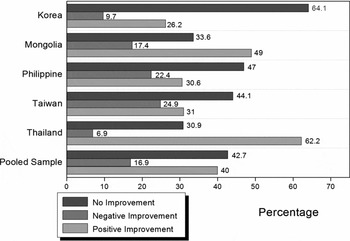
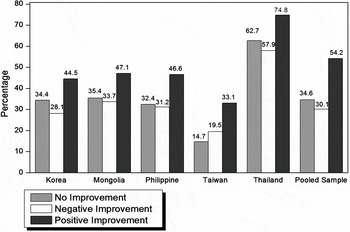
Figure 2 shows how East Asians appraise the performance of the current regime in comparison with its authoritarian predecessors. The data reported in this figure confirm our suspicion that many East Asians remain nostalgic for the authoritarian past and critical of their current democratic system. In this regard, Norris (Reference Norris1999) points out the political, economic, and cultural costs of democratic transition can make citizens evaluate their current system in a negative light or in such a way that they perceive no improvement from the past.
National differences in relative assessments of regime performance (in percentage).

Of the five countries surveyed, critical citizens are more numerous in Korea (64%), the Philippines (47%), and Taiwan (44%). In these three countries, citizens critical of the current democratic regime (those who expressed dissatisfaction with its workings) outnumber those who believe that it performs positively better or more desirably than the authoritarian regime of the past. In Korea, a majority close to two-thirds strongly believe that their newly installed democratic system does not perform any better than the military dictatorship that freed many of them from poverty. In Mongolia and Thailand, perceivers of positive improvements in its performance outnumber those critical of the performance. However, Thailand leads the latter by a large margin of two to one (62% vs. 31%). Despite these differences, the five countries are alike in that those who rate the current regime as performing negatively better or less undesirably than the previous regime constitute the smallest minorities. These minorities expressing less dissatisfaction with the current democratic regime range from 5% in Korea and Thailand to 14% in Taiwan. This finding suggests that the democratic transformation of authoritarian rule engenders greater satisfaction than greater dissatisfaction among ordinary citizens in East Asia.
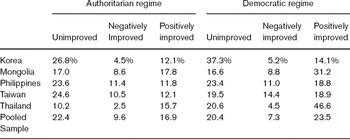
To determine if these citizens tend to perceive democracy as a lesser evil, Table 1 reports the distribution of each national sample into the six types of regime orientations. As mentioned earlier, adherents to Churchill's lesser-evil notion of democracy are those who perceive the current regime as a democracy that performs negatively but better than the previous authoritarian regime, i.e. ‘negatively improved democracy’. The percentages reported in Table 1 make it clear that lesser-evil perceptions are not the most popular type of regime orientations among East Asians. Instead, they represent one of the least popular types. In all five countries, minorities from 5% to 14% subscribe to this type. Looking at the whole sample shows that less than one in ten (9%) East Asians are lesser-evil perceivers.
National differences in citizen orientations toward regime change

Table 1 also shows that the most popular type of regime orientation varies considerably across the five countries. In Korea, the perceptions of an unimproved democratic regime are the most popular with a plurality of 37%. In Mongolia and Thailand, perceptions of a positively improved democratic regime are the most popular. In the remaining two countries, the Philippines and Taiwan, an unimproved authoritarian regime constitutes the most popular type. These findings make it clear that East Asians are more divided than united in perceiving and assessing their regimes of the past and the present. Such divisions may be one of the reasons why these new democracies have been struggling to become fully consolidated democracies (Chang et al., Reference Chang, Chu and Park2007; Cheng, Reference Cheng2003; Croissant, Reference Croissant2004).
National differences in democratic support
Our dependent variable of democratic support is measured with a 5-point index. The EAB surveys asked respondents to rate their personal desire to live in a democracy and the suitability of democratic rule for their country on a 10-point scale. Scores of 6 and above on these two scales confirm democratic desire and suitability. In addition, the surveys asked two questions regarding preferability and efficacy: (1) Is democracy always preferable to any other form of government?, and (2) Is democracy capable of solving the major problems facing the country? Using the answers to these four questions, we constructed a 5-point index of democratic support.Footnote 3 As a qualitative measure of democratic support, we selected as full or authentic democrats those who achieved the highest score of 4 on this scale.
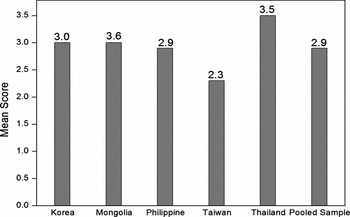
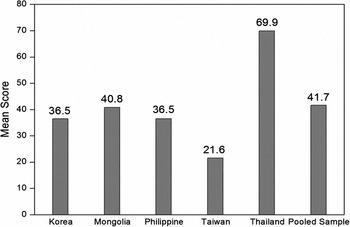
To what extent do East Asians support democracy? Figure 3 shows considerable variation across five East Asian countries in terms of the mean levels of their democratic support. These levels vary from a low of 2.3 in Taiwan to a high of 3.5 in Thailand. For the remaining three countries – Korea, Mongolia, and the Philippines – they hover around 3.0. Despite such differences in the mean support levels, all these countries, however, register democratic support above the midpoint (2.0) of the 5-point scale. This indicates that East Asians, as a whole, are more supportive than unsupportive of democracy.
National differences in levels of citizen support for democracy. Note: Scores presented in each cell are means on the 5-point index of democratic support.

As important as it is to know how the mean levels of democratic support vary across new East Asian democracies, it is more important to know how full supporters of democracy vary across these countries because full supporters are the most likely to demand further democratization. According to Figure 4, the percentages of these supporters range from a low of 22% in Taiwan to a high of 70% in Thailand. In other words, unqualified supporters of democracy are over three times more numerous in Thailand than in Taiwan. In the other three countries, as in Taiwan, these supporters form minorities from 36% to 40%. According to the figure for the pooled sample, a substantial minority of two out of five (42%) East Asians support democracy to the fullest extent. This means that a majority of three-fifths remains reluctant to embrace democracy fully or unconditionally even after a considerable period of democratic rule. Why the proportion of full democrats ranges so widely within the East Asian region remains a puzzle.
National differences in percentages fully supportive of democracy (in percentage).

Bivariate analyses
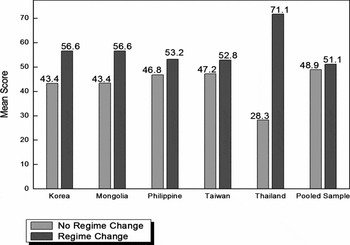
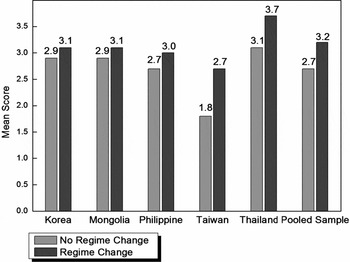
Now that we have looked at national differences in terms of our key independent and dependent variables, we proceed to examine the relationships between these variables. Does the experience of democratic regime change affect citizen support for democracy? Do those who have experienced such regime change support democracy more fully than those who have not? Are citizens who perceive democracy as a lesser evil more likely to be supportive of democracy? Figure 5 reports the relevant data to these questions.
Levels of democratic support by the experience of democratic regime change.

The figure shows that in every East Asian democracy most citizens who believe a regime change did occur are more supportive of democracy than those who do not. It also shows considerable cross-national variation in the mean level of democratic support between the former and the latter. In three of the five countries – Korea, Mongolia, and the Philippines – there is relatively little difference between those who experienced democratization and those who did not. In Taiwan and Thailand, the difference is substantial, over three times that observed in the other three countries. When all these five countries are considered together in the pooled sample, the message is clear that in East Asia as a whole, perceivers of democratic regime change are significantly more supportive of democracy than non-perceivers of the change (3.2 vs. 2.7).
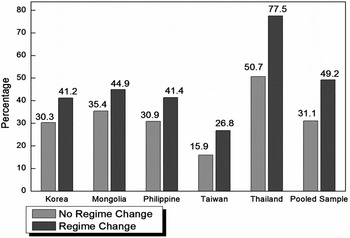
We now shift the analysis by changing our dependent variable from the 5-point index of democratic support to the qualitative variable that taps full support for democracy. You will recall that fully supportive citizens are those who view democratic rule as suitable, preferable, desirable, and efficacious. Similar to our previous analysis using the 5-point index, we see in Figure 6 that across the board, citizens who perceived the occurrence of democratic regime change in their polities are significantly more likely to be fully supportive of democracy than those who did not. In every East Asian country, the former lead the latter by a substantial margin of at least 10 percentage points. In the case of Thailand, the margin of their difference extends to 26 percentage points (51% vs. 78%). Undoubtedly the experience of democratic transition from authoritarian rule motivates citizens to support democracy.
Percentages fully committed to democracy by the experience of democratic regime change.

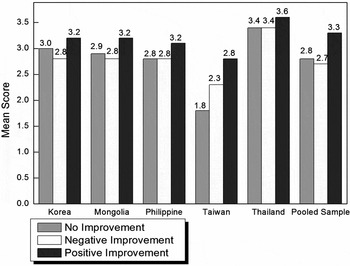
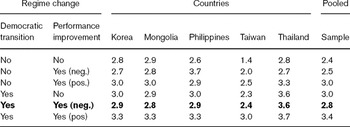
In terms of regime performance evaluation, we see a pattern confirming the conventional wisdom that greater satisfaction breeds more support. In Figure 7, we see a pattern that the respondents who rate their regime's performance as positively improved in the wake of their democratic regime transformation are significantly more supportive of democracy than those who rate it unimproved or negatively improved. This pattern holds true for all the countries surveyed. For the pooled sample, the mean of democratic support is a full half-point (or nearly 20%) higher among those who see positive improvements than among those who see no improvement, and it is 0.6 points (or 22%) higher among the former than among those who see negative improvement (3.3 vs. 2.8 and 3.3 vs. 2.7).
Levels of democratic support by relative assessments of regime performance change.

More noteworthy is the finding that the perceptions of negatively improved regime performance do not always engender greater democratic support, contrary to what the Churchillian lesser-evil notion of democracy implies. Only in one country – Taiwan – do those who are less dissatisfied with the current democratic regime than with the past regime register a higher level of democratic support than those who remain equally dissatisfied with both (2.3 vs. 1.8). In the other four countries, the former are either less supportive or equally supportive of democracy than the latter. This finding suggests that decreasing dissatisfaction with the regime does not motivate citizens to express greater support for it. This raises a serious question about the validity of the lesser-evil notion as a theoretical model for explaining democratic support.
We now examine whether the same relationship exists between relative assessments of regime performance and full support for democracy as exists between relative assessments of regime performance and support. Once again the relationship between these two variables is similar to the one found with the 5-point democratic support index. Figure 8 shows that citizens who evaluate their regime as performing better in a positive sense are significantly more likely to support democracy fully than those who evaluate their regime as performing better in a negative sense or who perceive no improvement in its performance. In every country, full supporters of democracy are most numerous among the former. Contrary to what is expected from the lesser-evil notion, they are least numerous among those who view democracy as a lesser evil in four of the five countries. Only in Taiwan are lesser-evil perceivers associated with a higher level of full support for democracy than those of unimproved democratic regime change. The figures for the pooled sample show that more than half (54%) the citizens in the category of positively improved democratic regime change fully supports democracy. The corresponding figure for those in the category of negatively improved democratic regime change is less than one-third (30%); moreover, the percentage of full supporters among lesser-evil perceivers is 5 percentage points lower than the percentage of full supporters in the category of an unimproved democracy (35%). Once again, this finding undermines the validity of the Churchillian notion linking citizen perceptions of democracy as a lesser evil to greater support for democracy.
Percentages fully committed to democracy by relative assessments of regime performance change.

We now begin to test the lesser-evil notion as a hypothesis. In Table 2, we examine whether this particular type of regime orientation is associated with a higher level of democratic support than are others. This particular type called ‘negatively improved democratic regime change’ is distinguished from the five other types in that citizens believe that a democratic transition did occur and that the current regime performs less undesirably or unfavorably than its authoritarian predecessor. For all five East Asian countries, it is evident that lesser-evil adherents are not the most supportive of democracy. In four of these five countries, they express even lower levels of democratic support than those who perceive no improvement in regime performance, not to mention those perceiving a positively improved democracy. The percentages for the pooled sample, moreover, indicate that East Asians in the lesser-evil category are less supportive of democracy than those who report living under a positively improved authoritarian or unimproved democratic system (2.8 vs. 3.4; 2.8 vs. 3.0).
Levels of support for democracy by perceptions of regime change

Notes: Entries are the percentages that scored the highest value of 4 on the five point index of democratic support.
The highlighted section represents ‘lesser evil category’.
Most notably, in every new East Asian democracy, respondents who report living in a positively improved democratic system are significantly more supportive of democracy than those who report living through any other kind of regime transition or non-transition. The figures for the pooled sample clearly substantiate this point. In the sample, those who experience the occurrence of democratic regime change and positive improvements in regime performance have a mean score of 3.4 on the 0–4 point democratic support index. This score is from 0.4 points to 1 full point (or 13–41%) higher than the mean scores of respondents who report living through any other transition or non-transition. Those mean scores range from 2.4 to 3.0. Of the six types of regime orientations, the most powerful contributor to democratic support appears to be that of a positively improved democracy, i.e. the new democracy performs more satisfactorily than unsatisfactorily and better than the regime of the authoritarian past.
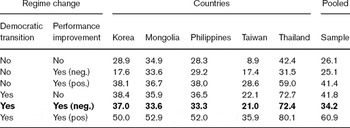
Table 3 tests the relationship between the six types of regime change orientations and full support for democracy. Similar to the results shown in Table 2, lesser-evil perceivers are less likely to support democracy fully than citizens who believe they live in a positively improved democratic system. In every country, the percentage of full democratic supporters is much higher among the latter than the former (50% vs. 37% in Korea; 53% vs. 34% in Mongolia; 52% vs. 33% in the Philippines; 36% vs. 21% in Taiwan; and 80% vs. 72% in Thailand). Moreover, in every country but Taiwan, one-half or more of those in the category of a positively improved democracy supports democracy fully. Corresponding figures for those in a negatively improved democracy are less than two-fifths in every country with the exception of Thailand. The figures for the pooled sample also show that the former lead the latter in supporting democracy fully by a margin of nearly 2 to 1 (34% vs. 61%).
Levels of full support for democracy by types of regime change orientations (in percentage)

Notes: Entries are the percentages that scored the highest value of 4 on the five point index of democratic support.
The highlighted are lesser-evil perceptions.
In every new East Asian democracy, moreover, lesser-evil perceivers are less fully supportive of democracy than those who perceive it as an unimproved democracy (fifth category). According to the percentage figures for the pooled sample, the former trails the latter by a substantial margin of 8 percentage points (34% vs. 42%). This indicates that even when citizens feel less dissatisfied with the performance of their democratic regime than with the past regime, they are not willing to support democracy to any greater extent than when they have seen no improvements.
Summary and conclusion
What does democracy mean to ordinary people with little experience in democratic politics and no knowledge of democratic theory? When do they decide to embrace it as the most preferred system of governance and why? Do dissatisfied or ‘critical citizens’ remain supportive of democratic principles and ideals? Understanding the answers to these questions is the key to unraveling the process of democratization taking place among individual citizens of new democracies.
Winston Churchill offered the notion of democracy as a lesser evil. He said, ‘democracy is the worst form of government, except all those other forms that have been tried from time to time’. In emphasizing that a new democratic regime does not have to be positively attractive to become the only political game in town, the Churchill notion constitutes a clear and meaningful alternative to the idealistic or positively oriented paradigm that has guided the study of third-wave democracies for the past two decades. Nonetheless, his notion of democracy as a lesser evil has not been explicated fully. Previous research failed to take into account both the notion's dynamic and multidimensional characteristics. Previous research also focused exclusively on post-Communist Europe. To overcome these limitations of the research, we first proposed a multidimensional and dynamic conception of and a more nuanced measurement of the Churchillian lesser-evil notion democracy, and tested it with surveys recently conducted in five East Asian new democracies.
Our analyses of the 2001–03 East Asia Barometer surveys revealed notable findings. First, we found that a substantial minority of East Asians was not cognitively capable of recognizing their country's transition to democracy. We also found that East Asians tend to view democracy in a positive rather than in a negative light. As a result, only very small minorities in all five new East Asian democracies actually perceive their current democratic system as a lesser evil or a negatively improved democracy. For the whole sample, these lesser-evil perceivers constitute less than one-tenth (7%) of the adult population. In none of the countries do they constitute a minority larger than one-seventh. This finding that a majority of East Asians do not view the current regime as a negatively improved democracy suggests that the lesser-evil notion of democracy as a concept cannot accurately represent the dynamics of democratization taking place in the minds of the mass citizenry.
Across all five East Asian democracies, moreover, we found that the most ardent supporters of democracy and democratization are not ‘lesser-evil perceivers’ but those who perceive the current regime as a positively improved or more satisfactorily performing democracy. In all five countries, moreover, lesser-evil perceivers are less fully supportive of democracy than those who see no improved regime performance, either negative or positive, in the wake of democratic transition. In striking contrast, a majority of those who perceive a positively improved democratic system support democracy fully. These findings suggest that perceiving democracy as a lesser-evil does not foster democratic support. East Asians are most likely to become unqualified democrats only when they see the malfunctioning regime of the authoritarian past transformed into a well- and better functioning democracy.
These findings clearly indicate that ordinary citizens are most likely to embrace democracy fully when they are satisfied with the current democratic regime and prefer it to the authoritarian regime of the past. It is not enough for them to prefer their new situation to their old if they are still unsatisfied with their government. In light of these findings, we conclude the lesser-evil notion of democracy cannot be considered a robust alternative paradigm for the study of democratization taking place among ordinary citizens in new East Asian democracies. Although widely used in the scholarly community and news media (Diamond, Reference Diamond2001; Rose, Reference Rose1997), this notion is of limited utility not only as a concept to describe the phenomenon accurately and but also as a hypothesis to explain it adequately. To unravel the contours and dynamics of cultural or subjective democratization more fully, future public opinion survey research needs to build a theory of why so many citizens of new democracies refuse to recognize democratic regime change affirmatively or favorably even after more than a decade of democratic rule.