Introduction
The possibility that large numbers of veterans struggle with persistent postconcussive symptoms has been a source of great concern since the publication of estimates of the prevalence of concussion in military personnel in Iraq and Afghanistan (Tanielian, Jaycox, & Rand Corporation, 2008). However, efforts to identify personnel who require treatment have been greatly complicated by a lack of clarity about the etiology of postconcussive symptoms.
Attempts to define how those symptoms constitute a syndrome or formal disorder have been only partly successful. The International Classification of Diseases, 10th edition (World Health Organization, 1992) offered diagnostic criteria for “Post-Concussional Syndrome” (PCS) and the Diagnostic and Statistical Manual, 4th Ed. (American Psychiatric Association. Task Force on DSM-IV, 1994) offered research criteria to be used in the diagnosis of “Postconcussional Disorder.” Both definitions have been criticized for their reliance on symptoms that are nonspecific and may be mistakenly associated with brain injury (Iverson, Zasler, & Lange, Reference Iverson, Zasler and Lange2007). While the DSM-IV criteria require objective evidence of associated cognitive deficits, establishing a causal relationship with brain injury is problematic when neuropsychological test performance can also be explained through suboptimal effort and other factors. Similarly, both definitions reference subjective complaints, which can also be explained by other factors.
With regard to cognitive deficits, a meta-analysis showed clear neuropsychological performance decrements within six days of concussion, although it also showed those deficits resolve by 3 months after concussion (Schretlen & Shapiro, Reference Schretlen and Shapiro2003). Among those who exhibit cognitive deficits beyond that 3 month period, it has been observed that the nature and severity of those deficits does not explain the functional impairment exhibited by some individuals months after concussion. First, the cognitive deficits are relatively mild. A comparison of a meta-analysis of concussion patients and several meta-analyses of other populations showed that remote history of concussion has a much smaller effect on symptom persistence than malingering / exaggeration and psychological factors such as depression (Iverson, Reference Iverson2005). Second, the severity of neuropsychological deficits after concussion is not associated with employment, income, or disability status (Vanderploeg, Curtiss, & Belanger, Reference Vanderploeg, Curtiss and Belanger2005). Something more than cognitive dysfunction is at work to cause postconcussive functional impairment.
With regard to subjective complaints associated with concussion (e.g., headache and insomnia), it is frequently observed that they are nonspecific. That is, they are observed in many individuals who have not sustained a concussion. Such complaints are frequently reported in healthy controls without a history of injury (Gunstad & Suhr, Reference Gunstad and Suhr2002; Iverson & Lange, Reference Iverson and Lange2003). Other individuals with clinical conditions besides concussion have these complaints and in some cases this results in misdiagnosis. Iverson reported depression is often misdiagnosed as PCS (Iverson, Reference Iverson2006). Hoge and colleagues suggested that many complaints that appear to be explained by concussion can be better explained by comorbid PTSD (Hoge et al., Reference Hoge, McGurk, Thomas, Cox, Engel and Castro2008). Subject characteristics that predate injury such as low premorbid intelligence also predict postconcussive complaints (Larson, Kondiles, & Zollman, Reference Larson, Kondiles and Zollman2011).
The latter finding has particularly important implications for a multifactorial model of the etiology of postconcussive symptoms. While both cognitive deficits and subjective complaints contribute to postconcussive functional impairment, there is evidence that for many of those symptoms, onset precedes injury (Mittenberg, DiGiulio, Perrin, & Bass, Reference Mittenberg, DiGiulio, Perrin and Bass1992). This has raised the intriguing hypothesis that patients mistakenly attribute those symptoms to concussion and that this perception complicates pre-existing pathology.
To assess the effects of perception on cognitive performance, Suhr and Gunstad administered neuropsychological tests to 36 students with a history of concussion after randomly assigning them to either a group that was informed it was their injury that was under study (diagnostic threat) or a group that was not informed of this (neutral). Although groups did not differ in concussion severity, the diagnostic threat group performed worse on tests of memory and reported they put forth less effort on testing (Suhr & Gunstad, Reference Suhr and Gunstad2002). This highlights a complex interplay between factors that contribute to postconcussive complaints. The perception that injury affects cognitive function (suggested to the diagnostic threat group, but not to the neutrals) resulted in poor effort, which apparently was manifest in poorer cognitive performance. Unfortunately, there was no report of whether that poor effort was also associated with a subsequent increase in severity of subjective complaints in the diagnostic threat group.
Others have assessed the effects of perception on postconcussive complaints (Whittaker, Kemp, & House, Reference Whittaker, Kemp and House2007). In a broader study of illness perception, Whitaker and colleagues reported findings specifically related to patients’ own attributions of causation for their complaints. In their study, patients who had been treated for concussion at an ED were contacted by phone to take a measure of illness perception 1–3 weeks after injury. They followed up with 73 patients 3 months later and administered a measure of postconcussive complaints. They found that at 1–3 weeks post-injury, assessment of illness perception (belief that postconcussive symptoms were caused by concussion and the belief that those symptoms will be chronic) accurately predicted outcome (persistent postconcussive complaints) 3 months later. They reported that adding measures of the severity of injury, PTSD complaints, anxiety, and depression did not improve prediction of outcome.
Additional study of the effects of effort and symptom attribution is needed. Previous reports of the impact of psychological factors on postconcussive symptoms described how self-reported symptom attribution affects complaints but did not examine whether that symptom attribution also impacts cognitive performance as might be expected based on the work by Suhr and Gunstad. The diagnostic threat study by those authors (Suhr & Gunstad, Reference Suhr and Gunstad2002) provides compelling evidence that experimental manipulation of a patient's perception can have an impact on cognitive performance, but they did not examine whether self-rating of that perception is also associated with impairment on neuropsychological measures. An investigation into the association of self-reported attribution and postconcussive symptoms would make a valuable contribution to the literature. Similarly, although Suhr & Gunstad did examine the association between effort and cognitive performance, they did not examine whether individuals who give inadequate effort on cognitive testing also report more severe subjective complaints. Further investigation into the relationship between postconcussive complaints and symptom validity is needed.
To examine how postconcussive symptoms relate to misperception and effort on testing, we examined postconcussive complaints, cognitive functioning, ratings of causal attribution and symptom validity in a sample of veterans who gave a history of concussion.
We hypothesized that symptom attribution would be associated with postconcussive complaints beyond the effects of subject characteristics (e.g., age, education, sex, race, and premorbid cognitive function), the effects of current cognitive ability and the effects of effort. We also hypothesized that effort would be associated with current cognitive performance beyond the effects of subject characteristics and postconcussive complaints.
Methods
Participant Information
Human subjects data included in this manuscript were obtained in compliance with regulations of the Northwestern University Institutional Review Board. As part of an ongoing study of a screening measure (not included in the present analyses), 300 veteran volunteers were recruited through newspaper advertisement. All proved military experience through military discharge papers or current identification cards from Veterans Affairs.
Of the 300 participants, 213 reported their history included a head injury with loss of consciousness or a period of posttraumatic amnesia. Of those 213, 35 were excluded because of missing data; most frequently due to failing to answer all the items on a questionnaire. Of the 178 that remained, 23 were excluded for reporting loss of consciousness greater than 30 min or posttraumatic amnesia greater than 24 hr. Of the 155 that remained, 93% were male, 30% were Caucasian, and 68% were African American. Age ranged from 22 to 83 (Mean = 51 ± 12) and education ranged from 9 to 20 years (Mean = 13 ± 2).
Evaluation Procedures
Participants spent approximately a half day in interviews and were compensated for their time and travel. At the completion of the workup, study personnel met with participants to summarize findings and provide referral information for treatment as needed.
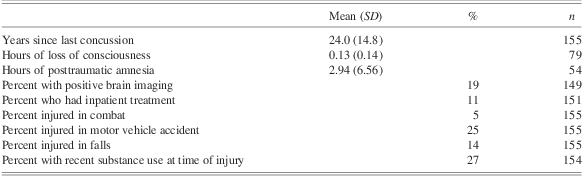
Physicians with expertise in traumatic brain injury examined participants and took a history of self-reported incidents of head trauma that resulted in neurological symptoms including loss of consciousness or a period of posttraumatic amnesia. Physicians used a structured interview procedure to obtain information on mechanism of injury, duration of loss of consciousness or posttraumatic amnesia, their recollection of imaging results (if any), and whether they were subsequently hospitalized (see Table 1). History of psychiatric treatment for depression, anxiety, and substance abuse was noted. These data were based on the self-report of the participants since medical records were not available for review. Participants completed self-report inventories of postconcussive complaints. Research personnel administered a brief battery of neuropsychological tests.
Self-Reported Injury Characteristics
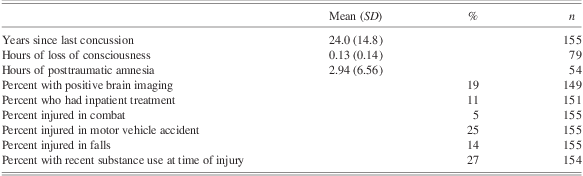
Note: n = Item sample size, which is the number of participants who provided item data during the physician exam. Item was coded as missing data for participants who could not recall the answer during exam. Resulting item sample size varies between items. All questions were asked of all participants who gave a self-report of concussion (N = 155).
Instruments
The Rivermead Postconcussion Questionnaire (RPQ) (King, Crawford, Wenden, Moss, & Wade, Reference King, Crawford, Wenden, Moss and Wade1995) is a self-report measure listing 16 postconcussive complaints experienced over the 24 hr before evaluation, which the participant is instructed to rate in severity. At the end of this test form, we designed a single new item to assess whether the respondent attributed to concussion the complaints listed in the RPQ. The item read, “To what extent do you believe the above symptoms were caused by a concussion?” Respondents were instructed to give a rating on a scale of zero (“Not at all related”) to five (“Exclusively related”).
The Wechsler Test of Adult Reading (WTAR) (Wechsler, Reference Wechsler2001) is a pronunciation test used to estimate premorbid cognitive ability. Using age-based norms provided in the test manual, we calculated the “WTAR Standard Score”.
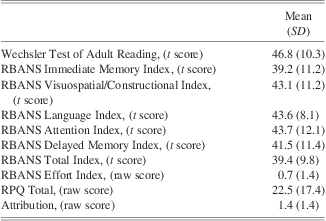
The Repeatable Battery for the Assessment of Neuropsychological Status (RBANS) (Randolph, Reference Randolph1998) is a collection of brief neuropsychological tests that provides measures of memory, attention, language, and visuospatial abilities. The Attention Index (RBANS-AI) from this battery has been shown to be sensitive to the effects of concussion (Moser & Schatz, Reference Moser and Schatz2002). We used normative data listed in the manual to calculate age and education adjusted t-scores for the RBANS-AI. We also used RBANS data to calculate an “Effort Index” (RBANS-EI) that has been shown to be sensitive to dissimulation for values of 1 or more (Silverberg, Wertheimer, & Fichtenberg, Reference Silverberg, Wertheimer and Fichtenberg2007) and which has been validated against other symptom validity tests (Barker, Horner, & Bachman, Reference Barker, Horner and Bachman2010). Following the methods described by those authors, list recognition scores of 20–18 were coded with values of 0, while list recognition scores of 17–10 were coded with values of 1 to 5 and digit span scores of 16–8 were coded with values of 0, while digit span scores of 7–5 were coded with values of 2 to 5. RBANS-EI was the sum of those two coded values resulting in possible values of 0 to 10. Descriptive data for all RBANS indexes and for all other measures included in the following analyses are listed in Table 2.
Descriptive Data for All Measures (N = 155)
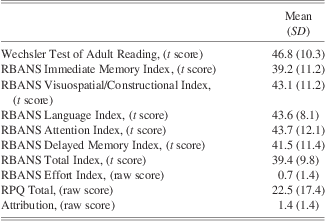
Note: RBANS = Repeatable Battery for the Assessment of Neuropsychological Status; RPQ = Rivermead Postconcussion Questionnaire; t scores calculated based on a population mean of 50 and standard deviation of 10.
Statistical Analysis
Mulivariate analyses involved hierarchical multiple regression. Analyses were performed with SPSS Version 17 (SPSS Inc., Chicago, IL).
Results
Postconcussive Subjective Complaints
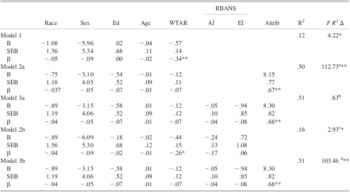
To assess the relative contributions of both symptom attribution and effort to postconcussive complaints and to determine whether subject characteristics / demographics might affect associations with those variables, multiple regression analyses were conducted. To test the hypothesis that symptom attribution explains postconcussive complaint over and above the effects of subject characteristics, effort and current cognitive performance, two hierarchical multiple regressions examined the unique variance in the RPQ accounted for by symptom attribution and by RBANS-AI and RBANS-EI. (Regarding the latter variables, although these two RBANS indexes are both partly based on the same Digit Span subtest, indicators of collinearity were in the normal range, allowing us to include both in the multiple regression.) Both analyses controlled for subject characteristics in a first block. Symptom attribution was entered alone in a subsequent block and RBANS-AI and RBANS-EI were entered together in another subsequent block. To determine the unique contributions of the symptom attribution block and the RBANS block, separate models were obtained in which each of these two blocks were entered last. Table 3 shows that in Model 3a, the RBANS AI and RBANS-EI block was entered last and in Model 3b, it was the symptom attribution block that was entered last. The change in variance associated with the last step in each procedure revealed the unique contribution of that block of variables.
Summary of Hierarchical Regression Analysis for Variables Predicting Severity of Postconcussive Complaints as Measured by the Rivermead Postconcussion Questionnaire (N = 155)

Note: *p<.05. **p<.001. aF for change in R 2 from Model 1 to Model 2a. bF for change in R 2 from Model 2a to Model 3a. cF for change in R 2 from Model 1 to Model 2b. dF for change in R 2 from Model 2b to Model 3b. WTAR = Wechsler Test of Adult Reading; Ed = Years of Education; RBANS = Repeatable Battery for the Assessment of Neuropsychological Status; AI = Attention Index; EI = Effort Index; Attrib = Symptom Attribution Item; B = unstandardized regression coefficient; SE B = Standard Error of B; β = standardized regression coefficient.
Caption: Symptom attribution accounts for a substantial amount of unique variance in postconcussive complaints, above what is explained by subject characteristics and cognitive variables.
The column labeled “R2” in Table 3 shows percentage of variance in postconcussive complaints explained by all the variables included in a model. The column labeled “F R 2 Δ” in this table shows whether statistically significant improvement of variance in postconcussive complaint resulted when a block of variables was added. Model 1 showed that approximately 12% of postconcussive complaint was predicted by subject characteristics alone, especially premorbid cognitive ability. Adding symptom attribution to the equation in Model 2a significantly improved explained variance to 50%. Adding cognitive performance / effort in Model 3a did not increase the explained variance by a significant amount. In the second regression, when cognitive performance / effort was entered in Model 2b (before symptom attribution), it added only 4% more of the variance in postconcussive complaints over what was explained by subject characteristics alone in Model 1. However, as hypothesized, adding symptom attribution in Model 3b significantly improved the explained variance by 35%. An examination of the weights in the third model also confirmed our hypothesis, showing that the unique association of symptom attribution with postconcussive complaint was much greater than any other factor included in the analysis, including premorbid intelligence, current cognitive performance and effort. These findings suggest that in this patient sample, symptom attribution was more strongly associated with postconcussive complaints than cognitive performance and effort as measured by the RBANS. Symptom attribution accounted for a unique portion of the variance that did not overlap with the RBANS scores.
Cognitive Performance
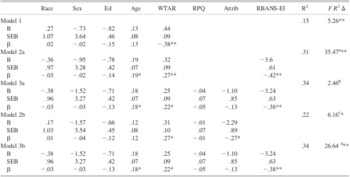
To assess the relative contributions of both symptom attribution and effort to cognitive performance and to determine whether subject characteristics / demographics might affect associations with those variables, multiple regression analyses were conducted. To test the hypothesis that effort explains cognitive performance over and above the effects of subject characteristics and postconcussive complaints, two hierarchical multiple regressions examined the unique variance in the RBANS-AI accounted for by RBANS-EI and by postconcussive complaints (including both the total RPQ score and our symptom attribution item). Both analyses controlled for subject characteristics in a first block. RBANS-EI was entered alone in a subsequent block and RPQ and the symptom attribution item were entered together in another subsequent block. To determine the unique contributions of the RBANS-EI block and the RPQ / attribution block, separate models were obtained in which each of these two blocks were entered last. Table 4 shows that in Model 3a, the RPQ / symptom attribution was entered last and that in Model 3b, it was the RBANS-EI block that was entered last.
Summary of Hierarchical Regression Analysis for Variables Predicting Current Cognitive Performance on the Attention Index of the Repeatable Battery for the Assessment of Neuropsychological Status (N = 155)

Note: *p<.05. **p<.001. aF for change in R 2 from Model 1 to Model 2a. bF for change in R 2 from Model 2a to Model 3a. cF for change in R 2 from Model 1 to Model 2b. dF for change in R 2 from Model 2b to Model 3b. WTAR = Wechsler Test of Adult Reading; Ed = Years of Education; RBANS = Repeatable Battery for the Assessment of Neuropsychological Status; EI = Effort Index; Attrib = Symptom Attribution Item; B = unstandardized regression coefficient; SE B = Standard Error of B; β = standardized regression coefficient.
Caption: Effort accounts for a substantial amount of unique variance in cognitive performance, above what is explained by subject characteristics and postconcussive complaints.
Model 1 showed that approximately 15% of cognitive performance was predicted by subject characteristics alone, especially premorbid cognitive ability. Model 2a showed adding effort to the equation significantly improved explained variance to 31%. Adding symptom attribution in Model 3a did not increase the explained variance by a significant amount. In the second regression, when postconcussive complaints were entered (before effort) in Model 2b, they added only 7% more of the variance in cognitive performance than what was explained by subject characteristics alone in Model 1. However, as hypothesized, adding the effort block in the Model 3b significantly improved the explained variance by 12%. An examination of the weights in the third model showed that the unique association of effort with cognitive performance was greater than any other factor included in the analysis, although age and premorbid ability also made significant contributions. These findings suggest that in this patient sample, effort was more strongly associated with cognitive performance than postconcussive complaints as measured by the RPQ and by our symptom attribution item. Effort accounted for a unique portion of the variance that did not overlap with postconcussive complaints.
Discussion
Although persistent symptoms are relatively rare in the general population of individuals who suffer a concussion, in clinical settings neuropsychologists often encounter individuals who, months after injury, still have subjective complaints and objective findings of cognitive impairment. Postconcussive complaints and postconcussive cognitive impairment both have a multi-factorial etiology. The present study examined three of these factors: subject characteristics, effort and symptom attribution. We will explain how our stepwise analysis of these factors may contribute to the development of a more complex etiological model. We offer suggestions for clinical practice and conclude with recommendations for further study.
A positive history of concussion is not a strong risk factor for chronic symptoms months after injury. The frequency of rapid and complete recovery after concussion suggests that other factors must be at work in individuals who experience symptoms longer than 3 months after concussion.
The first additional factor involves subject characteristics that predate injury. Previous reports have suggested demographic variables such as older age and female gender are associated with chronic postconcussive symptoms (Fenton, McClelland, Montgomery, MacFlynn, & Rutherford, Reference Fenton, McClelland, Montgomery, MacFlynn and Rutherford1993; Santa Maria, Pinkston, Miller, & Gouvier, Reference Santa Maria, Pinkston, Miller and Gouvier2001). The present sample showed that another subject characteristic, premorbid intelligence, was strongly associated with both cognitive performance and postconcussive complaints. While such a finding is not surprising given theories of cognitive reserve, clinical experience shows that some patients with low IQ have good outcomes even after more severe injuries and a recent report indicated that a related variable (higher educational attainment) may actually predict poor outcome after concussion (Snell, Siegert, Hay-Smith, & Surgenor, Reference Snell, Siegert, Hay-Smith and Surgenor2011). Preinjury characteristics alone cannot explain why symptoms persist in certain individuals after concussion.
Another factor associated with postconcussive symptoms is malingering, which is estimated to be involved in 40% of concussion cases in litigation or in which patients are seeking compensation (Mittenberg, Patton, Canyock, & Condit, Reference Mittenberg, Patton, Canyock and Condit2002). However, base rates of dissimulation vary by population. Among veterans and active duty military personnel, forensic and clinical samples scored above cutoffs on cognitive symptom-validity tests and validity scales more often than research samples (Nelson et al., Reference Nelson, Hoelzle, McGuire, Ferrier-Auerbach, Charlesworth and Sponheim2010, Reference Nelson, Hoelzle, McGuire, Sim, Goldman, Ferrier-Auerbach and Sponheim2011). Prevalence estimates from forensic samples may not apply to the general population. Furthermore, the presence of malingering does not rule out the possibility of past or present valid neurological impairment. Some dissimulation of impairment is exaggeration of actual symptoms or report of past symptoms as if they are continuing (Resnick, Reference Resnick1997). Consequently, when assessing the role of malingering in the etiology of postconcussive symptoms, it is important not to treat malingering and neurological impairment as orthogonal categories. Finally, while the association between effort and performance is robust, it is also clinically complex. Suhr and Gunstad found a correlation between self-rated effort and performance on a neuropsychological memory test in their diagnosis threat group (Suhr & Gunstad, Reference Suhr and Gunstad2002). However, those authors go on to note that this group was unlikely to perform poorly for secondary gain, which suggests that poor effort is not always synonymous with malingering. It is unclear why elevated scores on symptom validity tests exist in individuals who have nothing to gain. Although reduced effort may be the mechanism that brings down cognitive test scores, in some cases other psychological factors besides the pursuit of personal benefit are related to that reduced effort.
The present data show that another psychological factor related to cognitive performance and subjective complaints is symptom attribution. The present data show that such attribution is associated with postconcussive complaints after effort is controlled statistically. Some individuals with a relatively good education, who gave their best effort, and who performed well on neuropsychological testing, still describe themselves as damaged and this description is associated with their attribution of causality to a concussion.
It remains unclear whether strong symptom attribution leads to increased symptom report or vice versa. It is possible that some other factor might affect the severity of post-concussive symptoms which in turn causes increased certainty that the symptoms are related to concussion. Although many questions about these correlations remain, the strength of association indicates the importance of taking into consideration the statements patients make about the nature and the origin of their symptoms.
Consideration of self-reported symptom perception along with postconcussive complaints would be a departure from current use of self-report postconcussion questionnaires in isolation. Such questionnaires have been interpreted through a cut-off score or through counting the number of complaints endorsed without examining patient beliefs about the origin of those complaints (Chan, Reference Chan2005; Lannsjo, af Geijerstam, Johansson, Bring, & Borg, Reference Lannsjo, af Geijerstam, Johansson, Bring and Borg2009). The present data show that strong attributions of injury causality may contribute to postconcussive complaint, and thus should be taken into consideration during diagnosis.
Identification of such attributions in a clinical evaluation would be an indication to refer the patient for cognitive behavioral psychotherapy that not only addresses depressive ideation in general, but specifically focuses on the distorted beliefs that contribute to postconcussive symptoms (Mittenberg, Canyock, Condit, & Patton, Reference Mittenberg, Canyock, Condit and Patton2001; Snell, Surgenor, Hay-Smith, & Siegert, Reference Snell, Surgenor, Hay-Smith and Siegert2009). Immediately after injury, education regarding the good prognosis for full recovery from concussion should be provided to all patients, especially those who voice anxiety about protracted disability. When patients mention such attributions to medical personnel providing emergent treatment, it would also be important to notify their primary care providers about the nature of the patients’ perception of injury and to educate those providers about the implications of that perception. Such consultation may be helpful in limiting iatrogenic pathology that can complicate recovery from concussion.
There are several limitations of the present study. First, the concussion group was made up of individuals who provided a retrospective report of remote injury without presenting any corroborating evidence. It has been proposed that such self-report is inaccurate, especially among military personnel whose alleged injuries may have coincided with emotional trauma that can produce effects that are very similar to the definition of “alteration of consciousness” that is specified in definitions of mild brain injury (Hoge, Goldberg, & Castro, Reference Hoge, Goldberg and Castro2009). However, others have stated that retrospective accounts are the gold standard of diagnosis as long as they are scrutinized by an experienced clinician, preferably one who uses a validated structured interview to ensure that relevant questions about the nature of the trauma and its effects are assessed (Corrigan & Bogner, Reference Corrigan and Bogner2007a, Reference Corrigan and Bogner2007b). In the present study, experienced clinicians used an unpublished structured interview to ensure that such relevant questions were uniformly addressed, although a validated structured interview instrument was not used. Future studies of symptom attribution and effort in concussion may improve their diagnostic accuracy by use of validated instruments. Second, the present study's veteran sample was heterogeneous, with some older participants reporting on injuries that occurred several decades (an average of 24 years) in the past, while others recalled injuries that were only a few months before evaluation. It is possible that older recollections are less accurate and it is also possible that cohort effects exist. Future studies of symptom attribution and effort in people with concussion may control this through focusing specifically on veterans of recent conflicts. Third, other aspects of symptom attribution were not addressed. It is possible that attributing symptoms to other factors (e.g., life stressors, depression) may be associated with persistent complaints as well. Studies of unexplained complaints show that patients look for multiple explanations for their symptoms including organic, psychological and neutral etiologies (Rief & Broadbent, Reference Rief and Broadbent2007). It is possible that by assessing only one type of attribution, our evaluation contributed to a form of diagnosis threat that may have been attenuated if other options were listed. Future studies should use broader measures of symptom attribution and illness perception. Fourth, the present analyses did not include any measures of psychiatric disorders. Past studies have shown that these disorders are associated with postconcussive symptoms (Iverson, Reference Iverson2006). Future studies of the relationships between attribution, effort and postconcussive symptoms should include assessment of depression and PTSD to determine if those conditions have an effect on those relationships.
In addition to further study of individuals with confirmed concussion, we recommend study of individuals whose belief they have a concussion is mistaken. This population affords researchers a better understanding of the effects of psychological factors independent of neuropathology. Study of this population will help us understand the role of symptom attribution and effort in confirmed concussion.
Acknowledgments
This study was funded by grants from the Robert M. McCormick Tribune Foundation, the Julius N. Frankel Foundation, the Joseph G. Nicholas Foundation and the Barker Welfare Foundation. All of the authors report they have no conflicts of interest.