I. INTRODUCTION
In the past, the Fe–Al-based intermetallic alloys had been studied with interest due to their excellent corrosion resistance and their potential application as structured materials at elevated temperatures in hostile environments in the energy conversion industries as: geothermal or fossil fuels and nuclear fuels to generate electrical power systems. Reference Charlot, Gaffet, Zeghmati, Bernard and Niepce1–Reference Liu, George, Maziasz and Schneibel7 However, the use of those alloys as structural components had been limited due to their brittle fracture behavior and low ductility properties at room temperatures resulting from environmental embrittlement, weak grain boundaries, vacancy hardening, and embrittlement. Reference Liu, George, Maziasz and Schneibel7 Environmental embrittlement involves moisture in air, which is the major cause of low tensile ductility. Such environmental embrittlement is the consequence of a chemical reaction involving the reaction of Al with oxygen from moisture, releasing hydrogen atoms that could be absorbed. Reference Stoloff and Liu8 However, there are other factors that can modify mechanical behavior at room temperature, such as grain size, improving ductility as the grain size is reduced. Reference Baker, Klein, Nelson and George9 The quantity of Al in the FeAl alloy systems also has an important effect on both the mechanical properties Reference Morris, Munoz-Morris and Requejo10 and corrosion resistance at high temperature applications. Reference Liu, George, Maziasz and Schneibel7 For reason of this, a best condition for those properties for high temperature applications has been reported for Al concentrations between 35 and 45 at.%. Reference Liu, George, Maziasz and Schneibel7,Reference Morris, Munoz-Morris and Requejo10–Reference Pang and Kumar12 This has become the baseline for the production of those alloys.
Hence, the production of alloys by conventional melting techniques such as air-induction melting, vacuum-induction melting, vacuum-arc melting are applicable to melt and obtain intermetallics with different levels of purity is of industrial interest due to its relative low cost. Reference Deevi and Sikka13 From above, first technique is the most economical technique. In those techniques, the kind of crucibles; the melting atmospheres applied (air, inert gas, vacuum); furnace loading of low and high-melting-point metals between others, need to be considered. Exo-MeltTM process for melting Reference Deevi and Sikka14,Reference Sikka, Wilkening, Liebetrau and Mackey15 had been applied to process Ni and Fe aluminides with higher quality, by modifying the furnace-loading sequence to initiate the highly exothermic aluminide reaction to form superheated (Ni, Fe)–Al liquid. On the other hand, powder metallurgy technology described with the application of thermo-mechanical processing including sintering, cold rolling, annealing, and heat treating, Reference Mistler, Sikka, Scorey, McKernan and Hajaligol16,Reference Hajaligol, Deevi, Sikka and Scorey17 and the atomization and deposition procedure Reference Martinez, Amaya, Porcayo-Calderon and Lavernia18 consisted in to feed the master alloy casting previously obtained in the spray atomization and deposition system; to obtain a fine-grain structure in both cases.
In that sense, the induction melting and casting processing is one of the procedures that is also used for producing these FeAl alloys Reference Liu, George, Maziasz and Schneibel7,Reference Morris, Munoz-Morris and Requejo10–Reference Hamana, Amiour and Bouchear19 and it could be sequenced by work-hardening Reference Morris, Munoz-Morris and Requejo10,Reference Pang and Kumar12 and/or heat treatment Reference Kupka11,Reference Hamana, Amiour and Bouchear19 processes to change the mechanical properties of the base alloy. In addition, alloying with ternary element additions is also useful for improving mechanical properties and hot corrosion resistance. The alloying process during melting is a very easy way to incorporate a third chemical element (or compound), which can be incorporated in solid solution Reference Schneibel20 and/or partially, to form a secondary phase, usually like a segregated phase on the grain boundaries. The effect of alloying Fe–Al by third elements on the mechanical properties at room temperature has been studied before Reference Eumann, Palm and Sauthoff4,Reference Mekhrabov and Akdeniz5,Reference Hamana, Amiour and Bouchear19–Reference Hausild, Karlik, Siegl and Nedbal27 with different results. Furthermore, the alloying effects on those mechanical properties of both the grain refinement and the environmental interaction have been evaluated. Reference Rosas, Esparza, Bedolla-Jacuinde and Perez21,Reference Huang and Froyen22,Reference Pike and Liu26–Reference Wu and Baker29
In this way, the alloying effect on the mechanical properties at room temperature of materials produced by the induction melting process becomes very interesting. Hamana et al. Reference Hamana, Amiour and Bouchear19 reported that the raise of Cr additions to a Fe–28 at.% Al stabilized the B2 phase of the microstructure, which, in turn, increased its hardness when a heat treatment was applied, due to the modification of the B2 to D03 transition rate. Similarly, grain size modification, Reference Wasilkowska, Bartsch, Stein, Palm, Sauthoff and Messerschmidt23 third phase formations, and carbide precipitation Reference Huang and Froyen22,Reference Cieslar, Karlık, Benko and Cernoch24 are important factors for improving mechanical properties. Salazar et al. Reference Salazar, Albiter, Rosas and Perez25 observed a notable upswing in ductility under compression tests at room temperature when Li was added to an FeAl intermetallic. Rosas et al. Reference Rosas, Esparza, Bedolla-Jacuinde and Perez21 have also reported a rise in ductility when adding Li to an Fe3Al-based alloy, but under tensile loads. However, the effect on the mechanical properties by adding Ag to an FeAl-based alloy has not been reported. As the first step for a future high temperature assessment, the effects on the mechanical properties at room temperature of Li and Ag additions to an Fe–40 at.% Al-based alloy, produced by conventional casting, were evaluated in this work. The alloys were metallographic and chemically characterized by light microscopy, scanning electronic microscopy (SEM), x-ray diffraction, and energy dispersive spectroscopy (EDS).
II. EXPERIMENTAL PROCEDURE
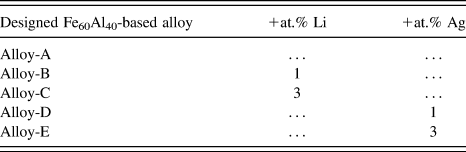
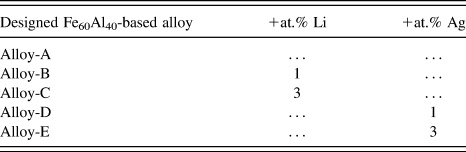
The experimental alloys were produced in an induction furnace by using a silicon carbide crucible. Reference Romo Castañeda30 To produce Fe–40 at.% Al-based intermetallic alloys with additions of 1 and 3 at.% of Li and Ag, high purity raw materials were used (99.9% of purity). Table I summarizes the designed atomic chemical composition of the intermetallic cast alloys without considering the carbon content acquired from crucible due to this crucible type tends to contaminate the AlFe alloys with small amounts of carbon. Reference Salazar, Albiter, Rosas and Perez25 In accord with Salazar et al., Reference Salazar, Albiter, Rosas and Perez25 a 0.053 wt% of carbon contents was measured in a Fe(40 at.%)Al + 1Li(at.%) forming carbides, mainly AlFe3C. Carbon contamination was not measured here; however, it is expected to find some carbides traces in the FeAl-based alloys here characterized by x-ray results; it is discussed in results and discussion section. An Inductotherm induction furnace using an argon protection atmosphere was used to cover the liquid iron, and aluminum was then added and mechanically stirred. Finally, the third element was added, followed by a stirring for full dissolution and homogenization. To avoid losses by evaporation, the addition of Li was realized using an aluminum capsule to minimizing the spontaneous reaction of Li in the casting. The melt was cast into sand molds to produce next-to-shape tensile specimens directly from casting. Mechanical properties were measured by tensile tests according to the ASTM E8 standard. 31 They were carried out on a Shimadzu (UH-300kNI) universal testing machine (Shimadzu Scientific Instruments, Columbia, Maryland) at a strain rate of 0.4 mm/min. Hardness was measured in a Shimadzu (HMV-2) hardness tester by applying 100 g of load for 20 s with a diamond indenter. 32 Prior to the mechanical characterization, intermetallic alloys were isothermally heat-treated at 800 °C for 48 h to reduce the adsorbed hydrogen contents, and removing or stabilizing quenched-in vacancies also, as was described before, Reference Deevi and Sikka13,Reference Schneibel20 however, that effect of the heat treatment over those was not measured.
Chemical composition of intermetallic alloys.
Samples with a size close to 10 × 10 × 5 mm were cut from the castings, grinded to 1.0 µm grades with emery paper up to 1000 grind size, polished with 0.5 µm diamond particle suspension, and then etched for metallographic characterization. Chemical etching was performed using Keller's etchant (HCl, HNO3, HF, and H2O). 33 Stoichiometric characterization of the phases present in each alloy was determined by x-ray diffraction patterns, using Cu Kα radiation in a two-theta range from 20° to 110° in a SIEMENS 5000 diffractometer (Siemens Aktiengesellschaft, Munich, Germany). Optical microscope observation was done using a Nikon Epiphot 300 (Nikon Corporation, Tokyo, Japan) equipped with a digital camera for imaging. SEM was performed for imaging characterization and microanalysis by EDS in a Phillips ESEM-XL30 (FEI Company, Hillsboro, Oregon) equipped with an EDAX.
III. RESULTS AND DISCUSSION
A. Microstructural and chemical characterization
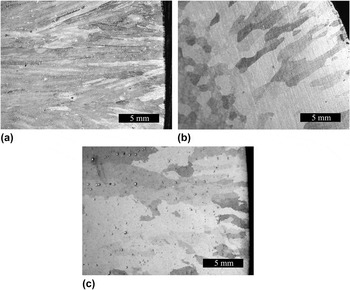
The macrostructure of the as-cast Fe–(40at.%Al)-based alloys was modified with the addition of a third alloying element. Figure 1 shows the optical image of metallographies at low magnifications of the base alloy and FeAl with 3 at.%Li and 3 at.%Ag (Alloy-A, Alloy-C, and Alloy-E). The base FeAl intermetallic showed a columnar grain distribution from the periphery toward the center bar in the opposite direction of the heat flow [Fig. 1(a)]. This characteristic morphology was identified (and described further ahead) with a low amount of the Fe3Al phase homogeneously distributed into the FeAl matrix. The addition of Li to the base alloy improved a change in the appearance of the solidified macrostructure. The main observation was the modification of macro-grains: they changed from a columnar to an equiaxial shape; it is suggested that they formed due to a higher nucleation process during solidification. Thus, it was to be expected when equiaxed grains formed at the end of the solidification (in the center of the bar) and the percentage of this solidification mode was proportional to the quantities of Li addition [Fig. 1(b)]. A similar behavior was shown by the alloys with Ag addition (1, 3 at.%) [Fig. 1(c)]. However, those alloys showed a third phase formation, a singular phase containing high amounts of Ag and Al, almost at 3:1 ratio. This third phase increased with the addition of Ag [Fig. 1(c)].
Metallographic images observed by light microscopy of (a) Alloy-A, (b) Alloy-C, and (c) Alloy-E.

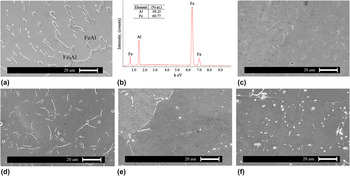
Figure 2 shows the detailed microstructure of all alloys observed by SEM at higher magnifications. Figure 2(a) displays the morphologies of the structural phases of the base FeAl. The base alloy was composed of two phases: the small amount of the Fe3Al phase homogeneously dispersed into the major phase of FeAl, as described above, and in agreement with the x-ray diffraction results and EDS [Fig. 2(b)] Reference Romo Castañeda30 The minor phase showed size variations, up to 20 µm in length and an average width of 3–7 µm. The minor phase solidified as a dendritic mode with primary and secondary arms of around 5 µm in diameter. Li additions promoted the modification of such a type of morphology and decreased the amount of the Fe3Al minor phase [Figs. 2(c) and 2(d)]. It was suggested that this decrease was caused by an incorporation of solid solution, according to the x-ray diffraction results. Reference Romo Castañeda30 On the other hand, Ag additions promoted the formation of a third phase, identified as an Ag3Al intermetallic compound. Similar to the Li additions, the Ag alloying promoted the modification of the microstructural morphology by decreasing the amount of Fe3Al [Figs. 2(e) and 2(f)] and, in turn, increasing the amount of Ag3Al.
SEM micrographs observed for (a) Alloy-A, (b) EDS chemical analysis of Alloy-A, (c) Alloy-B, (d) Alloy-C, (e) Alloy-D, and (f) Alloy-E.

The EDS analysis carried out for all the observed phases showed the semiquantitative stoichiometry of the compounds. Those analyses corresponded to the atomic ratio of the FeAl, Fe3Al, and Ag3Al intermetallic compounds verified by x-ray diffraction (described further ahead). The SEM characterization showed that the second phases in the base FeAl alloy presented a quasiregular distribution [Fig. 2(a)]. Additions of Li led to a refinement of the minor phase, showing a uniformly distributed needle shape [Fig. 2(c)]. X-ray diffraction results did not present patterns of Li or Li compounds; we suggest that Li remains in solid solution into the base alloy. Also, close to 0.5 at.% of Ag was incorporated in solid solution in the FeAl + Ag (1, 3 at.%) alloys. In those alloys, the excess of Ag concentration segregated toward the solidification front, as Ag3Al [Figs. 2(e) and 2(f)]. Similarly, the Fe3Al phase was refined and showed a needle shape, as did the FeAl + Li alloy. The effect of the third alloying element (Li and Ag) on the refinement of the Fe3Al phase could be due to the ability of iron to occupy sublattice sites, originally occupied by aluminum, through an excess of iron atoms. This is known as the antisite defect. Reference Baker and Munroe6 It is suggested that microalloying may promote a decrease in the occupied sites by Fe in the FeAl B2 lattice, hence decreasing the Fe contents for Fe3Al formation, which, in turn, decreases the amount of this latter phase.
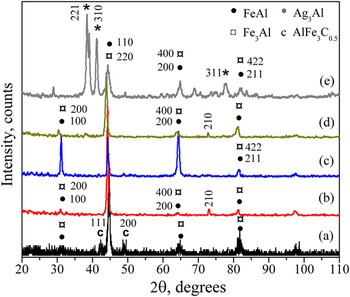
Figure 3 shows the x-ray diffraction patterns obtained for the FeAl-based alloys according to PCPDF-based data patterns: 28-0034 (Ag3Al), 65-6132 (FeAl), and 65-5188 (Fe3Al). Alloy A (base FeAl) shows the presence of a carbide phase with a stoichiometry composition given by AlFe3C0.5 (PDF 29-0044 pattern) only observed in this alloy. The presence of this carbide phase was related to the carbon content, as reported before. Reference Salazar, Albiter, Rosas and Perez25 The FeAl and Fe3Al phases had similar reflections of principal peaks, but different plane orientations. The planes associated to these peaks were (220) for Fe3Al and (110) for FeAl around at 45°, while they were (400) for Fe3Al and (200) for FeAl at 65° approximately. The AlFe3C0.5 had two main peaks related to the planes (111) and (200). Similarly, Alloy-B and Alloy-C showed FeAl and Fe3Al phases, but not other phase formations when Li was added as carbides compounds. The FeAl+3Li had a remarkable intensity increment in the peaks at 32 and 65° approximately; those associated to the planes (100) and (200) respectably, whereas there was an intensity decrement in the peak at 45°. Therefore, these modifications in the intensity of the main reflection, we suggested that this element entered into the solid solution, and its effect was reflected on the microstructure and mechanical properties (last are discussed later). However, one of the main effects of the alloying additions to the FeAl-based alloys is related with the appreciable reduction of the carbides presence. Reference Salazar, Albiter, Rosas and Perez25
X-ray spectra obtained on the FeAl-based and FeAl + (Li, Ag) intermetallic alloys (summarized in Table I).

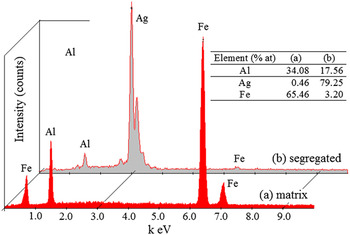
On the other hand, Ag additions to the base FeAl (Alloy-D and Alloy-E) did indeed promote an Ag-rich phase formation during the solidification process, identified as Ag3Al (Fig. 3). Figure 4, shows the EDS spectra of the FeAl + Ag matrix and the segregated particles of the Ag-rich phase. The matrix showed limited Ag solubility, between a 0.4 to 0.6 Ag at.% content [Fig. 4(a)], whereas the segregated phase showed higher amount of Ag. The Ag additions had two types of interactions with the base FeAl alloy. An amount of approximately 0.5 at.% Ag atoms entered into the B2 crystalline lattice through the substitutional solid solution [Fig. 4(a)], and the remaining amount of Ag was segregated toward the solidification front, forming the Ag3Al phase [Fig. 4(b)]. A similar effect has been observed with Mo addition to a FeAl due to the Mo3Al phase formation. Reference Eumann, Palm and Sauthoff4
EDS chemical analysis of FeAl with Ag additions (a) matrix phase and (b) Ag-rich segregated phase (segregated from Alloy-D).

Due to x-ray diffraction, patterns did not show any carbide existence in the alloys with third element addition (Fig. 3), the existence of AlFeC0.5 can not be discarded; but the carbon and the carbide formation in those alloys could be reduced with third alloy elements Reference Rosas, Esparza, Bedolla-Jacuinde and Perez21,Reference Salazar, Albiter, Rosas and Perez25 at concentrations not measurable with this tool. In this work, Li and Ag were used to improve the mechanical properties in a Fe–40 at.% Al alloy, and both elements diminished the carbon contents, around 75% with 1 at.% Li addition in base FeAl alloy. Reference Salazar, Albiter, Rosas and Perez25
The intensity changes of diffraction peaks was observed with the third element addition (Fig. 3), The intensity peak around 45° increased for 1Li as before reported, Reference Rosas, Esparza, Bedolla-Jacuinde and Perez21 whereas for both 3Li and 3Ag additions, the peak intensity decreases but increases at 65°. The study case in this work showed the FeAl-1Li had similar peaks as previously reported for an Fe3Al alloy with 1 at.% Li identified at the 2θ angles: 32° 45°, 65°, 82° (diffraction planes: 200, 220, 400, 422, respectively). Reference Rosas, Esparza, Bedolla-Jacuinde and Perez21 The explanation for these changes was that the additions of the third alloy element could modify the preferential orientations along certain axes. In this sense, the Li addition effects were associated to an expansion of unit cell Reference Yang, Masaaki, Masao and Ryoji34 as a microstructure and multiplicity factors by the peak diffraction on the (100) and (200) planes (at 32 and 65°), due its solid solution ingress.
B. Mechanical characterization
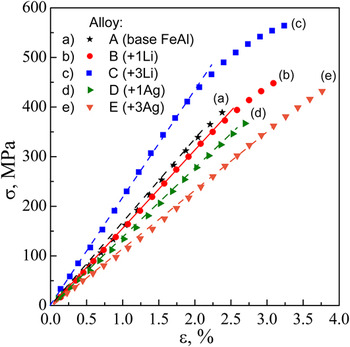
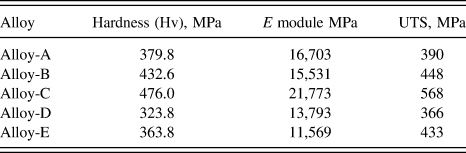
The addition of both Ag and Li to the FeAl-based alloy promoted some changes in the mechanical properties. Both elements improved the ductility in terms of elongation change percentage, and tensile strength of the base alloy, as well as the hardness. Addition of third element improved the elongation around 35, 85, and 130% for 1Li, 3 Li and 3Ag versus the showed by base alloy (which present a 0.31% in its plastic elongation); but 1 at.% Ag did not cause apparent ductility. A previous report on the mechanical evaluation of an FeAl (36.5% Al) alloy showed brittle cleavage fracture and only 2.2% tensile elongation when tested in air at room temperature, but the same alloy tested in a conventional vacuum had a ductility of about 8%. Reference Liu, George, Maziasz and Schneibel7 The addition of Li to the base FeAl improved the solid solution hardening effect, which is suggested to be due to the modification of red parameter by expansion Reference Yang, Masaaki, Masao and Ryoji34 and effect of carbon addition by contamination from SiC crucible, as similar effect as carbon or Mo. Reference Eumann, Palm and Sauthoff4,Reference Baligidad and Radhakrishna35 The x-ray results show evidence of the precipitation of AlFe3C0.5 carbides in the alloy A, but no evidence was observed in the alloys with Li and Ag additions. Therefore, the AlFe3C0.5 presence is due to an interaction between the melted alloy elements and the SiC crucible. Reference Salazar, Albiter, Rosas and Perez25 The use of SiC crucibles is a very common practice in alloy casting such as the technique used in this work. Although the AlFe3C0.5 was not planned to be obtained, the carbide compounds could benefit the mechanical strengthening Reference Huang and Froyen22 and ductility. Reference Deevi and Sikka13 Plots of tensile results are shown in Fig. 5, and some mechanical parameters from hardness and tensile measurements are summarized in Table II. Yield strength of a brittle material was calculated with the ultimate tensile strength (UTS), as recommended by the ASTM E8 standard. 31
Strength–strain plots of tensile test from FeAl-based alloys.

Strength–strain parameters (σ, ε) and hardness measurements of FeAl-based alloys.
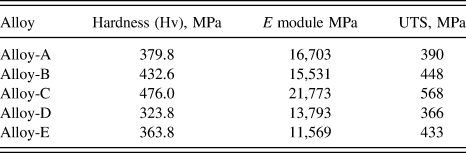
The FeAl-based alloy presented a UTS value of 390 MPa in air at room temperature (Table I). Morris et al. Reference Morris, Munoz-Morris and Requejo10 have reported that yield stress increases with Al content up to 25%, and it decreases rapidly in the 25–28% Al range, but shows increment over the 30–40% Al range. They described ductility as an inverse relationship to the yield stress, with a rapid fall in ductility up to 25% Al, a slight maximum at 28% Al, and a steady, slow fall thereafter. The yield stress and ductility of the base FeAl in the present work are in agreement with the observations of Morris et al. Reference Morris, Munoz-Morris and Requejo10 Besides, it was in according with the 360 MPa strength value at room temperature for the B2 structured Fe–45Al–4Cr–0.1Zr–0.02B alloy, melted in vacuum and homogenizing at 1000 °C/72 h, reported by Kupta Reference Kupka11 ; however it was tested in an argon atmosphere. In our work, the additions of Li to the FeAl-based alloy improved the mechanical properties, showing UTS values of 448 and 568 MPa (Fig. 5) and elongation increasing between 35 and 85% for Alloy-B and Alloy-C, respectively versus base alloy. Similar upswings of UTS values of FeAl alloys have been obtained with additions of carbon Reference Baligidad and Radhakrishna35 or molybdenum. Reference Eumann, Palm and Sauthoff4 Salazar et al. Reference Salazar, Albiter, Rosas and Perez25 reported similar effects when adding Li to a similar alloy, but tested under compressive stress. The effects of Ag additions were more meaningful in the elongation results, increasing around 130% for 3Ag (at.%), respectively. However, a small increase in UTS values was observed, around 366 and 433 MPa (Fig. 5; Alloy-4 and Alloy-5).
C. Fractographic characterization
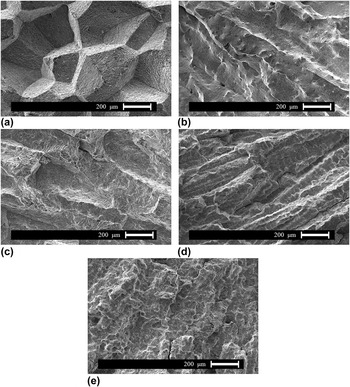
The results of mechanical strength and hardness showed a direct correlation with Li addition contents, but this was not seen in relation to elongation, which was similar at the 1 and 3% Li content. On the other hand, Ag additions did not significantly improve strength. However, elongation was higher than the one of the added lithium alloys, particularly the alloy with 3 at.% of Ag. Ductility in the FeAl + Ag systems was affected in proportion to the Ag addition. This effect is explained in terms of the third phase formed in the alloys, which allowed the plastic displacement among the grain faces of both the FeAl and Ag3Al phases (Fig. 2). In this sense, fracture morphology of the tensile tests provided more evidence of the plasticity or hardening effect of the Li and Ag additions. Figure 6 shows the SEM images of the resulting fractographs of the tensile tests of the FeAl-based alloys.
SEM images at ×100 magnification of specimens fractured by the tension test of: (a) Alloy-A, (b) Alloy-B, (c) Alloy- Alloy-C, (d) Alloy-D, and (e) Alloy-E.

The effect of the third element addition on the improvement of elongation was more evident with 3Ag and 3Li additions rather than 1Li was added. Namely, the maximum elongation % at strain condition was increased by Alloy-E (around 85% versus base FeAl), whereas (1, 3 at.%) Li addition promoted an increasing change of around 35 and 85%. However, characteristic brittle fractures were observed on all alloys (Fig. 6). Alloy-A showed intergranular failure mode by grain decohesion [Fig. 6(a)], associated with
 $\left\langle {111} \right\rangle$
or
 $\left\langle {100} \right\rangle$
slips,
Reference Baker and Munroe6
but it was modified by the third alloying additions, particularly with the Ag additions. Due to the plasticity improvement of the Ag additions, the fracture mode was changed from only intergranular to a mixture of intergranular and transgranular fracture [Figs. 6(d) and 6(e)]. On a minor level, Li additions promoted a fraction of transgranular fracture mode mixed with intergranular decohesion of the strongly anchored columnar grains, as an effect of the increase in strength [Figs. 6(b) and 6(c)]. This long intergranular failure mode occurred parallel to the columnar grain length.
FeAl intermetallic alloys did not show an apparent yield point discontinuity on the tensile tests (Fig. 5). This behavior is typical of brittle alloys. However, some level of ductility was evidenced by the change in the percent of elongation at strain condition with the 3Ag addition (Fig. 6) and the characteristic fracture mode. The change in the fracture mode for these alloys showed a transition from intergranular to transgranular and cleavage fracture, as previously reported. Reference Hausild, Karlik, Siegl and Nedbal27 That fracture mode was caused by the addition of ternary elements, and in this way the effect of Li represented an increase of around 44% in the UTS. Although tensile tests were not carried out in a controlled environmental atmosphere, the results could be comparable to those obtained when studying the effect of the environment and the strain rate on tensile properties of FeAl crystals by Wu and Baker. Reference Wu and Baker29 In addition, those results also concur with the results obtained by Pike and Liu, Reference Pike and Liu26 who studied the effect of vacancies on the environmental yield strength dependence of boron-free and boron-doped Fe–40Al. They reported an increase of almost 200 MPa of UTS on tests carried out in a vacuum, compared with the same alloys tested in air. The UTS values of the vacuum tests are similar to the UTS value shown by the Alloy-C in the present work. The Ag addition alloys (Alloy-D and E) showed a small effect on UTS behavior and the rise in the percentage of transgranular fracture, which evidences cleavage facets promoted by the presence of the Ag3Al ductile phase, has also been previously observed. Reference Chao, Morris, Muñoz-Morris and Gonzalez-Carrasco28
The change in the ductility of the base FeAl alloy represented by an increase in the elongation percentage is attributed to the modification of the microstructures. Similar results were reported by Huang Reference Huang and Froyen22 and Chao et al. Reference Chao, Morris, Muñoz-Morris and Gonzalez-Carrasco28 The former studied the influence of microstructure and test conditions on the tensile behavior of FeAl-based alloys with Mo, Nb, Zr, and C, which effectively improved the strength properties. Reference Huang and Froyen22 The latter analyzed that influence with Y2O3 particles (18 and 150 nm) and found that the major changes of strength were obtained by the grain refinement. They reported an increase of ductility of about 10% associated with grain size ranging from 1 to 100 µm. Reference Chao, Morris, Muñoz-Morris and Gonzalez-Carrasco28 Of course, the environmental control and surface finishing of the samples were very closely controlled. In the present work, the strengthening modification was attributed to the microstructure refinement in the base FeAl by the Li addition through redistribution and shape modification of the Fe3Al phase (Fig. 2). The increase in hardness was associated with the microstructural modifications by means of the combined contributions of vacancy hardening into an ordered and disordered domain/particle between grain borders and phases generated by the Li addition. Reference Amils, Nogues, Suriñach, Baro, Muñoz-Morris and Morris36 On the other hand, the softening effects due to the Ag additions were associated with the decreased Fe3Al phase and the formation of the third Ag3Al phase. In that case, the ordered and disordered vacancy hardening was not associated with the decrease of hardening, but was related to the third soft phase, which enhanced the plastic behavior. These results are in agreement with those reported by Cielsar et al., Reference Cieslar, Karlık, Benko and Cernoch24 who studied the influence of Cr and Ce additions on the mechanical properties of the Fe–(28 at.%)Al system, which promoted the precipitation of Cr–Fe–(C) particles, decreasing the hardness of the alloy with Cr content. In summary, the additions of Li and Ag to the Fe–(40 at.%)Al-based alloys increased the tensile strength at room temperature, due to the contribution of both the solid solution hardening and the vacancy increasing in the microstructures. Additionally, the change in ductile behavior was promoted by the microstructural changes, which had an important effect on slip plains, but the main contribution was attributed to the formation of the soft Ag3Al phase in the Ag content alloys.
IV. CONCLUSIONS
The additions of both Ag and Li into the FeAl-based alloy led to modify ductility and tensile strength. Li promoted a direct increase on strength and hardness due to solid solution hardening effects, and improvement in ductility for both additions. On the other hand, Ag additions did not significantly improve the strength properties. However, this addition promoted an elongation higher with 3 at.% addition than 1 at.% similar to 1 at.% Li effect.
Changes in the fracture mode were also observed when alloying the FeAl. The change in the fracture mode for these alloys showed a transition from intergranular to transgranular and cleavage fracture. Li additions caused an approximately 50% increase in the UTS, whereas a lower effect was shown by the Ag addition. Additionally, Ag additions could rise the percentage of transgranular fracture due to the presence of the ductile phase.
Additions of Li and Ag to the Fe–(40 at.%)Al-based alloys increased the tensile strength at room temperature due to the contribution of both the solid solution hardening and the vacancy increasing in the microstructures. Additionally, the increase in ductility was promoted by the microstructural change, which had an important effect on slip planes, but the primary contribution was attributed to the formation of the soft Ag3Al phase in the Fe60Al40–(1,3)Ag alloys.
ACKNOWLEDGMENTS
The present research was supported by CONACYT for the project financing Number: 243236, CB-2014-02, I0017 Fund.