

Introduction
Fish farming has become the fastest growing food-producing sector, accounting for half of seafood consumption worldwide.Footnote 1 Atlantic salmon holds only a small percentage of global supplies, but represents the largest trade flow in economic value, due to the salmon's high market price.Footnote 2 From being a wild-capture industry in the 1970s, about 90 percent of all salmon today is farmed.Footnote 3
However, the sector's rapid growth and industrialization has also had substantial environmental repercussions.Footnote 4 A major problem has been the proliferation of sea lice, a parasite which infects and threatens surrounding habitats, with potentially detrimental consequences for wild populations.Footnote 5 In Norway, the world's largest salmon exporter,Footnote 6 producers have faced increasingly stricter regulations since 2013, requiring substantial innovation and reductions of sea lice.
This article analyzes how fish-farming companies have responded to new environmental regulations in Norway. We note a marked strategic divergence within the industry, between small firms who strongly oppose new and costly regulations and large firms who support or advocate for such measures.
Studies of business engagement with environmental politics show that regulatory strategies may vary greatly according to a broad range of conditions, from company-level variables like managerial perceptions or the ability to produce technological innovations, to industry type, distributional effects, and the firm's socio-political context.Footnote 7 However, less is known about the roots of heterogeneous firm preferences within industries that face common regulatory pressures.Footnote 8 Studies often distinguish between ideal-typical corporate strategies as either reactive or proactiveFootnote 9—the former depicting business opposition when regulation threatens profitability and competitiveness, the latter pointing to support or advocacy when firms can seize opportunities that strengthen their competitive advantages. Why do some firms support or promote costly environmental standards, while others strongly oppose them?
This article contributes to the scholarship on business engagement with environmental politics and regulation in two ways. First, we expand the mainstream view of opportunities that can motivate proactive strategies. Earlier studies tend to see such opportunities as linked to competitive benefits derived from the firm's own environmental performance and innovation. We examine, in addition, the role of “predatory opportunities” for large firms to strengthen their competitive advantages and market share at the expense of smaller rivals that become asymmetrically burdened and disadvantaged by regulation.Footnote 10 While economic theory predicts that competition for market share can motivate leading firms to support stricter standards that may drive weaker rivals out of business,Footnote 11 this perspective has been largely neglected by political scientists studying corporate strategy in regulatory politics. Second, we show how company size can affect strategic choices. Research demonstrates that regulation often affects small and large companies differently, but few studies have examined how and why company size relates to the choice of political strategy.
Our analysis shows that a reactive and proactive “model” for corporate strategies can only partly explain the diverging responses of fish-farming companies. We find that the asymmetrical distribution of regulatory burdens and competitive advantages between small and large firms provides a plausible complementary explanation for the marked discrepancy in response strategies. The effect of such asymmetries is shown in the distribution of new production permits, all of which have stricter environmental and innovation requirements. Whereas big and competitively advantaged firms have managed to attain a large share of new permits, smaller and more disadvantaged competitors have only been able to seize a small percentage of these. Predatory motives behind corporate support or advocacy for stricter regulation are, thus, plausible. This article shows that size matters with regards to a firm's ability to capitalize on opportunities and competitive advantages under strict environmental regulation, and sheds new light on why market and technology leaders promote stricter standards that raise production costs.Footnote 12
Our empirical data draw on a combination of twenty-one interviews with representatives of companies and public authorities, position papers, and secondary material.
Analytical point of departure
The focus for explanation is intra-industry divergence in strategic responses to environmental regulation. We distinguish between company-external political responses and company-internal market responses. Footnote 13 The former refers to strategic company support or opposition to new regulation; the latter concerns compliance- and problem-solving measures, such as innovations in production technology.
In studies of the relationship between business and environmental regulation, a distinction can be made between those based on a neoclassical economics-inspired assumption of company behavior as “perfectly rational”—which suggests a negative relationship between regulation and competitiveness—and studies anchored in a behavioral economics-inspired assumption of company actions as “boundedly rational”—which suggests a positive relationship between regulation and competitiveness. These competing views also underpin two models for expected strategic responses as either reactive or proactive.Footnote 14 The models are ideal-typical, representing opposite poles on the same analytical continuum, and can be utilized as heuristic tools for analyzing variation and difference in corporate responses to environmental regulation.
The reactive corporate response model
The “reactive” model is grounded in the traditional economics view of firms as unitary rational, profit-maximizing agents that develop strategies based on full information on the relative costs of various alternatives.Footnote 15 Prior to regulation, companies will have adapted optimally in output and input markets at levels reflecting marginal income equal to marginal costs. Since new environmental regulations charge companies for previously free by-products and impose sizeable compliance costs that can erode profits, regulation is seen as diverting capital away from innovation and other investments, thereby threatening competitiveness.Footnote 16
In this view, environmental regulation can be assumed to represent a threat to corporations, and we expect political responses that seek to minimize new regulatory costs by opposing increasingly strict regulation. Opposition expressed in interviews, government consultations, and other lobby papers would be in line with this expectation. As to market responses, companies would be likely to choose compliance options based on cost-ranking, adopting only low-cost, incremental, and business-as-usual options—assuming that profit-maximizing firms with full information have already discovered all the “low-hanging fruits” and taken advantage of such opportunities before regulation was implemented.Footnote 17 We would expect business-as-usual activities and compliance measures focused on incremental improvements to existing production and mitigation options, with no strong focus on radical innovation.Footnote 18
The proactive corporate response model
The “proactive” response model assumes that the firm is “boundedly rational.”Footnote 19 While striving to maximize profits, strategic managerial choices are assumed to be influenced by other, company-internal and external factors, including the design of regulations or market failures, organizational practices and operating procedures, perceptions of risks and opportunities, and information constraints, habits, or routines.Footnote 20
According to these assumptions, environmental regulation will not necessarily represent a threat to profits and competitiveness: indeed, it may contribute to innovation, improved performance, and competitive advantages.Footnote 21 Porter and van der LindeFootnote 22 hold that “appropriately” designed environmental regulation is particularly likely to create new opportunities, spur learning about resource inefficiencies and technological improvements, reduce uncertainty about future investment, and stimulate innovations that can offset compliance costs. Appropriate regulation should focus on outcomes, not specific technologies. Best-available-technology regulation will hinder innovation, as companies will lack incentives to progress beyond the technology required. Second, regulation must be strict enough to spur radical innovation, as companies are likely to respond to lax regulation with short-term adjustments and incremental improvements to existing practices. Third, regulation should incentivize continuous improvement and be based on market incentives. Finally, uncertainty should be reduced by coordinating relevant regulations, ensuring predictability and providing phase-in periods to avoid the over-hasty implementation of expensive solutions.
In this view, environmental regulation can represent an opportunity for corporations. We would expect political responses that support or advocate stricter regulation that enable firms to exploit new business opportunities and strengthen competitive advantages in environmental management and technology. Support to government proposals or a preference for regulation expressed in interviews, consultations, and other lobby papers would be in line with this expectation. Concerning market responses, companies can be assumed to start searching for new, innovative solutions beyond business-as-usual, to create early-mover advantages. We expect beyond-compliance measures and investments in long-term, radical innovation projects since corporate management would direct attention toward new entrepreneurial opportunities. Documentation of technology innovation and demonstration projects, or participation in private certification schemes requiring stricter environmental management than government regulation, would be line with this expectation.
Size and predatory opportunities as conditions for reactive and proactive responses?
The reactive and proactive models capture how regulation can represent both a threat and an opportunity to company profitability and competitiveness. However, they fail to explain why some firms manage to seize opportunities to build competitive advantages, while others fail and remain disadvantaged by regulation. Here, we focus on two interlinked factors—company size and “predatory opportunities”—and explore how these may be analytically relevant for explaining divergence in strategic responses within industries facing common regulatory pressures.
Previous research indicates that size may be linked to a firm's ability to compete effectively in environmentally regulated markets. This is due partly to the disproportionate effects of environmental standards on small versus large firms within an industry. When regulations apply equally to businesses of all sizes, adjustment costs are likely to be greater for the smaller ones, because larger companies can spread fixed costs over a larger output volume.Footnote 23 When there are scale economies in compliance, environmental regulation can also place an asymmetrical burden on smaller ones and can lead to a shift in market power towards the large.Footnote 24 For example, Dean et al. find that stricter standards put small firms at a unit cost disadvantage.Footnote 25 Moreover, size could be linked to company-level innovation: SanchezFootnote 26 finds that large firms are more likely to develop radical innovations in response to strict regulation, which indicates that varying innovation capabilities may be linked to heterogeneous compliance capacity. Corporations of different sizes may also have different “dynamic capabilities” to “integrate, build, and reconfigure internal and external competences to address rapidly changing environments.”Footnote 27 Corporate managements often differ significantly in their capacity to scan the external environment for opportunities and threats, grasp new opportunities, and maintain competitiveness by enhancing, combining, protecting, and, when necessary, reconfiguring the assets of the business enterprise.Footnote 28 Baylis et al. found that large firms managed their environmental impact more effectively, partly because of superior managerial and human resources,Footnote 29 implying that dynamic capabilities may vary with size, and contribute to diverging strategic responses towards compliance.
Size also appears closely related to “predatory opportunities” for competitively advantaged firms to strengthen their market position at the expense of disadvantaged rivals under strict environmental regulation.Footnote 30 Economic regulation theory suggests that large and powerful producers will support strict and costly rules when these provide barriers to entry, or serve to weaken and possibly drive disadvantaged rivals out of business.Footnote 31 However, this focus on competitive dynamics over market share has been largely absent in the political science literature on business strategies vis-a-vis regulation.Footnote 32 We posit that “predatory opportunities” for leading firms to expand their market share at the expense of weaker rivals, or to absorb the weakest competitors market share through mergers and acquisitions, represents a plausible driver of proactive strategies. Large firms are likely to have abundant resources and a broad range of competencies, significant innovation capacity, and scale economies in compliance. These factors may all contribute to making it less costly and burdensome for large companies to comply with strict environmental standards, as compared with small, less resourceful, and technologically lagging companies. For leaders, the potential for profits from increased market shares can compensate for higher production costs resulting from stricter standards and investments in innovation.Footnote 33 Thus, when weaker firms struggle disproportionally to bear adjustment costs, and to develop or implement new technologies to comply with stricter standards, large and leading firms may be (partly) motivated by predatory opportunities to increase their market share at the expense of these rivals. Investigating intra-industry competitive dynamics, acquisition history and strategies, and the logic behind different regulatory positions can provide indications of whether predatory opportunities are a relevant driver of strategic corporate responses.
Data and methodology
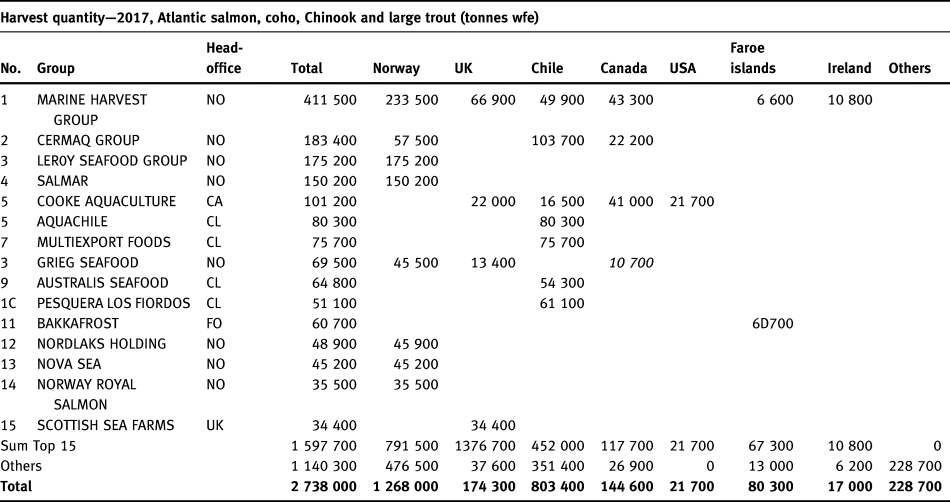
Our case study of corporate responses to environmental regulation in the fish-farming industry draws on multiple data sources. First, we conducted twenty-one semi-structured, in-depth interviews with owners, CEOs, and top management in fish-farming firms, grouped by size.Footnote 34 Our sample of large firms consisted of Marine Harvest, Lerøy Seafood Group, Salmar, Cermaq/Mitsubishi, Grieg Seafood, Nordlaks Holding, and Norway Royal Salmon. Together, these firms own 606 permits and represent 77 percent of total large-company production output.Footnote 35 They also rank among the world's ten largest salmon-farming companies, with four at the very top (see table 1). Our sample of small firms consisted of Lingalaks, Salaks, Gratanglaks, Edelfarm, Wenberg, and Engesund.Footnote 36 We granted anonymity to most of our company interviewees but provide a complete list of informants and sources in annex 1. In addition, we conducted four interviews with two top fish-farming policymakers, one NGO representative, one fish-farmer consultant, and one salmon market analyst. All interviews were transcribed.
World's largest salmon farming corporationsFootnote 37

In the analysis, we used pattern matching to compare our expectations with company responses and the model's heuristic value to capture the mechanisms that link regulation to responses by mapping views, perspectives, arguments, stated interests, and strategies across companies.
Second, we triangulated our interview data against key documentation like legal documents, industry position papers, and written comments by individual companies and industry interest associations to new regulatory proposals in government consultations.Footnote 38 Small companies tend to align behind interest associations mandated to protect the interests of small firms vis-à-vis the government (the Salmon Group and Seafood Companies, formerly the NSL), making their written comments central to our analysis. We also draw on written inputs from the largest industry organization, the Norwegian Seafood Federation (NSF/Sjømat Norge) and submissions by individual and groups of large firms.Footnote 39 This provided abundant information about corporate responses, showing the correspondence between positions stated in interviews and those submitted to government consultations.
Norwegian fish farming: the new regulatory regime
Norway's fish-farming industry is regulated by a government permit systemFootnote 40 that provides private companies with a right to produce fish at specific geographical sites.Footnote 41 All permits are subject to a “maximum allowed biomass” (MAB), an absolute ceiling of fish-weight to be maintained in farms at any given time.Footnote 42 Permits are distributed to industry actors by the Ministry of Trade, Industry, and Fisheries through allocation rounds. Companies compete to satisfy the government's criteria for new permits, which the Fisheries Directorate then distributes to winning firms, either for a fixed price or through an open or closed auction requiring pre-qualification.Footnote 43
Between 2005 and 2011, Norwegian production output remained well below the total MAB limit. But around 2012, little room remained for expanding production capacity,Footnote 44 which spiked industry demand for new permits and “capacity increases”—permission to increase the MAB of an existing permit.Footnote 45 This brought industry growth to the top of the government agenda. But awareness of the negative environmental impacts of fish farming was also growing. Public concerns that the proliferation of sea lice in dense farming localities was beginning to threaten the health, if not the very survival, of surrounding wild salmon populations were mounting, and the government encountered substantial criticism for having prioritized growth over the protection of wild salmon. Thus far, medicinal treatments had kept the sea-lice situation under control, but growing resistance to such medicines, combined with increasing stocking density and agglomeration of sea-lice hosts, spiked worries about further acceleration of the problem.
In response, the government begun to enact increasingly stricter sea-lice regulations from 2013: Under Regulation no. 1140 on mitigation of salmon lice in fish-farming facilities §6, they required all farms to keep lice levels below 0.5 adult female lice per fish, and from 2017, below 0.2 in week 16–22, the migration period for wild smolts.Footnote 46 The same year, they also introduced a new category of “green” permits, which required even lower sea-lice levels between 0.25 and 0.2. and no more than three medicinal delousing treatments per production cycle. In 2015, after several rounds of government–stakeholder consultations and heated public debate on whether further growth was environmentally defensible,Footnote 47 the government made capacity increases conditional on implementing a lice limit of 0.2 and use of max 2 medicinal treatments per production cycle. They also launched another new category of “development” permits intended for the demonstration of new, large-scale, and capital-intensive fish-production technologies that could alleviate the sea-lice problem. In 2017, the government launched a whole new production regime, the so-called Traffic Light System (TLS). The TLS divides Norway into thirteen production areas (PAs), in which the infection pressure on wild salmon is measured on a biannual basis. Companies within a PA deemed to have an “acceptable” impact on wild salmon (green light) may be rewarded with an invitation to apply for capacity increases and potentially auctions for new licenses. Companies within a PA deemed to have a “moderate” impact (yellow light) are simply allowed to maintain production volumes. Companies within a PA deemed to have an “unacceptable” impact may be punished with a requirement to reduce production volumes up to 6 percent. However, the TLS production-area regulation includes a caveat that exempts companies that can demonstrate 0.1 sea lice from this requirement and allows them to apply for a capacity increase along with firms situated in green PAs.
Overall, sea-lice standards have, thus, become much stricter since 2013. All salmon producers are now required to keep lice levels below 0.5 and below 0.2 during the migration period for young smolt. A limited number of new production permits have also been issued: green permits require lice levels between 0.25–0.2 all year round, as well as technical improvements or innovations that reduce sea lice, while development permits require the demonstration of radical innovations that help alleviate the sea-lice problem. Since the implementation of the TLS in 2017, capacity increases are only made available to companies in production areas deemed to have an “acceptable” impact on wild salmon, or to firms that can demonstrate very low (0.1) sea lice levels at their production facility.
Corporate responses to stricter environmental regulation
Small companies: reactive responses
Politically, small companies have generally opposed the government's introduction of stricter sea-lice standards and the linkage to growth permits.
First, many small companies deny the existence of a sea-lice problem per se, stressing scientific uncertainties and questioning the validity of the government's model for measuring impact on wild salmon under the TLS. As the industry association Seafood Companies argued, “we still lack crucial knowledge about the relationship between the salmon lice in production cages and the risk of unacceptable levels of salmon lice on wild fish.”Footnote 48
Second, small firms tend to argue that the 0.5 sea-lice limit has been counterproductive, because the upscaling of medicinal de-lousing treatments has caused growing resistance and reduced the effectiveness of medicinal mitigation tools. “Sea lice have become resistant to treatments, so we now have fewer tools for managing them. That's a big problem,” a small-company CEO emphasized. Many also noted that strict regulation causes high stress levels and mortality rates in production cages. “The welfare of our fish is so affected that we don't want to do it [reduce sea lice],” one owner pointed out. “We killed 60 to 70 fish trying to de-louse a cage just now,” another complained.
Third, most small firms are strongly opposed to implementing sea-lice standards below 0.5, claiming that a 0.2 or 0.1 standard is impossible to implement and maintain in practice. According to one small-company owner, “there is enormous pressure on us to keep levels below 0.5. But the limit set to attain capacity increases (0.2)—that's just impossible. Only a few companies can do that.” “With a 0.2 limit,” said another owner, “you start to wonder what kind of measures you're supposed to implement. It's very difficult.” According to Seafood Companies, a standard of 0.2 or 0.1 “is not an option for our members.”Footnote 49
Fourth, the costs of producing salmon have increased substantially as a result of sea-lice management efforts,Footnote 50 and all small firms stress that high compliance costs motivate their opposition to stricter standards. “The fight against sea lice is the biggest expense we have,” explained one CEO. Further, many said they worried about market prices plunging, a scenario where costs would be likely to exceed profits and threaten the survival of many small and family-owned firms. “Now that salmon prices are high, we're ok, but if prices plunge, we'll get a big problem. Production costs now average between NOK 35 to 40 per kilo, which is a lot. Historically, salmon prices have regularly dropped below that. Yet the government just keeps increasing our costs by imposing such strict rules,” a small-firm representative complained. For this reason, small-company industry associations have opposed every attempt to introduce stricter sea-lice standards since 2012.Footnote 51 “If the Ministry cannot remove the sea-lice standard,” Seafood Companies wrote, regarding the proposed regulation of capacity increases, “we request cancellation of the proposal altogether.”Footnote 52
Finally, small firms tend to emphasize their right and need to increase production volumes, but worry about being able to qualify for new permits and capacity increases under stricter sea-lice standards. For example, Seafood Companies argued that the requirement of redeeming an existing permit (applying stricter sea-lice standards to an additional permit) to qualify for a new green permit favored large firms: “the relative burden [of doing so] is bigger the smaller a company is.”Footnote 53 The Salmon Group noted that a 0.2 limit attached to capacity increases placed small firms at a competitive disadvantage due to costs: “Growth in the MAB limit is called for, but the cost is exclusionary: A high cost favors companies that are stock-listed.”Footnote 54 Small companies also oppose the TLS on grounds of competition: many operate in only one or two production areas, which puts them at a disadvantage vis-à-vis larger actors, who operate in many production areas with far greater flexibility to increase production or move elsewhere. Small firms may be “locked into a production area that is not allowed to grow, while larger, national actors would be able to continue and even increase their volumes in other production areas,” the National Seafood Federation argued.Footnote 55
Many companies also noted the conflict between small and large fish-farming firms stemming from differences in cost burdens, production flexibility, and resources needed for compliance. Because implementing stricter lice standards requires financial and human resources, including professionalized organizational systems for counting, managing, and reporting lice, large companies have a competitive advantage. A market analyst noted how stricter regulation could induce mergers and further consolidation, because compliance is easier under the umbrella of a large company that enjoy economies of scale in compliance and has a professional governance system. Several small firms linked this asymmetry to large-company motives for supporting stricter regulation. “There's a lack of understanding between large and small firms,” a small-company representative argued. “When it comes to framework conditions, large firms […] have an agenda: that is to change the structure of the industry. They want to get rid of actors. So there is no trust between large and small firms […] I think that many companies won't exist 10 years from now, simply because the framework conditions for production are getting so strict. Small firms don't have the resources or human capital to handle this,” the representative stressed.
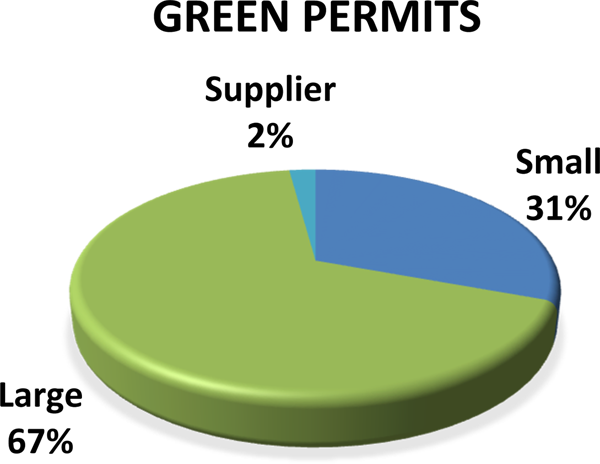
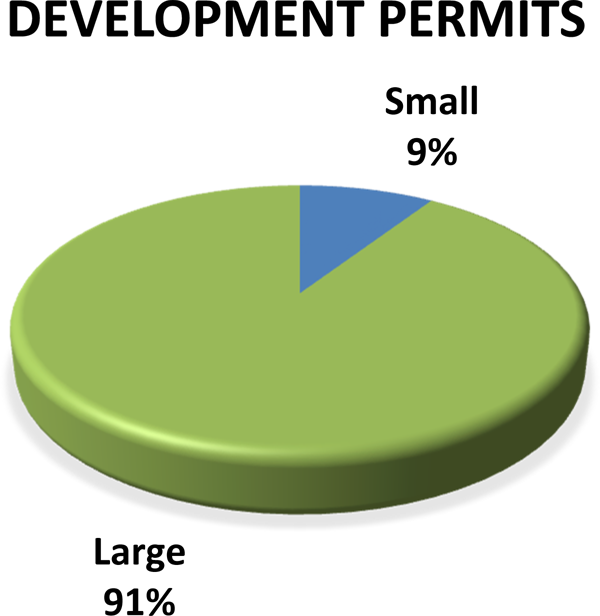
We find less consistency in market responses. Small companies were granted 24 percent of the new green permits (figure 1). All our interviewees argued that the compliance and problem-solving methods implemented through green permits were not radical innovations, but incremental improvements to the best available technologies. Many small companies also applied for the new development permits, but only 7 percent of these permits were granted to small companies (figure 2). Some small firms say they allocate funds to R&D and lice-related innovation, while others admit they simply aim to comply with the 0.5 standard in the most cost-effective way possible. In general, most small firms seem to focus on incremental improvements and implementing lower-cost de-lousing routines, mechanical methods, and equipment.
Share of green permits by company sizeFootnote 56

Share of development permits by company size

An exception seemed to be two of the small companies in our sample that belong to the Aquaculture Stewardship Council (ASC), a non-state ecolabelling and certification scheme that requires members to implement a 0.1 sea-lice limit. However, being located in Skjerstadfjorden, a brackish fjord completely free of sea lice, these companies admit to having a specific competitive advantage.
Large companies: proactive responses
Politically, all large companies support the implementation of stricter sea-lice standards, albeit with some variation between national and multinational firms: Whereas the former acknowledge the problem and support stricter regulation to resolve it, multinationals have gone further, advocating stricter standards than initially proposed by the government. Here, we summarize large companies’ main arguments for supporting or advocating stricter standards.
First, especially the multinationals state that a major motivation behind their advocacy is to see an improvement in “biological control.” This refers to the industry's ability to control and prevent parasites, such as sea lice, but also viruses and bacteria, from spreading within and between production facilities via water currents. Elevated sea-lice levels can degrade fish immune systems, making them more prone to viral or bacterial disease, which causes high mortality rates and may force companies to reduce stock or fallow considerably. As Marine Harvest—the world's largest salmon producer—argued, the economic repercussions of high sea-lice levels can be extensive. During the Chilean Infectious Salmon Anemia (ISA) crisis of 2007/8—in which lenient and poorly enforced regulation led to a major outbreak of ISA—salmon producers were forced to fallow considerably, resulting in substantial downsizing and financial write-downs in the ensuing years.Footnote 57 According to several interviewees, what happened in Chile provided a costly “lesson,” a reminder that strict regulation is needed to hedge against costs associated with loss of biological control. “We're affected by what our neighbors are doing, and if we lose control over sea-lice levels in one area, that's a big problem for everyone,” one CEO explained. “Because we operate in a commons and share the waters for production, what the neighbor does is almost as important as what you do yourself. Your lice are my lice. We think 0.1 or 0.2 is a good limit,” another COO held.
This argument has substantiated Marine Harvest's efforts to halt all regulatory proposals that would have allowed growth in production volumes without a parallel enforcement of stricter sea-lice standards. It has also underpinned their specific request for sea standards of 0.2 or 0.1.Footnote 58 Backed by other multinationals, they opposed a change to the MAB limit, arguing that it would create a build-up of biomass during the summer and autumn and result in a worsening of the sea-lice problem.Footnote 59 In a widely cited newspaper article, their CEO also stated that while an increase in the MAB limit would have enabled them to increase revenues by NOK 4 billion, “we are willing to sacrifice short-term profits […] because the long-term costs of not acting may be so much higher. […] Sea lice has become such a big problem in Norway that we think it's time to slow down. We recommend that the government does not allow the industry to expand production through the regulatory change currently under consideration.”Footnote 60 Instead, they recommended allowing capacity increases of 5 percent, conditional on implementation of a 0.2 sea-lice limit and restricted medicinal treatment, which later became legislation.Footnote 61
Third, many large companies worry about negative public reputation; some said this was among the reasons for supporting stricter standards. “We depend on our business model being accepted by consumers and the public. It's not a good thing when people think of sea lice when they hear of ‘farmed salmon’ (…) Negative publicity really affects us in the long term,” a VP in a large company argued. “We think it's wise for the industry to be viewed as caring about the wild salmon,” another CEO said. “There may be some disagreement about the exact level […] but it's nevertheless important that we fight the lice.”
Fourth, two companies said a limited increase in production volumes was desirable, as it helped maintain stable and high spot-market prices. This may partially underlie support for stricter regulation.Footnote 62 “We think it's in our interest for somebody to act as cartel,” one large company explained. “It's better to avoid boom and bust.”
Fifth, large companies admit that it is easier for them to support stricter regulation due to their competitive advantages in sea-lice mitigation and compliance and, thus, in competing to qualify for government-issued growth permits vis-à-vis most small firms. Reasons mentioned were financial resources, organizational skills and professional management systems, innovative technical solutions, and scale economies in compliance. “The stricter the regulations, the more resources are required from companies,” one CEO explained. “Large companies have benefits: we have our own departments working on environmental and sea-lice issues, and we have more resources, and often scale advantages.” “We are more competitive than small, family-owned firms,” another head of finance noted. “They are not as innovative. Future growth will be conditional on sustainability. You must demonstrate that you can comply with strict standards. The small companies don't take that seriously […] To be competitive, you need to produce sustainably, to get new permits […] But you also need to be of a certain size.”
Not surprisingly, no company admitted to being motivated by predatory opportunities, but their existence was indirectly verified by several interviewees. For example, one public affairs manager said that the company was routinely criticized for advocating stricter sustainability regulations in order to burden and raise the costs for small competitors. “We get a lot of criticism for being frontrunners on sustainability. Many think we do it because we want to squeeze small companies, so we can buy out everyone, and so on. They say the reasons behind our position are economic, not environmental concerns,” the manager explained. “This conflict is about costs. It's costly to mitigate lice, even for us […] But let's be clear, for small companies, it's a very big expense that can break them. So, when we push for sustainability, they think we're saying they don't have the right to survive.” Further, some large companies said that acquisitions were the best growth strategy: “It's hard to grow organically because of the regulations and limited number of permits,” a CEO explained. “To grow substantially in Norway, you must do it through acquisitions,” noted a salmon market analyst working closely with Norway's top salmon-farming brokers and traders. “Right now, there are many buyers but few sellers, due to today's high spot-market prices, which make salmon production so profitable. But large companies want to buy. I haven't spoken to anyone who doesn't want to buy.” Another head of finance said, “we aim to get bigger, through development permits and capacity increases—so we need to be sustainable [to qualify for such permits]. There are no sellers right now, due to the high salmon price, but we're interested in buying if there are sellers in the north of Norway.” For all the large, national companies, acquisition is also a stated goal and a means towards increasing their market share.
Concerning market responses, the multinationals have committed to implementing the ASC certification and ecolabeling standardFootnote 63 in all Norwegian farms by 2020, which requires them to comply with a sea-lice standard equivalent to 0.1. Large national companies have also implemented the ASC, but in selected production areas—notably in northern Norway, where it is easier to implement because of less sea lice, due to colder water and lower stocking density.Footnote 64
All large companies have invested heavily in incremental and radical innovations to the existing open-cage production method. Large companies obtained 69 percent of the new green permits (figure 1), where various problem-solving measures were implemented, ranging from lice-mitigating “skirts” for open pens to semi-closed production cages. The most innovative and expensive compliance technologies through green permits, such as closed production cages, were also applied by large companies. Most importantly, large companies were granted 91 percent of development permits (figure 2) and are now in the process of building and testing a range of radically new production technologies, like large offshore farms and closed production systems.Footnote 65 These projects are highly capital-intensive and involve significant financial risk. If successful, they might contribute to a radical change in methods for producing salmon that could significantly reduce, if not resolve, the sea-lice problem.
Explaining corporate responses
We find a marked divergence between the strategic responses of small and large fish-farming companies. While small firms have opposed stricter regulation and implemented mostly incremental and low-cost improvements to existing technologies, large ones have supported or advocated stricter standards, implemented beyond-compliance practices, and developed radical, production-technology innovations. Overall, market responses correlate with political responses: strategic positions conform to actual behavior, ruling out proactive responses as mere “greenwash” or branding exercises to score reputational points.
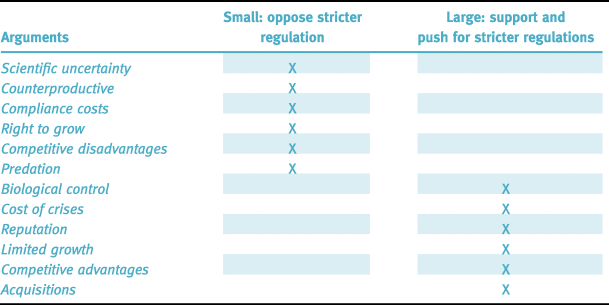
The substantiation of strategic responses is also markedly different. Table 2 summarizes and compares justifications of reactive and proactive positions.
Substantiation of strategic responses

The expectations of the reactive model correspond with small firms’ view of regulation as a threat and focus on higher production costs threatening their profitability and competitiveness. As a heuristic tool, this model captures well the importance of short-term incremental adaptation by minimization of regulatory costs. However, small firms’ worry about asymmetrical competitive disadvantages and compliance burdens vis-à-vis large companies, as well as predation and consolidation, are not captured well by the reactive model. It also fails to account for large-company responses.
The expectations of the proactive model correspond well to the responses of large firms and partly to their stated motives for supporting or recommending stricter regulation. Large firms have competitive advantages in environmental management and production technology, shown by their demonstration of radical innovations that might resolve the sea-lice problem. This also made them winners of the competition for new permits. As such, this model complements the reactive model as a heuristic tool by indicating the importance of attention, learning, and the search for new business opportunities in a long-term perspective.
The design of new regulations corresponds significantly to what Porter and van der Linde considered “appropriate” for driving proactive responses. The regime focuses on outcomes (lice levels and wild salmon impact), not specific lice-prevention technologies, and has become increasingly stricter. It encourages continuous improvement through market incentives, by linking successful sea-lice management and innovation to the attainment of growth permits. Stricter standards have been phased in gradually, and the TLS provides predictability regarding growth opportunities, thus reducing business uncertainty. It is, therefore, likely that this “appropriate” design has stimulated innovation among large companies and resulted in competitive advantages in technology. However, this model fails to explain why small firms have generally been unable to seize such opportunities but remain burdened and competitively disadvantaged by regulation.
Other apparent motives can hardly be accounted for by the proactive model. For example, the motivation to improve biological control or enhance the reputation of fish farming cannot be said to represent opportunities to strengthen competitive advantages: these are industry benefits enjoyed by all firms. Perhaps large firms are more exposed to both reputation damage and production risks. Firms that operate many production facilities also face high exposure to neighboring firms and, thus, the risk of infectious crises. They are also highly visible actors—whereas small companies are less evident to the public, and their small-scale operations render them less exposed to neighbors. Yet, small firms are certainly not sheltered from biological crises in their areas, and it is puzzling that they seem unaffected by such risks.
Neither does a proactive model capture the role of asymmetries in competitive advantages and compliance capabilities—or the possibility that uneven effects of regulation creates predatory opportunities that incentivize support for stricter regulation.
To explain the divergence in responses, we turn to our propositions regarding size and predatory opportunities. Statements by both small and large firms, as well as industry associations, confirm that regulatory burdens and compliance costs are generally much greater for small actors, given their lack of innovation capacity, resources, scale economies, and flexibility in production. Their dynamic capabilities also seem low, with many focused on resisting the science and legitimacy of change. Market responses validate that small firms have lower capacity to produce radical innovations.
In figures 1 and 2, we show how small firms have been strongly disadvantaged in the competition for new production permits after 2013. Measured in tons of growth (biomass of salmon), large firms won 67 percent of the production growth allowed through green permits and an overwhelming 91 percent of the production growth allowed through development permits.Footnote 66
Overall, our analysis indicates that large firms tend to have greater financial, human, and technical resources, a higher level of professionalization (e.g., organizational and administrative systems), scale economies in compliance, and flexibility in production. Large companies are also frontrunners on technology innovation, which has enabled them to increase their market share by seizing the brunt of new, stricter, and innovation-geared production permits after 2013. Conversely, small companies appear to have lower dynamic capability, less professionalization, a lack of scale economies, and less flexibility. They also appear to be more strongly burdened by increased costs of compliance, and to have invested less in innovation—all of which contributes to their relative failure in the competition for new production permits.
Company statements indicate that these asymmetries underpin an apparent intra-industry conflict, and that large firms may have been motivated by predatory opportunities to increase their market power at the expense of more disadvantaged competitors. However, interview data cannot prove the existence of predatory motives, as no company would openly state a wish to weaken a rival's ability to compete and survive in the market. Small companies nevertheless accuse large ones of such motives, and large firms confirm these accusations, admitting that stricter regulation could threaten small-firm survival in a lower-price market.
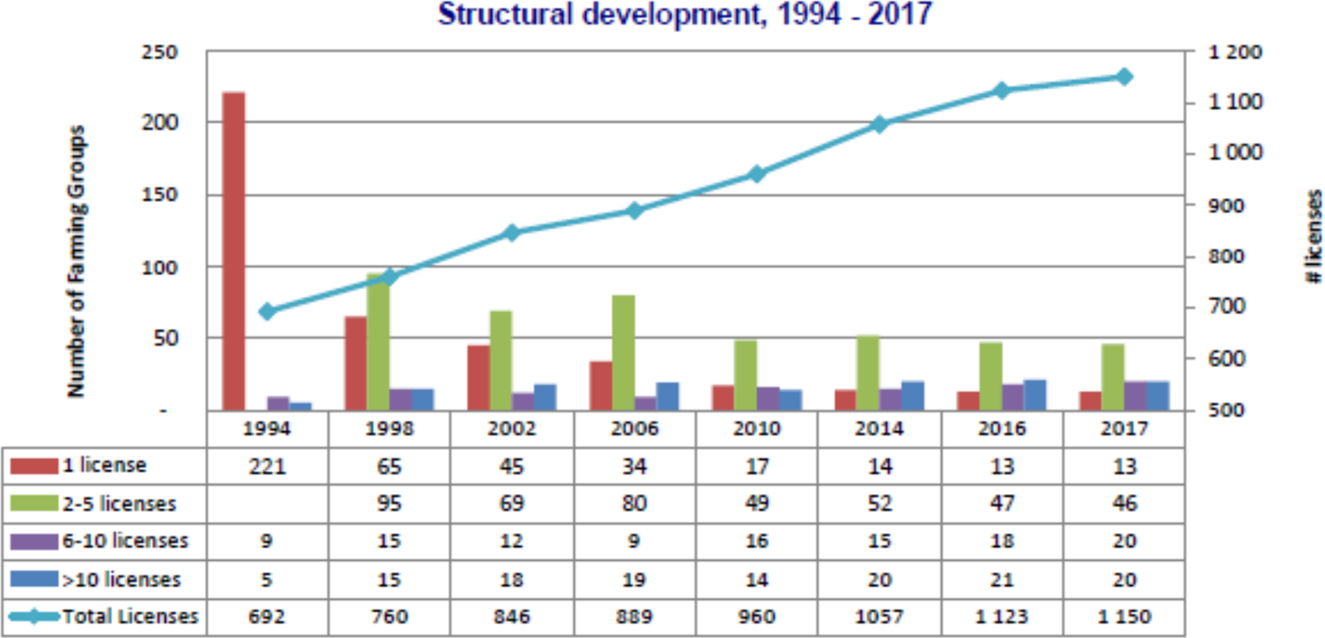
There is, thus, an indication of a link between market price and the potential effect of cost-raising environmental regulation on industry consolidation through mergers and acquisitions. Historically, salmon prices have indeed plummeted and net revenues fallen below net costs, in a cyclical pattern.Footnote 68 As the director of a large company explained: “We've been through many dumps. We've sold truckloads of salmon at 13 NOK [per kilo], when production costs were only 20 NOK [per kilo]. Now, when prices are so high, in the range 60–90 NOK, we're well above production cost—so you can make money anyway.” But with record-high production costs (37.5 NOK per kilo on average in 2018, a doubling since 2005), which is largely due to stricter sea-lice standards and rising feed prices, company margins would be severely threatened in a lower-price market. Some estimate that with a salmon price below 50 NOK per kilo, many firms would struggle to break even.Footnote 69 Past consolidation of the industry has also been rapid, with a 75 percent decrease of firms between 1994 and 2017 (figure 3). Many interviewees linked high production costs resulting from stricter environmental standards to the possibility for a new wave of consolidation in a low-price market.
Norwegian salmon farming industry: structural development 1994–2017Footnote 67

Whether predation is enabled by stricter standards may, therefore, hinge on market price. A lower-price scenario, where net revenues fall below net production costs, could more likely have verified our hypothesis that strict environmental regulation can enable large market leaders to absorb small and weaker competitors in this case.
Conclusions
This study shows that a reactive or proactive “model” for corporate responses can only partly explain the marked divergence on stricter regulation between small and large companies. While a reactive model captures the importance of cost minimization and short-term adaptation among the small, a proactive model illustrates the role of competitive advantages in environmental management and technology innovation as drivers of proactive strategies among the large. However, we find the asymmetrical distribution of regulatory burdens and competitive advantages in compliance to provide an important complementary explanation for why small firms have tended to strongly oppose stricter regulation, while large firms have either supported or promoted stricter and cost-raising standards.
Large companies have high dynamic capability, scale economies in compliance, and flexibility in production. They are also technology frontrunners, enabling them to go beyond compliance through incremental and radical innovations to existing production technology. Conversely, small companies suffer from competitive disadvantages, such as few or no scale economies, disproportionately higher compliance costs, lower innovation capacity, and lower dynamic capabilities.
Therefore, small firms have incentives for opposing stricter regulation, which makes it harder to compete for new production permits and could trigger a scenario where production costs climb beyond net profits—plausibly spurring further consolidation of the industry. By contrast, large companies have incentives for supporting stricter standards, as advantages in compliance and technology innovation make them more qualified in the competition for government permits. This asymmetry is reflected in the relative distribution of new green and development permits after 2013, where large firms became highly favored and managed to attain most of the allowed production growth at the expense of smaller, disadvantaged competitors. While we conclude that predatory opportunities do exist, our empirical data cannot verify that large-company support for stricter standards was motivated by the potential for small-firm exit. Indeed, actual predatory behavior is more plausible in a lower-price market, where production costs fall toward or below net profits, which could trigger a new wave of acquisitions.
The uneven effects of environmental regulation, and the associated competitive advantages and disadvantages between small and large firms, can also explain the use of competing normative arguments to legitimize strategic positions. Small fish-farming companies have confidently played the bad-guy role, as antagonists of public efforts to protect wild salmon populations, leaning on “right to grow” and “right to survive” arguments that stress job creation and economic growth in remote areas—historical priorities of all Norwegian governments. Large companies have played the good guys, the self-appointed guardians of environmental protection, claiming that short-term profits must be sacrificed for the good of long-term sustainability. However, these normative positions should be interpreted as efforts towards legitimacy, and not actual determinants of reactive or proactive responses. Whether large companies have played ugly, supporting stricter environmental standards to enable further consolidation, remains a matter of informed speculation.
Two implications can be drawn from these observations. First, motivations for proactive behavior may have consequences for trade-offs between different societal concerns. If stringent environmental regulation favors large, commercial actors over small-scale producers, and enables predation and consolidation over time, environmental improvements may conflict with local economic development and ownership. This is highly relevant where fish farming has become a fast-growing food-production sector—as in many Asian and African economies, where the traditionally smaller-scale, fish-farming sector is evolving towards industrialization and commercialization.Footnote 70 Second, whether “appropriate” environmental regulation can trigger proactive corporate responses appears closely related to size. This calls for more research on the effects of environmental regulation on firms of different sizes within other natural-resource based industries—where small and large corporate entities produce and compete alongside each other in the same market.
Acknowledgements
The authors thank the four anonymous reviewers for their constructive comments on an earlier version of this article, and Mari Lie Larsen for her helpful research assistance.
ANNEX 1:
Written industry comments and input to government consultations
– 2012: Government consultation on proposed change to the MAB limit, 2012
(Forslag om videreutvikling av produksjonsreguleringssystemet (MTB)
URL: https://www.regjeringen.no/no/dokumenter/horing-av-forslag-om-videreutvikling-av-/id739000/?factbox=horingssvar (accessed 01 January 2018).
– 2013: Government consultation on environmental standards for 45 new “green permits” (Forslag til forskrift om tildeling av lisenser til havbruk).
URL: https://www.regjeringen.no/no/dokumenter/hoyring--forslag-til-forskrift-om-tildel/id715988/?factbox=horingssvar (accessed 01 Janary 2018).
– 2014: Government consultation on proposed increase in MAB limit (Forskrift om økning av maksimal tillat biomasse for akvakulturlisenser)
URL: https://www.regjeringen.no/no/dokumenter/Hoyring---forskrift-om-auke-av-maksimalt-tillaten-biomasse-for-loyve-til-akvakultur-med-laks-aure-og-regnbogeaure-/id764283/?factbox=horingssvar (accessed 20 June 2018).
– 2016: Government consultation on the proposed regulatory system for production-capacity adjustments and growth in salmon farming (Traffic Light System)
(Forslag til regelverk for å implementere nytt system for kapasitetsjusteringer i oppdrett)
URL: https://www.regjeringen.no/no/dokumenter/forslag-til-regelverk-for-a-implementere-nytt-system-for-kapasitetsjusteringer-i-lakse--og-orretoppdrett/id2505908/?factbox=horingssvar (accessed 20 June 2018).
List of informants
– Edelfarm and Wenberg, Environmental Management Coordinator, 19 January 2017
– Engesund Fiskeoppdrett, Lingalaks and Tomre Gruppen, Head of Societal and Political Relations, 1 February 2017
– Gratanglaks, CEO, 1 February 2017
– Grieg Seafoods, Director of Feed and Nutrition, 18 January 2017
– Grieg Seafoods, COO, 18 January 2017
– Havbrukspartner, Director of Communications, 19 December 2018
– Lerøy Seafood, Quality Director, 26 January 2017
– Lerøy Seafood, CEO, 31 January 2017
– Marine Harvest, Head of Sales, 1 November 2017
– Marine Harvest, Public Affairs Manager, 2 October 2014
– Marine Harvest, VP of Finance and Treasury, 2 October 2014
– Marine Harvest, COO of Salmon Farming in Norway and Chile, 1 February 2017
– Ministry of Trade, Industry and Fisheries, Director General, Oslo, 1 October 2014
– Ministry of Trade, Industry and Fisheries, Director, 2 December 2016
– Ministry of Trade, Industry and Fisheries, Senior Advisor, 2 December 2016
– Mitsubishi/Cermaq, CEO, 25 January 2017
– Mitsubishi/Cermaq, Corporate Affairs Director, 25 January 2017
– Mitsubishi/Cermaq, Head of Sales, 31 January 2017
– Nordlaks, Director of Salmon Farming, 25 January 2017
– Norway Royal Salmon (NRS), Head of Finance, 13 January 2017
– Pareto, Head of Salmon Market Analysis, 25 September 2014, and 16 December 2016
– Salaks, CEO and Owner, 24 January 2017
– SalMar, Head of Societal Relations, 16 January 2017
– Salten Aqua, CEO, 31 January 2017
– WWF, Head of the Marine Program, 9 October 2014