We sought to liberate ourselves from the weight of our sins, we wanted to look ourselves in the face and tell ourselves the truth, to discover who we really were.
Vittorio De Sica, La table ronde (1960)Si percorre il deserto con residui
Di qualche immagine di prima in mente,
Della Terra Promessa
Nient'altro un vivo sa.
Giuseppe Ungaretti, Ultimi cori per la Terra Promessa (1960)Othello: What doest thou thinke?
Iago: Thinke my Lord?
Othello: Thinke my Lord? By heauen he ecchoes me.
Shakespeare, Othello, III. iiiOn the evening of 13 April 1961, having crossed Venice's Campo San Fantin, entered the Teatro La Fenice and taken their seats amidst the splendour of red and gold, the public viewed the noisy spectacle of Luigi Nono's latest work, Intolleranza 1960. The opera's police cells and concentration camps conspicuously jarred in such theatrical surroundings. Clearly fashioned as a protest work, a rallying call to arms, it was effective in an unintended way: midway through the performance a demonstration was mounted by a group of neo-Fascists from the Ordine Nuovo, who were seated in the upper tier of the theatre.Footnote 1 The demonstrators, booing and jeering, threw down pamphlets denouncing Intolleranza as a work of political propaganda.Footnote 2 The disturbance was dismissed in the leftist press as a response to the fact that both Nono and the musical director, Bruno Maderna, were members of the Partito Comunista Italiano (or PCI),Footnote 3 rather than to anything in the work. But Intolleranza's political resonance was to become the starting point of a wide-ranging debate on the function of art in society.
The experiences of that spring Venetian night were to feed in to contemporary discourses concerning the postwar rebuilding of the Italian nation, discourses among intellectuals who were still coming to terms with wartime experience and its catastrophic climax in 1943–5. This was done in tandem, particularly among the Left, with a reappraisal of the Risorgimento. The publication of Antonio Gramsci's notes on the latter subject, which had appeared only a couple of years after the war, had dominated both public and scholarly discussion over the preceding decade.Footnote 4 There was, in other words, widespread analysis of the attempts at revolution that had shadowed the project of a unified Italy over the previous hundred years.
The question of how Intolleranza can be read in light of these debates does not necessarily entail an apocalyptic narrative; to turn Michael André Bernstein's critique of foreshadowing 180 degrees, such events need not be interpreted purely as a belated response to Fascism.Footnote 5 Italy in 1961 was, for one thing, undergoing changes unforeseen decades earlier; this was a period of increasing urbanisation, and in particular of immigration from the rural south to the more industrialised north. The human consequences of this disruption were a common trope in literature of the time, and often figured through the experience of overwhelming noise. In Paolo Volponi's novel Memoriale (1962) the protagonist, a homesick war veteran seeking work in the north, enjoys an interesting moment of self-reflexivity: ‘I write of noise, because the first time that one enters the factory, noise is the most important thing, and more than looking one is listening, and listening unwillingly to that great noise which falls on you like a shower’.Footnote 6 As we shall see, sheer noise played an important part in the critics' interpretation of Nono's opera on its opening night.
To set another narrative of change from this period in relief, the 1950s to early 1960s also marked the consolidation of capitalism via the so-called ‘economic miracle’, a phase of prolonged economic growth in Italy from the end of the Second World War up until the late 1960s.Footnote 7 A new consumerism was evident in the Fiat Seicento and Cinquecento car models that began to fill Italian streets; or in the brightly coloured plastic chairs of Vico Magistretti and Joe Colombo, chairs which were designed not only for sitting on but, more importantly, for looking at, for fetishising as objets d'art. Furthermore, this was the height of the Cold War; only the day before the premiere of Intolleranza, the Soviet Union had displayed its technological strength by sending Yuri Gagarin into space; in the same year the Berlin Wall had been erected. Communist papers glorified the Soviet technical achievements.
A period of great change, then; but also one in which events were pushed into broader and longer-arching narratives – about the potentiality of humanity, or about technology and modernity. An autochthonous tint is also significant. This article seeks to probe the limits of modernism as a transnational phenomenon, thus going against the tendency of globalisation narratives, which suggest that by the mid-twentieth century, societies and cultural practices in the West were becoming increasingly homogenised. As part of the destabilising of the idea of a 1945 zero hour, notions of recuperation, heritage and evocation of Italian, and eminently Venetian, traditions suggest a striking degree of aesthetic continuity between the pre-Fascist, Fascist and post-Fascist periods.
Bureaucracy, displacement, topicality
Intolleranza tells the story of a nameless Emigrant (tenor) who is desperate to escape his current existence in a desolate mining town and return to his place of origin. The opera traces his journey, sketched as a series of events that subject the protagonist to various instances of intolerance. Part One opens with slogans projected on the stage curtain, accompanied by taped choruses issuing from a series of speakers situated around the theatre. As the curtain rises the audience sees the Emigrant singing of his desire to leave the mines in which he works in the harshest of conditions, an escape that involves leaving behind a Woman (soprano) who has been caring for him.Footnote 8 He first heads to a city and becomes caught up in a street demonstration; he is arrested and taken to a police station, then interrogated and tortured. Sentenced to a concentration camp, he immediately plots another escape, along with an Algerian prisoner (baritone).Footnote 9 Before Part Two proper begins, the audience is presented with a montage: a mocking of mass culture and a Kafkaesque critique of the illogicality of modern bureaucracy entitled ‘Alcune assurdità della vita contemporanea’ (Some absurdities of contemporary life). When the plot resumes, the Emigrant encounters a woman who becomes his Companion (alto) for the remainder of his journey. They arrive at a town where a dam has been installed to provide hydroelectric power; the river is, as a result, threatening to burst its banks. In a catastrophic dénouement, the dam breaks, and the town and its people, including the Emigrant and his Companion, are swept away. A commentary is provided by a series of choruses that intercept, transfigure and intensify the drama: of miners, demonstrators, the tortured, prisoners, emigrants, Algerians and peasants.
Intolleranza was commissioned by Mario Labroca for the Venice Biennale. Correspondence between Nono and his collaborators shows that most of the work was written in only three months, once the Venetian commission was agreed.Footnote 10 The drama was directed by the Czech composer and director Václav Kašlík, with technical preparation by the Czech artist Josef Svoboda, both members of the Laterna Magika theatre of Prague; the costumes and scenography were by the Venetian artist Emilio Vedova.Footnote 11 Divided into two parts, the libretto of Intolleranza contained texts by Angelo Maria Ripellino, Henri Alleg, Bertolt Brecht, Aimé Césaire, Paul Éluard, Vladimir Mayakovsky, Julius Fučík and Jean-Paul Sartre, all of them united by a marked political commitment.
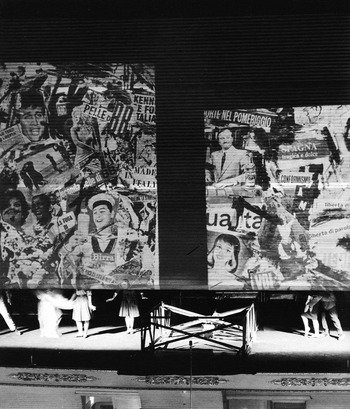
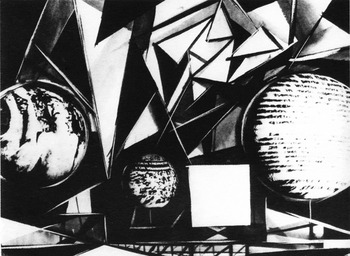
The scenographic accompaniment to the drama consisted of a series of placards smothered in montages of newspaper cuttings, photos and abstract paintings, simultaneous with projections of images and video clips (see Figure 1). The backdrop was thus heavily stylised, retaining a degree of detachment from the unfolding events, hindering the believability of the drama. This effect was augmented not only by the mixed-media extravaganza of the scenography but also by the fact that at times such a backdrop hid the faces of the figures onstage. Yet in many ways it also reinforced the potency of the ‘realities’ of the drama: the angular lines of black and bright red in Vedova's paintings heightened the disturbing force of the music; the movement of images across the stage furthered the sense of immersion provided by the distribution of sounds through loudspeakers; and the playing of documentary footage provided a window onto the events referred to in the drama. This concern with contemporaneous events is evident from the earliest stages of the scenographic design: space imagery was drawn and printed on the sketches and models made by Svoboda – floating planets, astronauts and space rockets – that gesture towards space travel (see Figure 2). In the final version, of 1961, alongside the abstract projections that accompanied the demonstration in the city (Part One, Scene 3), there was video footage of police charges at street demonstrators, reinforcing the sense that what is seen on stage also happens outside the theatre.
Luigi Nono, Intolleranza 1960. © Fondazione Cassa di Risparmio di Modena and © Fondazione Emilio e Annabianca Vedova

Sketch for Luigi Nono, Intolleranza 1960. Archivio Luigi Nono, Venice – © Luigi Nono heirs

Nono and his leftist critics hoped that, by being both immersed and unsettled in the theatre, the audience would be encouraged towards a reappraisal of current society, thus realising the oppression and intolerance still taking place around them, regardless of their own improved quality of life. The composer claimed that traditional opera had long since failed to achieve the provocative, unsettling effects needed to counteract the increasing passivity of consumerist existence. Nono's consternation at the sacralization of opera, of people hearing the same things again and again with an unquestioning attitude, was interlinked with a wider fear of passivity.Footnote 12
Nono was not the only composer in Italy trying to reinvigorate music theatre. Indeed Raymond Fearn sees 1960 as a watershed: a year during which young composers began decisively to reengage with the stage.Footnote 13 While there is indeed a sudden frequency of new works, such as Giacomo Manzoni's La sentenza (1960) and Bruno Maderna's Don Perlimplin (1961), the idea of a sudden theatrical turn is debateable. Such reengagement can better be traced to developments over the preceding decade and in response to broader theatrical initiatives in other cultural media.Footnote 14La sentenza and Don Perlimplin, however, have much in common with Intolleranza: all three are theatrical works of overt political commitment that attempt to integrate recent models (Brecht, Piscator, Sartre) with reminiscences of the Italian operatic tradition all sewn together into a post-Schoenbergian soundworld. To use Pierluigi Petrobelli's distinction, these are works that form part of the trend of Italian music characterised by ‘seriousness’ and ‘commitment’, where
the composers who belong to this trend express themselves verbally in lucid prose, sometimes even in a kind of manifesto. The artists I like to place in this category see themselves as active and responsible members of society; they see their art as a means by which to propose and then project a programme, an artistic credo.Footnote 15
However, Italy's economic miracle was for music theatre a double-edged sword: whilst it enabled funding for larger-scale works, it also aided the rapid proliferation of mass media technologies. Cinema attendance rose dramatically in the decade after the war, eventually giving way in the late 1950s and early 1960s to increasing television ownership;Footnote 16 at the same time, theatre audiences had halved by the end of the decade.Footnote 17 To save theatre from obsolescence, the cultural elite decided that the experiences of cinema and television needed to be brought in to reinvigorate the medium, just as the Laterna Magika had attempted only a few years before in Prague. We see this concern in newspaper reviews of Intolleranza: in Manzoni's claim of the work's importance ‘in the new musical theatre of our time, and in a fight for the renewal of the avant-garde’;Footnote 18 or Massimo Mila in L'espresso, ‘Such a work is, in terms of accomplishment, without precedent’;Footnote 19 or Luigi Pestalozza in Cinema nuovo, ‘It is not only the work of a great musician, but it is a work that poses and solves a problem of theatre’.Footnote 20 Leftist intellectuals saw the increasing economic prosperity of the working classes and their enjoyment of new mass entertainments as leading to a muting of the desire for revolution. The perceived offshoot of this was that former Fascist ministers and officials were being reinstated in government positions, seemingly without the public being aware. Indeed the postwar Republican state comprised many bureaucrats from the Fascist period; Tony Judt states that by 1971, 95 per cent of Italy's senior civil servants had also served during the Fascist regime.Footnote 21 The widely held fear was that if people forgot the oppression and intolerance the Fascist Party had perpetrated, then the regime might be reborn.
Echoing voices, unseen bodies
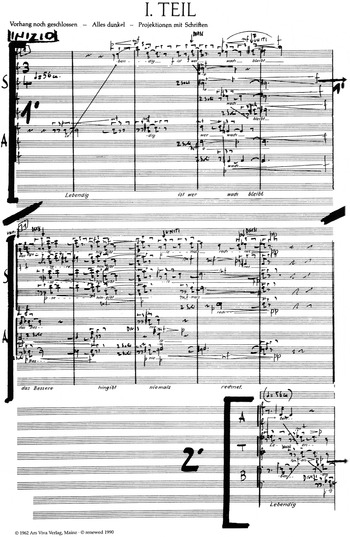
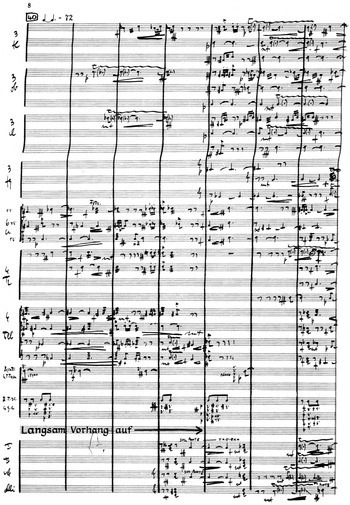
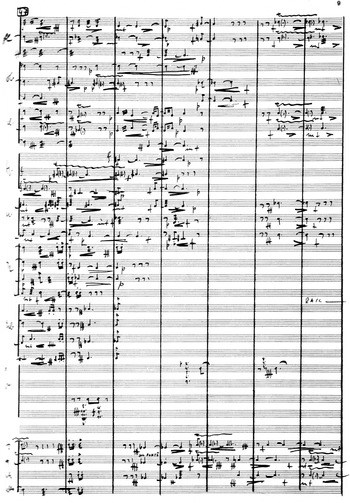
Before the curtain had risen at La Fenice, the audience heard sounds that at first it could not place. Fragments of choral singing emanated from four loudspeaker groups: one on the stage, three others placed around the perimeter of the auditorium. A pre-recorded chorus sang a poem by Ripellino, ‘Vivere è stare svegli’. The sound was distant and ethereal, giving a sense of both temporal and geographical distance, as if to reinforce its coming from elsewhere. The first line was relayed through the onstage speakers; before ‘Vivere’ had entirely faded, its echoing tones cut into new sounds. The transfer of its syllables, ‘Vi-ve-re’, each linked by a series of diagonal lines on the score, reverberated between altos and sopranos, echoing across the theatrical space. This effect was continued at the first climactic moment of unison at bars 3–4, the loudest point so far (mf), with the splintering of syllables between vocal parts (see Ex. 1).
Intolleranza 1960 by Luigi Nono.

Continued

Thus the sounds of the opening chorus immediately surrounded and immersed the audience, something achieved through the use of echo effects. The words may still have been just about decipherable; but at later moments, such as the interlude on bureaucracy and mass entertainment, the noisiness of taped sounds and voices reached a peak and the echoing obscured the words almost completely. Dynamics became part of the drama, a testing of the audible. Indeed, so much of the score was written at fff that the effect almost became routine. If the very first phrase ascended from nothing and descended back to nothing, this mid-point scene reached the other extreme: the sheer loudness made all but a sense of noise inaudible.
These echo effects in Intolleranza – both material and allegorical – can be a starting point for reading the powerful evocations mentioned by the critics. More specifically, echoes offer a way of exploring the historical impulses that make up this particular modernist soundscape. We find reverberations of heritage and history in modernist literature of the period too: Dante resounding in the poetry of Eugenio Montale; Petrarch in that of Salvatore Quasimodo; Pier Paolo Pasolini's references to the tercets of Dante's Divina commedia. What is more, the idea of the echo as an auditory phenomenon has a long Venetian history. Goethe, that eighteenth-century flâneur of Venice, wrote in his travel journal on 7 October 1786 of arranging to hear the ‘famous singing’ of the Venetian gondoliers, who exchange verses of Tasso and Ariosto across the lagoon:
The singer sits on the shore of an island, on the bank of a canal or in a gondola, and hears it. He knows the melody and the words and answers with the next verse. The first singer answers again, and so on. Each is the echo of the other.Footnote 22
Moreover, Venetian echoes articulate the architectural spaces. If today you find yourself in the city and walk towards La Fenice, along the Calle de Veste or the Calle de la Verona, you will hear a steady stream of shuffles and murmurs from unseen people; if you detour and enter an interior such as the Basilica di San Marco, you find yourself at the site of a choral tradition based on this very idea of disembodied echoes, of voices from heaven resounding in liturgical space. Goethe's diary entry on 3 October 1786 mentioned a service in the Conservatorio in which ‘the women were singing an oratorio behind the choir screen; the church was filled with listeners, the music beautiful and the voices superb’.Footnote 23 Here, rather than political authority, such singing is imbued with the authority of the word of God, a music that speaks for those present, singing what they cannot themselves express. As we shall see, the incorporation of this tradition of vocal authority into Nono's own aesthetic raises pertinent questions as to the political effectiveness of Intolleranza.
There are multifaceted echo effects at play in Nono's opera: on the one hand, in the realism of the noisiness; on the other, in a more mechanistic sense, in the way the idea of the echo is used to bring the offstage into the drama. To quote Carolyn Abbate (writing about Monteverdi's L'Orfeo), echoes ‘can “bring the beyond” downstage’.Footnote 24 This expansion of the dramatic realm heightens the sense of an immersive theatrical space in Intolleranza. Interestingly, Abbate also likens echo effects to loudness (the magical effect of transmission over large distances), something referred to in Goethe's diary entry. Thus from the gondoliers' songs to Monteverdi's choruses, the use of echoes to carry voices across the large interior and exterior spaces of Venice has a long heritage.Footnote 25
Disembodiment and its relaying through echo effects in opera is thus nothing new.Footnote 26 What is significant is that the voice heard but not seen is often endowed with ultimate authority; from the perspective of twentieth-century political theory, it becomes the word of the law.Footnote 27 In Intolleranza's first scene, set in the mining village, as the Emigrant sang of his homesickness and desire to return to his place of origin, it was the chorus of miners (relayed through two groups of loudspeakers) that further lent credence to his statements, at times overwhelming his song. They extracted phrases from the Emigrant's line and echoed them back, as in the full choral reiteration of ‘il desiderio di tornare nella mia terra’ (the desire to return to my homeland).Footnote 28 There are numerous references to the power of these choruses in the reception of Intolleranza, often with religious undertones: as Laura Fuà wrote in the Giornale del popolo, ‘In the chorus, which by virtue of megaphones and skilful technical devices invades the scene from every side and oppresses the listening experience with the violence of a judgment of God, Nono has found his most expressive mode’.Footnote 29 The reviews often suggest that it was the unseen choruses and voices that were most overwhelming and intriguing. It was these disembodied voices that were given the lines requiring most reflection: they had poetry rather than dialogue, and they extracted important phrases from the dialogue of others, echoing them back.
These different modes created a rupture in Intolleranza: between the speech uttered by the characters on stage and the language of the choruses on tape. The former were relatively mundane, fragmented, daily utterances; the latter were powerful voices, heard but not seen. However, as the work unfolded, Nono gradually broke down the division: by bringing onstage the offstage drama, he rendered any distinction between them redundant.Footnote 30 The choruses possessed a certain agency in the drama, then, while also occupying a position exterior to it: the sound source could not be seen on stage, yet at times it commented on and intercepted the realism of the onstage drama. The Emigrant existed at the opposite extreme, and was oppressed by onstage physical power (he was at the mercy of the other characters and of the hostile landscape) and offstage vocal power (the taped choruses at times interrupt and engulf his song).Footnote 31
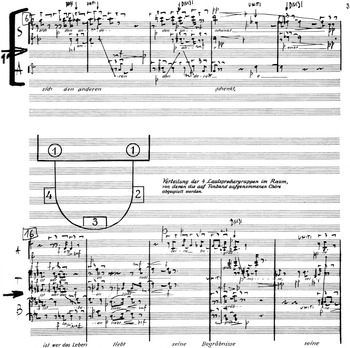
Vocality in Intolleranza was in this way politicized. While the onstage characters were busy articulating their roles in the drama, the offstage choruses suggested how the audience might change their existence (in other words, they conveyed the political meaning of the work). At the very beginning of the opera there was no visual drama. The taped choral rendition of the opening poem suggested what the work was going to be about: the disembodied singing was an example of an acousmêtre commentateur, the disembodied as narrative voice-over. Phrases came from nothing and descended back to nothing. The orchestral interlude that followed and comprised the second half of the introduction broke this initial aura. Indeed this rupture (bars 39–40) was the first point of heightened aural drama, a moment of sheer noise (see Ex. 2). After the close listening required of the opening vocal phrases beginning and ending pianissimo, with their scattered syllables, what followed was brash fff brass and percussion, playing their most clichéd sonic effects: tremolos, crescendos and brazen vibrato. Sheer noise became potent in reinforcing the political resonances.
Intolleranza 1960 by Luigi Nono.

Continued

The debate in L'Unità: Gramsci, television and popularity
Interpretations of noise in the opera were central to the debate that appeared in L'Unità after the premiere.Footnote 32 Manzoni initiated discussion with a series of articles defending Nono's use of modernist musical means to express a political text.Footnote 33 He suggested that controversy about such music was at the centre of the contemporary artist's dilemma: whether it was possible to use modernist language to expose social problems. Several important questions arose in the ensuing exchanges. The first concerned what ‘popular’ might mean in contemporary Italian society, and began by a question in academic Ugo Duse's open letter to Manzoni: ‘Who and what allows us, for example, to define Intolleranza 1960 as a work that is truly popular?’Footnote 34 This can be seen as a reconfiguration of a Gramscian concept: in response to the emerging threat of the consolidation of Fascist power in the period of his leadership of the PCI (1922–6), Gramsci strove to form an alliance of proletariat, peasantry and intellectuals – a ‘national-popular’ alliance.Footnote 35 The critics' concern about the popularity of Intolleranza was, in other words, symptomatic of an unease felt by the PCI that the glorification of intellectuals, whom Gramsci placed at the centre of the party, was failing to engage the majority. For this new cultural party to achieve broader power and appeal, an intellectual from the working class, what Gramsci called an ‘organic intellectual’, was needed to take charge and effect change.
One aspect deemed popular in the debate on Intolleranza was its subject matter.Footnote 36 Echoes of recent events, critics assumed, were enough to make the work appealing to a broader public. The other main reference to popularity was in the espousal of a new theatre that built on the experiences of the mass media. For theatre to become a medium popular enough to challenge the ascendancy of television and other mass entertainment, it had to achieve consensus among a broad populace. Pestalozza wrote in the Socialist daily Avanti! that: ‘The direction of movement, which brings to the theatre the experiences of cinema and television’ eliminates ‘the traditional baggage’ of the theatre.Footnote 37 The underlying message here, and in the general debate on Intolleranza, seems to be that failure to reinvigorate theatre would result in cultural irrelevance, and that the experiences of new media provide a way out of traditional problems.
In this respect the characteristics listed so far as belonging to Intolleranza – disembodiment, echo effects and immersive noise – relate not only to the Italian operatic tradition but also as a response to the cultural dominance of cinema and the increasing ubiquity of television. Disembodiment and sonic effect had become superior techniques with the advent of sound cinema, and Nono was reincorporating and experimenting with the potential of these techniques in the theatre. In this context, Intolleranza marks an interesting turning of the tide in the influence of sound cinema on opera production. Less than a decade before, one strand of postwar Italian cinema – art-house films of the self-styled auteurs who were predominantly leftist – was much influenced by operatic practice (think back to the opening of Luchino Visconti's Senso, for example). Now opera was seeking cultural legitimacy in response to cinema.
One of the main models for Intolleranza was, in this sense significantly, a film: D.W. Griffiths's hit of the silent era, Intolerance (1916). Indeed Nono's first mention of Intolleranza appears in a letter of 25 September 1957 to the German writer Alfred Andersch, announcing that he wanted to compose a work (‘theme: intolerance’) based on Griffiths's film.Footnote 38 The realist concerns of Intolerance are first and foremost with visual spectacle. The director famously wanted to create as ‘realistic’ an impression of Babylon as possible: the outdoor set was the largest Hollywood had thus far created, with numerous chariots, white elephants and thousands of extras. In Nono's use of Intolerance – as well as of more recent sound cinema – to create the sense of immersion and movement (what critic Giorgio Vigolo called ‘an ultra-dynamic audiovisual synthesis’Footnote 39) in audience experience, he turned the techniques back onto the new media as a critique. If such techniques had become both stultifying and intoxicating with the advent of television, then for Nono's critics the importance of Intolleranza lay in its break with the passivity of such new media. One such critic, Pestalozza, praised Intolleranza's directness in numerous articles: writing in Avanti!, for example, he applauded the way ‘the choral elements, the vocal tools, always converge to form a miraculous essential communicativeness’.Footnote 40 There was also a politically darker threat of passivity, one that echoed recent history: the postwar period was dominated by debates about whether the Resistance had been a failed revolution, just as Gramsci claimed of the Risorgimento. The Left asserted that a passive populace had allowed Fascism to gain hegemony, and although the Resistance had played a part in the regime's undoing, it had failed to instigate any lasting change. Nono's evocations of Brechtian epic theatre – Intolleranza's stylized scenery of placards, graffiti and slogans, assaults on the audience through shouting and screaming, the way the music seemed to interrupt and comment on the drama – were continuously employed, never allowing the spectators to become too caught up in what was happening onstage.
Stylized scenography for a politically engaged drama also has precursors in earlier epic theatre, namely the work of Erwin Piscator and the Russian theatre director Vsevolod Meyerhold.Footnote 41 These dramatists also saw theatre as a stage for political ideas and political agitation. As Pestalozza wrote,
Soprattutto notevole, tuttavia, è che l'incontro di Nono con la Laterna magika, si sia compiuto nel proposito di ricuperare e ‘rilanciare’ le prove più avanzate del teatro fra le due guerre, da Piscator a Maierhold a Brecht stesso, per un teatro dunque che nel rompere con lo schema convenzionale palcoscenico-pubblico, faccia il secondo attivo protagonista del primo, vale a dire della dimensione epica a cui questo tende.Footnote 42
[Notable above all, however, is that the collaboration between Nono and the Laterna Magika has been accomplished with a view to reviving evidence of the most progressive theatre between the wars, from Piscator to Meyerhold to Brecht himself – a theatre that in breaking with the conventional scheme of the stage versus audience, figure the latter as an active protagonist among the former.]
The purpose of epic theatre was, in other words, to reinvigorate the social possibilities of stage drama.Footnote 43 Rather than encourage empathy in the audience, the objectification of characters on stage was to elicit a critical response. A layer of artifice should be foregrounded, so that the audience was continually aware that what was being presented was only a representation of reality. Their espousal of a modernist realism – one that allied avant-garde theatrical means with a depiction of contemporary social problems – became a central aesthetic impetus to the postwar generation of young Italian composers.Footnote 44 Press reactions to the perceived rupture between socially realist content and stylized modernist aesthetics in Intolleranza suggest that what Nono was doing was something new: Manzoni, for example, wrote that ‘this score constitutes an interesting experience of the fusion of a text with democratic content […] with music that postulates a very current language and technical construction’. What is more, this put Nono ‘at the centre of a controversy’: to integrate social critique with modernist language was clearly to occupy a contested position.Footnote 45
Noise, onomatopoeia and aural realismo
The second point raised in L'Unità, as well as in the broader reception, is a redefinition of realism. This more general category of realismo sits rather strangely here: whilst the theatrical presentation was decidedly avant-garde, and the content ‘popular’ in its socialism, the music was judged by the critics to be both modernist and realist. This latter, specifically musical realism was achieved by the music often seeming to be on the edge of noise, a condition that has a resonant Italian genealogy. Arman Schwartz has recently discussed the limits of musical verismo in Puccini's Tosca (1900), highlighting the fact that after the opera's premiere, the press complained that the harsh, noisy sound world pushed the definition of music to its limits, into the antimusical.Footnote 46 The aspects denounced in Tosca, the ‘urban soundscape, musique concrète, degree zero of musical meaning’, may have been too much for the audience of 1900, but they were to become prized as the most effective facets of Intolleranza in 1961.Footnote 47 Modernist realism here picks up from the most extreme edges of verismo; as Fuà wrote in the Giornale del popolo,
La partitura è tutta tagliente, aggressiva, ferisce e mozza il fiato; non v'è strumento – soprattutto i corni e le trombe – che non sia usato nella sua espressione fonica meno gradevole. Raffiche di suoni duri, agghiaccianti, rabbiosi, stigmatizzano l'orrore della nostra condizione umana.Footnote 48
[The score throughout is sharp, aggressive and breath-taking; no instrument – especially the horns and trumpets – is not used in its least attractive register. Gusts of harsh sounds, terrifying and furious, condemn the horror of our human condition.]
For Fernando Lunghi, writing in the Giornale d'Italia, ‘there are no melodies, neither humble nor sublime; in compensation there are noises and gunfire’; it was music composed of ‘rarefied sonorities and apocalyptic explosions’.Footnote 49 This continual emphasis on Intolleranza's noisiness – one of the most remarked upon aspects of the opera – is in part because the power and expressive force of its soundworld came to be interpreted as an evocation of Fascist terror and the sounds of war,Footnote 50 as M. Ugolini remarked:
a questi contenuti la musica si adegua creando uno sfondo sonoro imperniato quasi costantemente su congestioni timbriche che riescono a dare con precisione ‘onomatopeica’ una rappresentazione fonica dell'umanità straziata dall'oppressione fascista; così che sembra che nella partitura vengano a confluire le grida dei torturati, il rumore delle armi degli aguzzini, il fragore dei bombardamenti.Footnote 51
[to such content the music adapts, creating a background noise almost constantly centred on closely overlapping timbres, that can give an accurate ‘onomatopoeic’ representation of humanity ravaged by Fascist oppression; so it seems that in the score there is a merging of the cries of the tortured, the noise of the weapons of torturers and the noise of bombing.]
The level of noise is described as a heightened and vivid realism in the soundworld, while the stage action is judged unrealistic in any visual or strictly narrative fashion. The underlying consensus seems to be that this new realism gives the music its political import, despite its absence of broader appeal. Pestalozza writes of Nono that:
tuttavia la sua opera è tanto più interessante e valida, in quanto la si faccia rientrare nella più vasta esigenza di un determinato settore della nostra giovane musica, che di certo costituisce il più serio tentativo in corso per dare forma e sostanza musicali al realismo contemporaneo. Intolleranza 1960 è appunto, in questa direzione un traguardo raggiunto.Footnote 52
[however, his work is all the more interesting and valid, in that it faces the urgent need among a certain sector of our new music, and is certainly the most serious effort under way to give musical shape and substance to contemporary realism. Intolleranza 1960 is precisely, in this sense, a goal achieved.]
Any notion of realism here has clear limits: the production's stylisation, glimpses of the musicians in the pit and the use of a symphony orchestra demarcate an obvious boundary of believability. However, such obvious discrepancies did not seem to matter. What was important was that as soon as the critics heard the noise and aural realism of Intolleranza, they made a connection with Fascism.
The critics' reading of onomatopoeic noise in the premiere thus suggests an understanding of the music as allegorical: the brutality and aural violence, the way the music often tips into overwhelming noise, is used by the critics to remind their readers of recent history.Footnote 53 Such noise was accepted, and indeed emphasized, because it was a reminder of the barbarity of Fascism and the Babel of war; it was meant to shock people out of a neo-bourgeois capitalist existence.Footnote 54 Indeed, the memory and engagement of the listener seemed to be constantly tested as the work progressed through various instances of self-quotation and intervallic relationships.Footnote 55 But if, in his own words, Nono foregrounded the intellectual over the visceral, the critics' reception instead stressed the visceral over the intellectual.Footnote 56 The critical dismissal of the work's intellectual heritage was also evident in responses to the fact that its noisy urbanity, the integration of the sounds of modern warfare and the city within the realm of an aesthetic modernism, was seemingly assimilated into a framework indebted to Schoenberg, namely his Die glückliche Hand (1910–13) and Survivor from Warsaw (1947).Footnote 57 René Leibowitz's L'Artiste et sa conscience (1950), a book widely read by the European avant-garde, had named Survivor from Warsaw as an important example of commitment in music.Footnote 58 What is interesting here is that, as Friedrich Spangemacher put it: ‘When Nono then refers once more explicitly to Schönberg in his first piece of music theatre … he no longer does it with regard to specific questions of compositional technique and structures, but rather with regard to the conception of theatre’.Footnote 59 In other words, Schoenberg provides a model for doing away with the sacralization of opera, for devising a new system of music and text relationships, and for a new concept of sound spatialisation.Footnote 60 In the reception of Intolleranza, however, this use of Schoenberg is seen as incongruous in the context of noise for its own sake. For Duse, Schoenberg transmuted into the postwar milieu resulted in music devoid of any political import – with a stagnant artificiality that hindered Intolleranza's visceral force. In the responses that followed, the consensus was that the use of Schoenberg stopped the music being popular in the sense of having broader appeal. The centrality of this aesthetic modernism in the reconfiguration of realism – the preoccupation with popularity and ultimately the concern with what a postwar Italian culture should be – in the end put too much weight on too-contested a musical language.
Modernist realism: noise and memories of Fascism
A sense of imminence and urgency shadowed these debates: the rhetoric used to discuss the interface between popularity and realism quickly became inflammatory. Indeed, after attending the premiere of Intolleranza Vigolo wrote that ‘What Intolleranza 1960 has is the singular sense of catastrophe we feel about our age’.Footnote 61 That the debate quickly slid into state-of-the-nation questions on the function of art in society shows that there was some sort of crisis amongst the Italian Left, and that the categories of popular and realist, although clearly of great importance, were heavily contested. The nature of this crisis was twofold: on the one hand it concerned the ways that the Left sought to rebuild an Italian postwar culture; on the other, it concerned an increasing anxiety over the use of modernist musical means. Despite these differences, however, there persisted a curiosity about the surface expressive power of the music of Intolleranza as evocative of the political. Amidst the cultural reconstruction and planning for the future of 1961, there remained concern that a recent past must not be forgotten; the opera's politicization of the sounds of war fed into the anxiety of memory through aurality: above all the fact that the horrors of Fascism could be recalled through sound.Footnote 62
This is where praise for Nono's techniques of immersion comes in. The consolidation of American-style capitalism, fuelled by Italy's economic miracle, and the established pre-eminence of cinema and ascendancy of television, provoked an engagement with these mass cultural media within elite genres such as opera. The espousal of this new type of theatre and the assertion of Nono's achievements in literature of the Left suggests an attempt on their part to regain cultural hegemony. An interesting line of influence between opera and film is thus exposed. What is also intriguing is how this influence is centred on reconfigurations of realism. Indeed, realism seems to become the mode par excellence for interpreting Italian modernism. In the earliest decades of the century, we have operatic verismo – its noisiness constrained by a need for bel canto; then followed a filmic visual realism playing on the earlier operatic themes, such as in Roberto Rossellini's Roma città aperta (1945). Now, finally, we have music theatre going beyond operatic verismo and turning neorealist film on its head – a realismo of sheer noise, with just enough bel canto to make sure that culture still triumphs over barbarity.Footnote 63
Rather than hunt for a definition of realism, this article has suggested some of the impulses that the need for an aesthetic realismo show up. With Intolleranza, the importance of realism feeds into the topos of memory: the memory of both the recent world war and Fascism; the memory that Nono in turn uses as a critique of class oppression in 1961. Intolleranza's undoing is that this musico-political project was achieved through modernist realism, the allusive style of Joyce's Ulysses, Eliot's The Waste Land and Woolf's Jacob's Room – works that resound with elitist European heritage. Just as a full understanding of the resonances of The Waste Land arguably requires some knowledge of Shakespeare, Chaucer, Ancient Greek, the Old Testament and late nineteenth-century music aesthetics, so Intolleranza demands an acquaintance with the previous fifty years of Western high-modernist art music, literary models such as Kafka, historical revolutionary theatres such as that of pre-Soviet Russia, and the Venetian choral heritage. The problem with Intolleranza is that the need for understanding its allusions and allegories, for multiple re-hearings and knowledge of its intellectual history, seems to jar with its supposed political import. Ultimately, perhaps, it matters little whether the references are grasped the first time around. Perhaps that is what the noisiness is there for.
The production and reception (particularly in L'Unità) of Intolleranza, show more than anything the class-ridden antagonism that blighted the postwar Italian landscape. The historical advocates of the working class, the intellectual Left, could not keep up with the burgeoning mass media. The crisis of the Left was in part a realisation of increasing obsolescence. In this sense, Intolleranza provides a reminder of high modernity in its death throes, of a modernist realism that both goes beyond verismo and neorealism while inheriting their problems. The work also marks a transition to the capitalist Italy of la bella figura, of the empty hedonism of Dino Risi's Il sorpasso (1962) and, particularly in Venice, of museum-style tourism. The echoes that resounded at the premiere of Intolleranza, of opera history and Venetian heritage, were in other words a veil of artificiality covering the realities onstage, an artificiality needed for reality to become realismo. By the time the Emigrant was washed away, stripped of his bare life and devoid of a voice in the noise that marked his demise, any reality that adhered to his plight was already becoming fiction.