INTRODUCTION
Semantic memory is the cognitive system in which the meaning of words and the knowledge of the relationships among concepts are stored. A disorder of semantic memory has been repeatedly observed in patients with schizophrenia, suggesting abnormality in the way semantic knowledge is organized (Doughty, Done, Lawrence, Al-Mousawi, & Ashaye, Reference Doughty, Done, Lawrence, Al-Mousawi and Ashaye2008; Green, Done, Anthony, McKenna, & Ochocki, Reference Green, Done, Anthony, McKenna and Ochocki2004; Moelter, Hill, Hughett, Gur, Gur, & Ragland, Reference Moelter, Hill, Hughett, Gur, Gur and Ragland2005; Rossell & David, Reference Rossell and David2006). These disorders are assumed to underlie broader cognitive abnormalities, particularly in the domains of language and reasoning, and to contribute to the formation of certain clinical symptoms. Enhanced semantic priming, which suggests greater spread of activation in the semantic network, has been found to be associated with thought disorder in schizophrenia patients (Kiefer, Martens, Weisbrod, Hermle, & Spitzer, Reference Kiefer, Martens, Weisbrod, Hermle and Spitzer2009; Kreher, Holcomb, Goff, & Kuperberg, Reference Kreher, Holcomb, Goff and Kuperberg2008; Moritz, Woodward, Küppers, Lausen, & Schickel, Reference Moritz, Woodward, Küppers, Lausen and Schickel2002; Pomarol-Clotet, Oh, Laws, & McKenna, Reference Pomarol-Clotet, Oh, Laws and McKenna2008). Thought disorder has also been associated with impaired semantic fluency (Goldberg, Aloia, Gourovitch, Missar, Pickar, & Weinberger, Reference Goldberg, Aloia, Gourovitch, Missar, Pickar and Weinberger1998; Stirling, Hellewell, Blakey, & Deakin, Reference Stirling, Hellewell, Blakey and Deakin2006), as have delusions, which have in addition been associated with the production of category inappropriate words (Rossell, Reference Rossell2006).
It has been suggested that semantic memory dysfunction in patients with schizophrenia comprises overinclusive thinking, characterized by vagueness of conceptual boundaries. Chen, Wilkins, & McKenna (Reference Chen, Wilkins and McKenna1994) explored this abnormality using a task in which participants were required to judge whether presented words were members of given categories. The words differed in their degree of semantic relationship to the category: they were either typical of the category (e.g., robin, for the category BIRD), atypical (turkey), borderline, that is, with equal probability of being classified as within or outside the category, (penguin); outside the category but related to it, (aeroplane); or unrelated to it, (bell). Both schizophrenia patients and healthy controls required longer judgment times for atypical than for typical exemplars, and even longer judgment times for the borderline words. When the words were not members of the category but were related to it, healthy controls were faster in making a category judgment than for the borderline words. Schizophrenia patients by contrast demonstrated even longer judgment times for the outside-but-related than for the borderline words. This suggests that, while the healthy controls rapidly classified the outside-but-related words as outside the category, the patients hesitated as to whether these words were category members or not. They seemed to process the outside-but-related words as if they were borderline for the given category. In addition, patients accepted more borderline and outside items as category exemplars than did healthy controls. The extent of the semantic category broadening, as assessed by the response time difference between related and borderline conditions, was not associated with either hallucinations, delusions, positive formal thought disorder, global negative symptoms, alogia, or depression. Elvevåg, Weickert, Wechsler, Coppola, Weinberger, and Goldberg (Reference Elvevåg, Weickert, Wechsler, Coppola, Weinberger and Goldberg2002) used the same procedure as Chen et al. (Reference Chen, Wilkins and McKenna1994) but failed to replicate the finding of more inclusive semantic categories in patients.
Broadening of semantic boundaries might also be reflected by the production of exemplars that are not closely related to the semantic categories. Few data regarding this issue are available so far. Elvevåg, Storms, Heit, & Goldbeg (Reference Elvevåg, Storms, Heit and Goldberg2005) reported that the exemplars produced by a sample of schizophrenia patients were fairly similar in content and structure to those produced by a healthy control group. They concluded that both groups were similar in terms of the structure of semantic knowledge. Using a nonclinical sample, Kiang and Kutas (Reference Kiang and Kutas2006) administered a task that required participants to produce as many exemplars as possible from four semantic categories. They observed that higher schizotypy scores were associated with more atypical responses for the category “Fruits.” All in all, the issue of overinclusive thinking in schizophrenia, and its association with clinical symptoms, deserves more investigation.
Semantic abnormality may be associated with negative symptoms. We have observed in previous research that certain negative symptoms are unexpectedly associated with decreased rates of various cognitive errors derived from memory tasks. This includes commission errors, notably free-recall intrusions (Brébion, Gorman, Amador, Malaspina, & Sharif, Reference Brébion, Gorman, Amador, Malaspina and Sharif2002; Brébion, David, Bressan, Ohlsen, & Pilowsky, Reference Brébion, David, Bressan, Ohlsen and Pilowsky2009) and false recognition of words and pictures (Brébion et al., Reference Brébion, Gorman, Amador, Malaspina and Sharif2002; Brébion, David, Jones, & Pilowsky, Reference Brébion, David, Jones and Pilowsky2005; Brébion, David, Ohlsen, Jones, & Pilowsky, Reference Brébion, David, Ohlsen, Jones and Pilowsky2007; Brébion, Ohlsen, Pilowsky, & David, Reference Brébion, Ohlsen, Pilowsky and David2008). Inverse associations between intrusions and negative symptoms have been reported by other groups (Heinrichs & McDermid Vaz, Reference Heinrichs and McDermid Vaz2004; Turetsky et al., Reference Turetsky, Moberg, Mozley, Moelter, Agrin and Gur2002). In our data, negative symptoms were also associated with fewer errors in remembering the source of events. More specifically, they were associated with fewer errors in remembering by whom (Brébion et al., Reference Brébion, Gorman, Amador, Malaspina and Sharif2002) and in which list (Brébion, Amador, Smith, Malaspina, Sharif, & Gorman, Reference Brébion, Amador, Smith, Malaspina, Sharif and Gorman1999; Brébion, David, Jones, Ohlsen, & Pilowsky, Reference Brébion, David, Jones, Ohlsen and Pilowsky2007) the target items were produced. The symptoms specifically involved in these inverse associations with various types of memory error were those that reflected lack of emotion or social interactions (anhedonia, alogia, lack of spontaneity, emotional withdrawal, blunted affect, social withdrawal). By contrast, other negative symptoms (e.g., avolition, difficulty with abstract thinking, stereotypy, disorders of attention) were unrelated to these errors.
This inverse relationship has thus been observed, fairly consistently, with two categories of memory errors, namely commission errors and source memory errors. Such an association, unexpected and counterintuitive, is difficult to interpret and warrants more investigation and characterization. It would be worth determining whether these negative symptoms are specifically related with decreased rates of memory errors, or whether the relationship also applies to other types of cognitive abnormality not derived from a memory task, such as abnormality in semantic organization.
In this study we used a task in which participants were required to provide one exemplar from several target categories. The typicality of the instances produced by the subjects was rated. This procedure presents the advantage of yielding a quantitative measure, which lends itself to correlational studies. We expected the patients with schizophrenia to provide responses more atypical than those of a healthy control group. We also expected atypicality to be associated with thought disorganization and, possibly, delusions. Finally, we sought to determine whether the alleged abnormality in schizophrenia patients is inversely associated with certain negative symptoms, that is, affective flattening, alogia and anhedonia. Following our previous results, we did not expect any association with avolition and disorders of attention.
METHOD
Subjects
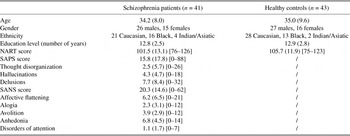
Forty-one patients with schizophrenia (8 inpatients) were recruited from the South London and Maudsley NHS Foundation Trust, London (see Table 1 for sociodemographic and clinical information). Diagnosis was made on the basis of DSM IV criteria by two experienced psychiatrists who used clinical interview, as well as patients’ history and chart review, to reach a consensus. All but three patients were on daily antipsychotic medication.
Sociodemographic data for the schizophrenia patients and healthy control subjects, and clinical data for the schizophrenia patients (mean, standard deviation and range)

Note
NART = National Adult Reading Test; SAPS = Scale for the Assessment of Positive Symptoms; SANS = Scale for the Assessment of Negative Symptoms.
Forty-three healthy control subjects were recruited by local advertisements, and were screened by telephone interview to rule out any current or recent psychiatric history. The two groups were not significantly different with respect to age, gender distribution, ethnicity, education level, and verbal IQ as assessed by the National Adult Reading Test (NART), which provides an estimation of premorbid IQ (p > .10 for all comparisons). Ethical approval for the study was obtained from the local hospital Research Ethics Committee. After a full explanation of the study, subjects provided written informed consent to participate.
Clinical Ratings
Clinical assessments were conducted by psychiatrists. Videotape training in the relevant clinical rating scales was undertaken to achieve over 90% interrater agreement in assigning subscale score. Positive symptoms were assessed using the Scale for the Assessment of Positive Symptoms (SAPS). A “thought disorganization score” was tallied by summing all subscores from the thought disorganization scale. Only nine patients presented with significant thought disorganization (“thought disorganization score” > 2). A “hallucination score” and a “delusion score” were tallied as well, by summing the subscores for all types of hallucination, and for all types of delusion. Negative symptoms were assessed using the Scale for the Assessment of Negative Symptoms (SANS), which includes affective flattening, alogia, avolition, anhedonia, and disorders of attention. A score for each negative symptom was computed by summing all the subscale scores. Depression severity was assessed using the Montgomery and Asberg Depression Rating Scale (MADRS; Montgomery & Asberg, Reference Montgomery and Asberg1979). Clinical symptom assessment and cognitive testing were conducted on the same day for most of the patients, and in all cases within a week of each other. The psychiatrists were blinded to cognitive results during clinical assessment. The experimenter (GB) was blinded to patients’ symptoms during the administration of the task.
Material and Procedure
The task was designed as part of a reality-monitoring study aimed at investigating confusion between mental imagery and perception. The entire procedure, as well as the results of the reality-monitoring task, is described in Brébion et al. (Reference Brébion, Ohlsen, Pilowsky and David2008). This article focuses on the degree of typicality of the patients’ responses.
Sixteen categories from the Battig and Montague’s (Reference Battig and Montague1969) set were selected (Alcoholic beverage, Animal, Article of furniture, Country, Flower, Fruit, Nonalcoholic beverage, Part of body, Part of building, Profession, Sport, Tool, Toy, Tree, Type of vehicle, Vegetable). Two common instances from each category were chosen. The experimenter indicated the name of a category (e.g., “Fruit”), and briefly presented two cards displaying the instances (i.e., PLUM and GRAPES). The subject was required to provide a third instance of the category. The experimenter wrote down the subject’s responses. The two instances from each of the 16 categories were thus presented, the category order having been randomized for each subject.
The typicality of each of the 16 items provided by the subject was rated according to Battig and Montague’s (Reference Battig and Montague1969) norms, wherein a higher score is given for a more atypical response. For example, if the subject’s response for the category FRUIT was “apple,” the obtained score was 1; if the response was “kumquat,” the score was 31. If the category instance provided by the subject was outside the category, or so atypical that it was not listed in the provided norms, the score granted for this response was the number next to the highest available number for the given category. For example, the response “olive” for the category FRUIT would be given a score of 32. An averaged typicality score was computed for each subject. For the category exemplars provided by the experimenter, the average typicality was 7.4 (SD = 6.7).
The associations between typicality score and clinical symptoms were investigated by means of regression analyses including each positive, then each negative symptom, alternately. The NART score was entered in the regression, to control for verbal IQ. The MADRS score was also entered because depression might influence the production of more or less typical category instances. Besides, certain negative symptoms overlap with depressive symptoms (e.g., blunted affect, social avoidance, disturbance of volition, psychomotor retardation).
RESULTS
All measures followed a normal distribution except the thought disorganization, alogia, and disorders of attention scores. These scores were normalized by square root transformation before data analysis.
Group Comparisons
A regression analysis involving all participants was conducted on the typicality score, with diagnosis, NART score, age, sex, and education level entered simultaneously as predictors. The purpose of this analysis was to test the hypothesis that the patients differed from the healthy controls in the typicality of their response. As expected, diagnosis made a significant contribution to the typicality score (β(78) = .34; p < .001). Examination of the scores indicates that the category examples produced by the patients were more atypical than those produced by the healthy controls (patients: m = 12.1; SD = 4.6; range = 5.8–22.7; healthy controls: m = 8.9; SD = 3.0; range = 3.0–16.8; effect size d = .82). The NART score also made a significant contribution to the typicality score (β(78) = −.32; p < .005). The direction of the association shows that higher verbal abilities were associated with more typical responses. None of the other predictors was significant.
We then recomputed the regression analysis separately in each group after removing diagnosis from the predictors to determine whether the contribution of the NART score was observed similarly in both groups. NART score contributed significantly to the typicality of the response in the patient group (β(36) = −.42; p < .01). However, no association with NART score emerged in the healthy control group (β(38) = −.09; p = .66).
Associations Between Atypicality and Positive Symptoms
Regression analyses were conducted on the typicality score in the patient sample. They included the thought disorganization score, hallucination score, and delusion score, alternately, along with the MADRS and NART scores. Results are presented in Table 2. Contrary to our expectations, the thought disorganization score was unrelated to the typicality score. The hallucination and delusion scores were also unrelated to it.
Regression analyses in the 41 schizophrenia patients

Note
Associations of the typicality score with positive symptoms, depression, and NART score (β coefficient and p value). MADRS = Montgomery and Asberg Depression Rating Scale; NART = National Adult Reading Test.
Associations Between Atypicality and Negative Symptoms
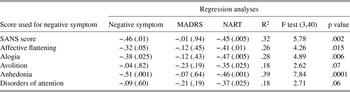
A regression analysis was conducted on the typicality score in patients, first involving the SANS score, along with the MADRS and NART scores. Results are presented in Table 3. The SANS score contributed significantly to the typicality score. The direction of the association indicated that higher ratings of negative symptoms were associated with more typical responses, as expected.
Regression analyses in the 41 schizophrenia patients

Note
Associations of the typicality score with negative symptoms (global score or individual symptoms), depression, and NART score (β coefficient and p value). MADRS = Montgomery and Asberg Depression Rating Scale; NART = National Adult Reading Test; SANS = Scale for the Assessment of Negative Symptoms.
Our hypothesis was that only certain negative symptoms are involved in the inverse association with the SANS score. We, therefore, conducted further regression analyses, this time using each negative symptom alternately (see Table 3). In agreement with our expectations, affective flattening, alogia, and anhedonia made significant negative contributions to the typicality score, indicating that higher ratings of these symptoms were associated with more typical responses. Avolition and disorders of attention did not make any contribution to the typicality score.
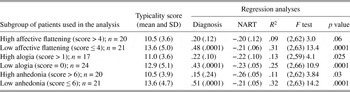
To investigate further the finding of an inverse association with affective flattening, alogia and anhedonia, we attempted to determine whether the patients who presented these symptoms demonstrated some atypicality, although reduced, or whether their response was normalized. This was achieved by contrasting these patients with the healthy control group. The patients were split along the median of each of the relevant negative symptoms to keep a somewhat equivalent statistical power for all subgroup comparisons. Regression analyses were conducted on the typicality score. They included the 43 healthy control participants, along with each subgroup of patients presenting with either high or low ratings of each of the three target negative symptoms, alternately. Diagnosis and NART scores were entered as predictors. Results are presented in Table 4.
Regression analyses involving the 43 healthy controls, and subgroups of patients with high or low ratings of affective flattening, alogia, or anhedonia

Note
Associations of the typicality score with diagnosis and NART score (β coefficient and p value). NART = National Adult Reading Test.
The regression analyses that included the subgroups of patients with high ratings of either affective flattening, alogia, or anhedonia revealed no significant effect of diagnosis. This indicates that these patients were not significantly different from the healthy controls in the typicality of their response. By contrast, the patients presenting with no or low ratings of these symptoms produced highly significantly more atypical responses than the healthy controls.
DISCUSSION
Various types of semantic memory disorder have been established in patients with schizophrenia (Doughty & Done, Reference Doughty and Done2009). It was suggested that these patients demonstrate overinclusive thinking, characterized by broadening of category boundaries. Chen et al. (Reference Chen, Wilkins and McKenna1994) observed that schizophrenia patients process words that are outside target semantic categories but related to them as if they were borderline members of these categories; they also include more borderline and outside category words as definite members of given categories than do the healthy controls. We investigated semantic memory organization in schizophrenia through a different paradigm consisting of production of category exemplars. In line with our expectations, the exemplars provided by our group of patients were more atypical than those provided by the healthy control group. Our data suggest that, when patients are required to provide members from a category with few constraints, they choose items that are more distant from the core concept than do healthy individuals. This abnormality might also exist in schizotypy, since Kiang and Kutas (Reference Kiang and Kutas2006) reported that schizotypy was associated with atypicality in generating “Fruit” exemplars. Our results corroborate those of Chen et al. (Reference Chen, Wilkins and McKenna1994), although by means of a different procedure. Both studies converge to suggest broadening of semantic category boundaries in schizophrenia.
Several studies have reported an association between specific types of semantic impairment—namely, enhanced semantic priming and poor semantic fluency—and thought disorders. In our data, the atypicality of response production was unrelated to clinical ratings of thought disorganization. The association, therefore, does not seem to extend to this index of semantic category structure. However, the low prevalence of thought disorganization in our sample prevents us from drawing strong conclusions. It is also possible that abnormality in thought disordered patients manifests itself by increased rapidity in the production of category exemplars, due to greater spread of semantic activation, rather than by increased atypicality of the exemplars.
Our previous work has consistently revealed that certain negative symptoms are associated with fewer commission errors in memory tasks, and fewer source memory errors. More specifically, affective flattening was associated with less confusion between self- and externally generated items (Brébion et al., Reference Brébion, Gorman, Amador, Malaspina and Sharif2002). Both affective flattening and anhedonia were associated with fewer intrusions in free recall (Brébion et al., Reference Brébion, Amador, Smith, Malaspina, Sharif and Gorman1999, Reference Brébion, David, Bressan, Ohlsen and Pilowsky2009), fewer false recognitions of words and pictures (Brébion et al., Reference Brébion, Amador, Smith, Malaspina, Sharif and Gorman1999, Reference Brébion, David, Jones and Pilowsky2005, Reference Brébion, Ohlsen, Pilowsky and David2008; Brébion, David, Ohlsen, et al., Reference Brébion, David, Jones, Ohlsen and Pilowsky2007) and fewer list errors (Brébion, David, Jones, et al., Reference Brébion, David, Ohlsen, Jones and Pilowsky2007). Turetsky et al. (Reference Turetsky, Moberg, Mozley, Moelter, Agrin and Gur2002) similarly observed that affective flattening in a schizophrenia sample was associated with fewer intrusions. Alogia has shown less consistent inverse associations with memory errors, but has been found to be associated with decreased rate of false recognitions (Brébion et al., Reference Brébion, Amador, Smith, Malaspina, Sharif and Gorman1999). We investigated whether the association pertains restrictively to memory errors, or whether affective flattening, alogia, and anhedonia are similarly associated with reduced semantic abnormality as indexed by the typicality score. Regression analyses controlling for the potential confounds of depression and verbal IQ revealed that these three symptoms were indeed associated with production of more typical category instances. Chen et al. (Reference Chen, Wilkins and McKenna1994) found the extent of semantic category broadening to be unrelated to alogia and to a global score of negative symptoms. Their quantitative measure (response time difference between two conditions) might capture a different aspect of the phenomenon of overinclusive thinking than measuring by response atypicality. In our data, regression analyses contrasting subgroups of patients with healthy controls indicate that the patients presenting with affective flattening, alogia or anhedonia were not atypical in their responses. So, these symptoms appear to be associated with a normalization of this semantic memory function. By contrast, avolition and disorders of attention were unrelated to atypicality, as they were unrelated to various types of memory error in our previous research.
Our data thus evince still another type of cognitive aberration which is inversely associated with certain negative symptoms. With regard to the previously studied rate of memory errors, one possible explanation for this inverse association is that these negative symptoms may strengthen the inhibitory processes that prevent commission errors (Heinrichs & McDermid Vaz, Reference Heinrichs and McDermid Vaz2004). This may result in fewer intrusions and false recognitions in memory tasks. However, the spontaneous production of category exemplars does not obviously rely upon inhibition processes. We could tentatively propose that cued word production begins with a large corpus of potential items, followed by inhibition of all but the most appropriate. Such a process would not appear to be efficient or parsimonious, but could potentially account for the link between negative symptoms and more typical exemplars.
Another notable finding in our data is the negative association between NART and typicality scores in the patient group. Higher verbal abilities were associated with more typical responses. This observation suggests that high verbal abilities, or high premorbid IQ, might be protective of the type of semantic abnormality which leads to the production of atypical responses.
An important limitation of our study is that the norms used for the rating of response typicality were old. This might have had some impact on the results. Besides, few of the patients presented with significant thought disorganization, one of the clinical symptoms of interest. Lastly, we cannot rule out that some of the participants from our healthy control group presented schizotypy, which might have influenced the typicality of their response.
Atypicality in the production of category members, which is easily elicited, might be a cognitive marker of schizophrenia. This cognitive abnormality was unrelated to thought disorganization in our data, but may underlie various types of cognitive dysfunction. Further studies may explore the extent to which providing a strategy or explicit instructions to produce an exemplar as opposed to any within-category item, is able to reduce the atypicality of the response.
ACKNOWLEDGMENTS
The first author was funded by grants from the Bial Foundation, the British Academy, the National Alliance for Research on Schizophrenia And Depression, and the Wodecroft Foundation. The authors declare no conflict of interest. We are sad to report the untimely death of Professor Pilowsky.