INTRODUCTION
In the North Sea, observations of Caryophyllia smithii (Stokes & Broderip, 1828) are mostly limited to the north-east coast of the United Kingdom including the Shetland and Orkney islands (Wilson, Reference Wilson1975; de Kluijver, Reference De Kluijver1993; UK National Biodiversity Network: Joint Nature Conservation Committee, 2010a, b; UK National Biodiversity Network: Marine Biological Association, 2010a, b; UK National Biodiversity Network: Marine Conservation Society, 2010; UK National Biodiversity Network: Porcupine Marine Natural History Society, 2010; UK National Biodiversity Network: Scottish Natural Heritage, 2010; VLIZ Belgian Marine Species Consortium, 2010). Caryophyllia smithii has also been reported from offshore installations in the northern North Sea (Guerin, Reference Guerin2009). Further to the east it occurs on the south-west coast of Norway (UK National Biodiversity Network: Joint Nature Conservation Committee, 2010b; Natural History Museum University of Oslo: Norwegian Biodiversity Information Centre, 2015). South of the North Sea it has been reported at coastal locations with the most eastern observations on wrecks in the English Channel near Eastbourne (UK National Biodiversity Network: Marine Conservation Society, 2010).
The life cycle of C. smithii includes a larval planktotrophic stage with a duration of 8–10 weeks (Tranter et al., Reference Tranter, Nicholson and Kinchington1982). During this time, the released larvae float freely in the water column and are transported in the direction of net water movement, which is driven by tidal currents and wind (Holmedal & Wang, Reference Holmedal and Wang2015). These residual currents in the North Sea range between 0.02 and 0.08 cm s−1 (Prandle, Reference Prandle1984; Thorpe, Reference Thorpe2012). The potential for distribution is high for species with a long planktonic larval stage (Kinlan et al., Reference Kinlan, Gaines and Lester2005) because the dispersal distance is correlated to the duration of the free-floating stage (Shanks, Reference Shanks2009). However, C. smithii needs hard substrata to attach to at the end of its planktonic stage (Best, Reference Best1968; Wilson, Reference Wilson1976), for example in the form of exposed rocks (Hiscock & Howlett, Reference Hiscock, Howlett and Drew1976). The bottom of the central southern North Sea is mostly composed of muddy and fine sand (Duineveld et al., Reference Duineveld, Künitzer, Niermann, De Wilde and Gray1991), which is unsuitable for attachment by C. smithii larvae. To distribute itself to central southern North Sea locations, C. smithii would need locations with alternative hard substrata present on the sand bottom. These are provided by artificial structures, as shown by Guerin (Reference Guerin2009) who observed C. smithii at several offshore oil production platforms in the northern North Sea. Species with planktonic stages like C. smithii may use these hard substrata as stepping stones, whereby the next generation continues the expansion, depending on current direction, mixing of the water column and larval behaviour.
To date, the coral has not been reported from far offshore locations in the North Sea south of 57.7°N. Here we report the first sighting of C. smithii on a shipwreck on the Dogger Bank, central southern North Sea.
MATERIALS AND METHODS
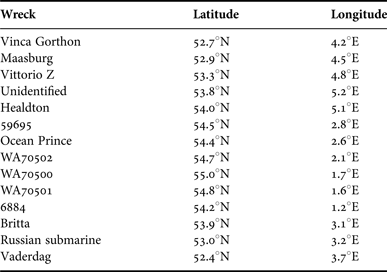
From 4 to 13 September 2014 a group of scuba divers visited 14 wrecks in the Dutch and British part of the southern North Sea (Table 1). During this expedition a wreck of an unknown steam ship on the Dogger Bank was visited. The wreck was found on side scan sonar images during an archaeological assessment of geophysical data acquired for the Environmental Impact Assessment of the Forewind Creyke Beck wind farm development (Wessex Archaeology, 2013) with number WA70500. The wreck is located at 55.037°N 1.703°E, approximately 200 km east of Newcastle upon Tyne, on a sandy bottom in a maximum water depth of 33 m.
Names, numbers or descriptions and positions (WGS84) of the wrecks visited during the diving expedition.

The scuba divers performed a visual biodiversity inventory for a wide range of species and collected specimens for later identification, as described in Schrieken et al. (Reference Schrieken, Gittenberger, Coolen and Lengkeek2013). A total of two dives were carried out on wreck WA70500 on 10 September 2014: one during daylight and the other at night to a maximum depth of 32 m for 50 and 41 min, respectively.
Inventory of previous reports
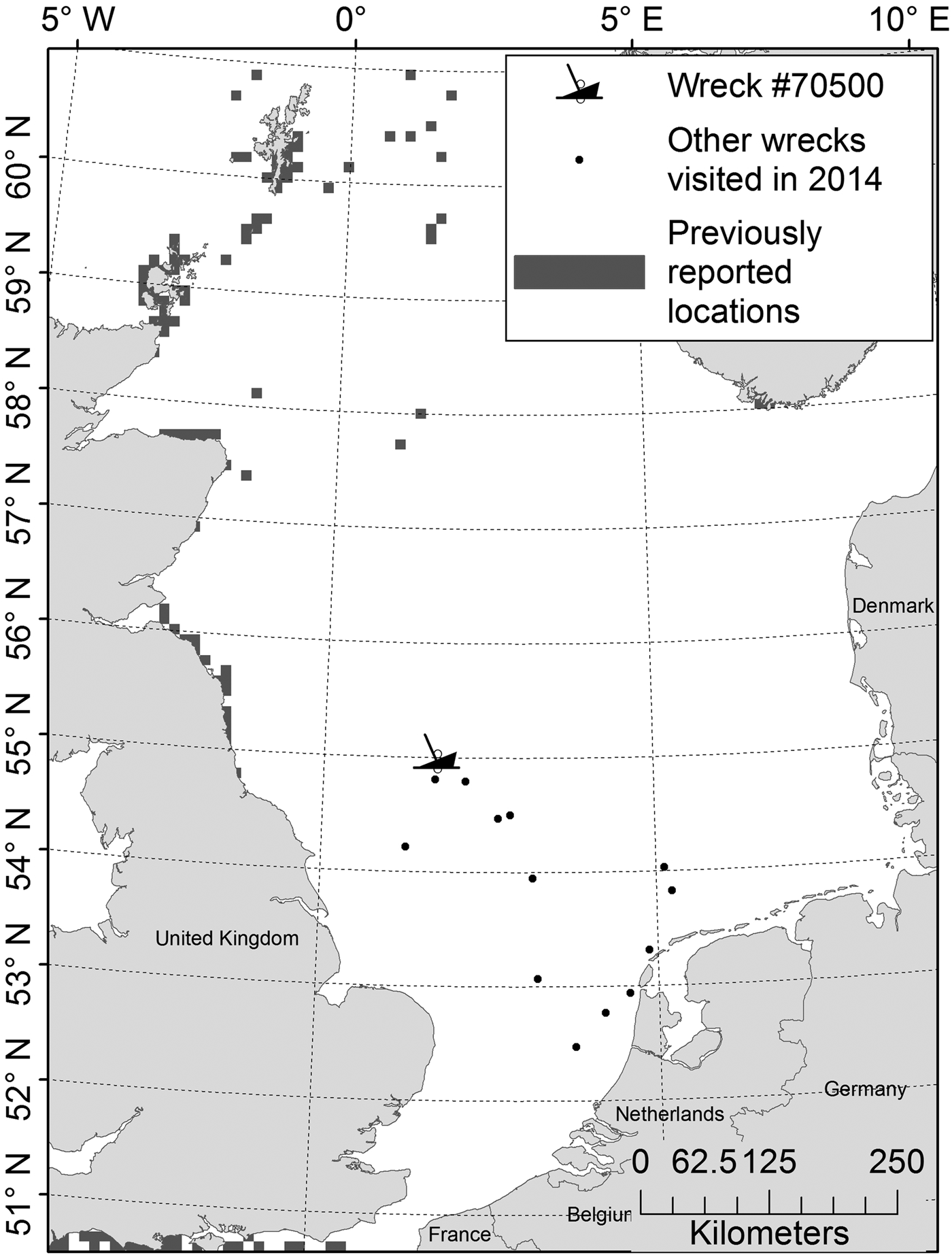
A literature search was performed to assess the known distribution of Caryophyllia smithii in the North Sea between 50.5° and 61° north, 3.5° west and 10.5° east, ignoring locations on the west of the British Isles. Descriptive locations without coordinates were given an estimated coordinate in the approximate centre of the described location. In total, 429 records were found in the North Sea and 469 in the English Channel, the oldest account dating back to 1828. Records with a coordinate precision of less than 10,000 m were excluded. All remaining records are included in Figure 1.
Locations of previously reported (as compiled from literature) and new sightings of Caryophyllia smithii (Stokes & Broderip, 1828) on the WA70500 wreck. Reports west of 3.5°W and west of the British Isles were excluded.
RESULTS
During the dives on the WA70500 shipwreck, two pseudocolonies (with two and three individuals per pseudocolony) and two solitary individuals were observed. The corals were all fixed to different vertical steel or stone parts of the wreck, with varying distances between them. Photographic and video equipment were used to document live specimens in their natural habitat. One specimen was collected for confirmation in the IMARES Wageningen UR benthic laboratory and stored in a borax buffered formaldehyde solution (4%) in the IMARES Wageningen UR reference collection (number 2014IRC050001). For identification, the works by Manuel (Reference Manuel1988) and Cornelius et al. (Reference Cornelius, Manuel, Ryland, Hayward and Ryland1995) were used. The specimen was confirmed to have a solid and imperforate substance of corallum, with pali present and tentacles terminating in knobs (Figure 2).
In situ top view photograph of Caryophyllia smithii (Stokes & Broderip, 1828) on wreck WA70500. The terminal knobs, which are an important diagnostic feature, are clearly visible.
DISCUSSION
The observation of Caryophyllia smithii on the Dogger Bank shows that the distribution of this coral is wider than previously reported. Furthermore, this is the first report of any hard coral in the central southern North Sea because all previous offshore observations of hard coral were from northern North Sea locations (Wilson, Reference Wilson1979; Bell & Smith, Reference Bell and Smith1999; Roberts, Reference Roberts2002; Gass & Roberts, Reference Gass and Roberts2006; Guerin, Reference Guerin2009). Several other observations of C. smithii have been reported from shipwrecks in British waters (Hiscock, Reference Hiscock1980; Hiscock et al., Reference Hiscock, Sharrock, Highfield and Snelling2010; UK National Biodiversity Network: Marine Conservation Society, 2010), demonstrating that the species favours steel substrata. With its bright colours, C. smithii is a conspicuous species, easy to find for the trained observer. The untrained observer, however, may mistake it for a species belonging to other Hexacorallia groups, such as the Actiniaria, resulting in an underestimation of the number of earlier identifications.
Hiscock & Howlett (Reference Hiscock, Howlett and Drew1976) report low abundance of C. smithii at locations with low tidal current strength and high sedimentation. On the Dogger Bank the currents can be weak, increasing sedimentation (Kröncke & Knust, Reference Kröncke and Knust1995). This would decrease the colonisation potential of C. smithii on the Dogger Bank. Densities reported under ideal circumstances by Hiscock & Howlett (Reference Hiscock, Howlett and Drew1976) are up to 482 individuals m–2, a number far exceeding the few individuals we have observed.
From all current and previous observations, it is clear that C. smithii is able to colonise artificial reefs in temperate waters. Even where natural reefs are lacking, the coral is able to expand its distribution by using the wrecks scattered on the sea bottom as stepping stones. With a planktonic stage of 8–10 weeks (Tranter et al., Reference Tranter, Nicholson and Kinchington1982), C. smithii can easily disperse over large distances. Prandle (Reference Prandle1984) observed the maximum residual currents in the North Sea to be less than 0.06 m s−1 and Thorpe (Reference Thorpe2012) communicated average flows between 0.02 and 0.08 m s−1. Using these extremes in an extremely simplified estimate and combining them with a free-floating stage of 8–10 weeks, C. smithii larvae may travel between 96 and 480 km. The offshore currents in the area of interest are parallel to the British coast (Thorpe, Reference Thorpe2012) and a source population of the specimens on wreck WA70500 should be sought in a northerly direction. The nearest known observation of C. smithii in that direction is over 320 km away at the Andrew oil platform (Guerin, Reference Guerin2009). Although this is within the potential dispersal range of C. smithii larvae, Shanks (Reference Shanks2009) has shown that dispersal models tend to overestimate the dispersal distance of species with a long planktonic larval stage. Therefore, it seems likely that the observed specimens originated from a population located between the WA70500 wreck and the Andrew platform. This source is likely to be one of the many platforms and shipwrecks present in the central North Sea. Over 27,000 wrecks were present in the area we had specified for our inventory of earlier observations of C. smithii (Anonymous, 2015) and the potential for further distribution is large. In the near future, the development of large offshore wind farms throughout the North Sea may further facilitate the stepping stone effect for species like C. smithii. However, because the WA70500 shipwreck was identified as a steam ship, it is very likely that this wreck is much older than the expected life span for any planned or constructed wind farm. Although C. smithii does inhabit offshore installations in the northern North Sea (Guerin, Reference Guerin2009), it is unknown if the species will also colonise the future offshore structures on the Dogger Bank. We found the species on several locations on the wreck and we expect the find was not incidental and that it is possible that C. smithii inhabits other shipwrecks in this area as well; however, C. smithii was not encountered on the two nearby wrecks we investigated on the Dogger Bank. The exact distribution of this species remains unclear.
CONCLUSION
We observed several live specimens of Caryophyllia smithii on an unidentified shipwreck on the Dogger Bank. This is the first offshore observation of any hard coral in the central southern North Sea. The find of this coral suggests that species with long free-floating larval stages are capable of extending their range using artificial structures such as wrecks, oil and gas platforms and wind farms as stepping stones. With the many shipwrecks present in these waters, we expect that future investigations of shipwrecks in the Dogger Bank area will show that the distribution of this species includes the central southern North Sea.
ACKNOWLEDGEMENTS
We thank the volunteers and board members of the Duik de Noordzee schoon Foundation who organised the 2014 expedition. Furthermore we thank the crew of the Cdt. Fourcault (IMO 7304675; NV Seatec). Without their professional support at all levels, the wreck dives would have been impossible. We are grateful to the participating divers and organisations, such as the Adessium foundation and WWF, who all contributed to the funding of the diving expedition. Part of the work reported in this publication was funded through the Wageningen UR TripleP@Sea Innovation program (J.C., KB-14-007). We thank Ron Ates who checked our identification. We thank two anonymous reviewers for their comments on an earlier version of the manuscript.