The performance of Mexican folk music and theater in the Southwest has become the subject of a growing body of work by scholars of Mexican American culture.Footnote 1 In an environment of racial tension and conflict in Southern California during the first half of the twentieth century, the Ramona Pageant and the plays by the Padua Hills Mexican Players (hereafter referred to as the “Mexican Players”) enabled Mexican American performers to play a vital role in cultural memory through music and dance. The Ramona Pageant, launched in 1923 and still in operation as of this writing, remains one of the longest-running pageants, or historical dramas, in U.S. history, whereas the Mexican Players arose during the Great Depression and performed continuously for more than forty years, from 1931 to 1974.Footnote 2 Significantly, although Anglos created and directed both the Ramona Pageant and the Mexican Players, they did not create or perform the music. Mexican American musicians achieved a degree of cultural agency in spite of the plays’ romanticized portrayals of California's Spanish and Mexican past.Footnote 3 Although we cannot claim that the music and dance they performed were “representative” of Mexican culture—such a task would be impossible for any single troupe to achieve—these musicians took part in plays that offer scholars important opportunities for the interpretation of aspects of Mexican music and dance, in part based on the extensive documentation in programs, newspaper reviews, photos, sheet music, and interviews.Footnote 4
The performance of folk and popular music and dance has long had an important role in the expressive culture of Mexican Americans.Footnote 5 As numerous scholars have argued, music can represent a form of cultural empowerment, serving to communicate a sense of identity in a society that often seeks to repress that identity.Footnote 6 There are strong parallels with African American music and theater, and scholars have amply demonstrated how forms of cultural expression long aided African Americans during the Jim Crow era of almost constant discrimination.Footnote 7 Karen Sotiropoulos, for example, has argued that through the manipulation of stage types, African Americans used music and theater as a means of cultural agency or control that was denied them in other professional fields during the late nineteenth and early twentieth centuries.Footnote 8 Similarly, I argue that Mexican Americans communicated ethnic identity through music in theatrical productions in Southern California during the 1920s and 1930s, which gave the musicians a degree of artistic control they otherwise rarely experienced in white venues. Such opportunities proved especially important during the Depression, when Hispanic theater in the Southwest declined through a combination of the economic downturn and extensive repatriation drives, as Nicolás Kanellos and Vicki Ruiz have argued.Footnote 9 The Ramona Pageant and the Mexican Players thus provide key examples of expressive culture by Mexican Americans during this period by offering a prominent response to discrimination and marginalization.
In considering how music formed an essential part of the “soundscape” of the Southwest, much recent research in the field of cultural history has involved the senses. Scholars in interdisciplinary studies are probing beyond the traditional reliance on text sources to consider how earlier societies experienced the world through the senses of touch, smell, and hearing. As cultural historians such as Richard Cullen Rath, Leigh Eric Schmidt, Emily Ann Thompson, and R. Murray Schafer have demonstrated, music and other sounds formed an important part of the “soundways” or “soundscapes” of earlier cultures, which we can define as auditory or aural environments.Footnote 10 In investigating Mexican American culture during the first half of the twentieth century, it becomes patently clear not only the enormous importance that music and dance had in that culture, but also the inherent difficulties in seeking to investigate that world because of its strong reliance on oral traditions. It is here that sensory history has a role to play: to recover, as Rath has put it, those “instrumental sounds [that] held meanings in an early America we have lost.”Footnote 11
In contributing to the soundscapes of the Southwest, musicians in the Ramona Pageant and the Mexican Players emphasized two types of songs: canciones and corridos.Footnote 12Canciones usually deal with the theme of love, whereas corridos are narrative ballads, often based directly on historical events or famous figures. Such songs reflected a common culture with Mexico, as seen in the instruments that the musicians played: guitar, guitarrón, harp, mandolin, and violin, which are the traditional instruments of nineteenth- and early twentieth-century Mexico.Footnote 13 Despite participating in an often-stereotypical version of that past, the musicians in the Ramona Pageant and the Mexican Players sought to communicate Mexican cultural traditions within the confines of Anglo dominated theaters.
In an era when many Mexican Americans lived in largely segregated communities in East Los Angeles, downtown Los Angeles, and in Pomona and the San Fernando Valley, Anglo Americans made several efforts to recall Mexican cultural life in Los Angeles. The colorful re-creation of the old city's “downtown” on Olvera Street by city patron and booster Christine Sterling during the 1930s is a case in point. It formed part of a wider project of rebuilding the Los Angeles Plaza area, and at its center was a mercado, which became a major tourist destination as a “picturesque Mexican marketplace,” and several of the original businesses remain in operation.Footnote 14 The Plaza could also be a site of contention, as seen in a furor that arose over David Alfaro Siqueiros’s anti-imperialist mural America Tropical, which reflected conflicting claims to representation—who “owned” the city's identity and should communicate its history?
Many Anglos made precisely those claims. A case in point is writer John Steven McGroarty, the author of the highly popular Mission Play of 1912, which included Mexican American dancers and musicians in a multiethnic cast in a decidedly romanticized portrayal of California's early history. Inspired in part by a series of colorful civic parades in the late 1890s, called La Fiesta de Los Angeles, McGroarty claimed that he had re-created the “true” history of Spanish conquest of California. He and his wife, Ida McGroarty, founded and oversaw the operations of the play's own Mission Theatre in San Gabriel in Los Angeles County. The Mission Play's extraordinary run continued almost uninterrupted into the 1930s, with sporadic performances continuing into the 1960s. The McGroartys even made occasional trips to Mexico for costumes and artifacts for the play. With its combination of entertainment and “Spanish” food and drink, the play established a model for subsequent Anglo productions that dealt with the region's “mission past” while consistently claiming historical authenticity.Footnote 15
As with the Mission Play, both the Ramona Pageant and the Mexican Players offer insights into the representation of Mexican music and culture in Southern California. They featured Mexican music and dance at a time when a general climate of racism against Mexicans in Southern California served to uphold the power of whiteness by the dominant ethnic group. The Mexican American performers in these plays, by contrast, communicated aspects of Mexican culture of the Southwest by presenting their own musical traditions on stage, which offered them a form of cultural agency within the restrictions of Anglo theatrical venues.
Mexican Music in the Ramona Pageant
To explain how Mexican Americans expressed aspects of their culture in productions created by whites demands an explanation of how these productions first arose. The Ramona Pageant was based on the 1884 runaway bestseller by Helen Hunt Jackson, which launched one of the first tourist booms in Southern California in the 1880s.Footnote 16 Jackson had written a study on the plight of Native Americans, published in 1881, A Century of Dishonor, which met with indifference by both the federal government (despite her sending a copy to every member of Congress) and the public. She thus decided to write a novel that might soften Americans’ hearts, based in part on actual events in the Southwest, which she hoped would have as much impact as Harriet Beecher Stowe's Uncle Tom's Cabin on understanding the hardships of Native Americans.Footnote 17 It worked in a manner that Jackson could never have imagined.
Hunt's story of Ramona is part fact, part fiction. The factual basis of the novel involves a historical figure, Juan Diego (Alessandro in the novel), who married a woman from the Cahuilla tribe, Ramona. Not long before Jackson arrived in Southern California in 1883 to do research for her book, a white man named Sam Temple (Jim Farrar in the novel) murdered Diego in the belief that Diego had stolen his horse. Temple was subsequently released without serving a jail sentence because no one formally brought charges against him (Native Americans, the only evident witnesses to the murder, by law could not testify in court). Upon hearing of this tragedy, Jackson decided to make it the foundation of her story. She created the lead figure of Ramona, a half–Native American, half–Anglo orphan brought up under the watchful gaze of her imperious aunt, Señora Moreno, who oversees the family rancho during a transitional period from Mexican to U.S. rule in the 1840s.
Even over a century later, Ramona remains a beguiling character in the novel. What makes her complex, as Robert McKee Irwin has argued, is that despite being a mestiza, or of mixed ethnic background, she “is raised as ‘white’ in a well-to-do Mexican family.”Footnote 18 The Moreno family is central to the plot, because it upholds the early Californio cultural traditions of property, pride in Spanish descent (despite frequent intermarriage with Native Americans), and adherence to values of the Catholic Church. In explaining why she had large white crosses erected on the hills surrounding her property, Señora Moreno proclaims, “[so] that the heretics may know, when they go by, that they are on the estate of a good Catholic . . . and that the faithful may be reminded to pray.”Footnote 19 When Ramona falls in love with Alessandro, a full-blooded Luiseño Native American on her family's rancho, she breaks the unwritten law of transgressing racial boundaries, and the couple must flee the fury of Señora Moreno in order to marry. After a series of terrible hardships, including the murder of her husband, Ramona is finally saved by her beloved stepbrother, Felipe, who takes her to Mexico to find peace at last.
Although the figure of Ramona and most of the events surrounding her life in the novel were fictional, the legend of Ramona, the creation of an Anglo woman, nonetheless drew on the reality of persecution and discrimination in the region. As other scholars have argued, Californios during the nineteenth century represented European whiteness by seeing themselves as hierarchically above the Native Americans who worked their lands, tended their children, and served in the manor houses that they owned before the U.S. conquest after the Mexican–American War of 1846–48.Footnote 20 This perception of whiteness among Californios had both a legal and cultural basis. When indigenous migrants came north to Alta California during the eighteenth and nineteenth centuries, they could legally change their racial status from either indigenous or mestizo to white or of Spanish ancestry; “white” and “Spanish” were identical in colonial Spain. As Lisabeth Haas explains, although in the nineteenth century “race categories remained relatively flexible concepts . . . [Californios] continued to define themselves as being of pure blood when they could.”Footnote 21
Recognizing the remarkable popularity of Jackson's novel, although perhaps ignoring the racial nuances, members of the Chamber of Commerce in the town of Hemet sought to dramatize the story. Hemet was then a small settlement in Riverside County adjacent to Orange and San Bernardino Counties, and the Chamber wanted to publicize their location. The Ramona Pageant thus resulted from commercial as well as cultural interests.Footnote 22 The problem with Hemet was precisely its location—a relatively barren outpost surrounded by rocky hills and desert about eighty-five miles east of downtown Los Angeles. The Chamber of Commerce felt that a historical drama staged by the local community would attract tourists as well as potential residents because several incidents in the novel had occurred in the region. Foremost among them was the murder of Juan Diego.Footnote 23
As numerous scholars have shown, pageantry was a common form of community theater in the United States during the first half of the twentieth century.Footnote 24 It arose originally out of the mystery plays of medieval England that depicted the life and crucifixion of Christ.Footnote 25 Although its religious roots ebbed, pageants that were staged during the early modern era emphasized more secular historical reenactments in May Day festivities and historical plays in English village festivals. As in Britain, pageantry in the United States took on multiple forms at the turn of the twentieth century, including pageant drama, or the use of music and dance to portray a historical event or era. It is this form of pageantry that concerns us here. As historian David Glassberg has argued, the attraction of pageantry was that it was against both modernity and elitism.Footnote 26 It rejected the perceived falseness and arrogance of modern theater and the patrons who supported it. Its strength came from relying on amateur actors from local communities, in which community members sought to reenact historic eras or personalities. The transformative nature of pageantry thus lay in empowering performers, playwrights, and audiences.Footnote 27
Members of the Hemet Chamber of Commerce chose a veteran pageant master from England, the Cambridge-educated and Shakespearean-trained actor Garnet Holme (1873–1929), to write and direct the Ramona Pageant. Holme, who had lived in California for almost two decades and had written and staged numerous pageants and plays, was enthralled by both the story and the location. He carefully coached more than one hundred men, women, and children who made up the cast, most of whom were white residents from the neighboring towns of Hemet and San Jacinto, along with Hollywood actors who portrayed Ramona and Alessandro. The first performances took place over three weeks in spring 1923 in a natural outdoor amphitheater called the Ramona Bowl, which could seat up to 6,000 patrons. The pageant was an immediate success among the public, and by 1935 more than 200,000 people had seen it.Footnote 28
Although it is difficult to determine the class and ethnicity of audiences, we know that regional publications such as the Los Angeles Times, the Pasadena Star-News, and the Hemet News, all of which had a large, white readership, continuously covered and promoted the pageant.Footnote 29 Fliers and programs were distributed throughout Southern California, and patrons could buy tickets at the Southern California Music Company ticket office at various locations in Los Angeles, Pasadena, and Long Beach.Footnote 30 As with the Mission Play, the Ramona Pageant was readily accessible by the Red Car rail system, and fliers and other publicity materials also showed how to reach the Ramona Bowl by bus or car.Footnote 31 Such a journey was a major expedition in the 1930s, and visitors often spent the night at local hotels. White Angelenos and tourists seem to have made up the majority of audiences, and joining them were residents from Hemet and San Jacinto, who each year watched friends and family members on stage in a kind of ritual celebration. These events were thus strongly community oriented, often with successive generations of family members taking part in the pageant.
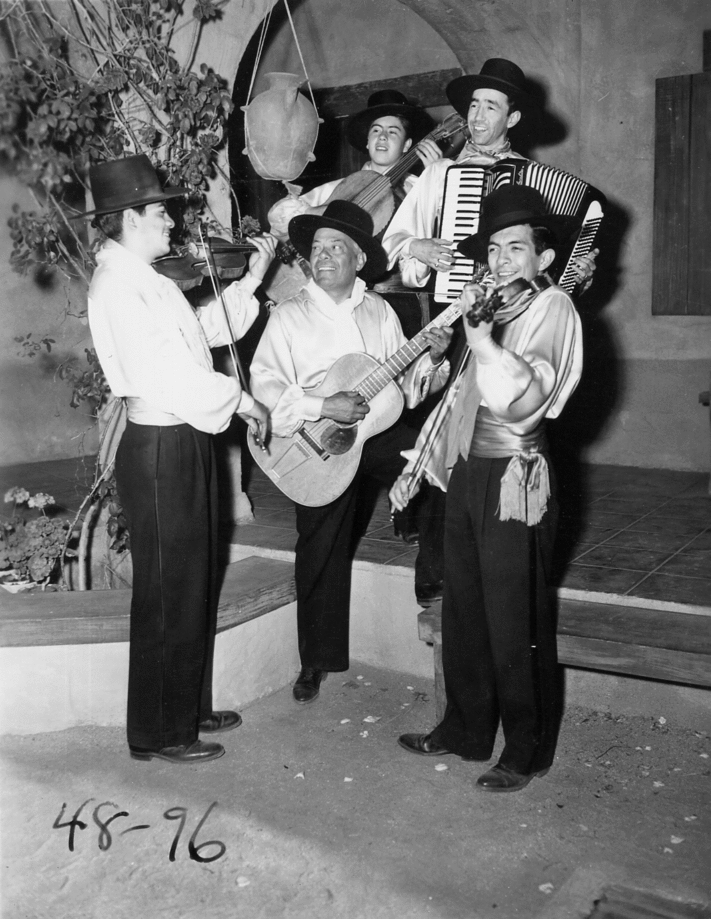
Despite the Anglo leadership and audience, the Mexican American musicians played an important role in the production. Mexican cultural agency began with guitarist and bandleader José Arias, Sr. (1889–1972) (see Figure 1). Born in Guanajuato, Mexico, Arias immigrated to the United States in 1910 and spent his entire career in Southern California. While learning the music of the region, he founded a group, the Arias Troubadours, in 1915. The name of the group differed for Hispanic events, such as performances at private dances or parties, for which it became Arias's “Orquesta típica.” It was a family venture, consisting largely of Arias's brothers-in-law, the Corrals from Riverside County, who played mandolin, guitar, and violin; he later added bass, guitarrón, marimba and other instruments as the group expanded during the 1920s.Footnote 32 Well before he began performing for the Ramona Pageant, Arias was thus a seasoned veteran in playing with his group throughout Southern California.
For much of its history, the Arias Troubadours consisted mainly of family members. At the 1948 Ramona Pageant, José Arias Sr. (center) is surrounded by his two sons, Alfonso and José Arias Jr. on violin, his nephew Antonio Corral on guitarrón, and Rafael Gama (unrelated) on accordion. Among other family members who played with the group were Arias's nephews Carlos (accordion), Eugene (guitarrón), and Armando Corral (guitar). Courtesy of the Ramona Bowl Museum, Hemet, CA.

Holme first heard the Arias Troubadours perform at a pageant celebrating the history of Mission San Juan Capistrano north of San Diego and was impressed with their musicianship. After the opening season of the Ramona Pageant, for which he had chosen local mandolin player Charlie Randall and a guitarist, he hired the Arias Troubadours for the second season of 1924. Despite the numerous changes in personnel over the ensuing decades, the Arias Troubadours remains the sole group to perform at the pageant—a degree of continuity that to my knowledge does not exist in any other Anglo productions in Southern California.Footnote 33
The Arias Troubadours specialized in Mexican American music, especially in the songs of the Californios, who claimed Spanish descent from the era of colonial Spain, some of whom still lived in the region during the 1920s and 1930s. Although Arias was no Californio himself, he did admire the music that arose when they flourished and often dressed in the classic Californio stage costume of black hat, white shirt, and black pants with sash (see Figure 1). Significantly, Californio music relies mainly on strings: guitar, violin, and bass. In an interview I conducted, his oldest son, José Arias Jr., explained that the music of the Californios was a hybrid of European and direct Mexican influences, in which waltzes and marches were performed alongside jarabes and rancheras.Footnote 34 This mixture of Mexican and European musical genres provided the foundation for much music of the Southwest in the eighteenth and nineteenth centuries.
The Arias Troubadours were not restricted to performing in the Ramona Pageant, of course. The group toured throughout the Southwest and across the country annually, at times at the behest of the Los Angeles Chamber of Commerce. Arias further plied his trade in several silent and sound films during the 1920s and 1930s, including two films based on the Ramona story, one of which featured the glamorous Mexican star Dolores Del Rio.Footnote 35 Although no known recordings by the Arias Troubadours were made at this time, the group did record an album in 1949.Footnote 36 Eventually four of Arias's six children joined the ensemble, which enabled the Arias Troubadours to maintain a relatively stable repertoire of songs for almost a century, because their descendants and relatives have continued the family's musical legacy up to the present day.Footnote 37
One indication of Holme’s high esteem for the Arias Troubadours is an apparent lack of exploitation of the musicians. In their first year in the production, the six musicians together received a total of $445.90 for three-weeks’ work. This amount was comparable to what most of the lead actors received: a total of $523.50 for seven actors to split among themselves. All of the community actors were volunteers. Moreover, payment for musicians steadily increased even into the Depression, peaking at $1,148.50 in 1931 before declining to a low of $428.31 in 1934 and then increasing again.Footnote 38 It seems evident that the management recognized the musicians as vital to the production and paid them accordingly.
What kinds of songs did the Arias Troubadours perform? Fortunately, several songs in Arias's vast repertoire of Mexican American music appeared in a collection of sheet music, Spanish Songs of Old California, which a friend of Arias, Los Angeles booster and writer Charles Fletcher Lummis, published in 1923.Footnote 39 As many scholars of Mexican American music will attest, a challenge to scholarship on this music is its origin in oral tradition. After having lived over three decades in the Southwest, Lummis was deeply acquainted with many of these songs and selected several of them for publication based on recordings he made between 1903 and 1906 of local Mexican singers Manuela Garcia, Adalaida Kemp, and Rosa and Luisa Villa, among others.Footnote 40 Lummis then arranged for the East Coast composer, pageant master, and music promoter Arthur Farwell to transcribe the songs for piano and voice. Farwell had a strong interest in the music of Mexican California, and he eagerly began transcribing the songs. It was painstaking work, requiring constant repetition of the recordings for accuracy, and Farwell worked on the project intermittently for almost two decades. As a result, scholars have found Spanish Songs of Old California highly useful in understanding traditional, Spanish-language songs of nineteenth- and early twentieth-century California.Footnote 41
Above all, the Arias Troubadours specialized in canciones, three of which they regularly performed at the pageant: “La hamaca,” “El capotín” and “Cielito lindo.” Because “La hamaca” and “El capotín” appear in Lummis's songbook, and “Cielito lindo” was published by composer Quirino Mendoza y Cortés (ca. 1859–1957), we have sheet music that indicates how one could perform these songs; the sheet music gives the lyrics (with English translations), notation for rhythm, and so on. The songs thus provide useful examples in analyzing the soundscape of the Southwest, although with the exception of “Cielito lindo,” given the distance in time between composition of the songs and their publication, we cannot be certain that the arrangements are stylistically authentic.
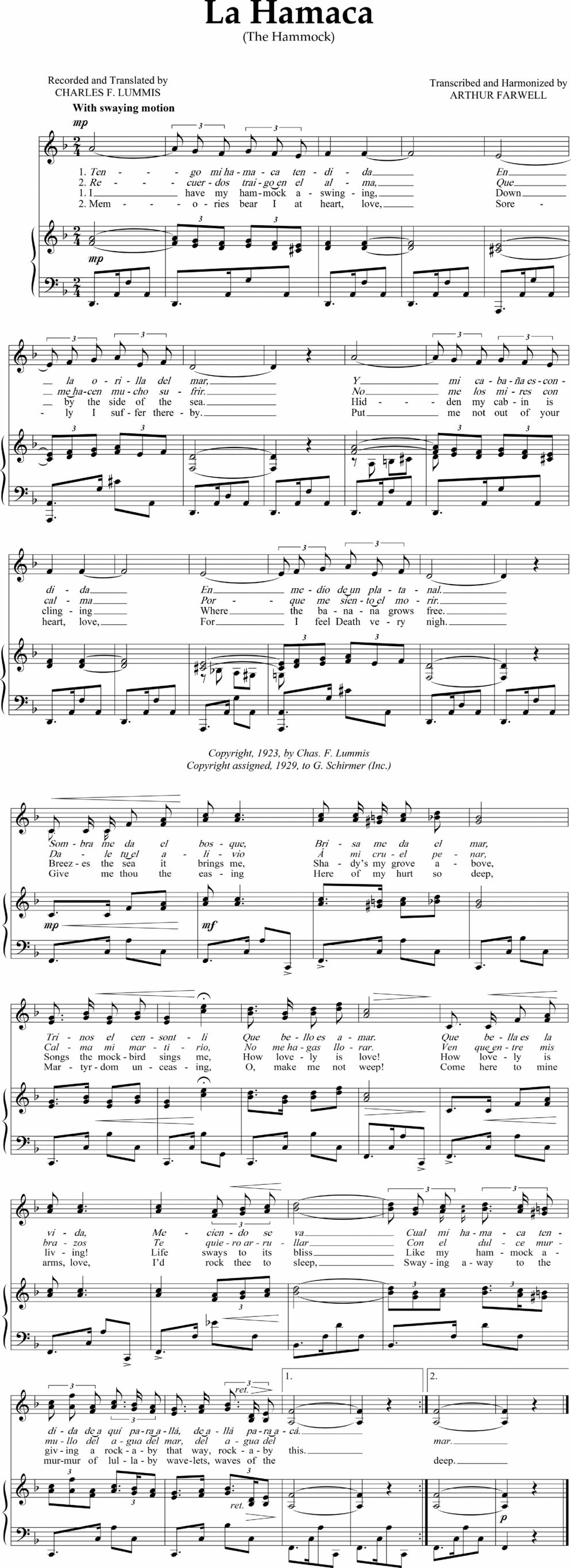
The themes of longing and desire, which appear in abundance in both the novel and the pageant, characterize these songs. “La hamaca” (The Hammock) is a passionate love song about a man who dreams of his lover while he rocks in his hammock by the seashore.Footnote 42 Its fundamental habanera rhythm originated in Cuba and later became common in Mexican canciones (see Example 1). The song begins in a somber mood (in D minor), which the lyrics reinforce: “I bear these memories in my soul,/Which cause me much suffering” (Recuerdos traigo en el alma/Que me hacen mucho sufrir). After the first sixteen measures, however, there is a dramatic change in both the music and lyrics. The music first signals this shift by moving to the relative major in the second half of the piece. The lyrics reflect this change, turning from melancholy to sheer longing, such as stating that “the wooded grove gives me shade,” and “I feel breezes by the sea” (Sombra me da el bosque/Brisa me da el mar). The steadily repeated rhythm in the bass continues, thereby providing the rhythmic unity with the first half of the piece. Still suffering from memories of his lover, the singer calls out, “Come to my arms./I would like to rock you to sleep” (Ven que entre mis brazos/Te quiero arrullar).
The cast of the Mexican Players poses in front of the Mexican flag for a 1935 play, Aguila y Nopal (“The Eagle and the Cactus”), which featured music from eighteenth- and nineteenth-century Mexico. In the front row (far right) is Juan Matute, one of the lead guitarists and vocalists, and seated next to his right is Mexican guest artist and the star of the play, Graciela Amador, wife of painter David Alfaro Siqueiros. Courtesy of the Pomona Public Library, Pomona, CA.
Visiting artists from Mexico assisted the Mexican Players in creating and performing plays in the 1930s. One play was ¿Idolos Muertos? (“Are the Idols Dead?”), which Francisco Sánchez Flores from Guadalajara oversaw. The troupe re-enacted Aztec and Mexican rituals, music and dance, and both the program and the stage design were inspired by Aztec iconography. Courtesy of the Pomona Public Library, Pomona, CA.
“La hamaca” (“The Hammock”), a canción popular in nineteenth-century California, was commonly performed at the Ramona Pageant. It was published in a 1923 song collection, Spanish Songs of Old California, by Los Angeles writer Charles F. Lummis, who arranged for composer and pageant master Arthur Farwell to write the piano accompaniment. © 1923 Charles F. Lummis. Copyright renewed © 1951 G. Schirmer, Inc. International Copyright Secured. All Rights Reserved. Reprinted by Permission.
The passionate yearning of “La hamaca” is also central to “El capotín” (The Rain Cape), although in a different fashion (see Appendix 1). The song tells of a man's love that is so strong, he “drinks wine, gets drunk / and goes to sleep without a meal” (Toma vino, se emborracha/Y se acuesta sin comer).Footnote 43 Stumbling outside, he tries to protect himself from the pouring rain with a cape (capotín) made from thatched leaves, a typical form of covering in nineteenth-century Mexico. The melody remains largely within the range of a fourth, with only occasional reliance on as wide a range as a sixth (which differs from “La hamaca,” whose melody extends beyond an octave). Five harmonies (I–IV–iii–V7–I) appear in the first seventeen measures, which contrast with the extended chorus of I–V–ii–V–I in the next twenty-five measures. A further difference is that unlike “La hamaca,” this canción is in triple meter, which was common in colonial Spain and Mexico at least from the eighteenth century. In the chorus, the singer repeats the third syllable of capotín, as if to capture the vibrant beat of the rain beating down on his cape. The amorous agony of the canción perfectly reflects the feelings of the desperate lovers in the pageant, Ramona and Alessandro. “Do not kill me with a pistol or a dagger,” the singer cries, “Kill me with your eyes/and with your red lips” (No me mates, Con pistola ni puñal/Mátame con tus ojitos/Y tus labios de coral).
A third song the Arias Troubadours often performed in the pageant is “Cielito lindo” (Heavenly One, see Appendix 2). Although not part of Lummis's song collection, “Cielito lindo” was nonetheless widely popular in the late nineteenth and twentieth-century Southwest and Mexico and remains popular today.Footnote 44 A canción like the other two songs discussed here, it expresses the passionate longing for a love that can never be consummated that inhabits these songs.Footnote 45 Several printed versions of the song exist; to determine the version that the Arias Troubadours sang, we are fortunate to have the only known studio recording that Arias Sr. made with his group.Footnote 46 This recording from 1949 features a duet between soprano and baritone, and the instrumentation is similar to the group's other songs, consisting of guitars, guitarrón, violins, mandolins, and castanets. Like “El capotín,” “Cielito lindo” is in triple meter. The lyrics are about a dark-eyed man from the mountains who falls in love with a valley woman promised to someone else. “Sing and don't cry,” she exclaims, as they furtively spend time together but can never marry, hence the haunting refrain:

“Cielito lindo” is one of the few songs performed at the pageant for which we know the composer: Quirino Mendoza y Cortés. He was the son of a church organist and grew up in Xochimilco, a town about seventeen miles south of Mexico City. Although he became a schoolteacher by profession, Mendoza y Cortés wrote many songs, some of them based on European forms: the waltz, polka, and mazurka and the Spanish jota (a common triple-meter dance form). He also drew on traditional Mexican forms such as the huapango (a dance from southeast Mexico that combines duple and triple meter) and the ranchera, a love song that typically expresses themes of rural life.Footnote 47 Probably written in the 1880s, “Cielito lindo” quickly became one of Mendoza y Cortés's most popular songs.Footnote 48
The songs in the pageant are about love and so might seem to affirm a romanticized portrayal of the past. Yet they represent much more: the songs are about sadness as much as they reveal romantic longing. They thus directly reflect the pathos of the novel and indeed of the pageant itself, regardless of the gaiety of the dance sequences or the seeming merriment of the melodies. In short, the songs were essential in maintaining cultural memory. Mexican Americans had fought to overcome both overt and subtle forms of cultural oppression that had existed since the U.S. conquest of Native American and Mexican lands in the 1840s. Mexican Americans in Southern California watched with dismay as both their physical sphere and their cultural influence, which included their music and art, became increasingly marginalized by, or subsumed into, the dominant, Anglo culture. The songs of the Ramona Pageant provided a way of combating that marginalization by providing a thread of cultural continuity that transcended Anglo cultural domination, because Mexican Americans had cultural agency in choosing and performing the music.Footnote 49
The Mexican Players and Mexican Culture
As with the Mexican American musicians in the Ramona Pageant, the Mexican Players remained strong proponents of Mexican culture.Footnote 50 Over a period of forty years, they performed music and dance from Mexico and early California. Beginning in the Depression, they usually appeared in musical comedies, yet they also created and performed works that aimed for historical authenticity in musical performance. Regardless of the plays’ content, the troupe's members took their music seriously, seeing themselves as cultural preservationists in an era of Anglo domination.
Productions combining music and drama were common in Mexican theater in Los Angeles until the Depression era. Among the main theaters were Teatro Hidalgo, Teatro México, Teatro Capitol, Teatro Zendejas, and Teatro Principal, all located near downtown Los Angeles, and at least seventeen Spanish-speaking professional companies also operated, albeit irregularly.Footnote 51 Theatrical forms such as zarzuelas and revistas became increasingly popular during and after the Mexican Revolution (1910–20), when performances often had a political edge. The loss of many Spanish-language theaters during the Depression, however, resulted in the loss of professional opportunities for Mexican musicians and dancers in Los Angeles. This situation made the work of the Mexican Players all the more significant—to help keep Spanish-language theater alive during this period—because theater had long served to reinforce direct cultural ties between Mexico and the Southwestern United States.Footnote 52
As with the Ramona Pageant, Anglos with an interest in both musical drama and local real estate development founded the Mexican Players. A wealthy businessman and his wife, Herman and Bess Garner, joined fellow inhabitants of Claremont (in eastern Los Angeles County) in 1930 to create a dinner theater, the Padua Hills Theatre, in the nearby foothills. The city, located about thirty-three miles east of the main terminal in downtown Los Angeles, was accessible by the Red Car rail system. True to the ideals of the contemporaneous Little Theatre movement, the original purpose of the theater was to stage productions with actors from the local community. As the popularity of the Mexican Players grew, the Garners founded the Padua Institute, a non-profit institution to study and perform Mexican music and dance. Like Ida McGroarty with the Mission Play, Bess Garner often traveled to Mexico to find costumes and props for the Mexican Players. In addition, the Garners and other investors encouraged real estate development in the area to promote settlement in the region.Footnote 53 As the number of residents grew, so, too, did the potential audience for the Mexican Players.
Initially two groups performed at the dinner theater: an Anglo troupe of actors, the Claremont Community Players, and a Mexican group of actors and musicians, which soon began calling itself the Mexican Players. The Claremont Community Players, of whom little record remains, lasted three years until disbanding as a result of the economic hardship of the Depression.Footnote 54 The Mexican Players survived, however, in part because the performers waited on tables, worked in the kitchen, and did other tasks to keep costs low. In contrast to the Arias Troubadours, members of the troupe received minimal wages for their work, although they did receive room and board. According to one performer, however, costs for room and board were even deducted from their wages, in spite of their additional work in the kitchen and gift shop.Footnote 55 Originally their performance schedule consisted only of July through September, four days per week, twice per day. Eventually they began performing year round.
Like the Arias Troubadours, the Mexican Players worked within the limits of an Anglo theater, but their repertoire in these plays was considerably larger and more varied. Anglos typically wrote the scripts and directed the plays, while Mexican Americans performed the music, created the dances, and did almost all of the improvised dialogue. One of the first scriptwriters and directors was Bess Garner, who enlisted the aid of a drama student at nearby Scripps College, Charles Dickinson; Dickinson himself later became a full-fledged member of the theater as a writer and director. The fact that the music and dance were entirely the product of the Mexican Players themselves, however, is significant. Scholars who ignore the music thus miss the historical significance of the troupe, who sought to portray the expressive culture of Mexico and early California through precisely such songs and dances.
Although a complete account of the Mexican Players’ performances over almost forty years would go well beyond the limits of this article, we can give some indication of the kinds of performances the troupe gave during the 1930s.Footnote 56 At times both capitalizing on and belying the romanticization of the Mexican past in the Southwest, they sought to include a measure of authenticity to the Anglo-authored plays. The play that first garnered the Mexican Players renown was Serenata Mexicana (Mexican Serenade, 1931), which illustrated the daily life of a small, Mexican village.Footnote 57 Actor and guitarist Juan Matute y Remus, an immigrant from Veracruz, Mexico, aided scriptwriter Bess Garner and director Charles Dickinson in creating the production; in a series of musical scenes, the troupe depicted people going to church, to the market, to a cockfight, and even to a funeral.Footnote 58
The essential point here is that in searching for the thread of cultural memory, we must focus on the music. In contrast to the script and the direction, the musicians arranged, composed, or chose the music for Serenata Mexicana in addition to performing. Matute arranged one of the songs, and three of the actors, Salvador Sanchez, Miguel Vera, and Catalino Alva, wrote the cancíon “La Serenata” specifically for the play.Footnote 59 Four other songs were traditional and had appeared (as with the Ramona Pageant) in the Lummis collection.Footnote 60 Similar to the Ramona Pageant and Californio music in general, strings featured prominently, rather than horns, which are common in mariachi music. Accompanying at least fourteen pieces over the course of a performance were a guitarist, a violinist, a harpist, and a percussionist.Footnote 61 Although it is not clear how long each performance lasted, the songs would have been performed roughly every four minutes had the play lasted sixty minutes. Regardless of the play's duration, music was dominant throughout and an essential part of the production.
An important goal of the troupe, and its inherent challenge, was to present Mexican culture while resisting stereotypes. As in the case of the Ramona Pageant, an important song of Serenata Mexicana was “Cielito lindo.” The lyrics include the phrase “sing and don't cry,” rather like African American jazz artists, who longed to end racial stereotypes while entertaining whites to earn a livelihood. As Matt Garcia asserts, the Mexican Players indeed put on “that Padua Hills smile.”Footnote 62 Yet the troupe also sought to communicate the cultural richness of Mexican music despite an era of intense racial conflict in the southwestern United States during the 1920s and 1930s. “Communication” here takes on two meanings, however, because as with the Ramona Pageant, all of the songs were in Spanish; the Mexican Players rarely sang translations and so were essentially communicating among themselves. If white audiences could not understand the lyrics, then at least they could assume that what they were witnessing aimed for an “authentic” musical performance.
Although many of the plays were romantic comedies, written first by Mrs. Garner and then mainly by fellow scriptwriter Charles Dickinson, others aimed for historical re-enactment and thus belonged to the genre of pageant drama as a form of instruction. The search for authenticity characterized a series of historically based productions that featured a series of artists from Mexico to accompany the Mexican Players. Although the Garners did not write the script for these plays, they may have paid the guest artists or arranged for the Mexican government to do so. The formal invitation to the guest artists most likely came from Herman Garner, who later received a national award of merit from the Mexican government for his services in promoting Mexican culture.Footnote 63
One example of a Mexican Players pageant drama was Aguila y Nopal (The Eagle and the Cactus), which featured Mexican guest artist Graciela Amador in 1935.Footnote 64 In Figure 2, we see Amador with the troupe and a large Mexican flag in the background, which prominently depicts an eagle atop a cactus. This production reflected Amador's historical interest and the Mexican Players’ strong desire to promote that interest, although it is not clear whether it is an original play from Southern California or if the troupe adapted it from a Mexican production.Footnote 65 It consisted of five parts, divided both temporally and geographically; parts 1 and 2 featured music of the eighteenth and nineteenth centuries, respectively, and parts 3 through 5 featured music from various parts of Mexico: the Isthmus, the Gulf of Mexico, and Central Mexico. The songs and dances thus served as a kind of travelogue across time and space.Footnote 66
Several songs and dances in Aguila y Nopal communicated these cultural ties. Whereas the Ramona Pageant featured canciones as the main musical genre, Aguila y Nopal offered at least five types of songs and dances. For example, a romance entitled “Romance de Delgadina,” a song about attempted but refused incest, dates from before the eighteenth century, and a corrido, “El curripiti,” describes the downfall of Emperor Ferdinand Maximilian (r. 1864–67), an Austrian noble supported by France, whose rule over Mexico ended in his execution. The corrido arose originally from the Spanish romance, and both genres have long had enormous importance in communicating the history and peasant life of Mexico. If a song was to have political overtones, most likely it would take the form of a corrido, which could be in either duple or triple meter.Footnote 67 In communicating Mexican culture to a largely Anglo audience, the troupe chose a wide variety of songs that reflected the cultural richness and history of the country.
Dances were also highlights of the production. One dance, the flirtatious jarabe, was common throughout Mexico. It features the women acting coy and the men aggressive to allegedly follow the mating rituals of doves. The jarabe unites different melodies and rhythms together (such as transitioning from triple to duple meter), in this case melodies from Tlaxcala and Michoacán of central and southern Mexico. Another dance, the triple meter “Sandunga,” was common in the Zapotec culture from the Isthmus in the state of Oaxaca. The Mexican Players also performed several vigorous huapangos from eastern Mexico, notably from Veracruz, where guitarist Juan Matute y Remus was born.Footnote 68 In all, the play incorporated eighteen selections of song or dance. If we assume it lasted one hour, then there was a song or dance roughly every three minutes; if the production lasted two hours, then a song or dance was performed every six or seven minutes. As with Serenata Mexicana, the music had a central role in the production and thus served as a vital means of cultural agency.
The title of the play, Aguila y Nopal, is significant, because the symbols of the eagle, the cactus, and the serpent are powerfully ingrained in Mexican culture. They appear on the modern Mexican flag, as shown in Figure 2, and are historic symbols that date back to Aztec times. According to Aztec legend, the eagle, cactus, and serpent all played important cultural roles that continued long after the Aztec empire declined. As Gloria Anzaldúa writes, “The eagle symbolizes the spirit (as the sun, the father); the serpent symbolizes the soul (as the earth, the mother). Together, they symbolize the struggle between the spiritual/celestial/male and the underworld/earth/feminine.”Footnote 69 By inviting a prominent Latina artist from Mexico, the Mexican Players asserted an identity seemingly apart from one they often had to portray; this production was not the light musical comedy that tended to affirm stereotypes of the “happy Mexican peasant,” but rather a demonstration of cultural solidarity precisely against those stereotyped portrayals.
The music in these productions thus derives from the expressive culture that many Mexican immigrants brought to the United States. The repatriation of at least 300,000 Mexicans from Southern California in the 1930s, a government-led reaction to disastrous job losses during the Depression, created a climate of enmity and fear within the Mexican American community that has lasted to the present day. Within the limited and admittedly romanticized framework that the plays allowed them, the Mexican Players asserted that Mexican culture was neither monolithic nor backward as many whites perhaps perceived it, but rather contained much regional variation that was instantly recognizable in the songs, dances, and dress of those regions. In this sense the group contributed to “the rise of the Mexican American consciousness in the 1930s” as Alicia Arrizón notes.Footnote 70
Although the Mexican Players did not advocate political activism as such, their abiding interest in instruction as well as entertainment—an interest they shared with the Garners themselves—led to the invitation of numerous Mexican artists to perform their works with the troupe. For example, an artist from Guadalajara, Francisco Sánchez Flores, aided in the production of ¿Idolos Muertos? (Are the Idols Dead?), a re-enactment that dramatized the destruction of Aztec culture with the Spanish conquest, and thus included both Aztec and Mexican rituals (see Figure 3). As Flores explained in the program: “And so there was conquered in its dead idols, its muted drums and broken arms a people who defended their city . . . [thereby creating] a hybrid civilization, charged with prejudices and defended alternatively by a cross and a sword.”Footnote 71 The Mexican Players performed these and other pageant dramas that integrated aspects of Mexican rituals and beliefs, in part by inviting artists from Mexico to aid them in performing the plays. Among them were Luz Maria Garcés, who taught at the University of Mexico, and Ema Duarte and Amado López Castillo.Footnote 72
Further productions in which the Mexican Players took part had both historical and religious roots, to which we can only allude here. Among them were The Fiesta of San Ysidro and the annual Christmas play, Las Posadas. The Fiesta of San Ysidro was essentially a re-enactment of an annual cultural ritual in Mexico, based on the life of Saint Isidore, a poor, twelfth-century Spanish farmer canonized in 1622. In The Fiesta of San Ysidro, the Mexican Players performed a dozen dances from Michoacán, Zacualpan, and Guerrero, including a dance that recalled the Aztec rain god Tlaloc, worshipped before the Spanish conquest.Footnote 73 Similarly, the Mexican Players re-created the deeply important Mexican tradition of Las Posadas, which formed part of a long-standing December ritual: telling the birth of Christ. Traditionally, participants travel from house to house in re-enacting the biblical story of Mary and Joseph. The Mexican Players included songs, dances and rituals common in Mexico. The Garners published a book of lyrics and music of the Padua Hills version, titled Las Posadas—one of the few texts that the Padua Institute produced. Seemingly emphasizing ritual over race, Bess Garner wrote, “Whatever one's race or people or creed in music, the age old story of the Holy Babe may still warm and gladden our hearts and widen our sympathies.”Footnote 74
Who, then, made up the audience of the Mexican Players? And how did they respond to these performances? Although it is difficult to determine due to the scarcity of relevant sources, there is little doubt that well-to-do whites from the local community remained a consistent core of Padua Hills theater-goers, such as those who had initially supported its founding. The Garners, who oversaw all of the marketing, had an extensive network of friends and colleagues who patronized the theater—an important reason it lasted more than forty years.Footnote 75 It further seems that middle class, white Americans from Los Angeles formed a major portion of the audience. Regular advertisements in the Los Angeles Times emphasized the fact that dinner accompanied the productions, which continuously drew in patrons, and the newspaper's theater critics loyally covered the Mexican Players throughout the 1930s, usually with glowing reviews.Footnote 76
One notable admirer was Walt Disney, who featured the musicians and dancers in one of the first feature-length films to integrate animation with live action, The Three Caballeros (1944). It was premiered in Mexico City on 21 December 1944 as part of the new Good Neighbor Policy of the United States government toward Latin American countries. The film is a musical travelogue by Donald Duck and his Mexican friends, the parrot José and the rooster Panchito. In a scene from Las Posadas, the Mexican Players even interact with “Señor Donald.” Ample time in the film is given over to dancing, although it is debatable which characters get more attention: the dancers or the duck.Footnote 77
Despite their effort to preserve Mexican culture in the face of racial stereotypes, the Mexican Players have not avoided criticism from scholars. Alicia Arrizón argues that the troupe served primarily Anglo interests by offering simplified portrayals that allowed whites to see Mexicans the way they wanted to see them: as smiling singers and dancers delighted to put on a show. Although Arrizón does not discuss the historical re-enactments, such as Aguila y Nopal, ¿Idolos Muertos?, or the annual Las Posadas, her comments do make a point—how can one combat a racial stereotype by seemingly offering another one in its place, notably in the romantic comedies?Footnote 78 Similarly, Matt Garcia suggests that a certain superficiality characterized the troupe's productions. Like Arrizón, he emphasizes the servile nature of many of the roles that the Mexican Players portrayed, which did little to move beyond the depiction of the simple, happy peasant.Footnote 79
There seems little doubt that exploitation with little remuneration was a constant issue, with the Garners seeming to have expected the performers to be content with steady work in the theater. Nonetheless, several of the performers developed a camaraderie as a result of performing together over a period of several decades; a demanding schedule of at least eight productions per year, each performed on average four-to-six times per week, created close associations, and the performers organized regular reunions long after the theater closed. One of the main actors and musicians, Juan Matute y Remus, assembled a scrapbook of the Padua Hills Theatre fifty years after its first performances, in which he included photographs and programs.Footnote 80 Yet whereas there is no escaping the framework the Garners originally put in place to present Mexican culture in a highly romanticized light, the Mexican Players steadfastly performed the centerpiece of these plays, the music and dance, in spite of those limitations. As with the Ramona Pageant, the songs recalled the memory of the past.
Conclusion
These theatrical productions, with their communication of Mexican culture, contain some similar elements. Each one depicts the past through song and dance. Although limited by the often-stereotyped portrayals, the ample opportunities for music and dance in the plays enabled Mexican Americans nonetheless to present on stage aspects of Mexican culture by re-creating the soundscape of the Southwest. Despite the climate of mistrust and anger over whites’ treatment of Latinos during the Depression, there seem to have been few criticisms by Mexican Americans concerning either the Ramona Pageant or the Mexican Players. “On the contrary,” notes Matt Garcia, “many of the local Mexican residents proudly remember the players’ performances and the significant presence of the Padua Hills Theatre in the Pomona Valley.”Footnote 81 Similarly, perhaps because the Ramona Pageant offered a much-needed outlet for Mexican musicians during the 1920s and 1930s, criticism of the pageant was rare, in spite of the irony that these productions flourished while the U.S. government, with the aid of Los Angeles authorities, deported hundreds of thousands of Mexicans and Mexican Americans to Mexico.Footnote 82
Despite these tensions, ties between Anglos and Mexicans were central to the productions. The organizers of the Ramona Pageant enlisted the aid of Garnet Holme, who in turn first hired the Arias Troubadours. Similarly, the Garners’ relationship with the Mexican musicians and dancers appears to have been warm but almost certainly more exploitive than in the case of the Arias Troubadours. There is no doubt that the Garners had a genuine interest in Mexican music and dance, and frequently made trips to Mexico to bring back props, costumes, etc. for the performers, yet their beliefs in how Mexican culture was typically to be portrayed remained romanticized. Further, in both cases the expression of Mexican culture arose as classic products of civic boosterism and land development in Southern California. The Ramona Pageant was created out of an interest by the Chamber of Commerce in Hemet/San Jacinto to promote the areas and attract prospective residents, whereas the Mexican Players and the Padua Institute resulted in part from an appeal to tourism and real estate development during the Great Depression.
Yet the main point is this: whites had little role in creating, arranging, or performing the music of these productions. This marginalization of whites in aesthetic terms clearly arises in the canciones, corridos, and other songs in which the work of Anglo composers is not present. That the songs are in Spanish rather than in translation further underlines their essential role in cultural memory. Music and dance have long held a distinct importance in the cultural life of Mexican Americans, and it is here where the Ramona Pageant and the Mexican Players have significance. We can criticize the romanticization of the productions, but the musicians’ contributions in the choice and performance of the music suggest a different story. They performed in plots created largely by Anglos, but the music was their own, and that degree of agency for Mexican American performers in Anglo forums scarcely existed outside of these productions during this period. Within these venues, Mexican American musicians and dancers thus reconstructed a world on stage that gave them artistic control. The music was a basic expression of ethnic identity, because it arose from the Mexican culture of the Southwest.