INTRODUCTION
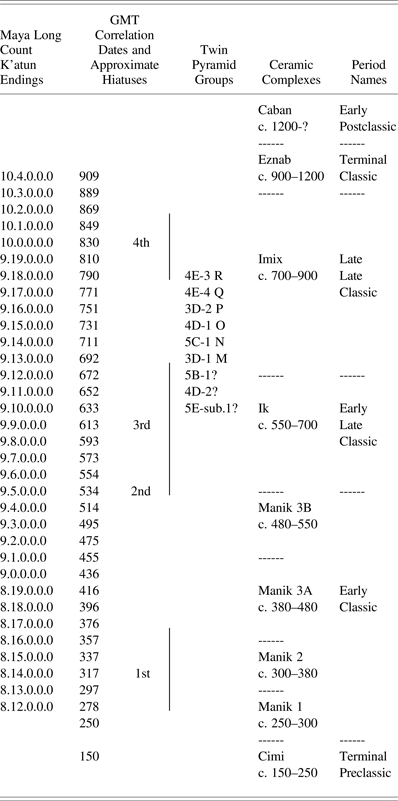
Carved stone stelae and altars are one of the most distinctive attributes of ancient Lowland Maya civilization. Their span of use conventionally defined the Classic period, ca. a.d. 250–900 (Table 1), the epoch when Maya civilization is considered to have reached its apogee. They belong to an ancient tradition of stone monuments that emerged with complex society in eastern Mesoamerica during the Early Preclassic period, ca. 1500–1000 b.c. (Clark Reference Clark1997). Although different kinds of stone monuments can be assumed to have had diverse functions and meanings (Stuart Reference Stuart, Guernsey, Clark and Arroyo2010), by the Late and Terminal Preclassic periods in the Maya area, ca. 400 b.c.–a.d. 250, stelae and altars had come to commemorate rulership. The rise of dynastic rule and concern with legitimacy and collective memory fostered an awareness of the political value of history, in the sense of recorded events and knowledge, and promoted the use of carved portraits and inscribed texts and dates on stone stelae and altars (Clark et al. Reference Clark, Guernsey, Arroyo, Guernsey, Clark and Arroyo2010; Golden Reference Golden2010:373). The inscriptions can be used to construct fine-grained chronologies for Maya sites, which, in turn, has focused attention on gaps or hiatuses when they occur in date sequences.
Chronology of the Classic period at Tikal, Guatemala (after Coe Reference Coe1990; Culbert Reference Culbert1993; Jones Reference Jones1969; Jones and Satterthwaite Reference Jones and Satterthwaite1982; Laporte Reference Laporte Molina1989)

The exciting possibility of constructing a history of the Maya from their own texts and representations has sometimes had a counterproductive effect on interpretations of the archaeological context of hiatuses. A widely held view sees gaps as indicative of a decline or a dark age for a polity as a whole. However, there is no support for a dark age at Tikal, an important central Maya lowlands capital in the rain forest of northern Guatemala, where its longest hiatus period can be shown to have been an epoch of general material prosperity and cultural innovation (Moholy-Nagy Reference Moholy-Nagy2003a).
The most promising research to date on stone monuments and other material evidence of kingship views them within the overall context of Maya culture (e.g., Clark et al. Reference Clark, Guernsey, Arroyo, Guernsey, Clark and Arroyo2010:24; Coggins Reference Coggins1975; Guernsey et al. Reference Guernsey, Clark and Arroyo2010; Martin Reference Martin, Colas, Delvendahl, Kuhnert and Schubart2000; Watson Reference Watson2012). This paper approaches the problem of hiatuses in date sequences on stone monuments by emphasizing their nature as artifacts, items of material culture recovered from archaeological context, to propose an alternative explanation for hiatuses at Tikal and elsewhere in the Classic Maya lowlands.
THE FUNCTIONS OF CLASSIC LOWLAND MAYA STONE STELAE AND ALTARS
Maya rulers erected stone monuments to assert their legitimacy by establishing genealogical ties to past rulers and mythological ancestors, record autobiographical information such as births, accessions, marriages, and deaths, and proclaim military victories (Carter Reference Carter and Raaflaub2014a:365; Carter Reference Carter2015:1; Freidel Reference Freidel, Demarest and Conrad1992; Marcus Reference Marcus1992; Sanchez Reference Sanchez2005; Sharer Reference Sharer2006). Although great progress has been made in the decipherment of Maya texts, problems still remain regarding their reliability. The meanings of some glyphs are still ambiguous or unknown and many texts are found damaged, eroded, and incomplete. Even if texts have been correctly deciphered, it cannot be taken for granted that the information presented is truthful (Marcus Reference Marcus1992:10). If texts are to be incorporated into constructions of Maya history, their readings must, at the least, be consistent with the existing archaeological data.
An elaborate hieroglyphic script and a linear calendar, the Long Count, were invented to record persons and events. The Maya wrote on a great variety of perishable and durable materials. There are rare examples on wood, textile, and bark paper. Nearly all surviving texts are on architectural carvings and murals, freestanding sculptures, decorated ceramic vessels and other kinds of portable material culture, and, most famously, on stone monuments.
Although stone monuments were typically erected where they could be seen by everyone, and much information was conveyed through iconography, the ornate complexity of Maya script suggests that target audiences were the literate uppermost ranks of Lowland Maya society. Texts indicate that rulers and nobility were mainly interested in communicating with their peers. When they were not waging war on each other, they traveled to other cities to attend the celebrations that marked important royal life-cycle events, such as accessions, monument dedications, marriages, and funerals (Demarest Reference Demarest2004:230; Graham Reference Graham, Foias and Emery2012:428). Classic Maya carved and plain stone monuments were an essential element in the royal paraphernalia of what has been called a theater state, wherein the power of the ruler derives from the performance of ideological ritual (Demarest Reference Demarest2004:206–207; Martin and Grube Reference Martin and Grube2008:18). The concentration of stone monuments in the large plazas that form the civic-ceremonial epicenters of Lowland Maya cities mark these spaces as settings for events and performances centered around rulers and nobility (Sanchez Reference Sanchez2005:282).
During the Classic period Lowland Maya stelae and altars were usually erected as pairs (Figures 1, 2). Stelae take the form of elongate shafts set upright. An altar, a shorter stone usually round in plan, was placed close to and in front of it and could have served as a surface for rites and material offerings (Christie Reference Christie2005:281–282). A cached offering was frequently buried beneath the stela, occasionally beneath the altar, according to the customs of each site. The durable contents varied considerably in quality and quantity, and at some sites like Tikal, variations have chronological value (Moholy-Nagy Reference Moholy-Nagy2008:18). The most important texts, dates, ruler's portrait, and offerings were typically associated with the stela.
Restored Stela 11 and Altar 11, Group 5D-2, Tikal are the latest carved monuments known from the epicenter. Stela 11 commemorates the k'atun ending of 10.2.0.0.0, a.d. 869. Photograph by Hans-Ruedi Hug.

Twin Pyramid Group 4E-4, which commemorated the k'atun ending of 9.17.0.0.0 (a.d. 771). The standardized, rectangular plan of this group included twin pyramidal structures on the east and west sides, a nine-roomed range structure on the south, and a stela and altar pair in an unroofed enclosure on the north. A variable number of paired plain stelae and altars were aligned in rows in front of the east pyramid. Drawing by Norman Johnson.

Classic-period carved stelae are thought to have been commissioned by a ruler or his or her descendants. Sometimes the ruler is portrayed accompanied by subordinate persons, such as an adult male prisoner. The ruler is usually depicted almost overwhelmed by an elaborate costume and headdress laden with ornaments, feathers, and insignia that reference his, rarely her, religious and political roles (Figure 3).
Tikal Stela 22. Twin Pyramid Group 4E-4, depicting the Late Classic king, Yax Nuun Ayiin II, in full regalia conducting a ritual at the k'atun-ending ceremony of 9.17.0.0.0, a.d. 771. Drawing by William R. Coe.

An equally important message conveyed by carved stone monuments, which arose from the rulers’ concern with their place in history, was their connection to time. Stone monuments were also erected to commemorate the endings of culturally important intervals of time, particularly the endings of k'atuns, periods of approximately twenty years. Texts describe rulers as presiding over period-ending ceremonies (Figure 3). Stuart (Reference Freidel, Demarest and Conrad1996:165–166) suggests that rulers themselves were believed to be “embodiments of time and its passage—a role that was fundamental to the cosmological underpinnings of divine kingship” (Martin and Grube Reference Martin and Grube2008:18; see also Stuart Reference Stuart, Guernsey, Clark and Arroyo2010:296).
Plain stone stelae and altars were erected from the time of the Middle Preclassic, ca. 1000–400 b.c. They are invariably described as without traces of plaster or paint. At some sites they are considerably more numerous than carved monuments. Their close similarities to carved monuments in form, stone type, and offerings, as well as their occurrence at some sites in groups associated with one or more carved pairs, indicate they belonged to the same functional assemblage. Carved stelae were an easily recognized representation of a particular individual and may have been regarded as animate (Navarro Farr et al. Reference Navarro Farr, Freidel, Arroyave Prera, Stanton and Magnoni2008; Stuart Reference Stuart1996). Plain monuments may well have been incorporated into the theater state rituals and celebrations associated with that individual. The stones, which are often smoothed and polished (Stuart Reference Stuart, Guernsey, Clark and Arroyo2010), may have been left plain so they could be bound or decorated with different kinds of perishable materials, such as textiles or paper, appropriate to a variety of events. Binding, wrapping, and bundling of precious or sacred objects is well-attested among the Maya of the Classic period (Christie Reference Christie2005:282, Figure 7). The k'altun glyph for a stone-binding ritual is frequently associated with period-ending rituals, particularly the celebration of k'atun endings (Carter Reference Carter2015:10; Stuart Reference Stuart1996:155–158; Reference Stuart, Guernsey, Clark and Arroyo2010:289). Depictions are known of plain stelae and altars bound or bundled in cloth (Stuart Reference Stuart1996:157, Figures 10, 12, 13).
THE LIFE AND DEATH OF LOWLAND MAYA STONE MONUMENTS
The importance that Maya rulers placed upon stone monuments led to both creation and destruction. Reigning kings or their descendants erected stelae and altars to glorify their deeds and lineages and assert their right to rule. But rival factions or subsequent rulers of opposing lineages had the status and the manpower to destroy the monuments and the claims to legitimacy of their contemporaries and predecessors (Clark Reference Clark1997:221; Clark et al. Reference Clark, Guernsey, Arroyo, Guernsey, Clark and Arroyo2010:23). From their first appearance in Olmec sites in eastern Mesoamerica during the Early Preclassic period, many carved stone monuments exhibit two striking features: the ruined condition in which most of them are found and evidence of frequent displacement and relocation (Clark Reference Clark1997:220–222; Coe and Diehl Reference Coe and Diehl1980:1:297–298). Monument destruction and dislocation at Tikal participated in a tradition of considerable time depth and broad spatial extent. Carved monuments, particularly those depicting humans, were affected much more frequently than plain ones. The expression of this tradition in Classic Maya cities varied considerably; it was remarkably prominent at Tikal.
Stone monuments were deliberately broken, burned, removed from their original locations, and often buried after mutilation. Much of the destruction is patterned (Coe and Diehl Reference Coe and Diehl1980:1:297–298; Guenter Reference Guenter2002:177; Jones and Satterthwaite Reference Jones and Satterthwaite1982; Navarro Farr et al. Reference Navarro Farr, Freidel, Arroyave Prera, Stanton and Magnoni2008), which implies often repeated, ritualized procedures. Pieces of a monument were sometimes scattered around a site, or could be commingled with other monuments in a deposit (Coe Reference Coe1990:675–804; Beetz and Satterthwaite Reference Beetz and Satterthwaite1981:107; Jones and Satterthwaite Reference Jones and Satterthwaite1982; Navarro Farr et al. Reference Navarro Farr, Freidel, Arroyave Prera, Stanton and Magnoni2008). Large fragments of incomplete monuments were sometimes re-erected in the open (Clark et al. Reference Clark, Guernsey, Arroyo, Guernsey, Clark and Arroyo2010:23), an act that restored their former commemorative function (Figure 4). The scattering, commingling, or burial of fragments may have been intended to prevent such reuse.
A fragment of late Early Classic Stela 23, which was reset during the Late Classic period in Group 7 F-1, possibly near its original location. It commemorates a queen known as Lady of Tikal. Drawing by William R. Coe.

There was considerable movement of these heavy objects around sites (Clark et al. Reference Clark, Guernsey, Arroyo, Guernsey, Clark and Arroyo2010; Martin Reference Martin, Colas, Delvendahl, Kuhnert and Schubart2000). They were often relocated and reset. At Tikal several appear to have been accompanied by their original caches. Epigraphy also provides support for relocation, sometimes over considerable distances, as from the epicenter to peripheral locations (Martin Reference Martin, Colas, Delvendahl, Kuhnert and Schubart2000). Stone monuments were principally associated with structures of civic or ceremonial function at the epicenter of the settlement. Carved stelae were usually paired with carved altars, and plain stelae with plain altars. In carved pairs, the stela faced the altar. Relocation is indicated by any variation in this pattern, such as monuments and fragments in structure groups at some distance from the site centers, especially in residential groups; stelae or altars without architectural associations; fragments reset in the open or interred in structures; stelae reworked into altars; monuments reset upside down or backwards; and carved stelae paired with plain altars and vice versa (Jones and Satterthwaite Reference Jones and Satterthwaite1982:14; Martin Reference Martin, Colas, Delvendahl, Kuhnert and Schubart2000; Satterthwaite Reference Satterthwaite1958a).
Causes of Monument Destruction and Dislocation
Internal and external causes have been proposed for monument destruction during the life of a polity. Recent progress in Maya epigraphy tends to favor external causes, while looking at monuments as artifacts tends to favor internal ones. Attempts have been made to draw causal connections between the destruction of carved monuments and the military victories and defeats deciphered from inscriptions on other durable objects, especially Late Classic painted pottery vessels. A number of authors suggest that monuments were destroyed in raids or after the conquest and occupation of a polity by another (Harrison Reference Harrison1999:92; Martin and Grube Reference Martin and Grube2008:40; Sharer Reference Sharer2006:369).
There is also a good deal of speculation about internal causes. Some recent proposals attribute Lowland monument hiatuses to structural political instability (Demarest Reference Demarest2004:215–217; Sanchez Reference Sanchez2005:270), excessive attention to the prophecies of the k'atuns (Haviland Reference Haviland, Danien and Sharer1992; Puleston Reference Puleston, Hammond and Willey1979), obsolescence (Coe Reference Coe1990:834), and factionalism and the intentional obliteration of rival rulers and lineages in an effort to rewrite history for their peers and shape the collective memory of their subjects (Carter Reference Carter and Raaflaub2014a:365; Clark Reference Clark1997:221; Clark et al. Reference Clark, Guernsey, Arroyo, Guernsey, Clark and Arroyo2010:23; Moholy-Nagy Reference Moholy-Nagy2003a; Navarro Farr et al. Reference Navarro Farr, Freidel, Arroyave Prera, Stanton and Magnoni2008).
There is ongoing discussion about whether the intentional termination of still-useful structures, artifacts, burials, and other offerings was reverential or desecratory. Some researchers distinguish intent by the presence or absence of certain kinds of artifacts and objects like human remains, the degree of breakage, burning, scattering of fragments, or the burial of damaged monuments or fragments (Navarro Farr et al. Reference Navarro Farr, Freidel, Arroyave Prera, Stanton and Magnoni2008:136, 142; O'Neil Reference O'Neil, Boldrick, Brubaker and Clay2013:57; Pagliaro et al. Reference Pagliaro, Garber, Stanton, Brown and Stanton2003:75). However, no generally applicable discriminating traits have yet been identified and quantified.
Desecratory destruction of monuments is an ancient, worldwide tradition that targets those that commemorate individuals, events, structures, and ideological symbols. It continues vigorously into our own time. Depictions of those who have lost power and/or are considered irredeemably evil are usually destroyed or removed from sight when there is a change of regime or cultural values. Removing the representation obliterates the event, the individual, and, in the case of the Maya, his or her legitimating ancestors. It rewrites history for the literate and alters the collective memory of the social group.
A study of stone monuments in their past cultural context strongly favors internal factors as the causes of destruction. During the Classic period, possibly as early as the Late Preclassic, Lowland Maya sociopolitical structure was unstable, characterized by competition for power between rulers of different polities and among rulers and nobles of the same polity (e.g., Carter Reference Carter and Raaflaub2014a:26; Clark et al. Reference Clark, Guernsey, Arroyo, Guernsey, Clark and Arroyo2010:23; Graham Reference Graham, Foias and Emery2012; Inomata Reference Inomata, Inomata and Houston2001:34–36; Marcus Reference Marcus1992). Intense and chronic factionalism among the ruling elite may have been the normal state of affairs. External causes, such as war and enemy occupation, would be expected to cause some degree of decline or disorganization in the economy, social structure, political organization, or ceremonial practices of a city that could be detected in the archaeological record. Destruction due to raiding is unlikely in view of the evidence of patterned destruction and the considerable effort needed to demolish, and often bury, these large heavy artifacts.
The association of stone monuments with rulers amply demonstrated by epigraphy and archaeology suggests that political turbulence caused by structural instability gave rise to desecratory monument destruction. Perhaps it was thought that only the greatest effort and most powerful rituals could effectively obliterate the memory of the depicted ruler and his or her ancestors.
We can speculate further about those who carried out these terminations and why their activities seemingly had no direct effect upon the polities as a whole. Members of a reigning lineage, a rival lineage or faction, or a rival lineage that had just come to power would have had the motivation and manpower to destroy monuments that commemorated a peer (Carter Reference Carter2014b:113; Clark et al. Reference Clark, Guernsey, Arroyo, Guernsey, Clark and Arroyo2010:23).
There is plentiful material evidence in the form of palatial residences, burials and caches, and associated portable material culture to support social and residential segregation of the ruling elite during Classic, especially Late Classic, times. The principal interests of Maya rulers lay in politics and the displays and performances that promoted their ideological position. There is, as yet, no archaeological or epigraphic evidence that Classic Maya rulers took any interest in quotidian matters (Demarest Reference Demarest2004:24–25, 160). Perhaps because of their detachment from those they ruled, the rivalries and struggles among the uppermost elite of Tikal society seem to have had no archaeologically visible impact upon their subjects, although there may well have been indirect consequences.
HIATUSES AT TIKAL AND IN THE MAYA LOWLANDS
Morley (Reference Morley1938–1939:vol. 4, p. 333, cited in Willey Reference Willey and Hammond1974:417) defined a three-k'atun hiatus between 9.5.0.0.0 and 9.8.0.0.0 (a.d. 534 and 593) in the sequence of dates inscribed upon Lowland Maya monuments (Table 1). For decades this apparent gap was thought to have been the result of a historical event. In an influential paper, Willey suggested that a withdrawal of Teotihuacan influence from the Maya lowlands caused turmoil, even a minor cultural collapse (Willey Reference Willey and Hammond1974:417). We now know that some polities continued to erect carved monuments during the period defined by Morley. Throughout the Classic period other sites experienced gaps at different times, and some, like Tikal, experienced more than one (Guenter Reference Guenter2002:Tables 3–5; Satterthwaite Reference Satterthwaite1958b). Nevertheless, the notion still persists that a hiatus in dates on monuments must be a sign of a site's overall decline.
Other archaeologically observable indicators can be suggested as more probable evidence of site decline, especially when they occur contemporaneously. They include a halt to civic and ceremonial construction, partial neglect or abandonment of public or domestic structures, depopulation, the loss of trade routes indicated by fewer imported status goods, fewer or lower quality offerings in burials and caches, robbing or vandalism of chamber burials and cached offerings, a lack of innovation and diversity in material culture. It is admittedly difficult to correlate archaeological evidence with the fine-grained chronology provided by inscriptions. However, site-wide decline can only be attested for Tikal's last hiatus period.
A Brief Overview of Tikal Monuments
The corpus of stone monuments recorded from Tikal at present includes 46 numbered carved stelae, 24 carved altars, 91 plain stelae, and 70 plain altars. In addition to the numbered monuments, there is a supplementary group of 812 pieces of stelae and altars that could not be matched up with other known monuments, including 756 numbered miscellaneous stones (Jones and Satterthwaite Reference Jones and Satterthwaite1982:86–87) and 56 unnumbered small fragments. At present only the carved monuments, miscellaneous stones, and unnumbered fragments have been published (Carr and Hazard Reference Carr and Hazard1961; Coe Reference Coe1990:675–805; Jones Reference Jones1969; Jones and Satterthwaite Reference Jones and Satterthwaite1982; Moholy-Nagy Reference Moholy-Nagy2008:72; Valdés et al. Reference Valdés, Fahsen and Cosmé1997).
Tikal's stone monuments and fragments were concentrated in civic-ceremonial structure groups. Most were found in the city's epicenter, Group 5D-2, which includes the North Acropolis and Great Plaza (Coe Reference Coe1990). Beginning in the early Late Classic period, monuments were also erected in Twin Pyramid Groups, architectural assemblages that commemorated the endings of k'atuns.
Of the 32 Early Classic carved stelae known at the date of publication of the Tikal Report on carved monuments (Jones and Satterthwaite Reference Jones and Satterthwaite1982), eight were mostly intact, although Stela 4 had been reset upside down. Fourteen had been reset in the open, 10 were recovered from general excavations or problematical deposits of uncertain purpose, three had been buried out of sight in temples and two others may have been (Martin Reference Martin, Colas, Delvendahl, Kuhnert and Schubart2000:58), and only three were still in their original setting. Of 14 Late Classic carved stelae, nine were mostly intact. Four were recovered from general excavations or problematical deposits. Ten stelae were still in their original setting.
Many of the 812 monument fragments were recovered from contexts that could not be dated because the pottery found with them could not be securely attributed to a ceramic complex (Figure 5). However, the kind of stone from which the piece was made can provide an approximate date. From the end of the third century to the beginning of the Early Late Classic period, ca. a.d. 550, nearly all Early Classic stone monuments were made of a hard, compact limestone. Afterwards a softer, bedded limestone was used almost exclusively (Coe Reference Coe1990:793; Jones and Satterthwaite Reference Jones and Satterthwaite1982:2). However, the earliest monument fragments, which were recovered from Late Preclassic contexts, were also of soft limestone. Incomplete Stela 34, tentatively dated to a.d. 692, is of shale (“slate”) and there are fragments of one or two others (Coe Reference Coe1990:804–805). The stone type of several limestone monument fragments was not recorded.
Chronological distribution, by count, of limestone miscellaneous stones and unnumbered monument fragments. Fragments of shale are not included because the typical breakage pattern into numerous small pieces overemphasizes the rare use of shale for monuments at Tikal.

The chronological distribution of recorded carved limestone monument fragments is shown in Figure 5. It is only an approximation due to the number of fragments that could not be dated, the difficulties in recognizing and recording monument fragments in the field, the uncertain sources of construction fill in which many fragments and the ceramics used to date them occurred, and the fact that the fragments were inappropriately recorded by count rather than weight, which makes it difficult to estimate how many monuments are represented. Nevertheless, two episodes of destruction are suggested, which appear to coincide with periods of cultural transition apparent in other aspects of Tikal's archaeology and epigraphy.
The earlier and major episode occurred towards the end of the Early Classic period during the time of the Manik 3B ceramic complex, ca. a.d. 480–550 (Table 1, Figure 5). Nearly all of the Early Classic monuments erected before that time were damaged or destroyed. The earliest stelae that survived more or less intact were also set in Manik 3B times (Jones and Satterthwaite Reference Jones and Satterthwaite1982:Chart 1). They belong to a stylistically distinctive group of seven known as staff stelae, which were erected between ca. a.d. 485 (Stela 13) and a.d. 497 (Stela 8). They commemorate the king, Kan Chitam, who may have acceded to the throne in a.d. 458, and his son and successor, Chak Tok Ich'aak II, who may have died ca. a.d. 508 (Martin and Grube Reference Martin and Grube2008:37). Archaeological and epigraphic data suggest that this earlier episode of massive destruction took place during or just after the reign of Chak Tok Ich'aak II. Perhaps future epigraphic research will reveal why the staff stelae were spared.
The number of mutilated monuments and fragments declined during the subsequent Early Late Classic Ik ceramic complex (Coe Reference Coe1990:842–843). There appears to have been little or no monument destruction during the time of the late Late Classic Imix ceramic complex (Jones and Satterthwaite Reference Jones and Satterthwaite1982:118).
The later episode of monument destruction, which was quite minor in comparison with the earlier one, occurred after ca. a.d. 869, at the beginning of the Terminal Classic period when the Eznab ceramic complex had begun to replace Imix. This was a period of disorder, marked by depredations of caches and burials in the epicenter (Coe Reference Coe1990:866).
Hiatus Periods at Tikal
Although a hiatus is understood as a gap in the sequence of dates on stone monuments, no standard definition exists regarding length. Based upon present knowledge, four hiatuses of 30 years or longer interrupted the Tikal monument sequence (Table 1). Satterthwaite (Reference Satterthwaite1958b:122–123) suggested 30 years because it exceeds the time span of a k'atun. The endings of k'atuns were widely commemorated by one or more carved stone monuments at settlements throughout the Maya lowlands.
Fragments of carved monuments and sculpture recovered from sealed Late Preclassic contexts (Jones and Satterthwaite Reference Jones and Satterthwaite1982:117, Table 2) imply early instances of monument destruction and hiatuses, but not enough information is available to delimit them. The earliest defined hiatus, therefore, falls between 8.12.14.8.15 (a.d. 292 on Stela 29) and 8.17.0.0.0 (a.d. 376 on Stela 39; Laporte Reference Laporte Molina1989:303, Figure 139; Martin and Grube Reference Martin and Grube2008:28). Fragmentary Stelae 33 and 36 from Tikal (Jones and Satterthwaite Reference Jones and Satterthwaite1982:Table 3), Stela 1 from the peripheral site of El Encanto, and Stela 1 from the peripheral site of Corozal (Martin Reference Martin, Colas, Delvendahl, Kuhnert and Schubart2000:54–55) have been tentatively dated to this 84-year gap. This fourth-century hiatus was the time of the Manik 2 ceramic complex. The ritual and residential seat of Tikal's ruler had shifted from Group 5D-2, the North Acropolis–Great Plaza, to Group 5C-11, the Lost World or Mundo Perdido (Laporte Reference Laporte Molina1989:298, 378; Laporte and Fialko Reference Laporte Molina, Fialko C., Clancy and Harrison1990). The archaeological record indicates a rapid growth of population and political power during this epoch as Tikal rose to become the dominant polity of its immediate region.
Stela 39 of a.d. 376, the earliest known with a k'atun ending date, brought the first hiatus to a close. It commemorated the king, Chak Tok Ich'aak I. Texts record his overthrow and death two years later (Martin and Grube Reference Martin and Grube2008:28–29). The next century or so was characterized by the strongest expression at Tikal of style traits from Teotihuacan, which appeared in architecture, stone monuments, ceramics, and other types of portable material culture (Borowicz Reference Borowicz and Braswell2003; Clancy Reference Clancy, Clancy and Harrison1990; Coggins Reference Coggins1975:253). The ceramics belong to the Manik 3A ceramic complex. The texts and iconography on monuments and the revival of Group 5D-2 as the royal necropolis indicate a change of dynastic rule and the establishment of an ideological new order under the rule of the next king, Yax Nuun Ayiin I, and his immediate successors (Coggins Reference Coggins1975:249–250; Demarest Reference Demarest2004:104, 106; Martin Reference Martin and Sabloff2003:3).
The dynastic line initiated by Yax Nuun Ayiin I ruled for more than a century, until ca. a.d. 508 (Martin and Grube Reference Martin and Grube2008:36–38). The new order also came to an end at that time. Between a.d. 508 until after 517 Tikal may have been co-ruled by a queen depicted on Stela 23 (Figure 4) and her regent or consort (Martin and Grube Reference Martin and Grube2008:37–38).
Tikal's second and third hiatuses occur from 9.4.13.0.0 (a.d. 527 on Stela 10) to after 9.6.3.9.15 (a.d. 557 on Stela 17; Jones and Satterthwaite 1983:24–25, 38–42; Martin and Grube Reference Martin and Grube2008:39) and from 9.6.3.9.15 (Stela 17) to 9.13.0.0.0 (a.d. 692 on Altar 14) (Jones and Satterthwaite Reference Jones and Satterthwaite1982:62–63, Figure 50). Satterthwaite (Reference Satterthwaite1958b:120–123) referred to the second hiatus as Gap 1. It began late in Manik 3B complex times and lasted into the initial appearance of Ik complex ceramics. Tikal's third and longest hiatus was contemporaneous with Ik ceramics. It lasted for nearly 135 years, from a.d. 557 to 692. It is usually the only Tikal hiatus mentioned in the literature.
The third hiatus can be usefully merged with the second, Satterthwaite's Gap 1, because only the single tentative date on Stela 17 separates the two. Stela 17 is a large section of a relocated carved monument (Figure 6). It had been reset in an isolated area in Late Classic or later times without an altar or a cache (Jones and Satterthwaite Reference Jones and Satterthwaite1982:39; Satterthwaite et al. Reference Satterthwaite, Broman and Haviland1961). The incomplete condition of Stela 17, its dislocation from its original setting, the uncertain reading of its date, and its fortuitous discovery all weaken its suitability as a chronological divider of the long span of time to which no other carved stelae and altars can be securely assigned. In this paper the second and third hiatuses and the entire period between a.d. 527–692 will be referred to as Tikal's long hiatus.
Stela 17, a late Early Classic monument provisionally dated to a.d. 557 and reset in Late Classic times. Drawing by William R. Coe.

Over the years, this unusually long stretch of time has attracted scholarly attention. Text decipherments at other sites, together with the persistent notion that a gap in the sequence of monument dates is a sign of site-wide decline, have given rise to a historical explanation based upon readings of an inscription on Altar 21 at Caracol (Chase and Chase Reference Chase and Chase1987:33, Figure 27). The eroded and incomplete text (Figure 7) has been deciphered as the record of a military defeat of Tikal's king, Wak Chan K'awiil (Double Bird), in April of a.d. 562, by a king of Caracol (Chase and Chase Reference Chase, Chase, Brown and Stanton2003:177), or possibly Calakmul (Martin Reference Martin2005; Martin and Grube Reference Martin and Grube2008:90–91), or by an alliance between Calakmul and Caracol (Sharer Reference Sharer2006:377). The defeat is assumed to have been so devastating that it silenced Tikal for the next 135 years. This decipherment of the Altar 21 text is generally accepted by Mayanists. The defeat of Wak Chan K'awiil has come to be seen as the immediate cause of Tikal's hiatus of a.d. 557–692 (e.g., Harrison Reference Harrison1999:92; Martin and Grube Reference Martin and Grube2008:40; Sharer Reference Sharer2006:369). The defeat of Tikal has also been regarded as the impetus for the contemporaneous population growth and material prosperity evident at Caracol (Chase and Chase Reference Chase, Chase, Brown and Stanton2003:185).
Caracol Altar 21. Its eroded text has been deciphered as describing a defeat of Tikal in a.d. 562. Drawing by Stephen D. Houston for the Caracol Archaeological Project, used with permission of the Caracol Archaeological Project.

Unfortunately this satisfying historical explanation is contradicted by the archaeological record. To begin with, the timing is off. The dates are close, but in order to attribute the beginning of the third hiatus to the defeat, we would have to ignore Satterthwaite's Gap 1 of a.d. 527–557, which had begun 35 years earlier. More significantly, the prosperity attested at Caracol, the victor, is also attested at the same time at Tikal, the vanquished. Moreover, Caracol continued to flourish during a subsequent, almost century-long hiatus that occurred between a.d. 702–798 (Chase and Chase Reference Chase, Chase, Brown and Stanton2003:185), which also supports the notion of a disconnect between gaps in dates and the overall fortunes of a polity. Just the well-supported fact that hiatuses in dated monuments throughout the Classic Maya lowlands do not coincide with each other or with times of decline or prosperity suggests that gaps were due to internal causes and independent of recorded events.
Besides the inscription on Altar 21 there are other indicators of a close relationship of some kind between the rulers of Caracol and Tikal during the later decades of the long hiatus. One of the most striking is Tikal's Altar 14, which accompanied Stela 30 and commemorated the k'atun ending of 9.13.0.0.0 (a.d. 692) (Jones and Satterthwaite Reference Jones and Satterthwaite1982:62–63, Figures 50a–50b). The pair was erected by the powerful ruler, Jasaw Chan K'awiil, and ended the long hiatus. These monuments are unique for Tikal in two respects: the date appears on the altar rather than on the stela and the altar is carved in the style of the Giant Ahau altars at Caracol. It may be significant that a Giant Ahau altar commemorating the 9.13.0.0.0 k'atun ending has not been located at Caracol (Beetz and Satterthwaite Reference Beetz and Satterthwaite1981:Table 2).
Around the time of Jasaw Chan K'awiil’s accession in a.d. 682, the Imix ceramic complex replaced the Ik complex and inaugurated the Late Classic period. In contrast to Ik, the motifs on Imix display pottery are mostly about hierarchic relationships. There is a sparse reappearance of Teotihuacan iconography (Coggins Reference Coggins1975:296, 302–303; Culbert Reference Culbert1993:Figures 64c2, 68, 69, 84). Jasaw Chan K'awiil’s accession initiated another new order of strong autocratic rule that was carried on by his son and grandson for over a century. Its ideological success is indicated by the survival in relatively good condition of several of their carved monuments, as well as a scarcity of monument fragments associated with the Imix ceramic complex (Figure 5).
The fourth and last Tikal hiatus of 60 years began in late Imix times after the k'atun ending of 9.19.0.0.0 (a.d. 810) on Stela 24 (Jones and Satterthwaite Reference Jones and Satterthwaite1982:52–55, Figures 37–39) and ended in 10.2.0.0.0 (a.d. 869) with the setting of Stela 11 and Altar 11 (Figure 1) (Jones and Satterthwaite Reference Jones and Satterthwaite1982:29–12, Figure 16). It corresponds to Satterthwaite's Gap 3 (Satterthwaite Reference Satterthwaite1958b:120).
In contrast to earlier hiatus periods, several of the indicators of site-wide decline mentioned above are evident at this time. Some of the North Acropolis temples fell into disrepair, but then, somewhat enigmatically, were refurbished and returned to use (Coe Reference Coe1990:801–802, 861–873). An interregnum lasting several decades may have occurred during this period (Carter Reference Carter2014b:113–116). It ended, along with the last hiatus, with the setting of Stela 11 and Altar 11, which commemorated the accession of Jasaw Chan K'awiil II (Martin and Grube Reference Martin and Grube2008:52). A few plain stelae and altars were set somewhat later (Coe Reference Coe1990:863). Several Lowland Maya polities also exhibit evidence of material decline in the decades before the collapse (Carter Reference Carter2014b; Chase and Chase Reference Chase, Chase, Brown and Stanton2003:185; Navarro Farr et al. Reference Navarro Farr, Freidel, Arroyave Prera, Stanton and Magnoni2008; Sharer Reference Sharer2006:497).
An increase in monument fragments in recovery contexts that include Terminal Classic Eznab complex ceramics mixed with Imix material (Figure 5) suggests that the last destruction episode was concurrent with the collapse, when Tikal's rulers and highest ranking elite vanish from the archaeological record. Only a few monument fragments were recovered from contexts that can be dated to later times. The widespread looting of North Acropolis chamber burials and caches and relocation of several stone monuments attributed to this post-collapse period have been characterized as “a murky try at revival” (Coe Reference Coe1990:872).
Was the longstanding tradition of erecting carved stone monuments temporarily given up during Tikal's hiatus periods, or were carved monuments still commissioned and erected, but only exist now as unrecognized or unexcavated fragments? The inevitably incomplete nature of archaeological evidence precludes a definite answer to this question at present, but it could very well have been both factors. Three carved monuments have been provisionally placed within the long hiatus period (a.d. 527–692). Severely damaged Stela 26 has a style date of 9.7.10.0.0 ± 2-1/2 k'atuns (a.d. 583) (Jones and Satterthwaite Reference Jones and Satterthwaite1982:57–58, Figures 44a–b, 45a–b), although Guenter (Reference Guenter2014) suggests an earlier dedication date around a.d. 507. Guenter has also revised the date of Stela 8, a staff stela, from a.d. 497 to a.d. 573 (Guenter Reference Guenter2002:97–100; Jones and Satterthwaite Reference Jones and Satterthwaite1982:21–23, Figures 12a–12c), although this later date seems to be inconsistent with the iconography. We cannot exclude the possibility that remains of other carved monuments that date to gap periods lie buried in the unexcavated portions of Tikal, even in its relatively well-explored epicenter. During most of the long hiatus plain stelae and altars continued to be set in Group 5D-2 and in the Twin Pyramid Groups discussed below. On the other hand, persistent destruction may have eventually persuaded rulers to emphasize other mediums to present themselves to their peers and supporters.
PROSPERITY AND INNOVATION DURING TIKAL'S LONG HIATUS
Tikal's first hiatus occurred during its ascendancy to regional power; its long hiatus spanned a time of general material prosperity. The last hiatus was concurrent with a period of site-wide decline. This variability alone suggests date gaps are not an indicator of overall site conditions.
Prosperity and innovation during the long hiatus, which included the last decades of the Manik 3B ceramic complex and the ca. 150 years of the Ik ceramic complex, are evident in monumental architecture (Coe Reference Coe1990), plain stone monuments (Coe Reference Coe1990:845), cached offerings (Coe Reference Coe1990:856; Moholy-Nagy Reference Moholy-Nagy2008), display and utilitarian ceramics (Coggins Reference Coggins1975; Culbert Reference Culbert1993), and utilitarian and non-utilitarian artifacts (Moholy-Nagy Reference Moholy-Nagy2003c, Reference Moholy-Nagy2008). Interregional and long-distance exchange of artifacts and materials continued. Imported goods were available to most of Tikal's residents through marketplace exchange (Moholy-Nagy Reference Moholy-Nagy and Sabloff2003b, Reference Moholy-Nagy2003c, Reference Moholy-Nagy2008; Moholy-Nagy et al. Reference Moholy-Nagy, Mark Golitko and Kestle2013). Craft production and distribution of utilitarian goods by means of a well-developed market system apparently remained in the hands of well-to-do commoners.
Dramatic changes in architectural design and construction methods took place at Tikal's epicenter (Coe Reference Coe1990:840–846). Two impressive architectural innovations occurred that were more fully elaborated in the later Late Classic: Great Temples and Twin Pyramid Groups. The first of the Great Temples was Structure 5D-33-1st (Coe Reference Coe1990:842), constructed ca. a.d. 600 over Burial 23, the chamber burial of a still unidentified king (Martin and Grube Reference Martin and Grube2008:36). At least nine Twin Pyramid Groups were built between a.d. 633 and 790 to commemorate the k'atun endings between 9.10.0.0.0 and 9.18.0.0.0 (Figure 2; Jones Reference Jones1969). The three earliest groups, constructed during the long hiatus, were partially demolished later. These architectural complexes of highly standardized layout were probable venues for elaborate ceremonies that linked the ruler's place in social history with the great cosmic cycles of time (Figure 3).
Caches placed with temples proliferated (Coe Reference Coe1990:845) and were also placed with plain stelae. They are as large, diverse, and well stocked with durable precious goods as those of the previous period. This period saw the maximum use of jade in offerings and an increased emphasis on imported marine materials (Moholy-Nagy Reference Moholy-Nagy2008). New kinds of ceremonial lithics appeared: incised obsidians and large obsidian eccentrics made on macroblades and macroflakes, and eccentrics of fine brown chert from an as-yet undetermined source. The increased ceremonial use of imported materials ordinarily used for utilitarian purposes demonstrates that Tikal's exchange networks were functioning as well as ever.
There are fewer offerings of durable materials in the four royal chamber burials known from this time, Burials 23, 24, 195, and 200, although those recovered are of high quality (Coe Reference Coe1990:842; Coggins Reference Coggins1975; Culbert Reference Culbert1993; Moholy-Nagy Reference Moholy-Nagy2008). The serendipitous preservation of traces of many ordinarily perishable artifacts from Burial 195 (Coe Reference Coe1990:565–568) suggests a trend towards fewer durable offerings and more perishable ones in royal burials and more durable offerings in caches, a practice that was conspicuously reversed in mid-Imix times after the death of Jasaw Chan K'awiil in a.d. 834.
Ik complex display pottery is characterized by simple, graceful forms, masterfully executed figurative decoration, and an increased emphasis on functional hieroglyphic texts (Coggins Reference Coggins1975:260). The decoration on some vessels consists entirely of texts (e.g., Culbert Reference Culbert1993:Figures 46c3, 49a2). Some texts on pottery vessels of this time provide the information that would have been carved on the absent stone monuments (Martin and Grube Reference Martin and Grube2008:40). Texts painted on pottery vary in quality, but it might be assumed that some of them were the work of trained scribes. Literary production in the service of the ruling elite may have not only persisted but flourished.
Developments in domestic artifacts used by elites and commoners are especially interesting. They display innovation, production by craft specialists, and a high proportion of imported finished artifacts and raw materials (Moholy-Nagy Reference Moholy-Nagy2003c). Tikal continued to be an important center of obsidian prismatic blade production, demonstrated by large workshop debitage deposits exterior to chamber burials, in caches, and even in domestic contexts at this time. The great deposits of blade production debitage also suggest that Tikal stone knappers continued to produce prismatic blades for export to surrounding areas (Moholy-Nagy Reference Moholy-Nagy2003c). And now, after an almost total absence of approximately four centuries, pottery figurines reappear in abundance (Moholy-Nagy Reference Moholy-Nagy2008:14).
The archaeology of Tikal during its long hiatus does not indicate a polity in decline. It does suggest disarray at the top of the social hierarchy. If the assumption of a theater state with socially segregated rulers approximates Classic period conditions, then we might propose an elite class of knowledgeable bureaucrats who managed the essential functions of the state while rulers and their supporting factions competed for political and ceremonial positions (Gillespie Reference Gillespie2010:401; Inomata Reference Inomata, Inomata and Houston2001:31–32; Martin and Grube Reference Martin and Grube2008:18).
CONCLUSIONS
Archaeology and epigraphy have established the close association of carved and plain stone stelae and altars with Lowland Maya rulers of the Classic period. The commission, erection, relocation, destruction, and resetting of monuments were activities engaged in by rulers without direct impact upon the other residents of their polities. The nature and extent of monument disturbance is highly variable among sites. Hiatuses or gaps in sequences of dated stone monuments most likely arose from the unstable nature of Maya rulership expressed through a long tradition of monument destruction.
Advances in text decipherment have animated Maya archaeology and brought Maya rulers to life. Epigraphy gives us their names, their genealogies, the important events in their lives, and the rituals they celebrated. However, in our excitement of being able to recognize and name these rulers, we need to keep in mind that interpretations of contents of texts and iconography must not contradict existing archaeological evidence. Classic Maya carved stone stelae and altars were more than inert supports for texts and images. Contributions to knowledge are made when monuments are studied as archaeological objects and situated in their past cultural context. Whenever epigraphers and archaeologists have coordinated their research, both fields have benefited.
RESUMEN
Las estelas de piedra y los altares grabados con fechas y retratos del gobernante al que conmemoran definen el periodo clásico de las tierras bajas Maya. Estos dan testimonio de la comprensión de la historia desde el punto de vista de la élite gobernante y fueron usados para afirmar la autoridad y legitimidad de su gobierno. La importancia de la historia Maya permanece evidente cuando el desciframiento de los textos anula la evidencia arqueológica. El privilegiar de los textos se vuelve especialmente problemático al considerar la extensamente aceptada explicación histórica de la falta de registros o hiato de 135 años en la secuencia de monumentos grabados conocidos en Tikal. El desciframiento de los textos contradice la evidencia arqueológica al demostrar considerable prosperidad material e inovación cultural durante este periodo. Al considerar el contexto cultural e histórico de los monumentos de piedras y sus textos se da a conocer que la falta de los registros se debe a causas internas que surgieron de una larga tradición mesoamericana de profanación de monumentos ejecutada por facciones rivales élites. Siempre que los epigrafistas y los arqueólogos toman en cuenta las investigaciones de cada uno, ambos campos se benefician.
ACKNOWLEDGMENTS
My special thanks go to my late colleague and longtime friend, Christopher Jones, for his thoughtful comments on an earlier draft of this paper. William A. Haviland, Marshall J. Becker, and two anonymous reviewers offered additional useful suggestions. Stanley Guenter and Simon Martin kindly provided copies of their important papers. Angy Pérez Martínez and Dante and Elizabeth Sobrevilla translated the abstract into Spanish.