Introduction
Cardiovascular risk appears to contribute to impaired cognition as people age. The metabolic syndrome (MetS) is a multifactorial disorder consisting of cardiovascular risk factors including hypertension, dyslipidemia, raised fasting glucose, large waist and obesity linked to heightened risk for Type 2 Diabetes Mellitus (T2DM), cardiovascular disease (CVD), and clinical stroke (Kwon et al., Reference Kwon, Kim, Lee, Choi, Oh and Yoon2006). MetS has been linked to several pathophysiological indices including impaired cerebrovascular reactivity (Giannopoulos et al., Reference Giannopoulos2010), increased carotid stiffness, intima-media thickness (Koivistoinen et al., Reference Koivistoinen2011), and carotid atherosclerosis (Romero et al., Reference Romero2009). Neuropathologically, MetS is associated with microvascular damage (Furie and Smith, Reference Furie and Smith2007), leukoaraiosis (Panza et al., Reference Panza2011), silent brain infarction (Wang et al., Reference Wang, Ruotsalainen, Moilanen, Lepistö, Laakso and Kuusisto2008), and increased brain atrophy (Muller et al., Reference Muller, van der Graaf, Algra, Hendrikse, Mali and Geerlings2011). Raz et al. (Reference Raz, Rodrigue, Acker and Kennedy2007) showed that specific regions of the brain are more susceptible to vasculopathy including the hippocampus, entorhinal, and prefrontal cortex. Over five years, the fastest cortical degeneration was observed in the prefrontal cortex and the hippocampus. Significantly, fluid intelligence correlated with white matter hyperintensities (WMH) burden and declined with WMH progression whilst working memory declined with temporal lobe degeneration (Raz et al., Reference Raz, Rodrigue, Acker and Kennedy2007). MetS has also been associated with general cognitive decline (Yaffe et al., Reference Yaffe, Weston, Blackwell and Kruegar2009) and amnestic mild cognitive impairment (a-MCI) (Feng et al., Reference Feng2013) although not always (Solfrizzi et al., Reference Solfrizzi, Scafato, Capurso, D’Introno, Colacicco and Frisardi2010). MetS has also been shown to predict vascular dementia (VaD; Solfrizzi et al., Reference Solfrizzi, Scafato, Capurso, D’Introno, Colacicco and Frisardi2010) and while there is some evidence supporting an association between MetS and Alzhiemer's dementia (AD; Vanhanen et al., Reference Vanhanen2006), this association has not been consistent (Muller et al., Reference Muller, Tang, Schupf, Manly, Mayeux and Luchsinger2007; Solfrizzi et al., Reference Solfrizzi, Scafato, Capurso, D’Introno, Colacicco and Frisardi2010).
Meta-analysis of MetS studies has revealed multiple-domain neurocognitive impairments but as yet no single replicable neuropsychological profile (Yates et al., Reference Yates, Sweat, Yau, Turchiano and Convit2012). For example, Dik et al. (Reference Dik2007) found MetS was associated with slower speed of information processing, memory and fluid intelligence, a proxy variable of executive function. Hassenstab et al. (Reference Hassenstab, Sweat, Bruehl and Convit2010) showed that MetS was significantly related to deficits in episodic (short-term) memory, new learning and executive dysfunction. Segura et al. (Reference Segura, Jurado, Freixenet, Albuin, Muniesa and Junque2009) found that MetS was primarily associated with deficits of speed of processing, immediate memory and executive dysfunction akin to vascular cognitive impairment (VCI). In contrast, large-scale population studies by Muller et al. (Reference Muller2010) found MetS was associated with memory and visuospatial impairment but not executive dysfunction whereas Roberts et al. (Reference Roberts2010) reported no association between MetS and either a-MCI or na-MCI.
Whilst research into MetS continues in western countries, a smaller number of studies have examined the syndrome in Asians. Several factors make the MetS syndrome of particular concern to Asia including (but not limited to) increased energy consumption with a concomitant reduction of physical activity (Janus, Reference Janus2004); lower high-density lipoprotein (HDL) and higher levels of small, dense low-density lipoprotein (LDL) compared to Caucasians in some societies (Gama et al., Reference Gama, Elfatih and Anderson2002); higher proportions of body fat but lower adiposity thresholds compared to Caucasians of the same age, gender, and body mass index (BMI; World Health Organization, 2004) that may be associated with greater risk for hypertension and hyperlipidemia in some societies; and traditionally high rates of ischaemic heart disease, cerebrovascular disease (Misra and Khurana, Reference Misra and Khurana2009).
MetS in Asia is likely to vary greatly from the west according to region, diet, and lifestyle, socioeconomic and cultural factors, and urbanization. In India, for example, estimates suggest that up to one-third of urban dwelling adults have MetS (Misra et al., Reference Misra, Misra, Wijesuriya and Banerjee2007). In Pakistan, the incidence increases to 49% when classified according to the International Diabetes Federation (IDF) definition and modified National Cholesterol Education Program, Adult Treatment Panel III (NCEP ATP III) criteria (Basit and Shera, Reference Basit and Shera2008). Singapore, a country which consists of a majority population of migrant Chinese, and minority indigenous Malay and migrant Indian populations, has varying rates of MetS. Using a modified NCEP ATP III definition in a health survey of 4,723 adult Singaporean participants, Tan et al. (Reference Tan, Ma, Wai, Chew and Tai2004) reported prevalence of 28.8% in Indians, 24.2% in Malays, and 14.8% in Chinese. A higher rate (26%) was reported by Ho et al. (Reference Ho, Niti, Yap, Kua and Ng2008) in a community sample of 1,352 Chinese Singaporean older adults without CVD, stroke, or cognitive impairment (Mini-Mental State Examination, MMSE <24). In many other Asian countries, the incidence of MetS is presently unknown.
The relationship between MetS and neurocognitive impairment in Asians is not well documented. In Singapore, Ho et al. (Reference Ho, Niti, Yap, Kua and Ng2008) found a negative association between MetS and overall cognitive decline predefined as at least 2-point drop in MMSE total score at follow-up one to two years after baseline assessment, but the association was limited to the Chinese population only. Ng (Reference Ng2009) reported mean MMSE scores amongst different clinical conditions including hypertension and diabetes but found no significant associations with decline. In South Korea, Lee et al. (Reference Lee, Kim, Choi and Sohn2009) found no significant relationship between MetS and overall cognitive abilities using the Korean version of MMSE (K-MMSE). However, it is important to note that the MMSE is a limited tool for the assessment of neuropsychological status and is unlikely to tap the subtle aspects of cognitive change in the MetS population.
Feng et al. (Reference Feng2013), in predominantly Chinese Singaporean sample, was the first to demonstrate a direct positive association between MetS and a-MCI when a more comprehensive battery of neuropsychological tests was used including tests of memory, attention, executive function, language, and visuospatial skills. Of particular note, central obesity, the principal component of MetS, showed increased odds of association with a-MCI. Unfortunately, insufficient sample size precluded the authors from examining the relationship between MetS and na-MCI, and the association between MetS and impaired cognitive functioning that includes Malays and Indian ethnicities were not examined directly.
Aim of the study
Currently, MetS is not well understood in Asia, and past neuropsychological studies in Asian populations are limited. The present investigation aimed to examine the neurocognitive profile of MetS in Asians using sophisticated and subtle neuropsychological measures and to explore the influence of individual risk and/or protective factors (age, race, education level) and vascular risk factors on performance indices.
Methods
Participants
Participants in the present study were identified from an on-going cross-sectional correlational study conducted by the National University Health System (NUHS). Participants were Singapore citizens or Singapore permanent residents aged 55 years and above. The rationale for this age cut-off was that midlife risk factors may provide as a more accurate indication of the total sum of vascular risk in a lifetime (Debett and Seshadri, Reference Debette and Seshadri2009).
Medical history was taken at the time of enrollment in order to exclude participants with known or suspected histories of neurological diseases, psychiatric illnesses, or other conditions which could affect neurocognitive performance. Exclusion criteria were: formal diagnosis of dementia or cognitive impairment, current cancer treatment (radiotherapy or chemotherapy), depression, visual or hearing impairment, wheelchair-bound and living in a nursing home. Participants were recruited primarily from the Diabetes Clinic at the National University Hospital (NUH) while controls included spouses, relatives, or friends of the participants in the experimental group.
In total, 97 participants were identified from study referrals who had their MetS status determined from medical records and history, blood tests, and physical examination. From this sample, 53 participants, who met criteria for MetS, were classified as the MetS group, and 44 participants, who demonstrated varying degrees of vascular risk (i.e. presence of at least one vascular risk factor) but did not meet criteria for MetS, were included as clinical controls. Importantly, the clinical control group demonstrated characteristics that closely reflected the midlife health status of the broader Singaporean population in that they possessed at least one vascular risk factor. The study was approved by the National Healthcare Group (NHG) Domain Specific Review Board (DSRB) and informed consent was obtained from all participants.
Measures
MetS at baseline was determined using modified IDF criteria (Alberti et al., Reference Alberti, Zimmet and Shaw2005) that included obesity. Obesity is considered to be a premature contributing factor that is becoming more widespread in Asia. Local evidence indicates that approximately half of adult Singaporeans with even relatively low levels of BMI have at least one cardiovascular risk factor (Deurenberg-Yap et al., Reference Deurenberg-Yap, Chew, Lin, Tan, van Staveren and Deurenberg2001). As such a revised BMI cut-off point of ≥23 kg/m2 plus the presence of at least two of the following criteria was applied including: (1) elevated blood pressure: systolic ≥130 or diastolic ≥85 mm Hg, using anti-hypertensives or treatment for previously diagnosed hypertension; (2) elevated fasting plasma glucose: ≥5.6 mmol/L, using any anti-diabetic drugs or treatment of previously diagnosed T2DM; (3) elevated triglycerides >1.7 mmol/L or using any lipid-lowering drugs; (4) low HDL-cholesterol <1.03 mmol/L in men and <1.29 mmol/L in women, or using lipid-lowering agent.
For participants who were recruited from the NUH Diabetes Clinic, details of vascular conditions of interest (i.e. T2DM, hypertension, and hyperlipidemia) were obtained from medical records. These records were matched with self-reports. For participants whose medical records were unavailable, self-reports for physician diagnosis of diabetes, hypertension, cardiovascular heart diseases and stroke, or treatment for these conditions were verified by the research assistant during the interview session. Participants were asked to produce all current medications and treatments for diabetes, hypertension, high cholesterol, heart diseases, and stroke, and they were noted.
Neuropsychological assessments
Mini-mental state examination
General cognitive function was assessed using the MMSE (Appendix C), a 23-item test which incorporates short questions on orientation in time and place, attention, language, memory, and visual construction.
Cambridge neuropsychological test automated battery (cantab)
The associations between MetS and memory and executive functioning were examined using the Cambridge Neuropsychological Test Automated Battery (CANTAB). CANTAB has been used extensively to assess multiple neuropsychological functions and neural substrates, and has been validated in elderly and clinical populations. The test battery was chosen for its reduced reliance on verbal skills that may confound performance on testing in some cultures, and its ability to identify subtle impairments in psychomotor processing speed, memory, and executive function. The non-verbal nature, standardized procedures, and stable psychometric properties as established in the West and in Taiwan (56) made the CANTAB ideal as a prospective screening tool for cognitive impairment and early dementia.
In this study, the tailored CANTAB comprised of four key tests:
Paired-associate learning (pal)
PAL assesses visuospatial memory and associative learning. Participants were required to remember up to eight pattern–location associations. Initially, colored patterns were presented sequentially in boxes on the monitor screen at different locations. The patterns then appeared sequentially in the center of the screen and participants were instructed to remember and later locate the box in which each pattern was initially presented. If participants were able to correctly match the patterns to the respective locations, the test proceeded to more difficult stages. If incorrect response was made, all the patterns would reappear in their original locations, followed by another recall phase. The test would be terminated after ten trials if all patterns were consistently matched incorrectly. Performance was scored based on PAL Trials in four levels of difficulty (two-shape, three-shape, six-shape, and eight-shape stages) which measured the total number of presentations required to correctly locate all the patterns in each stage.
Intra-extra dimensional set shift (ied)
IED assesses visual discrimination and attentional flexibility. Participants were required to learn a nine-stage string of two-alternative forced choice discriminations starting with a simple discrimination and its reversal of one dimension. Compound discrimination and its reversal were then assessed with the addition of another alternative dimension overlapping the shapes. Success was dependent on the ability to shift attention to a different pattern within a previously relevant perceptual dimension (intra-dimensional shift, IDS) and then shift attention to a different aspect of a previously unrewarded perceptual dimension (extra-dimensional shift, EDS). Participants proceeded through the tests by fulfilling a set of learning criteria at each stage (six consecutive correct responses). If unable to reach the criteria after 50 trials at any stage, the test was terminated. Attentional flexibility was scored based on the aggregate of IED Errors (blocks 6 and 8), which measured the number of errors taken to successfully complete an IDS and EDS respectively.
Stockings of cambridge (soc)
SOC measures spatial planning and spatial working memory (SWM). Participants were required to plan and carry out a set of movements on the touch screen to replicate a particular arrangement of colored balls. At the start of each trial, three suspended vertical stockings and three colored balls were presented. In the problem solving condition, the objective was to move the colored balls, one move at a time, to replicate the target arrangement within a specified number of moves (i.e. three, four, five moves). Performance was scored based on two indices: (1) problems solved in minimum moves: recording the number of occasions upon which the participant successfully completed a test problem in the minimum possible number of moves; (2) mean moves (three-move, four-move, and five-move problem): the mean number of moves taken in excess of the specified minimum number, but within the maximum allowed.
Spatial working memory
SWM measures ability to retain spatial information and to manipulate remembered items in working memory; it also assesses strategy. Participants were instructed to search through a number of boxes presented on the screen to find blue tokens hidden inside. Each box only contained one token per trial. The aim of the task was to recall and to avoid those boxes in which a token had already been located. Participants were able to search the boxes in any particular sequence they wished. Performance was based on effective strategy across four to eight box arrays.
Procedure
At the time of study entry, each participant underwent an in-person interview of general health status and function, medical history, physical examinations, followed by the administration of neuropsychological test battery by trained research assistants. The interview was conducted in English or Mandarin, according to the participant's dominant language. Interview and neuropsychological test battery scripts were standardized. In the event where participants did not understand English or Mandarin, a family member fluent in English or Mandarin assisted in translation. Where possible, participants were tested in their own home. The assessment was administered in one session, usually lasting 2 h each.
Statistical analysis
Baseline demographic variables (age, gender, race, and education level) were compared using t-tests and χ 2. Analysis of variance (ANOVA) compared the CANTAB neuropsychological performance indices between the MetS and control groups. Repeated measures ANOVA examined the interaction between groups and the difficulty levels of tasks for performance indices with different levels of difficulty. Stepwise multiple regression analyses were performed to determine the influence of independent demographic characteristics and MetS components on outcome variables that were found significant in the prior ANOVA. All data were analyzed with SPSS, version 21.0 (IBM SPSS, Inc.) and an alpha level of 0.05 was used to assert statistical significance.
Results
Demographic variables
The final sample consisted of 97 participants; 56.7% (n = 55) were male, 78.4% (n = 76) were Chinese, 5.2% (n = 5) were Malay, 13.4% (n = 13) were Indian, and 3.1% (n = 3) were Mixed race. The average age of the study participants was 64.96 years (SD = 7.23) and mean education level was 10.37 (SD = 3.89).
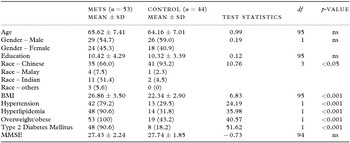
Table 1 shows the demographic characteristics and mean MMSE scores between the MetS group and the control group. Participants in the MetS group (n = 53) had significantly greater BMI, prevalence of hypertension, elevated triglycerides, T2DM, and were significantly overweight or obese compared to the control group (n = 44). Within the control group, the prevalence of T2DM, hypertension, hyperlipidemia, and overweightness and obesity matched those within the general local elderly population. There were no significant differences between groups in age, education, and gender proportion. There was no difference in mean MMSE scores between the MetS and control groups. Significant differences in racial proportions were present between the two groups (p = 0.013), hence race was included as a covariate in all subsequent analyses.
Comparisons of demographic characteristics and mean scores of MMSE among MetS and control group

Note: Figures shown are n (%).
MMSE = Mini-Mental State Examination; BMI = body mass index.
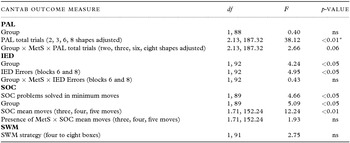
Table 2 provides a summary of the ANOVA results of CANTAB performance for MetS and control groups.
CANTAB performance for MetS and control group

*p < 0.05.
CANTAB = Cambridge Neuropsychological Test Automated Battery; PAL = paired-associate learning; IED = intra-extra dimensional set shift; SOC = stockings of Cambridge; SWM = spatial working memory.
Paired associates learning
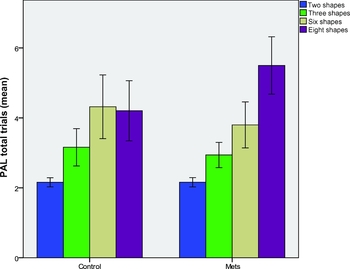
The key variables of interest for PAL were total trials (two, three, six, eight shapes adjusted) and total errors (two, three, six, eight shapes adjusted). Two separate repeated measures analyses of variance were performed, with total trials and total errors as the within-participants factors and group as the between-participants factor. Mauchly's test indicated that the assumption of sphericity had been violated in both total trials and errors analyses (χ 2 (5) = 58.22, p < 0.01; χ 2 (5) = 232.25, p < 0.001), therefore degrees of freedom were corrected using Greenhouse–Geisser estimates of sphericity (ε = 0.71 and 0.49 respectively). A significant main effect was found for total trials (two, three, six, eight shapes), (F (2.13, 187.32) = 38.12, p < 0.01) indicating that, overall, as the difficulty level increased, the number of trials required to complete the test increased. There was no significant main effect for group (F (1, 88) = 0.40, p = 0.528). The interaction effect was within the range of significance (F (2.13, 187.32) = 2.66, p = 0.069; Winer, Reference Winer1970) and permitted post hoc testing. Post hoc with Bonferroni correction for significance indicated that in the eight-shapecondition, the average number of total trials required was significantly higher in the MetS group (M = 5.50, SD = 2.89) than in the control group (M = 4.20, SD = 2.83), t(93) = 2.20, p = 0.030 (Figure 1). For total errors, no significant main effects or interaction effects were present.
Total trials of MetS and control groups in the paired-associate learning task.

Intra-extra dimensional shift
A repeated measures ANOVA was performed with IED Errors (block 8) and IED Errors (block 6) as the within-participants factor, and group as the between-participants factor. A significant main effect was found between block 8 and block 6, (F (1, 92) = 4.95, p = 0.029), revealing that more errors were committed in the EDS (block 8) than the IDS (block 6). A significant main effect was also found for group (F (1, 92) = 4.24, p = 0.042), as the MetS group committed more errors in the block 8 and block 6 conditions combined than the control group. No significant interactions were present.
Stockings of Cambridge
ANOVA revealed significant group differences, (F (1, 89) = 4.66, p = 0.034) with the control group solving significantly more problems using an optimum strategy compared to the MetS group. Repeated measures ANOVA, with mean moves (three-, four-, five-move problems) as the within-participants factor and group as the between-participants factor was performed. Mauchly's test indicated that the assumption of sphericity had been violated (χ 2 (2) = 16.31, p < 0.01), therefore degrees of freedom were corrected using Greenhouse–Geisser estimates of sphericity (ε = 0.86). A significant main effect was found for group (F (1, 89) = 5.09, p = 0.027) as the MetS group took more moves to solve each of the three-, four-, and five-move problems. Significant main effect was also found for mean moves (three-, four-, five-move problems; F (1.71, 152.24) = 12.24, p < 0.01), illustrating that as the difficulty level of the problem increased from a three-move to five-move problem, more moves were needed by both groups to solve the problems successfully. However, there was no interaction between group and mean moves.
Spatial working memory
Between-participants ANOVA showed a trend for SWM strategy (four to eight boxes; p = 0.101) but no significant effects were present.
Regression analyses
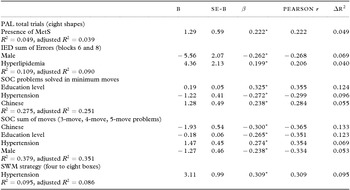
Presence of MetS, age, education, gender, race, overweightness/obesity, hypertension, hyperlipidemia, and type II diabetes mellitus were entered in a stepwise multiple regression analysis on the CANTAB variables including PAL total trials (eight shapes), IED Errors (blocks 6 and 8), SOC problems solved in minimum moves, SOC sum of moves (three-, four-, five-move problems), and SWM strategy use (four to eight boxes) separately (Table 3).
Results of stepwise multiple regression analyses for demographic and vascular risk factors that influenced CANTAB performance

*p < 0.05.
B = Unstandardized Beta coefficients; SE-B = Standard Error of Beta coefficients; CANTAB = Cambridge Neuropsychological Test Automated Battery; PAL = paired-associate learning; IED = intra-extra dimensional set shift; SOC = stockings of Cambridge; SWM = spatial working memory.
PAL total trials (eight shapes) were predicted by the presence of MetS F (1, 93) = 4.83, p < 0.05 which accounted for approximately 5% of the variance in PAL total trials (eight shapes). IED Errors (Block 6 and 8) was primarily predicted by gender (male) and to a lesser extent by presence of hyperlipidemia F (2, 94) = 5.75, p < 0.05 which accounted for approximately 7% and 4% of the unique variance respectively. SOC problems solved in minimum moves was predicted by education level and hypertension, and to a lesser extent by race (Chinese) F (3, 91) = 11.53, p < 0.05 which accounted for approximately 12%, 10% and 6% of the variance respectively. In the same vein, SOC sum of moves was primarily predicted race (Chinese) and education level, and to a lesser extent by hypertension and gender (male) F (4, 91) = 13.87, p < 0.05 which accounted for approximately 13%, 12%, 7%, and 5% of the variance. SWM strategy use was predicted by the presence of hypertension only, F (1, 94) = 9.91, p < 0.05, which accounted for approximately 10% of the variance in SWM strategy use.
Discussion
The main objective of the study was to determine the neuropsychological profile of MetS in a mixed Asian sample using a sensitive neuropsychological test battery. After adjustment of possible confounders (race, gender, education level), MetS participants consistently performed more poorly in the domains of memory and executive functioning but such deficits were subtle and only present at higher levels of cognitive processing and task difficulty. For example, in the PAL test, above chance differences occurred only at the highest difficulty level (eight shapes). MetS participants required more trials to successfully complete the level indicating deficits in non-verbal learning and learning visual memory. This is in accordance with preceding studies reporting comparatively worse new learning and poorer recall amongst MetS individuals compared with controls (Dik et al., Reference Dik2007; Hassenstab et al., Reference Hassenstab, Sweat, Bruehl and Convit2010) although we tested participants with visuospatial memory tests.
Executive function was also impaired as MetS participants showed consistently lower performance compared with controls. First, in the IED test, MetS participants made more errors in the IDS and EDS phases combined with inability to make shifts in mental set to solve problems indicating a reduction in cognitive flexibility. Second, in the SOC test, MetS participants solved fewer problems in the stipulated number of moves and required more moves in order to successfully solve a problem, indicating reduced overall planning accuracy. Third, whilst only a trend, responses on the SWM test suggested that MetS participants had a poorer use of strategy when searching for the blue tokens to complete the task. The results relating to executive abilities of MetS individuals concur with Dik et al. (Reference Dik2007) and Hassenstab et al. (Reference Hassenstab, Sweat, Bruehl and Convit2010) who found cognitive aspects of fluid intelligence, executive functioning, and overall intellectual functioning to be inversely associated with MetS. Our findings are based on sensitive measures of executive function that point to subtle issues of cognitive flexibility and planning.
Whilst we did not examine the entire gamut of neuropsychological functions, on the whole the findings are in line with most western studies with middle-aged or “young old” cohorts, i.e. individuals in our study were aged 55 years and above, with fewer patients above 75 (mean age = 65 years old; Dik et al., Reference Dik2007; Ho et al., Reference Ho, Niti, Yap, Kua and Ng2008; Hassenstab et al., Reference Hassenstab, Sweat, Bruehl and Convit2010), and mirror previous studies which have reported memory and executive function deficits in association with vascular disease. Comparably, Hassenstab and colleagues (Reference Hassenstab, Sweat, Bruehl and Convit2010) reported that MetS patients showed impaired cognitive function in a normal aging study of individuals (mean age = 60.4 years) compared with age- and education-matched controls. Nordlund et al. (Reference Nordlund, Rolstad, Klang, Lind, Hansen and Wallin2007) showed significantly worse performance on tests of attention, visuospatial functions, and executive functions in MCI patients with vascular disease (i.e. hypertension, hyperlipidemia, diabetes mellitus) compared with MCI patients without vascular disease.
Our findings contrast with a number of studies that have failed to establish an association between MetS and impaired cognition. Reports of no association, a decelerated decline, or even better cognitive functioning in older MetS patients have been shown in several studies including the Olmsted study with participants aged between 70 to 89 years (Roberts et al., Reference Roberts2010), the Leiden-85 Plus study with individuals aged 85 years and above (van den Berg, et al., Reference van den Berg, Biessels, de Craen, Gussekloo and Westendorp2007), and the Tuscan (Italy) aged 75 years and above (Laudisio et al., Reference Laudisio2008), respectively. The effect we see may be because our study contained “young old” participants who acquire MetS earlier in life. Alternately, many of the more severe MetS patients in older cohort studies may have already progressed to dementia or death from other causes, leaving a relatively intact group under investigation. However, the possibility that Asian patients may develop a more severe form of MetS as a consequence of elevated vascular risk also cannot be ruled out at this stage. Further large-scale studies are required to investigate this possibility.
The second objective of the study was to examine the individual influences of vascular risk and intrademographic factors (age, race, education level) on performance. The presence of MetS by itself exerted a significant influence on PAL performance in terms of total trials but not errors. Because PAL does not permit verbal strategies to assist encoding, it is viewed as more sensitive to encoding deficits than other memory tests and has demonstrated ability to detect early learning deficits in a-MCI and AD (Swainson et al., Reference Swainson2001; de Jager et al., Reference de Jager, Milwain and Budge2002; Fowler et al., Reference Fowler, Saling, Conway, Semple and Louis2002; Nestor et al., Reference Nestor, Scheltens and Hodges2004; Mitchell et al., Reference Mitchell, Arnold, Dawson, Nestor and Hodges2009; Junkkila et al., Reference Junkkila, Oja, Laine and Karrasch2012) and discriminate between a-MCI and AD (Hammers et al., Reference Hammers2011; Junkkila et al., Reference Junkkila, Oja, Laine and Karrasch2012). Although previous studies of AD have tended to show impairments expressed in the number of errors rather than trials, this effect may be age related (Lee et al., Reference Lee, Archer, Wong, Chen and Qiu2013) and present in the oldest patients (Junkkila et al., Reference Junkkila, Oja, Laine and Karrasch2012), and not as common in midlife. Moreover, in the current data, the effect on number of trials is only apparent at the highest level of difficulty suggesting that it is potentially more subtle than in AD. As such, the inclusion of PAL in future MetS follow-up studies is further underlined.
In addition to the general effect of MetS on associate learning and memory, the presence of hyperlipidemia and hypertension may exert individual effects on executive function caused by cerebrovascular disease and cerebral atrophy. Hyperlipidemia was associated with poorer attentional or set shifting flexibility on the IED task whereas hypertension was consistently associated with reduced spatial planning ability and strategy use on the SOC task. Hyperlipidemia in Caucasians is an early risk factor for Alzheimer's disease and has been associated with impaired memory (Waldstein et al., Reference Waldstein1996; Zhang et al., Reference Zhang, McKeown and Hajjar2005). In contrast, hypertension in Caucasians is linked to impaired executive abilities in adults without dementia (Elias et al., Reference Elias, Wolf, D’Agostino, Cobb and White1993; Panza et al., Reference Panza2010), and it predicts progression to dementia in older people who demonstrate executive dysfunction but not memory dysfunction (Oveisgharan and Hachinski, Reference Oveisgharan and Hachinski2010), suggesting that executive dysfunction is the primary neuropsychological marker of vasculopathy and possible future decline. Goldstein et al. (Reference Goldstein, Ashley, Endeshaw, Hanfelt, Lah and Levey2008) reported that the presence of hypertension and hyperlipidemia, but not their severity, were related to cognitive performance in AD patients. Both are linked to white matter damage and have been independently associated with smaller prefrontal cortex and underlying white matter volumes as well as increased frontal WMH (Raz et al., Reference Raz, Rodrigue and Acker2003; Reference Raz, Rodrigue, Acker and Kennedy2007; Yoshita et al., Reference Yoshita2006). The association between white matter lesions and progression of brain atrophy (Enzinger et al., Reference Enzinger2005; Schmidt et al. Reference Schmidt2005; Raz et al Reference Raz, Rodrigue, Acker and Kennedy2007) indicates that cerebral small-vessel disease leads to cognitive impairment through generalized brain atrophy. Further large-scale studies can consider individual contributions of vascular risk factors relative to neuropathology in the context of MetS in terms of both individual and additive effects.
Possible protective factors were present in male gender and education on some tests. For executive abilities, males tended to perform better in the IED and SOC tests, while higher education level was also positively correlated with better performance in the SOC test. Previous studies suggest females with MetS are twice as likely to develop cognitive impairment (Schuur et al., Reference Schuur2010) and demonstrate poorer executive function (Hilal et al., Reference Hilal2013). Whilst males tend to outperform females in spatial tasks at a sample level and this may have influenced the findings, the sample size here is rather small to elicit such trends. The effect may be more due to lower education levels in females than gender per se as previous local studies have shown that poorer neuropsychological test performance in cognitively normal elderly is influenced by the number of education years attained (Lee et al., Reference Lee, Collinson, Feng and Ng2012). In Singapore, those with less than one year and more than six years of education have also shown significant differences in dementia prevalence of 1.9% and 0.4% respectively (Sahadevan et al., Reference Sahadevan2008). Furthermore, as compared to the Chinese, dementia distribution among the Malays and Indians is 1.9 and 2.3 times higher (Sahadevan et al., Reference Sahadevan2008). In view of the potential interactive influence of Mets-related cognitive impairment with education, race, and dementia risk, further large-scale studies would be helpful in determining if demographic differences in Mets patients translate to differential risk for dementia across the various strata of Asian societies.
The present study has several limitations. Foremost is the limitation of its cross-sectional design which prohibits causal inferences between MetS and cognitive decline. Second, due to the unselected nature of the sample, there was a preponderance of Chinese participants who show the lowest prevalence of Mets within the Singapore population (Tan et al., Reference Tan, Ma, Wai, Chew and Tai2004; Ho et al., Reference Ho, Niti, Yap, Kua and Ng2008), which suggests genetic, diet, and lifestyle factors could, despite the presence of MetS, offer some protection from cognitive decline. Greater numbers of Malay and Indian participants would have permitted clearer statements regarding the important effect of race on Mets-related cognitive change; hence the present findings in relation to race are highly tentative and require replication in a larger sample. In addition, the effect of the level of control of the individual risk factors of hypertension, dyslipidaemia, diabetes mellitus, and the effects of treatment complications, such as hypoglycaemia, were not studied. In general, the percentages of variance explained by the data are somewhat small and imply that these or other unaccounted variables may contribute more variance that is presently unaccounted for or, alternatively, could reduce the strength of the observed associations. Finally, genetic susceptibility and markers of inflammation were not assessed in this study. The ε4 allele of Apolipoprotein E (APOE-ε4) is a recognized risk factor for AD and among APOE-ε4 carriers, inflated risk of cognitive impairment or dementia is associated with hypertension (Carmelli et al., Reference Carmelli1998), diabetes mellitus, and hyperlipidemia (Blair et al., Reference Blair, Folsom, Knopman, Bray, Mosley and Boerwinkle2005). Feng et al. (Reference Feng2013) showed in Singaporeans that the principal component of MetS, central obesity, showed increased odds of association with a-MCI but this association was strongest among APOE-ε4 carriers and at younger age. Similarly, inflammation biomarkers have been linked to a heightened risk of cognitive decline and dementia particularly (C-reactive protein; Dik et al., Reference Dik2007). Future studies would benefit from the inclusion of both lipid and inflammatory biomarkers.
Conclusion
MetS is a serious health condition that appears to have negative consequences on cognitive function as the brain ages. Asians may be particularly vulnerable to the detrimental impacts of MetS and early detection of subtle neuropsychological abnormalities in older adults without dementia, and effective management of vascular risks will aid in successful aging and preservation of quality of life. Currently, whilst the cure for dementia remains elusive, the only option we have is to target those at risk and take all measures to delay its onset.
Conflict of interest
None.
Description of author's roles
S.L. Collinson supervised the analysis of the data and wrote the paper. R.A. Merchant designed the study and supervised the data collection process. S.J.F. Tong collected the data and assisted with writing the paper. S.S.K. Loh was responsible for the analysis of the data and assisted with writing the paper. S.B. Chionh assisted in the data collection process and provided expert consultation.
Acknowledgments
This study was funded by the Oon Chiew Seng Fellowship grant.