Implantable cardioverter defibrillators (ICDs) are an effective treatment for the primary prevention of arrhythmic events and mortality in patients with severe left-ventricular dysfunction. Data from primary prevention randomized controlled trials (RCTs) suggest that the use of ICDs is associated with a relative risk reduction of 19 percent, whereas observational data suggest the relative risk reduction may be as high as 46 percent (Reference Ezekowitz, Rowe and Dryden23). However, ICDs are an expensive treatment, particularly in the setting of primary prevention, because many patients will not experience severe arrhythmic events (Reference Hreybe, Bedi and Ezzeddine28;Reference Wilkoff, Hess, Young and Abraham55). Although some previous cost-effectiveness analyses suggest that ICD therapy for primary prevention may be cost-effective (Reference Owens, Sanders and Harris44;Reference Sanders, Hlatky and Owens47), others suggest the contrary (Reference Bryant, Brodin, Loveman and Clegg12;Reference Buxton, Caine and Chase13;Reference O'Brien, Connolly and Goeree42). Consequently, there is a need to identify which patients will derive the greatest benefit from this effective but expensive therapy.
Recent studies suggest that microvolt T-wave alternans (MTWA) predicts mortality and severe arrhythmic events in this population (Reference Cohen18;Reference Klingenheben and Ptaszynski30;Reference Van Der Avoort, Filion, Dendukuri and Brophy53). MTWA is an inexpensive diagnostic test analogous to a traditional treadmill test. Patients with non-negative (either positive or indeterminate) MTWA test results have a threefold increased risk of mortality or severe arrhythmias compared with those with a negative test (Reference Van Der Avoort, Filion, Dendukuri and Brophy53). MTWA has thus been suggested as a method to risk stratify this patient population and identify the patients most likely to benefit from ICD implantation. However, the impact of MTWA on ICD cost-effectiveness is unknown. Therefore, the objective of this study was to examine the effect of MTWA testing on ICD cost-effectiveness in primary prevention among patients with severe left-ventricular dysfunction.
METHODS
Decision-Analysis Model
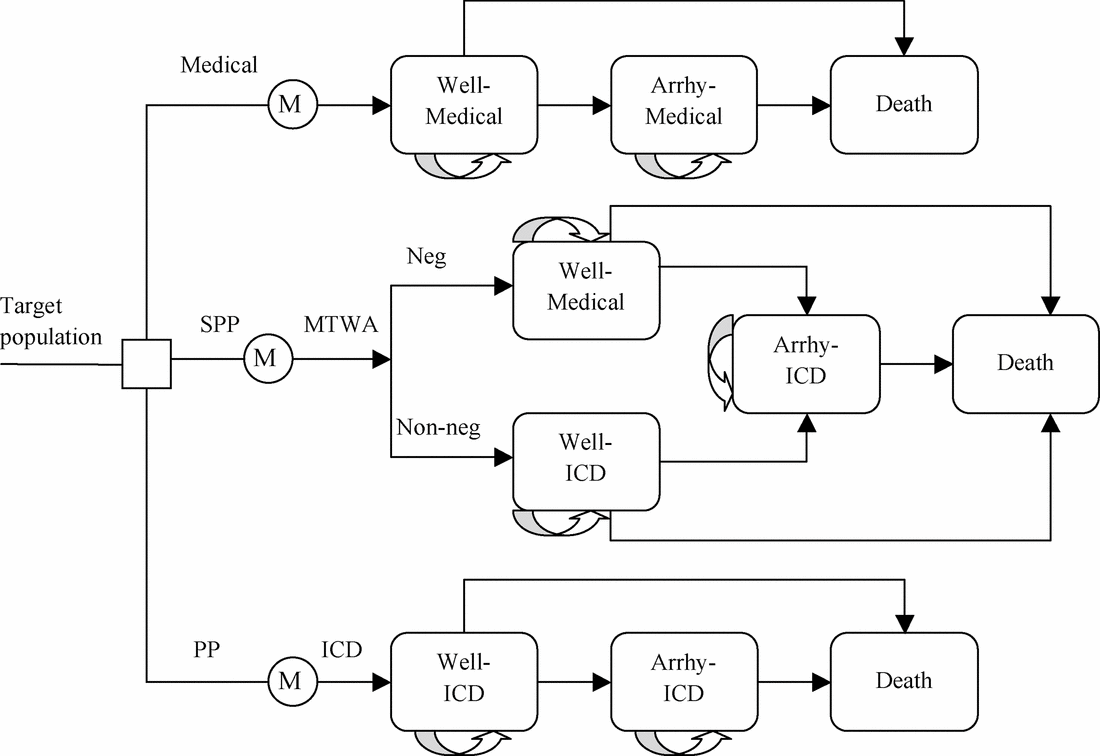
Our Markov model evaluated three treatment strategies for primary prevention in patients with severe left-ventricular dysfunction: (i) medical therapy for all, (ii) ICD therapy for all, and (iii) selective ICD therapy based on non-negative (positive or indeterminate) MTWA test results (Figure 1). Each treatment strategy had three possible health states (well, nonfatal arrhythmic events, and death). The model used 3-month cycles, and costs and quality-adjusted life-years (QALYs) were projected over a 10-year horizon.
Markov decision analysis model of treatment options for primary prevention. The three treatment strategies are as follows: (i) medical therapy for all, (ii) ICD therapy for all, and (iii) selective ICD therapy based on non-negative (positive or indeterminate) MTWA test results. In this model, square nodes denote decision nodes, round notes with an “M” indicate the Markov model treatment options, square text boxes denote Markov health states, and arrows indicate pathways. Arrhy, arrhythmia; ICD, implantable cardioverter defibrillator; Med, medical thrapy; MTWA, microvolt T-wave alternans; Neg, negative MTWA; Non-neg, non-negative MTWA; PP, primary prevention involving ICD therapy for all; SPP, selective primary prevention based on MTWA test results.

Model Inputs
Data were obtained from the best available evidence, with an emphasis placed on results of previous meta-analyses and RCTs. Expert opinion was used for model inputs for which published data were unavailable or inappropriate.
Transition Probabilities. ICD efficacy data were derived from a recent meta-analysis (Reference Ezekowitz, Rowe and Dryden23). We assumed that the efficacy of ICD therapy relative to medical therapy is constant over time. We also assumed that ICDs are similarly efficacious in low- and high-risk patients. Pooled baseline mortality rates for the medical therapy group were not reported in this meta-analysis. Consequently, we systematically reviewed the literature to identify RCTs examining the efficacy of ICD therapy for primary prevention in adults with severe left-ventricular dysfunction, and we pooled data from identified studies using a random-effects generalized linear mixed model (Reference Chu and Cole17;Reference Hamza, van Houwelingen and Stijnen26) to estimate this annual mortality rate. We then derived age-specific population mortality rates using Canadian major chronic diseases mortality rates (45).
Our model inputs for MTWA testing are based on our recently completed systematic review and hierarchical Bayesian meta-analysis of the predictive ability of MTWA testing in patients with severe left-ventricular dysfunction (Reference Van Der Avoort, Filion, Dendukuri and Brophy53). The effect measure from this meta-analysis was combined with the baseline mortality rate and the proportion of negative and nonnegative MTWA tests to obtain annual mortality rates for each MTWA category.
We calculated the annual rate of nonfatal arrhythmic events by multiplying the initial resuscitation rate by the proportion of patients who survive ventricular fibrillation or tachycardia (Reference Chan, Stein and Chow15;Reference Stiell, Wells and Demaio50). Once patients suffer nonfatal arrhythmic events, they moved to the “arrhythmia” state in our model. We pooled annual mortality rates of the medical therapy control groups of ICD secondary prevention RCTs to obtain the baseline mortality rate for patients in this “arrhythmia” state. These data were combined with efficacy measures for ICD therapy in secondary prevention to estimate the mortality rate in secondary prevention patients with ICDs.
Costs. This economic analysis was conducted from the perspective of the Canadian healthcare system and thus focuses on direct health care costs, including professional fees. For modeling purposes, we categorized costs into two types: (i) transition, or one-time, costs; and (ii) state, or general recurrent, costs. The sum of the transition and state costs represents the total costs. All costs are presented in 2007 Canadian dollars (CAD) and were adjusted by purchasing power parities and consumer price index, healthcare component (43;49). Costs of ICD implantation were derived from our technology assessment conducted at our institution (Reference McGregor and Chen37). Previous studies suggest that an ICD can last 6 years (Reference Maisel, Sweeney, Stevenson, Ellison and Epstein35;Reference Medical48;Reference Yao, Freemantle and Calvert56), at which point a new ICD is implanted. We determined annual general care costs for patients in the “Well-ICD” and “Well-medical” states by adding the cost of anti-arrhythmic medical therapy to the Canadian age-specific average annual expenditures per capita (14;Reference O'Brien, Connolly and Goeree42). Cost data for nonfatal arrhythmic events were not available; we approximated these costs with those of atrial fibrillation (Reference Eckman, Falk and Pauker21;Reference Le Heuzey, Paziaud and Piot34;Reference Marshall, Levy and Vidaillet36). Previous studies suggest that the cost of a second ICD implantation and ICD battery replacement are similar to those of initial ICD implantation (Reference McGregor and Chen37). Consequently, we assumed that all ICD implantations had equal costs.
Utilities. Previous studies have provided conflicting estimates of the effect of ICD therapy on health-related quality of life (Reference Buxton, Caine and Chase13;Reference McGregor and Chen37). We have, therefore, assumed that patients in the medical therapy and ICD therapy groups have similar quality of life. Estimates for quality of life, assessed using the EuroQoL-5 dimensions (EQ-5D) scale, were obtained from the literature (Reference Buxton, Caine and Chase13). The effect of nonfatal arrhythmic events on quality of life remains poorly understood but was estimated by the decrease in quality of life following defibrillator shocks (Reference Buxton, Caine and Chase13).
Cost-Effectiveness Analysis
Using our decision-analysis model, we compared the cost-effectiveness of the three treatment strategies. Our main outcome measure was the incremental cost-effectiveness ratio (ICER), measured in cost per QALY gained. Our base-case model involved annual discount rates of 3 percent for both utilities and costs (Reference Drummond, Sculpher, Torrance, O'Brien and Stoddart20), which were accrued over a 10-year period. There is no universally accepted maximum willingness-to-pay threshold in Canada and thus, we examined cost-effectiveness at three different thresholds: $20,000, $50,000, and $100,000/QALY (Reference Laupacis, Feeny, Detsky and Tugwell33).
We conducted univariate sensitivity analyses to identify the primary variables influencing our ICERs. We then further examined the effect of these variables in two-way sensitivity analyses. Ranges for sensitivity analyses were primarily based on 95 percent confidence intervals (CI) obtained from the literature. We also conducted probabilistic sensitivity analyses using second order Monte Carlo simulations (10,000 samples). In these probabilistic sensitivity analyses, transition probabilities and utilities were assumed to follow beta distributions (Reference Briggs10). Costs, hazard ratios (HR), and relative risks (RR) were assumed to follow gamma distributions (Reference Miners, Cairns, Fox-Rushby and Cairns38), and mortality rates were assumed to follow normal distributions. Analyses were conducted using Treeage pro Suite 2007, SAS 9.1, and Excel 2003.
RESULTS
Model Inputs
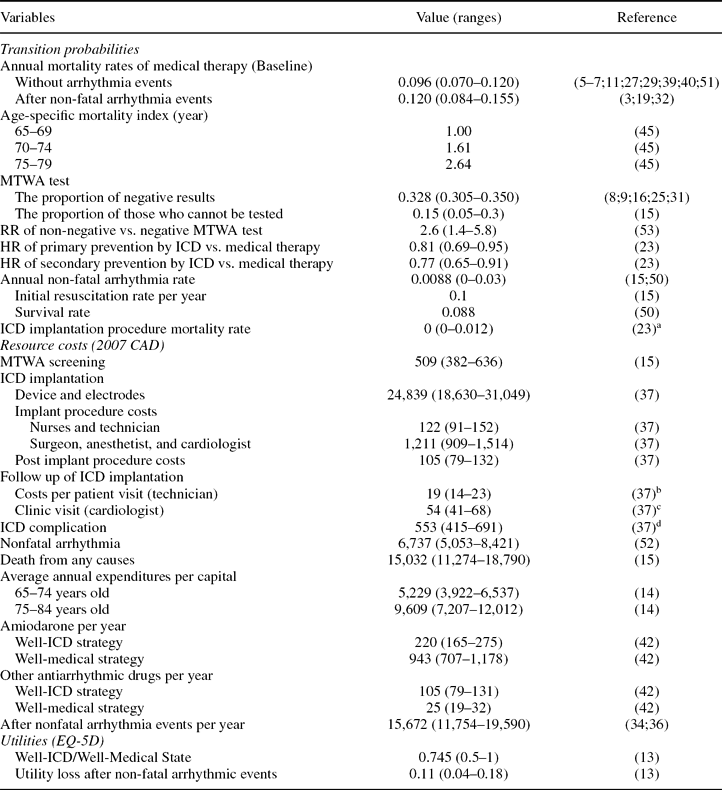
Model inputs are described in Table 1. Efficacy data for ICD therapy and MTWA were obtained from previous meta-analyses (Reference Ezekowitz, Rowe and Dryden23;Reference Van Der Avoort, Filion, Dendukuri and Brophy53). Our literature review identified 9 ICD primary prevention RCTs (Reference Bansch, Antz and Boczor5–Reference Bigger7;Reference Bristow, Saxon and Boehmer11;Reference Hohnloser, Kuck and Dorian27;Reference Kadish, Dyer and Daubert29;Reference Moss, Hall and Cannom39;Reference Moss, Zareba and Hall40;Reference Strickberger, Hummel and Bartlett51), and pooling of these data revealed an annual mortality rate in the medical therapy group of 0.096/year. Efficacy data were obtained from the meta-analysis by Ezekowitz and colleagues (Reference Ezekowitz, Rowe and Dryden23), who found a HR for all-cause mortality of 0.81 (95 percent CI, 0.69–0.95) among patients randomized to ICD therapy compared with those randomized to medical therapy. From our recent MTWA meta-analysis, we estimated the proportion of patients with negative MTWA to be 32.8 percent. We also approximated that 15 percent of patients are unable to undergo exercise testing (Reference Chan, Stein and Chow15) and included them with non-negative MTWA patients. The risk of mortality or severe arrhythmic events was 2.6 times greater in patients with non-negative MTWA than in those with negative MTWA (95 percent credible interval, 1.4–5.8) (Reference Van Der Avoort, Filion, Dendukuri and Brophy53). We estimated the quality of life of patients in the ‘well’ state is 0.745 on the EQ-5D scale (Reference Buxton, Caine and Chase13).
Model Inputs

a Mortality rate associated with ICD implantation is 0 at the McGill University Health Centre. Consequently, we have used this rate in our base case. In sensitivity analyses, we increased this rate from 0 to 0.012, the rate reported in previous reviews (Reference Ezekowitz, Rowe and Dryden23).
b Follow-up begins at 1 week after implant and consists of one visit every 3 months.
c Follow-up begins at 1 week after implant and consists of one visit every year.
d The weighted cost per patient of all main possible complications, including lead displacement, infection, pneumothorax, perforation, and bleeding.
CAD, Canadian dollars; EQ-5D, Euro-QoL–5 dimensions (22); HR, hazard ratio; ICD, implantable cardioverter defibrillator; MTWA, microvolt T-wave alternans; RR, relative risk.
Base Case
The differences in ICER were driven by differences in costs and efficacy (Table 2). A treatment strategy involving ICD therapy in all patients was associated with an ICER of $121,800/QALY compared with medical therapy. A treatment strategy involving the selective use of ICDs based on MTWA test results was associated with an ICER of $108,900/QALY compared with medical therapy. Although neither ICD therapy for all patients or selective ICD therapy were cost-effective compared with medical therapy at willingness-to-pay thresholds of $20,000, $50,000, or $100,000 CAD, selective ICD therapy based on MTWA test results decreased the ICER relative to medical therapy by approximately 10 percent.
Results of Primary Cost-Effectiveness Analyses Examining Cost-Effectiveness of Three Treatment Strategies

a The selective ICD therapy treatment strategy involves the implantation of ICDs only in those with non-negative (positive or indeterminate) MTWA test results.
CAD, Canadian dollars; ICD, implantable cardioverter defibrillator; ICER, incremental cost-effectiveness ratio; LYs, life-years; MTWA, microvolt T-wave alternans; QALY, quality-adjusted life-years.
Sensitivity Analyses
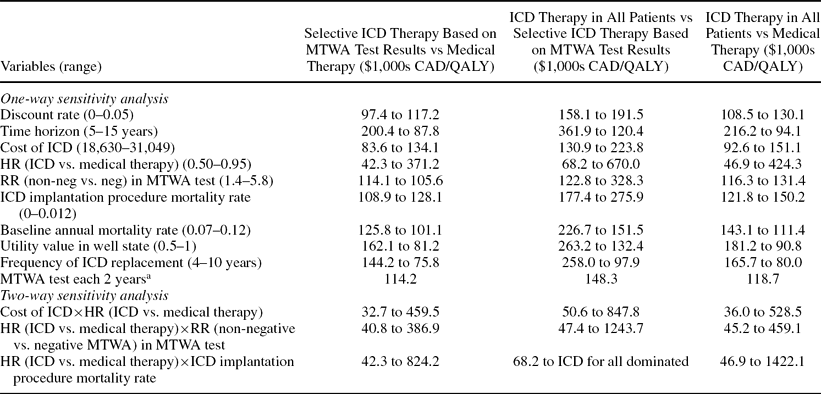
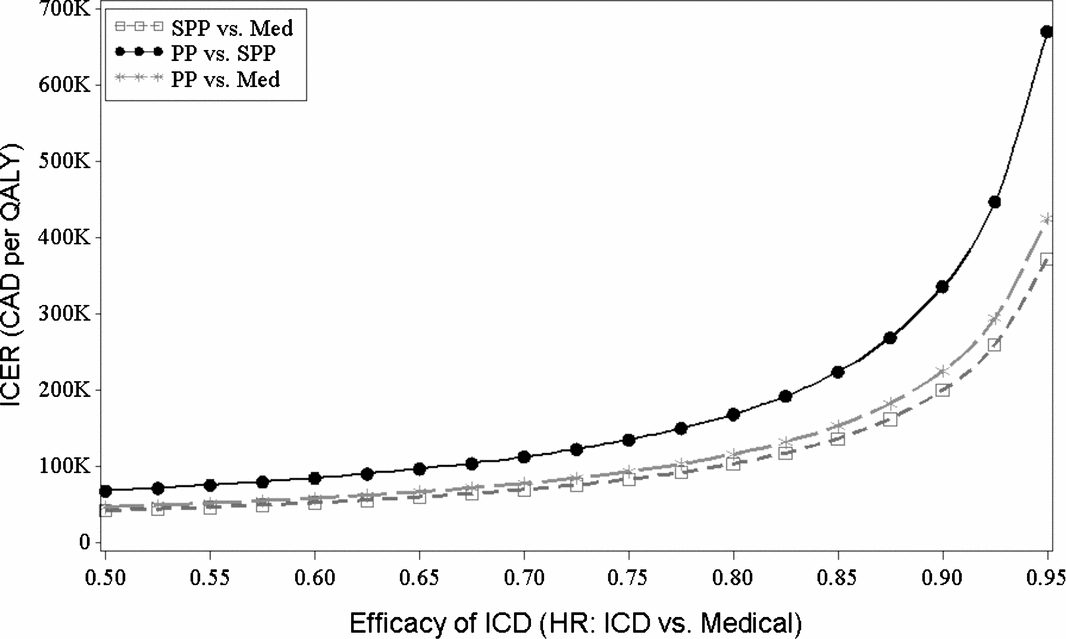
We examined the robustness of our ICER estimates by varying our model inputs in both one-way and two-way sensitivity analyses (Table 3). The parameters that had the greatest effect of the ICER values were the time horizon, the cost of ICD implantation, the frequency with which ICDs needed to be changed, and the efficacy of ICD therapy (Figure 2). The efficacy of ICD therapy relative to medical therapy had a particularly important effect. Our sensitivity analyses revealed that, under most scenarios, both ICD therapy for all and selective ICD therapy based on MTWA test results were associated with ICERs that were greater than $100,000/QALY. In additional sensitivity analyses, we assumed that all patients who suffered a nonfatal arrhythmic event received an ICD, regardless of treatment strategy. This analysis had similar results as those reported in our base case (data not shown).
One-Way and Two-Way Sensitivity Analyses Examining the Effect of Model Inputs on Estimates of Cost-Effectiveness of Different Treatment Strategies

a We estimated that the proportion of negative results and those who cannot be tested are 0.80 and 0.03, respectively, in subsequent MTWA tests.
CAD, Canadian dollars; HR, hazard ratio; ICD, implantable cardioverter defibrillator; ICER, incremental cost effectiveness ratio; MTWA, microvolt T-wave alternans; QALY, quality-adjusted life-year; RR, relative risk.
Sensitivity analysis examining the effect of efficacy of implantable cardioverter defibrillators on the cost-effectiveness of three treatment strategies. The three treatment strategies are as follows: (i) medical therapy for all, (ii) ICD therapy for all, and (iii) selective ICD therapy based on non-negative (positive or indeterminate) MTWA test results. CAD, Canadian dollars; ICD, implantable cardioverter defibrillator; Med, medical therapy; PP, primary prevention involving ICD therapy for all; SPP, selective primary prevention based on MTWA test results.

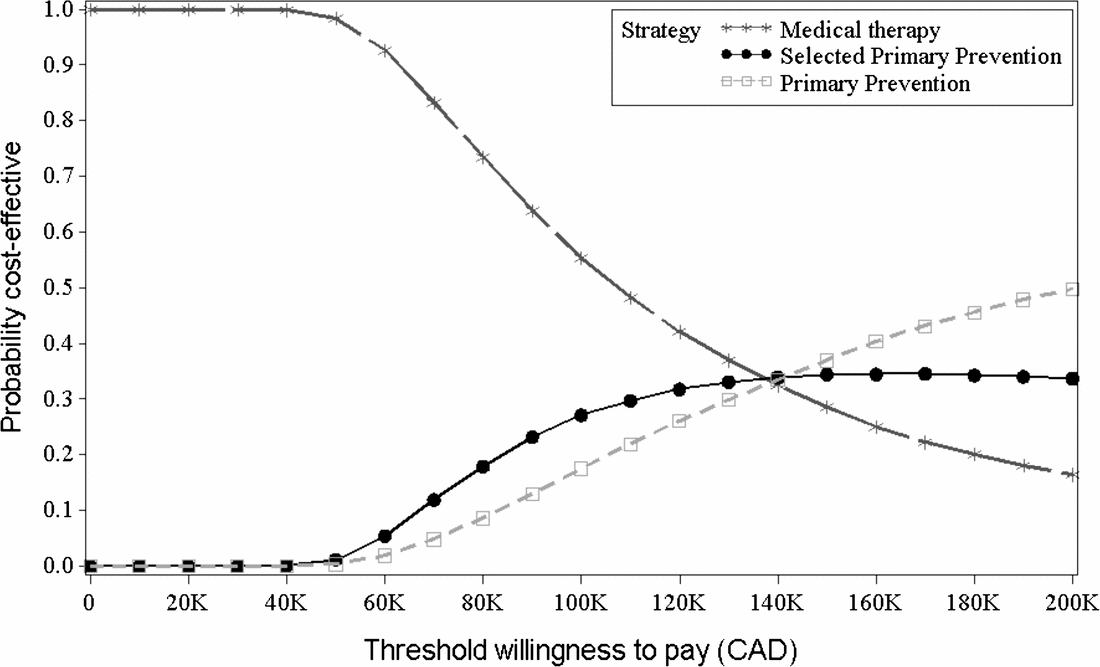
We also conducted multivariate probabilistic sensitivity analyses, examining the probability that each treatment strategy was cost-effective while varying the willingness-to-pay threshold from $0/QALY to $200,000/QALY (Figure 3). At a willingness-to-pay of $40,000/QALY, the probability that medical therapy is more cost-effective than the other two strategies was 100 percent. Conversely, ICD therapy for all was cost-effective compared with the other two strategies for willingness-to-pay thresholds of ≥$140,000/QALY. Probabilistic sensitivity analyses also indicated that the probability that the selective use of ICDs is cost-effective compared with medical therapy was 36.6 percent and 1.1 percent at willingness-to-pay thresholds of $100,000/QALY and $50,000/QALY, respectively.
Probabilistic sensitivity analysis examining the effect of the willingness-to-pay threshold on the probability that the treatment strategies are considered cost-effective. The three treatment strategies are as follows: (i) medical therapy for all, (ii) ICD therapy for all, and (iii) selective ICD therapy based on non-negative (positive or indeterminate) MTWA test results. CAD, Canadian dollars.

DISCUSSION
Our study was designed to examine the effect of MTWA testing on the cost-effectiveness of ICD therapy for primary prevention in patients with severe left-ventricular dysfunction. We found that both a treatment strategy of ICD therapy for all patients as well as a strategy involving the selective use of ICD therapy based on MTWA test results are not cost-effective compared with medical therapy. Although MTWA modestly improved the cost-effectiveness of ICDs for primary prevention, MTWA testing did not reduce the cost-effectiveness of ICDs to below the willingness-to-pay threshold of $100,000/QALY, the upper limit of the proposed “gray zone” of cost-effectiveness (Reference Greenberg, Bakhai and Cohen24). The medical therapy treatment option was the most cost-effective option up to a willingness-to-pay of $140,000/QALY. Consequently, in light of the limited resources available, this economic analysis does not support the unrestricted use of ICDs for primary prevention with the addition of MTWA testing to assist in patient stratification.
Several other diagnostic tests have been proposed for the risk stratification of this patient population. These tests include the use of left-ventricular ejection fraction, ambulatory electrocardiogram (Reference Verrier, Kumar and Josephson54), QT interval dispersion (Reference Sakabe, Ikeda and Sakata46), and electrophysiological testing (Reference Amit, Costantini, Super and Rosenbaum2). There remains a need to further investigate the predictive ability and cost-effectiveness of these tests and hopefully identify a cost-effective method to risk stratify this patient population.
Only one other study has examined the effect of MTWA on the cost-effectiveness of ICD therapy. Chan and colleagues (Reference Chan, Stein and Chow15) also examined MTWA for primary prevention and similarly found that MTWA testing improved the cost-effectiveness of ICD therapy by only a modest $7,000/QALY. Notwithstanding this similarity with our study, the study by Chan et al. had several significant differences with ours. Importantly, they found the baseline ICER for ICD implantation to be $55,800/QALY compared with our result of $121,800/QALY. Their study was conducted using U.S. costs from a societal perspective and, thus, included direct costs and indirect costs, including loss of productivity. Our study was conducted using 2007 CAD from the perspective of a third party payer. Second, their estimates for the predictive ability of MTWA testing were based on a single, large cohort study (Reference Chow, Kereiakes and Bartone16), whereas our MTWA measures our based on a recently completed meta-analysis (Reference Van Der Avoort, Filion, Dendukuri and Brophy53). Third, we have used a more systematic (and conservative) measure of ICD efficacy. This previous study (Reference Chan, Stein and Chow15), as well as other ICD cost-effectiveness studies (Reference Al-Khatib, Anstrom and Eisenstein1;Reference Mushlin, Hall and Zwanziger41), have used ICD efficacy measures from the MADIT (HR = 0.46) (Reference Moss, Hall and Cannom39) and MADIT-II trials (HR = 0.69) (Reference Moss, Zareba and Hall40). In our cost-effectiveness study, we have based our ICD efficacy inputs on the results of a recently completed meta-analysis of all ICD RCTs (HR = 0.81) (Reference Ezekowitz, Rowe and Dryden23). This discordant measure of efficacy obviously directly increases the ICER associated with its use.
Our study has several important strengths. First, we based our model inputs on the totality of the best available and recent evidence, including several meta-analyses. This includes a recently completed systematic review and meta-analysis of MTWA as a predictor of mortality and severe arrhythmias in patients with severe left-ventricular dysfunction (Reference Van Der Avoort, Filion, Dendukuri and Brophy53). Second, our decision analysis has targeted a clinically important patient population as primary prevention patients represent the majority of the economic burden associated with ICD therapy. Third, our sensitivity analyses demonstrated that, under most reasonable assumptions, our results are consistent.
Our study also has potential limitations. First, as is true with all decision-analyses, our model is based on a certain set of assumptions. However, our sensitivity analyses revealed that our results are robust under all reasonable situations. Second, it has been suggested that patients with negative MTWA should be retested every 1–2 years (Reference Armoundas, Hohnloser, Ikeda and Cohen4). However, to our knowledge, no study examining the utility of MTWA testing included retesting (Reference Van Der Avoort, Filion, Dendukuri and Brophy53). We, therefore, did not include retesting in our base-case model. We did, however, include retesting every 2 years in our sensitivity analyses. This retesting resulted in additional ICD implantation in the selective primary prevention strategy and higher ICER compared with medical therapy. Thus, our base-case scenario of no retesting represents a conservative assumption. Third, although we used the best available evidence for MTWA efficacy, the quality of this evidence is limited. There remains a need for RCTs to examine the efficacy of MTWA. Finally, this analysis was conducted from the perspective of a third party payer in the context of the Canadian healthcare system, and these results may, therefore, not be generalizable to other healthcare systems.
CONCLUSIONS
MTWA only marginally improves the cost-effectiveness of ICDs for primary prevention in patients with severe left-ventricular dysfunction. Under most scenarios, including the most likely scenario, both ICD therapy for all and selective ICD therapy based on MTWA test results are not cost-effective compared with medical therapy in this patient population. Consequently, there remains an economic need for improved means to effectively identify which patients will derive the greatest benefit from ICD implantation.
CONTACT INFORMATION
Kristian B. Filion, MSc (kristian.filion@mail.mcgill.ca), Doctoral Candidate, Department of Epidemiology, Biostatistics, and Occupational Health, McGill University, 1020 Pine Avenue West Montreal, Quebec H3A 1A2, Canada; Division of Clinical Epidemiology, McGill University, 687 Pine Avenue West (Ross Pavilion), Suite R4.06, Montreal, Quebec H3A 1A1, Canada
Xuanqian Xie, MSc (shawn.xie@muhc.mcgill.ca), Research Assistant, Technology Assessment Unit, Royal Victoria Hospital, McGill University Health Center, 687 Pine Avenue West, Room: R4.14, Montreal, Quebec H3A 1A1, Canada
Charlotte J. van der Avoort, MSc (charlotte.vanderavoort@gmail.com), Intern, Department of Epidemiology, Biostatistics, and HTA, Radboud University Nijmegen Medical Centre, Geert Grooteplein Noord 21, route no. 138, 6500 HB Nijmegen, the Netherlands
Nandini Dendukuri, PhD (nandini.dendukuri@mcgill.ca), Assistant Professor, Department of Epidemiology, Biostatistics and Occupational Health, McGill University, 1020 Pine Avenue West Montreal, Quebec H3A 1A2, Canada; Director, Technology Assessment Unit, McGill University Health Center, 687 Pine Avenue West, Room: R4.14, Montreal, Quebec H3A 1A1, Canada
James M. Brophy, MD, PhD (james.brophy@mcgill.ca), Professor of Medicine & Epidemiology, Department of Medicine, McGill University Royal Victoria Hospital, McGill University Health Center, 687 Pine Avenue West, Room: R4.14, Montreal, Quebec H3A 1A1, Canada