1. Introduction
The exponential family
 $f_a(z) = e^z + a$
;
 $a\in \mathbb C$
, is the most studied family of functions in the theory of the iteration of transcendental entire functions. For any parameter
 $a\in \mathbb C$
, the Julia set
 $J(f_a)$
is known to be equal to the closure of the escaping set
 $I(f_a)\,:\!=\,\{z\in \mathbb C\,:\,f_a^n(z)\to\infty\}$
[Reference Eremenko and Lyubich8]. And when a belongs to the Fatou set
 $F(f_a)$
(e.g. when
 $a\in ({-}\infty,-1]$
), the Julia set
 $J(f_a)$
can be written as a union of uncountably many disjoint curves and endpoints [Reference Devaney and Krych6, Reference Evdoridou and Rempe–Gillen9]. A point
 $z\in J(f_a)$
is on a curve if there exists an arc
 $\alpha\,:\,[{-}1,1]\hookrightarrow I(f_a)$
such that
 $\alpha(0)= z$
. A point
 $z_0\in J(f_a)$
is an endpoint if
 $z_0$
is not on a curve and there is an arc
 $\alpha\,:\,[0,1]\hookrightarrow J(f_a)$
with
 $\alpha(0)=z_0$
and
 $\alpha(t)\in I(f_a)$
for all
 $t\in (0,1]$
. The set of all endpoints of
 $J(f_a)$
is denoted
 $E(f_a)$
.
The first to study the surprising topological properties of the endpoints was Mayer in 1988. He proved that
 $\infty$
is an explosion point for
 $E(f_a)$
for all attracting fixed point parameters
 $a\in ({-}\infty,-1)$
[Reference Mayer16]. That is,
 $E(f_a)$
is totally separated but its union with
 $\infty$
is a connected set. A similarly paradoxical result is due to McMullen 1987 and Karpinska 1999: If
 $a\in ({-}\infty,-1)$
then the Hausdorff dimension of
 $E(f_{a})$
is two [Reference McMullen17], but the set of curves has Hausdorff dimension one [Reference KarpiŃska10].
Alhabib and Rempe extended Mayer’s result in 2016 by focusing on the endpoints of
 $I(f_a)$
. They proved that
 $\infty$
is an explosion point for the escaping endpoint set
 \begin{equation*}\dot E(f_a)\,:\!=\, E(f_a)\cap I(f_a),\end{equation*}
as well as for
 $E(f_a)$
, for every Fatou parameter
 $a\in F(f_a)$
. The set of non-escaping endpoints
 $E(f_a)\setminus I(f_a)$
is very different in this regard. Its union with
 $\infty$
is totally separated [Reference Evdoridou and Rempe–Gillen9] and zero-dimensional [Reference Lipham13].
Conjugacy between escaping sets [Reference Rempe19] implies that
 $\dot E(f_a)$
and
 $\dot E(f_b)$
are topologically equivalent when a and b are Fatou parameters. The primary aim of this paper is to distinguish the space
 $\dot E(f_a)$
;
 $a\in F(f_a)$
, from a certain line-free subgroup of the Hilbert space
 $\ell^2$
. For comparison, the entire endpoint set
 $E(f_a)$
is homeomorphic to complete Erdős space
 $\mathfrak E_{\textrm{c}}\,:\!=\,\{\textbf{x}\in \ell^2\,:\,x_n\in \mathbb R\setminus \mathbb Q\text{ for each }n<\omega\}$
for every
 $a\in ({-}\infty,-1]$
[Reference Kawamura, Oversteegen and Tymchatyn11]. The space
 $\dot E(f_a)$
is not homeomorphic to
 $ \mathfrak E_{\textrm{c}}$
[Reference Lipham12], but has many of the same topological properties as (the plain) Erdős space
 \begin{equation*}\mathfrak E\,:\!=\,\left\{\textbf{x}\in \ell^2\,:\,x_n\in \mathbb Q\text{ for each }n<\omega\right\}.\end{equation*}
For example,
 $\dot E(f_a)$
and
 $\mathfrak E$
are both one-dimensional, almost zero-dimensional
 $F_{\sigma\delta}$
-spaces which are nowhere
 $G_{\delta\sigma}$
; see [Reference Lipham12, Reference Lipham15]. Moreover
 $\dot E(f_a)$
contains a dense copy of
 $\mathfrak E$
in the form of all endpoints that escape to infinity in the imaginary direction [Reference Lipham14]. However, in this paper we will show that the two spaces are not equivalent. This provides a negative answer to [Reference Lipham12, question 1] and suggests that
 $\dot E(f_a)$
is a fundamental object between the ‘rational and irrational Hilbert spaces’
 $\mathfrak E$
and
 $\mathfrak E_{\textrm{c}}$
. It is still unknown whether
 $\dot E(f_a)$
is a topological group, or is at least homogeneous.
The key property distinguishing
 $\dot E(f_a)$
from
 $\mathfrak E$
will involve the notion of a C-set. A C-set in a topological space X is an intersection of clopen subsets of X. Note that for every rational number
 $q\in \mathbb Q$
the set
 $\{\textbf x \in \mathfrak E\,:\,x_0=q\}$
is a nowhere dense C-set in
 $\mathfrak E$
because the
 $\ell^2$
-norm topology on
 $\mathfrak E$
is finer than the zero-dimensional topology that
 $\mathfrak E$
inherits from
 $\mathbb Q ^\omega$
. Thus
 $\mathfrak E$
can be written as a countable union of nowhere dense C-sets. On the other hand:
Theorem 1·1. If
 $a\in F(f_a)$
then
 $\dot E(f_a)$
cannot be written as a countable union of nowhere dense C-sets.
Corollary 1·2. If
 $a\in F(f_a)$
then
 $\dot E(f_a)\not \simeq \mathfrak E$
.
Our proof of Theorem 1·1 will involve constructing simple closed (Jordan) curves in
 $\mathbb C$
whose intersections with
 $J(f_{-1})$
are contained in
 $I(f_{-1})$
.
Theorem 1·3. If
 $a\in ({-}\infty,-1]$
then each point of
 $\mathbb C$
can be separated from
 $\infty$
by a simple closed (Jordan) curve in
 $F(f_a)\cup I(f_a)$
.
Note that the curve in Theorem 1·3 avoids all non-escaping endpoints of
 $J(f_a)$
.
Corollary 1·4. If
 $a\in ({-}\infty,-1]$
then
 $F(f_a)\cup I(f_a)$
is path-connected.
We observe that
 $F(f_{-1})\cup I(f_{-1})$
is simply the set of all points
 $z\in \mathbb C$
such that
 $f_{-1}^n(z)\to 0$
or
 $f_{-1}^n(z)\to\infty$
.
2. Preliminaries
2.1. Outline of paper
We will prove Theorem 1·1 and Corollary 1·2 for the particular mapping
 \begin{equation*}f(z)\,:\!=\,f_{-1}(z)=e^z-1.\end{equation*}
The proof for all other Fatou parameters will then follow from the conjugacy [Reference Rempe19, theorem 1·2]. Theorem 1·3 and Corollary 1·4 will essentially follow from the case
 $a=-1$
as well.
Instead of working directly in the Julia set
 $J(f)\subset \mathbb C$
, we will work in a topologically equivalent subset of
 $\mathbb R^2$
known as a brush. In this section we will give the definition of a brush and its connection to exponential Julia sets. We will then define a specific brush which is homeomorphic to J(f), together with a mapping which models f.
In Section 3 we will prove three easy lemmas for the model mapping. In Section 4 we will show that certain endpoint sets in brushes cannot be written as countable unions of nowhere dense C-sets, given the existence of certain Jordan curves. In Section 5 we will prove Theorem 1·1 by showing that such curves exist with respect to our model of
 $\dot E(f)$
. Theorem 1·1 is strengthened by Remark 6·2 in Section 6. Finally, the proofs of Theorem 1·3 and Corollary 1·4 are given in Section 7.
2.2. Brushes and Cantor bouquets
Let
 $\mathbb P=\mathbb R\setminus \mathbb Q$
. A brush is a closed subset of
 $\mathbb R^2$
of the form
 \begin{equation*}B=\bigcup_{y\in Y} [t_y,\infty)\times \{y\},\end{equation*}
where
 $Y\subset \mathbb P$
and
 $t_y\in \mathbb R$
. The endpoints of B are the points
 $\langle t_y,y\rangle$
.
When
 $a\in ({-}\infty,-1]$
, the Julia set
 $J(f_a)$
is a Cantor bouquet [Reference Aarts and Oversteegen1, Reference Alhabib and Rempe-Gillen2] which is homeomorphic to a brush with a dense set of endpoints. For all other Fatou parameters,
 $J(f_a)$
is a pinched Cantor bouquet that is homeomorphic to a brush modulo a closed equivalence relation on its set of endpoints; see [Reference Rempe19, corollary 9·3] and [Reference Alhamed, Rempe and Sixsmith3]. The relation establishes a one-to-one correspondence between endpoints of J(f) and equivalence classes of endpoints ofB [Reference Lipham13, section 3·2].
2.3. Brush model of J(f)
We will now define a mapping
 $\mathcal F$
and a brush
 $J(\mathcal F)$
that model f and
 $J(\mathcal F)$
. These objects were studied extensively in [Reference Alhabib and Rempe-Gillen2, Reference Rempe19].
Let
 $\mathbb Z ^\omega$
denote the space of integer sequences
 $\underline{s}=s_0s_1s_2\cdots$
in the product (or lexicographic order) topology. Define
 $\mathcal F\,:\,[0,\infty)\times \mathbb Z ^\omega\to \mathbb R\times \mathbb Z ^\omega$
by
 \begin{equation*}\langle t,\underline{s}\rangle\longmapsto \langle F(t)-2\pi|s_0|,\sigma(\underline{s})\rangle,\end{equation*}
where
 $F(t)=e^t-1$
and
 $\sigma$
is the shift map on
 $\mathbb Z ^\omega$
; i.e.
 \begin{equation*}\sigma(s_0s_1s_2\cdots)=s_1s_2s_3\cdots.\end{equation*}
For each
 $x=\langle t,\underline{s}\rangle\in [0,\infty)\times \mathbb Z ^\omega$
put
 $T(x)=t$
and
 $\underline s(x)=\underline{s}$
. The integer sequence
 $\underline{s}(x)$
is called the external address of x.
Define
 \begin{equation*}J(\mathcal F)=\left\{x\in [0,\infty)\times \mathbb Z ^\omega\,:\,T\!\left(\mathcal F^n(x)\right)\geq 0\text{ for all }n\geq 0\right\}.\end{equation*}
Continuity of
 $\mathcal F$
implies that
 $J(\mathcal F)$
is closed in
 $[0,\infty)\times \mathbb Z ^\omega$
. Now let
 \begin{equation*}\mathbb S=\left\{\underline s\in \mathbb Z^\omega\,:\,\text{ there exists } t\geq 0\text{ such that }\langle t,\underline{s}\rangle\in J(\mathcal F)\right\},\end{equation*}
and for each
 $\underline s\in \mathbb S$
put
 $t_{\underline{s}}=\min\{t\geq 0\,:\,\langle t,\underline{s}\rangle\in J(\mathcal F)\}.$
Then
 \begin{equation*}J(\mathcal F)=\bigcup_{\underline s\in \mathbb S} [t_{\underline s},\infty)\times \{\underline s\}.\end{equation*}
Finally,
 $\mathbb Z^\omega$
can be identified with
 $\mathbb P$
using an order isomorphism between
 $\mathbb Z ^\omega$
in the lexicographic ordering and
 $\mathbb P$
in the real ordering [Reference Alhabib and Rempe-Gillen2, observation 3·2]. Under this identification,
 $J(\mathcal F)\subset \mathbb R\times \mathbb P$
. Hence
 $J(\mathcal F)$
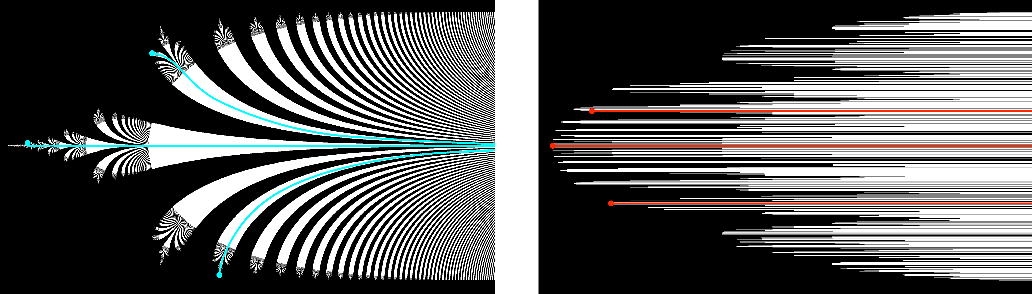
is a brush. See Figure 1.
Three endpoints and curves in J(f) (left) and in
 $J(\mathcal F)$
(right).

The restrictions
 $\mathcal F\restriction J(\mathcal F)$
and
 $f\restriction J(f)$
are topologically conjugate [Reference Rempe19, section 9]. Hence
 $J(\mathcal F)$
is homeomorphic to J(f), and the action of
 $\mathcal F$
on
 $J(\mathcal F)$
captures the essential dynamics of f on J(f); see also [Reference Alhabib and Rempe-Gillen2, p.74].
3. Lemmas for
 $\mathcal F$

In orderto prove Theorem 1·1 we need a few basic lemmas regarding the model above. Define
 $F^{-1}(t)=\ln(t+1)$
for
 $t\geq 0$
, so that
 $F^{-1}$
is the inverse of F. For each
 $n\geq 1$
, the n-fold composition of
 $F^{-1}$
is denoted
 $F^{-n}$
.
Lemma 3·1 (Iterating between double squares)Let
 $x\in J(\mathcal F)$
. If
 $k\geq 5$
and
 \begin{equation*}T\!\left(\mathcal F^{2k^2}(x)\right)\geq F^{k^2}(1),\end{equation*}
then
 $T(\mathcal F^{n}(x))\geq F^{k}(1)$
for all
 $n\in [2(k-1)^2,2k^2]$
.
Proof. Suppose
 $k\geq 5$
and
 $T(\mathcal F^{2k^2}(x))\geq F^{k^2}(1)$
. Let
 $n\in [2(k-1)^2,2k^2]$
. Then there exists
 $i\leq 4k-2$
such that
 $n=2k^2-i$
. We have
 \begin{equation*}F^i\!\left(T\!\left(\mathcal F^{n}(x)\right)\right)=F^i\!\left(T\!\left(\mathcal F^{2k^2-i}(x)\right)\right)\geq T\!\left(\mathcal F ^i \!\left(\mathcal F^{2k^2-i}(x)\right)\right)=T\!\left(\mathcal F ^{2k^2}(x)\right)\geq F^{k^2}(1).\end{equation*}
Applying
 $F^{-i}$
to each side of the inequality shows that
 \begin{equation*}T\!\left(\mathcal F^{n}(x)\right)\geq F^{k^2-i}(1)> F^{k}(1),\end{equation*}
where we used the fact
 $k^2-i>k$
for all
 $k\geq 5$
and
 $i\leq 4k-2$
.
Lemma 3·2 (Forward stretching).Let
 $x,y\in J(\mathcal F)$
. If
 $\underline s(y)=\underline s(x)$
and
 $T(y)>T(x)$
, then for every
 $n\geq 1$
we have
 $T(\mathcal F^n(y))\geq F^n(T(y)-T(x)).$
Proof. Suppose
 $\underline s(y)=\underline s(x)$
and
 $T(y)> T(x)$
. Let
 $\varepsilon=T(y)-T(x)$
and
 $\delta=T(\mathcal F^n(y))-T(\mathcal F^n(x))$
. Note that
 $\delta>0$
. So
 $T(y)\leq T(x)+F^{-n}(\delta)$
by [Reference Alhabib and Rempe-Gillen2, observation 3·9]. Therefore
 $\delta \geq F^n(\varepsilon)$
. We have
 \begin{equation*}T\!\left(\mathcal F^n(y)\right)\geq T\!\left(\mathcal F^n(y)\right)-T\!\left(\mathcal F^n(x)\right)=\delta \geq F^n\!\left(\varepsilon\right) =F^n\!\left(T(y)-T(x)\right)\end{equation*}
as desired.
Lemma 3·1 implies that
 $T(\mathcal F^n(x))\to\infty$
if the double square iterates
 $T(\mathcal F^{2k^2}(x))$
increase at a sufficient rate. Lemma 3·2 will be used to show that
 $T(\mathcal F^{2k^2}(x))$
increases at that rate for certain points
 $x\in J(\mathcal F)$
.
Lemma 3·3 (Logarithmic orbit).
 $F^{-n}(1)<3/n$
for all
 $n\geq 1$
.
Proof. The proof is by induction on n. If
 $n=1$
then we have
 $F^{-n}(1)=F^{-1}(1)=\ln\!(2)<3=3/n$
. Now suppose the inequality holds for a given n. Then
 \begin{equation*} F^{-(n+1)}(1)=F^{-1}(F^{-n}(1))<F^{-1}(3/n)=\ln\left(\frac{3}{n}+1\right)<\frac{3}{n+1}\end{equation*}
by calculus.
Although the series
 $\sum_{k=1}^\infty F^{-k}(1)$
diverges, Lemma 3·3 implies that
 $\sum_{k=1}^\infty F^{-k^2}(1)$
converges (to something less than
 $\pi ^2/2$
).
4. Jordan curve lemma
The following topological lemma will also be required to prove Theorem 1·1. Recall that a C-set in a space X is an intersection of clopen subsets of X.
Lemma 4·1. Let
 \begin{equation*}B=\bigcup_{y\in Y} [t_y,\infty)\times \{y\}\end{equation*}
be a brush, and let
 $E=\{\langle t_y,y\rangle\,:\,y\in Y\}$
denote the set of endpoints of B. Suppose
 $\tilde E\subset E$
and
 $\tilde E\cup \{\infty\}$
is connected. If there exists an open set
 $U\subset \mathbb R ^2$
such that:
-
(i)
$U\cap \tilde E\neq\varnothing$
; -
(ii)
$\partial U$
is a simple closed curve; and -
(iii)
$\partial U\cap E\subset \tilde E$
,


then
 $\tilde E$
cannot be written as a countable union of nowhere dense C-sets.
Proof. Suppose that
 $\tilde E$
, U, and
 $\beta\,:\!=\,\partial U$
satisfy all of the hypotheses. Let
 \begin{equation*}A\,:\!=\,\{y\in Y\,:\, \beta\text{ contains an interval of }[t_y,\infty)\times \{y\}\}.\end{equation*}
Since every collection of pairwise disjoint arcs of a simple closed curve is countable,A is countable. So
 $\tilde E\cap (\mathbb R\times A)$
is countable. Observe also that since B is closed in
 $ \mathbb R\times Y$
and
 $Y\subset \mathbb P$
, the space E has a neighbourhood basis of C-sets of the form
 $E\cap ({-}\infty,t]\times W$
, where
 $t\in \mathbb R$
and W is clopen in Y. By [Reference Dijkstra and Lipham4, theorem 4·7] and the assumption that
 $\tilde E\cup \{\infty\}$
is connected, we see that
 $\tilde E\setminus (\mathbb R\times A)\cup \{\infty\}$
is connected.
Now aiming for a contradiction, suppose that
 $\tilde E=\bigcup \{C_n\,:\,n<\omega\}$
where each
 $C_n$
is a nowhere dense C-set in
 $\tilde E$
. Let V be the unbounded component of
 $\mathbb R^2 \setminus \beta$
. Since
 $\tilde E\setminus (\mathbb R\times A)$
 $\cup \{\infty\}$
is connected,
 \begin{equation*}\tau\,:\!=\,\overline{U\cap \tilde E}\cap \overline{V\cap \tilde E}\cap \tilde E\setminus (\mathbb R\times A)\end{equation*}
is non-empty. Note also that
 $\tau$
is a relatively closed subset of
 \begin{equation*}\beta\cap \tilde E\setminus (\mathbb R\times A)=\beta\cap E\setminus (\mathbb R\times A),\end{equation*}
which is a
 $G_\delta$
-subset of E. And E is a
 $G_\delta$
-subset of
 $\mathbb R \times \mathbb P$
because B is closed and
 $B\setminus E$
is the union of countably many closed sets
 $B+\langle {1}/{n},0\rangle$
. Therefore
 $\tau$
is completely metrisable. By Baire’s theorem there is an open rectangle
 $(x_1,x_2)\times (y_1,y_2)$
and
 $n<\omega$
such that
 $\varnothing\neq \tau\cap ((x_1,x_2)\times (y_1,y_2))\subset C_n.$
Let
 \begin{equation*}\langle t_y,y\rangle\in \tau\cap ((x_1,x_2)\times (y_1,y_2)).\end{equation*}
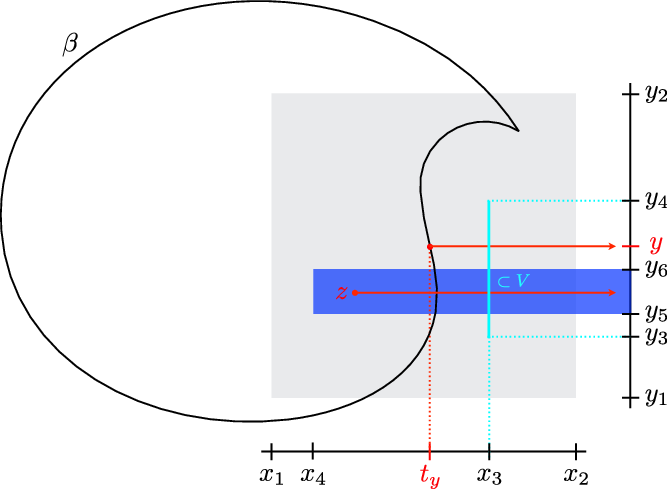
See Figure 2.
Construction of clopen set in Lemma 4·1.

Since
 $y\notin A$
, there exist
 $x_3\in (t_y,x_2)$
and
 $y_3,y_4\in (y_1,y_2)\cap \mathbb Q$
such that
 $y_3<y<y_4$
and
 $\{x_3\}\times [y_3,y_4]\subset \mathbb R ^2\setminus \beta$
. Without loss of generality, assume
 $\{x_3\}\times [y_3,y_4]\subset V$
. Note that
 $U\cap\tilde E\cap ((x_1,x_3)\times (y_3,y_4))\neq\varnothing$
because
 \begin{equation*}\langle t_y,y\rangle\in \overline{U\cap \tilde E}\cap ((x_1,x_3)\times (y_3,y_4)). \end{equation*}
Further,
 $C_n\cup (\tilde E\cap (\mathbb R\times A))$
is nowhere dense in
 $\tilde E$
, so there exists
 \begin{equation*}z\in U\cap\tilde E\cap ((x_1,x_3)\times (y_3,y_4))\setminus (C_n\cup (\mathbb R\times A)).\end{equation*}
Since z is an endpoint and B is closed in
 $\mathbb R\times Y$
, we can find
 $y_5,y_6\in (y_3,y_4)\cap \mathbb Q$
and
 $x_4>x_1$
such that
 $y_5<y_6$
,
 $z\in(x_4,\infty)\times (y_5,y_6)$
, and
 \begin{equation*}(\{x_4\}\times [y_5,y_6])\cup ([x_4,\infty)\times \{y_5,y_6\})\cap B=\varnothing.\end{equation*}
Further, since
 $z\notin C_n$
there is a relatively clopen subset O of
 $\tilde E\setminus (\mathbb R\times A)$
such that
 $z\in O$
and
 $C_n\cap O=\varnothing$
. Then
 \begin{equation*}U\cap O \cap ([x_4,x_3]\times [y_5,y_6])\end{equation*}
is a non-empty bounded clopen subset of
 $\tilde E\setminus (\mathbb R\times A)$
. This contradicts the previously established fact that
 $\tilde E\setminus (\mathbb R\times A)\cup \{\infty\}$
is connected.
5. Proof of Theorem 1·1
As indicated in Section 2.2, we will identify
 $\mathbb Z ^\omega$
with
 $\mathbb P$
, so that
 \begin{equation*}J(\mathcal F)\subset \mathbb R\times \mathbb P\subset \mathbb R ^2.\end{equation*}
Let
 $E(\mathcal F)=\{\langle t_{\underline{s}},\underline{s}\rangle\,:\,s\in \mathbb S\}$
denote the set of endpoints of
 $J(\mathcal F)$
. Define
 \begin{align*}I(\mathcal F)&=\{x\in J(\mathcal F)\,:\,T(\mathcal F^n(x))\longrightarrow\infty\} \text{ and}\\\tilde{E}(\mathcal F)&= I(\mathcal F)\cap E(\mathcal F).\end{align*}
The conjugacy [Reference Rempe19, theorem 9·1] shows that
 $\tilde{E}(\mathcal F) \simeq \dot E(f)$
, and
 $\tilde{E}(\mathcal F)\cup \{\infty\}$
is connected by [Reference Alhabib and Rempe-Gillen2, theorem 3·4]. Thus to reach the conclusion that
 $\dot E(f)$
cannot be written as a countable union of nowhere dense C-sets, by Lemma 4·1 we only need to find a simple closed curve
 $\beta\subset \mathbb R ^2$
such that:
-
(i) if U is the bounded component of
$\mathbb R ^2\setminus \beta$
then
$U\cap \tilde E(\mathcal F)\neq\varnothing$
, and -
(ii)
$\beta\cap J(\mathcal F)\subset I(\mathcal F)$
(in particular,
$\beta\cap E(\mathcal F)\subset \tilde E(\mathcal F)$
).




The
 $\beta$
that we construct will essentially be the boundary of a union of rectangular regions in
 $\mathbb R ^2$
. We recursively define the collections of rectangles (or “boxes”) as follows. Choose n sufficiently large so that
 $({-}n,n)^2\cap \tilde{E}(\mathcal F)\neq\varnothing$
. For the sake of simplicity, let us assume
 $n=1$
. Let
 $\mathscr{B}_0=\{[{-}1,1]^2\}$
.
Claim 5·1. There is a sequence of finite collections of boxes
 $\mathscr{B}_1, \mathscr{B}_2,\ldots$
such that for every
 $k\geq 1$
and
 $B\in\mathscr{B}_k$
:
-
(i)
$B=[a,b]\times[c,d]$
for some
$a,b\in \mathbb R$
and
$c,d\in \mathbb Q$
with
$a<b$
and
$c<d$
; -
(ii)
$b-a=F^{-k^2}(1)$
; -
(iii)
$d-c\leq F^{-k^2}(1)$
; -
(iv) there exists
$B'\in \mathscr{B}_{k-1}$
such that
$\{a\}\times [c,d]\subset\{b'\}\times [c',d'];$
-
(v)
$\{a\}\times [c,d]\cap J(\mathcal F)\neq\varnothing$
; -
(vi)
$B\cap B^*=\varnothing$
for all
$B^*\in \mathscr{B}_{k}\setminus \{B\}$
; -
(vii) if
$\underline s,\underline {\hat s}\in [c,d]\cap \mathbb Z ^\omega$
then
$\underline s\restriction 2k^2=\underline{\hat s}\restriction 2k^2$
(i.e.
$s_i=\hat s_i$
for all
$i<2k^2$
); and -
(viii) for every
$B'\in \mathscr{B}_{k-1}$
and
$x\in J(\mathcal F)\cap \{b'\}\times [c',d']$
there exists
$B\in \mathscr{B}_k$
such that
$x\in B$
.













Proof. Suppose
 $\mathscr{B}_{k-1}$
has already been defined. Let
 \begin{equation*}K=\bigcup_{B'\in \mathscr{B}_{k-1}} J(\mathcal F)\cap \{b'\}\times [c',d'].\end{equation*}
Since
 $J(\mathcal F)$
is closed in
 $\mathbb R^2$
[Reference Alhabib and Rempe-Gillen2, theorem 3·3] and
 $\mathscr{B}_{k-1}$
is finite, K is compact. Given a segment of integers
 $\langle s_0,s_1,...,s_{2k^2-1}\rangle$
of length
 $2k^2$
, observe that the set
 $\{\underline s\in \mathbb Z^\omega\,:\,\underline s\restriction 2k^2=\langle s_0,s_1,...,s_{2k^2-1}\rangle\}$
is clopen and convex in the lexicographic ordering on
 $\mathbb Z^\omega$
, and thus corresponds to the intersection of
 $\mathbb P$
with an interval whose endpoints are in
 $\mathbb Q$
. By compactness of K, the projection
 \begin{equation*}\pi_1[K]=\{y\in \mathbb R \,:\,[0,\infty)\times \{y\}\cap K\neq\varnothing\}\end{equation*}
can be covered by finitely many of those intervals. Let
 $\mathcal I$
be a finite cover of
 $\pi_1[K]$
consisting of such intervals. Let
 \begin{equation*}-1=q_0<q_1<q_2< \cdots <q_n=1\end{equation*}
be the increasing enumeration of all c’s and d’s used in
 $\mathscr{B}_{k-1}$
, together with the endpoints of all intervals in
 $\mathcal I$
. If necessary, we can insert a few more rationals to obtain
 $q_{i+1}-q_i\leq F^{-k^2}(1)$
for each
 $i< n$
. Since
 $\pi_1[K]$
is a compact set missing
 $\mathbb Q$
, we can also guarantee that for every
 $i<n-1$
,
 $[q_i,q_{i+1}]\cap \pi_1[K]=\varnothing$
or
 $[q_{i+1},q_{i+2}]\cap \pi_1[K]=\varnothing$
.
Note that b
′ is the same for each box
 $B'\in \mathscr{B}_{k-1}$
(in fact,
 $b'=1+\sum_{i=1}^{k-1}F^{-i^2}(1)$
). If
 $\{b'\}\times [q_i,q_{i+1}]\cap J(\mathcal F)\neq\varnothing$
then add the box
 $[b',b'+F^{-k^2}(1)]\times [q_i,q_{i+1}]$
to the collection
 $\mathscr{B}_k$
. It can be easily shown that defining
 $\mathscr{B}_k$
in this manner will satisfy conditions (i) through (viii).
Let
 $\mathscr{B}=\bigcup \{\mathscr{B}_k\,:\,k<\omega\}$
. For each
 $B=[a,b]\times [c,d]\in \mathscr{B}$
let
 \begin{equation*}h_B\,:\,\{a\}\times [c,d]\longrightarrow ([a,b]\times \{c,d\})\cup (\{b\}\times [c,d])\end{equation*}
be a homeomorphism with fixed points
 $\langle a,c\rangle$
and
 $\langle a,d\rangle$
.
Claim 5·2. There is a continuous mapping
 \begin{equation*}g\,:\,[0,1] \longrightarrow [1,\infty)\times [{-}1,1]\end{equation*}
such that
 $g(0)=\langle 1,-1\rangle$
,
 $g(1)=\langle 1,1\rangle$
, and
 $g[0,1]\cap J(\mathcal F)\subset I(\mathcal F)$
.
Proof. The mapping g will be the pointwise limit of a uniformly Cauchy sequence of continuous functions. To begin, define
 $g_0(t)=\langle 1,2t-1\rangle$
for all
 $t\in [0,1]$
. Now suppose
 $k\geq 1$
is given and
 $g_{k-1}$
has been defined. Let
 $t\in [0,1]$
. We set
 \begin{equation*}g_k(t)=g_{k-1}(t)\end{equation*}
if
 $g_{k-1}(t)$
is not in any member of
 $\mathscr{B}_k$
. Otherwise, by item (vi) there is a unique box
 $B=[a,b]\times[c,d]\in \mathscr{B}_k$
which contains
 $g_{k-1}(t)$
. Inductively
 $g_{k-1}(t)$
is contained in some element of
 $\mathscr{B}_0\cup\ldots\cup \mathscr{B}_{k-1}$
, so by (iv) we have
 $g_{k-1}(t)\in \{a\}\times [c,d]$
. Put
 \begin{equation*}g_k(t)=h_{B}(g_{k-1}(t)).\end{equation*}
The mapping
 $g_k$
defined in this manner is easily seen to be continuous.
Note that the image of
 $g_k$
is contained in
 $[1,\infty)\times [{-}1,1]$
,
 $g_k(0)=\langle 1,-1\rangle$
, and
 $g_k(1)=\langle 1,1\rangle$
. To see that the sequence
 $(g_k)$
is uniformly Cauchy, fix
 $\varepsilon>0$
. Let N be such that
 $\sum_{k=N}^\infty 1/k^2<\varepsilon/5$
. For any
 $t\in [0,1]$
, if
 $g_k(t)\neq g_{k-1}(t)$
then
 $g_k(t)$
and
 $g_{k-1}(t)$
belong to the same element of
 $\mathscr{B}_k$
. Hence, by items (ii) and (iii), the distance between
 $g_k(t)$
and
 $g_{k-1}(t)$
is at most
 $\sqrt{2}F^{-k^2}(1)$
. Combined with Lemma 3·3 we have
 \begin{equation*} |g_k(t)-g_{k-1}(t)|\leq \sqrt{2}F^{-k^2}(1)<\sqrt{2}\frac{3}{k^2}<\frac{5}{k^2}\end{equation*}
for every
 $k<\omega$
and
 $t\in [0,1]$
. Thus for any
 $i> j\geq N$
and
 $t\in [0,1]$
,
 \begin{equation*} |g_i(t)-g_{j}(t)|\leq \sum_{k=j}^{i-1} |g_{k+1}(t)-g_{k}(t)| <\sum_{k=N}^\infty \frac{5}{k^2}<\varepsilon.\end{equation*}
This proves that
 $(g_k)$
is uniformly Cauchy. Therefore
 $(g_k)$
converges uniformly to a continuous function
 $g\,:\,[0,1]\to[1,\infty)\times [{-}1,1]$
which satisfies
 $g(0)=\langle 1,-1\rangle$
and
 $g(1)=\langle 1,1\rangle$
.
It remains to show that
 $g[0,1]\cap J(\mathcal F)\subset I(\mathcal F)$
. Let
 $x=g(t)\in g[0,1]\cap J(\mathcal F)$
. ByLemma 3·1 and the fact
 $F^k(1)\to\infty$
, to prove
 $x\in I(\mathcal F)$
it suffices to show
 $T(\mathcal F^{2j^2}(x))\geq F^{j^2}(1)$
for all
 $j\geq 1$
. Fix
 $j\geq 1$
. To prove
 $T(\mathcal F^{2j^2}(x))\geq F^{j^2}(1)$
, by continuity of
 $T\circ \mathcal F^{2j^2}$
we only need to show that every neighbourhood of x contains a point w such that
 $T(\mathcal F^{2j^2}(w))\geq F^{j^2}(1)$
.
Let W be a neighbourhood of x. Observe that since c and d are rational in item (i), the top and bottom edges of all boxes miss
 $J(\mathcal F)$
. So if
 $g_k(t)\in J(\mathcal F)$
, then
 $g_k(t)$
belongs to the right edge of an element of
 $\mathscr{B}_{k}$
. Then by the construction of
 $g_{k+1}$
and items (iv) and (viii) we get
 $g_{k+1}(t)\neq g_k(t)$
. Since
 $g_k(t)\to x$
, it follows that the sequence
 $g_0(t),g_1(t),\ldots$
is not eventually constant. So for every k there exists
 $B\in \mathscr{B}_k$
such that
 $g_k(t)\in B$
. By (ii) and (iii), the diameter of each box in
 $\mathscr{B}_k$
is at most
 $\sqrt{2} F^{-k^2}(1)$
, which goes to 0 as
 $k\to\infty$
(e.g. by Lemma 3·3). Since
 $g_k(t)\to x$
and x belongs to the interior of W, there exists
 $k>j$
such that W contains a box
 $B(k)\in \mathscr{B}_k$
. By (v) there exists
 $w\in B(k)\cap W\cap J(\mathcal F)$
.
By (iv), for each
 $i<k$
there exists a unique
 $B(i)\in \mathscr{B}_i$
such that
 $\pi_1[B(k)]\subset \pi_1[B(i)]$
. By (iv) and (v) there exists
 $y\in B(j)\cap B(j-1)\cap J(\mathcal F)$
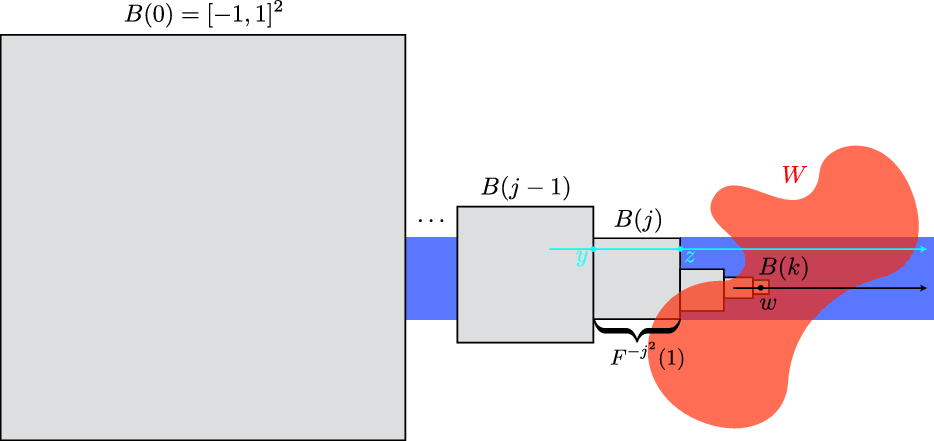
. Then y is on the left edge of B(j). Let z be the point on the right edge of B(j) such that
 $\underline s(z)=\underline s(y)$
(see Figure 3). Then
 $z\in J(\mathcal F)$
, and by (i) we have
 $T(z)-T(y)= F^{-j^2}(1)$
. Thus, by Lemma 3·2
 \begin{equation*}T\!\left(\mathcal F^{2j^2}(z)\right)\geq F^{2j^2}\!\left(T(z)-T(y)\right)=F^{2j^2}\!\left(F^{-j^2}(1)\right)=F^{j^2}(1).\end{equation*}
Note also that
 $\underline s(z)\restriction 2j^2= \underline s(w)\restriction 2j^2$
because z and w are contained in the same horizontal strip where the first
 $2j^2$
coordinates agree; see items (vii) and (iv). The preceding equations together with
 $T(z)\leq T(w)$
imply that
 \begin{equation*}T\!\left(\mathcal F^{2j^2}(w)\right)\geq F^{j^2}(1),\end{equation*}
as desired.
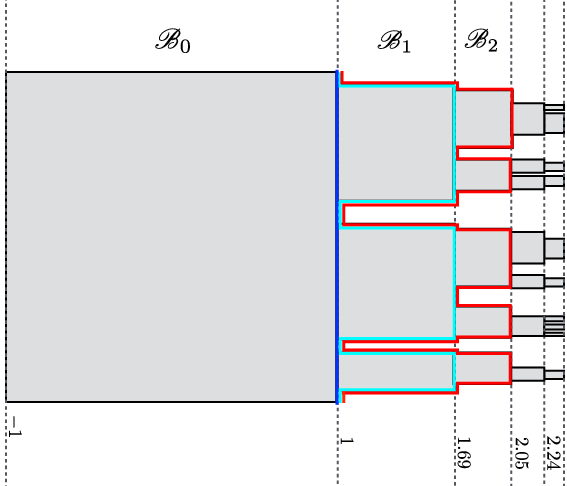
Illustration of
 ${\color{blue}g_0},{\color{cyan}g_1} \textrm{ and}\; \color{red}g_2$
.

Proof of Claim 5·2.

By [Reference Nadler18, corollary 8·17] and [Reference Nadler18, theorem 8·23], there is an arc
 $\alpha\,:\,[0,1]\hookrightarrow g[0,1]$
such that
 $\alpha(0)=g(0)=\langle 1,-1\rangle$
and
 $\alpha(1)=g(1)=\langle 1,1\rangle$
. Let
 $\beta=(\{-1\}\times [{-}1,1])\cup ([{-}1,1]\times\{-1,1\}) \cup \alpha[0,1].$
Then
 $\beta$
is a simple closed curve, and by Claim 5·2 we have
 $\beta\cap E(\mathcal F)\subset \tilde E(\mathcal F).$
If U is the bounded component of
 $\mathbb R ^2\setminus\beta$
then
 $({-}1,1)^2\subset U$
, hence
 $U\cap \tilde{E}(\mathcal F)\neq\varnothing$
. Now we can apply Lemma 4·1 to see that
 $\tilde{E}(\mathcal F)$
cannot be written as a countable union of nowhere dense C-sets. This concludes the proof of Theorem 1·1.
6. Remarks on Theorem 1·1
Remark 6·1. In the proof of Theorem 1·1 it is possible to show that g is one-to-one, so
 $\alpha=g$
. And the curve
 $\beta$
is just the boundary of
 $\bigcup \mathscr{B}$
.
Remark 6·2. The statement of Theorem 1·1 can be strengthened to: No neighbourhood in
 $\dot E(f)$
can be covered by countably many nowhere dense C-sets of
 $\dot E(f)$
. To see this, let
 $x_0\in\mathbb R ^2$
and
 $\varepsilon>0$
. Since
 $J(\mathcal F)$
is closed, there is a box
 $[a,b]\times [c,d]\subset B(x_0,\varepsilon/2)$
containing
 $x_0$
such that
 \begin{equation*}(\{a\}\times [c,d]\cup[a,b]\times \{c,d\})\cap J(\mathcal F)=\varnothing.\end{equation*}
Begin the construction of the
 $\mathscr{B}_k$
’s with
 $\mathscr{B}_0=\{[a,b]\times [c,d]\}$
, and choose l large enough so that
 \begin{equation*}\sum_{k=1}^\infty F^{-(l+k)^2}(1)<\frac{\varepsilon}{2}.\end{equation*}
Construct
 $\mathscr{B}_k$
with
 $l+k$
replacing each k in items (ii), (iii) and (vii). By the arguments in Claim 5·2, if
 $x\in J(\mathcal F)$
lies in the limit of
 $(g_k)$
(constructed using the new
 $\mathscr{B}_k$
’s), then
 $T(\mathcal F^{2n^2}(x))\geq F^{n^2}(1)$
for all
 $n>l$
and consequently
 $x\in I(\mathcal F)$
. As in Claim 5·2 we can construct an arc
 $\alpha$
such that
 $\beta\,:\!=\,(\{a\}\times [c,d]\cup[a,b]\times \{c,d\})\cup \alpha$
is a simple closed curve in
 $B(x_0,\varepsilon)$
, the bounded component of
 $\mathbb R ^2\setminus \beta$
contains
 $x_0$
, and
 $\beta\cap J(\mathcal F)\subset I(\mathcal F)$
. Lemma 4·1 now shows that
 $B(x_0,\varepsilon)$
cannot be covered by countably many nowhere dense C-sets of
 $\tilde E(\mathcal F)$
.


7. The space
$F(f_a)\cup I(f_a)$
when
$a\in ({-}\infty,-1]$


We are now ready to prove Theorem 1·3 and Corollary 1·4. Fix
 $a\in ({-}\infty,-1]$
.
Proof of Theorem 1·3. Let
 $z\in \mathbb C$
. By [Reference Rempe19, section 9] and [Reference Alhabib and Rempe-Gillen2, theorem 2·8], there is a homeomorphism
 $\varphi\,:\,\mathbb R ^2\to \mathbb C$
such that
 $\varphi[J(\mathcal F)]=J(f_a)$
and
 $\varphi[I(\mathcal F)]=I(f_a)$
. Let
 $x=\varphi^{-1}(z)$
. We have shown that there is a Jordan curve
 $\beta\subset(\mathbb R ^2\setminus J(\mathcal F))\cup I(\mathcal F)$
around x; see Remark 6·2, or simply begin the construction in Section 6 with
 $\mathscr{B}_0=\{[{-}n,n]^2\}$
where
 $n\in \mathbb N$
is such that
 $x\in ({-}n,n)^2$
. Then
 $\varphi[\beta]\subset F(f_a)\cup I(f_a)$
is a Jordan curve which separates z from
 $\infty$
.
In the proof below we will make use of two well-known facts: (a)
 $F(f_a)$
is path-connected and (b) each component of
 $J(f_a)$
is contained in
 $I(f_a)$
, with the possible exception of its endpoint.
Proof of Corollary 1·4. Let
 $z_0,z_1\in F(f_a)\cup I(f_a)$
. We will find a path in
 $F(f_a)\cup I(f_a)$
from
 $z_0$
to
 $z_1$
. There are three cases to consider.
The case
 $z_0,z_1\in F(f_a)$
is trivial since
 $F(f_a)$
is path-connected.
The next case is that
 $z_0\in F(f_a)$
and
 $z_1\in I(f_a)$
. Let
 $\beta$
be a simple closed curve around the point
 $z_1$
, such that
 $\beta\cap J(f_a)\subset I(f_a)$
(apply Theorem 1·3). Let
 $\gamma$
be the component of
 $J(f_a)$
containing
 $z_1$
. There exists
 $z_2\in \beta\setminus J(f_a)$
and
 $z_3\in \gamma\cap \beta$
. There are paths
 $\alpha_1\subset F(f_a)$
from
 $z_0$
to
 $z_2$
,
 $\alpha_2\subset \beta$
from
 $z_2$
to
 $z_3$
, and
 $\alpha_3\subset \gamma$
from
 $z_3$
to
 $z_1$
. It is clear that
 $\alpha_3$
can be constructed to avoid the endpoint of
 $\gamma$
, so that
 $\alpha_3\subset I(f_a)$
. Then
 $\alpha_1\cup \alpha_2\cup \alpha_3\subset F(f_a)\cup I(f_a)$
contains a path from
 $z_0$
to
 $z_1$
.
The third and final case
 $z_0,z_1\in I(f_a)$
can be handled by connecting each point
 $z_0$
and
 $z_1$
to a third point of
 $F(f_a)$
, as was done the second case.
Acknowledgements
We thank the referee for their careful reading and helpful suggestions.