The Ocampo Caves of southwestern Tamaulipas, Mexico, hold a prominent position on the northeastern periphery of the Mesoamerican cultural region. Investigated by Richard MacNeish in the early 1950s, these sites profoundly influenced perceptions of early agriculture in Mexico (Kaplan and MacNeish Reference Kaplan and MacNeish1960; MacNeish Reference MacNeish and West1964, Reference MacNeish1992; Ramírez Castilla Reference Ramírez Castilla2007; Smith Reference Smith1997). Indigenous peoples in Ocampo began periodically adopting various introduced domesticated crop plants (i.e., maize, squash) around 6,000 years ago, integrating them into an economy that remained dominated by gathered and possibly managed resources. Ocampo is therefore recognized as an example of “low-level food production,” an enduring economy in which local wild and possibly managed resources were prominent for millennia despite sporadic and cumulative additions of exotic and distinctly domesticated cultigens (Smith Reference Smith1997, Reference Smith2001).
The few publications generated from these investigations accentuate various domesticated plants and the “farming” aspect of the economy while largely underemphasizing other resources (Hanselka Reference Hanselka2017). Most published accounts acknowledge the importance of gathered resources, but this is only vaguely stated, highlighting an important gap in our knowledge of the Ocampo economy. Greater awareness of the wider resource base not only provides the economic context into which exotic domesticates were introduced but also elucidates human adaptations and relationships with various resources. How did the diversity and availability of traditionally utilized local resources influence integration of exotic cultigens, and vice versa? Were low-level food producers who adopted domesticates also managing or cultivating plants generally recognized as “wild?” Among those available, which resources (if any) were targets of intesification to support growing populations over time?
Agave (genus Agave, family Asparagaceae, subfamily Agavoideae) is among the nondomesticated plant taxa used by the Ocampo Caves’ occasional inhabitants throughout the cultural sequence. Agaves have been a valued food resource across a vast geographical range for at least 10,000 years, both for general subsistence and in ritual feasting (Koenig and Miller Reference Koenig and Miller2023). In some regions, they were intentionally cultivated and/or domesticated (Hodgson and Salywon Reference Hodgson and Salywon2013; Hodgson et al. Reference Hodgson, Salywon and Doelle2018). Elsewhere, they were staple foods, yet they remained biologically undomesticated despite intensified treatment and management (Koenig et al. Reference Koenig, McQuistion, Black, Frederick, Phil Dering, Kevin Hanselka, Bush, Lawrence, Koenig and Miller2023). Agave has a much longer lifespan and exhibits a very different domestication syndrome than annual crops grown for seed. Furthermore, agave is multifunctional: its products have served ritual, ceremonial, and political purposes; alcoholic beverages are prepared from its fluids; and as a fiber resource, its constituents serve as raw material for cordage, textiles, and tools (Miller Reference Miller, Harry and Roth2019). Therefore, its use complexly articulates with other aspects of subsistence and daily life.
Given its variable function and significance, a deeper exploration of agave use is needed to clarify its role in the Ocampo low-level food production system. Here, I review published mention of agave use in Ocampo and then employ additional lines of evidence to demonstrate that agave was continuously used as a stable, important food resource for millennia. Sustained and consistent agave use underscores the nature of Ocampo low-level food production and demonstrates the important nonculinary contributions of agave products in food acquisition technology, implements, and clothing. Although scholarly attention has traditionally focused on the domesticates involved, agave and several other wild plants remained prominent in the diet. However, the Ocampo inhabitants did not intensify agave processing to the same degree as other regions.
Agave Use in Northeast Mexico
The human–agave relationship spans millennia and a vast geographical area encompassing Mexico, the US Southwest, and the Texas borderlands (Castetter et al. Reference Castetter, Bell and Grove1938; Dering Reference Dering1999; Gentry Reference Gentry1982; Parsons and Parsons Reference Parsons and Parsons1990). These versatile plants have provided food from their stems, flowering stalks, and blossoms; alcoholic beverages from their sap; leaf fibers for cordage, basketry, and textiles; and other raw materials for implements (Castetter et al. Reference Castetter, Bell and Grove1938). By far the most common archaeological indicators of agave use in northeast Mexico are burned rock features, specifically earth ovens and their associated residues. Agaves store valuable carbohydrates in their stems, but they also contain indigestible compounds that must be exposed to heat for up to 48 hours to render them edible. Earth ovens with stone heating elements have been used in North America for this purpose (and others) for at least 10,000 years (Black and Thoms Reference Black and Thoms2014; Cloud et al Reference Cloud, Walter, Frederick and Mallouf2016; Thoms Reference Thoms2009). Thousands of burned rock middens throughout the Lower Pecos Canyonlands of Texas, some containing literally tons of burned rock, are attributed to large-scale processing of agave and other desert succulents (Koenig et al. Reference Koenig, McQuistion, Black, Frederick, Phil Dering, Kevin Hanselka, Bush, Lawrence, Koenig and Miller2023). Burned rock concentrations are abundant throughout Nuevo León and Coahuila (Varner Reference Varner1967). Collectively termed “hearths,” in most cases, these are likely to be instead small, single-use earth oven facilities.
Due to generally poor preservation, most unequivocal archaeobotanical evidence for agave use is often limited to dry cave and rockshelter deposits. Large-scale processing and consumption of lechuguilla (A. lechuguilla) is well documented in the Lower Pecos (Brown Reference Brown and Turpin1991; Koenig et al. Reference Koenig, McQuistion, Black, Frederick, Phil Dering, Kevin Hanselka, Bush, Lawrence, Koenig and Miller2023; Sobolik Reference Sobolik, Reitz, Margaret Scarry and Scudder2008). Cueva Pilote, a small cave in the Sierra Encantada of northern Coahuila, yielded unusual evidence for ritual use of agave parts. Three fiber pads cut from the trunk of the desert palm (Yucca carnerosana) were riddled with punctures, and one still held five agave spines (Turpin and Eling Reference Turpin and Eling1999:29). Protein residue analysis detected traces of human blood on some spines, suggesting they were associated with bloodletting ceremonies (Turpin and Eling Reference Turpin and Eling1999:47). Various lechuguilla parts—including leaf and stem fragments, leaf quids, stripped leaves, fruit, seeds, and fiber—are commonly preserved in dry shelters in Nuevo León (e.g., Rivera Estrada Reference Estrada and Araceli2014). Closer to Ocampo, MacNeish (Reference MacNeish1958:149, Table 20) reports abundant chewed agave quids and unchewed leaf bases from occupations spanning several millennia in La Perra and Armadillo Caves in the Sierra de Tamaulipas, demonstrating the longevity of agave as a food resource in the general region.
In addition to cooking features and agave remains, several distinctive artifact types are considered as indirect evidence for agave harvesting and processing. “Agave knives,” also known as mescal knives or tabular knives, are large, marginally flaked tabular stone implements resembling ethnographically documented tools used to sever the tough, fibrous leaves of agaves (Castetter et al. Reference Castetter, Bell and Grove1938:38; Fish and Fish Reference Fish, Fish and Minnis2014:122; Miller Reference Miller, Miller, Graves, Landreth, Frederick, Gregory and Tabitha Burgess2013:288; Parsons and Parsons Reference Parsons and Parsons1990:301). Taylor (Reference Taylor, Ekholm and Willey1966:69) reports such tabular implements in northern Coahuila but refers to them as limestone “choppers.” Chipped stone artifacts variously classified as scraper planes, turtleback scrapers, steep-edged core scrapers, or pulping planes are also potentially important signatures of agave fiber processing (Fish and Fish Reference Fish, Fish and Minnis2014:122; Parsons and Parsons Reference Parsons and Parsons1990:301; Tolstoy Reference Tolstoy, Ekholm and Bernal1971:282–285). Defining characteristics include a steeply angled scraping edge and flat base. Experiments demonstrate their utility for detaching marginal leaf spines and removing leaf cortical tissue and pulp to extract fibers (Fish and Fish Reference Fish, Fish and Minnis2014:122; Hester and Heizer Reference Hester and Heizer1972; Parsons and Parsons Reference Parsons and Parsons1990:301).
Environment and Archaeology of the Ocampo Caves
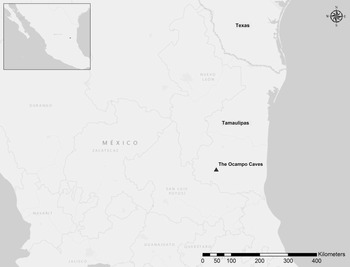
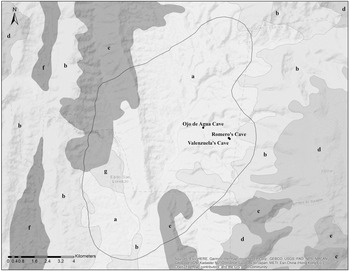
The Ocampo Caves are about 30 km north of Ocampo and 6 km northeast of the farming and ranching community of San Lorenzo las Bayas, 850–1,070 m above sea level on the eastern slopes of the Sierra Madre Oriental (Figures 1 and 2; Instituto Nacional de Estadística, Geografía e Informática [INEGI] 2002). The karstic limestone terrain is dissected by canyons with abundant caves and rockshelters. Local topographic relief supports several vegetation zones with distinct plant resources within relatively short travel distances (Figure 2), including gallery forest, grassland, thorn scrub, and weedy vegetation in drainages and valley bottoms; dry tropical forest upslope; and oak forest, mixed oak–pine forest, and pine forest as elevation increases (Hanselka Reference Hanselka2011, Reference Hanselka2017; INEGI 2003). Cloud forest also extends within about 6 km to the southeast.
Location of the Ocampo Caves within Tamaulipas and Mexico.

The Ocampo Caves and surrounding vegetation zones (INEGI 2003): (a) dry tropical forest; (b) oak forest; (c) oak–pine forest; (d) pine–oak forest; (e) mountain cloud forest; (f) seasonal agricultural land; (g) introduced pasture. The circa 10,600 ha (106 km2) area surveyed by Hanselka (Reference Hanselka2011) is encircled.

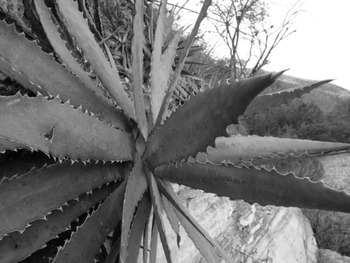
Jacques-Hernández and Salazar Bravo (Reference Jacques-Hernández and Salazar Bravo2009:97) list 31 agave species present in Tamaulipas, but their distributions vary, and at least some are likely recent introductions to augment fiber and distilling industries (Supplemental Table 1). In my experience, the most abundant taxon in the Ocampo Caves vicinity is thorn-crested agave (A. lophantha Scheide). Ranging from southern Texas throughout Tamaulipas and into central Veracruz, it prefers limestone outcrops where forest cover allows sufficient sunlight (Gentry Reference Gentry1982:159–160). During survey, I observed it growing in thick stands on rocky slopes and canyon walls in dry tropical forest (Figure 3). Although I did not observe them, several other taxa are potentially present in or near the study area based on their ranges and habitat preferences (Gentry Reference Gentry1982; Hernández Sandoval et al. Reference Sandoval, González Romo and Medrano1991). A. celsii Hook var. celsii may also be found in dry tropical forest, as well as adjacent oak forest and nearby cloud forest. A. americana L. ssp. protoamericana, A. difformis A. Berger, and A. striata Zucc. ssp. striata may be present in the oak forests, and oak–pine and pine–oak forests may support A. polyacantha and A. macroculmis. Curated remains are too fragmentary to permit identification of the species utilized by the cave inhabitants, but thorn-crested agave is a likely candidate based on abundance and firsthand observation alone.
Thorn-crested agave (A. lophantha) is abundant on the rocky slopes and canyon walls in the Ocampo Caves vicinity. (Photograph by the author.)

Richard MacNeish's excavations in Ocampo (1953–1954) centered on three caves in the southern wall of the Cañon los Portales, a narrow tributary of Cañon del Infiernillo. Romero's Cave (site number Tmc247) is immediately adjacent to and above Valenzuela's Cave (Tmc248), and Ojo de Agua Cave (Tmc274) is about 2 km downstream (Figure 2). These investigations were never fully published, but his interpretations are summarized in several landmark articles, and several specialist publications emphasized analyses of paleofeces and domesticated plants in the caves (Supplemental Text 1).
Cumulative data suggest that Ocampo hunter-gatherers began adopting domesticated plants by about 6000 cal BP (Table 1; Kaplan and Lynch Reference Kaplan and Lynch1999; Mangelsdorf et al. Reference Mangelsdorf, MacNeish, Willey and West1964; Smith Reference Smith1997). The period from 6000 to 3500 cal BP was peopled by what Smith (Reference Smith2001) describes as “low-level food producers with domesticates,” a subsistence economy based primarily on wild resources but enhanced by periodic additions of various cultigens. Surficial daub fragments suggested substantial habitations by the Guerra phase (4400–3600 cal BP). Stable agricultural settlements were firmly established by the Mesa de Guaje phase (3600–3000 cal BP), based on open-air sites with circular platforms of stacked limestone which were foundations for wattle and daub structures (MacNeish Reference MacNeish1992:105). The ceramic period occupations of the Ocampo Caves are directly related to these pueblos de la sierra (“mountain villages”) of the Sierra Madre Oriental and Sierra de Tamaulipas (the Región Serrana; Ramírez Castilla Reference Ramírez Castilla2007; Romero and Valenzuela Reference Romero and Valenzuela1945). MacNeish (Reference MacNeish1947) termed this distinct regional development the “Pueblito Culture.” Although agriculture gained prominence over time, use of nondomesticated resources—and caves—persisted. The past cultural geography of northeastern Mexico was ethnically complex, and many of these later groups retained traditional use of local resources including agave (Supplemental Text 2 and Supplemental Table 2).
Cultural Sequence of the Ocampo Region with Major Local Events, Including Earliest Directly Dated Examples of Key Domesticated Plants.

a MacNeish Reference MacNeish1958
b MacNeish Reference MacNeish1992
c Smith Reference Smith1997
d Kaplan and Lynch Reference Kaplan and Lynch1999
e MacNeish Reference MacNeish2001
Ocampo Agave Use: The Published Literature
Ten major publications (1957–1992) present varying levels of information on plant use in the Ocampo Caves (Supplemental Text 1). These include specialized reports of analyses of the Ocampo cucurbits (Cutler and Whitaker Reference Cutler and Whitaker1961; Whitaker et al. Reference Whitaker, Cutler and MacNeish1957), legumes (Kaplan and MacNeish Reference Kaplan and MacNeish1960), maize and its relatives (Mangelsdorf et al. Reference Mangelsdorf, MacNeish and Galinat1967), and paleofeces (Callen Reference Callen1968, Reference Callen, Brothwell and Higgs1970); some include general lists of plant resources by time period. The remaining four articles are synthetic accounts of local cultural developments, including brief lists of plants utilized per phase (MacNeish Reference MacNeish1958, Reference MacNeish, Ekholm and Bernal1971, Reference MacNeish1992; Mangelsdorf et al. Reference Mangelsdorf, MacNeish, Willey and West1964). Most publications emphasize the domesticated plants encountered in the cave deposits and treat nondomesticated taxa almost secondarily. Although they generally acknowledge that gathered resources were crucial in Ocampo, this is often vaguely stated (e.g., MacNeish Reference MacNeish1958:168). Callen's (Reference Callen1968, Reference Callen, Brothwell and Higgs1970) analysis is the notable exception, reporting fragments of agave and several other wild taxa found in the paleofeces.
As they are reports on various cultigens, Cutler and Whitaker (Reference Cutler and Whitaker1961), Kaplan and MacNeish (Reference Kaplan and MacNeish1960), Mangelsdorf and colleagues (Reference Mangelsdorf, MacNeish and Galinat1967), and Whitaker and colleagues (Reference Whitaker, Cutler and MacNeish1957) do not mention agave use at all. When mentioned in the four synthetic articles, it is simply listed among a few other gathered wild plants (Table 2). Mangelsdorf and colleagues (Reference Mangelsdorf, MacNeish, Willey and West1964:430) mention agave only in Infiernillo contexts, whereas MacNeish (Reference MacNeish, Ekholm and Bernal1971, Reference MacNeish1992) includes it among the plants collected during the Infiernillo, Ocampo, Flacco, and Guerra phases.
Published References to Agave Use in Ocampo by Cultural Phase.

* Notes agave only as cordage.
According to MacNeish (Reference MacNeish and West1964:422), the most common weaving materials of the Ocampo early agriculturalists were stripped leaves of yucca, agave, or similar plants. He acknowledges use of agave during Flacco times only as cordage (MacNeish Reference MacNeish, Ekholm and Bernal1971:577). In his 1958 monograph, he does not discuss agave as a food item in Ocampo, yet he notes “maguey cord” in Infiernillo, Palmillas, and San Antonio contexts. In all likelihood, many of the unspecified cordage and textiles reported in the caves (MacNeish Reference MacNeish1958, Reference MacNeish and West1964:422, Reference MacNeish, Ekholm and Bernal1971) were in fact of agave fiber (or possibly yucca). Furthermore, several sources attribute “scraping planes” and/or “disk scrapers” to the Infiernillo, Ocampo, Flacco, Guerra, Mesa de Guaje, Palmillas, and/or San Antonio phases (Kaplan and MacNeish Reference Kaplan and MacNeish1960; MacNeish Reference MacNeish1958, Reference MacNeish, Ekholm and Bernal1971, Reference MacNeish1992).
Callen (Reference Callen1968, Reference Callen, Brothwell and Higgs1970) provides the most detailed published data on agave use in Ocampo, and his analysis is the most detailed record of tangible evidence for the importance and longevity of agave as a food resource in the caves. He examined a sample of 281 coprolites from the caves, and he presents most of his results in tables as percent occurrence of bone and plant taxa identified per cultural phase (Table 2), although several taxa occurred in such low frequencies that they are mentioned in the text and not the tables (Callen Reference Callen1968:643, Reference Callen, Brothwell and Higgs1970:238). Callen identified agave leaf tissue in feces from all represented cultural phases. Two phases were not represented in the analysis: La Florida (only detected on survey and not recognized in the excavations, so fecal samples were unavailable) and Palmillas (which yielded no excavated samples). Percentages of samples containing agave are relatively high overall (63% of 281 total feces examined, n = 166) as well as per cultural phase (40%–80%, excluding the San Antonio phase for its small sample size of one). In addition, agave presence is relatively high compared to other identified foods per phase. Prickly pear is consistently higher with respect to percentage than agave (and everything else) in all phases except Mesa de Guaje, and bean and chili pepper outrank agave in Infiernillo.
Collectively, the publications generated from the Ocampo investigations note agave use in eight cultural phases (Table 2). Although the literature contains some useful information on agave use, these publications lack detail due to their generally synthetic nature. To expand on this partial picture, I employed several additional lines of evidence for agave use in Ocampo: unpublished field documentation from the original excavations, an examination of curated plant materials collected during the excavations, and observations from recent field survey near the caves.
Ocampo Agave Use: Unpublished Data and New Insights
Unpublished reports and notes from the excavations mention presence of agave remains at the occupation-layer level rather than the general cultural phases that frame the publications (Kelley Reference Kelley1954; MacNeish Reference MacNeish1954a, Reference MacNeish1954b). Also, agave remains in curated plant collections can be provenienced based on excavation inventories. Finally, site and artifactual evidence gathered on survey in the vicinity of the Ocampo Caves yielded intriguing insights about general agave harvesting and processing (Hanselka Reference Hanselka2011).
The curated Ocampo plant collections are dispersed among several facilities in the United States and Mexico (Supplemental Table 3); I examined most of these and compiled an inventory and assessment of their contents. Here, I consider two taxonomic classifications encountered in the collections—Agave spp. and Agavaceae (the agaves were formerly assigned to the Agavaceae family and are now reclassified to Asparagaceae); the comprehensive results of this work are presented elsewhere (Hanselka Reference Hanselka2011, Reference Hanselka2017). Excavators did not collect all plant remains encountered due to the sheer volume of vegetal matter in the deposits (MacNeish Reference MacNeish1954a, Reference MacNeish1958:8), so I also consulted unpublished field reports (obtained from the Robert S. Peabody Institute of Archaeology) for mention of agave remains (Kelley Reference Kelley1954; MacNeish Reference MacNeish1954a, Reference MacNeish1954b). These provide brief descriptions of plant materials and artifacts encountered in each cultural layer, and they are considered additional evidence for agave presence (Supplemental Tables 4–6).
Most evidence for agave use comes from Romero's Cave. MacNeish (Reference MacNeish1954a) mentions agave cordage in the Infiernillo phase Occupation 1a (Zone O); however, the earliest curated potential Agavaceae remains are attributed to the later Guerra phase (Occupation 7, Zone J1; Supplemental Table 4). Thereafter, curated specimens attributed to at least “Agavaceae” (the former family classification, e.g., “Agave,” “Agave?,” and “Yucca”) are documented from virtually all occupation layers, with two exceptions (Supplemental Table 7): Occupation 9 (Zone H, Mesa de Guaje phase) has no curated agave remains (but agave quids from this layer are mentioned in the field report), and Occupation 12 (Zone E, Palmillas phase) has no curated remains (but unspecified agave fragments from this layer are mentioned in the field report).
Overall, the curated remains are few, ranging from one to three fragments from early occupations. In the upper layers, Occupation 14 (Zone C, San Lorenzo phase) has eight Agavaceae leaf fragments, and the final prehistoric Occupation 16 (Zone A) has six curated remains. Most remains from Romero's Cave are leaf fragments, but Occupations 10 (Zone G, Mesa de Guaje phase), 13 (Zone D, San Lorenzo phase), and 14 (Zone C, San Lorenzo phase) include agave quids (Supplemental Table 7). The field report lists agave quids and leaf fragments in the Romero's Cave floor debris from Occupation 9 (Zone H, Mesa de Guaje) onward throughout subsequent occupations (with the exception of the final one: Occupation 16 (Zone A, San Antonio phase). A large fragment of cloth woven from what appears to be agave fiber is associated with a label that reads “Romero's cave? Possibly 1400 A.D.” If the site and suggested date are accurate, it may be from very late in San Lorenzo, possibly from Occupation 14 (Hanselka Reference Hanselka2011:165, 208).
Curated Agavaceae in Valenzuela's Cave is limited to the most recent Occupation 8 (Zone A, San Antonio phase; Supplemental Table 7). This layer contains undifferentiated Agavaceae leaf fragments, as well as a specimen identified as either Agave or Hechtia (a morphologically similar bromeliad). The field report lists agave materials in the floor debris of Occupations 3 (Zone 3, Infiernillo), 4 (Zone G, Ocampo), 7 (Zone B, San Lorenzo), and 8 (Zone A, San Antonio). However, artifacts potentially attributable to agave harvest and processing are mentioned from all cultural layers (Supplemental Table 5). No curated agave is attributed to Ojo de Agua Cave, and agave remains are only mentioned in one layer in this site (Occupation 10, Zone C, Palmillas). However, the field report indicates 249 fragments here, suggesting heavy agave use in this occupation (the report also mentions an impressive roasting pit in this layer).
Interestingly, the reports describe tools potentially for agave harvest and processing (e.g., discoid scrapers, scraper planes, turtleback scrapers, tabular/agave knives, “saw-like choppers”) in every occupation zone in all three of the caves (Supplemental Tables 4–7; Kelley Reference Kelley1954; MacNeish Reference MacNeish1954a, Reference MacNeish1954b). On a more speculative note, several small segments of branches with either pounded or wedged (sometimes fired) ends in the curated collections may respectively be proximal or distal fragments of pounded digging sticks, which could have served a variety of functions, including severing agaves at their base.
Potential Earth Ovens Described in the Field Documents
MacNeish (Reference MacNeish1954a, Reference MacNeish1954b) mentions several features encountered in the excavations that are likely earth ovens for agave preparation, but the descriptions are minimal. In Occupation 4, Zone L of Romero's Cave (Ocampo), excavators encountered a pit “with fired rock in it,” but no other details are presented (MacNeish Reference MacNeish1954a). In Occupation 10, Zone G (Mesa de Guaje), they describe “a pit which was filled with charcoal and some burned rock” (MacNeish Reference MacNeish1954a:40); agave remains were also noted in the floor refuse from this layer. In Palmillas phase Occupation 12, Zone E, they describe Pit 3, “a large hearth area filled with a great deal of burnt rock” (MacNeish Reference MacNeish1954a:56); agave is among the associated floor refuse. Finally, in San Lorenzo, Occupation 14, Zone C, MacNeish (Reference MacNeish1954a:62) describes a “pit filled with fire-cracked rock and charcoal;” agave remains are among the floor debris (Supplemental Table 4).
Based on abundant faunal materials and relatively few plant remains, Ojo de Agua Cave is interpreted to be a dry-season hunting camp, whereas Romero's and Valenzuela's Caves were wet-season gathering/cultivation camps. However, excavators here encountered one substantial plant-processing feature in Occupation 10, Zone C (Palmillas). MacNeish (Reference MacNeish1954b:133) described it as “a roasting pit that covered most of the excavation.” Considering that their excavation in Ojo de Agua consisted of 11, 1.5 m (5 ft.) squares (ca. 25.5 m2 or 275 ft.2) in several trenches, this may have been a very large pit indeed. About 249 unspecified agave fragments were tabulated in this layer (Supplemental Table 6). Both Romero's and Ojo de Agua Caves very likely contain agave roasting pits, but detailed profiles or maps are not present in the field documents.
Survey Data and Observations
Limited archaeological survey near the Ocampo Caves in 2005–2007 (Figure 2) provided additional insights into plant procurement strategies, including agave (Hanselka Reference Hanselka2011, Reference Hanselka2017; Hanselka and King Reference Hanselka and King2017). We identified 22 prehistoric sites, including seven artifact scatters / campsites in caves; an open-air lithic scatter / campsite; and 15 ceramic period settlements with circular masonry platforms that once supported perishable structures (Hanselka Reference Hanselka2011). These Pueblito settlements were documented in various topographic settings and ranged from isolated platforms to large complexes of over 100 features.
Settlements on slopes often have simple, conjoined terrace features. Whether these simply served as platforms for structures or as level surfaces for some other purpose is uncertain. Elsewhere in northern Mexico (e.g., La Quemada, Zacatecas) terraces on slopes contain evidence that they served for agave cultivation. Direct evidence is lacking here, but agave and other useful plants were potentially transplanted on terraces adjacent to habitations.
Although I did not encounter anything resembling a burned rock midden, I did record scattered burned rock on some village sites. Some of this may be the result of periodic recent fires given the local tradition of swidden agriculture, but at least some of it probably represents debris from earth ovens for cooking agave and other foods. The apparent lack of large accumulations of burned rock suggests that agave was not being regularly processed in excessively large amounts as in other regions, but instead may have been regularly processed in smaller earth ovens, perhaps at household rather than communal levels. Shelters in southwest Texas often have large taluses of burned rock spilling from their openings (Koenig and Black Reference Koenig and Black2019), but this is not the case for caves and shelters in Ocampo. It is possible that larger, communal/bulk processing features have yet to be identified, or they may have once existed in locations prone to large-scale erosion (e.g., periodic flooding in canyon bottoms).
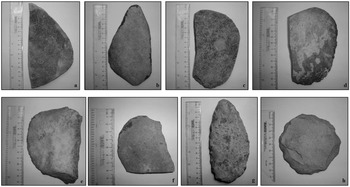
Artifacts detected on survey provide additional clues to the Indigenous inhabitants’ use of agave (Hanselka Reference Hanselka2011). Six expedient tabular knives were encountered in Cueva de las Tijeras 1, a rockshelter too small and low for more than temporary use by small groups. The implements are essentially thin, tabular pieces of limestone that likely flaked off naturally from the shelter wall, unifacially or bifacially retouched along one or more edge margins (Figure 4a–4f). They likely represent a specialized tool kit on an agave collecting campsite, possibly that of a small task-oriented group from some nearby village (based on the presence of several ceramics). Their expedient nature suggests a degree of forethought that the limestone in cave walls often fractures into tabular pieces that can be utilized with little or no alteration. A presumed agave knife was found on a La Florida–Palmillas–phase village site (La Coma); it is a large biface probably for agave harvesting or leaf removal (Figure 4g). As a more formally manufactured version of the expedient knives described above, this tool suggests provisioning for agave-collection forays in the surrounding canyons. A discoid scraper on a large La Florida–Palmillas and late San Antonio–phase river valley settlement (Potrero de Bueyes) suggests that agave leaf fiber processing occurred in villages (Figure 4h).
Stone tools recovered on survey likely attributable to agave harvest and/or processing: (a–f) tabular “agave knives” from rockshelter Cueva de las Tijeras 1; (g) large bifacial knife from settlement La Coma; (h) discoid scraper from settlement Potrero de Bueyes. Scales in centimeters. (Photographs by the author.)

Discussion
Agave Harvest
Artifactual evidence for agave harvest was encountered on sites recorded during survey, and potentially among the curated collections. A concentration of expedient, tabular “agave knives” was recorded in a small rockshelter that would have been suitable for only temporary stays. These are suitable for removing the leaves (a fiber source) from the central stem, or possibly for severing the stem (a food source) to harvest the plant. The tools may have been cached in anticipation of future harvesting rounds, and/or they may have been expediently made by a task-oriented group from a nearby home base intent on procuring agave plants in the canyons. A more formal chipped limestone knife on the La Coma village site suggests either harvesting or leaf removal on or near the settlement, or manufacture of tools to carry on harvesting forays. Furthermore, potential digging stick fragments in the curated collections may have once served to extract agave plants, among other functions.
Food Preparation and Consumption
Several quids in the collections constitute macrobotanical evidence for agave consumption. These result when fibrous leaf bases are removed from the cooked stem and chewed for the edible portion, and the fibrous mass is then expectorated. This complements Callen's (Reference Callen1968, Reference Callen, Brothwell and Higgs1970) paleofeces analysis signifying direct evidence for substantial and sustained ingestion of agave throughout most of the Ocampo cultural sequence: “The consumption of cactus, Agave (maguey), Cucurbita and Capsicum, and the remains of bone, have remained remarkably constant over several thousand years” (Callen Reference Callen1965:337).
Agave was presumably prepared in earth ovens, and the four features in Romero's and Ojo de Agua Caves are probable examples. It is surprising that so few were encountered in these sites: earth ovens are highly archaeologically visible because of the large amounts of waste material they produce (Black and Thoms Reference Black and Thoms2014). It is possible that cave floor space in Ocampo may have been customarily reserved for other activities, and that agave roasting more often took place elsewhere.
Fiber, Basketry, Cordage, and Textile Manufacture
Long inventories of perishable artifacts in published and unpublished accounts demonstrate that fiber and textile industries were significant in Ocampo (e.g., Kelley Reference Kelley1954; MacNeish Reference MacNeish1954a, Reference MacNeish1954b, Reference MacNeish1958, Reference MacNeish, Ekholm and Bernal1971). Considering the collections and the unpublished reports together, Agavaceae leaf fragments are present in almost all occupation layers in Romero's Cave from the mid-Guerra through San Antonio phases (Supplemental Tables 4 and 7). Agave remains were not noted or collected from lower layers, but fiber production was likely also practiced in these earlier phases.
Curated Agavaceae materials from Romero's Cave represent all stages in cordage and textile manufacture, including raw leaf materials (from agave, as well as palm, sotol, and bromeliads), leaves with partially extracted fibers and fully extracted fibers, cordage, fragments of mats, and one large textile fragment. Caves may have been preferred locations for fiber production, spinning, and weaving tasks. The cool, shady cave environment prevents raw materials and partially constructed basketry and textiles from drying prematurely, keeping them pliable during manufacturing (Horton Reference Horton2010).
Tools potentially attributable to extracting agave fiber (i.e., scraper planes and discoidal scrapers) noted in the excavation layers suggest that these activities were consistent throughout all occupations within the caves (even in layers where the leaf materials themselves are absent or not noted; Supplemental Tables 4–6). A discoid scraper on Potrero de Bueyes suggests that fiber extraction was not limited to caves but also occurred in villages.
Agave Intensification in Ocampo?
Intensification is the process by which people extract increasing amounts of resources from the same or smaller area of land, through increased labor or capital investment, most often attributed to the need to feed growing populations in constrained territories (see Boserup Reference Boserup1965). Examples include investment in labor-intensive trapping technologies to catch more fish or small animals, devising ground stone tools for small-seed processing, or adopting earth oven technology (Morgan Reference Morgan2015). Among the most obvious and archaeological visible examples are the domestication of plants and emergence of agricultural economies (Johnson and Hard Reference Johnson and Hard2008:138).
Johnson and Hard (Reference Johnson and Hard2008:144, 147) suggest that early intensification of plant resources should be expected in both southern Tamaulipas and in the Lower Pecos Canyonlands (LPC) of southwest Texas. Contrary to southern Tamaulipas, the LPC remained entirely the domain of hunter-gatherers until European contact (Turpin Reference Turpin and Perttula2004). Burned rock middens abound in the LPC, and dense talus cones of burned rock beneath many rockshelters are remnant waste from countless and repeatedly used earth ovens (Koenig and Black Reference Koenig and Black2019). These are interpreted as evidence for intensive processing of agave and other desert succulents to cope with growing food needs over time (Dering Reference Dering1999; Johnson and Hard Reference Johnson and Hard2008; Koenig et al. Reference Koenig, McQuistion, Black, Frederick, Phil Dering, Kevin Hanselka, Bush, Lawrence, Koenig and Miller2023).
Although agave was consistently consumed in Ocampo throughout both preceramic and ceramic periods, the large burned rock middens and taluses characteristic of agave intensification are notably absent. Agave earth-oven processing obviously did occur—given that it must be cooked thoroughly for consumption, and MacNeish (Reference MacNeish1954a, Reference MacNeish1954b) notes several likely roasting pits within the layers of Romero's and Ojo de Agua Caves—but the low-level food producers of Ocampo were probably not intensively processing agave in quantities or frequencies comparable to the LPC hunter-gatherers.
I propose that this was likely due to availability of other productive resources and potential targets for intensification in Ocampo, particularly the early introduction of tropical domesticates (Table 1). Bottle gourd (Lagenaria siceraria) and pepo squash (Cucurbita pepo) were introduced at least by the Ocampo phase (ca. 6,000 years ago), and cushaw squash (C. argyrosperma) and maize (Zea mays ssp. mays) arrived at least by the subsequent Flacco phase (ca. 5,000 years ago; Smith Reference Smith1997). Several cultigens and potential cultigens were present in the Ocampo feces (Callen Reference Callen, Brothwell and Higgs1970). Some bean fragments may be from cultivated varieties, but specific identification was not possible. Several cultigen pepo squash and bottle gourd seeds were recognized (wild varieties of the former are likely also present). Surprisingly, maize was identified in only four of 49 Mesa de Guaje feces.
For several thousand years, Indigenous Ocampo populations typified a low-level food production economy, integrating cultigens into their preexisting diversified diet, including agave, foxtail millet, prickly pear cactus, acorns, and many others (Hanselka Reference Hanselka2011, Reference Hanselka2017; Smith Reference Smith1997, Reference Smith2001). Although contents of floor debris suggest higher dependence on cultivated plants during later phases, comparatively higher occurrence of agave and prickly pear suggest that these were consistently more frequently consumed than cultigens—a hallmark of low-level food production. However, general subsistence practices were likely not uniform across the society at any given time. The portion of the population represented by the cave occupations may have been more regularly dependent on a diet of local, undomesticated (yet possibly managed or even cultivated) resources while tending and harvesting domesticated crops for higher status people in villages (Callen Reference Callen, Brothwell and Higgs1970:242). Alternatively, the occasional occupants of the caves may have relied on a diet of undomesticated plants while on these field excursions but subsisted on a more domesticated diet (not reflected in the cave feces) at home in their villages. Such a scenario assumes probable social status and/or village/rural distinctions, complicating the social landscape in which agave consumption likely occurred. Furthermore, these nonmutually exclusive possibilities underscore that during periods when sedentary villages are present, cave occupations were likely a marginal, seasonal, or specialized niche, so the diet demonstrated by cave feces is possibly not representative of the overall subsistence pattern (Farnsworth et al. Reference Farnsworth, Brady, DeNiro and MacNeish1985:109). Regardless, over time, the low-level food producers of southern Tamaulipas intensified their use of cultigens rather than agave or other wild plants, eventually culminating in settled agricultural villages.
Agave Cultivation in Ocampo?
Anderies et alia (Reference Anderies, Nelson and Kinzig2008) consider agave cultivation in northern Mexico a risk management strategy to ensure a food supply when maize crops failed because of drought. Precipitation conditions in northern Mexico are more variable and less dependable than the southern tropical regions where maize farming developed, so “agave may have permitted pre-Hispanic arid-lands farmers to temporarily bridge periods of low maize yields, making the maize strategy as viable as it might have been in better-watered areas” (Anderies et al. Reference Anderies, Nelson and Kinzig2008:411).
In Mesoamerica, proliferation of tools related to agave harvest and fiber and sap extraction suggests widespread cultivation by AD 200 (Anderies et al. Reference Anderies, Nelson and Kinzig2008:410; Parsons and Parsons Reference Parsons and Parsons1990:291–292). In Zacatecas, terrace systems in areas unsuitable for maize cultivation often have associated discoid scrapers, and the sediments trapped behind these terraces often contain abundant agave phytoliths, suggesting they were sites of agave cultivation (Trombold Reference Trombold, Foster and Weigand1985, cited in Anderies et al. Reference Anderies, Nelson and Kinzig2008:410). Similarly, evidence for agave cultivation among Classic period Hohokam (AD 1200–1450) in southern Arizona is in the form of fields of rock piles in areas inhospitable to agave. These mounds retain moisture, providing an ideal habitat for transplanted agaves. Artifacts typically associated with agave harvest and processing abound on these fields, and earth ovens that consistently contain agave remains are also common (Fish and Fish Reference Fish, Fish and Minnis2014). Recent work in central Arizona has identified several extant agave species purported to be clonal relict domesticates associated with archaeological sites (Hodgson and Salywon Reference Hodgson and Salywon2013; Hodgson et al. Reference Hodgson, Salywon and Doelle2018).
Presently, there is no evidence in Ocampo that the inhabitants cultivated agave. Small terrace complexes along hill slope villages may be analogous to the theorized agave plots at La Quemada, but direct evidence is lacking. Agaves grow in dense stands on rocky slopes throughout the region and would have been readily available without cultivation, although natural populations may have fluctuated depending on intensity of harvesting. This availability does not preclude the possibility for limited transplantation of a few plants closer to settlements or for small-scale tending in house gardens, on hillside terraces, or along margins of agricultural fields. Many agaves reproduce primarily vegetatively via basal offshoots that are essentially clones of parent plants. These are readily propagated by transplanting: they are easily extracted from the ground, and the succulent leaves resist dehydration, which allows the plant to survive for extended periods without soil.
Feasting and Fermentation
Food and fermented agave products were prominent in social and ritual feasting in Indigenous Mesoamerica, northern Mexico, and the US Southwest. Miller and Graves (Reference Miller, Graves, Koenig and Miller2023; Miller and Montgomery Reference Miller, Montgomery, Rocek and Kenmotsu2018) recognize ritual feasting involving large-scale baking (and potentially fermentation) of agave for large groups in the Jornada Mogollon culture area of west Texas and southern New Mexico, based on disproportionate labor investment in baking facilities and observable ritualistic signatures. More than 400 cooking features were excavated at Paquimé in northern Chihuahua, most of which are small and presumably single-use facilities by individual households. However, five exceptionally large ovens were most likely for mass food preparation for communal feasts. Agave is the most likely resource prepared in these ovens, but sotol, green maize, and cholla buds are also candidates (Minnis and Whalen Reference Minnis and Whalen2020:51).
Fermented, alcoholic pulque was a common component in Mesoamerican feasting events. Anderies and colleagues (Reference Anderies, Nelson and Kinzig2008:410) note that distinctive vessel types at La Quemada frequently have acid-etched interiors, suggesting that they contained pulque. Miller and Montgomery (Reference Miller, Montgomery, Rocek and Kenmotsu2018:240–241) note similar degradation on some El Paso brownware ceramics on Formative period sites in the Jornada Mogollon. Multiple northeastern Mexican hunter-gatherer and agricultural groups produced alcoholic beverages from agave (e.g., Eguilaz Reference Eguilaz1965:82; Newcomb Reference Newcomb1961:41; Toussaint Reference Toussaint1948). Indigenous populations in Tamaulipas clearly had rich ritualistic lives, and cooked or fermented agave very likely served social or ceremonial functions in Ocampo as it did elsewhere.
Conclusion
The excavated Ocampo Caves provided unique insight into the adaptations of local hunter-gatherers, low-level food producers, and later agricultural societies. Tamaulipas remains an interesting case study given its position on the northeastern periphery of Mesoamerica. Smith (Reference Smith and Vierra2005:302) points out that such regions, “which were outside of a primary center of initial domestication, often provide the most promising opportunities to study and compare the full range of different developmental pathways taken early on by low-level food-production societies.” Such “peripheries” are suitable for examining the adoption of plants domesticated elsewhere into localized economies with their own preexisting suite of wild resources.
Most publications on MacNeish's findings in the Ocampo Caves acknowledge agave among a wide variety of utilized wild foods and its role in local fiber and textile manufacture. Paleofecal analysis demonstrates that it was an important food in all cultural phases, rivaled only by prickly pear in terms of percentages. Here, I expand on this published information using MacNeish's field documentation and curated collections (providing greater detail from the previous excavations) and additional information from recent survey. This study yielded additional insights into the harvest and processing of agave into food and fiber within the excavated caves, other temporary camps, and open-air ceramic period settlements.
The Indigenous Ocampo populations did not practice intensification of agave to the extent that people in other regions did, likely because they had access to other potential intensification targets, including introduced domesticated plants. Yet, the data show that they maintained consistent use of agave and other wild resources. Whether wild or cultivated, agave represented a reliable contingency resource when less resilient crops failed, and it likely played a role in social and ritual contexts as it did elsewhere. Finally, we cannot overemphasize the significant technological role that agave held in the general economy: agave products directly contributed to the procurement of animal resources (e.g., fiber for bowstrings and snares, flowering stalks for dart shafts) and other wild or domesticated plant resources (e.g., fiber bags or nets for gathering), not to mention raw materials for clothing and other household essentials. Within their natural range, agaves have been indispensable to countless societies for at least 10,000 years, and Ocampo is no exception.
Acknowledgments
I extend my gratitude to the late Richard MacNeish, David Kelley, and their local crew for the pioneering work in the Ocampo Caves. I thank Washington University in Saint Louis and my doctoral committee. The field research was performed under a permit (2005, Oficio Núm. C.A. 401-36/0152) issued by the Instituto Nacional de Antropología e Historia. Many colleagues assisted with locating and accessing Dr. MacNeish's curated Tamaulipas field notes, documents, and curated plant collections. Comments from Leslie Bush, Phil Dering, Gayle Fritz, Charles Koenig, Myles Miller, and several anonymous reviewers greatly improved the quality of this manuscript. José Zapata translated the abstract into Spanish. Most importantly, I thank the residents of ejido San Lorenzo las Bayas and Ocampo, Tamaulipas, for their generosity and knowledge, especially my field guides Aquiles Puente Montalvo and Fermin Puente Castillo. Fermin sadly passed away recently, and I am deeply indebted to him and his family for their warmth, hospitality, and friendship.
Funding Statement
This study was supported by a Doctoral Dissertation Improvement Grant (BCS-05078899), “The Ocampo Caves in Context: Agricultural Development in Southwestern Tamaulipas, Mexico,” from the National Science Foundation.
Data Availability Statement
The curated Ocampo agave remains described in this article are housed at the following facilities: the Cutler-Blake Collection at the Illinois State Museum (Springfield, Illinois); Departamento de Prehistória, Instituto Nacional de Antropología e Historia (INAH; Mexico City); the Harvard University Herbaria (Cambridge, Massachusetts); and the Smithsonian Institution (Washington, DC). The artifacts collected on survey and described herein are housed at the INAH regional office in Ciudad Victoria, Tamaulipas. Dr. MacNeish's Tamaulipas field documents are curated at the Robert S. Peabody Institute of Archaeology (Andover, Massachusetts), and are currently available online at https://archive.org/details/tamaulipasprojectarchives.
Competing Interests
The author declares none.
Supplemental Material
For supplemental material accompanying this article, visit https://doi.org/10.1017/aaq.2023.34.
Supplemental Text 1. Key publications summarizing plant-related subsistence in the Ocampo region.
Supplemental Text 2. General cultural geography in northeast Mexico.
Supplemental Table 1. Agave taxa in Tamaulipas, according to Gentry (Reference Gentry1982), Hernández Sandoval et alia (Reference Sandoval, González Romo and Medrano1991), and Jacques-Hernández and Salazar Bravo (Reference Jacques-Hernández and Salazar Bravo2009). Shaded taxa potentially present in the study area, based on distribution and habitat / vegetation community preferences.
Supplemental Table 2. Select ethnohistoric sources describing agave use by hunter-gatherers in south Texas / northeast Mexico.
Supplemental Table 3. Key curated plant collections from MacNeish's excavations in the Ocampo Caves, examined 2005–2008.
Supplemental Table 4. Romero's Cave (Tmc247) agave, and potential processing tools and features, according to the field report / excavation layer descriptions (MacNeish Reference MacNeish1954a).
Supplemental Table 5. Valenzuela's Cave (Tmc248) agave, and potential processing tools, according to the field report / excavation layer descriptions (Kelley Reference Kelley1954).
Supplemental Table 6. Ojo de Agua Cave agave, and potential processing tools and features, according to the field report / excavation layer descriptions (MacNeish Reference MacNeish1954b).
Supplemental Table 7. Summary of agave remains in curated collections from Romero's and Valenzuela's Caves, by occupation and phase (none were attributable to Ojo de Agua Cave).