I. INTRODUCTION
Prior to the Rome Statute of the International Criminal Court (Rome Statute),Footnote 1 no international statute, code or charter included a general provision on the mental element required before criminal responsibility for an international crime would attach. The Nuremberg and Tokyo Charters,Footnote 2 which governed the trials of the major German and Japanese war criminals following the Second World War, contained no such provision. Nor did Control Council Law No 10,Footnote 3 which governed the subsequent trials of war criminals in post-war occupied Germany. The Statutes of the ad hoc International Criminal Tribunals for the former Yugoslavia (ICTY) and for Rwanda (ICTR)Footnote 4 did not contain such a provision, nor did the various Draft Codes of Crimes against the Peace and Security of Mankind prepared by the United Nations International Law Commission.Footnote 5 This omission was not repeated with the Rome Statute, which includes a specific provision (Article 30) on the mental element required for crimes within the jurisdiction of the International Criminal Court (ICC). This makes Article 30 the first of its kind.
Article 30 of the Rome Statute provides that:
1. Unless otherwise provided, a person shall be criminally responsible and liable for punishment for a crime within the jurisdiction of the Court only if the material elements are committed with intent and knowledge.
2. For the purposes of this article, a person has intent where:
(a) In relation to conduct, that person means to engage in the conduct;
(b) In relation to a consequence, that person means to cause that consequence or is aware that it will occur in the ordinary course of events.
3. For the purposes of this article, ‘knowledge’ means awareness that a circumstance exists or a consequence will occur in the ordinary course of events. ‘Know’ and ‘knowingly’ shall be construed accordingly.
Thus, Article 30 represents an ambitious attempt at codification of the rules relating to the mental element in international criminal law. As Pisani states, it is ‘designed to bring some consistency into this area of the law’.Footnote 6 First, it aims to set a default rule that applies, in principle, to all crimes included in the Rome Statute. It therefore requires that, unless otherwise provided, the material elements of a crime be committed with ‘intent and knowledge’. Second, it seeks to provide a comprehensive definition of these concepts of ‘intent’ and ‘knowledge’ in the two subsequent paragraphs.
While the mere presence of Article 30 in the Rome Statute is a step forward compared to previous international statutes, codes and charters that did not include any such provision, the article has been subject to criticism from all corners of academia. Cassese describes it as ‘confusing and ambiguous’,Footnote 7 while Werle and Jessberger state that it ‘raises more questions than answers’.Footnote 8 Satzger describes it as ‘an extremely complex rule’ that is ‘quite clearly a compromise between continental and Anglo-American criminal law’.Footnote 9 Eser, on the other hand, while recognizing that Article 30 ‘can certainly not be called a masterpiece of legal architecture’, considers that ‘it provides sufficient building blocks for a meaningful construction of “intention” ’.Footnote 10
This article analyses Article 30 of the Rome Statute from a comparative perspective, by drawing on the different approaches taken by two broad groupings of States: the common law grouping, and the civil law grouping. The primary systems drawn on as examples of the common law grouping are the United States, the United Kingdom and Australia,Footnote 11 while that drawn on as an example of the civil law grouping is Germany.Footnote 12 The article begins with a general introduction to the concept of intent, as it is understood in both civil law and common law domestic legal systems. This is necessary in order to understand the approach taken at Rome because, as Kelt and von Hebel explain, Article 30 ‘necessarily consisted of compromises between different concepts or norms from various legal systems’.Footnote 13 Part III examines the provisions of Article 30 in detail, and attempts to draw some conclusions as to what aspects of the common law and civil law concepts of intent are covered by it. Part IV discusses the exceptions to Article 30, and the article concludes with some opinions on the appropriate direction of future jurisprudence and a possible amendment to the Rome Statute.
II. THE CONCEPT OF INTENT IN COMMON LAW AND CIVIL LAW
A. Gradations of Intent
In all domestic criminal law systems, the general rule (although it is not without exceptions) is that conduct must be committed with ‘intent’ in order for it to constitute a crime.Footnote 14 Conduct that is unintentional, or that is committed negligently, will constitute a crime only in limited circumstances (usually, but not always, where specifically provided for by statute). While all systems require ‘intent’, the definition of intent varies widely depending on the particular domestic system in question. Furthermore, it is rare for a single definition of intent to be applied to every crime. Rather, domestic criminal law systems recognize different gradations or degrees of intent. The same goes for international criminal law. Each gradation or degree has two components: a cognitive component (the element of awareness) and a volitional component (the element of desire).Footnote 15 What sets each gradation or degree of intent apart is the relative level of each component.
Generally speaking, common law systems recognize three gradations of intent: direct intent, oblique intent and recklessness. In addition, certain crimes can be committed negligently, or even unintentionally (eg strict or absolute liability offences). Civil law countries similarly recognize three gradations of intent: dolus directus in the first degree, dolus directus in the second degree and conditional intent (generally referred to as dolus eventualis). In addition, civil law countries recognize two forms of negligence (advertent and inadvertent). Furthermore, both common law and civil law systems recognize some form of special (or additional) intent for particular crimes.Footnote 16
Table 1 represents my attempt to provide a visual comparison of the different gradations of intent recognized in the domestic criminal justice systems of common law and civil law countries, in descending order of culpability.Footnote 17 Inevitably, it only gives a broad outline of these gradations, as there is no one ‘common law’ or ‘civil law’ approach to intent. In fact, approaches differ considerably among civil law countries (and, to a lesser extent, between common law countries).Footnote 18 While some countries recognize every gradation listed, others do not recognize them all.Footnote 19 Similarly, while some countries define certain gradations in a particular way, other countries adopt very different definitions.Footnote 20 Therefore, the borders between each gradation should not be viewed as clear lines, but rather as boundaries that move, depending on the particular domestic legal system one is examining and the time at which it is examined.
Gradations of intent under common law and civil law

In the same way, there is no one view on how the various gradations of intent recognized by common law and civil law systems line up when compared directly. Commentators disagree, for example, on whether recklessness (in common law) and dolus eventualis (in civil law) are really different, and in what way. Thus, the placement of certain common law gradations next to (or above or below) certain civil law gradations should not be viewed as definitive, but rather as a starting point for the following discussion. In fact, it is questionable whether it is even possible to compare the different gradations directly, as the concepts are so different. Instead of comparing concepts, it may therefore be more accurate to view the following table as comparing the likely outcomes; in other words, comparing whether an individual in a particular case would be considered to fulfil the definition of the relevant gradation if that same individual was to come before each domestic criminal justice system.
Before examining Table 1, a few more explanations are required. First, in addition to the English terms for each of the civil law gradations of intent, I have provided both the German and Latin terms, which are more commonly used by commentators and courts. Second, beneath the name of each gradation, an indication has been given of the relative level of the volitional (V) and cognitive (C) components required for each. As will be seen, both the volitional and cognitive components are present for all gradations, except for (inadvertent) negligence.
B. Direct Intent (in the First Degree)
Putting aside the question of special or additional intent, the highest gradation or level of intent for both civil law and common law systems is characterized by the perpetrator's purposeful will to bring about the prohibited result. This gradation is captured by the following example:
P (the perpetrator) is a sniper who wishes to kill V (the victim). V is standing inside a building a significant distance away. P shoots in the direction of V when V passes in front of the window of the building. The bullet shatters the window, and hits V. V dies as a result of the gunshot wound.
In this example, P has a strong desire to kill V; thus, the volitional component is very high. He is not sure whether, by his conduct, he will succeed in killing V (that is, whether he can hit his target at such a distance), but this does not matter, as this gradation of intent is still satisfied even where the cognitive component is low.
This gradation is generally known in civil law systems as direct intent (or dolus directus) in the first degree. In German law, direct intent in the first degree (Absicht) requires that the perpetrator ‘have the completion of the offence (element) as his purpose’.Footnote 21 The perpetrator will be deemed to have this level of intent ‘also with regard to any fact that is a necessary or indispensable interim or ulterior consequence of his primary purpose’ (eg shattering the window in the example above).Footnote 22 As to the cognitive component, in German law it is not necessary that the perpetrator be certain that the prohibited result will occur (that is, it is not necessary that the perpetrator be certain that he will succeed in killing V).Footnote 23
This gradation is known in some common law systems (eg the US) as acting ‘purposely’, while other common law countries (eg the UK and Australia) refer to it simply as acting ‘intentionally’. To avoid confusion, I have adopted the more academic title for this gradation: direct intent. As to the content of this gradation in common law, the US Model Penal Code provides that a person acts ‘purposely’ when it is his or her ‘conscious object’ to engage in conduct or cause a result.Footnote 24 Similarly, the Commonwealth Criminal Code in Australia provides that a person acts with ‘intention’ if he or she ‘means to’ engage in conduct or to bring about a result.Footnote 25 Under English common law, this gradation covers cases where an individual acts ‘in order to bring about a result’.Footnote 26 As with the same gradation under civil law, where a person acts in order to achieve a particular purpose, knowing that this cannot be done without causing another result (eg shattering a window), he or she must be held to intend to cause that other result (whether it be a pre-condition for, or a necessary concomitant of, the first result).Footnote 27
C. Oblique Intent, or Direct Intent in the Second Degree
The second gradation or level of intent for both civil law and common law systems does not require the same purposive degree as the first gradation. This gradation is captured by the following example:
P wishes to kill V by bombing the building in which V is located. P is aware that there are other individuals in the building, and that they will almost certainly be killed as well. While P does not want these other individuals to be killed (and in fact he hopes fervently that they will somehow escape death), he nevertheless bombs the building. Both V and a number of other individuals are killed in the blast.
In this case, P will be held to have fulfilled the second gradation or level of intent with respect to the deaths of the other individuals who were in the building with V. So, with this second gradation of intent, the volitional component is weaker (P did not wish to kill these other individuals); it is the cognitive component that dominates (P was almost certain that these individuals would die as a result of his conduct in bombing the building).
This gradation is generally known in civil law systems as direct intent (or dolus directus) in the second degree. In such cases, the perpetrator foresees as a certainty or as highly probable that certain consequences will flow from his or her conduct.Footnote 28 As Van der Vyver explains, despite the perpetrator not having any desire for those consequences to occur, the perpetrator nevertheless engages in the conduct.Footnote 29 According to Badar, he or she acts indifferently with regard to the consequences, and is therefore deemed to have desired those consequences.Footnote 30 Similarly, the German Federal Supreme Court of Justice states that ‘a perpetrator who foresees a consequence of his conduct as certain is considered to act willfully with regard to this consequence, even if he regrets its occurrence’.Footnote 31
This gradation is known in some common law systems (eg the US) as acting ‘knowingly’, although in others (eg the UK and Australia) it is still referred to as acting ‘intentionally’.Footnote 32 Again, I have adopted the more academic title of oblique intent in Table 1. The US Model Penal Code provides that a person acts ‘knowingly’ with respect to a result when he or she is ‘practically certain’ that his or her conduct will cause such a result.Footnote 33 Similarly, under English common law, the concept of oblique intent covers cases where a consequence is ‘virtually certain’.Footnote 34 According to Williams, ‘[t]here are twin consequences of the act, x and y; the doer wants x, and is prepared to accept its unwanted twin y’.Footnote 35 In other jurisdictions, the test is not as high. For example, in the Australian Commonwealth Criminal Code, a person acts with this type of intention with respect to a result where he or she ‘is aware that it will occur in the ordinary course of events’.Footnote 36 This provision was based onFootnote 37 clause 18(b)(ii) of the Draft Criminal Code Bill prepared by the English Law Commission.Footnote 38 The Law Commission intended this phrase to cover cases where a result was ‘a virtual certainty’ (ie a result that would occur ‘in the absence of some wholly improbable supervening event’).Footnote 39 It admitted in its report, however, that it was possible, under this definition, that ‘juries will, in a few cases, find intention to be proved where, under the existing law [which required foresight of the virtual certainty of the result], they might not have done so’.Footnote 40 For this reason, in Table 1 the ‘oblique intent’ category (in the common law column) extends lower than the ‘direct intent in the second degree’ category (in the civil law column). This is an attempt to demonstrate that depending on the jurisdiction (for example, in Australia), this category may capture more cases (on the lower end of the scale) than the equivalent civil law category. This is because the test for acting with oblique intent in a common law system may require only that the result occur in the ordinary course of events, whereas the test for acting with ‘direct intent in the second degree’ in a civil law system will require that a consequence be foreseen as a certainty or as highly probable. Nevertheless, in both common law and civil law systems, this gradation of intent is characterized by a low volitional component, and a high cognitive component.
D. Recklessness and Dolus Eventualis
In the third gradation or level of intent, the volitional component remains weak and the cognitive component still dominates; however, the cognitive component is weaker than in the second gradation. Let us consider a slightly modified version of the last example:
P wishes to kill V by bombing the building in which V is located. This building is in a busy street. P is aware that there is a risk that, in the explosion, other individuals may be injured or even killed. While P does not want these other individuals to be injured or killed, he nevertheless bombs the building. Both V and a number of other individuals are killed in the blast.
In this example, while P is not certain that other individuals will be killed in the blast, he is aware of a risk that this might occur. Thus, the cognitive component is weaker than in the last example. Again, P does not wish to kill the other individuals, so the volitional component is low.
In civil law systems, this gradation is occupied by the concept of dolus eventualis or conditional intent. There is no one test or definition for dolus eventualis. Different tests or definitions have been put forward by commentators and adopted by courts at different times and in different jurisdictions.Footnote 41 Broadly speaking, dolus eventualis exists where a person ‘is aware that a material element included in the definition of a crime … may result from his conduct and “reconciles himself” or “makes peace” with this fact’.Footnote 42 As Bohlander explains, the major schools of thought generally agree that the perpetrator must have been aware of the fact that his or her actions might lead to particular consequences; the disagreement centres mainly on the volitional component.Footnote 43 Some theories do not require any volitional component (but differ as to the required level of awareness of the possibility or probability of the result occurring), while others do require a volitional component (but differ as to whether this should constitute approval/mental consent to the result, or whether an attitude of indifference would suffice).Footnote 44 According to Bohlander, the German courts have adopted a ‘watered-down approval theory’.Footnote 45 By this theory, a perpetrator will act with dolus eventualis where he or she foresees the consequences of his or her actions as possible (but not inevitable), and approves of them (in the sense that he or she has reconciled him- or herself to those consequences for the sake of achieving his or her goal).Footnote 46 The approval of the perpetrator does not need to be explicit, and the perpetrator need not morally approve of the result; it is sufficient if he or she nevertheless accepts it in order to reach his or her ulterior goal.
The broad equivalent of dolus eventualis in common law systems is recklessness. Essentially, recklessness is a form of ‘conscious risk-taking’,Footnote 47 as it involves a person taking an unreasonable and unjustifiable risk, of which he or she is aware. Under the Australian Commonwealth Criminal Code (which is based on the US Model Penal Code),Footnote 48 a person will be found to have acted recklessly if that person was aware of a substantial risk that his or her conduct would cause a particular result, and, having regard to the circumstances known to him or her at the time, it was unjustifiable to take that risk.Footnote 49 Under Australian common law, the test for recklessness is foresight of probability in cases of murder, and foresight of possibility for all other crimes. Recklessness is defined in the Code in terms of a ‘substantial’ risk rather than in terms of probability or possibility because those terms ‘invite speculation about mathematical chances’.Footnote 50 Regardless of the exact formulation, the cognitive element for recklessness is low. Unlike dolus eventualis, recklessness does not specifically require that a person reconcile him- or herself to, or accept the outcome of, his or her risk-taking. It simply requires a decision to take a substantial and unjustifiable risk.
Commentators disagree as to whether there is any real difference between the concepts of recklessness and dolus eventualis. Generally, those who believe there is a difference argue that dolus eventualis sets a ‘higher threshold’ than recklessness, because recklessness does not require as high a volitional component.Footnote 51 This appears to be the position taken by the ICTY Trial Chamber in the Stakić case,Footnote 52 as well as ICC Pre-Trial Chamber I in the Lubanga case.Footnote 53 However, while the test for recklessness does not explicitly require as high a volitional component as the test for dolus eventualis, because the individual does not have to be shown to have ‘accepted’ or ‘been reconciled with’ the outcome, the fact that the individual decides to proceed with the relevant conduct despite knowledge of the substantial risk is evidence of some level of volition.Footnote 54 Whatever the differences may be between the two concepts, as Werle suggests, these gradations of the mental element would ‘usually cover the same factual constellations’.Footnote 55 Nevertheless, in recognition of the fact that recklessness does not specifically require that a person reconcile him- or herself or accept the outcome of his or her risk-taking, recklessness is given a lower volitional element than dolus eventualis in Table 1.
Having introduced the concept of intent in common law and civil law domestic criminal justice systems and identified the various gradations of intent recognized in those systems, the next part of this article turns to Article 30 of the Rome Statute, and attempts to situate the concepts covered by it in relation to the gradations of intent set out in Table 1.
III. ARTICLE 30 OF THE ROME STATUTE
A. Intent and Knowledge
Paragraph 1 of Article 30 sets out the general rule that the material elements of an international crime must be committed with intent and knowledge. However, prior to the February 1997 session of the Preparatory Committee for the Rome Conference, there was debate as to whether these two terms should be disjunctive (‘or’) or conjunctive (‘and’).Footnote 56 Ultimately, a decision was made to use the conjunctive formulation. As both Pisani and Eser explain, it was felt that this formulation was necessary in order to emphasize, from a psychological-analytical point of view, the necessary co-existence of the cognitive and volitional components of intent, both of which can vary in different degrees for the different gradations (as depicted in Table 1 above).Footnote 57 However, as is noted below, this does not mean that each particular material element must be committed with both ‘intent’ and ‘knowledge’, as those terms are defined in the subsequent two paragraphs of Article 30.
B. Element Analysis Approach
Unlike the statutes and codes that came before it, the Rome Statute takes an ‘element analysis’ approach, rather than a ‘crime analysis’ or ‘offence analysis’ approach.Footnote 58 ‘Elements’ are the basic ‘building blocks’ of a crime.Footnote 59 The Rome Statute recognizes two types of element: material elements (also known variously in domestic systems as the actus reus, physical elements or objective elements) and mental elements (also known variously in domestic systems as the mens rea or subjective elements). The material elements represent the ‘external side of criminal conduct’, while the mental elements represent the ‘internal side’.Footnote 60 As Badar explains:
Under ‘offence analysis’, crimes are defined in general terms; intentional crimes, reckless crimes and negligent crimes, whereas ‘element analysis’ in contrast, recognizes that a single crime definition may require a different culpable state of mind for each objective element of the offence.Footnote 61
The jurisprudence of previous military and international tribunals tended to take an offence analysis approach, and did not distinguish the various material elements of a crime and apply different mental elements to each. The ICC, however, is required by its Statute to analyse crimes in terms of their different types of material elements, which are each assigned a different mental element.
The Rome Statute contemplates three types of material element: conduct elements, consequence elements and circumstance elements;Footnote 62 it does not define the terms ‘conduct’, ‘consequence’ or ‘circumstance’.Footnote 63 According to commentators:
• Conduct includes ‘a prohibited action or prohibited omission that is described in the definition of a crime’.Footnote 64 As Werle notes, ‘every international crime presumes some conduct that is more precisely delineated in the definition of the crime’.Footnote 65
• Consequences ‘can refer either to a completed result, such as the causing of death, or the creation of a state of harm or risk of harm, such as endangerment, for example’.Footnote 66
• Circumstances ‘qualify the conduct and consequences. They may, for example, describe the requisite features of the persons or things mentioned in the conduct and consequence elements’.Footnote 67 According to Heller, a circumstance element is ‘an additional state of affairs that must exist for the prohibited conduct and consequence to be criminal’ (which may be either factual or legal).Footnote 68
Because the mental element is defined differently for different kinds of material elements, the classification of a material element as a conduct, consequence or circumstance element is critical: the relevant mental element cannot be determined until each material element of a crime is properly characterized.Footnote 69 However, as a number of commentators have pointed out, the dividing line between these types of material elements is not always clear.Footnote 70 Robinson and Grall argue that most of these difficulties can be avoided if ‘conduct’ elements are
defined literally, and thus narrowly, to mean pure conduct, that is, to mean the actual physical movement of the actor. Thus, objective elements of an offense definition that might otherwise be classified as conduct elements, but which actually describe characteristics of the conduct—i.e., elements concerning the ‘nature of conduct’—should be treated as circumstances.Footnote 71
In a way, this would involve breaking down what would normally be considered one element (eg transferring, directly or indirectly, parts of the population of an Occupying Power into occupied territory)Footnote 72 into two or more separate elements (thus, in this example, transferring parts of a population into a territory as a conduct element, and the status of the territory as occupied territory and of the population as that of an Occupying Power as circumstance elements). According to this argument, whenever a phrase combines a conduct element with a circumstance element in the Rome Statute, the elements should be separated out.
Similarly, material elements that might otherwise be classified as conduct elements but that actually describe results following the conduct, should be treated as consequence elements. Again, this involves breaking down what would normally be considered one element (eg inflicting great suffering, or serious injury to body or to mental or physical health, by means of an inhumane act)Footnote 73 into two or more separate elements (in this example, committing the inhumane act as a conduct element, and the requisite effect of the act, such as great suffering, as a consequence element). Again, according to this argument, whenever a phrase combines a conduct element with a consequence element in the Rome Statute, the elements should be separated out.
Robinson and Grall also note the fact that distinguishing circumstance elements from consequence elements can be difficult.Footnote 74 To resolve such problems, they suggest defining a consequence as ‘a circumstance changed by the actor’.Footnote 75 All elements that do not fit this definition would be ‘independent circumstance elements’.Footnote 76 Let us take the example of the war crime of starvation as a method of warfare, and the particular element of that crime of ‘depriving civilians of objects indispensable to their survival’: the actor creates the deprivation (a consequence element), but he or she cannot alter the status of the objects as indispensable to the survival of the civilians (a circumstance element).Footnote 77
In conclusion, Robinson and Grall's suggestions create the following situation:
In every offense, the conduct element, although perhaps linguistically merged with other elements, would simply perform the function of the act requirement. [Consequence] elements would be easy to detect; they would be circumstances changed by the actor. All other elements would be circumstance elements.Footnote 78
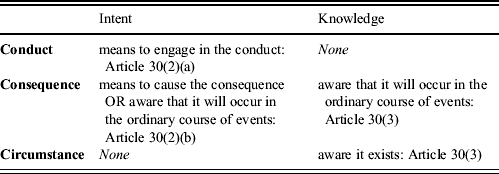
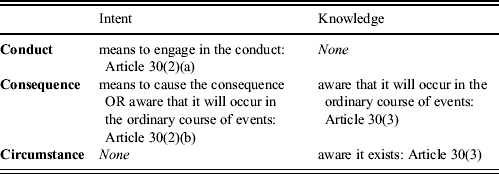
Once a material element has been properly characterized as a conduct, consequence or circumstance element, paragraphs (2) and (3) of Article 30 provide the applicable definition of the mental element. For a conduct element, only intent is required, as knowledge is not defined with respect to conduct. Similarly, for a circumstance element, only knowledge is required, because intent is not defined with respect to circumstances. For a consequence element, however, both intent and knowledge must be proven, because Article 30 defines both those terms with respect to consequence elements. The definitions of ‘intent’ and ‘knowledge’ provided in Article 30, as they apply to the three different material elements, are set out in Table 2.Footnote 79
Definitions of ‘intent’ and ‘knowledge’ in Article 30
Therefore, depending on whether a particular element is a conduct, consequence or circumstance element, the required mental element will be either intent or knowledge or both. This position is supported by the Elements of Crimes, which states that
where no reference is made in the Elements of Crimes to a mental element for any particular conduct, consequence or circumstance listed, it is understood that the relevant mental element, for example, intent, knowledge or both, set out in article 30 applies.Footnote 80
For this reason, although Article 30(1) provides that a person shall be criminally responsible only if the material elements are committed with intent and knowledge, as Werle and Jessberger explain, this part of the article ‘cannot be interpreted as requiring that all material elements have to be committed with intent and knowledge’.Footnote 81
Nevertheless, as all crimes under the jurisdiction of the ICC involve conduct and at least one other type of material element (whether it be a consequence element or a circumstance element), when the various elements of the crime are combined, one will end up with proof of both intent and knowledge.Footnote 82
C. Definitions of ‘Intent’
Article 30(2) defines two different levels or gradations of ‘intent’. A person has ‘intent’ with respect to conduct or a consequence if he or she ‘means to’ engage in the conduct (Article 30(2)(a)) or cause the consequence (Article 30(2)(b)(first alternative)). A person also has ‘intent’ with respect to a consequence if he or she ‘is aware that it will occur in the ordinary course of events’ (Article 30(2)(b)(second alternative)).
1. ‘Means to’
The first level or gradation of intent (‘means to’ engage in conduct or cause a consequence) is defined using language identical to the wording found in the Australian Commonwealth Criminal Code, which was based on the English Draft Criminal Code Bill. In those Codes, this language was used to codify the concept of ‘direct intent’. I submit, therefore, that this language covers what is known in the common law as direct intent, and what is known in civil law countries as dolus directus in the first degree (that is, the highest gradation or level of intent).Footnote 83 In my view, it should therefore be interpreted as covering cases characterized by the accused's purposeful will to engage in the conduct or bring about the prohibited consequence (ie where the volitional component is very high). In the language of the US Model Penal Code, engaging in the conduct or causing the result should be the perpetrator's ‘conscious object’. This interpretation of the language ‘means to’ is supported by the jurisprudence of Pre-Trial Chambers I and II of the ICC, which have held that this language requires that the accused act with the ‘concrete intent’,Footnote 84 ‘purposeful will’Footnote 85 or ‘express intent’Footnote 86 to bring about the material elements of the crime. As is the case for this level or gradation of intent in domestic law, the perpetrator should also be taken to have this level of intent with regard to any fact that is a necessary or indispensable interim or ulterior consequence of his or her primary purpose (such as shattering the window in the example given above).
There will, in my view, be one significant difference between the ‘means to’ concept in Article 30 and the concept of direct intent or dolus directus in the first degree in common law and civil law systems respectively. That difference relates to the required cognitive component. In common law and civil law systems, the law relating to this gradation of intent generally does not require anything more than a low cognitive component to accompany the very high volitional component. Thus, it is not required that the perpetrator be certain that he or she will succeed in engaging in the conduct, or in bringing about the prohibited result. In fact, it would be sufficient for the perpetrator to believe that it is very unlikely that he or she will succeed. Take, for example, the case of an individual who shoots at a target that is some distance away. In this case, the perpetrator believes it unlikely that he or she will successfully kill the victim at such a great distance, but, if he or she succeeds, he or she will be considered to have fulfilled this gradation of intent, so long as it was his or her conscious object to kill the victim.
Under Article 30, however, for a person to be held criminally responsible for a crime, the material elements must be committed with intent and knowledge. From the discussion above, we know that both intent and knowledge will only be required in relation to a consequence element, because this is the only element for which ‘intent’ and ‘knowledge’ are defined.Footnote 87 Therefore, with respect to a consequence element, it must be proven not only that the perpetrator ‘meant to’ cause a consequence, but that he or she also fulfilled the definition of ‘knowledge’ (that is, that he or she was aware that the consequence would occur in the ordinary course of events). Therefore, while only a low cognitive component is necessarily required by the definition of intent, the cognitive component for a consequence element is raised by the requirement that consequence elements be committed with knowledge. The effect of this is that whereas a perpetrator need not be certain that he or she will succeed in engaging in conduct (because there is no knowledge requirement for a conduct element), a perpetrator must be aware that he or she will succeed in bringing about a consequence ‘in the ordinary course of events’. Therefore, this gradation of mental element in Article 30 of the Rome Statute is much more difficult to fulfil than the equivalent gradation in common law and civil law systems.
This position regarding the necessary cognitive component when applied to a consequence element is supported by ICC Pre-Trial Chamber I's decision in Lubanga, where the Chamber noted that Article 30 covered ‘first and foremost’ the concept of ‘dolus directus of the first degree’. It defined this concept as covering situations where the perpetrator:
… (i) knows that his or her actions or omissions will bring about the objective elements of the crime, and (ii) undertakes such actions or omissions with the concrete intent to bring about the objective elements of the crime …Footnote 88
Thus, the Chamber viewed this gradation of intent as requiring that the perpetrator ‘know’ that his or her conduct would bring about a certain consequence (a very high cognitive component).
In conclusion, while at first it might appear that the language ‘means to’ in Article 30(2)(a) and (b)(first alternative) incorporates the concept of direct intent or dolus directus in the first degree (as those concepts are defined in domestic law), the requirement that consequence elements also be committed with ‘knowledge’ means that this gradation in Article 30 is in fact much higher than its equivalent in domestic law. Unlike in domestic law, where this gradation is normally characterized by a very high volitional component and only a low cognitive component, under Article 30 the gradation is characterized by very high volitional and cognitive components (when it is applied to consequences).
To give an example of the practical impact this may have, consider the case of an accused who plants an improvised explosive device (or ‘IED’, which have a notoriously low success rate), which he or she intends to initiate remotely when civilians come within range. It is the perpetrator's conscious object to kill those civilians; however, unless it could be shown that he or she knew (at the time the device was initiated) that the device would explode successfully and thereby result in the death of those civilians, the perpetrator would not satisfy this gradation of intent. Regardless of how much he or she might desire to kill those civilians, and how much he or she might hope that the IED will initiate properly, this would not be sufficient if it could not also be shown that he or she had the required knowledge. This obviously represents an unexpected and undesired consequence of the conjunctive ‘intent and knowledge’ wording of Article 30.
2. ‘Aware it will occur in the ordinary course of events’
The second level or gradation of intent defined in Article 30(2) exists where a person ‘is aware that [a consequence] will occur in the ordinary course of events’ (Article 30(2)(b)(second alternative)). As with the first level, this language is identical to the wording used in the Australian Commonwealth Criminal Code and the English Draft Criminal Code Bill. In those Codes, it was used to codify the concept of oblique intent. I submit, therefore, that this language broadly covers what is known in the common law as oblique intent, and what is known in civil law countries as dolus directus in the second degree.Footnote 89 In such cases, the perpetrator foresees as practically certain or as highly probable that certain consequences will flow from his or conduct. While the perpetrator does not have any desire for these consequences to occur, he or she nevertheless engages in the conduct, and is therefore deemed to have desired them. This gradation does not require the same purposive degree as the first gradation defined in Article 30 (that is, it does not require the same high volitional component), but the cognitive component is high (that is, the perpetrator must see the relevant consequence as virtually certain or highly probable).Footnote 90 Therefore, as with the interpretation of the phrase ‘in the ordinary course of events’ under the English Draft Criminal Code Bill, I submit that this phrase in Article 30 should be interpreted to mean that the result would occur in the absence of some wholly improbable supervening event.Footnote 91 This is also the position taken by Werle and Jessberger and by Badar, who interpret the language to mean that the consequence would occur ‘unless extraordinary circumstances intervened’.Footnote 92
It is relatively clear that the language of Article 30(2)(b)(second alternative) covers the concept of oblique intent or dolus directus in the second degree. This has been confirmed by the jurisprudence of the Court to date. For example, in Bemba, ICC Pre-Trial Chamber II described this gradation as requiring that the accused be ‘aware that [the material] elements will be the almost inevitable outcome of his acts or omissions’.Footnote 93 The more important question, however, is whether such language includes anything lower than this. In other words, do the words ‘will occur in the ordinary course of events’ also cover cases that would fall within the categories of dolus eventualis or recklessness, as they are understood in their respective domestic criminal law systems?
Provisions giving definitions of dolus eventualis and recklessness were present early on in the negotiations of a draft statute prior to Rome. According to Badar, the notion of dolus eventualis ‘was last discussed in the 1996 Report of the Preparatory Committee and since then had vanished from all the subsequent reports and Statute drafts’,Footnote 94 whereas, as Clark explains, the provision on recklessness ‘was ultimately to vanish also from the Statute at Rome’.Footnote 95 In both cases, there was no formal decision to drop the relevant provisions,Footnote 96 leading commentators to speculate now with respect to the intentions of the drafters. For example, Clark explains that his understanding of the terms of the debate among States at the Rome Conference ‘was that most of the players … were generally uncomfortable with liability based on recklessness or its civil law (near) counterpart dolus eventualis’.Footnote 97 Pisani argues that, while a formulation that clearly included dolus eventualis did not appear in the final formulation of Article 30, ‘this consideration on its own would not constitute an obstacle to the application of international criminal responsibility based on [dolus] eventualis’.Footnote 98 She concludes, however, that:
[t]he extensive debate amongst the various points of view as well as the preparatory drafts and the definitive choice adopted by the Statute to exclude recklessness as a form of responsibility are all unequivocal indications that those who drafted the Statute wanted to limit the subjective element to … direct intent … [and] oblique intent … It seems clear, then, that the word ‘intent’ must be interpreted as excluding recklessness as well as … dolus eventualis.Footnote 99
Werle and Jessberger argue that ‘the fact that a definition of recklessness provided for in the Draft Statute was removed during the negotiations at Rome does not militate against including recklessness as a basis for criminal responsibility under the ICC Statute’.Footnote 100 Other authors, such as Ambos, have interpreted this deletion as meaning exactly that.Footnote 101
It is possible that a provision defining dolus eventualis was dropped early on because drafters viewed it as being already covered by the terms of Article 30. On the other hand, it is arguable that the fact that the provision defining recklessness was retained up until Rome suggests that this concept was not already covered by the terms of Article 30 (that is, the definitions of ‘intent’ and ‘knowledge’ contained therein); in other words, if the wording ‘will occur in the ordinary course of events’ left room for such a concept, there would have been no need for a separate provision defining it.
With the drafting history providing little help, the dispute over whether recklessness and dolus eventualis are included within the meaning of Article 30 comes down to differing interpretations of the specific wording of that provision. With respect to recklessness, academics generally agree that this concept is not covered by Article 30, because it does not have the necessary volitional component required by the conjunctive use of ‘intent and knowledge’ in Article 30(1).Footnote 102 This was also the position adopted by ICC Pre-Trial Chamber I in the Lubanga case.Footnote 103 As the Chamber explained:
The concept of recklessness requires only that the perpetrator be aware of the existence of a risk that the objective elements of the crime may result from his or her actions or omissions, but does not require that he or she reconcile himself or herself with the result. In so far as recklessness does not require the suspect to reconcile himself or herself with the causation of the objective elements of the crime as a result of his or her actions or omissions, it is not part of the concept of intention.Footnote 104
Thus, recklessness, which the Court regards as having a lower volitional component than dolus eventualis, is not, in the view of Pre-Trial Chamber I, covered by the terms of Article 30. Pre-Trial Chamber II also took the view in Bemba that recklessness is not captured by Article 30 of the Statute.Footnote 105
As for the concept of dolus eventualis, the dispute comes down to the interpretation of the wording ‘will occur’. On the one side, there are those who argue that such wording cannot be interpreted to include dolus eventualis. They argue that mere probability that a consequence may occur is insufficient, and that the wording requires that the perpetrator foresee the occurrence of the consequence as certain. For example, according to Werle and Jessberger, dolus eventualis is excluded by the wording ‘will occur’; in their view, dolus eventualis (which requires only a risk that a consequence may occur, rather than a practical certainty) would only be covered if the language were ‘may occur’.Footnote 106 This is also the view taken by Eser,Footnote 107 Ambos,Footnote 108 HellerFootnote 109 and van Sliedregt.Footnote 110
On the other side, those in favour of the inclusion of dolus eventualis argue that this phrase requires only that the perpetrator be aware of the probable occurrence of the consequence. However, as Werle and Jessberger note, ‘[r]emarkably, the few commentators who advocate the inclusion of … dolus eventualis … hardly ever give any reasons for their position’.Footnote 111 Examples include Jescheck,Footnote 112 Mantovani,Footnote 113 Knoops,Footnote 114 TrifftererFootnote 115 and Cassese.Footnote 116 One exception is Piragoff and Robinson, who argue that if the concept of dolus eventualis is defined in terms of a substantial or high degree of probability (as opposed to merely a risk) that the consequence will occur, then it is covered by the terms of Article 30(2)(b)(second alternative); only those definitions of dolus eventualis that require merely a risk that a consequence will occur would be excluded.Footnote 117 Ambos seems to agree with Piragoff and Robinson, stating that ‘there are other, more cognitive concepts of dolus eventualis (requiring awareness or certainty as to a consequence) and these may indeed be included in Article 30’.Footnote 118
Some of those commentators who argue against inclusion of dolus eventualis in Article 30(2)(b)(second alternative) have recognized that it would be possible for the ICC to interpret the phrase ‘in the ordinary course of events’ in a way that would include recklessness or dolus eventualis, but consider that such an interpretation may well conflict with the principle of strict construction.Footnote 119 Indeed, this is exactly what has occurred: Pre-Trial Chamber I, in the first substantive decision of a Chamber of the ICC to interpret Article 30, found that the wording ‘will occur in the ordinary course of events’ does include the concept of dolus eventualis. It stated that the concept of intention in Article 30 covers
situations in which the suspect (a) is aware of the risk that the objective elements of the crime may result from his or her actions or omissions, and (b) accepts such an outcome by reconciling himself or herself with it or consenting to it (also known as dolus eventualis).Footnote 120
The Chamber went on to state:
if the risk of bringing about the objective elements of the crime is substantial (that is, there is a likelihood that it ‘will occur in the ordinary course of events’), the fact that the suspect accepts the idea of bringing about the objective elements of the crime can be inferred from:
i. the awareness by the suspect of the substantial likelihood that his or her actions or omissions would result in the realization of the objective elements of the crime; and
ii. the decision by the suspect to carry out his or her actions or omissions despite such awareness.
… Where the state of mind of the suspect falls short of accepting that the objective elements of the crime may result from his or her actions or omissions, such a state of mind cannot qualify as a truly intentional realization of the objective elements, and hence would not meet the ‘intent and knowledge’ requirement embodied in article 30 of the Statute.Footnote 121
Thus, it appears that Pre-Trial Chamber I viewed the definition of intent with respect to consequences (ie that a consequence ‘will occur in the ordinary course of events’) as being fulfilled where: (a) there is a ‘substantial’ risk that the consequence will occur; and (b) the accused is shown to have been aware of this risk, and to have proceeded with the conduct regardless. While the Chamber was devoted to the idea that a volitional element must be shown in the form of acceptance of the outcome, however, this definition does not appear all that different from the definition of recklessness. In reality, therefore, there may not be any difference in terms of outcome. In Weigend's view, whether or not Pre-Trial Chamber I is correct in its interpretation of the wording of Article 30(2)(b), ‘the Court's more expansive interpretation of that clause certainly makes theoretical and political sense’.Footnote 122 While he does not explain what he means by this, it is likely that he is referring to the fact that both domestic legislation implementing provisions of the Rome Statute and the jurisprudence of the ICTY and ICTR have recognized liability for international crimes in cases where the perpetrator has only recklessness or dolus eventualis.Footnote 123
More recently, in the Bemba case, ICC Pre-Trial Chamber II took the opposite position to Pre-Trial Chamber I regarding dolus eventualis, holding that the concept is not captured by Article 30.Footnote 124 The Chamber made this finding on the basis that the wording ‘will occur’ ‘does not accommodate a lower standard than the one required by dolus directus in the second degree (oblique intention)’.Footnote 125 Pre-Trial Chamber II stated further:
by way of a literal (textual) interpretation, the words ‘[a consequence] will occur’ serve as an expression for an event that is ‘inevitably’ expected. Nonetheless, the words ‘will occur’, read together with the phrase ‘in the ordinary course of events’, clearly indicate that the required standard of occurrence is close to certainty. In this regard, the Chamber defines this standard as ‘virtual certainty’ or ‘practical certainty’, namely that the consequence will follow, barring an unforeseen or unexpected intervention that prevent[s] its occurrence.
This standard is undoubtedly higher than the principal standard commonly agreed upon for dolus eventualis—namely, foreseeing the occurrence of the undesired consequences as a mere likelihood or possibility. Hence, had the drafters of the Statute intended to include dolus eventualis in the text of article 30, they could have used the words ‘may occur’ or ‘might occur in the ordinary course of events’ to convey mere eventuality or possibility, rather than near inevitability or virtual certainty.Footnote 126
Pre-Trial Chamber II found that this interpretation was supported by the travaux préparatoires of the Statute, which suggested that ‘the idea of including dolus eventualis was abandoned at an early stage of the negotiations’ of the Statute.Footnote 127
No decision has yet been made by the Appeals Chamber of the ICC to resolve the contradictory conclusions reached by Pre-Trial Chambers I and II with regard to dolus eventualis. Thus, it remains unclear whether this concept is covered by Article 30. In my view, however, the detailed analysis conducted by Pre-Trial Chamber II of the language and travaux préparatoires of the Statute lends greater weight to its finding that dolus eventualis is not covered by the language of Article 30. Furthermore, as a matter of policy, given the ICC's nature as a court of last resort and the principle of strict construction, an interpretation of Article 30 that does not include dolus eventualis is appropriate.
D. Definitions of ‘Knowledge’
Article 30(3) provides two definitions of ‘knowledge’. A person has ‘knowledge’ with respect to a circumstance if he or she has ‘awareness that [it] exists’, while a person has ‘knowledge’ with respect to a consequence if he or she has ‘awareness that … [it] will occur in the ordinary course of events’.
1. ‘Awareness that a circumstance exists’
The first definition (‘awareness that a circumstance exists’) appears to require positive or actual knowledge of the relevant circumstance. The question is whether this requirement could be satisfied by proof of ‘wilful blindness’, as it is understood under the common law.Footnote 128 In other words, would it be sufficient to prove that an accused suspected that a circumstance existed, but avoided actual knowledge by deliberately shutting his or her eyes to an obvious means of knowledge.Footnote 129
Piragoff and Robinson recognize that the specific definition in Article 30(3) may exclude such a concept and that actual awareness or cognizance may be required. They also recognize, however, that ‘it may be open to the Court to interpret “awareness” to include wilful blindness in some situations’.Footnote 130 Eser seems to have come to the same conclusion, submitting that while a draft clause covering wilful blindness had been considered prior to Rome but was ultimately abandoned,Footnote 131 this does not necessarily mean that the language of Article 30 could not be interpreted to cover cases of ‘implied’ or ‘constructive’ knowledge.Footnote 132 Badar argues, on the other hand, that the wording of Article 30(3) ‘limits the meaning of knowledge to “actual knowledge” as opposed to “constructive” knowledge’.Footnote 133 He states that ‘[e]ven knowledge of “high probability” of the existence of a particular fact” is insufficient.Footnote 134 He therefore concludes that the doctrine of ‘wilful blindness’ would only be covered by Article 30 ‘if the doctrine is understood to apply only in situations where the perpetrator is virtually certain that the fact exists’.Footnote 135 Thus, in his view, Article 30 could be argued to cover cases where the accused realized the high probability that the circumstance existed, but purposely refrained from obtaining the final confirmation because he or she wanted to be able to deny knowledge.Footnote 136
In my view, in the context of international crimes, where criminal conduct is widespread and ongoing, actual knowledge will be extremely difficult to prove if some concept of wilful blindness is not permitted as a method of proof. For this reason, Article 30(3) should be interpreted as allowing proof by at least a limited form of wilful blindness, as put forward by Badar. As such, proof that an accused was virtually certain that a circumstance existed should be taken to satisfy the definition of knowledge in that provision.
2. ‘Awareness that … a consequence will occur in the ordinary course of events’
The second definition of knowledge is formulated in exactly the same terms as the second gradation of intent defined in Article 30(2)(b)(second alternative). The issue of whether dolus eventualis is covered by this wording therefore applies equally to this definition of knowledge.
Having examined the default rule in Article 30 and the meaning of the terms intent and knowledge, the final substantive part of this article considers exceptions to that default rule.
IV. EXCEPTIONS TO ARTICLE 30 OF THE ROME STATUTE
A. Interpretation of ‘Unless otherwise provided …’
As indicated by the phrase ‘[u]nless otherwise provided’ in Article 30(1), there are exceptions to the rule that the material elements of all crimes must be accompanied by knowledge and intent. Article 30 merely sets out a general or default rule that applies unless another rule provides for a departure from the general rule by requiring a different mental element.Footnote 137
The issue of what sources of law may provide for a deviation from Article 30 in accordance with paragraph (1) was not settled at the Rome Conference, and commentators also hold differing opinions. Some argue that only provisions of the Rome Statute can provide an alternative mental element to that required by Article 30. For example, Weigend submits that the principle of legality means that ‘expansions of the definition of the mental element in art. 30 of the ICC statute would have to be found in the statute itself, not in outside sources’.Footnote 138 Eser is more specific: he argues that a deviation from Article 30 ‘may be found elsewhere in the Statute, for instance within the specific definition of crimes or general principles of criminal law’.Footnote 139 Ambos goes further, however, arguing that ‘deviations from Art. 30 can only arise directly from Art. 6–8’ (the provisions which set out the crimes within the ICC's jurisdiction).Footnote 140 This view is untenable, because Article 28, which relates to superior responsibility, is clearly a provision within the Statute that provides an alternative (and less strict) mental element. Schabas argues that ‘[i]t would seem to be going too far to suggest that the Article 30 standard in the Statute could be amended if an exception is provided for in the Elements of Crimes’, although he notes that this is exactly what they have done.Footnote 141 Similarly, Kreβ has stated his opinion that the Elements of Crimes cannot ‘by themselves “provide otherwise” ’.Footnote 142
Others argue that the terms of Article 30(1) may encompass rules arising from the Elements of Crimes and other sources of international law under Article 21 of the Statute.Footnote 143 According to Article 21(1) (which sets out the applicable law that governs the Court), the Court shall apply, in the first place, the Statute and the Elements of Crimes. In the second place, it may apply, ‘where appropriate’, applicable treaties and rules of customary international law. A final subsidiary source of law is ‘general principles of law derived by the Court from national laws of legal systems of the world’.
The argument that sources outside the Statute may ‘otherwise provide’ for a mental element is based on a literal interpretation of the language of Article 30. As this argument goes, the wording of Article 30(1) does not specify that the default rule requiring intent and knowledge applies ‘unless otherwise provided for in this Statute’; rather, a comparison of that wording with other wording in the Statute suggests, according to Werle and Jessberger, ‘that the range of norms referred to in this case is much wider’:Footnote 144
When other provisions in the Statute itself are referenced, the reference is generally made explicit; thus, a comparable clause in Article 31(1) ICCSt. on the grounds for exclusion from punishment explicitly refers to ‘other grounds for excluding criminal responsibility provided for in this Statute’.Footnote 145
While Werle and Jessberger recognize the argument that the principle of legality requires that any expansion of the definition of the mental element in Article 30 ‘would have to be found in the Statute itself and not in outside sources’, they view the ‘uniform interpretation and application of the ICC Statute and customary international law’ as a more important objective in the context of international criminal law.Footnote 146
Debate on this issue continued at the negotiations by the Preparatory Commission of the Elements of Crimes.Footnote 147 As Piragoff and Robinson explain:
Some delegations were of the view that the Elements could not call for a deviation from article 30, as the Elements document is subsidiary to the Statute. Other delegations, while conceding that the Elements could not override the Statute, argued that some deviations were necessary to make the crimes workable and to faithfully reflect the intent of the Statute as well as the jurisprudence.Footnote 148
The latter view was eventually accepted, and the General Introduction to the Elements of Crimes indicates that any exceptions to the standard of Article 30 that are found in the Elements of Crimes are based ‘on the Statute, including applicable law under its relevant provisions’.Footnote 149 Piragoff and Robinson further state that:
This formulation recognizes the primacy of the Statute, and indicates that exceptions must directly or indirectly flow from the Statute, but also recognizes that the Statute itself, through article 21 (applicable law), allows reliance on other sources, including treaties, general principles and the Elements. Thus, the approach seems to avoid suggesting that States Parties could legislate a deviation through the Elements, but allows them to codify a deviation where necessary to reflect their intent when drafting the Statute or to reflect the relevant treaties and jurisprudence.Footnote 150
This position is consistent with rules of interpretation applicable to treaties, whereby a subsequent agreement among all treaty parties (eg the Assembly of States Parties to the Rome Statute) concerning the application or interpretation of a treaty (in this case, the Statute) may be taken into account in interpreting the treaty (ie may be taken into account by the Court itself when it interprets its Statute).Footnote 151
While the ICC Pre-Trial Chambers have thus far accepted that the Elements of Crimes can provide for a deviation from the Article 30 standard,Footnote 152 it remains unclear whether, in the absence of a clear indication in the Elements of Crimes, the Court can have reference to sources of law outside the Statute to found a deviation from that standard. For example, when determining what mental element is applicable to the modes of liability set out in Article 25(3) of the Statute (the elements of which were not elaborated in the Elements of Crimes), could the Court rely on customary international law to found a deviation from the Article 30 standard?
The argument put forward by Werle and Jessberger—that uniform interpretation and application of the Rome Statute and customary international law is a more important objective than strict adherence to the principle of legality—is compelling.Footnote 153 While it is desirable to have clarity and precision in codification in order to give fair notice of the scope of prohibitions, it is perhaps more desirable for the law that is to be applied by a newly established and permanent international criminal court to be consistent with customary international law, as has been developed over a significant period of time prior to its establishment. Therefore, in my view, Article 30(1) should be interpreted to allow the Court to balance the potentially competing aims of the principle of legality and consistency with customary international law, by allowing the Court to have recourse to sources outside the Statute when determining the applicable mental element in a particular case, where the Elements of Crimes are silent (or where there are no Elements of Crimes, as in the case of modes of liability under Article 25 of the Statute).
B. Types of Exceptions to Article 30
Determining whether the language of a provision establishes an exception to the general rule set out in Article 30 must be done on a case-by-case basis.Footnote 154 According to both Eser and to Werle and Jessberger, provisions that ‘otherwise provide’ for a mental element can do one of three things:
(i) impose a mental element that is less stringent than that provided for in Article 30;
(ii) impose a mental element that is more stringent than that provided for in Article 30; or
(iii) impose a mental element in addition to that provided for in Article 30 (ie a special or additional mental element).
Examples from the first category broaden or expand criminal responsibility, by requiring anything from recklessness or dolus eventualis to negligence.Footnote 155 The second and third categories narrow criminal responsibility.
1. Less stringent mental elements
In addition to examples of the Statute itself providing for a less stringent mental element than that imposed by Article 30,Footnote 156 there are various examples of the Elements of Crimes providing for a less stringent mental element with respect to one of the crimes it considers.Footnote 157 These less stringent mental elements were imposed because, in the view of the Preparatory Commission that drafted the Elements of Crimes (and the Assembly of States Parties that adopted them), a less stringent mental element was justified in those cases (perhaps on the basis of a rule under some other ‘applicable law’). It will be up to the Court to decide whether it agrees with this assessment, and whether it will therefore uphold the imposition of a less stringent mental element than that required by Article 30.Footnote 158
2. More stringent mental elements
It is not entirely clear what the difference is between the second and third categories of provisions that ‘otherwise provide’ for a mental element (ie the category that imposes a mental element that is more stringent than that provided for in Article 30, and the category that imposes a special or additional mental element). In fact, Eser cites some of the same examples (eg aiding and abetting) for both categories,Footnote 159 and Werle and Jessberger do not provide any example of the category of more stringent mental requirements.Footnote 160 It is perhaps for this reason that Piragoff and Robinson recognize only two categories (the first (less stringent mental elements) and the third (special or additional mental elements).Footnote 161
In my view, because Article 30 incorporates what is understood to be the highest gradation of mental element in both common law and civil law systems (direct intent or dolus directus in the first degree), there is simply no room for other provisions to impose a more stringent mental element. There is, of course, room to impose additional mental elements (as is the case with genocide). However, in order to impose a more stringent mental element, the only possibility would be to require, for example, that the accused ‘meant to’ cause a consequence (thereby removing the lesser alternative included in Article 30(2)(b) of being aware that a consequence ‘will occur in the ordinary course of events’). There are no such examples of a more stringent mental element in the Statute or the Elements of Crimes.
3. Additional mental elements
As Piragoff and Robinson explain, an additional mental element exists where the Statute states that conduct must be committed for an ulterior purpose, or in pursuance of a specific goal (ie ‘with intent to’, ‘with the intention of’ or ‘for the purpose of’ achieving certain ends).Footnote 162 This special intent, they state, is an element that must be proved in addition to any intent imposed by Article 30: ‘It is a separate mental element that is not linked to any material element that must be proved or to which … article 30 would apply’.Footnote 163 Similarly, Werle and Jessberger view an additional mental element as one that does ‘not necessarily refer to a material element of the crime, such as conduct, consequence or circumstance’.Footnote 164 This may be where the difference lies between this category and the second category discussed above: where a more stringent mental element is required with respect to a particular material element, such a case would fall within category (ii) above;Footnote 165 where an additional mental element is required that is not linked to any material element, such a case would fall within category (iii) above.
The fact that an additional mental element is not linked to any material element means that the accomplishment of the consequence that is the focus of that additional mental element—because the additional mental element is almost always directed at a particular consequence, rather than a circumstance or conduct—does not have to be proven.Footnote 166 According to Triffterer, it does not even have to be proven that the particular consequence could ever be achieved.Footnote 167
Examples of additional mental elements that are commonly cited are: the intent to inflict pain or suffering for such purposes as ‘obtaining information or a confession, punishment, intimidation or coercion or for any reason based on discrimination of any kind’ for the war crime of torture under Article 8(2)(c)(i);Footnote 168 the intent to maintain the ‘institutionalized regime of systematic oppression and domination by one racial group over any other racial group or groups’ for the crime against humanity of apartheid under Article 7(1)(j); the intent to destroy ‘in whole or in part, [a] national, ethnical, racial or religious group, as such’ for the crime of genocide under Article 6;Footnote 169 the intent to discriminate on ‘political, racial, national, ethnic, cultural, religious, gender … or other grounds’ for the crime of persecution under Article 7(1)(h);Footnote 170 the intent to ‘deprive the owner of the property and to appropriate it for private or personal use’ for the war crime of pillaging under Article 8(2)(b)(xvi) or 8(2)(e)(v);Footnote 171 and the intent to ‘facilitat[e] the commission of … a crime’ for the purposes of aiding and abetting under Article 25(3)(c).
One interesting question is whether the definitions of ‘intent’ and ‘knowledge’ contained in Article 30 apply to additional mental elements, or whether a higher or lower gradation of intent or definition of knowledge might apply. As an additional mental element is, by definition, a mental element that has no corresponding material element, it would appear that Article 30 does not apply, as Article 30's definitions of ‘intent’ and ‘knowledge’ are required only with respect to the material elements of a crime. If it is accepted that Article 30 does not regulate the mental element with respect to additional mental elements (that is, that there is a gap in the Statute), then the Court would be permitted to turn to other sources of law to provide the necessary contents of those mental elements. For example, the Court would be permitted to turn to customary international law (and the rich jurisprudence of the ICTY and ICTR before which that law has developed) in order to determine the meaning of the ‘intent to destroy’ requirement for genocide. Thus, it would be possible for the Court to adopt a different gradation of intent (ie one that includes the concept of dolus eventualis) or a different definition of knowledge (ie one that includes a more expansive concept of wilful blindness) for the purposes of such additional mental elements, if there is a basis to do so in another source of law to which the Court can have reference under Article 21.Footnote 172
V. CONCLUSION
This article has demonstrated that some of the criticisms of Article 30 made by academics may be well founded. Article 30 does establish an extremely complex rule,Footnote 173 requiring that material elements be classified as conduct, consequence or circumstance elements, and then requiring that a different definition of ‘intent’ or ‘knowledge’ or both be applied to each. Certain aspects of Article 30 are indeed confusing and ambiguous.Footnote 174 For example, the lack of any definition of the terms ‘conduct’, ‘consequence’ and ‘circumstance’ (given the critical importance of accurately classifying material elements in order to determine what definition of ‘intention’ or ‘knowledge’ applies) is a clear failure on the part of the drafters of the Statute. Furthermore, the provision's attempt to define the concept of intent in Article 30(2)(a) is not entirely satisfactory, as the requirement that consequence elements be committed with intent and knowledge means that the gradation of mental element established under this sub-paragraph is higher than that of direct intent or dolus directus in the first degree under common law and civil law systems respectively. As noted above, this obviously represents an unexpected and undesired consequence of the conjunctive ‘intent and knowledge’ wording of Article 30. Moreover, the use of the phrase ‘will occur in the ordinary course of events’ in Article 30(2)(b) and (3) clearly ‘raises more questions than answers’,Footnote 175 as it has led to conflicting opinions among both academics and the different Pre-Trial Chambers of the Court with respect to dolus eventualis. Finally, the definition of knowledge with respect to a circumstance in Article 30(3) appears to set too high a standard.
Nevertheless, I agree with Eser that Article 30 ‘provides sufficient building blocks for a meaningful construction of “intention” ’.Footnote 176 Some creative jurisprudence from the Chambers of the Court (in particular, from the Appeals Chamber on the issue of dolus eventualis) would go a significant way towards addressing these failures of drafting. In my view, the Court should:
1. Adopt definitions of the different types of material elements along the lines of those suggested by Robinson and Grall. Thus, conduct elements would be defined literally and narrowly to mean pure conduct; consequence elements would be defined as circumstances changed by the actor; all elements that do not fit these definitions would be independent circumstance elements.
2. Clearly exclude dolus eventualis from the definition of intent under Article 30(2)(b) and (3), along the lines of the decision in Bemba.
3. Allow for knowledge of a circumstance to be satisfied by proof of ‘wilful blindness’ (that is, by proof that the accused was virtually certain that a circumstance existed, but avoided actual knowledge by deliberately shutting his or her eyes to an obvious means of knowledge).
4. Interpret Article 30(1) to allow for recourse to sources outside the Statute when determining whether the applicable mental element in a particular case is ‘otherwise provided’, in circumstances where the Elements of Crimes are silent.
Finally, in my view it would be desirable for Article 30(1) of the Rome Statute to be amended by the Assembly of States Parties to replace the conjunctive ‘and’ with the disjunctive ‘or’, to avoid the difficulties involved with requiring both knowledge and intent with respect to consequence elements (and to prevent the perpetrator who plants an unpredictable IED from escaping liability).