Introduction
The nasopharyngeal airway is a useful tool in managing the airway in a conscious patient. Its advantage over the oropharyngeal airway is that it can be used in a patient with trismus, oral trauma and an intact gag reflex.Reference Roberts, Whalley and Bleetman1 The commonly described methods of sizing the nasopharyngeal airway involve comparing it to the patient's fifth finger or nares.Reference Gwinnut2 In paediatric practice, it has been reported that a nasopharyngeal airway of appropriate length will blanch the nares.Reference Roberts, Whalley and Bleetman1
Securing a nasopharyngeal airway is essential, as small changes in position can cause loss of airway control and oxygen desaturation. Adhesive tapes used to secure the nasopharyngeal airway to the face quickly become moist and separated, with dislodgement of the airway.Reference Smyth3 Few methods of securing the nasopharyngeal airway have been described in the literature.Reference Smyth3, Reference Chang, Masters, Williams, Harris and O'Neil4 Those that have been reported are time-consuming and may not be appropriate in an emergency situation. A literature search did not reveal any quick, easy techniques of securing a nasopharyngeal airway in an emergency situation.
The objective of this report was to describe a rapid and very simple method of securing a nasopharyngeal airway in an agitated patient. This technique was devised when the authors were faced with the difficult task of securing a nasopharyngeal airway in a conscious patient with upper airway obstruction due to angioedema involving the tongue base.
Methods
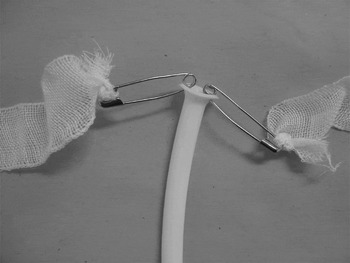
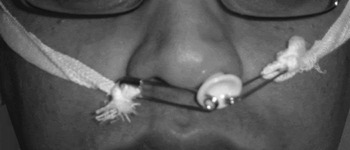
A nasopharyngeal airway appropriate for the patient is selected. Safety pins and ribbon gauze or Velcro tape are obtained (all should be readily available in any emergency department). Two safety pins are pierced through the edges of the nasopharyngeal airway, one on either side (Figure 1). Lengths of ribbon gauze or Velcro tape are then threaded through the safety pins (Figure 1). The nasopharyngeal airway is inserted and secured using the strips of ribbon gauze or Velcro (Figure 2). This method tethers the nasopharyngeal airway securely in the patient who is agitated because of hypoxia and is sweating.
Safety pins pierced through the nasopharyngeal airway, and ribbon gauze threaded through the safety pins.

Nasopharyngeal airway secured using safety pins and ribbon gauze.

This technique has been used by the authors in several patients in the emergency situation, and has been found to be quick and effective.
Discussion
The important factor in sizing a nasopharyngeal airway is not the width of the tube but rather the length. A correctly placed nasopharyngeal airway will lie just above the epiglottis, having separated the soft palate from the posterior wall of the oropharynx.Reference Stoneham5 If the airway is too short, it will fail to separate the soft palate from the pharynx, and if it is too long it can either pass into the larynx or into the valeculla. Ideally, the nasopharyngeal airway should lie approximately 10 mm above the epiglottis.Reference Stoneham5 The ideal nasopharyngeal airway length, measured using nasal endoscopy, correlates with the patient's height and is independent of their sex.Reference Roberts, Whalley and Bleetman1 A woman of average height requires a Portex (Kent, UK) size six nasopharyngeal airway, and a man of average height requires a size seven nasopharyngeal airway.Reference Roberts, Whalley and Bleetman1
The use of nasopharyngeal airway within hospitals is less clear. In the hospital setting, the nasopharyngeal airway generally is used less frequently than the oropharyngeal airway. This might be due to fear of complications associated with nasopharyngeal airway use. The oropharyngeal airway is an obvious alternative to the nasopharyngeal airway; however, in practice, the patient must have a level of consciousness far below that at which a nasopharyngeal airway will be tolerated. If an oropharyngeal airway is placed in a conscious patient, it can aggravate the gag reflex, leading to increased risk of vomiting, aspiration and increased intracranial pressure.Reference Roberts, Whalley and Bleetman1
Use of nasopharyngeal airways outside hospitals is very limited. A review of national paramedic practice identified that only 27 per cent of UK National Health Service ambulance trusts provided their paramedics with nasopharyngeal airways.Reference Porter, Allison and Greaves6 Following the publication of national guidelines supporting the use of the nasopharyngeal airway, a further review in 2002 found that this practice had increased to 55 per cent.Reference Roberts, Whalley and Bleetman1 In 2003, only 21 per cent of ambulance trusts would permit their paramedics to use nasopharyngeal airways in children.Reference Roberts, Jewkes, Whalley, Hopkins and Porter7
Chang et al. have described a method of securing a modified nasopharyngeal tube.Reference Chang, Masters, Williams, Harris and O'Neil4 The tube is prepared by cutting at the measured length plus 5 cm. The extra 5 cm is cut into four strips; three are used for anchoring the tube and the fourth is cut off. The two lateral strips are secured onto the patient's cheeks and the third strip is anchored on the lateral aspect of the nose.
Smyth has described constructing a nasal splint to hold the nasopharyngeal airway securely in position, to maintain the airway and facilitate feeding in children.Reference Smyth3 This splint is constructed using a silicone impression material around the nasopharyngeal airway, nose, upper lip and cheek area. The splint is constructed from clear acrylic resin and has two wings with enclosed wire loops for attachment of ties.
Conclusions
The nasopharyngeal airway is a simple piece of equipment that is cheap and easy to use. It is effective and has advantages over the oropharyngeal airway. The length of the nasopharyngeal airway is more important than its width. The technique described in this article is a simple, practical and effective method of securing a nasopharyngeal airway in an emergency situation.