


Introduction
There is extensive literature outlining the importance of safety (seeking) behaviours in the maintenance of anxiety disorders. Salkovskis (Reference Salkovskis1996) identified three main categories of safety behaviours; avoidance of situations, escape during a panic attack, and behaviours carried out to prevent a feared outcome. Cognitive models have been applied to understanding the experience of auditory hallucinations (of which hearing voices is the predominant mode) and the maintenance of distress (e.g. Chadwick and Birchwood, Reference Chadwick and Birchwood1994; Morrison, Reference Morrison1998). Chadwick and Birchwood (Reference Chadwick and Birchwood1994) reported that behavioural responses (particularly engagement and resistance) chosen by people who experienced auditory hallucinations appeared to be driven by underlying beliefs about voices, and suggested that “affective, cognitive and behavioural responses . . . are always meaningfully related”. Morrison (Reference Morrison1998) posed the question “are voices to schizophrenia what bodily sensations are to panic?” Morrison proposed that auditory hallucinations are a normal phenomena and that it is the misinterpretation of these experiences that causes the distress and disability often seen in people with a diagnosis of schizophrenia. As in the cognitive models of panic, Morrison also suggested that these misinterpretations were maintained by safety behaviours (including hypervigilance). A metacognitive model (Wells and Matthews, Reference Wells and Matthews1994) suggests that the choice of coping mechanism is cognitively mediated (compensatory beliefs) in a top down process. This paper considers whether people who experience hearing voices report using safety behaviours to prevent a feared outcome and whether the choice of behaviour may be cognitively mediated.
Methods
Participants
Twelve participants completed the study, 7 of whom were male. All reported hearing voices within the last 2 weeks and having a diagnosis of schizophrenia. The mean age was 40 years (range 16–52 years). Three of the participants were inpatients on psychiatric wards.
Measures and procedure
Participants completed one self-report measure; The Interpretation of Voices Inventory (IVI; Morrison, Wells and Nothard, Reference Morrison, Wells and Nothard2002) a 26-item questionnaire designed to assess interpretations of voices. In a non-clinical sample, a three factor solution suggested; metaphysical beliefs about voices, positive beliefs about voices, and interpretations of loss of control. They completed two structured interview schedules; the Psychotic Symptom Rating Scale (PSYRATS) (Haddock, McCarron, Tarrier and Faragher, Reference Haddock, McCarron, Tarrier and Faragher1999) with 11 items relating to different indices of voice hearing. In addition, the Safety Behaviour Semi-structured Interview devised by the authors, was used to gain specific information about feared outcomes and safety behaviours. This was a cognitive behavioural interview to elicit the specific links between catastrophic misinterpretations, related beliefs and behaviours (see extended report). Participants were recruited from the NHS and the Hearing Voices Network. Interviews were carried out by the first author.
Results
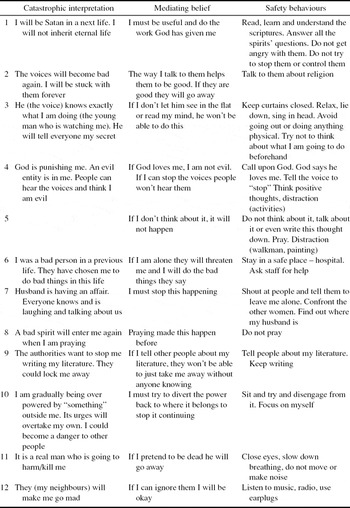
As this was a pilot study with 12 participants, statistical analysis of the data was not appropriate. The PSYRATS and IVI data were summarized and there appeared to be some interesting individual scores but no overall patterns were evident (see extended report). Table 1 summarizes the individual data from the semi-structured interviews.
Summary of the semi structured interviews

Eleven of the 12 participants reported catastrophic interpretations relating to their voices and all reported using safety behaviours. For participant 5, possibly due to the mediating beliefs s/he held, only safety behaviours were reported. For 5 people, their catastrophic interpretations related to evil spirits or entities and making them do bad things. For one person the interpretations related to a previous traumatic experience, 2 people about being stuck with the voices or going mad, and 3 people had quite idiosyncratic interpretations relating to important people or tasks currently in their lives. For mediating beliefs, 3 people identified beliefs such as “If I am good, religious or make the voices good then. . .” For 3 people, their beliefs were about doing certain things to prevent the feared outcome, such as “If I pretend to be dead”. The beliefs of 2 people concerned not thinking about the feared outcome, or not listening to the voices, such as “If I ignore them I will be okay”. Three beliefs were more idiosyncratic and closely linked to the catastrophic interpretation, for example “If I tell other people about the book I am writing they won't be able to take me away”. People used a number of different safety behaviours, which could be categorized as follows: 4 counts of behaviours related to the bible, talking about religion or to God; 3 examples of using relaxation or distraction behaviours; 3 of avoidance or avoiding certain things such as getting angry; 5 counts of idiosyncratic behaviours such as closing eyes, slowing down breathing, not moving or making any noise.
Discussion
The results showed that participants reported catastrophic interpretations about the experience of hearing voices, and corresponding safety behaviours that served to prevent these feared outcomes, as Morrison (Reference Morrison1998) predicted. It appeared that there were mediating links between the choice of these behaviours and the catastrophic interpretations and these seemed to be cognitively mediated. Compensatory beliefs may be one way of conceptualizing these links. For example, the catastrophic interpretation “He (the voice) is watching me and knows exactly what I am doing”. The mediating belief was “If I do not let him see in the flat or read my mind, he will not be able to do this”. The safety behaviours reported were “keep curtains closed, relax, lie down, sing in head, try not to think about what I am going to do beforehand”. These findings appear to suggest that people who hear voices have interpretations about the experience of hearing voices and that if this interpretation threatens the physiological or psychological wellbeing of that person they will engage in safety behaviours to prevent this feared outcome. The choice of the safety behaviour appears to be cognitively mediated by the beliefs held by that person. All 12 participants self-reported using safety behaviours and 11 participants reported catastrophic interpretations.
Wells and Matthew's (Reference Wells and Matthews1994) S-REF model of cognitive functioning may be one way of conceptualizing the choice of behaviour. This proposes that compensatory beliefs can be used to direct behaviour and thinking in difficult situations and provide a link between more generic strategies. The model suggests that it is the strategies driven by this knowledge that are involved in the escalation and maintenance of psychological disorder.
As this is an exploratory, cross sectional study, the clinical implications are limited. If, as Morrison (Reference Morrison1998) suggests, a cognitive model of panic were to be applied to distress and voice hearing, it would be important to formulate how this cycle is maintained. From specific assessment information including interpretations and associated safety behaviours, an idiosyncratic model could be shared with the person to illustrate how distress, voices, interpretations and safety behaviours may be linked in a maintenance cycle. With consent, in therapy, cognitive and behavioural techniques would be used to test out the feared outcome and obtain balanced evidence.
The S-REF model specifies that different types of self-knowledge, declarative and procedural (this includes compensatory beliefs) are involved in the metacognitive regulation of action and thinking. This study has suggested that different types of belief may be associated with auditory hallucinations (i.e., catastrophic interpretations and compensatory beliefs). In this context, it may be possible to devise strategies that challenge both types of knowledge simultaneously, for example a behavioural experiment. However, some misinterpretations may be difficult to challenge, for example “I will be Satan in the next life”. In these instances, it may be necessary to provide an alternative explanation for the experiences, such as constructing an alternative model.
In conclusion, this is the first study to have focused on the reported content of misinterpretations and the nature of safety behaviours for people who hear voices. The findings offer some support for Morrison's (Reference Morrison1998) cognitive analysis of the maintenance of auditory hallucinations. Wells and Matthews’ (Reference Wells and Matthews1994) model of emotional disorders may be useful in conceptualizing the mediating link between beliefs and choice of behaviour. This pilot study begins to explore the presence of catastrophic interpretations, safety behaviours, and how they may be linked. There needs to be further validation of the Safety Behaviour and Voices Semi Structured Interview with a larger sample. The hypothesized causal links could be examined by asking people to drop their safety behaviours to test out their beliefs.
Acknowledgements
Thank you to all the people who shared their time and experiences as part of this study.




Comments
No Comments have been published for this article.