Implications
Our results indicated that milk yield is heritable and genetically strongly correlated with maternal weaning weight in Nguni cattle. These results motivate for inclusion of maternal breeding value for weaning weight as an indicator trait for milk yield in Nguni cattle breeding programme.
Introduction
Milk production in beef cattle is generally considered the most significant component of maternal effect on the growth of the calf from birth to weaning (Clutter and Nielsen, Reference Clutter and Nielsen1987; Gregory et al., Reference Gregory, Cundiff and Koch1992). Thus, maternal effect for weaning weight has been used as an indicator for milk yield in beef cattle due to the positive genetic correlation between the two traits (Gregory and Cundiff, Reference Gregory and Cundiff1980). Meyer et al. (Reference Meyer, Carrick and Donnelly1994) argues that weaning weight reflects the expression of the genes for both the growth of the calf and the genes for milk production of the dam.
Several studies conducted to investigate the genetic relationship between weaning weight and milk production mainly considered European breeds in which positive genetic correlation between the two traits was reported (Mallinckrodt et al., Reference Mallinckrodt, Bourdon, Golden, Schalles and Odde1993; Meyer et al., Reference Meyer, Carrick and Donnelly1994). Such genetic parameters are of importance in developing breeding objectives and selection programmes aimed at improving efficiency of beef production. However, there is paucity of data of such genetic parameters particularly in indigenous breeds such as the Nguni. The aim of the current study was to estimate genetic parameters for weaning weight and milk yield in Nguni cattle.
Material and methods
The experiment to collect milk yield data was conducted in 2011 and 2012 at the Loskop South Farm and Mara Research Station located in Limpopo Province of South Africa, respectively. The Loskop South Farm is situated 25° 18' S and 29° 20' E in a bushveld region, South-East of Groblersdal, with the annual rainfall ranging between 447 and 468 mm. Mara Research Station is located about 54 km west of Makhado (23° 05'S, 29° 25'E) under the arid sweet bushveld area. The mean annual rainfall at Mara is 452 mm and the mean daily maximum temperature varies from 23°C in June to 30°C in January. Weaning weight records (n=28 893) from 146 Nguni herds that participated in the National Beef Cattle Improvement Scheme from 1989 to 2012 were obtained from the Integrated Registration and Genetic Information System (INTERGIS). All animal procedures were carried out following the standard guidelines for animal use and care approved by the ethics committee of Agricultural Research Council, South Africa. The manuscript does not contain clinical studies or patient data.
The stud Nguni cattle in Loskop and Mara research station have a long history of participation in the National Beef cattle improvement Scheme. The herds from the two farms are genetically well-connected to the national Nguni herd which makes it suitable for genetic analysis. Almost all cows considered in this study had pedigree records. The number of animals considered in this experiment was modest due to constraints imposed by the availability of labour as this research was labour intensive. A total of 55 Nguni cows from Loskop South Farm and 117 Nguni cows from Mara Research Station were chosen based on age to obtain a representative sample of the different age groups because milk production level depends on age of the cow (Beal et al., Reference Beal, Notter and Akers1990). A total of 1941 repeated milk yield observations were collected during the experimental period. Milk yield was estimated using the weigh-suckle-weigh technique (Beal et al., Reference Beal, Notter and Akers1990; Lee and Pollak, Reference Lee and Pollak2002; MacNeil and Mott, Reference Macneil and Mott2006). Milk yield data were collected at least once per month from birth to weaning at about 7 months for the period of 2 years (i.e. 2011 and 2012).
The weigh-suckle-weigh technique can be described as follows: Cows were separated from their calves at 1500 h and re-united at 1800 h, allowed to suckle for about 30 min to ensure that all cows are milked out before the trial; cows were then separated from the calves at 1830 to 0600 h the following morning. In the morning of the trial, calves were quickly weighed before they were re-united with their dams. Calves were allowed to suckle their dams for about 30 min and then re-weighed as soon as possible. The difference between the weight of the calf before and after suckling was assumed to reflect milk yield produced during the 12-h period. The 12-h milk yield was multiplied by 2 to obtain 24-h milk yield ((milk yield/12)×24). The weigh-suckle-weigh technique was used successfully to measure milk yield in beef cattle in several experiments (e.g. MacNeil and Mott, Reference Macneil and Mott2006).
Several estimates of milk yield per cow per lactation were obtained. These estimates were averaged per cow to obtain a more accurate measure of daily milk yield per cow. Milk yield records which were beyond 3 SD from the mean were removed. After editing, there were 125 records available for analysis distributed over three contemporary groups which was defined as a concatenation of herd-year. Weaning weight data were also edited to remove extreme weights, that is weights beyond 3 SD from the mean. After editing, there were 19 065 weaning weight observations remaining. These records were distributed over 990 contemporary groups defined as herd-year-season. The calves were progeny of 8749 dams and 862 sires from 146 herds.
The pedigree data of the animals used in the current study were traced as far back as the early 1960s. The number of base animals was 4507.
The GLM procedure of Statistical Analysis System (2012) was used to test the significance of fixed effects, that is contemporary group; sex of the calf; age of the dam and age of the calf. The fixed effects model for milk yield was:
 $${\bf{y}} _{1} \,{\equals}\,{\bf{X}} _{1} {\bf{b}} _{1} {\plus}{\bf{e}} _{1} $$
where y 1 is a vector of observations for milk yield, that is average daily milk yield; X 1 a design matrix linking fixed effects with milk yield observations; b 1 a vector of fixed effects for contemporary group, sex of the calf and age of the dam (fitted with the following classes: ⩽3, 4, 5, 6, 7, 8+ years); and e 1 a vector of residual effects assumed to be identically, independently and normally distributed (e~N (0, I σ 2 e )).
The fixed effects model for weaning weight was:
 $${\bf{y}} _{2} \,{\equals}\,{\bf{X}} _{2} {\bf{b}} _{2} {\plus}{\bf{e}} _{2} $$
where y 2 is a vector of observations for weaning weight; X 2 a design matrix linking fixed effects with weaning weight observations; b 2 a vector of fixed effects for contemporary group, sex of the calf, age of the calf (fitted as linear and quadratic) and age of the dam (fitted with the following classes: ⩽3, 4, 5, 6, 7, 8+ years); and e 2 a vector of residual effects assumed to be identically, independently and normally distributed (e~N (0, I σ 2 e )). The I is an identity matrix and σ 2 e is the residual variance.
A bivariate linear mixed animal model was used to estimate the genetic correlation between milk yield and weaning weight. The PEST and VCE software were used to estimate (co)-variance components (Groeneveld, Reference Groeneveld1998).
The following bivariate animal model was fitted to estimate (co)variance components for milk yield and weaning weight:
 $$\eqalignno{ \left[ {\matrix{ {{\mib{y}} _{1} } \cr {{\mib{y}} _{2} } \cr } } \right]&{\equals}\left[ {\matrix{ {\matrix{ {{\mib{X}} _{1} } & 0 \cr } } \cr {\matrix{ 0 & {{\mib{X}} _{2} } \cr } } \cr } } \right]\left[ {\matrix{ {{\mib{b}} _{1} } \cr {{\mib{b}} _{2} } \cr } } \right]{\plus}\left[ {\matrix{ {\matrix{ {{\mib{Z}} _{1} } \cr 0 \cr } } & {\matrix{ 0 \cr {{\mib{Z}} _{2} } \cr } } \cr } } \right]\left[ {\matrix{ {{\mib{u}} _{1} } \cr {{\mib{u}} _{2} } \cr } } \right]{\plus}\cr&\left[ {\matrix{ {\matrix{ 0 \cr 0 \cr } } & {\matrix{ 0 \cr {{\mib{Z}} _{2} } \cr } } \cr } } \right]\left[ {\matrix{ 0 \cr {\mib{m}} \cr } } \right]{\plus}\left[ {\matrix{ {\matrix{ 0 \cr 0 \cr } } & {\matrix{ 0 \cr {\mib{W}} \cr } } \cr } } \right]\left[ {\matrix{ 0 \cr {\mib{c}} \cr } } \right]{\plus}\left[ {\matrix{ {{\mib{e}} _{1} } \cr {{\mib{e}} _{2} } \cr } } \right]$$
For milk yield: y 1, X 1, b 1 and e1 are as defined previously; y 1 , X 1, b 1 and e1 are as defined previously; Z 1 is an incidence matrix linking random direct additive genetic effects with observations; u 1 is a vector of random direct additive genetic effects assumed to be normally distributed as follows: u 1~N (0, A σ 2 u1). A is a numerator relationship matrix and σ 2 u1 is the direct additive genetic variance. The u 1 and e 1 are assumed to be uncorrelated.
For weaning weight: y 2, X 2, b 2 and e 2 are as defined previously; Z 2 is an incidence matrix linking random direct additive genetic and maternal additive genetic effects with observations; W is an incidence matrix linking permanent environmental effects of the dam with observations; u 2 is a vector of random direct additive genetic effects; m is a vector of random maternal additive genetic effects; and c is a vector of random permanent environmental effects of the dam.
The following covariance structure was assumed for the random effects:
The (co)variance of u, m, e, were assumed as follows:
 $${\rm var}\left[ {\matrix{ {{\mib{u}} _{1} } \cr {\matrix{ {{\mib{u}} _{2} } \cr {\mib{m}} \cr {\matrix{ {\mib{c}} \cr {{\mib{e}} _{1} } \cr {{\mib{e}} _{2} } \cr } } \cr } } \cr } } \right]{\equals}\left[ {\matrix{ {\matrix{ {{\mib{A}} \sigma _{{u1}}^{2} } & {{\mib{A}} \sigma _{{u1,u2}} } & {A\sigma _{{u1,m}} } \cr {} & {{\mib{A}} \sigma _{{u2}}^{2} } & {A\sigma _{{u2,m}} } \cr {} & {} & {{\mib{A}} \sigma _{m}^{2} } \cr } } & {\matrix{ \hskip-28pt{0 } & \hskip-9pt{0 } & \hskip 15pt0 \cr \hskip-28pt{0 } & \hskip-9pt{0 } & \hskip 15pt0 \cr \hskip-28pt{0 } & \hskip-9pt{0 } & \hskip 15pt0 \cr } } \cr {{\rm symmetric}} & {\matrix{ {{\mib{I}} \sigma _{c}^{2} } & \hskip -15pt{ 0} & \hskip -15pt0 \cr {} & {{\mib{I}} \sigma _{{e1}}^{2} } & {{\mib{I}} \sigma _{{e1,e2}} } \cr {} & {} & {{\mib{I}} \sigma _{{e2}}^{2} } \cr } } \cr } } \right]$$
The σ u1,u2 is the additive genetic covariance between milk yield and weaning weight; σ u1,m the covariance between direct genetic effect for milk yield and maternal genetic effect for weaning weight; σ u2,m the genetic covariance between direct and maternal genetic effects for weaning weight; σ e1,e2 the residual covariance between milk yield and weaning weight. All the other terms are as defined before.
Results
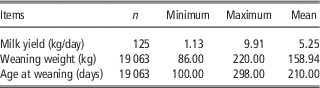
Descriptive statistics for weaning weight, milk yield and age of the calf at weaning are presented in Table 1. The average milk production in Nguni cows was 5.25 kg/day with a minimum of 1.13 kg/day and a maximum of 9.91 kg/day. The average weaning weight was 158.94 kg with a minimum of 86 kg and a maximum of 220 kg and the average age at weaning was 210 days with a minimum of 100 days and a maximum of 298 days.
Descriptive statistics for weaning weight, milk yield and age of the calf at weaning in Nguni cattle

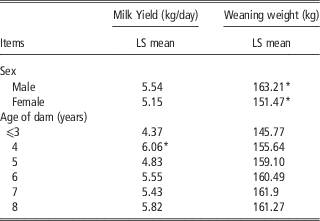
Contemporary group, sex of the calf, age of the calf and age of the dam at weaning had significant (P<0.001) effect on weaning weight. The Contemporary group and age of the cow had significant (P<0.05) effect on milk yield, whereas sex of the calf was not significant (P>0.05). The results indicate that weaning weight was affected by contemporary group, age of the calf and dam at weaning. Milk yield was also affected by contemporary group and age of the cow. Sex of the calf did not affect milk yield. The least square means for sex and age of the dam for milk yield and weaning weight are presented in Table 2.
Least square means for age of the dam and sex of the calf for milk yield and weaning weight in Nguni cattle

*Numbers are significantly different (P<0.05).
As illustrated in Table 2, cows that had male calves tended to produce slightly more milk (5.54 kg/day) than cows with female calves (5.15 kg/day). Male calves were heavier at weaning (163.21±0.34) than female calves (151.47±0.31). It was also observed that 3- and 5-year-old cows produced less milk compared with 4-year-old cows (6.06 kg). Milk yield was similar for cows aged 6, 7 and 8 years. The results indicate that milk yield depend on the age of the cow. Age of the dam had a significant effect (P<0.01) on the calf weaning weight. Weaning weight increased with age of the dam.
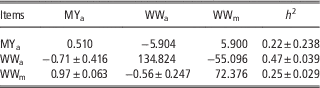
Genetic parameter estimates for milk yield and weaning weight are reported in Table 3. The heritability estimate for direct weaning weight is much higher than the heritability for maternal weaning weight. The genetic correlation between direct and maternal weaning weight was moderate (−0.56±0.247) and high between direct weaning weight and milk yield (−0.71±0.416). Milk yield and maternal weaning weight were genetically almost the same trait (0.97±0.063) because of highly genetic correlation between the two traits.
Estimates of the (co)variance components (on and above diagonal), genetic correlations (below diagonal) and heritability for milk yield (MYa), weaning weight direct (WWa) and maternal (WWm)

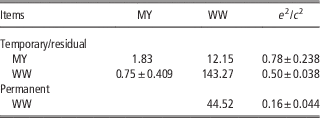
The estimates of (co)variance components for temporary (residual) and permanent environmental effects, correlation and the ratio of residual variance to phenotypic variance (e 2) for milk yield and weaning weight are presented in Table 4. The residual environmental effect accounted for more variation in milk yield (0.78±0.238) than in weaning weight (0.50±0.038), whereas residual correlation between milk yield and weaning weight was also high (0.75±0.409).
Estimates of (co)variance components for temporary (residual) and permanent environmental effects (on and above diagonal), correlation (below diagonal) and the ratio of residual variance to phenotypic variance (e 2) for milk yield (MY) and weaning weight (WW)

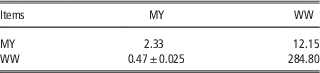
The results of the phenotypic correlation between milk yield and weaning weight are shown in Table 5. The phenotypic correlation between weaning weight and milk yield was 0.47±0.025.
Estimates of the phenotypic (co)variance components (on and above diagonal) and phenotypic correlation (below diagonal) for milk yield (MY) and weaning weight (WW)

Discussion
The aim of the current study was to estimate genetic parameters for weaning weight and milk yield of indigenous beef cattle (Nguni) in South Africa. The average weaning weight observed in the current study (158.94 kg) was higher than that reported by Collins-Lusweti (Reference Collins-Lusweti2000), who reported average weaning weight in Nguni cattle of 135.6 kg. However, Collins-Lusweti study was based on weaning weights collected during a drought period. Similar to the results obtained in the current study, Kars et al. (Reference Kars, Erasmus and Van der westhuizen1994) reported an average weaning weight of 152.98 kg in Nguni cattle, whereas Carvalheira et al. (Reference Carvalheira, Blake, Pollak and Van soest1995) reported an average weaning weight of 149.5 kg in Landim cattle which are also known as Nguni cattle in Mozambique. It should be noted that Carvalheira et al. (Reference Carvalheira, Blake, Pollak and Van soest1995) study was based on the data collected from 1968 through 1981. High average weaning weight (183 kg) corrected to 205 days was observed in Nguni cattle by Scholtz and Theunissen (Reference Scholtz and Theunissen2010) based on the data collected over a period of 3 years. Both genetic and environmental factors could have contributed to the differences observed in average weaning weight of Nguni cattle in different studies which makes the current results to be of critical importance.
The average daily milk yield observed in the current study was 5.25 kg/day. Similar observations of daily milk yield in beef cattle have been reported in several studies that used the weigh-suckle-weigh technique. Meyer et al. (Reference Meyer, Carrick and Donnelly1994) reported 14-h milk yield of 3.6 and 4.9 kg/day using weigh-suckle-weigh technique for Hereford and Wokalups cattle, respectively. Melton et al. (Reference Melton, Riggs, Nelson and Cartwright1967) reported mean daily milk yield of 3.79, 4.48 and 3.32 kg collected outer 175-day period for Angus, Charolais and Hereford cattle, respectively. Maiwashe et al. (Reference Maiwashe, Nengovhela, Nephawe, Sebei, Netshilema, Mashaba, Nesengani and Norris2013) also reported milk yield in Bonsmara cattle of 8.50 kg/day.
Heritability estimate for weaning weight direct of 0.47 observed in the current study was slightly higher compared with other findings indicating that direct weaning weight in Nguni cattle is highly heritable. The different heritability might be to different herds used as other studies also reported differing heritability on the same breed. Van Niekerk et al. (Reference Van niekerk, Neser and Van wyk2004) observed a heritability of 0.17 for direct weaning weight in Nguni cattle, whereas Norris et al. (Reference Norris, Banga, Benyi and Sithole2004) reported a heritability of about 0.29 for direct weaning weight in Nguni cattle. In other beef breeds, Neser et al. (Reference Neser, Van wyk, Fair, Lubout and Crook2012) reported heritability for direct weaning weight of 0.23 in Brangus cattle, whereas Van Niekerk and Neser (Reference Van Niekerk and Neser2006) reported heritability of 0.19 for South African Limousin cattle. Higher heritability estimates for direct weaning weight has been reported in other studies. For example, Wasike et al. (Reference Wasike, Indetie, Ojango and Kahi2009) reported the direct heritability for weaning weight of 0.62 in Kenya Boran cattle.
The heritability estimate for maternal weaning weight of 0.25 observed in the current study was comparable with the maternal heritability observed in other studies. These results indicate that maternal weaning weight is moderately heritable and is in agreement with other reports in other breeds. In contrast to results obtained in the current study, Wasike et al. (Reference Wasike, Indetie, Ojango and Kahi2009) reported maternal heritability for weaning weight of 0.14 in Boran cattle in Kenya. Norris et al. (Reference Norris, Banga, Benyi and Sithole2004) also observed a lower maternal heritability of about 0.16 in Nguni cattle. Furthermore, Ndofor-Foleng et al. (Reference Ndofor-foleng, Ebangi, Agu and Okenyi2012) reported a maternal heritability of about 0.11 in Gudali beef cattle, whereas Meyer et al. (Reference Meyer, Carrick and Donnelly1994) reported the weaning weight heritability of the same low magnitude in Wokalups breed of about 0.11 using a model that did not include milk production of the dam and heritability of 0.08 in a model that included milk production of the dam, respectively. They further observed maternal heritability of weaning weight of about 0.19 in Hereford cattle in a model that did not include milk production of the dam and heritability of 0.15 in a model that included milk production of the dam, respectively. It must be further noted that other studies observed different heritabilities in estimates that included milk yield and estimate that did not include milk yield. The moderate heritability for maternal weaning weight was also confirmed by Van Niekerk and Neser (Reference Van Niekerk and Neser2006) who reported the maternal heritability of 0.19 in South African Limousin cattle. Recently, Neser et al. (Reference Neser, Van wyk, Fair, Lubout and Crook2012) reported maternal heritability for weaning weight of 0.11 in Brangus cattle.
The current estimates for maternal heritability and the genetic correlation between the direct and maternal components for weaning weight provide evidence that response in genetic improvement can be obtained if both the direct and maternal breeding values are considered in a breeding programme. The results also provide useful information for developing dam lines based on the maternal abilities. The response to selection would be slow due to the moderate maternal heritability.
The positive genetic correlation between maternal weaning weight and milk yield (0.97) observed in the current study is higher than the estimates of 0.80 from MacNeil and Mott (Reference Macneil and Mott2006) for Line1 Hereford cattle; 0.80 from Meyer et al. (Reference Meyer, Carrick and Donnelly1994) for Hereford and Wokalups and 0.76 from Miller and Wilton (Reference Miller and Wilton1999) for Hereford and multibreed rotational cross cattle. However, estimates from MacNeil and Mott (Reference Macneil and Mott2006) were measured on adjusted age at weaning of 180 days from the data which were measured from 1994 through 2005 using the weigh-suckle-weigh technique. An estimate from Meyer et al. (Reference Meyer, Carrick and Donnelly1994) was estimated from single observation per lactation which was obtained using the weigh-suckle-weigh technique. It is also important to note that different method to measure milk yield was used in a study by Miller and Wilton (Reference Miller and Wilton1999) who used two to four records from machine milking after the oxytocin injection following a 6-h calf removal to estimate 200-day milk yield. Mallinckrodt et al. (Reference Mallinckrodt, Bourdon, Golden, Schalles and Odde1993) reported a low correlation between maternal weaning weight and milk yield (0.4) for Polled Hereford and Simmental cattle. Mallinckrodt et al. (Reference Mallinckrodt, Bourdon, Golden, Schalles and Odde1993) results were based on 163 and 154 observations from Polled Hereford and Simmental cattle, respectively, in which the cows received supplementation feeding during winter. Greater variation in estimates from different studies might be explained by the different techniques used in measuring milk yield and the management applied. However, the positive relationship between the maternal weaning weight and milk yield as observed in different studies using different protocols is evidence that the two traits are influenced by the same genes; this phenomenon has been explained in few scientific reports (e.g. Miller and Wilton Reference Miller and Wilton1999). As suggested by MacNeil and Mott (Reference Macneil and Mott2006), selection for milk yield using maternal weaning weight as an indicator trait in Line 1 Hereford would be as effective as mass selection. Thus, selection for milk yield in Nguni cattle using maternal weaning weight would also be as effective as direct selection for milk yield.
The negative genetic correlation estimated between direct and the maternal effects is largely an indication of the genetic antagonism between the genes that influence the two traits (Lee and Pollak, Reference Lee and Pollak2002; Norris et al., Reference Norris, Banga, Benyi and Sithole2004; Van Niekerk et al., Reference Van niekerk, Neser and Van wyk2004). The negative correlation between the direct and maternal effect for weaning weight observed in the current study was also observed in other studies. Norris et al. (Reference Norris, Banga, Benyi and Sithole2004) reported a negative genetic correlation between direct weaning weight and maternal weaning weight of −0.52 in Nguni cattle. Similarly, Meyer et al. (Reference Meyer, Carrick and Donnelly1994) observed a correlation of −0.57 and −0.17 in Hereford and Wokalups cattle, respectively. Recently, a moderate genetic correlation was observed by Ndofor-Foleng et al. (Reference Ndofor-foleng, Ebangi, Agu and Okenyi2012) who reported a negative correlation of −0.42 between direct weaning weight and maternal effects in Gudali beef cattle. A slightly lower genetic correlation of −0.32 was reported for Nelore beef cattle by Eler et al. (Reference Eler, Van vleck, Ferraz and Lôbo1995). A weak genetic correlation (−0.18) was reported for crossbred animals by Splan et al. (Reference Splan, Cundiff, Dikeman and Van vleck2002).
The negative genetic correlation between direct weaning weight and milk yield observed in the current study was much higher than the estimates observed by Lee and Pollak (Reference Lee and Pollak2002) who observed a correlation of −0.04 to −0.21 for weaning weight and milk yield in Korean Hanwoo beef cattle using the weigh-suckle-weigh method. It is also of interest to note that MacNeil and Mott (Reference Macneil and Mott2006) observed a very low positive genetic correction of 0.18 between pre-wean direct and milk yield in Line 1 Hereford beef cattle using the weigh-suckle-weigh method. The results of the current study indicate that milk yield is heritable and genetically strongly correlated with maternal weaning weight. These results motivate for inclusion of maternal breeding value for weaning weight as an indicator trait for milk yield in Nguni cattle breeding programme. Limited records of milk yield were used in the current study and therefore, more studies are necessary to strengthen the current study and to provide greater knowledge on milk yield potential of Nguni cattle.
Acknowledgements
The authors acknowledge technical assistants provided by animal attendants from Mara Research Station and Loskop South Farm, respectively. This research was financially supported by the Agricultural Research council of South Africa, Limpopo department of Agriculture (South Africa), Red Meat Research and Development of South Africa (RMRD-SA) and Technology and Human Resources for Industry Program (THRIP) of the Department of Trade and Industry (DTI).