In fact, there is no such thing as my hometown anymore. It exists only in my memories, as a beautiful shiny place of my childhood. I can never come back to it, not because I have to cross three lines of checkpoints, but because there is just no such place on any of the maps
– Lilia, 23, Donetsk region–KyivIntroduction
The armed conflict has already lasted in Ukraine for more than six years: while the outbreak of the war was connected with the annexation of Crimea in March 2014, the subsequent emergence of two self-declared republics in the Donbas region led to armed violations from April 2014 onwards. These dramatic events followed the change of power in Ukraine that occurred after mass protests during the winter 2013–2014, known as Euromaidan (from the name of the central square in Kyiv – Maidan Nezalezhnosti, Independence Square – where the protests took place). Following this, the corrupt president, Viktor Yanukovych, fled from the country, and the new authorities declared a course towards European integration. The events known as “Euromaidan,” or just “Maidan,” appeared to create a division in the national narrative, together with the subsequent armed conflict, and provided a reason for looking for a new national idea.
The conflict itself is often defined by scholars as a hybrid war, as it includes both the usage of weapons and an ideological component (Wilson Reference Wilson2016; Katchanovski Reference Katchanovski2016; Lakomy Reference Lakomy2016; Lazarenko Reference Lazarenko2018). The current Ukrainian conflict itself is labelled differently according to various perspectives: academics may define the situation as a “conflict,” “armed conflict,” “civil war,” or “insurgency,” while Ukrainian authorities and media mostly use the word “war” or the official names of “anti-terroristic operation” (2014–2018) and “operation of joint forces” (since 2018). However, the Donbas conflict in Ukraine, according to the International Criminal Court Preliminarily Report, could still be called an “armed conflict,” and I shall use this term throughout the article.
The ideological component of the conflict resulted in the reshaping of the national narrative of the Ukrainian nation, a nation trying to distance itself from the Soviet past (Gentile Reference Gentile2020; Sasse and Lackner Reference Sasse and Lackner2018). The social situation resulting from the creation of a new “national biography” of the Ukrainian nation, and the declaration of a new reality, became the background to the daily life of Ukrainians, including those traumatized by the armed conflict and those seeking new parameters of their identity.
I have spent the last four years working with people who became internally displaced (IDPs)Footnote 1 and have been forced to leave their places of residence in the occupied territories of the Donbas region. My research shows that their need to fit themselves into a new life context is inextricably bound up with the appropriation of living-space and the new national narrative of post-Maidan Ukraine. Hence, their greater “sensitivity” towards the renaming and reclaiming of urban spaces is a direct result of such re-thinking of personal spatial and national identities.
As Mikheeva and Kuznetsova have shown in their recent research, displaced people face different problems with housing, employment, and receiving financial support from the state, as well as mental health issues and coping with traumatic experience (Kuznetsova et al. Reference Kuznetsova, Mikheieva, Gulyieva, Dragneva and Mykhnenko2018; Kuznetsova and Mikheieva Reference Kuznetsova and Mikheieva2020). At the same time, IDPs may find themselves searching for a new identity as a “displaced person,” creating a personal story of war and displacement to fit themselves into a new context. Unlike the situation in Georgia, another post-Soviet country dealing with an armed conflict and thousands of internally displaced people, where the majority of IDPs were resettled into compact places of residence called “collective centers” (Salukvadze et al. Reference Salukvadze, Sichinava and Gogishvili2014; Gogishvili and Harris-Brandts Reference Gogishvili and Harris-Brandts2019), the displaced people in Ukraine resettled on their own, and thus could feel alienated and excluded from city communities.
Integration and adaptation of internally displaced people, as shown by Kuznetsova (Reference Kuznetsova and Mikheieva2020) and Lazarenko (Reference Lazarenko2020), is linked to the sense of place, feeling of home, and sense of belonging or not-belonging, as well as the rethinking of spatial identities. Hence, it might be assumed that the ongoing process of renaming urban spaces in Ukraine, which started in 2015 and is still ongoing at the municipal level, may jeopardize the process of integration of the IDPs. Exploration of IDPs’ spatial identity provides a critical view of the perception of decommunization by a group of people experiencing the trauma of resettlement, and outline the main problems of decommunization in Ukraine.
In this article, I am going to explore the process of renaming urban spaces in Ukraine, and answer the following question: how do the internally displaced people perceive such renaming considering (1) their places of origin and (2) their current place of living? The article starts with an analysis of the novel attempts to create a new “national biography” for the Ukrainian state, and the long-lasting process of decommunization. Further, based on three personal stories of displaced people from the case study of identities of IDPs in Ukraine, I am going to show how the renamed spaces are perceived, what attitudes the internally displaced demonstrate towards the state memory politics, and how the renaming affects their spatial identities.
Creating the New National Biography of Ukraine
In April 2015, the matter of decommunization in Ukraine received considerable attention within academia: 68 distinguished scholars had signed an open letter (Marples Reference Marples2015) aiming to convince then-president Petro Poroshenko not to sign a package of so-called “decommunization” laws including the law On Condemning the Communist and National Socialist (Nazi) Totalitarian Regimes and Prohibiting the Propagation of their Symbols” (Law no. 2558). This particular law was claimed as one that contradicts freedom of speech by making it a criminal offence to deny, “including in the media, the criminal character of the communist totalitarian regime of 1917-1991 in Ukraine.” The following discussion culminated in another open letter by Volodymyr Viatrovych, then a head of the Institute of National Memory (a governmental body responsible for the implementation of the Law no. 2558). In his letter he had admitted “these laws were directly connected with the security issues of the country, and if they would have been adopted earlier, there would probably not have been any conflicts in the eastern part of the country” (Viatrovych Reference Viatrovych2015). Hence, the issue of decommunization was declared as inseparable from the matters of security, national narrative, and national identity.
Still, the law was signed despite the heated discussions. Five years after the implementation of the law started, we can already claim that it has become a trigger for change in the national narrative in Ukraine. The law interprets decommunization as a matter of culture, so the process is to be carried out through the renaming of place names, the removal of communist-era monuments, and by altering the meaning of remembered dates.
The Law no. 2558 itself may have controversial interpretations, especially in the matter of renaming the toponyms. For instance, it implies the A, B, and C lists of communist-era events and actions, so the toponyms featuring their names are to be altered. While the A list includes the names directly connected with communism and the USSR (including the names of Lenin and Marx, Bolsheviks and the October revolution), the B list and C list are more complicated as they asses the people and the ideas by the unmeasurable matter of “involvement into the propaganda of communist regime.”
The legislative mechanism of renaming, itself, also remains quite tangled. For instance, Verkhovna Rada, the Parliament, was responsible for renaming the cities, towns, and villages throughout the following six months, during which time local councils could provide their own suggestions on renaming. In case such suggestions were not received, or were assessed as “irrelevant,” the Parliament followed the expert recommendations from the Institute of National Memory. The names of the urban and village spaces were due to be renamed by the municipal councils in the six-month term as well. The majority of the towns and villages passed the renaming orders during the following months, whereas the big cities, like Kyiv or Kharkiv, are still processing the renaming of minor streets.Footnote 2
Overall, the Law no. 2558 was quickly claimed to be a “memory law,” as it was intended to shape, rather than simply to reflect, social norms about how the past should be understood and discussed (Soroka and Krawatzek Reference Soroka and Krawatzek2019; Belavusau and Gliszczyńska-Grabias Reference Belavusau and Gliszczyńska-Grabias2017). Enforcement of the Law was assigned to the Ukrainian Institute of National Memory, a governmental body that proclaims its function as “realisation of state policy in restoring and keeping the national memory of Ukrainian people,” literally meaning the reshaping of the national narrative from a “Soviet” to a “national-patriotic” one (Siddi Reference Siddi2017). As Törnquist-Plewa and Yurchuk (Reference Törnquist-Plewa and Yurchuk2019) point out, “while these laws are presented as the cure for a society saturated with conflicts, in reality they can serve as strong catalysts for conflicts and tensions,” adding that while aiming at the de-ideologization needed in Ukraine, the Law instead produces another “ideologization” of history and memory.
Consequently, the topic to be discussed is inseparable from the power discourse. In the case of the renaming and reclaiming of urban spaces, power manifests itself in the ability to govern the past by means of re-shaping the narrative, renaming the objects in the urban tissue and thus establishing the new norms. As Felix Bereskoetter points out, a generalized narrative about the state, its history, present conditions, and aspirations for the future, may take the form of a “national biography,” an abstraction that is a simplified history of the state (Berenskoetter Reference Berenskoetter2014). Сreation of such a national biography implies both selection of the “useful” historical events and of their interpretation, in order to create a story that would fit the chosen agenda and facilitate the identification process of the members with an imagined community of the nation (Anderson Reference Anderson2006). The sense of ontological security is the result of the process when a person incorporates themself into the generalized narratives, and thus achieves meaning and legitimization.
At the same time, the processes of rewriting the national biography in Ukraine are multifaceted, thus making it barely possible to distinguish between the causes and consequences of a certain phenomenon. Hence, recent research shows that “Ukraine has become more Ukrainian” over the past few years, as Ukrainian identity tends to prevail over the local and regional ones among the research participants (Arel Reference Arel2018; D’Anieri and Kuzio Reference D’Anieri and Kuzio2019; Sasse and Lackner Reference Sasse and Lackner2018; Mitchnik Reference Mitchnik2019; Kudelia and van Zyl Reference Kudelia and van Zyl2019). However, it would be mere speculation to claim a particular reason for such “Ukrainization” of the nation, as the construction of a new national-patriotic narrative overlapped with the political upheaval and the external armed aggression.
Herein arises the problem of identities and identification. Re-writing the national biography is inextricably linked with the processes of collective memory, itself subject to change with the reshaping of the national discourse (Vermeersch Reference Vermeersch2013). Collective memory is commonly referred to as a socially framed discourse of the past constructed by subjectivity in the present in order to forge identities that strengthen social cohesion (Siddi Reference Siddi2017; Halbwachs and Coser Reference Halbwachs and Coser2008; Huyssen Reference Huyssen2003). Hence, the alteration of toponyms in contemporary Ukraine becomes one of the most widely used techniques to reshape the collective memory and thus construct a new “national biography” with different highlights and interpretations of the present, followed by discussion about the legitimacy of the past.
Spatial Aspects of Decommunization
From the anthropological point of view, assigning the name of a particular historical figure to a certain space is a way of constructing memory politics. At the same time, it works as a way to legitimize the historical figure for the members of the society (Halbwachs and Coser Reference Halbwachs and Coser2008; Stiperski et al. Reference Stiperski, Lorber, Heršak, Ptaček, Górka, Kołoś and Lončar2011). As Stiperski et al. point out, during the past two centuries the urban toponyms (especially the street names) turned out to reflect the collective identities and became a means for the ruling elites to shape such identities (Stiperski et al. Reference Stiperski, Lorber, Heršak, Ptaček, Górka, Kołoś and Lončar2011). The histories of different cities throughout Central Europe show that political elites tended to react to resentment against the previous regimes by using the renaming of urban spaces as a soft power. Thus, the renaming worked as a tool to reshape the narratives about the past, bringing to light the persons and events that fitted the new national narrative, and cleansing the “outliers” from the national biography and the collective memory of the city dwellers.
As Light and Young show in their exploration of Bucharest, the communist regime was widely using the mechanism of renaming places to “displace the memories” about the pre-socialist times and spread the new socialist agenda. Thus, the streets and avenues with a central location were firstly renamed to honour the events and actors involved in bringing communism to Romania, but then were subsequently changed so that they glorified the actors who took part in Romania’s struggle for nation-building in the pre-communist times (Light and Young Reference Light and Young2014). Hence, the street names in Bucharest reflected the ideological changes in the country. The experience of Balkan countries provided by Paskaleva and Cooper (Reference Paskaleva and Cooper2017), and of Budapest, given in the works of Palonen (Reference Palonen2008), also shows that toponyms, especially the politicized usage of them, might be used by governments for an ideological purpose.
Thus, the renaming of urban spaces in Ukraine might also be explored in a political and anthropological context. On the public debates level, the starting point for the decommunization process was the demolition of the Lenin monument in Kyiv in early December 2013. This collective action was believed to be an important step in the protest movement, and was interpreted as a symbolic victory by the protesters against the Soviet-centric regime (Chervonenko Reference Chervonenko2014; Portnov Reference Portnov2015). According to Törnquist-Plewa and Yurchuk (Reference Törnquist-Plewa and Yurchuk2019), this act can be interpreted as a manifestation of spontaneous, anticolonial mass protest. The demolition act by itself, as well as the space where the monument existed, became a fruitful ground for reflective artistic projects aiming to rethink the act (Pyvovarov Reference Pyvovarov2018).
However, decommunization as a process started in Ukraine decades earlier, after the declaration of independence in 1991. Back then, this process was aimed at introducing a new national narrative into different spheres, including the city topography, as shown in the example of the city Lviv in the work by Hrytsak and Susak (Reference Hrytsak and Susak2003). During the first years of the Ukrainian state, the governmental bodies received new names, Soviet symbols such as red flags and red stars were wiped out of the public space, the school and university curriculums were cleared of courses on communism, and the central streets and squares of the major cities received new names. Thus, in Kyiv, Odesa, or Lviv, the streets and squares named after Lenin, Karl Marx, or the October revolution were given back their original pre-Soviet names (like Ryshylyevska in Odesa or Lychakivska in Lviv), or granted new names bearing the sentiments of modern Ukraine (e.g. Bohdana Khmelnystkogo Street in Kyiv received the name of a national hero of the 17th Century, while the main square was named Independence Square). This was the first wave of decommunization that implied not the discourse of “condemning” the Soviet past, but a discourse of shaping the identity of a newly emerged country, based on the ideas of freedom, democracy, and the historical heritage of Cossackdom (Oleinik Reference Oleinik2019). The second wave of renaming urban spaces occurred during the presidency of Viktor Yuschenko (2005–2010), a western-oriented politician who paid much attention to the creation of a new national biography for Ukraine. Again, a range of Soviet toponyms were granted back their historical names or received new ones, mostly of prominent fighters for Ukrainian freedom, or cultural figures. Finally, the third wave of decommunization started with the passing of the Law no. 2558 in 2015 and is still in progress.
Despite the fact that decommunization is a lasting process in Ukraine, it still faces lack of financial support. For instance, renaming of urban spaces requires a full change of traffic signs and address plates. This usually happens years after the actual renaming took place, or does not happen at all due to lack of money, as the municipal bodies explain (Hontar Reference Hontar2019). Hence, a certain form of “parallel spaces” may appear in the cities, when a street is officially granted a new name that appears on the map, but does not exist on any address plate or traffic sign. Such a situation is potentially frustrating for a person vainly trying to get to a certain place, and thus may contribute to a feeling of alienation experienced by migrants.
Both the first and the second waves of the renaming process contributed mostly to the toponymical landscape of the central parts of some of the big cities and did not affect cities in Crimea or the Eastern part of Ukraine, where the Lenin-based and communist-based topography persisted up to 2014. The particular reason for this may be the fact that the decommunization idea was suggested by the state, but the local authorities may not have seen the need for it.
The question of the identity of displaced people seems to be interconnected with the political and ideological landscape of their destination city. People coming from Donbas may bear a specific regional identity, as described in numerous works (Kuznetsova et al. Reference Kuznetsova, Mikheieva, Gulyieva, Dragneva and Mykhnenko2018; Pikulicka-Wilczewska and Uehling Reference Pikulicka-Wilczewska and Uehling2017; Wilson Reference Wilson2016; Kuromiya Reference Kuromiya2015), mostly centred around the local narratives of freedom and worship of work. Herein, glorification of the workers and their labour feats becomes an important part of the local narrative, so the fact that local toponyms derive from the cult of labour (and World War II) seems to be a logical consequence (Wilson Reference Wilson2016). Examples of such naming were the cities of Stakhanov (named after Alexei Stakhanov, the “heroic” miner), Shakhtarsk (literally “the city of miners”), Antratsit (the name of valuable hard-coal), Vuhledar (literally “coal-giving city”), Artemivsk (named in honour of Artem, the Bolshevik leader from Donbas), Komsomolsk, and so on. Those toponyms directly bearing Soviet connotations were changed in 2015–2016, and this renaming caused heated discussions. One of the arguments referred to the “elimination” of the importance of the historical past by changing the names to ones that “sound village-like,” as in the case of the city of Stakhanov, changed to Kadiivka (even though that is a historical naming, the name belonged to a village, not a city). The same goes for Krasnoarmiysk (Red Army City), which had a toponym with active, aggressive connotations, that was changed to the Christian name of Pokrovsk (in honour of the Protection of the Holy Virgin). Such renaming is predominantly handed down from the governmental structures without the community discussions required by the law (or with simulations of them), so, in some cases, the new toponyms may be ignored or denied by the community members or people that appropriated those spaces. Hence, a large proportion of the informants of my research mentioned that the new toponyms “just [do] not exist to them,” as they “do not follow the renamings” and will always keep “calling Krasnyy Luch as Krasnyy Luch and Artemivsk as Artemivsk.”
The process of decommunization-related renaming of toponyms in the occupied territories of Donbas is even more contested. As already mentioned, the renaming of cities was a responsibility of the Parliament, that used its right to rename the cities, towns, villages, and districts without consultations with the local communities (or, in the case of people displaced from that location, with those people themselves). Still, the renaming took place, but only on paper. The informants of my research used to mention that they could not avoid experiencing the discrepancy between their hometowns existing with an old name in reality, and having the need to use the “virtual” name of the same hometown in Kyiv (for instance, while signing documents or stating their birthplace).
Conceptual Framework of the Research
As the research on the perception of renamed places is being conducted at the crossroads of social psychology, urban anthropology, and human geography, it seems essential to explain some of the theoretical framework behind it. Studying the experiences of internally displaced people (IDPs) implies looking into “place” as a research category, as the linguistic structure of the term, literally the morphological word root “place,” assumes the core role of spatial relations and the meanings of space and place for the displaced people (Lazarenko Reference Lazarenko2020). At the same time, it is important to distinguish the notions of “space” and “place”: according to the phenomenological approach, it is human experience that turns space into place (Tuan [Reference Tuan1977], 2011; Cresswell Reference Cresswell2005).
In my research, I also follow Maria Lewicka’s concept of “place inherited” and “place discovered,” which provides a distinction between the two types of a person’s attachment to the place of residence (Lewicka Reference Lewicka2013). According to Lewicka, those two attitudes do not correspond directly with the fact of a person living in a place since birth, or changing the place of residence, as a single person can experience both attitudes towards different places of dwelling at different stages of life – for example, by “discovering” the city of dwelling or “inheriting” a new place, accepting it unconditionally and effortlessly (Lewicka Reference Lewicka2013).
The appliance of this concept is also supported by the fact that Maria Lewicka has elaborated it based on data from broad research of place attachment in Poland and Ukraine. Moreover, Lewicka put together the types of a person’s attachment to the place and the concept of agency. According to Kuznetsova (Reference Kuznetsova2017) and Lazarenko (Reference Lazarenko2020), the overall idea of agency is very important in studying the experiences of internally displaced people in Ukraine, who value active subjectivity and being able to make decisions about their own life. An approach that bases on agency and active appropriation of space enables one to conceptualize the experiences of displaced people from their point of view, letting them maintain the authorship of their own stories (that include both the “places inherited” and “places discovered”).
Lewicka’s concept appears to be particularly important in the context of the perception of renamed spaces and places, as we might suppose that the change of name of an inherited place would be harder to accept than the change of a discovered place’s name. Per contra, a person who “discovers” the city, in Lewicka’s terms, might either appropriate it with a name outside the ideological context, or re-appropriate a renamed place. Notwithstanding, I assume that the renaming of spaces that bear the connotation of place for a particular person or community would be the most debatable (in the context of acceptance or ignorance of a new place name) and hence controversial to accept.
Research Methodology and Design
The article is based on the data from a broader research project on identities of displaced people in Ukraine, grounded on a series of in-depth interviews with the IDPs who left their homes in the occupied territories of Donetsk and Luhansk regions for Kyiv in 2014–2015. To match the research goals of exploring human-spatial relations, the research methodology is built upon the mixed method approach that features mental mapping and narrative interview.
Mental mapping is selected as the core research method, as it provides an effective way to combine perspectives from both social psychology and also human geography. The method itself was introduced back in the 1950s in the works of Guy Debord (Reference Debord and Wolman1956), and further elaborated by Kevin Lynch (Reference Lynch1960). Through the decades, mental mapping has proven to be effective in studying the dynamics of human-environment relations (Milgram et al. Reference Milgram, Jodelet, Proshansky, Ittelson and Rivlin1976; Downs and Stea Reference Downs and Stea1977; Gould and White Reference Gould and White2012; Kitchin and Dodge Reference Kitchin and Dodge2007; Powell Reference Powell2010) and is widely used to study traumatic experience (Gieseking Reference Gieseking2013; Campos-Delgado Reference Campos-Delgado2018; Lang and Sakdapolrak Reference Lang and Sakdapolrak2015).
In the current research, I follow Gieseking’s approach to the mental mapping exercise, the mental sketch mapping in which participants draft visual maps derived from their cognitive maps of space and the information, emotions, and ideas they hold, whether real and/or imagined (Gieseking Reference Gieseking2013).
As the research design requires a combination of the mental mapping exercise with a narrative interview and the collection of life stories, the mapping exercise itself is a tool to study the spatial representations of the cities as well as a starting point for the interviewing process. Thus, the simultaneous usage of the two main research methods allows the researcher to make a two-dimensional data analysis of both representations of space and the stories about the space.
The process of creation of a mental map appears to be a way for the informants to re-construct their own spatial identity, as, according to Campos-Delgado, mapping allows the subject to maintain the ownership of her/his story, and, at the same time, reflect on the story being told (Campos-Delgado Reference Campos-Delgado2018). By creating the map, the research participants are able to re-create their own spatial narrative about their hometown and the current place of residence from their present-day position, and thus reconsider past events (Lazarenko Reference Lazarenko2020).
In my research, I consider the proposal to map the hometown, and tell a story about the place, as the main narrative impulse. Upon completion of the mapping exercise on the home city, the suggestion was made to map the new city of residence. Kyiv was chosen as, according to a Ukrainian governmental report, it has the third largest number of internally displaced people, after Donetsk and Luhansk regions. For me as a researcher, the addition of the map of the new city of residence to the completed mapping exercise of the home city creates the potential for an integrated life story. Thus, the mapping exercise should also be seen to have a therapeutic or transformative effect upon the respondents, as the research subjects may be changing during the interviewing process while reflecting on the maps and the stories they tell.
All the maps were created during personal interviews with the researcher. The participants were invited to create their maps on a standard-sized A3 sheet of paper using a six-colour set of marker pens. Following Gieseking’s approach, each of the participants had 20 minutes to complete a single map and tell a story about the city mapped.
For me, the mental mapping exercise was a kind of entry point into the interviewing process; for the respondents, it allowed them to focus on the narratives and place-based identities, and to reveal their most essential elements. Thus, each research participant was asked to complete the same task: “please, draw a map of your hometown and tell me about it,” followed by the suggestion to draw Kyiv after completing work on the first map. On completion and during the follow-up discussion on the maps, the participants were asked to compare the maps created, and reflect on the differences and similarities.
The overall research sampling included 25 people aged from 21 to 51 years old, who moved from Donbas to Kyiv either in summer 2014, with the first migration wave (22 persons), or in summer 2015 (3 persons). All the participants come from the cities and towns that still remain under occupation, and maintain their ties with the hometowns by visiting family members.
The sample was acquired by means of a snowball approach. The stories and maps to be discussed in detail in the next part of the article were created by respondents aged from 21 to 36 years old during personal interviews held by the author from September 2018 to February 2020, in the participants’ native languages, Russian and Ukrainian.
My research intentionally prioritizes the voices of displaced people themselves in order to allow them to demonstrate how certain aspects of the decommunization process contribute to the feeling of placelessness and existential outsideness that they feel.
The empirical data was encoded and abstracted to ensure confidentiality and to meet the ethical requirements, taking into account the traumatic content of the research, so the participants’ names and their personal details were altered.
Data Analysis and Interpretation
Some data that initially seems to only fit the geographical framework of the analysis may also actually provide insights into perception of space in the context of ideologies. For instance, David Pocock’s (Reference Pocock1976) approach to analyze the “good figures” of the maps can reveal the implicit ideological senses of the spaces mapped by the research participants. By “good figure,” Pocock, as well as Kitchin, means the element which is a symbolic centre and attracts the main attention of the viewers (Pocock Reference Pocock1976; Kitchin Reference Kitchin1994). Remarkably, in my research findings, such “good figures” were mostly the monuments of Soviet times – like Lenin statues and “The Worker with a Torch” in Luhansk, alongside the Independence and Motherland monuments in Kyiv. It appears that the socialist resentments (the public space monuments) are still the semantic centre of the cities of Donbas, while in Kyiv the central objects may bear either Soviet meanings (for example, the Motherland monument), or the ideals of modern Ukraine. The latter can be attributed to the images of Maidan (Independence Square, a place where the Revolution of 2013–2014 happened); this place carries a lot of meaning regarding modern Ukraine and in particular the values associated with the resettlement.
However, the Soviet-centric mapping of the hometowns was also a subject of reflection for the participants. Most of them represent the first post-Soviet generation, and, according to their stories, they have never had any special sentiment towards the Soviet heritage and perceived it just as a part of the urban landscape of the hometowns. For instance, Tamara said that she used to meet her friends “near Lenin’s left foot” in her hometown, while Larysa remembered seeing the shiny figure of the Motherland monument in Kyiv that was her first childhood memory of the city. Thus, the participants perceived the monuments as a part of the urban fabric, just like numerous Lenin Squares, Soviet Streets, and Petrovsky Avenues that were never decommunized. However, while reflecting on maps, the “Soviet-ness” of the place names was condemned by some of the participants: hence, Vasyl mentioned several times during his narrative that Lenin has never been to Donetsk, but was still honoured with numerous toponyms in the city. Moreover, Vasyl tended to resent the case of guests of the UEFA EURO 2012 football championship who “were suggested to stay in a hotel in Postyshev street – the one named after a criminal who signed the death penalty protocols in 1937.”
But the mapping exercises evoked their reflections on the past; thus, many of them concluded that, probably, the embedded Soviet heritage was one of the indirect prerequisites of the conflict in society that turned into the armed violations. For instance, Polina not only made the Lenin monument the symbolic centre of her hometown map but also mapped the statue as if it was big, while in fact the height of it barely exceeded one metre. In her reflections on the map, she mentioned that she was feeling “a shadow of Lenin upon all the town.” Boris revealed that in his hometown, the Lenin monument was damaged during the shelling, but the local authorities of the self-proclaimed republic reconstructed it immediately, instead of first repairing infrastructure and houses. That happened several weeks before his final decision to leave home, and, he admits, contributed to it.
Besides that, the mental mapping exercise reveals the ways the displaced people appropriate the space, both of the cities that they used to live in and the city that they reside in now. Among these ways of appropriating space, the routine practices prevail, as they allow a person to find his or her place by repeating the same actions and patterns (Certeau Reference Certeau2008; Lewicka Reference Lewicka2008; Bruchansky Reference Bruchansky2010).
Still, the analysis of the mental maps from the position of human geography is not able to reveal the psychological meaning of displacement and the patterns of spatial perception, unlike the narratives that the research participants construct alongside the mapping exercise. The narratives created by the respondents allow us to look deeper into the situation. For instance, these personal stories reveal that the participants’ attitudes to the renaming process are more than a matter of mere habit, and reflect their identities and experience of displacement.
Hence, the spatial perception of the renamed spaces and places appears to be another important aspect of the research. The following stories of three research participants, who experienced the renaming of the places they used to live in, will reveal and explain the common patterns of spatial perception and the reclaiming of renamed spaces by internally displaced people.
The Story of Lilia: a Personal Paradise in Donbas
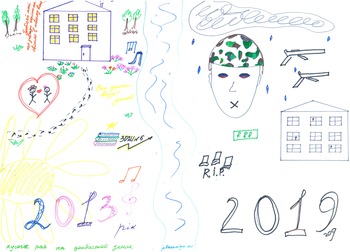
Lilia, a 23-year-old from a small industrial town in Donetsk regionFootnote 3, starts her mapping by dividing her sheet of paper into two parts, symbolizing times “before” the occupation and “after” the occupation (figure 1). She uses only the “old” Soviet name of her city and claims that it was “her personal paradise in Donbas.” Lilia chooses an image of her home to highlight the changes that have happened in her city since 2014: thus, she creates two similar images of home, using the ruler to make them “perfect,” as home itself must be for Lilia “flawless, just as a temple.” To express the contrast between the past and the present, the informant uses two colour schemes. Her city before 2013 appears to be light and bright, with lots of flowers and the symbols of her “childhood dreams.” As she states, the space of her past is full of love, support, and acceptance, thus she draws warm yellow light in every window and writes “all the roads lead home.” The city of her “present” is divided from the past by a river: here everything is murky and rainy, home is empty and surrounded by a graveyard, and the image is dominated by a picture of an armed combatant with “separatist flags covering the eyes.”
Lilia’s mental sketch map of her hometown.

Lilia proceeds with her story, mentioning that she visits home rarely, and every time sees the negative changes in the town. She explained that she uses the notion of “home” to tell about her native town, despite the fact that she moved to Kyiv in 2014. Lilia mentions that she found it hard to recognize the town she remembers in those already dark and depressed spaces – that is why she tends to connect with the image of the city-as-it-used-to-be, as it remains a cornerstone for her spatial identity.
Every time I come back home, I feel it more complicated to feel myself bounded to this place and to my memories, even though the memories are strong and warming. My town simply does not exist anymore: if I come there and open the Google map, I am … just nowhere.
Such an image of a “personal paradise” from the past is, for Lilia, inextricably linked with the old name of the town, while she associates the new toponymFootnote 4 with the death and destruction that has happened there during the last couple of years. The old place name, despite bearing soviet connotations in the name itself, is not perceived as soviet for Lilia: for her, the name was just a name, even though she understood the cultural codes implied in the name. Thus, the old place name remains for the informant an anchor for her empowering memories, and an important part of her identity.
Her perceived distance from Kyiv to home has increased: Lilia explains that not only does her journey home take around 20 hours, but also, due to the necessity of crossing the checkpoints, going through the renamed (and thus unappropriated) spaces, and a lack of sense of home in the native town on arrival, she perceives her hometown as a distant, almost unreachable, and even ghost-like place – as her town (the way Lilia remembers it) does not exist on a map anymore.
As Lilia states, she opposes the renaming of her hometown not because of being a soviet nostalgist, but because the new name denies her of her past.
Every time one asks me where I come from, I make a pause. Should I say the true name of my town, or one might think I have a sentiment on the soviet? Or tell the socially acceptable name and try to explain what my town is? The same goes for filling in the documents. I am still not used to the fact that my town never appears in any of the maps or dropdown lists.
Hence, the story described seems to deal with the renaming of what Lewicka calls her “place inherited.” Lilia describes her hometown as a cornerstone of her identity, and thus the renaming leads to the cancelling of her past and to the questioning of her own identity in the present.
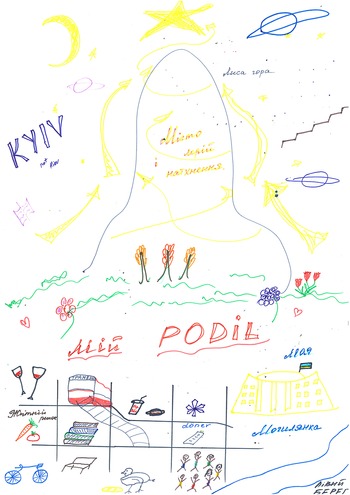
By contrast, her Kyiv appears as a “place discovered”: she centres her map around the neighbourhood of Podil downtown, where she used to study and now works (figure 2). For her, this cozy historic area contrasts with the other parts of the city that remain “undiscoverable” despite her experience of living and working there. Podil appears as a place where she feels secure as this part is completely discovered and accepted by her, and she feels that “here not much has changed in ages” – in contrast with other “placeless” parts of the city. Nevertheless, she claims she loves this city, and labels her map of Kyiv as “the way up to the top.”
Lilia’s mental sketch map of Kyiv.

The Story of Yelyzaveta: Searching for Sense
Yelyzaveta, a 22-year-old journalism student from the major city of Krasnyy Luch (literally – Red Ray), in Luhansk region, narrated a brief history of her town before coming to the mapping exercise. She mentioned in the beginning of the interview that the renaming of her city as Khrustalnyy (Crystal Town) seems to her absurd. According to a city legend, she narrates, the city of Krasnyy Luch acquired the toponym back in the 1920s, and was named to honour the red rays of dawn the miners were able to see after coming up from the night shifts. This story appears to be a symbol of hope, but not an embodiment of an early Soviet symbol, where the red colour denotes the Bolsheviks’ rule. This story was well-known in the city, and thus the removal of the famous and loved toponym was not accepted by the local community, nor by the people displaced from the city.
In the case of Yelyzaveta’s city, the renaming was not a return to the past, as the city was formed during the Soviet rule, and thus the new name is perceived, according to her words, as a threat to local identity.
My town is called Krasnyy Luch, and this name will stay with it forever, at least for me. Even if renaming is required, it could be done thoughtfully, not like a one-size-fits-all model. That memory law implied certain community discussions, so maybe it should be done with case of our town as well. For instance, the IDPs could have explained the true meaning of the name! And the state could demonstrate some respect to our locality instead of cancelling it.
After explaining her attitude towards the renaming of Krasnyy Luch / Khrustalnyy, Yelyzaveta adds that her position is definitely pro-Ukrainian, and she believes she will in future be able to go home without crossing the three lines of checkpoints. (Just as in the previous case, Yelyzaveta uses the notion of home to describe her hometown.) Yet again, Yelyzaveta’s case is not about having a special sentiment towards the soviet past of the Donbas region, but about the space appropriated jointly with its name – and becoming a part of a person’s spatial identity.
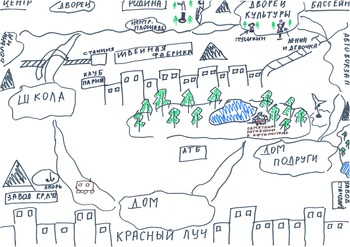
While completing the mapping exercise, Yelyzaveta adds factories, soil tips, and coal mines that used to be meaningful objects in the city, and labels them with their persistent soviet names: “Izvestiya,” “Standard,” etc. (figure 3). At the end of her mapping, she adds the final and still important elements of the cityscape: two Lenin monuments (near the city administration and in the park), and a movie theatre named “Rodina.” The latter was the single cultural object in the city, and, according to the informant, the locals tended to read its name either as “Rodina” with emphasis on the first syllable – with the meaning of “Motherland” in Russian – or with emphasis on the second syllable – with the sense of “Family” in Ukrainian.
…and thus it is not surprising that right after the separatist took over the control of the town, they changed the ambivalent name to “Russia,” written in ugly red neon. Literally, the “Motherland” turned into “Russia”! Isn’t it a sad metaphor of what happened to my hometown?
Yelyzaveta’s mental sketch map of her hometown Krasnyy Luch / Khrustalnyy.

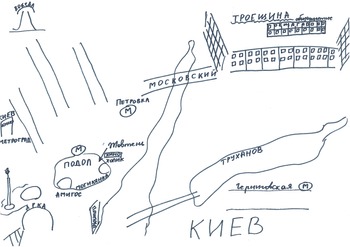
Just as in the previous case, the story of Yelyzaveta demonstrates the ontological discrepancy caused by the renaming of a “place inherited.” At the same time, she describes how she set about turning Kyiv into a “place discovered” after her displacement in 2015. Back then, she resided in a university campus in a remote neighbourhood and used to commute via the arterial roads of Moskovskyi Bridge and Vatutin Avenue, now renamed. Thus, she appropriated these places with the names they had had at that time, and mapped them with the “old” names.
When the streets and avenues I used to navigate were renamed, I … felt myself a lost person again, just the same feeling as I had when I just moved to Kyiv. One day I was staring on a bus with new avenue name on the front trying to guess whether it was mine!
Nevertheless, her map of Kyiv (figure 4) is centered around the historic neighborhood of Podil (same as Lilia’s map), and Yelyzaveta literally states that “Podil is her new Krasnyy Luch,” as it is the place she “inherited” as well, appropriating it effortlessly, as she states. But still, despite the range of opportunities in Kyiv, the city seems to her to hold discrepancies. Her map features a range of mismatched wide avenues that are the symbols of a noisy and unpredictable big city that may change at any moment, either in the name or in the architecture. Still, despite her complicated story of discovering and appropriating Kyiv, she feels existential outsideness in the city, and declares her will to study journalism and keep highlighting the IDP community.
Yelyzaveta’s mental sketch map of Kyiv.

The Story of Vasyl: Reflexive Acceptance
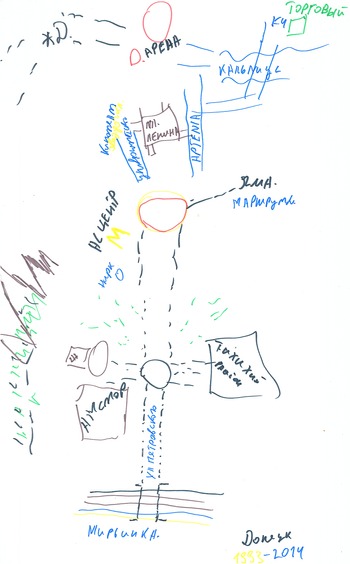
Vasyl, a 27-year-old from Donetsk, who has already lived in Kiev for 6 years, creates two vertically oriented maps of his places of residence (figure 5). He implies his maps are reflecting not the image of the city he lives in, but his personal life story and discoveries in the city – or, in other words, a “roadmap.” Thus, in the lower part of the format, he starts drawing his Donetsk by highlighting the house of his grandparents, where he spent his childhood years, and proceeds upwards with other images: there he draws his school, some places where he met his friends, the bus station, cinema houses, central streets and, finally, his high school and the Donbas-arena, a place he used to visit twice a month as a fan of “Shakhtar” football club. Thus, his map appears to be a visualization of his life journey in his hometown.
Vasyl’s mental sketch map of his hometown Donetsk.

Telling about his childhood years in the remote Petrovskyi district, Vasyl stresses that most of the local place names, like street names, mines, shops, and schools, were typically soviet. Moreover, the district itself was (and still is) named after Grigory Petrovsky, a Bolshevik politician who has never actually been to Donetsk. At the same time, Vasyl states that he used to explore the history of Donbas despite being a “typical” Donbas person, meaning that his grandparents came to Donetsk from other regions of the country and never used to work in the coal mining industry. Hence, Vasyl allegedly contrasts himself with the typical bearers of Donetsk identity, and mentions that his family used to speak Ukrainian and have a pro-Ukrainian position – the latter, as he explains, was the main reason for his family to flee Donetsk in the early stages of the conflict.
I support this idea with renaming urban spaces. And I would love to see Donetsk as a free city with new place names. Going back to historical places allow one to fully reclaim the space, to feel attached to a certain locality. It is amazing when the streetnames honour local manufacturers or philanthropists! This is a good story, I see it as a PR specialist. Much better than all this Lenins and Petrovskys that has never actually been in Donetsk!
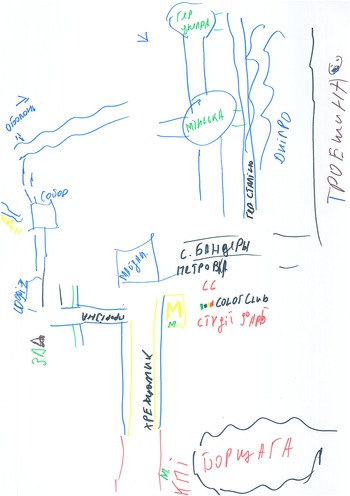
Vasyl seems also to welcome the renaming of toponyms in Kyiv: while creating his personal map of Kyiv (figure 6), he uses the street names introduced in 2016:
There is nothing wrong with having Stepan Bandera Avenue or Yevhen Konovalets Street in Kyiv, as we honour those people [who] were determined to fight for Ukraine.Footnote 5 I support honouring such fighters, as I definitely understand them.
Vasyl’s mental sketch map of Kyiv.

However, despite the active usage of the toponym Stepan Bandera Avenue, Vasyl still calls the area where he works Petrivka – this toponym resembles to him his native district in Donetsk (the area).
I grew up at Petrovka district in Donetsk, and now I work in Petrovka district in Kyiv. A nice parallel, isn’t it? Despite the area already should be named as Pochaina, I use the name Petrovka, as it reminds me of my lost home.
The fact that Vasyl expresses his content about the parallels between the toponyms in Kyiv and in Donetsk illustrates the idea of appropriation of space via spatial practices. Before 2018, Vasyl had started working in the part of Kyiv that was named after the same Bolshevik politician Grigory Petrovsky as his native district in Donetsk. The district in Kyiv was centered around the subway station with the same name. He appropriated it as a place with its previous name and did not change his inner image of the city when the name of the station was changed to Pochaina, after the river nearby.
Overall, Vasyl demonstrates ambivalence in his usage of renamed toponyms: on one hand, he favors renaming and interprets it as a reclaiming of the spaces by the locals by turning back to historical names or getting rid of soviet tradition. On the other hand, he finds a comforting parallel between the Petrovka districts in Donetsk and Kyiv, as he ties his “place discovered” in the current city with his “place inherited.”
Attempts to Reclaim the Urban Space
The empirical data from the research has shown that the issue of renaming and reclaiming urban spaces is inextricably linked to rethinking their own spatial identity by the displaced persons from Donbas. Herein, the ways of using the toponyms in the city context can problematize the integration efforts in the city by being a marker to distinguish the “others” in the city community by whether they use the relatively “old” or relatively “new” set of place names. Still, any migrant in the city can be a “lost person,” deprived of the option to navigate the city by not being able to use the taxi, or use public transport, just because of not knowing some layer of the historical toponyms (Boccagni and Baldassar Reference Boccagni and Baldassar2015). In the context of forced migration and the integration problems of the displaced people, as discussed, the feeling of being “an outsider” or “a stranger” in the city where a person resides may contribute to re-traumatization, othering, and the division of society.
On the other hand, it is important to acknowledge that the appropriation of space, and the turning of space into place requires time, since the collective memory processes (that also include the appropriation of space and the creation of city narratives) happen in other temporal coordinates than the political decisions. Still, reverting to the earlier-mentioned concept of Maria Lewicka (Reference Lewicka2013) about “place inherited” and “place discovered,” I am inclined to say that a person finds it much harder to accept the change of name of an inherited place than of a place discovered. Nevertheless, as the experience of Vasyl shows, a person who discovers a place might appropriate it with an existing place name beyond the ideological dimension, as well as re-appropriate it with the new place name provided.
However, in the case of Ukraine, the efforts to reshape the national narrative by a radical change of memory eventually led to the re-writing of the history of spaces and places. To some extent, this process can be perceived as a threat to the local collective identity of a community or its past, as it delegitimizes both the history of a place and the traces of memory about the place. The situation when the hometown, or a street where a person was born, is not present on a map anymore can lead to a feeling of “existential outsideness” experienced by people who are not capable of building any form of attachment to a constantly changing socio-spatial environment (Bourdieu Reference Bourdieu1977; Leach Reference Leach, Rooksby and Hillier2005). Apparently, the hometown appears to become placeless, thus devoid of the key factors that allow a person to define it as a place, identify with it, and appropriate it (Relph Reference Relph1980; Lewicka Reference Lewicka2013). In the same manner, Kyiv also appears to be placeless for the migrants who perceive it as a “foreign,” “volatile,” and “incomprehensible” space that they are not able to form an attachment to. Finally, such feelings of “placelessness” and “existential outsideness” challenge the existing spatial identities and prevent the formation of new ones, or, lead to the formation of “placeless identities” among the displaced people. Hence, the discussion about the renaming and reclaiming of urban spaces in Ukraine becomes inseparable from the discussion of spatial identities, and thus may lead either to public dialogue or to further divisions of the already-divided society.
Discussion
The problem of creating a new national biography in Ukraine, which includes decommunization and renaming of toponyms, remains quite uncomfortable for society. The experience of internally displaced people, who were traumatized by the war and the very fact of leaving home, shows that they might have a special type of sensitivity towards such changes in national narratives, which further contribute to their feelings of placelessness and existential outsideness. Thus, the analysis of their experience (and narratives of displacement) reveals two major problems of the ongoing national narrative-building embodied in the decommunization process. Firstly, decommunization that was supposed to be de-ideologization of space, de facto turned out to be re-ideologization. Secondly, the process that was supposed to develop community-based solutions turned out to be a set of top-down decisions. Such an approach led to frustration and a feeling by the locals that their views were being disregarded.
The first of the above-mentioned problems manifests itself in situations when, for instance, a street named after a figure from Soviet history is renamed after a figure from the Ukrainian insurgent army (a military group that fought against Soviet occupation during WWII and was accused of collaboration with the Nazis). Another problematic aspect is that the ideological discourse of the renaming process (and the fact that renaming is usually presented in the media stressing that “street A is now named street B, because person A should be condemned for collaboration with the Soviet regime”) may cause sharp political discussions on a routine basis. The very fact of using one or another name for a street or an avenue can be grounds for speculation about the political position of a person and cause unwelcome debates. As Portnov assumes, such discussion may “easily provoke mutual accusations, either of lack of patriotism or of hidden support of nationalism” (Portnov Reference Portnov2016). This particular problem may affect the daily lives of people, as shown by the example of Lilia, who always took care when choosing which name of her native town to use, even in routine small talk.
The second problem might be less visible at a glance, but can contribute even more to the complicated feeling of alienation experienced by displaced people. Admittedly, despite the opportunity for local communities to initiate discussions about renaming, as prescribed by Law no. 2558, the key role in the implementation of the decommunization process was performed by the Institute of National Memory, that saw (or used to see, while under the leadership of Volodymyr Vyatrovych, who left the post in 2019) the process as a way to elaborate and expand the national-patriotic narrative (Siddi Reference Siddi2017).
The idea of applying a bottom-up approach and initiating communal discussions on the possible options of renaming was not implemented in Donbas at all. But as the story of Yelyzaveta shows, such discussions could be possible (and desirable) among the communities of displaced people and even among the people who remained in occupation, if conducted via internet platforms. Such activities could possibly facilitate efforts to show that the occupied parts of Donbas still belong to the Ukrainian cultural field, and that the voice of people from there can be heard.
The overall problem of changing the names of objects in a highly ideologized space may have multiple solutions. One possible solution is to follow some of the best world practices. For instance, the case of Görlitz/ Zgorzelec City in the German-Polish borderland shows a remarkable example of dealing with traumatic memories of the past embedded in the urban tissue. During the 20th century, the city faced several waves of renaming of toponyms, as a result of belonging to different states, being divided, or experiencing dramatic changes of regime. In contrast to some of the renaming waves that bore ideological connotations (e.g., introducing socialistic values or establishing national narratives, as in the case of Poland), the recent set of renaming – which took place after both towns established the self-designated European City Görlitz-Zgorzelec in 1998 – introduced either neutral toponyms or those which reflected the idea of multiculturalism (Teufel Reference Teufel2014).
However, one of the few community-based decisions on the de-ideologization of space did not result in a positive outcome. The community of a suburban neighbourhood, Bortnychi, proposed to change the communist street names to names connected to bee-keeping, to reflect the local history, as the name of this area literally means “beekeepers.” Yet, the initiative was presented in the media with an ironic, and thus deprecating, connotation, thus the streets still bear their old names.
Overall, the described perspective of internally displaced people shows that the process of renaming urban spaces as a result of decommunization policy may be quite moving for those who have greater sensitivity towards the change of national narrative. The perspective of internally displaced people is one of many that points to the need for dialogue to decrease these tensions in society. In addition, the need for constant reclaiming of the volatile toponyms in Kyiv can contribute to the feeling of alienation and existential outsideness among displaced people. While the idea of changing the old “ideologically wrong” national narrative to a new one seems to have an empowering anti-colonial agenda, the whole tendency to cancel someone’s locality and identity because it is connected with communism seems to be intruding and belittling. As recent research shows, for displaced people, the memories of the past and the identity of the “inherited” hometown can be a platform to rely on while coping with the trauma of resettlement (Kuznetsova Reference Kuznetsova2017; Lazarenko Reference Lazarenko2020). Therefore, the decommunization process in Ukraine should create a de-ideologization of space, and be based on dialogue and bottom-up initiatives, in addition to legislative norms, in order to include the opinions of people who reclaim urban space on a daily basis.
Disclosures
None.