


Representation is a central concept in the study of politics (Eulau and Karps Reference Eulau and Karps1977; Mansbridge Reference Mansbridge1999; Pitkin Reference Pitkin1967). With the global increase in descriptive representation of women and racial minorities in legislative bodies, scholarly efforts have focused on how electoral structures affect this descriptive representation (Baldez Reference Baldez2006; Canon Reference Canon1999; Cox Reference Cox1997; Epstein and O'Halloran Reference Epstein and O'Halloran1999; Krook Reference Krook2006; Lublin and Voss Reference Lublin and Voss2000; Norris Reference Norris2004; Schwindt-Bayer and Mishler Reference Schwindt-Bayer and Mishler2005; Shotts Reference Shotts2003a; Reference Shotts2003b). Similar to the comparative literature, the U.S. scholarship concludes that the electoral success of minorities can be linked to electoral structure (Behr Reference Behr2004; Canon Reference Canon1999; Engstrom and McDonald Reference Engstrom and McDonald1982, Reference Engstrom, McDonald, Grofman and Lijphart1986; Reference Engstrom, McDonald, Moreland, Steed and Baker1997; Lublin Reference Lublin1997; Sass and Mehay Reference Sass and Mehay2003; Shah, Marschall, and Ruhil Reference Shah, Marschall and Ruhil2013, among others). One issue involving the relationship between electoral systems and African American representation in the United States remains in doubt. At-large elections, long thought to limit the election of minorities to office, may have declined in influence, but the structure-representation issue remains contested (see Leal, Martinez-Ebers, and Meier Reference Leal, Martinez-Ebers and Meier2004; Trounstine and Valdini Reference Trounstine and Valdini2008; Welch Reference Welch1990).
This article presents the results of a new national study of the 1,800 largest school districts in the United States for the years 2001, 2004, and 2008 that investigates how electoral structure influences African American representation. Its initial findings linking electoral systems to descriptive representation show that African Americans actually do better in at-large systems. Although this minority group may have been disadvantaged by at-large districts 30 years ago, they have since overcome these hurdles and now appear to be better off under this type of electoral structure in the case of school board elections. Because this finding is neither predicted by theory nor reported in the empirical literature, we consider several possible explanations and find that electoral structures’ influence on partisan incentives explains the apparent benefit of at-large elections for African Americans. These findings indicate that electoral structures designed to produce certain results (majoritarian outcomes) generate a set of rules that can actually be used in practice to increase the representation of racial minorities under specific conditions.
ELECTORAL SYSTEMS AND AFRICAN AMERICAN REPRESENTATION
An extensive literature claims that electoral systems create a set of rules that can create advantages for some groups and disadvantages for others (Davidson and Korbel Reference Davidson and Korbel1981; Hays Reference Hays1964; Norris Reference Norris2004; Tyack Reference Tyack1974). Electoral structures worldwide come in a large variety of forms. Within the United States, however, two systems dominate. At-large elections are majoritarian systems that elect all representatives from the entire jurisdiction; ward or single-member district elections divide the jurisdiction into smaller electoral units in which candidates run for a single seat. At-large elections permit a simple majority of voters to control all seats in an election; in contrast, single-member districts allow for the possibility that a numerical minority in the entire jurisdiction might be able to win an election in one of the individual wards.
The relative merits of at-large versus ward elections have generated a lively debate on the descriptive representation of African Americans in the United States. Because Congress relies on single-member districts, as do the overwhelming majority of positions for state legislatures, the analyses have focused on local governments – city councils and school boards. A large number of studies on both city councils and school boards conclude that blacks are more likely to be elected in single-member districts than in at-large elections (Davidson and Grofman Reference Davidson and Grofman1994; Davidson and Korbel Reference Davidson and Korbel1981; Engstrom and McDonald Reference Engstrom and McDonald1981; Karnig and Welch Reference Karnig and Welch1982; Lublin Reference Lublin1999; Marschall, Shah, and Ruhil Reference Marschall, Shah and Ruhil2010; Moncrief and Thompson Reference Moncrief and Thompson1992; Polinard et al. Reference Polinard, Wrinkle, Longoria and Binder1994; Robinson and England Reference Robinson and England1981; Stewart, England, and Meier Reference Stewart, England and Meier1989; Trounstine and Valdini Reference Trounstine and Valdini2008). In some cases these studies are able to document a change in representation within a jurisdiction after a change in the electoral system (Davidson and Korbel Reference Davidson and Korbel1981; Polinard et al. Reference Polinard, Wrinkle, Longoria and Binder1994).Footnote 1
The logic supporting ward/single-member districts as producing more descriptive representation assumes that electorates are polarized along racial lines (that is, that race is a significant electoral cleavage) and that the single-member districts are drawn in such a way – either as a result of residential segregation or perhaps because they are gerrymandered – that they are not microcosms of the overall jurisdiction and thereby facilitate racial representation. In such circumstances, blacks (and other numerical minorities) are likely to achieve greater descriptive representation in single-member district systems than in at-large systems because they can run in smaller, more homogeneous districts with larger black populations.
Other studies question the detrimental impact of at-large elections on descriptive representation, either disputing the negative impact on minorities in general or suggesting that the impact has disappeared over time. MacManus (Reference MacManus1978) concluded that electoral arrangements do not directly impose any significant burden on the election of blacks (but see Davidson Reference Davidson1979; MacManus Reference MacManus1979). Other studies that find no impact of electoral structure include Cole's (Reference Cole1974) examination of 16 New Jersey cities, Arrington and Watts’ (Reference Arrington and Watts1991) study of North Carolina school boards, and Fraga and Elis's (Reference Fraga and Elis2009) examination of Latino representation in school districts in California.
A second set of studies has suggested that the ill effects of at-large elections have declined either because most of the at-large systems in jurisdictions with large minority populations have been changed to single-member districts (as the result of lawsuits or pressure from the Justice Department) or because black candidates have adapted their candidacies to the realities of at-large elections (see Sass and Mehay Reference Sass and Mehay2003; Welch Reference Welch1990). The studies concluding that at-large elections no longer matter for descriptive representation, however, are not definitive. Because populations have continued to shift and the vigor of the Justice Department in challenging electoral systems has waned (Leal, Martinez-Ebers, and Meier Reference Leal, Martinez-Ebers and Meier2004; Trounstine and Valdini Reference Trounstine and Valdini2008), there are now more jurisdictions with sizable black populations that rely on at-large elections.Footnote 2 The recent Supreme Court decision (Shelby County v. Holder 2013 577 U.S. 193; Childress Reference Childress2013) and the recent litigation under the California Voting Rights Act (Merl Reference Merl2013) also suggest this issue is not settled.
The literature has also ignored one fundamental element of U.S. elections – the role of partisanship. Although the overwhelming majority of local elections, particularly school board elections (87%), are nonpartisan, political parties are likely to have an interest in who wins these elections (either as a tryout for recruiting candidates to run for partisan offices or because local governments implement policies enacted by state and federal law). Individual partisans are also likely to participate in local elections and are likely to vote consistent with their partisan ideology. More active partisans are likely to help recruit candidates for local office, assist in campaigning, or contribute funds. In short, there is no reason to expect that party identifiers will check their partisanship at the door simply because a local election is defined as nonpartisan (see Browning, Marshall, and Tabb Reference Browning, Marshall and Tabb1984, 44).
School boards are an especially appropriate locus for investigation of at-large elections because, unlike city councils, at-large elections are still the predominant structure for school boards. This study examines whether and through what mechanisms African Americans have been able to overcome the logical biases of at-large elections.
THE POLITICAL AND RACIAL CONTEXT OF SCHOOL DISTRICTS
Primary responsibility for elementary and secondary education in the United States is vested in local school districts. More than any other political institution, local education was dramatically transformed by the Progressive movement. The creation of the independent school district with its separate taxing authority removed schools from the jurisdiction of local governments. Additional reforms included nonpartisan elections, with school board candidates running at large rather than within smaller single-member districts (or wards) during elections that were not coincident with other state or national elections. Professional administrators and teachers replaced patronage appointments, with hiring based on a merit system; executive authority was vested in a professionally trained superintendent. The objective of these changes was clearly to disadvantage political parties with their ties to recent immigrants and to advance the interests of middle-class and upper-class business and professional interests (Davidson and Korbel Reference Davidson and Korbel1981; Hays Reference Hays1964; Tyack Reference Tyack1974).
Although framed as a way to eliminate politics from education, the reforms in reality simply transformed the political environment from one favoring urban political machines to one favoring the interests of the reform coalition. The low turnout of nonpartisan school board elections held in the spring has meant an electorate dominated by those with a direct interest in schools, primarily parents and teachers. This electoral condition also generated one factor not anticipated by the reformers in large urban areas – the increased activity and influence of teachers’ unions in recruiting and electing school board members (Katznelson Reference Katznelson1981).
Contemporary school district politics in the United States often has a racial dimension (Henig et al. Reference Henig, Hula, Orr and Pedescleaux1999; Orr Reference Orr1999; Portz, Stein, and Jones Reference Portz, Stein and Jones1999; Rich Reference Rich1996). Access to education was central to the civil rights movement, and legal and political efforts to desegregate schools lasted for several decades (Bullock and Lamb Reference Bullock and Lamb1984). Although efforts to eliminate de jure segregation continue to the present day (Orfield and Lee Reference Orfield and Lee2005), focus has shifted to other issues with racial elements, including equal funding (Evans, Murray, and Schwab Reference Evans, Murray and Schwab1997), greater choice among schools for minorities and others (Witte Reference Witte2000), disparities in school discipline (Skiba et al. Reference Skiba, Michael, Nardo and Peterson2002), assignments to special education classes (Eitle Reference Eitle2002), and, with the requirement to publish test scores by race under the federal No Child Left Behind law, the racial gap in test scores (Jencks and Phillips Reference Jencks and Phillips1998; Thernstrom and Thernstrom Reference Thernstrom and Thernstrom2003). Although not every issue in education politics has a racial element, a substantial number explicitly or inexplicitly link to racial dissimilarities.
MODELING AFRICAN AMERICAN REPRESENTATION
The literature on race and representation in the United States specifies a relatively parsimonious theoretical model whereby minority representation is a function of minority resources, electoral structure, and allies. All these factors relate to the ability of minority groups to mobilize political resources within the constraints of electoral structures (for a full discussion, see Browning, Marshall, and Tabb Reference Browning, Marshall and Tabb1984; Meier, Stewart, and England Reference Meier, Stewart and England1989). The primary electoral resource is the size of the group's population: Population size is always the most significant factor in all empirical assessments of minority representation. In addition, the urban politics literature, built primarily on studies of white ethnics, argues that viable electoral candidates require a middle-class status that permits sufficient time for participation in politics (Karnig Reference Karnig1976; Wolfinger Reference Wolfinger1965). Middle-class status also provides a base for raising campaign funds. Although this argument has intuitive appeal, most empirical studies of African American representation find that African American levels of income, education, and other resources have little impact on the level of representation. However, our model does include measures of African American education, income, and home ownership, as well as a measure of white poverty designed to tap the relative economic status of blacks versus whites.
The role of electoral structure, the central concern of this article, is incorporated via an interaction between structure and population (see Engstrom and McDonald Reference Engstrom and McDonald1981). The theory implies that the electoral structure affects the efficiency of the process of translating population into votes. Comparing the various structure coefficients as they interact with population provides an estimate of how well the group is represented relative to its population under different electoral structures.Footnote 3 Finally, Browning, Marshall, and Tabb (Reference Browning, Marshall and Tabb1984), in their comparative case studies of San Francisco area local governments, recognized that when racial minorities are a numerical minority, they need to be part of an electoral (and governing) coalition. Lacking a population majority, a racial minority needs to rely on the votes or the support of white liberals who share its views on various election issues. The clear evidence from case studies, however, is difficult to translate to large-N studies because the group “white liberals” is usually measured by demographic surrogates, such as education (see Marschall, Shah, and Ruhil Reference Marschall, Shah and Ruhil2010). This study introduces two new measures of allies: a school-district–level measure of Democratic partisanship and the relative influence of unions in each state. Unions provide both allies and also some organizational capacity gained from their experience in contesting elections.Footnote 4
DATA AND MEASUREMENT
The data for this analysis were drawn from three sources. Basic demographic and socioeconomic information were collected from the 2000 U.S. Census school district files; school districts are not conterminous with cities or other jurisdictions and so required the use of special census files. Data on the partisan distribution of school districts were constructed using data on election returns for 2004 and 2008 presidential elections (see the later discussion). The data pertaining to school board representation for 2001, 2004, and 2008 came from original surveys of all school districts with student populations larger than 5,000 as of 1999. Of the 5,493 district years, 5,192 (a 94.5% response rate) provided data on school board composition.Footnote 5 Because the theoretical logic concerns numerical minorities, we eliminated all school districts with an African American majority (leaving 4,980 total district years), and because some census data were coded as missing,Footnote 6 the actual number of cases in the analysis is a bit lower than that figure.
The original surveys of school districts collected information on the electoral structure of the school districts and the racial representation of the school board. Representation is measured as the percentage of African Americans on the school board, the most common method of measuring racial representation in the literature.Footnote 7 The measure of African American population is from the 2000 census files and is the percentage of the population that is African American within the school district.
School boards have two predominant electoral structures. Approximately 59% use pure at-large systems in which all representatives are elected at large. Another 29% percent use pure single-member–district systems with all members elected from such districts. A small number of districts are dependent school districts, in which board members are appointed by the chief elected official for the jurisdiction that contains the school district, rather than being elected (3%). The remaining districts (9%) mix these three systems. To avoid losing all the mixed electoral system cases, we measured the ward variable and the appointed variable as the proportion of members who were selected by ward or by appointment; thus they range from zero to one (by analogy, the at-large variable is measured similarly).
We included four measures of the relative resources of the African American community – the percentage of African Americans over the age of 25 with a college degree, the percentage of African American families that own a home, the per capita income for African Americans, and the percentage of whites living in poverty. The first three variables capture the absolute level of black socioeconomic resources. The fourth measure is included in these models as a measure of social distance based on the argument that white voters may be more willing to accept a middle-class black candidate than a lower-class white candidate (Evans and Giles Reference Evans and Giles1986; Rocha and Hawes Reference Rocha and Hawes2009).
When creating a measure of potential allies or coalition partners, we first focused on crafting a measure of liberal whites. Such a measure is difficult to estimate because we do not have public opinion data on subnational jurisdictions as small as cities and school districts. We therefore used the percentage of Democratic voters as our first surrogate. We calculated the Democratic percentage variable by taking presidential election returns for 2004 and 2008 at the county level (the closest level of aggregation to school districts) and regressing these percentages on a set of demographic variables including race, income, and education. We then used the coefficients from these regressions to adjust the Democratic percentages for the county where the school district is located to a school district Democratic percentage.Footnote 8 As an example, Harris County Texas (Houston) has a Democratic percentage of 47.8, but contains several school districts that range from 36.3% (Channelview Independent School District) to 61.4% Democratic (North Forest Independent School District). The measure of Democratic partisanship should be viewed as more than just a measure of liberal whites; the Democratic Party is also a political institution and is unlikely to be a passive actor in the electoral process.Footnote 9
A second potential set of allies for African Americans are unions, especially teachers unions, which have played a strong role in school board elections (Katznelson Reference Katznelson1981; Moe Reference Moe2009). The ideal measure would be the percentage of the teaching force in each district who are members of either the American Federation of Teachers (AFT) or the National Education Association. Neither organization is willing to provide membership numbers at the school district level, and the AFT does not even provide figures at the state level. As a result we opted for using the percentage of the workforce that was unionized in that state. This assumes that the presence of unions within a state is correlated with the level of teacher unionization or simply that unions per se might be a potential source of allies for African Americans.Footnote 10 The union measure also taps elements of organizational structure in the community that the Democrat measure might not. Unions aggressively contest elections and can generate volunteers and in-kind contributions; such resources are especially valuable in low-turnout elections such as those for school boards (Bascia Reference Bascia1994).
The dataset contains information on school districts for three different years. Panel datasets such as this one can be affected by both serial correlation and unit heterogeneity (Durbin and Watson Reference Durbin and Watson1951; Levin, Lin, and Chu Reference Levin, Lin and James Chu2002). We dealt with the serial correlation problem by including a set of dummy variables for the individual years. To deal with unit heteroskedasticity, we clustered the standard errors by case (Wooldridge Reference Wooldridge2003).
AT-LARGE ELECTIONS AND BLACK REPRESENTATION
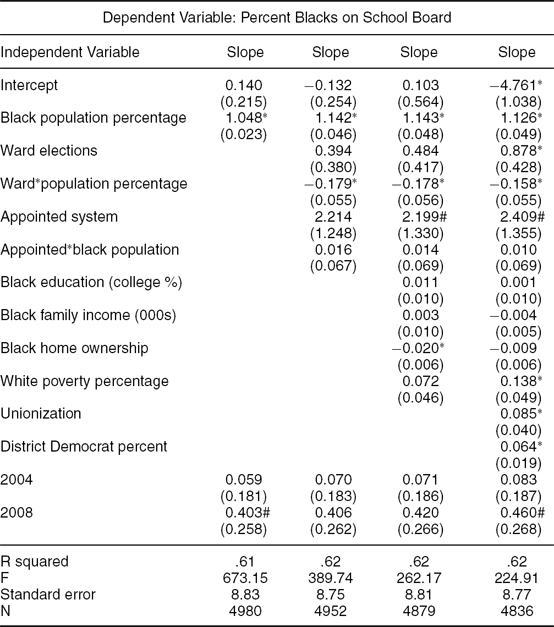
Table 1 relates African American population to African American representation on the school boards in four regressions. Column one uses a single independent variable, black population. Because the intercept of this equation is essentially zero, the slope coefficient can be interpreted as a representation ratio. An increase of one percentage point in black population is associated with a 1.048 percentage point increase in black representation.Footnote 11 There are two surprises here: The representation coefficient is not less than one, and it is significantly, albeit modestly, greater than one. Thus, African Americans receive slightly more representation than would be expected based on population alone. School boards are anomalous institutions in American politics in this regard; black representation ratios are consistently less than one in other legislative bodies.Footnote 12 We return to this puzzle of black representation after examining the role of electoral structure and other factors.
Impact of Electoral Structure on the Quantity of Black Representation: School Board Seats

Districts where blacks are less than 50% of total population
Errors clustered by LEAID
Standard errors in parentheses
*p < .05; # p < .10.
The classic way to examine electoral structure is to create a set of interaction terms as recommended by Engstrom and McDonald (Reference Engstrom and McDonald1981). They proposed an equation that included black population, a dummy variable for ward electoral systems, and the interaction between the dummy variable and black population. This estimation provides a direct test of whether representation in ward systems is significantly different statistically from that in at-large systems. We followed that recommendation with two slight adjustments. First, some school boards are appointed rather than elected, so we included another set of coefficients for appointive systems.Footnote 13 Second, other school board selection processes are mixed, with some members elected at large and some by ward (and in some cases some members are appointed). Rather than omitting the mixed systems, we substituted the proportion of members elected by ward (or appointed for that variable) in the interaction. This substitution means that our interpretation compares pure ward with pure at-large systems, but uses the full range of cases for more efficient estimates.
The second column of Table 1 contains this interactive regression, and the third column adds four resource variables that the literature suggests can affect black electoral success: black education levels (percent with college degrees), black median family income, black home ownership, and percent whites living in poverty. These demographic factors, which translate into economic resources, have only a modest relationship with representation (the joint f-test = 2.96, p = .02), suggesting that black representation on school boards is almost exclusively a function of black population and electoral structure (see also Marschall and Ruhil Reference Marschall and Ruhil2006; Marschall, Shah, and Ruhil Reference Marschall, Shah and Ruhil2010; Rocha Reference Rocha2007, but see the later discussion).
Using the results in column 3, in a pure at-large system, the ward elections variable, the appointive variable, and their interactions will be equal to zero. The relationship between black population and black representation in an at-large system reduces to the following:
 ${\rm Representation} = .103 + 1.143\;{\rm Population}$
 \begin{eqnarray*}
{\rm Representation} &=& .103 + .484 \\
&&+\, (1.143 - .178)\,{\rm Population} \\
{\rm Representation} &=& .587 + .965\;{\rm Population}
\end{eqnarray*}
For appointive systems, both the slope and the intercept differ in interesting ways. Because the ward variables are equal to zero in an appointive system, the representation relationship in these districts is as follows:
 \begin{eqnarray*}
{\rm Representation} &=& .103 + 2.200 \\
&&+\, (1.143 - .014)\;{\rm Population} \\
{\rm Representation} &=& 2.303 + 1.129\;{\rm Population}
\end{eqnarray*}
The final regression equation in Table 1 introduces partisanship and unions to the model. Although only 13% of these school board elections are partisan and elections are generally not held at the same time as partisan elections, there are reasons why one might expect that black representation might be affected by the partisan distribution in the district. Browning, Marshall, and Tabb (Reference Browning, Marshall and Tabb1984) contend that racial minorities need to form coalitions with liberal whites to govern and that the Democratic Party would be the logical place to seek liberal whites. Education issues at times split along partisan lines, and the general expectation is that African Americans might perceive more commonality with the Democratic Party on such issues given their strong ties to it. The regression shows that partisanship matters; all other things being equal, a district with 50% Democrats would have an additional 3.2% black school board members. Unions also matter. A 10% increase in the unionized workforce (this is a significant jump given the range is from 2.9% in North Carolina to 23.2% in New York), however, would add less than 1% to representation. Adding both variables has a major impact on the intercept, which suggests that their impact will occur primarily in districts with smaller black populations. Their addition also brings white poverty into statistical significance.
Table 1 presents the puzzle of African American representation in stark terms. African American politicians have somehow overcome the logical limitations of at-large elections, going beyond neutralizing their impact to the point where black electoral fortunes are better in at-large elections. This finding is clearly a puzzle in the literature given that there are no formal or even anecdotal discussions of why at-large elections would result in an overrepresentation of African Americans when they are a minority of the population.
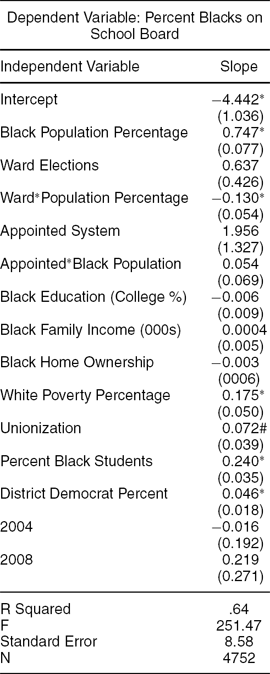
We considered five explanations for this phenomenon and found each wanting. First, because school board elections are characterized by low voter turnout (Wirt and Kirst Reference Wirt and Kirst1997), we considered whether African Americans might be more likely to vote in school board elections because they are more likely to have children in the schools. To assess this hypothesis, we controlled for the racial distribution of the school enrollment. Although the inclusion of this variable is significant, it does not affect the relationship between structure and representation (see Appendix Table A1).
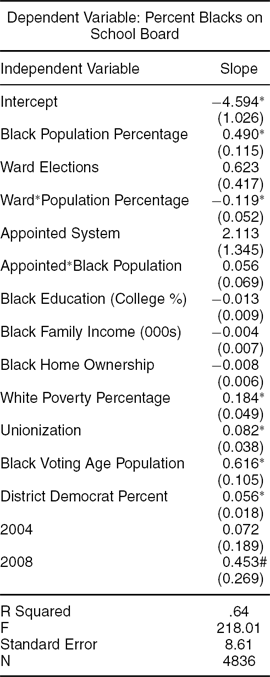
Second, we probed whether the differences might be a function of the different age distributions of African Americans and others. Younger populations are disadvantaged because those under the age of 18 cannot vote. When we controlled for the racial percentages of voting age population in the models in Table 1, the results did not affect the relationship between structure and population (see Appendix Table A2).
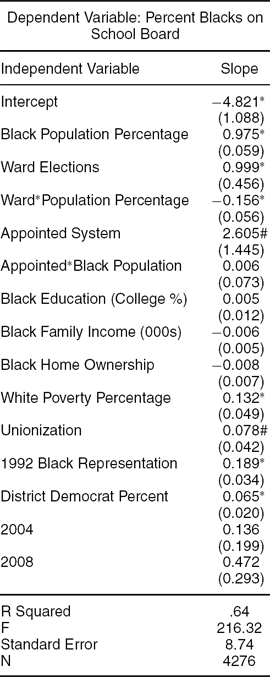
Third, African American politicians have several decades of experience in running for and winning urban elections. This experience could translate into greater levels of political skills, which might provide an advantage in running in at-large elections. Although we have no measure of candidate skill, we do have a prior measure from 1992 of successful black candidates. When we controlled for prior successful black candidates, however, the impact of at-large elections remained undiminished (see Appendix Table A3).
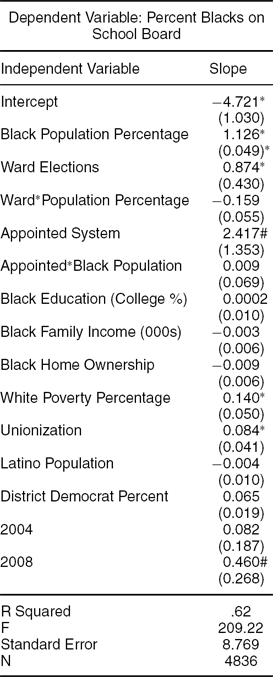
Fourth, one might think that these results are an anomaly generated by demographic trends. Many whites left urban school systems as the result of desegregation or other migration reasons, thereby creating school districts with de facto black majorities (Clotfelter Reference Clotfelter2004; Schneider Reference Schneider2008; Wilson Reference Wilson1985). More recently large numbers of Latinos have moved into these urban districts. Might the results reflect black majorities or black pluralities exploiting the electoral system in regard to Latinos (see Rocha Reference Rocha2007)? We assessed this possibility even though the analysis deleted all school districts with a majority African American population. Controlling for Latino population, however, had no impact on the basic findings (see Appendix Table A4).
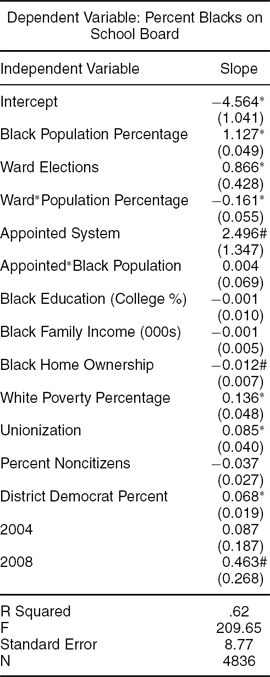
Fifth, many recent immigrants to these school districts, particularly in urban areas, are not citizens. Noncitizens generally cannot vote in elections; there are some exceptions (see Kini Reference Kini2005), but they are uncommon. As the number of noncitizens increases, the relative weight of the vote of citizens, including African American citizens, increases. Controlling for the percentage of noncitizens, however, had no impact on the findings presented (see Appendix Table A5).
Having eliminated these five explanations, how else might African Americans have overcome the biases of at-large elections, and who might have the incentive to create a system that permits them to overcome these biases? Electoral structures are simply a set of rules with biases, and there is no logical reason why any one group would not seek to use the existing rules to its advantage. The logical way to overcome the biases is to put together a slate of candidates to run as a bloc or to put together a majority coalition behind a candidate in an at-large election.Footnote 15 If this coalition fairly or overrepresented blacks among its candidates and if the coalition supporting the candidates was a majority, at-large elections would generate results very similar to those shown in Table 1.Footnote 16 Who might have an incentive to put together such a slate of candidates or such a coalition? One possibility is a group, such as the Democratic Party, that needs African American votes or sees compatibility with African American political interests. When might the Democratic Party have the incentive and capacity to put together coalitions and slates of candidates for school board elections (particularly given that most of these elections are on their face nonpartisan)? Democrats would have this incentive and capacity if they are a majority in the school district and if they need African American votes to win elections other than school board elections. Supporting African American candidates for school board elections could be one way for a party to demonstrate a credible commitment to push African American issues in other policy jurisdictions. Based on this logic, the implication is that, if the Democratic Party can win school board elections, it would also have the incentive to put together a coalition at the school district level to build stronger ties between the party and African American voters. When Democrats constitute a voting majority in the school district, the inherent biases of at-large elections should lead to an overrepresentation of Democrats and hence African Americans who are part of the Democratic majority.
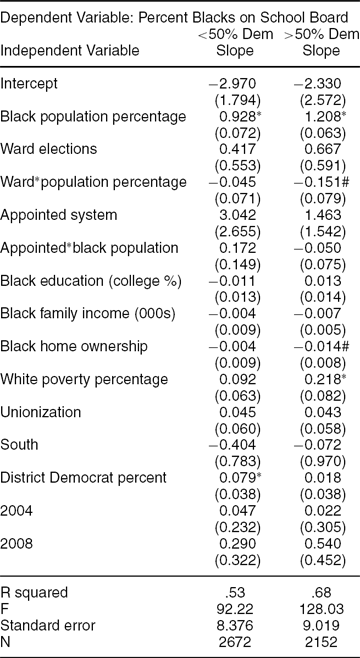
We tested this logic with a measure of Democratic vote at the school district level and ran regressions that divided the districts into those with a Democratic majority and those with a Republican majority (Table 2).Footnote 17 Again we combined the regressions to generate a single regression for ward and at-large districts in districts with potential Democratic victories and those without as follows:
Partisan Fortunes and the Impact of Structure on Representation: School Boards

Districts where blacks are less than 50% of total population
Errors clustered by LEAID
Standard errors in Parentheses
*p < .05; # p < .10.
Democratic districts
 \begin{eqnarray*}
{\rm At - large}\quad {\rm Representation} &=& - 2.330\\
&& +\, 1.208\,{\rm Population} \\
{\rm Ward}\quad {\rm Representation} &=& - 1.663 \\
&&+ \, 1.057\,{\rm Population}
\end{eqnarray*}
 \begin{eqnarray*}
{\rm At - large}\quad {\rm Representation} &=& - 2.957 \\
&&+ \, .928\,{\rm Population} \\
{\rm Ward}\quad {\rm Representation} &=& - 2.553\\
&& +\, .883\,{\rm Population}
\end{eqnarray*}
To make sure the findings occur as the result of party rather than region given the Republican domination of the South, we also added a control for southern districts.Footnote 20 We classified a district as southern if it was located in a state that operated a de jure segregated school system in 1954 when the Supreme Court declared such systems unconstitutional for the first time.Footnote 21 The coefficient for the South is not statistically significant, and its inclusion has no impact on the relationship for the party variable.
The nature of the comparison as already described stresses the marginal effect of electoral structure. The other way to combine the coefficients is to contrast how changes in party affect the coefficients for the various structures. For at-large elections, a Democratic majority increases the effect of the population-representation slope from .928 to 1.208, a gain of approximately 28 percentage points. For ward elections, a Democratic majority increases the size of the population-representation slope from .883 to 1.057 or approximately 17 percentage points. This indicates that a Democratic majority is an advantage regardless of the electoral system, but with at-large elections African Americans can use the bias of a majoritarian system to further increase the size of their electoral benefits.Footnote 22
One final issue remains to be addressed: the role of residential segregation as it influences the structure-representation relationship. The efficiency of ward elections in generating minority representation requires that populations in the small electoral units not be a microcosm of the entire jurisdiction; that is, it requires some degree of residential segregation.Footnote 23 If there is no residential segregation, then an overall minority has no better chance of winning in a smaller electoral district than in an at-large election. Therefore there should be an interaction between residential segregation and electoral structure. We calculated an African American–white residential segregation measure for each school district using block-level data from the 2000 census; using block-level data generates greater variation because it is quite possible for a block to be composed of a single race. This measure is essentially a Blau similarity index that indicates the probability that the next person one meets at random will be of the same race. Because it is a measure of integration, we reverse-coded it to measure segregation.
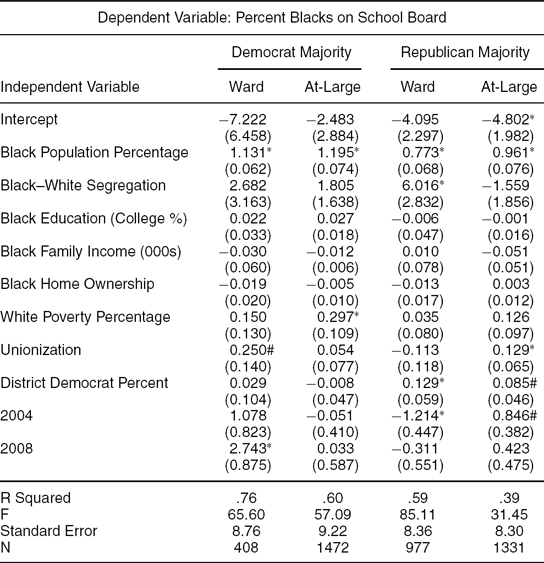
The optimal way to estimate the impact of residential segregation is to include it in the final model in Table 1 and also to interact it with ward elections (because segregation theoretically will only affect results in ward systems). Unfortunately, interacting residential segregation with ward elections and also population with ward elections generates massive collinearity and precludes reliable estimation. As in measuring the relationship of representation to partisanship, we partitioned the sample and ran regressions for those school districts using pure ward election systems and those using pure at-large systems for both Democratic-majority and Republican-majority districts. By including the measure of segregation in these regressions, we were able to determine if, as predicted, the degree of residential segregation improves electoral fortunes in ward-based elections.
Table 3 presents these four regressions. The residential segregation ranges from 0.02 (almost completely integrated) to 0.95 (virtually completely segregated). The regression coefficient can be interpreted as the increase in black representation for a completely segregated district (compared to one that is fully integrated), all other things being equal. The models in Table 3 show, as predicted, that residential segregation has no impact on representation in at-large systems. The ward system equations show that the degree of segregation matters, but only in a jurisdiction with a Republican majority; residential segregation does not matter in jurisdictions with Democratic majorities. The maximum impact of segregation in Republican-majority areas with ward elections is approximately a six percentage point increase in black representation, all other things being equal.
Partisan Fortunes and the Impact of Structure on Representation: School Boards

Districts where blacks are less than 50% of total population
Errors clustered by LEAID
Standard Errors in Parentheses
*p < .05; # p < .10.
The results of Table 3 reinforce the earlier findings about the importance of partisanship. Democratic majorities facilitate coalitions that include African Americans; this process is able to overcome the bias in at-large elections and to provide an advantage for African Americans in those systems relative to ward elections (Table 2). Democratic majorities also are associated with a reduced impact of segregation, presumably because even in ward systems with Democratic majorities the parties perform the same coalitional functions, with liberal whites supporting black candidates (Table 3). A comparison of the population coefficients in both Tables 2 and 3 indicates that when there are majoritarian election systems (at-large elections), a Democratic majority is associated with higher levels of African American representation.Footnote 24
CONCLUSIONS
This analysis explores two enduring puzzles regarding black representation in education policy: the extent of descriptive representation in different electoral systems and whether the negative impact of at-large elections has declined. We find that on average African American school board members have overcome the limitations of at-large elections. To assess exactly how African Americans have done this, we postulated a new theoretical idea. The findings indicate that one possible way to overcome such bias is through putting together a majority coalition to back African American candidates in at-large electoral systems. Such slates and coalitions are more likely in areas with Democratic voting dominance. In districts with a Democratic majority, African American representation in at-large elections is 18 percentage points higher than it is in ward elections. In Republican districts, structure matters very little; however, the representation levels are lower than in Democratic districts, all other things being equal. Our findings thus indicate that partisanship can be a salient factor in securing representation for African Americans in systems where they were traditionally underrepresented.
Our findings are consistent with the seminal work of Browning, Marshall, and Tabb (Reference Browning, Marshall and Tabb1984), who examined the incorporation of minorities in 10 Northern California cities. For Browning and colleagues, the variable we introduce here (Democratic majorities) was a constant (all 10 cities had a Democratic majority, and so they considered it a necessary condition for incorporation). Although our study confirms the importance of a Democratic majority, by itself a Democratic majority is not sufficient for African American to win electoral office. Fourteen percent of school districts with 10% black population and a Democratic majority in our study have no African Americans on the school board.Footnote 25 Neither is a Democratic majority a sufficient condition given that African Americans attain 92% of the representation that their population entitles them to in at-large elections in Republican jurisdictions (see Table 2).
The combined effect of partisanship and at-large elections in the U.S. context might be considered parallel to the comparative elections findings in regard to gender. That literature finds that “district magnitude,” the number of candidates elected from an electoral district, is positively associated with more women representatives (Kenworthy and Malami Reference Kenworthy and Malami1999; Kunovich and Paxton Reference Kunovich and Paxton2005; Norris Reference Norris1985; Paxton Reference Paxton1997; Reynolds Reference Reynolds1999; Rule Reference Rule1987). The district magnitude results are greatly influenced by systems that have a single nationwide electoral district and operate under proportional representation systems. In such systems, parties run a slate of candidates. The evidence for U.S. school districts is consistent with the logic in these comparative systems, except that the slating is not done via formal rules (that is, established party lists) but rather done informally or as an ad hoc coalition.
One open question is whether the findings here are an anomaly and African American representation on school boards is unique. The logic of the incentives created by electoral systems in terms of getting elected and forming governing coalitions, however, suggests that other cases can be identified and studied. City councils are an obvious case. Electoral systems are not immutable. As with any set of procedural rules, political parties and likely other political institutions have an incentive to create informal processes that overcome the biases of the formal electoral system. Election systems establish the rules of the game and incentives; they do not necessarily determine winners.
Given the current controversy over the Voting Rights Act and whether this policy should be continued, the implications of this study for that legislation need to be specified precisely. This study does not find that electoral structures do not matter. It finds that one minority group, African Americans, can overcome the biases of at-large elections in specific circumstances – in areas with a Democratic voting majority. Given the unique political history of African Americans in the United States, the findings here cannot necessarily be generalized to Latinos, Native Americans, Asian Americans, or other racial or ethnic minorities. Additional research is required to determine the impact, if any, of electoral structure on the political representation of these racial and ethnic minorities. The study also documents the average case; in many situations African Americans are significantly underrepresented on school boards, and structure along with local conditions could well be a factor in this pattern.
This assessment should be considered the first step in a new series of studies on the impact of electoral structure on minority representation in light of three events that are likely to affect the electoral process. First, the Supreme Court in Shelby County v. Holder (2013) has weakened the Voting Rights Act, which has encouraged some local jurisdictions to move to majoritarian electoral structures (Childress Reference Childress2013). Second, the California Voting Rights Act has resulted in many California jurisdictions switching from at-large elections to ward systems, and some states such as Washington are considering similar laws. Third, the Military Overseas Voting and Empowerment Act requires states and communities to facilitate absentee voting by members of the U.S. military. To reduce the costs of compliance with this law, some states such as Michigan have moved all local elections to November concurrent with other elections, and other states such as New Jersey now allow that scheduling. If November elections increase voting turnout (that is, there is not significant rolloff) for school board elections, this could complicate the relationships between population numbers and electoral structure.
APPENDIX: ALTERNATIVE SPECIFICATIONS
The Percent of Black Students and the Impact of Electoral Structure on the Quantity of Black Representation: School Board Seats

Black Voting Age Population and the Impact of Electoral Structure on the Quantity of Black Representation: School Board Seats

1992 Black Representation and the Impact of Electoral Structure on the Quantity of Black Representation: School Board Seats

Latino Population and the Impact of Electoral Structure on the Quantity of Black Representation: School Board Seats

Noncitizens and the Impact of Electoral Structure on the Quantity of Black Representation: School Board Seats




Comments
No Comments have been published for this article.