Background
Epidemiological studies have reported that birthweight is indicative of short- and long-term health consequences including morbidity and mortality, as well as elevated risk for developmental delays. 1–Reference Avan, Raza and Kirkwood5 Families of low birthweight (LBW) children experience increased financial burden as a result of extended hospitalization, prescribed medication, and healthcare utilization. Reference Hummer, Lehner and Pruckner4,6 Majority of studies that examined causes associated with LBW focused on biological, nutritional, socioeconomic, behavioral, and other parental factors, with limited studies examining the impact of exposure to extreme weather events during pregnancy. Reference Ramakrishnan3,Reference Catov, Lee, Roberts, Xu and Simhan7,Reference Valero De Bernabé, Soriano and Albaladejo8
Over the past decade, climate change has emerged as a major public health concern due to its effect on increasing global temperatures and severe weather events, such as weather-related extreme heat events (EHE). Reference Schär, Vidale and Lüthi9–Reference Meehl and Tebaldi11 Previous studies examining EHEs effect on pregnancy outcomes reported an association with increased odds of birth defects and preterm birth. Reference Wang, Williams, Guo, Pan and Tong12–Reference Poeran, Birnie, Steegers and Bonsel18 However, findings on how and to what extent EHE might impact birthweight have not been widely reported. A recent nationwide study assessing the relationship between extreme ambient temperatures and birthweight observed exposure to hot temperatures (>95th percentile) during pregnancy was associated with increased risk of LBW. Reference Ha, Zhu, Liu, Sherman and Mendola19 Two ecological studies exploring the relationship between exposures to high ambient temperatures on birthweight found a negative correlation between high temperatures and birthweight. Reference Wells and Cole20,Reference Flouris, Spiropoulos, Sakellariou and Koutedakis21 A time-series ecological study conducted in 19 African countries reported a correlation between increasing number of hot days and decreasing precipitation on birthweight, as well as elevated rates of LBW in sub-Saharan Africa. Reference Grace, Davenport, Hanson, Funk and Shukla22
Although some prior studies suggest high ambient temperature during pregnancy raises maternal core temperatures resulting in LBW, few studies have assessed the relationship between EHE and term low birthweight (tLBW) as preterm could be a mediator of LBW. Reference Poeran, Birnie, Steegers and Bonsel18,Reference Wells23,Reference Huynen, Martens, Schram, Weijenberg and Kunst24 Among studies that explored the relationship between high ambient temperature and LBW, findings have been inconsistent. These inconsistences can be attributed to use of different windows of exposure, lack of adjustment for confounders, and lack of assessment for potential mediating effects related to gestational age. In addition, majority of studies summarized the impact of high ambient temperature exposure during pregnancy on LBW, failing to consider that estimates can differ by birthweight percentile or distribution. This limitation can hinder the ability to identify sensitive sub-population, thus impacting the development of an effective public health intervention. Reference Barker, Eriksson, Forsén and Osmond25 Finally, to the best of our knowledge, no other study has assessed the influence of both EHE frequency and duration on tLBW, particularly by birthweight percentile.
To fill the knowledge gaps described earlier, our objective was to evaluate the relationship between EHE and tLBW by trimester of pregnancy. We also investigated variability in birthweight and tLBW percentile by heat indicators (EHE frequency and EHE duration). New York State (NYS) is the ideal location for this study due to its diverse geographic regions, temperature zones, and demographic characteristics.
Methods
Study design and study population
We used a case–control design to assess the relationship between EHE and birthweight. Cases consisted of all singleton, term, non-malformed, and LBW babies (birthweight <2500 gram) born between 1991 and 2006. Controls consisted of a random sample of singleton, term, non-malformed, and normal birthweight babies recorded within the same years. The study population consisted of singleton, term, and non-malformed live births recorded in NYS (excluding New York City [NYC], as birth certificate information was not available) from 1991 to 2006. Excluded were observations with birthweight inconsistent with gestational age according to the criteria published by Alexander (1996). Reference Alexander, Himes, Kaufman, Mor and Kogan26 Term babies were defined as deliveries at 38–42 weeks of gestation calculated from the first day of the last normal menstrual period. We limited our study population to term babies (38–42 weeks of gestation) to control for potential confounding effects of pregnancy duration on birthweight. Reference Parker, Woodruff, Basu and Schoendorf27 For both cases and controls, gestation time had to include at least 1 d in the summer season.
Birth certificates were used to ascertain cases and controls. Information from birth records included maternal and infant demographic characteristics, such as maternal age, race, ethnicity, education level, infant’s date of birth, sex, birthweight, gestational age (in weeks), and maternal behavioral characteristics, including tobacco use and alcohol consumption. The validity of information reported on NYS birth certificates was previously assessed in a study revealing a high specificity (91%–100%) for most data elements and a high sensitivity for maternal lifestyle (86%–100%) and birthweight (100%). Reference Roohan, Josberger, Acar, Dabir, Feder and Gagliano28
The Data Support Section of the Computational and Information System Laboratory and the National Center for Atmospheric Research of the National Weather Service provided meteorological data on hourly observations for temperature, dew point, and barometric pressure (P). Metrological data were used to derive daily maximum, minimum, and mean for each of the weather variables.
We obtained hourly ambient ozone data from the NYS Department of Environmental Conservation. Data were measured hourly for each day (reported in parts per billion). We used the 8 h maximum hourly value during peak outdoor exposure time (10:00–18:00 h) in this study to represent daily ozone level. Reference Lin, Liu, Le and Hwang29 EPA CMAQ data were used to comprehensively estimate daily particle with aerodynamic diameter ≤2.5 µm (PM2.5), as some time periods and regions are not covered by observational data. Reference Hogrefe, Lynn and Goldberg30
Summer season was defined as the period between May 1 and August 31 of each year. Fourteen weather regions were assigned in NYS. These regions were created by overlaying and merging the National Climate Data Center’s ten NYS climate divisions with 11 ozone regions developed by Chinery and Walker. Reference Chinery and Walker31 The small regions with two sets of boundaries that did not coincide completely were merged with adjacent regions that were most similar. This resulted in 14 regions of relatively homogeneous weather and ozone exposures. Each delivery was geocoded by residential address and assigned to one of these regions using Map Marker Plus®. In our analysis, only 10 weather regions were included, as NYC regions were excluded, because birth certificate information was not available. Detailed information and the map depicting the weather regions used in this study were previously published. Reference Fitzgerald, Pantea and Lin32 Estimated date of conception was calculated by subtracting 38 weeks from due date. However, in the instance where maternal due date was not available, then date of last menstrual period was used by adding 14 d to date of last menses. Reference Soim, Sheridan and Hwang16 Birth records were merged with daily weather data, and three exposure indicators were developed: EHE (yes/no), EHE duration, and EHE frequency. We used two definitions for EHE to determine duration and severity: 1) at least three consecutive days with maximum temperature ≥32.2 °C/90 °F (EHE90), and 2) two consecutive days of temperature ≥97th percentile of the distribution of the maximum temperature for the summer season (EHE97). Reference Soim, Sheridan and Hwang16 Exposure to EHE90 or EHE97 was defined as exposed.
Potential variables confounding the association between EHE and birthweight included maternal age (grouped in three age categories <20, 20–34, and ≥35), race (White, Black, or other), ethnicity (Hispanic or non-Hispanic), maternal level of education (<12, 12–15, or ≥16 years of education), infant’s sex, smoking (yes or no), alcohol consumption (yes or no), adequacy of prenatal care (Kessner index: adequate intermediate and inadequate), year of birth, and weather region. We included maternal education level as a potential confounder, because previous studies documented this to be associated with both prenatal exposure to extreme weather events and low birthweight. Reference Van Zutphen, Lin, Fletcher and Hwang13,Reference Cândido da Silva, Moi, Mattos and Hacon33–Reference Wang, Tong, Williams and Pan37 Moreover, means of daily PM2.5 (in µg/m3) and ozone concentrations (in parts per billion) were calculated across the entire hot season for each year.
Unconditional logistic, linear, and quantile regressions were performed. Multivariable models included the exposure variable, potential confounders/effect modifiers along with product terms between the main exposure variable and potential effect modifiers (atmospheric pressure, relative humidity, weather region, year of birth, PM2.5, ozone, maternal age, ethnicity, maternal education, smoking, alcohol consumption, race, and adequacy of prenatal care). Reduced models were built utilizing a backward elimination process and using observations for which there is complete information for all variables, while excluding those with incomplete information. Effect modification on the multiplicative scale was used to assess the deviation from perfect multiplicatively as determined by the Likelihood Ratio test with an alpha of 0.05 and results supported in the stratified analysis. Analyses were conducted for all three exposure indicators using both definitions of EHE. Adjusted odds ratios (ORs) and 95% confidence intervals (95% CI) were computed for the entire duration and by each trimester of pregnancy. Potential confounders included in our model were first screened and selected based on prior literature or biological plausibility, and among those biologically plausible variables selected, we then used a stepwise model to assess if the point estimate remained significant after controlling for all potential confounders. In particular, we integrated the stepwise model with an effect estimate change criterion, where a change in effect estimate >10% of the primary exposure variables was set as the criterion for including a variable in the model. Multiple-testing concerns were addressed using the Bayesian analysis approach with Jeffreys’ prior, which provides an automated way of finding a non-informative prior for any parametric model, where, in the multiple-testing analysis, we observed similar findings. Reference Lin, Lin and Ou36,Reference Greenland38 Data management and analysis were conducted using SAS 9.2 (SAS Institute Inc., Cary, North Carolina). Finally, the criterion for statistical significance was set at an α of 0.05, and all p values were based on two-sided tests.
Results
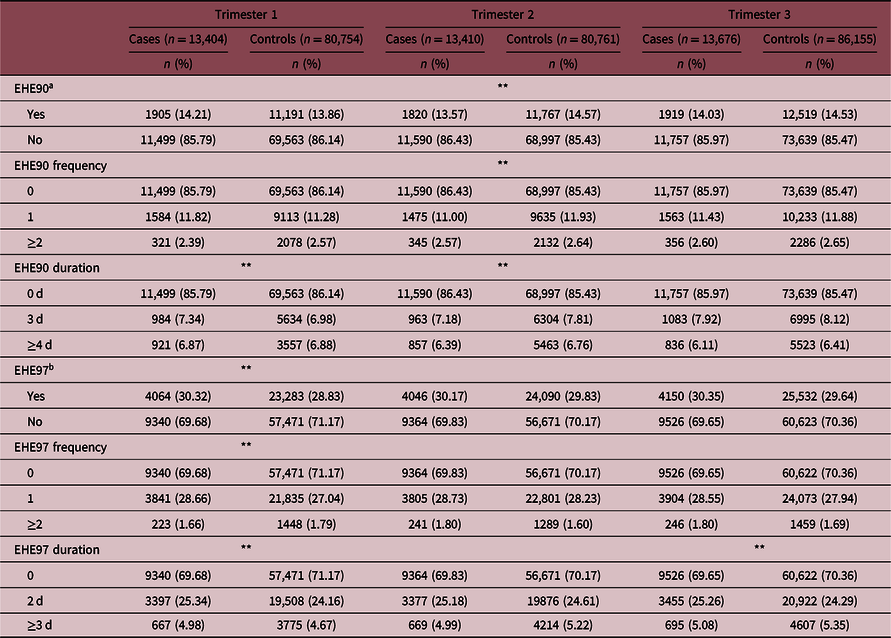
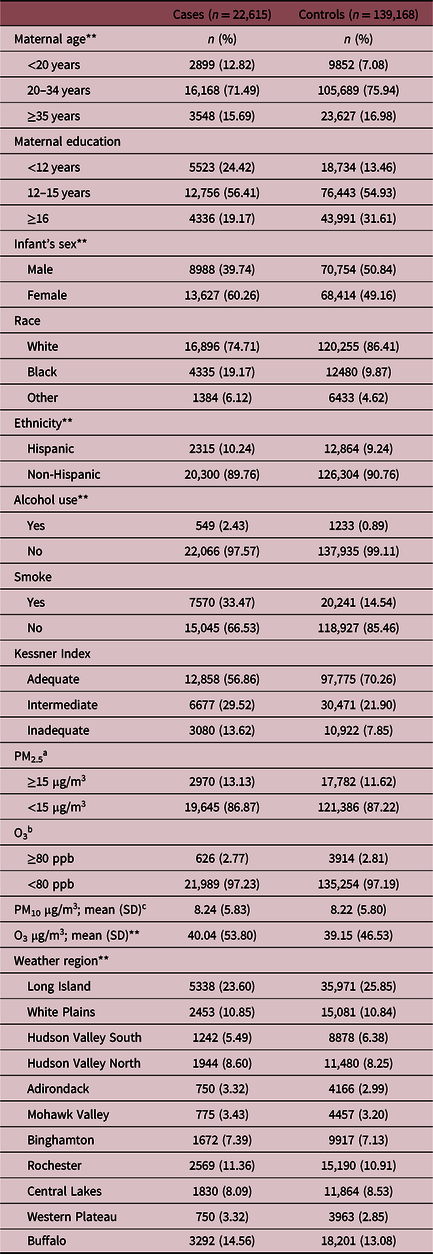
Our analyses included 22,615 cases of tLBW and 139,168 controls. We excluded observations with missing values (3.6%) and variables that are potential confounders or effect modifiers (maternal age, education, race, ethnicity, infant’s sex, maternal smoking, alcohol consumption, and adequacy of prenatal care [n = 5911]). Table 1 displays the three exposure indicators for EHE90 and EHE97 by trimester of pregnancy. We observed that, at each trimester, majority of mothers were exposed to no more than one EHE using both definitions. Table 2 presents the characteristics of participants in this study stratified by cases and controls. tLBW babies were more likely to be female, maternal ages 20–34 years, non-Hispanic, White, and receive adequate prenatal care. In addition, PM2.5 levels above 15 µg/m3 were slightly more frequent in cases than controls.
Weather-related extreme heat events distribution among mothers of term low birthweight and control babies by trimester of pregnancy in New York State, 1991–2006

Significant difference between cases and controls based on chi-square test (p ≤ 0.05).
** indicates p < 0.05
a EHE90, three consecutive days with maximum temperature 32.2 °C (90 °F) or above.
b EHE97, two consecutive days of temperature equal or above the 97th percentile of the distribution of the maximum temperature for the summer season.
Comparison of demographic characteristic between term low birthweight and controls New York State, 1991–2006

Significant difference between cases and controls based on chi-square test (p ≤ 0.05).
** indicates p < 0.05
a PM2.5, aerodynamic diameter of ≤2.5 µm.
b O3, ozone.
c SD, Standard Deviation.
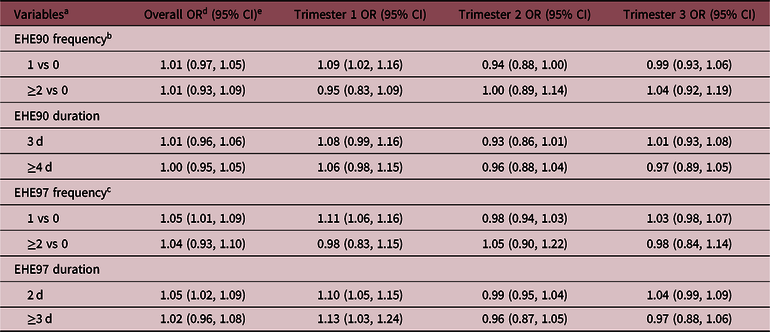
Table 3 shows the comparison of the odds of maternal exposure to EHE in frequency and duration between tLBW babies and their controls. We observed that EHE90 exposure was only associated with tLBW for exposure to only one EHE90 occurrence during the first trimester, compared with those not exposed (OR 1.09; 95% CI 1.02, 1.16). When assessing the association between EHE97, we observed only one exposure occurrence was associated with overall tLBW (OR 1.05; 95% CI 1.01, 1.09). However, the strongest association was observed for exposure during the first trimester (OR 1.11; 95% CI 1.06, 1.16). With respect to EHE duration, we did not observe any associations for EHE90, but we did observe an association for EHE97. The 2 d long EHE97 was associated with an increase in tLBW overall (OR 1.05; 95% CI 1.02, 1.09) and the first trimester (OR 1.10; 95% CI 1.05, 1.15) with the strongest association for ≥3 d in the first trimester (OR 1.13; 95% CI 1.03, 1.24). Both EHE during the second and third trimesters were not associated with tLBW.
Comparison of the odds of maternal exposure to extreme heat events in frequency and duration between term low birthweight babies and their controls in New York State, 1991–2006

a Adjusted for atmospheric pressure, relative humidity, weather region, year of birth, pm 2.5, ozone, maternal age, ethnicity, education, smoking, alcohol consumption, race, and adequacy of prenatal care.
b EHE90, three consecutive days with maximum temperature 32.2 °C (90 °F) or above.
c EHE97, two consecutive days of temperature equal or above the 97th percentile of the distribution of the maximum temperature for the summer season.
d OR, odds ratio.
e 95% CI, 95% confidence intervals.
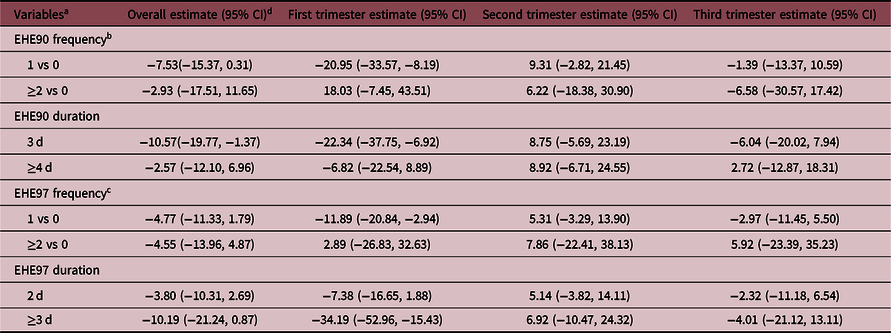
Table 4 presents the birthweight change among term babies by comparing tLBW babies with their controls in frequency and duration of maternal exposure to EHE. Occurrence of one EHE in the first trimester was associated with a decrease in mean birthweight for EHE90 (−20.95 g; 95% CI −33.57, −8.19) and EHE97 (−11.89 g; 95% CI −20.84, −2.94). EHE90 duration for 3 d was associated with overall (−10.57 g; 95% CI −19.77, −1.37) and the first trimester (−22.34 g; 95% CI −37.75, −6.92) decrease in mean birthweight. However, the strongest association was observed for EHE97 for duration ≥3 d during the first trimester (−34.19 g; 95% CI −52.96, −15.43).
Birthweight (gram) change by frequency and duration of extreme heat events on term-babies, New York State, 1991–2006

a Adjusted for atmospheric pressure, relative humidity, weather region, year of birth, pm 2.5, ozone, maternal age, ethnicity, education, smoking, alcohol consumption, race, and adequacy of prenatal care.
b EHE90, three consecutive days with maximum temperature 32.2 °C (90 °F) or above.
c EHE97, two consecutive days of temperature equal or above the 97th percentile of the distribution of the maximum temperature for the summer season.
d 95% CI, 95% confidence intervals.
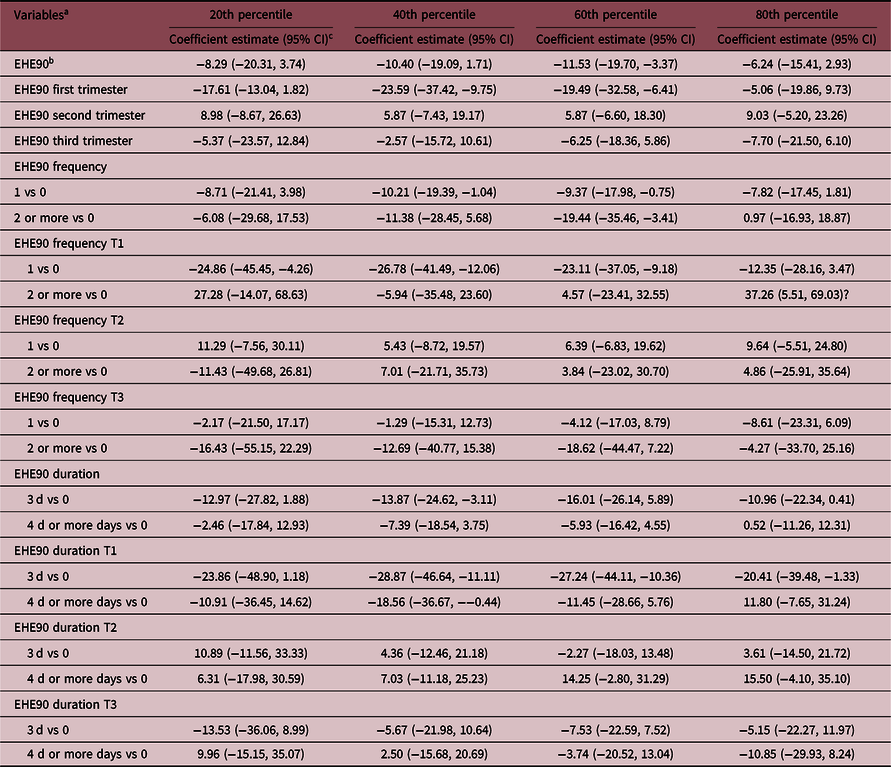
We further investigated the impact status of maternal exposure to EHE by frequency and duration had on birthweight percentile among term babies. To estimate changes in a specified percentile for birthweight, we conducted quantile regressions for both definitions of EHE. We observed ≥3 d long EHE97 exposure on overall pregnancy resulted in a decrease of 17.25 g (95% CI −52.83, −11.66) for the 60th percentile and 15.33 g (95% CI −28.72, −1.94) for the 80th percentile compared with no EHE (referent). Similarly, ≥3 d long EHE97 in the first trimester resulted in a decrease mean birthweight of 36.25 g (95% CI −58.02, −14.48) and 32.24 g (95% CI −52.83, −11.66) for the 40th and 60th percentiles, respectively (Supplemental Table 1). We then examined the influence status of exposure to EHE90 had on birthweight percentile. Table 5 presents the coefficient estimates of the quantile regression for various exposure indicators of EHE90. Occurrence of EHE90 anytime during pregnancy and in the first trimester was associated with a decrease mean birthweight for the 40th (−23.59; 95% CI −37.42, −9.75) and 60th (−19.49; 95% CI −32.58, −6.41) percentiles. EHE90 frequency was associated with a decrease in mean birthweight for the 40th (−10.21; 95% CI −19.39, −1.04) and 60th (−9.37; 95% CI −17.98, −0.75) percentiles for overall pregnancy, and the 20th (−24.86; 95% CI −45.45, −4.26), 40th (−26.78; 95% CI −41.49, −12.06), and 60th (−23.11; 95% CI −37.05, −9.18) percentiles in the first trimester of pregnancy. Similar patterns were observed for EHE90 duration for 3 d for the 40th (−28.87; 95% CI −46.64, −11.11) and 60th (−27.24; 95% CI −44.11, −10.36) percentiles.
Coefficient estimates for the association between various 90 °F temperature indicators and birthweight among term babies in New York State, 1991–2006

a Adjusted for atmospheric pressure, relative humidity, weather region, year of birth, pm 2.5, ozone, maternal age, ethnicity, education, smoking, alcohol consumption, race, and adequacy of prenatal care.
b EHE90, three consecutive days with maximum temperature 32.2 °C (90 °F) or above.
c 95% CI, 95% confidence intervals.
Discussion
In this study, we found that both frequency and duration of EHE were associated with tLBW. More specifically, our study demonstrated that compared with pregnant women not exposed to EHE97, those exposed were more likely to have a tLBW baby. In addition, we also observed that maternal exposure to EHE was negatively associated with tLBW, where magnitude of the association varied across term birthweight percentiles with the higher risks in the 40th and 60th birthweight percentiles. To date, there have been several studies that investigated the influence weather has on pregnancy outcomes, where findings reported that maternal exposure to high ambient temperatures were associated with low birthweight and preterm birth. Reference Wang, Williams, Guo, Pan and Tong12–Reference Strand, Barnett and Tong15,Reference Poeran, Birnie, Steegers and Bonsel18,Reference Lawlor, Leon, Davey Smith and Smith39 Two notable studies conducted in Brisbane and NYS assessed the influence of heatwave frequency and duration on birth defects. Wang and colleagues (2013) study in Brisbane found that the impact of heatwave on birth defects was influenced by frequency and intensity, where longer duration at higher temperatures had the strongest association, which is analogous with our results on tLBW. Reference Wang, Williams, Guo, Pan and Tong12 Similar with our findings on elevated odds during the first trimester, Van Zutphen and colleagues (2012) reported that in upstate New York, extreme summer temperature during gestation weeks 4, 6, and 7 was associated with increased susceptibility to birth defects. Reference Van Zutphen, Lin, Fletcher and Hwang13 However, no study to date examined the relationship between EHE and term birthweight.
Majority of previous literature that assessed the relationship between high ambient temperatures on birth outcomes focused exclusively on temperature, failing to account for the role duration and frequency of exposure has on birthweight, as well as exposure by trimester. In our parameter estimates for gram decrease in mean birthweight for EHE90 and EHE97, we observed an association in the first trimester, but not the second and third trimesters. Our results revealed that maternal exposure to one EHE was associated with a 20.95 and 11.89 g decrease in mean birthweight for EHE90 and EHE97, respectively. However, the greatest reduction in mean birthweight was experiencing EHE97 for more than 3 d, resulting in a 34.19 decrease in mean birthweight. Though we did not directly assess temperature, making it difficult to directly compare our findings with other studies, our results are similar with epidemiological studies evaluating the relationship between temperature and birthweight. For instance, in a Scotland study, among 12,150 infants suggested that a 1 °C increase in mean temperature during the first trimester was associated with a 5.4 g decrease in birthweight. Reference Lawlor, Leon, Davey Smith and Smith39 In an ecological study, among 140 populations worldwide suggested that increased heat stress, which is the combination of water content of the air and environmental temperature, was associated with reduced birthweight, where a 1 unit increase in perceived temperature utilizing a heat index was associated with a decrease birthweight of 2.7%. Reference Wells and Cole20 This difference in vulnerability by trimester between studies is potentially the result of different weather patterns between study populations, where temperature variation throughout the year is greater in NYS compared with Brisbane, Australia. Reference Lin, Lawrence and Lin40 In addition, we also observed that exposure to EHE90 during overall pregnancy and in the first trimester resulted in birthweight reduction for the 40th and 60th percentiles. In a similar study by Poeran and colleagues (2015) conducted in the Netherlands also reported that maximum exposure to high temperatures were associated with reduced mean birthweight in the first trimester; however, in contrast, they also observed the association remained into the second and third trimester, where we only observed in the first. Reference Poeran, Birnie, Steegers and Bonsel18 The differences between there study and ours could be the result of geographical and climatic differences, as well as differences in population adaptability. Similar findings were also observed in another study that examined seasonal variation in fetal growth. Reference Pereira, Cook, Haggar, Bower and Nassar2 The results revealed that an interquartile range increase in temperature for the entire pregnancy (0.73 °C) was associated with elevated likelihood of being small for gestational age. In addition, when examining by trimester, the greatest odds were in the first trimester, though each trimester failed to reach a statistical association. While previous studies are comparable with these findings, our analysis also revealed heterogeneity in reduced birthweight by percentile. However, the relationship by birthweight percentile remains not well known, making it arduous to compare our findings with others. Overall, our results along with these findings consistently demonstrate that birthweight is vulnerable to prenatal EHE exposure.
Although the exact biological mechanism by which EHE causes tLBW has not been widely reported, findings from animal models suggest lowered offspring birthweight caused by heat stress during pregnancy is associated with lower placental growth and decrease uterine and umbilical blood flow. Reference Wells and Cole20,Reference Wells23 Regarding our finding on the influence of EHE on tLBW being strongest in the first trimester, Wells (2002) suggested that relative heat stress during early pregnancy causes poor placental growth and subsequent intrauterine growth retardation. Reference Wells23 Prior studies have shown heat affects blood flow and cardiovascular health in humans. Reference Poeran, Birnie, Steegers and Bonsel18,Reference Huynen, Martens, Schram, Weijenberg and Kunst24 For this reason, it is plausible that the effect of heat on maternal blood flow may also influence fetal nutrition, where the adverse effects are greater during early fetal development (the first trimester) compared with later (the second and third trimester). In addition, Poeran and colleagues (2016) suggest that outdoor temperatures might influence maternal behaviors including physical activity, diet, and exposure to tobacco smoke, all which could influence birthweight. Reference Poeran, Birnie, Steegers and Bonsel18
We must note several limitations merit consideration when interpreting our findings. Although our population covered majority of the geographical region in NYS, we were unable to include NYC potentially missing the most vulnerable population. However, this concern is mitigated, in part, by our findings are similar with prior reports of high ambient temperatures on birth outcomes conducted in other countries. Reference Wang, Williams, Guo, Pan and Tong12,Reference Wells and Cole20 Information bias is another potential concern; however, both outcome and weather exposure data were obtained from objective sources, such as metrological data from the National Weather Service and birth certificates. Our estimates could potentially be biased due to residual confounding as we were unable to adjust for potential confounders, such as indoor temperature, hydration, air condition use, and outdoor time and activity patterns. In addition, we lacked information on medication use, which can potentially interfere with thermoregulation in pregnant women. We were also unable to know whether an individual was present at their residence during the time of a given EHE or their use of adaptive behaviors to avoid extreme heat exposure. Maternal residence was not linked to the closest weather monitoring station, and we did not have individual-level temperature measurements. Pregnant women were instead assigned the temperature of the climate region. Additionally, we were unable to account for occupational exposure to heat. In addition, though errors in estimated gestational age are possible, we have no reason to believe that these errors are differential between cases and control.
Our limitations are offset by notable strengths. First, to the best of our knowledge, this is one of few studies to assess maternal exposure to EHE on LBW, especially birthweight in grams and birthweight percentile. Reference Wang, Williams, Guo, Pan and Tong12,Reference Van Zutphen, Lin, Fletcher and Hwang13,Reference Poeran, Birnie, Steegers and Bonsel18 Second, we used two EHE definitions to highlight the influence EHE frequency and duration might impact birthweight and identifying differences in vulnerability. Third, we analyzed 15 years of birth certificate data consisting of a large demographically diverse population and geographical area. Fourth, we adjusted for ambient air pollutants, which exhibits temporal variation, as well as accounts for numerous maternal and sociodemographic risk factors, including pregnancy complications and exposure to smoking during pregnancy. Reference Pereira, Cook, Haggar, Bower and Nassar2 Fifth, similar studies relied on maternal recall after birth for identifying exposures to extreme weather events, potentially resulting in recall bias and misclassification due to poor memory. Reference Judge, Chasan-Taber, Gensburg, Nasca and Marshall41,Reference Suarez, Felkner and Hendricks42 However, we utilized objective measurements based on Metrologic data. Finally, this is one of few studies conducted in the U.S., particularly the northeast where the climate is cooler and residents are less accustomed to EHE. Reference Van Zutphen, Lin, Fletcher and Hwang13,Reference Luber and McGeehin43
Conclusion
Our findings suggest that maternal exposure to EHE, especially in the first trimester is associated with tLBW, where the magnitude of the association varied across birthweight percentiles. In addition, the impact of EHE on birthweight was strongly associated with EHE duration. This study recommends pregnant women to reduce EHE exposure, especially during the first trimester. As climate change is expected to result in increased frequency, longer duration, and more intense EHE, Reference Schär, Vidale and Lüthi9,Reference Meehl and Tebaldi11 future studies are needed to confirm our findings in a more representative population and improve our understanding on the biological mechanism of EHE on tLBW.
Supplementary material
To view supplementary material for this article, please visit https://doi.org/10.1017/S2040174420000392
Financial Support
This work was supported by grants from the Centers for Disease Control and Prevention (5U01EH000396-02 and 1U38EH000184-05).
Conflict of Interest
None.