The governing treaty in the Indus River Basin between India and Pakistan is now more than half a century old. There is also a growing list of damming and infrastructural development-related disputes between them. With their national plans to implement more dams and infrastructural development projects in the Basin, especially for hydropower, this paper first looks at the extent of the threat from, and disputes related to, development projects to the Basin.
When the Indus Waters TreatyFootnote 1 (also referred to as the “Treaty”) was negotiated in the 1950s, environmental standards, except those related to pollution control, largely did not exist. However, although both India and Pakistan are not Parties to the United Nations Convention for the Non-Navigational Uses of International Watercourses of 1997 [UN Watercourses Convention],Footnote 2 the Convention does reflect contemporary ideologies and practices to the extent that certain rights and obligations with regards to environmental use and protection have acquired customary international law status. Thus, in order to propose changes to the Treaty provisions which deal with damming-related development in the Indus Basin, this paper examines the UN Watercourses Convention with regard to: (1) the riparian states’ substantive rights and obligations in the use of transboundary waters; (2) their procedural obligations in relation to planned projects; and (3) their general obligation to protect, preserve, and manage the international watercourses. The analysis of the Indus Waters Treaty against the provisions of the UN Watercourses Convention helps to ascertain the gaps in the Treaty’s provisions.
Finally, the paper proposes the necessary changes so that the Treaty’s relevant provisions can be brought in line with current international water law standards. In order to achieve this, and to supplement the above analysis with a practical example, the paper also looks at the European regional framework. This framework deals with Member States’ obligations with practical aspects regarding: (1) conducting environmental impact assessments of planned projects at all stages of the projects; and (2) regular cyclic assessments, monitoring, and reporting on the environmental status of the basin. It is to be noted that, even though it is a framework of regional application, the fulfilment of the obligations is undertaken at the Basin level by the relevant Basin institutions, such as the International Commission for the Protection of the Rhine and the Danube Commission. This is because, under the framework directive, rivers are seen as the focal point for freshwater governance.
Thus, this paper proposes a shift away from the current approach of purely water resources allocation under the Indus Waters Treaty, to taking into account environmental considerations when utilizing shared water resources by improving the exiting framework through: (1) conducting environmental impact assessments prior to, during, and post the implementation of development projects; and (2) undertaking regular monitoring, assessment, and reporting through joint and comprehensive river basin management plans.
I. DAMMING AND INFRASTRUCTURAL DEVELOPMENT IN THE INDUS RIVER BASIN
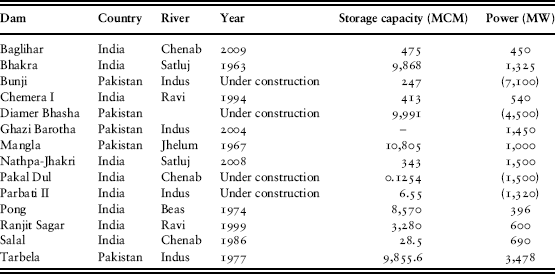
The Indus River Basin development comprises a number of dams, diversion structures, and canals, including the nineteenth-century Indus Basin Irrigation System [IBIS]. The IBIS, which is still the largest contiguous irrigation system in the world, constitutes an extensive system of diversion structures and canals on the Indus Basin, with a total length of 56,000 kilometres.Footnote 3 In the 1960s, in order to replace the irrigation water supplies from tributaries allocated to India under the Indus Waters Treaty,Footnote 4 Pakistan constructed two major dams: the Mangla and the Tarbela (the largest dams in the Basin).Footnote 5 These formed part of a wider set of infrastructural projects to further develop the IBIS.Footnote 6 Table 1 lists the major dams and reservoirs in the Basin.Footnote 7
Major dams and reservoirs in the Indus River Basin

The combined effects of the existing storage and diversion projects have already had serious impacts on the Indus Delta in Pakistan. According to a study by the International Union for Conservation of Nature and Natural Resources, the flow in the lower Indus River decreased from 105,000 million cubic metres [MCM] in 1932 to 43,000 MCM in 1970 as a result of the number of projects on the Indus.Footnote 8 In the 1990s, the flow further reduced to 12,300 MCM.Footnote 9 This led to a sharp reduction in the area of mangrove forests (thirty-eight percent), declining fish production (seventy percent), degraded water quality, and severe encroachment of the sea into the delta area by 64 kilometres [km] inland. The result was loss of 4,856 km2 of farmland.Footnote 10
From both existing projects and those under way, there is already an inventory of damming and infrastructural development-related disputes between India and Pakistan, including, but not limited to, the Salal Dam dispute (1968), the Tulbul Navigation Project (1984), the Baglihar Hydroelectric Project (2005), the Kishenganga Hydro-Electric Project (2010), and the Ratle Hydroelectric Project (2013). All of these disputes concern reduced flows into Pakistan due to India’s development of the Indus waters upstream. The Salal Dam dispute was resolved through state-level talks resulting in the Salal Agreement.Footnote 11 The Baglihar Hydroelectric Project matter was resolved by a Neutral Expert, who ruled on 12 February 2007.Footnote 12 The Kishenganga Arbitration was dealt with by the Permanent Court of Arbitration [PCA] in 2013.Footnote 13 However, recently, state-level talks between India and Pakistan regarding the design of the Ratle and the Kishenganga Hydro-Electric Projects have failed, and requests by India and Pakistan to the World Bank for appointments of a Neutral Expert and the Chairman of the Court of Arbitration, respectively, have been “paused” to allow the countries time to consider alternative ways to resolve their disagreements.Footnote 14
Despite evidence that such development is not environmentally sustainable for the Basin, and with disputes still pending, more large-scale damming and hydroelectric projects can still be expected in the future. Pakistan’s “Vision 2025” programme for the Indus Basin promises to develop eighty billion cubic metres of additional water storage and add 37,770 megawatts [MW] of hydropower generation capacity.Footnote 15 This programme has been evaluated for lack of environmental considerations, and significant problems with baseline data, as well as environmental and social impacts from primary cumulative impacts from disruptions to environmental flows.Footnote 16 To cure these, the programme has recommended, among other things, a national environmental flows framework and policy for a basin-wide integrated approach to water resources development rather than a project-by-project approach.Footnote 17 Despite such flaws (and difficulty arranging finance), Pakistan recently announced that the construction of the Diamer Bhasha Dam (its largest hydropower project) will go ahead.Footnote 18 India also has two large dams under construction, Pakal Dul and Parbati II, both of which are for hydroelectric generation. Against the potential capacity of 33,832 MW on the Indus, so far India has developed 10,779 MW, with construction of another 4,581 MW in progress, leaving a balance of 18,472 MW, or 54.60 percent of the total.Footnote 19 As illustrated from India’s Environmental Impact Assessment [EIA] report to the PCA in the Kishenganga Arbitration,Footnote 20 it also lacks consideration of environmental impacts in its project plans. Additional damming and infrastructural development by both India and Pakistan will only reduce flows in the Indus Basin and add to the list of pending disputes between them unless their right to develop the Indus waters start taking environmental considerations into account.
II. INDUS WATERS TREATY
The Indus Waters Treaty of 1960Footnote 21 is the only water-sharing agreement in the Basin. The objective of the Treaty is that both India and Pakistan, “being equally desirous of attaining the most complete and satisfactory utilization” of the Indus waters, recognized the need for “fixing and delimiting, in a spirit of goodwill and friendship, the rights and obligations of each in relation to the other concerning the use of these waters”.Footnote 22 Against this, taking into account problems such as increasing demands and pollution,Footnote 23 the UN Watercourses Convention was formulated with the idea that a framework convention will ensure “the utilization, development, conservation, management and protection of international watercourses and the promotion of the optimal and sustainable utilization thereof for present and future generations”.Footnote 24 By comparison, the Indus Waters Treaty is purely a water allocation agreement, which only deals with matters ancillary to it, without any regard to sustainability. The following spells out the Parties’ substantive rights and obligations as well as procedural obligations with regard to their right to develop the river’s waters under the Treaty. It also gives an overview of the mechanisms for dispute resolution, as well as management of the threats from damming and infrastructural development through monitoring, assessment, and reporting, which are each covered in turn.
A. Substantive Rights and Obligations
One of the fundamental rights provided for under the UN Watercourses Convention is that it provides for the right to equitable (and reasonable) utilization.Footnote 25 In this regard, the Indus Waters Treaty is said to be both complex and unique in its basic approach of segregating and allocating the Basin according to the geography of the tributariesFootnote 26 by dividing the watershed between its three Eastern Rivers and three Western Rivers. The Treaty provides that: “All the waters of the Eastern Rivers [The Sutlej, The Beas, and The Ravi] shall be available for the unrestricted use of India”,Footnote 27 and that: “Pakistan shall receive for unrestricted use all those waters of the Western Rivers [The Indus, The Jhelum, and The Chenab]”.Footnote 28 The exclusive use of the waters of the river system so far as it is located within India and Pakistan was granted in accordance with historic and planned use (for Pakistan)Footnote 29 and the actual location of the waters of the river. This is irrespective of whether the river flowed within the territory of one or the other. The allocations have been described as a “simple solution” by apportioning the three Eastern and Western Rivers equally;Footnote 30 the “usufructuary entitlements” were based upon physical location and not volumetric quantity;Footnote 31 and in juridical terms, it is the nature of the entitlement that is significant, namely, an entitlement to the exclusive use of waters in a specified location.Footnote 32 While Pakistan got seventy-nine percent of the total net volume of the waters, India’s share equalled the balance of twenty-one percent.Footnote 33 These allocations, however, are not absolute, as both Parties have been allowed certain uses in the rivers allocated to the other, subject to certain qualifications.
The Treaty obliges Pakistan to let flow, and not permit any “interference with the waters”,Footnote 34 except for domestic use,Footnote 35 non-consumptive use,Footnote 36 and agricultural use.Footnote 37 India is also under an obligation to let flow, and not to permit any interference with these waters, except for: domestic use, non-consumptive use, agricultural use, generation of hydroelectric power through “run-of-river plant”, and storage of water.Footnote 38 These exceptional uses are detailed in separate Annexures to the Treaty. Annexure B deals with agricultural use by Pakistan from certain tributaries of the Ravi River, which has been allocated to India, while Annexure C deals with agricultural use by India from the Western Rivers allocated to Pakistan. In addition, Annexure D deals with generation of hydroelectric power by India from the Western Rivers, while Annexure E deals with storage of water by India on the Western Rivers.Footnote 39
Thus, the principle of equitable utilization, as determined by the Parties, is reflected in both the equitable allocation of the Indus tributaries and the fact that either Party can equitably use rivers allocated to the other Party for domestic, non-consumptive, and agricultural use.Footnote 40 That the Treaty actually effected the equitable apportionment of the Indus waters is a conclusion that has been reached by many commentators.Footnote 41 While equitable use has been achieved by the Treaty, it has not qualified that use by obliging both Parties to use it reasonably or sustainably.
In terms of the generation of hydroelectric power, Pakistan, by way of concession, has allowed India to construct Run-of-River PlantsFootnote 42 on its Western Rivers, but in conformity with the specified criteria.Footnote 43 India has also been permitted to construct storage worksFootnote 44 with a total maximum storage capacity of 3.6 million acre feet [MAF] (0.4 on the Indus, 1.5 on the Jhelum, and 1.7 on the Chenab) for general, power, and flood storage.Footnote 45 Apart from these specifications, the Treaty generally provides that:Footnote 46
Each Party will use its best endeavours to maintain the natural channels of the Rivers … in such condition as will avoid, as far as practicable, any obstruction to the flow in these channels likely to cause material damage to the other Party.
While both Parties are entitled to construct on their own allocated rivers, in order to decipher what the above-stated provision means, according to the PCA, it has to be interpreted in the light of current international standards. “Best endeavours” is not defined, but the PCA has indicated that the phrase “expresses a stronger commitment” to merely being “aspirational in nature”Footnote 47 and thus the requirement that the parties will use their best endeavours is obligatory. For this reason, it is comparable to the substantive principle of no significant harm.
The obligation to not cause significant harm is the other fundamental principle upon which the UN Watercourses Convention is based. Since the early twentieth century, the concept of avoiding activities that may cause injury to a Basin state whilst utilizing the common waters had been present in international law under the aegis of the Institute of International Law.Footnote 48 However, the “no significant harm” principle under the UN Watercourses Convention puts watercourse states under an obligation to, “in utilizing an international watercourse in their territories, take all appropriate measures to prevent the causing of significant harm to other watercourse States”.Footnote 49 It relates to the right to an equitable and reasonable use by requiring that water use by one watercourse state does not significantly harm the allocation and use of the common waters by other watercourse states.Footnote 50 The main qualifier in this rule is the term “significant”, and it is not just harm to an international watercourse, but it must extend to other watercourse state(s). “Significant harm” has not been defined under the Convention, but means “non-trivial harm capable of being established by objective evidence without necessarily rising to the level of being substantial”.Footnote 51 The notion of significant harm “[i]s not a fixed one and ha[s] to be assessed according to the circumstances of each case”.Footnote 52 The aim of the provision is to avoid significant harm as far as possible, but at the same time to achieve a result that gives due regard to the principle of equitable and reasonable use.Footnote 53 Hence equity seeks to create a balance between optimal use and significant harm where competing interests are at stake.Footnote 54 According to the International Law Commission (the drafter of the Convention), this balance requires watercourse states to exercise due diligence when utilizing the waters of international watercourses so as to not cause significant harm.Footnote 55 “Due diligence” has been defined to mean “a diligence proportioned to the magnitude of the subject and to the dignity and strength of the power which is to exercise it [and] such care as governments ordinarily employ in their domestic concerns”.Footnote 56 It is an obligation of conductFootnote 57 rather than an absolute obligation as to result.Footnote 58 Hence a watercourse state whose use causes significant harm can be deemed to have conducted itself in such manner as to have breached its obligation to exercise due diligence, but only when it has “intentionally or negligently caused the event which had to be prevented or has intentionally or negligently not prevented others in its territory from causing that event or has abstained from abating it”.Footnote 59 Not only should watercourse states not allow transboundary harm but, according to the International Court of Justice [ICJ], “the principle of prevention, as a customary rule, has its origins in the due diligence that is required of a State in its territory”.Footnote 60 It is “the obligation of every [S]tate not to allow its territory to be used for acts contrary to the rights of other [S]tates”.Footnote 61 The ICJ has gone even further than the precautionary principle by iterating that “vigilance and prevention are required on account of the often irreversible character of damage to the environment and of the limitations inherent in the very mechanism of reparation”.Footnote 62 To this end, the UN Watercourses Convention provides that: “Where significant harm nevertheless is caused to another watercourse State, the States whose use causes such harm shall … take all appropriate measures … to eliminate or mitigate such harm”, having due regard to the principle of equitable and reasonable use.Footnote 63 Thus, whilst the obligation to not cause significant harm is subordinate to the principle of equitable and reasonable utilization under international law, it is fundamental to have consideration of one state’s obligation to another in the use of its share of transboundary waters.
As for the obligation “to maintain the natural channels”, the PCA has distinguished the “maintenance of the physical condition of the channels of the rivers [from] maintenance of the volume and timing of the flow of water in these channels”.Footnote 64 The term “channel” was taken to “denote the bed of the river, which may or may not be filled with water”.Footnote 65 In other words, this provision mandates preservation of the natural paths of the rivers in an effort to conserve the rivers’ capacity to carry water,Footnote 66 but does not extend to minimum environmental flows, especially that which India has to maintain upstream of Pakistan. The PCA further clarifies that Article IV(6) does not require the maintenance of the condition of the channels so as to avoid any type of river bed degradation, but bears more precisely on the avoidance of any obstruction to the flow in these channels likely to cause material damage to the other Party.Footnote 67 The term “material damage” is not defined, and rightly so as, according to Gulhati, “what might be material under one set of circumstances might not be so in a different set of conditions”.Footnote 68
One principle that has frequently been invoked is that “there should be nothing in the [T]reaty which would stand in the way of optimum utilisation of the water resources allocated to either party”.Footnote 69 Added to this is that “nothing could be included in the Treaty which was against good and sound engineering practice”.Footnote 70 This is in line with how the PCA has interpreted the overall provision:Footnote 71
The general obligation upon both India and Pakistan covering all uses of the Western and the Eastern Rivers under Article IV(6) must yield to the specific Treaty rights of the Parties. The Court cannot accept that Article IV(6) debars the construction and operation of works specifically contemplated by the Treaty.
In other words, the provision has been interpreted to confer the right to develop the Indus waters to achieve optimum utilization, but the phrase “likely to cause”—indicating that the Parties must take a precautionary approach to such development (as contended by Pakistan)—was ignored in the Kishenganga Arbitration.Footnote 72
B. Obligation to Protect, Preserve, and Manage
Part IV of the UN Watercourses Convention, which covers the protection, preservation, and management of international watercourses, provides that the watercourse states: (1) “shall … protect and preserve the ecosystems of international watercourses”;Footnote 73 (2) “shall … take all measures … that are necessary to protect and preserve the marine environment, including estuaries”;Footnote 74 and (3) “shall … respond to needs or opportunities for regulation of the flow of the waters of an international watercourse”. “Regulation” means “the use of hydraulic works or any other continuing measure to alter, vary, or otherwise control the flow of the waters of an international watercourse”.Footnote 75 It does not, however, oblige watercourse states to conduct regular environmental impact assessments of planned measures on the hydrological regimes, although this can be read into the general obligation to protect, preserve, and manage watercourses. It is noted that, apart from the maintenance of the natural channelsFootnote 76 (and pollution controlFootnote 77 ), the Indus Waters Treaty does not have any other provisions on environmental protection, preservation, or management of the Basin. This is not surprising, given that there is no evidence that environmental considerations were taken into account during negotiations preceding the Indus Waters Treaty.Footnote 78
C. Specific Procedural Obligations
The Indus Waters Treaty provides that if either Party plans to construct any engineering works which would cause interference with the waters of any of the rivers, and which, in its opinion, would affect the other Party materially, it is under an obligation to notify the other Party of its plans and supply such data relating to the work as may be available and as would enable the other Party to inform itself of the “nature, magnitude and effect” of the work.Footnote 79 Additionally, if a work would cause interference with the waters of any of the rivers, but would not, in the opinion of the Party planning it, affect the other Party materially, then the Treaty provides that the Party planning the work is under an obligation to supply the other Party, only if requested by it, with such data regarding the nature, magnitude, and effect, if any, of the work as may be available.Footnote 80 Thus, for new infrastructural developments, the only consideration is whether there would be any interference with the waters which would affect the other Party materially. This provision comes with a total disregard for the impact of any engineering works on ecological flows in the Basin, and only becomes a factor for consideration if any impact would affect the other Party in a material sense.
In addition to the substantive rights pertaining to equitable use and no significant harm, Part III of the UN Watercourses Convention covers procedural obligations relating to “planned measures” in international watercourses. In the Pulp Mills case,Footnote 81 in acknowledging the “functional link” between procedural and substantive obligations intended to ensure the equitable and sustainable management of a shared natural resource, the ICJ went some way towards clarifying the respective roles of the interrelated hierarchy of substantive and procedural rules commonly found in treaty regimes and, by implication, in general international law.Footnote 82 The generality of the principle of equitable and reasonable utilization, and the due diligence nature for the prevention of transboundary harm, require that they must be made normatively operational by means of a number of procedural requirements,Footnote 83 spread over nine Articles under the Convention (which are specific to planned measures and are intended to codify customary international law). Although “planned measures” has not been defined under the UN Watercourses Convention, they refer to new projects or programmes of a major or minor nature, as well as changes in existing uses of an international watercourse.Footnote 84 Put simply, they act as a means to bring about development for the optimal utilization of international rivers, but subject to the principle of sustainable development, a concept which is missing under the Indus Waters Treaty.
The ICJ in the Gabčíkovo-Nagymaros case, stated that: “[I]n order to evaluate the environmental risks, current standards must be taken into consideration.”Footnote 85 The Court explained that:Footnote 86
Throughout the ages, mankind has, for economic and other reasons, constantly interfered with nature. In the past, this was often done without consideration of the effects upon the environment. Owing to new scientific insights and to a growing awareness of the risks for mankind—for present and future generations—of pursuit of such interventions at an unconsidered and unabated pace, new norms and standards have been developed, set forth in a great number of instruments during the last two decades. Such new norms [relating to protection of the environment] have to be taken into consideration, and such new standards given proper weight, not only when States contemplate new activities but also when continuing with activities begun in the past. This need to reconcile economic development with protection of the environment is aptly expressed in the concept of sustainable development.
Thus, the ICJ in this case endorsed the concept of sustainable development, which played the role of reconciling the competing interests of Hungary and Slovakia, namely economic development with protection of the environment,Footnote 87 both of which have customary environmental law status.Footnote 88 Although it held that: “The awareness of the vulnerability of the environment and the recognition that environmental risks have to be assessed on a continuous basis has become much stronger in the years”,Footnote 89 it refrained, in this instance, from explicitly referring to the requirement for EIAs.Footnote 90
D. Environmental Impact Assessments?
The Indus Waters Treaty is specific in its provisions regarding upstream development (by India in all the six tributaries of the Indus Basin and by Pakistan on its Western Rivers), and provides for prior notification of planned measures. It does not, however, require that an EIA report be included, although the notice has to provide details about “the nature, magnitude and effect” of the work. As already stated above, any impact assessment undertaken is not directed towards the environment per se, but the harm any work may cause to the other Party.
In addition to the general obligation to regularly exchange data and information,Footnote 91 for any planned measure, it is a requirement under the UN Watercourses Convention that watercourse states “exchange information and consult each other and, if necessary, negotiate on the possible effects of planned measures on the condition of an international watercourse”Footnote 92 (emphasis added). “Possible effects” include all potential effects of planned measures, be it adverse or beneficial.Footnote 93 Thus, they are unconditional, irrespective of the actual effects of the planned measures, and the obligation is intended to avoid problems inherent in a unilateral assessment.Footnote 94 However, as per international environmental law, it is established that the obligation to inform is separate from the obligation to notify.Footnote 95
The UN Watercourses Convention provides that before a watercourse state implements or permits the implementation of planned measures which “may have a significant adverse effect upon other watercourse States”, it is under an obligation to provide those states with notification thereof.Footnote 96 The use of the term “may” means that the notifying state does not have to be sure that the significant adverse effect will in fact occur. “Significant adverse effect” is a lower threshold to “significant (or serious) harm”,Footnote 97 and was introduced in order to require notification even before legally significant harm might occur.Footnote 98 Also note that the requirement is that the significant adverse effect has to be upon other watercourse states, and not to their environment. In other words, it has to possibly infringe their substantive right to equitable and reasonable use. Where a significant adverse effect might occur, the UN Watercourses Convention requires that notification has to include available technical data and information, including the results of any EIA.Footnote 99 Thus, the UN Watercourses Convention has, in very certain terms, made it optional for watercourse states to undertake an EIA before a planned project is implemented.
Although the ICJ refrained from mentioning EIA in the Gabčíkovo-Nagymaros case, in the Pulp Mills case it endorsed the obligation to conduct EIAs as a “requirement under general international law … where there is a risk that the proposed industrial activity may have a significant adverse impact in a transboundary context, in particular, on a shared resource”, and which “must be conducted prior to the implementation of a project”.Footnote 100 The applicability of the concept of sustainable development as it translates to large-scale planned projects was further expounded by the PCA in the Kishenganga Arbitration in the following terms:Footnote 101
Applied to large-scale construction projects, the principle of sustainable development translates, as the International Court of Justice recently put it in Pulp Mills, into “a requirement under general international law to undertake an environmental impact assessment where there is a risk that the proposed industrial activity may have a significant adverse impact in a transboundary context, in particular, on a shared resource.” The International Court of Justice affirmed that “due diligence, and the duty of vigilance and prevention which it implies, would not be considered to have been exercised, if a party planning works liable to affect the regime of the river or the quality of its waters did not undertake an environmental impact assessment on the potential effects of such works.” … Finally, the International Court of Justice emphasized that such duties of due diligence, vigilance and prevention continue “once operations have started and, where necessary, throughout the life of the project.”
The PCA thereby linked the principle of sustainable development with the duty to undertake an EIA not only prior to undertaking a project where there is a risk of significant adverse impact to the quantity or quality of the international river waters from large-scale planned projects, but also with the ongoing duty to undertake EIAs where the potential for such risks continue to exist. Thus, not undertaking an impact assessment on the environment is no longer an option, and a report must accompany notification. However, given that EIAs are optional under the UN Watercourses Convention, content prescriptions regarding EIAs are also absent from its text.
In the Pulp Mills case, the ICJ observed that general international law does not specify the scope and content of an EIA,Footnote 102 and clarified that it “is for each State to determine in its domestic legislation or in the authorization process for the project”, depending on “the nature and magnitude of the proposed development and its likely adverse impact on the environment”.Footnote 103 It also emphasized “the need to exercise due diligence in conducting such an assessment”.Footnote 104 The ICJ further added that, in order to ensure the meaningful and effective application of international environmental rules to planned measures, states should understand that the duty to notify comprises two stages: (1) initial notification as soon as a plan is received and there is an intention to proceed with the works; and (2) subsequent detailed notification on the basis of an EIA study.Footnote 105 The Court added that “notification is intended to enable the notified party to participate in the process of ensuring that the assessment is complete, so that it can then consider the plan and its effects with a full knowledge of the facts”.Footnote 106 Thus, the duty to notify, and the related duty to conduct an EIA, exist in customary international law and, as confirmed by the ICJ, apply to all states, not just those that have concluded international agreements containing such obligations.Footnote 107
In order to set a minimum flow downstream from the Kishenganga Hydro-Electric Project, the PCA in the Kishenganga Arbitration had requested that both India and Pakistan provide an EIA report of the project on the environment, even though it is not required under the Indus Waters Treaty. The Court noted that “assessments of this nature are increasingly used by scientists and policymakers to bring a deeper understanding of ecology to bear on the management and development of river systems”.Footnote 108 The Court further commented that:Footnote 109
there is no single “correct” approach to such environmental assessments. For any given river or project, the correct approach will depend upon the existing state of the river, the magnitude of anticipated changes, the importance of the proposed project, and the availability of time, funding, and local expertise … For some situations, a simple assessment may indeed be preferred … [but] … for a project of the magnitude of the KHEP, the Court is of the view that an in-depth assessment … is a more appropriate tool for estimating potential changes in the downstream environment.
The PCA clarified that what it was looking for was a “degree of certainty” as to the “results”, and not any “attempt to apply contemporary international practices in a challenging setting”.Footnote 110 Although the PCA worked with the impact assessment reports that had been submitted by both Parties, it emphasized that “more comprehensive and accurate information on the likely impacts of infrastructure projects can only benefit decision-making in both Pakistan and India”.Footnote 111 Hence, the Court urged both Parties to “continue or expand their attention to environmental considerations at other projects”—an approach seen as “consistent with the acute need of both Parties for increased production of hydro-power”.Footnote 112 As is apparent from the Kishenganga Arbitration, guidance as to what information ought to be included in the EIA would be beneficial in addressing the pending disputes and monitoring the environmental impacts of already implemented projects. The European regional framework is helpful in this regard.
The UN Watercourses Convention’s counterpart, the United Nations Economic Commission for Europe’s Convention on the Protection and Use of Transboundary Watercourses and International Lakes [UNECE Water Convention],Footnote 113 deals with the topic of damming and infrastructural development in terms of transboundary impact.Footnote 114 In matters of assessing transboundary impact, it obliges all Parties to develop, adopt, implement, and, as far as possible, render compatible relevant legal, administrative, economic, financial, and technical measures, to ensure that EIAs (and other means of assessments)Footnote 115 are applied, and sustainable water-resources management, including the ecosystems approach, is also promoted.Footnote 116 Riparian Parties are also obliged to participate in the implementation of EIAs,Footnote 117 whereby specific reference has been made to the provisions of the Espoo (EIA) Convention.Footnote 118
The Espoo (EIA) ConventionFootnote 119 obliges its Parties to “take all appropriate and effective measures to prevent, reduce and control significant adverse transboundary environmental impact from proposed activities”.Footnote 120 This is “any activity or any major change to an activity”,Footnote 121 and includes “large dams and reservoirs”.Footnote 122 The general guidance for the identifying criteria to determine “significant adverse impact” is also prescribed.Footnote 123
In terms of EIAs, the Espoo (EIA) Convention obliges the Party of origin to undertake an EIA prior to a decision to authorize or undertake a proposed activity, and to notify affected Parties.Footnote 124 The Convention requires that, as a minimum, notification has to include:Footnote 125 (1) information on the proposed activity, including any available information on its possible transboundary impact; (2) the nature of the possible decision; and (3) an indication of a reasonable time within which a response is required, taking into account the nature of the proposed activity. The Convention encourages that EIAs, as a minimum requirement, be undertaken at the project level of the proposed activity.Footnote 126 It also prescribes the minimum information that an EIA documentation has to contain.Footnote 127 The Convention provides that, before a final decision on the proposed activity, due account is to be taken of the outcome of the EIA, including the EIA documentation, any comments received, and the outcome of the consultations.Footnote 128 In addition, the Convention also provides for post-project analysis if one is warranted.Footnote 129
In the context of the Espoo (EIA) Convention, the SEA ProtocolFootnote 130 was adopted, with the objective “to provide for a high level of protection of the environment”.Footnote 131 A Strategic Environmental Assessment [SEA], which means “the evaluation of the likely environmental … effects”Footnote 132 is undertaken for official draft plans and programmes, and any modifications to them, which are likely to have significant environmental effects.Footnote 133 An SEA is mandatory for plans and programmes which are prepared for water management, and this includes “large dams and reservoirs”.Footnote 134 The resulting environmental reportFootnote 135 has to identify, describe, and evaluate the likely significant environmental effects of implementing the plan or programme and its reasonable alternatives.Footnote 136 The basic difference between SEAs and EIAs are that SEAs are undertaken much earlier in the decision-making process than EIAs, offer a broader range of alternatives for consideration rather than as mitigating factors, and provide for greater opportunity to achieve environmental objectives.Footnote 137 Thus, SEAs are seen as a key tool for sustainable development.Footnote 138
While the UNECE Water Convention deals with projects with potential to cause significant adverse impacts on transboundary waters, the Espoo (EIA) Convention and its related Protocol primarily focus on EIAs of projects, not just prior to notification and during/post-implementation of such projects but also during the planning stage, well before the project plan is adopted. These ensure that transboundary consultations are based on prescribed impact assessment reports and explore not only alternatives to projects but also ways to mitigate and eliminate impacts.
E. Obligation to Consult and Negotiate
Under the Indus Waters Treaty, once notification including an EIA report (if one is available) is sent, the matter is then handled by the governing body for the Indus River Basin: the Permanent Indus Commission.Footnote 139 The general role of the Commission is to implement the Indus Waters Treaty and to promote co-operation between the Parties in the development of the Basin waters.Footnote 140 To this end, the Commission serves as a “regular channel of communication” and is under an obligation to: (1) furnish or exchange information or data; and (2) give any notice or response to any notice,Footnote 141 as well as to resolve any “questions” concerning the application or interpretation of the Treaty or the existence of any fact.Footnote 142 Hence, all notifications, consultations, and negotiations regarding damming and infrastructural development are undertaken through the Commission (at least initially).
The UN Watercourses Convention provides that watercourse states are under an obligation to consult and, if necessary, negotiate in “good faith”, paying “reasonable regard to the rights and legitimate interests of the other State” with a view to arriving at an “equitable resolution”.Footnote 143
To this end, the ICJ in the Pulp Mills case drew attention to the characteristics of the obligation to negotiate, and to the conduct which this imposes on the states concerned.Footnote 144 It highlighted the importance of co-operation, which is dictated by the principle of good faith. The Court recalled that, in the cases concerning Nuclear Tests (Australia v. France), “One of the basic principles governing the creation and performance of legal obligations, whatever their source, is the principle of good faith. Trust and confidence are inherent in international co-operation”,Footnote 145 and in the North Sea Continental Shelf case that “[the Parties] are under an obligation so to conduct themselves that the negotiations are meaningful”.Footnote 146 Although the Court recalled that “an obligation to negotiate does not imply an obligation to reach an agreement”,Footnote 147 it added that:Footnote 148
There would be no point to the co-operation mechanism provided for by [the provision concerned] if the party initiating the planned activity were to authorize or implement it without waiting for that mechanism to be brought to a conclusion. Indeed, if that were the case, the consultations and negotiations between the parties would no longer have any purpose.
In addition to this, the ICJ in the Gabčíkovo-Nagymaros case held that, during consultation, it is a duty of both Parties to take into account “newly developed norms of environmental law” by agreement, which “requires a mutual willingness to discuss in good faith actual and potential environmental risks”.Footnote 149 The ICJ attached great significance to respect for the environment: “the environment is not an abstraction but represents the living space, the quality of life and the very health of human beings, including generations unborn.”Footnote 150 Thus, absent specific obligations of performance, the ICJ qualified the relevant Articles of the Treaty concerned as “evolving provisions” based on “emerging norms of international law”.Footnote 151 A similar view was echoed about the Indus Waters Treaty provisions by the PCA in the Kishenganga Arbitration.
F. Dispute Resolution Mechanisms
The principle of good faith in international law requires watercourse states to co-operate and find an equitable resolution. However, where watercourse states are not able to come to an agreement, the UN Watercourses Convention prescribes a framework for dispute settlement via peaceful means. This includes:Footnote 152 negotiation, mediation, conciliation by a third party, arbitration, settlement through the ICJ, or an impartial fact-finding commission.Footnote 153 Almost all the water disputes between India and Pakistan are over construction projects.Footnote 154 These have either been or are being dealt with in all the avenues provided for under the Treaty, depending on the nature of the dispute: questions before the Permanent Indus Commission or through state-level talks, differences by a Neutral Expert, or disputes through the Permanent Court of Arbitration.Footnote 155 All of these procedures are designed to achieve resolution before construction of a project commences.Footnote 156
I. “Questions” before the Permanent Indus Commission
Although there have been a number of “questions” which have come before the Permanent Indus Commission, which do not get published other than those reported through the media, any question that does not get resolved by the Commission has to be dealt with directly by the two governments through diplomatic channels.
2. “State-level talks”
The following are two prominent damming and infrastructural-related disputes; the Salal Dam and the Tulbul Navigation Project, which have been dealt with over at least two decades.
(a) Salal Dam Dispute 1968
The Salal Dam, a run-of-river hydroelectric project by India on the Chenab River, was the first challenge to the Indus Waters Treaty. Under the terms of the Treaty, India submitted its plan to the Permanent Indus Commission for Pakistan’s approval in 1968.Footnote 157 Pakistan objected to the design and storage capacity of the Salal project.Footnote 158 Negotiations at state level led to the Salal Agreement, signed on 12 April 1978 in Delhi,Footnote 159 under which India agreed to make some changes in the design of the dam, including reducing the height of the dam and the permanent closure of the diversion canal after the hydroelectric plant had been commissioned.Footnote 160 The concessions made by India were hailed under the banner of “beneficial bilateralism” in both countries.Footnote 161
(b) Tulbul Navigation Project 1984
The Tulbul Navigation Project, which Pakistan calls the Wullar Barrage, was started by India in 1984 on the Jhelum River, which is at the mouth of Wullar Lake in the Indian Part of Kashmir.Footnote 162 While India contended that the project would make the lake navigable in summer, Pakistan objected to its construction, contending that it would allow India to control the flow of the river and could thus be used as a geo-strategic weapon.Footnote 163 Pakistan’s precondition to entering any talks regarding this project was suspension of the works, which India did on 2 October 1987.Footnote 164 Since then, ten rounds of state-level talks have been held, with the last one in 2012. In a joint statement, “it was agreed that the Indian side will provide additional technical data to Pakistan … Both sides further agreed that, if required, they will explore the way forward for resolving the issue under the provisions of the Treaty”,Footnote 165 which would have to be through a Court of Arbitration, having constituted a “dispute”.
3. Differences before a Neutral Expert
This avenue for dispute resolution has been employed by the Parties only once thus far. It concerned the Baglihar Hydropower Project dispute.
(a) Baglihar Hydropower Project 2005
On 15 January 2005, Pakistan asked the World Bank to appoint a Neutral Expert, stating that a “difference” had arisen between India and Pakistan under Article IX(2) of the Indus Waters Treaty in relation to the Baglihar Project. Prior to this, no dispute had gone to a Neutral Expert for forty-five years.Footnote 166 Pakistan contended that India was in breach of the Treaty provisions, raising objections to the design,Footnote 167 the pondage capacity,Footnote 168 and the height and gates of the spillway structure of the project,Footnote 169 all of which India did not agree with.Footnote 170 The World Bank appointed Professor Raymond Lafitte, a Swiss civil engineer, on 12 May 2005, to render a decision on the “difference” between the two governments.Footnote 171 Professor Lafitte, after a detailed analysis of about 13,000 dams worldwide, talks with both Parties, and visits to the dam site,Footnote 172 ruled on 12 February 2007.Footnote 173 He held that, although India’s construction of the Baglihar Dam on the Chenab River did not violate the Treaty, some of the minor objections of Pakistan needed to be taken into account, and ordered that the height of dam structure be reduced by 1.5 metres, the poundage capacity be reduced from 37.5 MCM to 32.5 MCM, and the power intake tunnels be raised by three metres, changes that India duly implemented. These design changes were to reduce the reservoir’s storage capacity, thereby limiting some of the flow control capabilities of the earlier design.Footnote 174
During the course of this determination, as for the interpretation of the Treaty in terms of dams and other projects, the Expert Determination was that, since the Treaty was negotiated and concluded during a period of tension, those who drafted the Treaty aimed for predictability and legal certainty in its drafting so as to ensure sound implementation.Footnote 175 It also determined that the rights and obligations under the Treaty should be read in the light of new technical norms and new standards as provided for by the Treaty.Footnote 176 The Neutral Expert was of the opinion that the interpretation of the Treaty must be guided by the “principle of integration and the principle of effectiveness”, so as to allow for the fulfilling of the object(s) and purpose(s) of the Treaty as laid out in its Preamble in “a spirit of goodwill and friendship” and in “a co-operative spirit”.Footnote 177 In view of this, it is considered that the Treaty was a “progressive instrument”.Footnote 178 The Neutral Expert also took into account the “best and latest practices in the field of construction and operation of hydro-electric plants”.Footnote 179
4. “Disputes” before the Permanent Court of Arbitration
The PCA has been used by the Parties only once since the Treaty was formulated. It concerned the Kishenganga Hydro-Electric Project [KHEP].
(a) Kishenganga Arbitration
The Kishenganga dispute is not new in the sense that the basic issue dates back to the late 1980s when Pakistan first raised an objection to the project.Footnote 180 In 2009, India began work on a 35.48-metre high (dropped from 75.48 metres)Footnote 181 dam on the Kishenganga River (also known as the Neelum River) in the Indus Basin, from which a tunnel of 24 km was to divert the Kishenganga River into the Jhelum River through electricity-generating turbines.Footnote 182 These were to redirect the Kishenganga waters some 100 km to Wullar Lake to support the Tulbul Navigation Project.Footnote 183 On 17 May 2010, Pakistan instituted arbitration proceedingsFootnote 184 against India, asking the PCA to determine two issues, one of which was whether India’s proposed diversion of the River Kishenganga (Neelum) into another tributary breached Pakistan’s substantive rights protected by: (1) Article III(2) (let flow all the waters of the Western Rivers and not permit any interference with those waters); and (2) Article IV(6) (maintenance of natural channels).Footnote 185
The full seven-member Court held that the obligation to maintain the natural channels did not extend to ensuring minimum flows. Furthermore, India’s right to generate hydroelectric powerFootnote 186 was an express exception to India’s obligation to let flow the waters of the Western Rivers,Footnote 187 but this right was subject to its obligation to operate those projects in such a way as to avoid adversely affecting Pakistan’s “then existing” agricultural and hydroelectric uses. In addition to the duty to avoid transboundary harm, the PCA also took into account contemporary customary international law to take environmental protection into consideration when planning projects that may cause injury to a bordering state:Footnote 188
It is established that principles of international environmental law must be taken into account even when (unlike the present case) interpreting treaties concluded before the development of that body of law … Similarly, the International Court of Justice in Gabčíkovo-Nagymaros ruled that, whenever necessary for the application of a treaty, “new norms have to be taken into consideration, and … new standards given proper weight.” It is therefore incumbent upon this Court to interpret and apply this 1960 Treaty in light of the customary international principles for the protection of the environment in force today.
Upon evaluating the EIA reports submitted by both India and Pakistan,Footnote 189 the PCA concluded that India was under an obligation to construct and operate the KHEP in such a way as to maintain a minimum flow of water in the Kishenganga/Neelum River at all times,Footnote 190 at the rate fixed by the PCA at 9 cumecs.Footnote 191 For the Treaty itself, Judge Stephen M. Schwebel, Chairman of the PCA in this dispute, observed that: “The Indus Waters Treaty was a great achievement of Pakistan and India and of the World Bank, and it remains so … and these proceedings are an illustration of its continuing vitality.”Footnote 192
As already stated, the Treaty does provide for India’s construction of the hydroelectric projects, but on the proviso that it does not disrupt or reduce water flows to Pakistan. Its duty to ensure that a minimum flow reaches Pakistan also stems from the Treaty’s interpretation in the light of customary international law.Footnote 193 However, the Treaty neither obliges India to furnish an EIA report for planned projects to evaluate transboundary impacts,Footnote 194 nor provides for ongoing audits of works already constructed by the two Parties. The Treaty does, however, allow for modifications to be duly made to the Treaty’s texts.Footnote 195 Given the Treaty’s continued vitality, India and Pakistan should revise the Treaty’s provisions rather than invoking its dispute resolution mechanisms for the same problems, which can be counter-productive in the face of general compliance with Treaty provisions and arbitration decisions.Footnote 196 This would ensure that its future development plans take form within a framework of environmental considerations to the extent that: (1) they know what the status of the hydrological regime of the entire Basin is; (2) they are able to consider the flow regime they have to work with, taking into account the socioeconomic impacts of such decisions; (3) they know what controls they would have to introduce in order to ensure minimum flows; and (4) conducting EIAs of all engineering works before, during, and post implementation.
G. Monitoring, Assessments, and Reporting
The Permanent Indus Commission does play a monitoring role, but how effectively it does so is not very clear. The Indus Waters Treaty provides for a monthly exchange of hydrological data collected daily regarding river flows, extractions for and releases from reservoirs, withdrawals, escapades (water flow from water infrastructures such as headworks, barrages, or dams),Footnote 197 and deliveries.Footnote 198 This, as confirmed in the Kishenganga Arbitration, has been taking place since the Treaty’s inception.Footnote 199 Furthermore, under the Treaty, either Party can request any additional data, including hydrological data, for the rivers.Footnote 200 This also promotes the exchange and co-ordination of hydrological data concerning:Footnote 201 (1) aspects of the hydrological regime (that is the quantity and dynamics of water flow); and (2) river continuity (although this too is limited to Pakistan’s border on India’s side). Thus, data collected is only for the purpose of utilization of the common waters and not for integrated river basin management. The Treaty also provides for the Commission to undertake, once every five years, “a general tour of inspection of the Rivers for ascertaining the facts connected with various developments and works on the Rivers”.Footnote 202 Although the Commission can “study and report to the two Governments on any problem relating to the development of the waters of the Rivers which may be jointly referred to the Commission by the two Governments”,Footnote 203 no such joint reference has been made to date. This provision thus remains unexplored.Footnote 204 Reporting in the Indus Basin is also undertaken by the Commissioners, who have an obligation to submit an annual report to their respective governments.Footnote 205 These reports are not publicly available, but it is noted that the Treaty does not prescribe any details of what is to be included in the report except “work”. How these reports are assessed, by whom they are utilized, and for what purpose, are also unascertainable.
By comparison, the European Commission oversees the implementation of the European Water Framework Directive [WFD],Footnote 206 which is intended as a freshwater management framework.Footnote 207 The WFD’s objective is the protection of Europe’s waters, which would not only prevent further deterioration, and protect and enhance the water environment, but also promote “sustainable water use based on a long-term protection of available water resources”.Footnote 208 The Directive strives to achieve “good ecological status” in river basins by: (1) taking an ecological approach to water protection;Footnote 209 and (2) setting environmental objectives for all water bodies to achieve the desired ecological status.Footnote 210 However, it recognizes that some water bodies may not achieve this objective for different reasons. Hence, in addition to assessments of natural water bodies, the Directive also defines and has to consider “Heavily Modified Water Bodies” [HMWB].Footnote 211
The concept of HMWB was introduced in recognition that many water bodies in Europe have been subject to “major physical alterations so as to allow for a range of water uses”.Footnote 212 These include rivers which have been dammed or developed by other infrastructural works. The Directive defines a HMWB as: “a body of surface water which as a result of physical alterations by human activity is substantially changed in character, as designated by the Member State”.Footnote 213 The environmental objectives for all water bodies are set in relation to reference conditions. For HMWB, they are based on “maximum ecological potential” [MEP].Footnote 214 MEP is defined as the state where “the values of the relevant biological quality elements reflect, as far as possible, those associated with the closest comparable surface water body type, given the physical conditions which result from the heavily modified characteristics of the water body”.Footnote 215 Thus, MEP represents the maximum ecological quality that could be achieved for a HMWB in comparison with the closest surface water body once all mitigation measures have been applied.Footnote 216 It is intended to ensure the “best approximation to ecological continuum” given the hydromorphological characteristics of the HMWB.Footnote 217 This requires consideration of all hydromorphological mitigating measures that could reduce any obstacles to migration and improve the quality, quantity, and range of habitats affected by the physical alterationsFootnote 218 or connectivity. Similarly, this also applies to any new dams or other structures that affect the ecological continuum. Once the reference condition for a HMWB has been ascertained, it is then necessary to identify environmental objectives for that water body.
I. Environmental objectives for a HMWB Footnote 219
The principal environmental objective for HMWBs is that they should all be protected and enhanced with the aim of achieving “good ecological potential” [GEP] and “good surface water chemical status”.Footnote 220 In terms of implementing the WFD, an assessment is made of the status in terms of achieving GEP. This is taken from an ecological point of view, including ecological restoration principles.Footnote 221 Whilst ecological flows are ordinarily the result of a technical/scientific process, in the case of a HMWB the flow regime takes into account any associated socioeconomic impacts as well.Footnote 222 Thus, GEP makes allowances for the ecological impacts resulting from physical alterations that: (1) are necessary to support a specified use; or (2) must be maintained to avoid adverse effects on the wider environment.Footnote 223 Although there are many definitions of what good ecological restoration is, one of the most widely cited definition is:
[R]estoration is defined as the return of an ecosystem to a close approximation of its condition prior to disturbance. In restoration, ecological damage to the resource is repaired. Both the structure and the functions of the ecosystem are recreated. Merely recreating the form without the functions, or the functions in an artificial configuration bearing little resemblance to a natural resource, does not constitute restoration. The goal is to emulate a natural, functioning, self-regulating system that is integrated with the ecological landscape in which it occurs. Often, natural resource restoration requires one of the following approaches: reconstruction of the antecedent physical, hydrologic and morphologic conditions; chemical clean-up or adjustment of the environment; and biological manipulation, including re[-]vegetation and the reintroduction of absent or currently nonviable native species.Footnote 224
This definition gives an indication of the end target (and, consequently, what ecological status is expected), when restoring a modified ecosystem.Footnote 225 Restoration measures for achieving GEP may range from measures aimed at reducing the environmental impact of the physical alteration to measures resulting in the complete removal of the physical alteration.Footnote 226 Thus, GEP is an ecological objective tailored to a HMWB.
2. Monitoring and assessment of an existing HMWB
The flow consistent with GEP is evaluated in accordance with the hydrological regime to be achieved. The definition of this requires consideration of adverse effects on the “specified uses”.Footnote 227 In order to determine the hydrological regime to be achieved, a holistic framework has been suggested, where flow standards are developed based on river-specific data but also integrating social, cultural, and economic values within ecosystem protection goals.Footnote 228 An assessment of the hydrological regime is carried out against GEP, together with any mitigating measures to improve the flow conditions.Footnote 229 In other words, achievement of GEP requires mitigation measures to improve the flow conditions to the extent that achieving the targeted hydrological regime would not have a significant adverse impact on the specified uses.
Indicators of hydrological alteration includes hydrologic parameters to characterize statistical attributes of the flow regime relevant to the ecosystem functioning, such as:Footnote 230 (1) magnitude of monthly flow conditions; (2) magnitude and duration of annual extremes; (3) timing of extreme flow events; and (4) frequency and duration of high- and low-flow flood pulses, and rate and frequency of changes in flows. But for the morphological modifications, the hydrological regime consistent with GEP may be very close to the ecological flow regime. Where the results of monitoring and assessments indicate that a HMWB is likely to fail to achieve GEP, Member States are required to establish an appropriate set of measures to improve the flow regime.
3. Programme of measures
The programme of measures are targeted at the drivers and pressures that have been identified as causing the flow alterations.Footnote 231 Basic measures impose setting controls over impoundments of fresh surface waters.Footnote 232 Controls on uses impacting the flow regime are implemented in order to ensure the achievement of environmental objectives, and are checked against ecological flow considerations. Any impoundments are periodically reviewed and if necessary revised. Where ecological status is already impaired because of hydrological alternations, and/or where there is a gap between the current flow regime and the ecological flow, no additional flow alterations are allowed.Footnote 233 This is unless the action is included in the programme of measures and implemented so that the ecological flow will be restored within the same timeframe.
4. Derogations for planned new modifications and activities
Although the WFD provides that the “overall principles should be laid down for control on impoundment in order to ensure the environmental sustainability of the affected water systems”,Footnote 234 it has also included a provision: the “objective derogation”.Footnote 235 This allows Member States to fail to achieve good ecological status or, where relevant, good ecological potential, or to prevent deterioration in the status of surface water when it is the result of new modifications to the physical (hydromorphological) characteristics of a surface water body,Footnote 236 but not the chemical and ecological dimensions of good water status.Footnote 237 In other words, derogation is not available if the new dam or reservoir will impact on ecological flows to the extent that the ecological regime would deteriorate from good status. Otherwise, Member States will have to prove that all the requisite conditions have been met,Footnote 238 which in essence assesses if the benefits of the new modification outweigh the benefits from good status.
5. River Basin Management Plans
Reporting under the WFD is undertaken through the River Basin Management Plans [RBMPs]. Annex VII of the WFD specifies the information that should be included in a RBMP for surface waters.Footnote 239 This is separate to the information that is required of updated versions of the RBMPs.Footnote 240 For international rivers specifically, the WFD requires that Member States: (1) produce a single RBMP;Footnote 241 (2) co-ordinate the requirements for the achievement of the environmental objectives;Footnote 242 and (3) provide reasons and details of modifications and alterations.Footnote 243 Such a co-ordinated approach is thought to be more natural and can be more productive,Footnote 244 as is demonstrated by the successful examples of the Danube and Rhine RBMPs. In these Basins, the riparian states have used their respective river basin institution as a platform to deal with matters ancillary to co-ordinated reporting.Footnote 245 Thus, RBMPs have recently been described as the pivotal instruments in the main substantive and managerial element in the current European water law for co-operation between riparian countries.Footnote 246 RBMPs are submitted to the European Commission for assessment for Member States’ compliance with their WFD obligations and feedback. The Commission also issues guideline documents to assist Member States to fulfil their obligations under the WFD. RBMPs are required to be reviewed and updated every six years. The next one is due in 2021.Footnote 247
The UNECE’s transboundary impact assessment regime, comprising the requirements for SEAs and EIAs for proposed activities, is supplemented by the WFD. The WFD is not only seeking to meet the environmental objective of good ecological status for all its water bodies but, through the concept of HMWB and the lower environmental objective of GEP, is also striving to ensure that Member States continue to strike the right balance between the ecological importance of the flow regime and human needs based on existing and new damming and infrastructural developments. As pointed out by Götz Reichert, it is the hybrid interface between the different dimensions of the transboundary water regime in Europe, such that its water law is influencing transboundary co-operation.Footnote 248 It is hoped that this continued co-operation will eventually lead to its environmental objective of good status for all water bodies in Europe.
Unlike the European framework, the Indus Waters Treaty does not oblige India and Pakistan to undertake any EIA (or SEA) for any of the proposed planned activity on the Indus Basin. For monitoring and assessment of existing infrastructure, the Treaty neither provides for any environmental objectives, nor prescribes any programmes of measures. Thus, any assessment/monitoring that is undertaken is without any benchmark. While there is collection of hydrological data pertaining to the hydrological regime and river continuity, it is not undertaken at the basin-wide level, and the data collection certainly does not measure the ongoing environmental impact of existing hydrological alterations, especially on ecological flows. Also, while the Commission submits an annual report to the respective governments on the “work”, there are no guidelines as to what information should be included in the reports. Hence, absent any environmental considerations under the Treaty’s provisions, there is also no provision for any ongoing impact assessment of existing infrastructural developments.
III. CONCLUSION
Damming and infrastructural development is not only a threat to the Indus River Basin but is also creating more friction between India and Pakistan, despite the Indus Waters Treaty being in place. The Treaty is purely a water-sharing agreement, and only addresses matters ancillary to that, to the exclusion of environmental considerations (except pollution). This is because it was negotiated in the 1950s, when environmental standards, except those pertaining to pollution control, largely did not exist in international law. For this reason, damming-related development in the Basin is not constrained by environmental considerations. Thus, EIAs prior to, during, and post implementation of projects is not required under the Treaty, nor is there any provision in place for the adequate assessment, monitoring, and reporting of the state of the river that would enable basin-wide water resources management.
The UN Watercourses Convention provides for substantive rights and obligations pertaining to the use and development of shared water resources, this being the right to an equitable and reasonable use, as well as the principle of no significant harm. In addition, it also provides that certain procedural obligations be observed with regard to planned measures, namely notification, consultations, and negotiations, aiming for an equitable resolution of any damming-related dispute. However, what is optional under the UN Watercourses Convention, but which has been endorsed by the ICJ and the PCA as per customary international law, is the obligation of riparian states to undertake EIAs of development projects, not only prior to project implementation but also on an ongoing basis. That this is no longer an option has been clearly spelled out in the Pulp Mills case, as well as in the Kishenganga Arbitration. While the PCA in the Kishenganga Arbitration has refrained from prescribing all the information an EIA report has to contain, the European regional framework does offer guidance. The UN Watercourses Convention also provides for the obligation to protect, preserve, and manage the international watercourse, but how this obligation is to be fulfilled is not articulated under the Convention. Again, the European regional framework is of much assistance.
The European regional framework provides practical guidance not only with conducting and reporting on EIAs (and SEAs), but also demonstrates how using environmental objectives, adopting programmes of measures and assessing, and monitoring and reporting on the status of the basin waters, especially in the case of HMWBs, can provide a real opportunity for the ongoing assessment and management of the basin waters. Crucial to this assessment is the role played by the European Commission, which not only oversees the implementation of the WFD through its assessment of RBMPs, but also provides guidelines to Member States to assist them in fulfilling their obligations under the Directive.
Therefore, in order to effectively deal with the threat from, and disputes related to, damming and infrastructural development in the Indus River Basin, it is recommended that the Treaty be revised to incorporate the obligation to conduct EIAs before, during, and post implementation of all planned projects. Regard can be had to the basic procedural requirements and the minimum information that has to be included in an EIA report under the European framework. It addition, it is also recommended that provision be made under that Treaty so that proper assessment, monitoring, and reporting can also be undertaken by the Permanent Indus Commission. This would entail introducing an environmental objective for the entire Basin covered by the Treaty, and, using the concept of HMWB, the Treaty can offer guidance on the sort of programmes of measures that India and Pakistan would have to work with, as well as prescribe the minimum information that the Commission would have to include in their annual reports. This can then translate into their five-yearly reports, which can coincide when they undertake a general tour of the works on the Basin as currently required under the Treaty. Until the Indus Waters Treaty is revised to bring it into line with developments in international law, we may continue to see both India and Pakistan resorting to dispute resolution mechanisms regarding each other’s development projects, which should only really be the very last resort. As already stated, lately both India and Pakistan have yet again asked the World Bank to appoint a Neutral Expert and the Chairman of the Court of Arbitration, respectively. Gauging that this simultaneous use of dispute resolution processes might undermine the Treaty itself, the World Bank has “paused” to allow the two countries time to consider alternative ways to resolve their disagreements. Thus, the time is ripe for both Parties to move away from the, so far, effective dispute resolution mechanisms towards Treaty reforms as that will make more sense in the long run, both in economic terms and having regard to the need to protect the Basin for current and future generations.