Statement of Research Significance
Research Question(s) or Topic(s): This study investigates whether older adults benefit even more from a mnemonic strategy (the method of loci) when it is combined with semantic congruence (associating words with familiar and related locations), as semantic relatedness has been shown to improve memory in aging. Main Findings: Both young and older adults significantly improved their memory performance when using the method of loci combined with semantically congruent associations (e.g., associating “cake” with “kitchen”). However, in older adults, no benefit was observed when associations were incongruent compared to encoding without specific strategies. Study Contributions: These results demonstrate that relying on pre-existing semantic knowledge can effectively compensate for age-related memory decline, making the method of loci particularly beneficial for older adults. This finding opens an avenue to a practical approach for enhancing memory during normal aging.
Introduction
Episodic memory is particularly vulnerable to aging (Collette & Angel, Reference Collette and Angel2015; Craik & Byrd, Reference Craik and Byrd1982; Salmaso, Reference Salmaso1993). Some encoding strategies known to improve episodic memory could however help improve the age-related decline.
The method of loci
Among those, the method of loci is a well-established mnemonic strategy, experimentally validated, and based on the principles of associative memory. It consists of associating each item to be remembered with a specific location within a familiar space, such as the steps of a well-known route (for example, a path through one’s own house). This imaginary route – also referred to as a “mental palace” – serves as a guide during memory retrieval: by mentally retracing the path, the individual can reactivate, in order, the items originally associated with each location. This encoding strategy contributes to reinforcing the organizational structure of the memory trace. It promotes deeper and more elaborative processing of the information (cf. Levels of Processing theory, Craik & Lockhart, Reference Craik and Lockhart1972) and provides powerful contextual cues that facilitate retrieval (Legge et al., Reference Legge, Madan, Ng and Caplan2012; Maguire et al., Reference Maguire, Valentine, Wilding and Kapur2003; Raz et al., Reference Raz, Packard, Alexander, Buhle, Zhu, Yu and Peterson2009; Ruchkin et al., Reference Ruchkin, Wallonius, Odekvist, Kim and Isaksson2022; Sandberg et al., Reference Sandberg, Boraxbekk, Zogaj, Nyberg and Gutchess2020).
This technique primarily relies on visuospatial mental imagery, as suggested by findings showing increased activation in occipital brain regions – key areas involved in visual processing (Nyberg et al., Reference Nyberg, Sandblom, Jones, Neely, Petersson, Ingvar and Bäckman2003). It also involves the ability to associate information with a familiar spatial context, and sequential planning, thereby supporting structured encoding and ordered recall of elements (Bower, Reference Bower1970, cited in Gross et al., Reference Gross, Brandt, Bandeen-Roche, Carlson, Stuart, Marsiske and Rebok2014; Nyberg et al., Reference Nyberg, Sandblom, Jones, Neely, Petersson, Ingvar and Bäckman2003; Singer et al., Reference Singer, Lindenberger and Baltes2003).
Several empirical studies have confirmed the effectiveness of this approach in young adults, especially compared to free recall conditions without specific strategies (Bellezza & Reddy, Reference Bellezza and Reddy1978; Blunt & VanArsdall, Reference Blunt and VanArsdall2021; Legge et al., Reference Legge, Madan, Ng and Caplan2012). For instance, in two experiments conducted by Blunt & VanArsdall (Reference Blunt and VanArsdall2021), participants using the method of loci recalled significantly more words, with reduced interference during recall, than those in a control condition in which they were asked to evaluate the pleasantness of the words. According to these authors, several features contribute to the effectiveness of this method: the use of mental imagery, temporal planning, as well as the personalized and actively engaging nature of the technique (Blunt & VanArsdall, Reference Blunt and VanArsdall2021; Sanchez, Reference Sanchez2019). Moreover, the method is robust across different types of words (living vs. non-living) and remains effective even when using unfamiliar environments, such as those explored virtually (Legge et al., Reference Legge, Madan, Ng and Caplan2012).
This method is of particular interest for older adults, as it mobilizes memory functions that are relatively preserved, such as visuospatial memory, to support more vulnerable functions like episodic memory, as well as certain attentional and executive processes involved in retrieval (Engvig et al., Reference Engvig, Fjell, Westlye, Moberget, Sundseth, Larsen and Walhovd2010). However, aging is also characterized by a specific decline in associative memory, on which the method of loci relies heavily.
Associative memory in aging
An influential hypothesis indeed suggests that the age-related episodic decline is largely due to specific difficulties forming and recognizing links between arbitrary units of information, in the face of relatively preserved recognition of individual elements (associative deficit hypothesis, Naveh-Benjamin et al., Reference Naveh-Benjamin, Hussain, Guez and Bar-On2003; Naveh-Benjamin, Reference Naveh-Benjamin2000).
However, the exact nature of this deficit remains a matter of debate. Traditionally, the associative deficit hypothesis attributes this difficulty to inefficient encoding of associations: older adults struggle to initiate or apply controlled encoding strategies that actively link the elements of an episode (Naveh-Benjamin et al., Reference Naveh-Benjamin, Hussain, Guez and Bar-On2003; Naveh-Benjamin, Reference Naveh-Benjamin2000). Yet, other studies have shown that older adults can encode certain associations but experience difficulty retrieving them strategically. From this perspective, the associative deficit is also attributable to retrieval failures, such as ineffective access to contextual cues, increased interference, or a lack of retrieval strategies (Hwang et al., Reference Hwang, Whitman and Umanath2024; Dew & Giovanello, Reference Dew and Giovanello2010; Naveh-Benjamin et al., Reference Naveh-Benjamin, Brav and Levy2007; Troyer et al., Reference Troyer, Leach and Strauss2006). So, on one hand, older adults exhibit a strategic production deficit, in that they do not spontaneously generate effective relational encoding strategies. On the other hand, they demonstrate a strategic efficiency deficit: even when applying suggested strategies, their performance remains lower than that of younger adults due to a generally less efficient implementation. These findings suggest that the associative deficit observed in aging results from both a lack of strategy initiation and a suboptimal use of memory strategies.
The method of loci in aging
Studies examining the effectiveness of the method of loci in older adults remain relatively limited. The available research indicates that this strategy can be beneficial in enhancing memory performance in older individuals (Engvig et al., Reference Engvig, Fjell, Westlye, Moberget, Sundseth, Larsen and Walhovd2010; Gross et al., Reference Gross, Brandt, Bandeen-Roche, Carlson, Stuart, Marsiske and Rebok2014; Kliegl et al., Reference Kliegl, Smith and Baltes1990; Nyberg et al., Reference Nyberg, Sandblom, Jones, Neely, Petersson, Ingvar and Bäckman2003; Singer et al., Reference Singer, Lindenberger and Baltes2003). However, the gains observed are generally smaller than those in younger adults (Sandberg et al., Reference Sandberg, Boraxbekk, Zogaj, Nyberg and Gutchess2020; see also the meta-analysis by Gross et al., Reference Gross, Parisi, Spira, Kueider, Ko, Saczynski, Samus and Rebok2012), even with extended training time (Kliegl et al., Reference Kliegl, Smith and Baltes1990). A possible explanation is that, even after specific training, older adults tend to favor simpler mnemonic strategies, such as semantic clustering or storytelling, rather than adopting more complex methods like the method of loci. The latter indeed requires, on top of its reliance on associative memory, the coordination of multiple cognitive processes (mental imagery, planning, serial recall), which can be challenging, despite its potential to compensate for certain functions weakened by aging (Kliegl et al., Reference Kliegl, Smith and Baltes1990; Nyberg et al., Reference Nyberg, Sandblom, Jones, Neely, Petersson, Ingvar and Bäckman2003, cited in Gross et al., Reference Gross, Brandt, Bandeen-Roche, Carlson, Stuart, Marsiske and Rebok2014).
Semantic knowledge and unitization in aging
A strategy that has been shown to compensate for episodic memory decline in older adults involves relying on pre-existing semantic knowledge, particularly through thematic associations between elements (for example, between a toothbrush and toothpaste; Delhaye et al., Reference Delhaye, Folville and Bastin2019a, Reference Delhaye, Folville and Bastin2019b; Folville et al., Reference Folville, Delhaye and Bastin2016). This benefit is thought to rely in part on a unitization mechanism, an encoding strategy whereby an object and its semantic associate are fused into a single memory representation – for example, instead of encoding “a cat” and “a couch” separately, one could imagine, based on preexisting knowledge, “a cat sleeping on a couch” as a coherent and integrated representation.
Unitization promotes familiarity-based retrieval rather than recollection, in contrast to memory for arbitrary associations or free recall that primarily rely on recollection (Yonelinas, Reference Yonelinas2002). Familiarity – the ability to recognize information without recalling the contextual details of its learning episode – is a process that remains relatively preserved with age (Koen & Yonelinas, Reference Koen and Yonelinas2014). In contrast, recollection, which involves active and controlled retrieval of the encoding context, is particularly vulnerable to aging (Light et al., Reference Light, Prull, LaVoie, Healy, Perfect and Maylor2000). Thus, by facilitating unitization through pre-existing semantic knowledge, it is possible to enhance older adults’ associative memory by leveraging memory mechanisms that are less affected by aging.
Interference in aging
Healthy aging, often associated with a decline in executive functions, is accompanied by a weakening of inhibitory mechanisms, which increases susceptibility to interference, notably in the context of learning and episodic memory retrieval. Notably, the inhibitory deficit hypothesis (Hwang et al., Reference Hwang, Whitman and Umanath2024) proposes that older adults display an increased tendency to involuntarily bind irrelevant elements together due to a decline in inhibitory mechanisms. In implicit encoding tasks, older adults tend to form associations even with distractors, leading to an excess of irrelevant associations and increased interference during retrieval (Hwang et al., Reference Hwang, Whitman and Umanath2024). This hyperbinding phenomenon (Campbell et al., Reference Campbell, Hasher and Thomas2010) would thus reflect nonselective encoding, in contrast with the lack of relevant associations emphasized by the associative deficit hypothesis.
The method of loci is presented as a strategy that can help compensate for certain executive difficulties by providing a structured system for retrieving information from episodic memory (Roediger, Reference Roediger1980; Wang & Thomas, Reference Wang and Thomas2000). However, this perspective is nuanced in the literature: some authors point out that when the same mental palace is used for multiple memorization episodes, interference effects may arise, both as proactive interference – where previously memorized lists hinder the learning of new ones – and retroactive interference – where new lists impair the recall of earlier ones (Massen & Vaterrodt-Plünnecke, Reference Massen and Vaterrodt-Plünnecke2006; De Beni & Cornoldi, Reference de Beni and Cornoldi1988). These effects appear to be particularly pronounced among novice users of the method of loci (Behra, Reference Behra2013). Given older adults’ decline in controlled resources (Hwang et al., Reference Hwang, Whitman and Umanath2024), they could be more susceptible to such interference when applying the method of loci.
However, some studies have shown that certain mnemonists are able to reuse the same mental path repeatedly without any decline in episodic memory performance, likely due to their ability to inhibit or quickly erase previous associations (De Beni & Cornoldi, Reference de Beni and Cornoldi1988; O’Brien, Reference O’Brien1993). Other research suggests that rigorous training in the method of loci could enhance its effectiveness (Behra, Reference Behra2013). Indeed, Behra (Reference Behra2013) demonstrated that training in spatial navigation and mental imagery significantly improves memory performance while reducing interference effects.
Study design and hypotheses
To improve episodic memory performance in older adults while engaging cognitive functions that are relatively well preserved with age, such as visuospatial and semantic memory, we used a strategic encoding approach based on the method of loci that we combined with the use of preexisting semantic knowledge to foster the formation of richer, more coherent, and more structured – and possibly unified – mental images.
Two groups of participants were recruited: a group of older adults and a group of young adults. Word list recall performance was compared in three experimental conditions. In the first condition, called “baseline” condition, participants encoded and recalled a list of words without any specific instructions or mnemonic technique to structure encoding. In the second condition, referred to as the “congruent method of loci,” participants were asked to encode a list of words by mentally navigating a familiar route through their home, with each word being semantically linked to a specific location (for example, “cake” with “stove”). We hypothesize that the presence of semantic links facilitates the unitization of word-location associations, allowing older adults to rely on preserved familiarity during episodic memory retrieval.
In contrast, in the third condition, called the “incongruent method of loci,” word encoding was also done while mentally navigating a route in their home, but words were associated with places in an incongruent manner (e.g., “doll” associated with “refrigerator”). Of note, this last condition corresponds to the traditional method of loci, with no specific semantic link between words and places.
We hypothesize that participantsʼ performance would follow a gradual progression, with the lowest scores in the baseline condition, intermediate scores in the incongruent method of loci condition, and the highest scores in the congruent method of loci condition. Furthermore, we anticipated that age-related differences should appear in the baseline and incongruent method of loci conditions but should be reduced, if not suppressed, in the congruent method of loci condition, given that older subjectsʼ pre-existing semantic knowledge should support and enhance their performance (Greenberg & Verfaellie, Reference Greenberg and Verfaellie2010; Greve et al., Reference Greve, Cooper, Tibon and Henson2018).
Methods
Participants
Two groups of participants took part in the study: 24 young adults aged 18 to 30 years and 24 older adults aged 60 to 75 years, based on prior studies (e.g., Bridger et al., Reference Bridger, Kursawe, Bader, Tibon, Gronau, Levy and Mecklinger2017; Naveh-Benjamin et al., Reference Naveh-Benjamin, Craik, Guez and Kreuger2005). These groups were matched based on educational level to ensure demographic homogeneity (t(45) = −0.90; p = 0.37).
Participants were recruited through word-of-mouth, and only those with all the required rooms in their homes necessary for applying the method of loci according to the standardized protocol of this study were selected. All participants reported having no history of neurologic or psychiatric disorder. A score below 23/30 on the MoCA (Montreal Cognitive Assessment; Nasreddine et al., Reference Nasreddine, Phillips, Bédirian, Charbonneau, Whitehead, Collin, Cummings and Chertkow2005) was an exclusion criterion, as it indicates possible cognitive impairment (Carson et al., Reference Carson, Leach and Murphy2017). One older adult was excluded from the study for this reason.
Each participant provided written informed consent before the study began. The study received approval from the Ethics Committee of the Faculty of Psychology at the University of Liège and was conducted in accordance with the Declaration of Helsinki. Demographic data is presented in Table 1.
Participants’ characteristics

Note: Standard deviations are indicated in parentheses. Educational level is determined by the mean number of years of formal education and its standard deviation. (Montreal Cognitive Assessment; Nasreddine et al., Reference Nasreddine, Phillips, Bédirian, Charbonneau, Whitehead, Collin, Cummings and Chertkow2005).
Materials
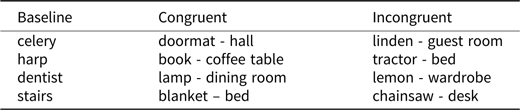
The materials included 100 words representing objects (taken from Lists A and B of the 16-item Free and Cued Recall test (RLRI-16) as well as the California Verbal Learning Test (CVLT) for children; the words from the CVLT were selected because they are constructed to represent semantic categories using common, familiar items) and 16 location names corresponding to rooms or corners of a house. The words were matched to locations in order to create semantically congruent and incongruent associations with the locations. The exhaustive stimulus list can be found in Table S1 of the Supplementary Materials and examples are provided in Table 2 below.
Description of the experimental material – three encoding conditions: baseline, congruent word-location associations, and incongruent word-location associations

Since the use of semantically congruent and incongruent words in this method had never been tested before, the material underwent a validation process. First, a questionnaire was administered to 15 independent participants (13 women and 2 men, with a mean age of 43.6 years old; range: 21 – 62 years old) to verify whether their home contained 21 identified locations for the task and to assess their ability to visualize each location using mental imagery on a Likert scale from 1 (I cannot visualize it) to 5 (I visualize it very clearly). The 16 selected locations, to be used as reference points in the method of loci mental journey, were owned by a minimum of 86% of the sample and rated as easy to imagine.
Next, another questionnaire was administered to 8 independent participants (3 women and 5 men, with a mean age of 40.5 years; range: 23 – 66 years old) to assess the semantic link between created word-location pairs. To associate the words with the locations, we first predefined a list of four words for each specific location (2 a-priori more congruent and 2 a-priori more incongruent). For each of the four words associated with a given location, participants were asked to rate the level of congruence on a scale from 1 (completely incongruent) to 5 (completely congruent). From this, we selected 28 word-location associations with an average score ≥ 4 to form the congruent associations (i.e., 12 of the 16 locations were presented twice in the congruent condition) and 28 word-location associations with an average score ≤ 2 to form the incongruent associations (i.e., 12 of the 16 locations were presented twice in the incongruent condition), so that we ended up with a total of 56 word-location associations. We selected 28 words from the remaining words to form the study list for our baseline condition. The words did not differ in terms of length and frequency across listsFootnote 1 . The 16 remaining words that were not selected for the main task served for the training during which participants familiarized themselves with the method of loci. The finalized material was tested on 9 pilot participants from both age groups (5 young subjects and 4 older subjects) to ensure the absence of ceiling and floor effects in the recall test.
Procedure
Each participant took part in the study individually in a testing session lasting between 1.5 and 2 hours which took place in their homeFootnote 2 . The tasks were performed on a laptop equipped with the E-Prime software. After providing written informed consent, participants began with the baseline free recall task, which required them to encode 28 words presented successively on the screen, with each word appearing for 4 s, followed by a 1-second fixation cross. After the encoding phase, a 1-minute and 30-second countdown distraction task was administered to reduce the effect of immediate repetition. Participants then completed a free recall test, in which they had to recall as many words as possible in any order. This condition established a baseline measure of their memory performance in the absence of mnemonic aid. Afterwards, the Block Tapping Test was administered, serving both as a distraction task and as a measure of visuospatial span (Corsi, Reference Corsi1972).
Next, participants underwent training in the method of loci. Detailed instructions, combining written and oral explanations, were provided to guide them in applying this technique. First, participants were asked to perform a structured mental exploration through various rooms in their home following a predefined route, visualizing each room in detail. The name of each room appeared on the computer screen in a fixed, predefined order, ensuring that all participants followed the same path. Participants had to confirm the presence of each room in their own home and then rated the vividness of their mental image for each location on a Likert scale from 1 (no image) to 5 (very vivid image) in a self-paced manner.
In the next phase, participants completed a training session for the main task, which included a word-location encoding task using the method of loci. This involved memorizing 16 words, each paired with a location (regardless of congruency), with each pair presented for 4 s, followed by a 1-second fixation cross. Locations were always presented in a fixed order along a predefined route to standardize the protocol across participants. After a 1-minute 30-second countdown distracting task, participants completed a free recall test of the words from the list. They were encouraged to use the route in the house to help recall the words, but they were not required to mention the associated locations. Subsequently, the Camel and Cactus Test (Bozeat et al., Reference Bozeat, Ralph, Patterson, Garrard and Hodges2000) was administered, serving both as a distraction task and an assessment of participants’ semantic association abilities.
Then, 56 words were encoded using the method of loci. These 56 words were distributed across two separate encoding blocks of 28 words each. Importantly, both congruent and incongruent associations were mixed within each block. The block order was counterbalanced across participants. The procedure mirrored that of the training phase, with the only difference being the division into two blocks to reduce participants’ cognitive load. Each block included 12 locations that were presented twice: once with a congruent word and once with an incongruent word. Additionally, four locations were presented only once – two with congruent words and two with incongruent words. This was done due to the limited number of locations common to most participants’ homes, according to our pre-tests. In total, in each block, participants navigated a set of 16 locations arranged along a predefined and standardized mental route, which remained the same for all participants. After encoding, there was a 1-minute 30-second countdown distraction task, and then participants recalled as many words as possible.
In each block, word recall was recorded as 1 or 0 (present or absent), and each intrusion was coded as 1 (the exact nature of the intrusions was not recorded) (Figure 1).
Illustration of our encoding task, showing the encoding conditions: without strategy (baseline, on the left) and with strategy (method of loci, on the right), where, in this example, the congruent condition appears first, followed by the incongruent one.

A mental imagery test was administered to both groups between the two blocks to evaluate their visualization abilities (Bourlon et al., Reference Bourlon, Chokron, Bachoud-Lévi, Coubard, Bergeras, Moulignier, Viret and Bartolomeo2009). Finally, the MoCA (Montreal Cognitive Assessment; Nasreddine et al., Reference Nasreddine, Phillips, Bédirian, Charbonneau, Whitehead, Collin, Cummings and Chertkow2005) was administered to older participants to assess their global cognitive functions. At the end of the study, a compliance questionnaire on the method of loci was given to all participants to verify that they had correctly applied this strategy during encoding. Each participant was asked whether they had used the method of loci during the encoding phase (yes/no). All participants confirmed that they had applied this mnemonic strategy as instructed.
Statistical analyses
We compared performance on cognitive tests (Block Tapping Test, Camel and Cactus Test, and mental imagery test) between the two groups using independent samples t-tests.
Then, we conducted a paired samples t-test to compare participantsʼ performance between the first and second blocks of the main task to assess whether participants improved their use of the method of loci during the second session.
Because we found that participants’ performance declined between block 1 and block 2, which could be explained by a fatigue effect (t(46) = 3.50; p < 0.001; Cohen’s d = 0.51; 95% CI: [0.20, 0.81])Footnote 3 , we calculated the average score across the two blocks, and computed the difference between the means of the two blocks (block 1 – block 2). This decline score was introduced in the two-factor (2×3) mixed ANCOVA with the factors: group (young vs. older) and learning condition (no strategy, congruent method of loci, incongruent method of loci) on the proportion of recalled words. Post-hoc tests (Dunn–Bonferroni) were used to compare performance inter-group differences for each experimental condition, and individual repeated-measures ANCOVAs with the factor learning condition (no strategy, congruent method of loci, incongruent method of loci) and the same covariate as previously were used to compare the effect of condition within each group.
Correlation analyses between performance on cognitive tests and “benefit scores” associated with the method of loci were conducted; details of the computation and results are presented in Supplementary Results (see also Table S2).
Finally, a non-parametric 2×2 mixed ANOVA (factors: group: young, older; condition: baseline vs. method of loci) was conducted on intrusion scores to assess interference control. The number of intrusions was recorded separately for each block during each of the 3 free recall phases and corresponded to recalled words that were not in the study list. Subsequently, we averaged mean intrusions across the two blocks of the method of loci, leading to a single method of loci intrusion score. Of note, intrusions cannot be attributed to the congruent or incongruent conditions, as words were not present at encoding. We predicted that the method of loci could either reduce or increase interference (and thus intrusions) in older adults.
To complement our frequentist approach and better quantify the strength of the evidence supporting our results, we also conducted Bayesian analyses by comparing alternative models to the null model. Bayesian analyses are particularly useful, as they make it possible to assess the strength of the evidence either in favor of the null hypothesis or in favor of the alternative hypothesis, or whether the data simply remain inconclusive. Here, we used the Bayes factor (BF10), which quantifies the strength of evidence in favor of the alternative hypothesis over to the null hypothesis. We present the results of our Bayesian analyses alongside the frequentist statistics in the Results section.
Results
Cognitive tasks
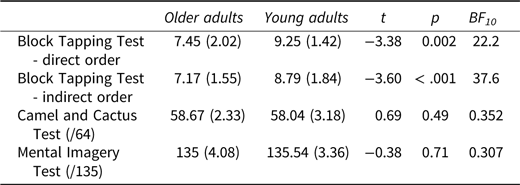
Performance in the cognitive tasks is presented in Table 3. Group comparisons revealed poorer performance in older adults in the Block Tapping Test but age invariance in the Camel and Cactus Test and Mental Imagery Test.
Mean scores (and standard deviation) young adults and older adults on cognitive test

Recall performance as a function of group and condition
Performance of the two groups in the three conditions is illustrated in Figure 2. The 2 (Group) × 3 (Condition) mixed ANCOVA revealed a significant main effect of condition (F(2,88) = 38.59, p < 0.001, η2 p = 0.47, BF10 = 2.36 × 10¹¹).
Recall proportion across the three conditions and the two age groups. Each point corresponds to an individual data value within the respective group and condition.

A significant main effect of group was also observed (F(1,44) = 14.55, p < 0.001, η2 p = 0.25, BF10 = 52.21). Young participants (M = 0.65) performed significantly better than older participants (M = 0.49). A significant interaction between conditions and groups was also found (F(2,88) = 7.68 p < 0.001, η2 p = 0.15, BF10 = 6.54 × 10¹⁴). In the incongruent method of loci condition, young participants (M = 0.64, SD = 0.2) outperformed older participants (M = 0.36, SD = 0.17), with a significant difference (t(44) = −4.95; p < 0.001, BF10 = 1894). However, no significant difference was observed between young (M = 0.77, SD = 0.17) and older adults (M = 0.66, SD = 0.20) in the congruent method of loci condition (t(44) = −2.04; p = 0.71, BF10 = 1.62). In the baseline condition, no significant difference was found between young (M = 0.53, SD = 0.17) and older adults (M = 0.44, SD = 0.12; t (44) = −2.10, p = 0.62, BF10 = 1.82).Footnote 4
To further explore the effect of condition, we conducted separate one-way ANCOVAs within each group. In older adults, the repeated-measures ANCOVA revealed a significant main effect of encoding condition, F (2, 42) = 26.38, p < .001, η2 p = 0.56, BF10 = 4.61 × 10⁴, indicating that memory performance differed significantly across the three encoding conditions (baseline, incongruent, congruent). Post hoc comparisons showed that memory performance was significantly higher in the congruent method of loci condition compared to the baseline (t(21) = –5.30, p < .001, BF10 = 1199.3) and compared to the incongruent condition (t(21) = 7.66, p < .001, BF10 = 179837.3). Additionally, performance in the incongruent condition was significantly worse than in the baseline condition (t(21) = 3.39, p = .007, BF10 = 17.5).
In younger adults, the repeated-measures ANCOVA revealed a significant main effect of encoding condition (F(2, 44) = 16.83, p < .001, η2 p = 0.43, BF10 = 46,132.82), indicating that memory performance varied significantly across the three encoding conditions (baseline, incongruent, congruent). Post hoc comparisons further clarified this pattern. Performance in the congruent method of loci condition was significantly higher than in the baseline condition (t(22) = –5.74, p < .001, BF10 = 3699.62) and than in the incongruent condition (t(22) = 5.82, p < .001; BF10 = 4460.94). Although performance in the incongruent condition was numerically higher than in the baseline, the difference did not reach significance (t(22) = –2.29, p = 0.078, BF10 = 2.06).
Intrusions
The number of intrusions is presented in Figure 3. Since the distribution of intrusion scores violated the assumption of homogeneity of variances across conditions (p = .05), a non-parametric test was used whenever possible (there is no non-parametric option for Bayesian analyses). Results revealed that the difference between younger and older participants in the number of intrusions in the baseline condition was not statistically significant (χ2 = 0.99, p = .32, ε2 = .022, BF10 = 0.658).
Number of intrusions according to the condition (baseline vs. method of loci) and the group.

However, when examining the number of intrusions following encoding using the method of loci (collapsing across congruent and incongruent conditions, as intrusions involve non-studied items that cannot be uniquely attributed to one encoding strategy), a significant group difference was found (χ2 = 8.268, p = .004, ε2 = .18, BF10 = 13.15). This indicates that older adults produced significantly more intrusions than younger adults during recall.
Discussion
Older adults experience a decline in episodic memory. To mitigate these difficulties, strategies based on the use of semantic knowledge have been proposed (Delhaye et al., Reference Delhaye, Folville and Bastin2019b). Indeed, it is well established that semantic knowledge is preserved or even strengthened with age (Bellezza & Reddy, Reference Bellezza and Reddy1978). Another recognized strategy for improving episodic memory performance is the method of loci (Blunt & VanArsdall, Reference Blunt and VanArsdall2021; Legge et al., Reference Legge, Madan, Ng and Caplan2012; Maguire et al., Reference Maguire, Valentine, Wilding and Kapur2003; Raz et al., Reference Raz, Packard, Alexander, Buhle, Zhu, Yu and Peterson2009; Ruchkin et al., Reference Ruchkin, Wallonius, Odekvist, Kim and Isaksson2022; Sandberg et al., Reference Sandberg, Boraxbekk, Zogaj, Nyberg and Gutchess2020), including in older adults, although the latter were shown to improve to a lesser degree than young adults do, thus exacerbating age differences (Sandberg et al., Reference Sandberg, Boraxbekk, Zogaj, Nyberg and Gutchess2020; for a meta-analysis, see Gross et al., Reference Gross, Parisi, Spira, Kueider, Ko, Saczynski, Samus and Rebok2012). The main objective of this study was to examine whether combining the method of loci with semantic knowledge would allow older participants to achieve performance comparable to that of young adults, thereby attenuating their episodic memory decline. To address this objective, two groups of participants (young and older) encoded a list of words using the method of loci versus without any strategy. In the method of loci, the words were either congruent (engaging semantic knowledge) or incongruent with the locations to which they were associated.
This study yielded three main findings. First, performance of both young and older participants significantly improved when encoding relied on the method of loci in conditions congruent with semantic knowledge compared with the use of the method of loci with incongruent object-location associations and the baseline condition. This is consistent with the previously reported benefit of semantic congruency in episodic memory, whereby new information is effectively integrated by leveraging preexisting associations to better organize and retrieve them (Bellezza, Reference Bellezza1996). However, to our knowledge, this is the first time that this semantic congruency effect has been demonstrated within the framework of the method of loci. Second, older participants performed worse than younger participants in the incongruent condition, but this difference between groups disappeared in the congruent condition. Third, the method of loci led older adults to higher intrusions than young adults, suggesting greater susceptibility to memory interference or reduced source monitoring in the older group, especially when applying this encoding strategy.
Surprisingly, the results also revealed comparable performance between young and older participants after encoding without a specific strategy (baseline condition). This contrasts with classical findings of age-related differences in free recall tasks (Light et al., Reference Light, Prull, LaVoie, Healy, Perfect and Maylor2000). This could partly be explained by the fact that we selected participants who had at least two bedrooms in their home, which may have introduced a socio-economic bias. Indeed, older adults from more privileged socio-economic backgrounds benefit from greater cognitive reserve. This increased reserve promotes neural plasticity and cognitive resilience, which translates into better cognitive performance at an advanced age (Fratiglioni & Wang, Reference Fratiglioni, Wang and Mecocci2007; Narbutas et al., Reference Narbutas, Chylinski, Van Egroo, Bahri, Koshmanova, Besson, Muto, Schmidt, Luxen, Balteau, Phillips, Maquet, Salmon, Vandewalle, Bastin and Collette2021). This could explain the lack of a significant difference between young and older subjects at baseline. Moreover, our baseline condition may have been too undemanding to reveal differences among cognitively healthy adults from relatively advantaged backgrounds (Light et al., Reference Light, Prull, LaVoie, Healy, Perfect and Maylor2000).
The method of loci in the incongruent condition in this study corresponds to the traditionally studied method of loci, whose effectiveness has previously been demonstrated both in young participants (Blunt & VanArsdall, Reference Blunt and VanArsdall2021; Legge et al., Reference Legge, Madan, Ng and Caplan2012; Maguire et al., Reference Maguire, Valentine, Wilding and Kapur2003; Raz et al., Reference Raz, Packard, Alexander, Buhle, Zhu, Yu and Peterson2009; Ruchkin et al., Reference Ruchkin, Wallonius, Odekvist, Kim and Isaksson2022; Sandberg et al., Reference Sandberg, Boraxbekk, Zogaj, Nyberg and Gutchess2020) and in older participants (Engvig et al., Reference Engvig, Fjell, Westlye, Moberget, Sundseth, Larsen and Walhovd2010; Gross et al., Reference Gross, Brandt, Bandeen-Roche, Carlson, Stuart, Marsiske and Rebok2014; Kliegl et al., Reference Kliegl, Smith and Baltes1990; Nyberg et al., Reference Nyberg, Sandblom, Jones, Neely, Petersson, Ingvar and Bäckman2003; Singer et al., Reference Singer, Lindenberger and Baltes2003). Surprisingly, no significant improvement in performance was observed in young participants when using the incongruent method of loci. Although their performance was numerically higher compared to baseline, the difference was not statistically significant. In contrast, among older adults, performance in the incongruent method of loci condition was significantly lower than in the baseline condition.
Several limitations in this study have however been identified. These may account for the unexpected results. First, the congruent condition was mixed with the incongruent condition, which may have directed participants’ attention toward congruent associations at the expense of words from the incongruent condition (Greve et al., Reference Greve, Cooper, Tibon and Henson2018), or generated interference between the two conditions. Relatedly, another important divergence from the classical method of loci that generally involves associating only one word per location is that here, most locations were associated with two words, one congruent and one incongruent.
Another point is that word-location associations were imposed, preventing participants from benefiting from the spontaneity helping for effective encoding using the method of loci (Berger-Mandelbaum & Magen, Reference Berger-Mandelbaum and Magen2017). Likewise, the standardized mental route may not have matched their actual home layout, potentially reducing the effectiveness of the method of loci.
Also, participantsʼ familiarity with their home environment was not controlled. However, this limitation should be interpreted with caution, as previous research has shown that the method of loci can remain effective even in previously unfamiliar environments (Legge et al., Reference Legge, Madan, Ng and Caplan2012). In addition, conducting the task at home may have influenced performance variably: while it reduced stress and increased ecological validity, it also introduced unequal contextual cues, especially from the room where testing occurred. Third, word lists were not counterbalanced across conditions, and words in the incongruent condition had lower valence and imageability. These lexical differences could partly explain the lack of significant improvement in that condition for older adults but also limit interpretations. Moreover, semantic relatedness between the words – especially congruent ones – to be encoded was not controlled. However, this represents an inherent feature of our experimental paradigm: words that are congruent with home locations tend to be more semantically related to one another. Finally, the specificity of the spatial locations varied (e.g., full rooms vs. sub-areas), introducing possible inconsistencies in mental imagery. This heterogeneity, though reflective of natural variations, may have affected the concreteness of associations and, in turn, performance.
However, the fact that our methodological limitations did not compromise encoding via the method of loci in the semantic congruence condition further highlights the strength and robustness of this strategy.
To further explore the avenue opened by the current study, future research should record the order of item recall to help assess whether the method of loci supports temporal organization, particularly in older adults. Finally, examining intrusion errors could reveal whether semantic schema activation interferes with encoding, especially when items are incongruent with familiar locations.
Conclusion
Numerous studies have demonstrated the effectiveness of the method of loci as a mnemonic strategy that enhances episodic memory performance and facilitates learning (Blunt & VanArsdall, Reference Blunt and VanArsdall2021; McCabe, Reference McCabe2015; Ruchkin et al., Reference Ruchkin, Wallonius, Odekvist, Kim and Isaksson2022; Sandberg et al., Reference Sandberg, Boraxbekk, Zogaj, Nyberg and Gutchess2020). However, few studies have examined its effectiveness in the context of aging, where episodic memory declines while semantic memory remains well preserved (Engvig et al., Reference Engvig, Fjell, Westlye, Moberget, Sundseth, Larsen and Walhovd2010; Gross et al., Reference Gross, Brandt, Bandeen-Roche, Carlson, Stuart, Marsiske and Rebok2014; Singer et al., Reference Singer, Lindenberger and Baltes2003). This study provides insights into this question by exploring the use of the method of loci in connection with semantic knowledge in older adults.
This study demonstrated that the method of loci in the congruent condition is an effective tool for improving memory performance in both young adults and older individuals. The results highlight the importance of semantic congruence between word-location associations in optimizing recall performance. Indeed, participants, regardless of age, achieved better performance in the congruent condition, confirming the benefit of semantic knowledge in information retrieval. Furthermore, using the method of loci in the congruent condition, older adults displayed recall performance equivalent to young adults. Additionally, the study highlights several key aspects to consider in future research in this field.
Competing interests
The authors declare that they have no competing interests related to this study.
Funding statement
This work was funded by the FRS-FNRS (grant T0009.19 and J.0007.24), the SAO/Fondation Recherche Alzheimer (grants 2020/0031, S#14003, #2017/0008), the Alzheimer Association (grant #2016-NIRG-394141), the University of Liège via Special Funds for Research (FSR-S-SS-20/16 and FSR2023-SS), the Léon Frédéricq Foundation, the CHU Liège, Classical Funding from Faculty of Medicine at Uliège, and the FCT – Fundação para a Ciência e a Tecnologia, I.P, through the Research Center for Psychological Science of the Faculty of Psychology, University of Lisbon (UID/04527: Centro de Investigação em Ciência Psicológica).