1 Introduction
Civil servant pension obligations have become a serious fiscal problem for many European countries in recent years (Gokhale, Reference Gokhale2009). Generous promises have been made by governments to avoid paying higher salaries immediately or to buy peace from public sector unions.
High replacement rates, low retirement ages, generous Pay-As-You-Go (PAYGO) provisions and especially demographic changes appear to be the main reasons for the significant burden on future government budgets, and ultimately for taxpayers (Oksanen, Reference Oksanen2004). For instance, for the OECD countries less than 25% of the civil service pension schemes have any accumulated reserves. As a result, these countries are now spending an average of nearly 2% of GDP on pensions for civil servants and other public-sector employees. In the 1990s, central government employment decreased relative to the population by a full percentage point in both developing and OECD countries. In developing countries, although the growth in the size of civil service slowed down or even stopped, the amount paid for public-sector employees’ pension benefits has often increased continuously because of the long lag in time between the reduction in the number of active employees and the decline in the number of retired civil servants together with their survivors (Palacios and Whitehouse, Reference Palacios and Whitehouse2006).
The average spending just on civil-service pensions is around 1.2% of GDP for OECD and around 1.33% of GDP for non-OECD countries. A better indicator of the fiscal pressure of civil-service pension spending on the budget is the ratio of pension spending to government revenues. For OECD countries, this ratio is 5%, whereas for the non-OECD countries it is 6% (Palacios and Whitehouse, Reference Palacios and Whitehouse2006).
In 1995, prior to implementing pension reforms, it was estimated that the implicit debt of the public sector pension systems amounted to 102% of GDP in France, 109% of GDP in Portugal and 132% of GDP in Sweden (Disney, Reference Disney2000).
In the US, the greatest fiscal problem is created by the defined benefit pension plans of state and local governments. Novy-Marx and Rauh (Reference Novy-Marx and Rauh2011) estimate the present value of the unfunded deficit in 2009 of these government pension plans to be approximately 3 trillion dollars.
Although the attempts to reform the public sector pension systems have faced great resistance and resulted in massive strikes, especially in Greece and France, the determination of the EU countries to solve this problem demonstrates the severity of the issue (Featherstone, Reference Featherstone2005). North Cyprus faces a similar funding crisis in its public sector sponsored pension funds. This study will show that its options for reform are severely limited.
2 The North Cyprus situation
In North Cyprus, the historical evolutions of the pension systems and the political forces at play have resulted in a large civil service relative to the size of its population, and a very generous defined benefit public sector pension system. Prior to 1974, Turkish Cypriots were largely shut out of influential public sector positions. This changed after 1974 with the area's separation from South Cyprus, hence, opening up full range of positions in the Turkish Cypriot government administrationFootnote 1. The implicit guarantee of financial support to the budget from Turkey made public sector employment a highly sought after career by most Turkish Cypriots. The public sector turned into a ‘protected’ sector in the economy's labor market with higher than market wages and the ultimate in job security. With competition for private sector employment coming from immigrants from Turkey, a depression of wage rates would have caused a pressure for Turkish Cypriots to move away to the UK and elsewhere. Hence, public sector employment with higher salaries and generous pension benefits became an effective instrument to retain indigenous Turkish Cypriot population on the Island.
Thus, a low statutory retirement age with generous pension replacement rates and loose eligibility rules increased the incentive for people to seek public sector employment and hence the number of people eligible for pensions.
In addition, the amalgamation of factors such as the attempts to unify the island with the further EU membership and current fiscal reforms taking place in Turkey has contributed to the 2008 civil service pension reform in North Cyprus. A more complete analysis of this reform is the subject of another paper.
The purpose of this paper is to evaluate the fiscal legacy of the civil service pensions system that is operative for all those employed or pensioned by the government prior to 2008. The magnitude of the unfunded pension liabilities of the retired civil servants and of those hired before 2008 and those still working will have an important bearing on the public sector budgets of the future United Cyprus. Alternatively, if North Cyprus remains as a separate entity, the magnitude of these unfunded liabilities will be a major factor to determine the fiscal viability of North Cyprus without budgetary transfers from Turkey.
3 The structure of civil service pensions system (for employees hired prior to 2008) in North Cyprus
In North Cyprus, the civil service pension system prior to 2008 consisted of two defined benefit pension funds. They were separate from the government sponsored social security system for private employees. The first plan includes those workers who started their employment in the public sector prior to July 1, 1987. It is financed entirely through the government budget. The second fund is for the government workers who entered into employment after July 1, 1987. The latter is partially financed by the contributions of its members. It was initially designed to be independent of the government budget, but the contributions have not kept pace with the accrued pension liabilities. In 2009, both of these plans were closed to new employees and a new pension plan was designed for the new government employees and new private sector workers.
In 2009, the civil service pensions system as a whole included 11,000 contributors and 11,813 retirees. This group represents about 20% of the total working population or about 8% of the total population of North Cyprus. Presently working male civil servants who were employed before 1987 contribute only 3.5% of their gross wages for the survivor retirement benefits for their wives and children. These workers make no direct contribution to the funding for their own pension benefits. Workers employed between 1987 and 1997; however, contribute 4% (women) and 8% (men) of their gross salaries to their pension system. In 1997, these rates increased to 5% and 9%, respectively.
New recruits to the civil service of North Cyprus enter into employment at an average age of 25 years old. The eligibility requirements for full pension benefit mandate a minimum of 25 years of service and a minimum of 55 years of age. The mandatory retirement age is 60. These retirement ages for civil servants are lower than for EU countries, where the normal retirement age is 65 for men and 60 for women. Even France which has traditionally had a low retirement age has recently increased it from 60 to 62.5 (Bennhold, Reference Bennhold2010).
In North Cyprus, every civil servant with 30 years of work experience is eligible to receive a pension based on a defined benefit formula that will give the person a replacement rate of 55.79%Footnote 2 of their last working month's salary. In addition, they are entitled to a lump sum gratuity payment at the point of retirement equal to the person's last monthly salary times the years of service. This gratuity payment has a value equal to an additional pension with a replacement rate of 13.95%Footnote 3. These two benefits make up a total replacement rate of about 70% of the final year's income. Since pension benefits are not subject to income tax in North Cyprus, this rate is a net replacement rate (NNR). If the average tax rate of a pensioner is 20%, then a 70% NNR is equal to a gross replacement rate of 87.5%Footnote 4. This is significantly higher than the 34 OECD countries’ average gross pension replacement rate (for workers with average earnings) of 58.7% (OECD, 2007).
Another benefit is the pension provision for payments to be made to surviving widows. Women receive 50% of the husband's pension benefits after his death, even if the husband has not yet retired. The opposite does not hold for male spouses, who enjoy no survival benefits from the wife's employment unless she makes a special contribution. Our data show that almost no women (<100 out of a total of 4,591) are paying for the survival benefits that will be enjoyed by their husbands. From the life tables for Cyprus (World Health Organization, 2011), we learn that when evaluated at age 25 (the average age when men are hired into the civil service) Cypriot women are expected to live on average 4 years longer than men. In addition, historical cultural practices have resulted in wives being on average 5 years younger than their husbands. We have carried out an actuarial estimation of the value of this benefit, considering both the probabilities of the husbands dying each year after 25 years of age and that the wife (5 years younger) is still surviving. In addition, we consider the expected life of the wife as of that point in time. The value of this additional spousal survivor benefit that is assigned to every male is estimated to be equal to the normal annual pension received by male civil servants for an additional 7 years beyond their expected life.
4 Estimation of the fiscal burden of the civil service pensions system
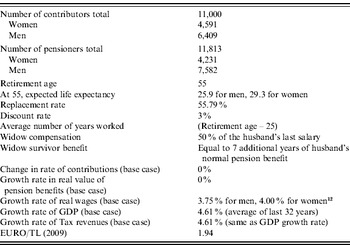
The aim of this paper is to evaluate the cost of the civil service pensions system as of 2009. The annual net cost and the present value of the future costs are made for the period from 2009 to the date that the last person in the system is expected to die. Using the parameter values presented in Table 1 for the base case, the fiscal burden of the existing civil service pensions system is estimated.
Parameter values for the base case analysis (all 2009 figures)

Our analysis consists of three components. First, an estimation of the present value of the cost of the future pensions payments received by public servants who have already retired (existing pensioners) is made. Second, the net cost is estimated, in present value terms, of the pensions that will be paid to those currently working. The net fiscal burden of the latter component is the difference between the present value of the future contributions made by civil servants and the present value of the future pension benefits they are entitled to receive. The third component is the present value of the cost of the gratuity payments to those who are still working and will be paid out in future in the form of a lump sum payment when they retire.
To derive the cost of the future pension payments by those currently retired, the first task is to determine the number of years each person is expected to live, given their current age. This number is calculated individually for each of the 11,813 retired individuals. This number is derived from the life tables for Cyprus where the expected life of each individual (men and women separately) is estimated, given their current ageFootnote 5. Subtracting the actual age of the individual from the person's expected future life (given their current age in 2009), gives us the number of additional years that this retired individual is expected to receive a pension. This variable is denoted as (n) in equation (1) below.
For those already retired, the estimation of the cost of future pension payments starts with the actual pension they received in 2009. This variable (P) is then increased each year until the expected year of death by the annual real rate of growth of pension (gp) payments. Finally, each of the annual payments is discounted by the rate of discount (r) to 2009. The resulting present value is the cost, evaluated as of 2009, of the future pension payments received by each individual. To find the present value for the entire set of retirees, the present values as of 2009 for each of the individuals are added together. This is expressed by the first term of equation (1).
The second term of equation (1) is to calculate the cost of pensions paid to widows after the death of their husbands. As discussed above, the value of this benefit is equivalent to
 $$C_{{\rm EP}} \equals \mathop{\sum}\limits_{i \equals \setnum{1}}^{\setnum{11}\comma \setnum{813}} {\mathop{\sum}\limits_{t \equals \setnum{1}}^{n} {{{\mathop P\nolimits_{i} \lpar 1 \plus g_{\rm p} \rpar ^{n} } \over {\lpar 1 \plus r\rpar ^{n} }}} } \plus \mathop{\sum}\limits_{s \equals \setnum{1}}^{\setnum{7}\comma \setnum{582}} {\,\,\mathop{\sum}\limits_{t \equals n}^{n \plus \setnum{7}} {{{\mathop P\nolimits_{s} \lpar 1 \plus g_{\rm p} \rpar ^{t} } \over {\lpar 1 \plus r\rpar ^{t} }}} } \comma $$
where P is the annual pension payment, n is the life expectancy after 2009, gp is the annual growth rate of pension benefits, r is the discount rate, i is the number of pensioners, s is the number of married male pensioners and EP stands for the existing pensioners.
The second group of people for which the pension burden should be calculated is made up of those individuals who are still working for the government, but belong to one of these two old pension plans. The present value of fiscal burden created by the pensions that will be paid to those still working less the present value of their contributions from 2009 to retirement is calculated using equation (2):
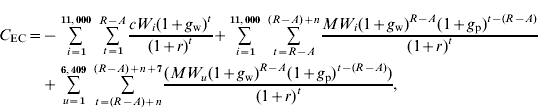 $$\eqalign{ C_{{\rm EC}} \equals \tab \minus\mathop{\sum}\limits_{i \equals \setnum{1}}^{\setnum{11}\comma \setnum{000}} {\,\,\mathop{\sum}\limits_{t \equals \setnum{1}}^{R \minus A} {{{cW_{i} \lpar 1 \plus g_{\rm w} \rpar ^{t} } \over {\lpar 1 \plus r\rpar ^{t} }}} } \plus \mathop{\sum}\limits_{i \equals \setnum{1}}^{\setnum{11}\comma \setnum{000}} {\,\,\mathop{\sum}\limits_{t \equals R \minus A}^{\lpar R \minus A\rpar \plus n} {{{MW_{i} \lpar 1 \plus g_{\rm w} \rpar ^{R \minus A} \lpar 1 \plus g_{\rm p} \rpar ^{t \minus \lpar R \minus A\rpar } } \over {\lpar 1 \plus r\rpar ^{t} }}} } \cr \tab \plus \mathop{\sum}\limits_{u \equals \setnum{1}}^{\setnum{6}\comma \setnum{409}} {\,\,\mathop{\sum}\limits_{t \equals \lpar R \minus A\rpar \plus n}^{\lpar R \minus A\rpar \plus n \plus \setnum{7}} {{{\lpar MW_{u} \lpar 1 \plus g_{\rm w} \rpar ^{R \minus A} \lpar 1 \plus g_{\rm p} \rpar ^{t \minus \lpar R \minus A\rpar } \rpar } \over {\lpar 1 \plus r\rpar ^{t} }}} } \comma \cr}$$
where n is the life expectancy after age of retirement, g w is the annual real growth rate of wages, gp is the annual growth rate of pension benefits, r is the discount rate, R is the retirement age, A is the current age in 2009, c is the contribution rate, Wi is the annual wages of contributors and i is the index for the number of contributors, Wu is the annual wages of married male workers and u is the index for the number of married male workers, M is the replacement rate and EC stands for the existing contributors.
To estimate this component of the cost of the pension system, we begin with the annual contributions made by each of the 11,000 individuals from 2009 until their retirement. The first term of equation (2) shows the summation of the discounted value of each civil servant's annual wage times the corresponding contribution rate. The annual wage is increased by the expected growth in the real wage rates (g w). The negative sign used for this part of the formula is because we need to subtract the present value of the contribution inflows from the pension benefits to be paid to each person after retirement. Secondly, the annual pension for each of the currently working civil servants is calculated using the replacement rate (M) times the expected real wage earned by the individual during the last year before retirement. This wage is estimated by taking the individual's wage rate in 2009 and adjusting it through time from 2009 until the year of retirement (R) by the expected real rate of growth of real wages (g w). Once the individual retires, the annual pension benefit is then increased each year by the assumed real growth rate of pensions (g p) until each individual dies. When the present value of the estimated pension payments for each contributor is added up and then subtracted from the present value of the summation of each person's contribution, the net cost of the pension system for the currently working civil servants is calculated. Finally, the last term of the equation calculates the expected present value of the future payments to the widows who are expected to receive benefits after the death of the spouse using the same assumption as employed in equation (1). The present value of the cost obtained from this term is added to the net cost calculated from the first two parts to find the present value of the fiscal cost that will have to be borne the current level of pensions to existing workers.
The last component of the analysis estimates the present value of the future fiscal cost created by the gratuity payments of the working civil servants that come under this scheme. These are received at the time of their retirement. Equation (3) below shows how this cost is calculated.
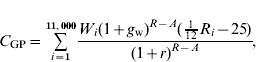 $$C_{{\rm GP}} \equals \mathop{\sum}\limits_{i \equals \setnum{1}}^{\setnum{11}\comma \setnum{000}} {{{W_{i} \lpar 1 \plus g_{\rm w} \rpar ^{R \minus A} \lpar {1 \over {12}}R_{i} \minus 25\rpar } \over {\lpar 1 \plus r\rpar ^{R \minus A} }}} \comma $$
where g w is the annual real growth rate of wages, r is the discount rate, R is the retirement age, A is the current age in 2009, Wi is the annual wages of contributors and GP stands for the gratuity payments.
Each individual's wage (Wi) is estimated at the time of their retirement using 2009 wages and adjusting them with the expected real annual growth rate in wages (g w). The number of years to make such an adjustment is found by subtracting the current age of each worker (A) from the retirement age (R). Then, each individual's estimated wage is multiplied by 1/12 times number of service years. This gives the gratuity payment to be received by each individual. Adding together the discounted value of the gratuity payments of the working civil servants makes up the third component of the fiscal burden of the civil service pensions system.
5 The results of the analysis
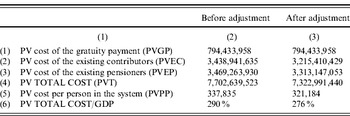
Table 2 shows the present value of the cost (in 2009 prices) of the unfunded liabilities of the civil service pensions system in North Cyprus. In our base case estimate, we have used a real discount rate of 3%Footnote 6.
Summary results of the baseline scenario (euros, 2009 price level)

To begin with, the present value of the cost of the pensioners is calculated to be about 3.3 billion euros, while the net fiscal cost of the working individuals in present value terms is estimated to be equal to about 3.2 billion euros. Moving on to the present value of the gratuity payments, it can be seen that the present value of the cost for the working individuals is estimated at 0.8 billion euros. Combined they give a present value of total cost of 7.3 billion euros, which is 321,184 euros per person within the system.
There are two adjustments that we needed to make to the estimations using equations (1)–(3) as reported in Table 2, column 2. The first adjustment arises because not all of the civil servants will survive until the age of retirement. For these individuals, the pension system will have savings in the own pension benefits they would have claimed, but at the same time there will be a loss of contributions between the time of death and the date of normal retirement. In the case of these historical civil service pension systems, the present value of contributions is equal only to 8% of pension benefits, so we simply apply the adjustment to the deficit numbers present in Table 2, column 2, row 2. In terms of the gratuity, the death benefits are given on the assumption that the person has worked 20 years even if the person dies after working less than 20 years and the payment is made immediately. Normally the gratuity is received only when the person reaches an age of 55. Hence, we make no adjustment to our base estimate of the cost of the gratuity payments, Table 2, column 2, row 1. Our estimate of the overstatement of the value of the pension deficits (based on the probabilities of a civil servant dying each year from age 25 to 55) for the base case (g w = 3.75% and 4.00%, and g p = 0%, retirement age 55) is 2% of the values in Table 2, column 2, row 2.
The second adjustment is required to reflect the fact that for the people who do live to the age of retirement they will not all live exactly to their average life expectancy (evaluated at the age of retirement), but there will be a distribution of ages of death with a mean equal to the expected age of death at retirement. Because future pension benefits are discounted, and also the real value of the pension benefits might be adjusted upward or downward over time then the present value of the pension benefits whose end periods are distributed over time will be different than the present value under the assumption that all deaths occur at exactly the expected age of death. With the base case assumptions, the present value of the cost of the pension benefits for those who are retiring in the future (Table 2, column 2, row 2) are overstated by a further 4.5%.
This means that we need to reduce the estimated cost of the pension benefits for contributors in Table 2, column 2, row 2 by 6.5%, and the cost estimates for the currently retired individuals that are reported in Table 2, column 2, row 3 by 4.5%. These adjusted values are presented in Table 2, column 3.
This debt is being rolled over to future generations. Clearly the government of North Cyprus is faced with an enormous fiscal challenge in the near and medium terms as the present value of the liability arising from the closed civil service pension plan is about 278% of its annual GDP. This figure is significantly higher than the corresponding figures for any of the EU countries.
According to OECD findings (Mylonas and Maisonneuve, Reference Mylonas and Maisonneuve1999), Greece's PAYGO system's unfunded liabilities are among the highest in OECD countries. In 1998, the estimated present value of the deficit of the future pension liabilities for Greece, calculated for in the same way as was done for North Cyprus, was in the order of 200% of GDP. However, this deficit included not only the deficit for the civil service pension system, but also for all publically managed pensions for the private sector as well. The comparison with Greece shows the severity of the situation in North Cyprus. Compared with the Euro zone countries with an average present value of pension's deficit equal to 50.6% of GDP, it is evident that the unfunded liabilities of the pension system of North Cyprus are likely to cause more serious problems for government budget makers in the long run than elsewhere in Europe.
Over a number of years, intensive negotiations have been taking place among the political leaders on how an integration of North Cyprus might be carried out with the Republic of Cyprus that would ultimately allow it to enter into the European Union with full legal rights. The issues of land and property have dominated these discussions. Many efforts have been made to estimate the nature and the value of the compensation to the Greek Cypriots that would be needed in order to obtain a resolution to the political conflict. A recent effort to arrive at an estimate of the amount of monetary compensation required, after territorial adjustments, has determined the amount to be 5.8 billion eurosFootnote 7. Although our estimate of 7.3 billion euros as the cost of the unfunded liability of only the civil service pensions of North Cyprus is 25.86% higher than the cash cost of settling the property issue, it is surprising that little or no attention has been given to the pension liability issue in the ongoing negotiations. It seems unlikely that North Cyprus or a United Cyprus could bear the fiscal burden of these historical civil service pension systems without continued infusion of budgetary support from outside the island. In the past, it has been the government of Turkey that had assumed this burden.
It should be noted that these estimates of the financial burden of these pension plans are based on the conservative assumptions that GDP will grow at a real rate of 4.61% a year (its historical average), where real wage rates are assumed to grow at a real rate of 3.75% for men and 4.00% for women a year. Once a person retires, the values of the pension benefits are adjusted nominally by only the rate of inflation.
6 Policy implications
The estimates of the size of the civil service pension deficit in present value terms are presented in accordance with a series of assumptions made about the growth rate of the real wages, the pension benefits and the retirement ages. Various sensitivity analyses have been conducted to estimate the changes in these results under alternative values of the assumptions that could also occur.
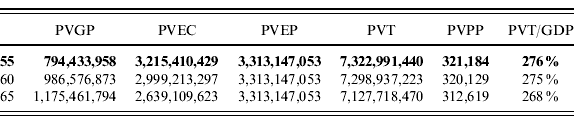
At present, the retirement age is 55 and Cyprus experiences considerable pressure from various sources, including Turkey, to raise the age of retirement. By assuming the retirement age for new retirees is raised to 60 and 65, we obtain the results shown in Table 3.
Sensitivity analysis for retirement age
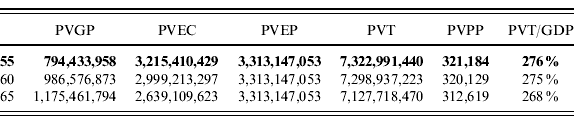
It is interesting to note that an increase in the retirement age from 55 to 65 actually increases the present value of the fiscal burden of the gratuity payments by 47.96%. However, the overall decrease of the present value of the cost of future annual pension payments to be paid to the existing working contributors dominates and the total impact, in 2009 values, is a net 2.8% decrease in the total cost from 7.3 billion to 7.1 billion euros and hence a fall in the ratio of present value of this pension liability to GDP from 276% to 268%. For the increase in the retirement age to 60 years, the impact is very small. However, because of the offsetting effects of the two components of the pension schemes, the increase in retirement age to 60 or 65 is not as effective as it otherwise would be in solving the budgetary crises created by these pension commitments.
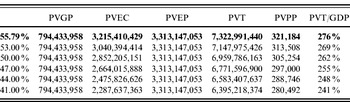
The next scenario considers the effect of change in the replacement rate on new retirees. The impact of changing replacement rates on the budget and the share of GDP used to pay defined benefit PAYGO pensions has been extensively studied by Oksanen (Reference Oksanen2005). This evaluation was undertaken in the context of analyzing a series of pension reform options. Alternatively, in a budgetary crisis similar to the one that Hungary, Poland and the Czech Republic faced in the 1990s, the replacement rates for new retirees might be unilaterally cut (Muller, Reference Muller2002). Currently (in 2009), the replacement rate for the basic pension is 55.79% of last monthly salary. If this ratio was to be decreased to a replacement rate of 41% instead of 55.79%, the total burden of the system would decrease from 7.3 billion euros to 6.4 billion euros. Such a substantial decrease in the replacement rate would affect only the present value of the cost of pensions to be paid to the existing employees upon retirement. Even with such a radical decrease in the replacement rate, the present value of civil servant pension liability to GDP ratio would only fall from 276% to 241% of GDP (see Table 4).
Sensitivity analysis for replacement rate

Sensitivity analysis for different discount rates

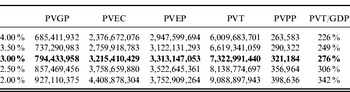
The discount rate plays an important role in estimating the present value of the deficit. In the base case scenario, a real discount rate of 3% is used. In addition, a sensitivity analysis for the impact of changes of this variable is carried out for a range of real rates from 2% to 4%. The estimated projections show a range for the present value of the civil servants pension liability from 226% of GDP in the case of a 4% discount rate to 342% in the case of a 2% discount rate.
In the latter case, the estimate of the total value of unfunded pension liabilities now equals to 9.1 billion eurosFootnote 8 (see Table 5).
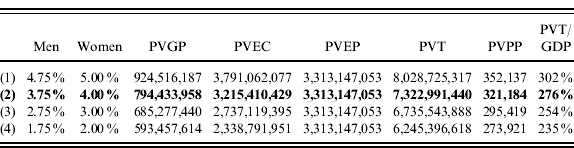
Table 6 shows the impact of the growth rate of real wages for the employed civil servants on the overall cost of the existing pension system. It can be seen that if wages are increased only by the rate of inflation and for seniority increments, then the total pension cost to GDP ratio is reduced to 235% (Table 6, row 4) from the base case of 276%. If the increase in wages is greater at 4.75% for women and 5.0% for men, then the per-person cost is 352,137 euros with a total cost to GDP ratio of 302%. These high values are close to the historical experience of real wage growth for the civil service of North Cyprus. These findings reveal that one of the most important factors affecting the unfunded liabilities burden on the budget is the real growth rate in wages of the currently employed civil servants.
Sensitivity analysis for growth rate in real wages
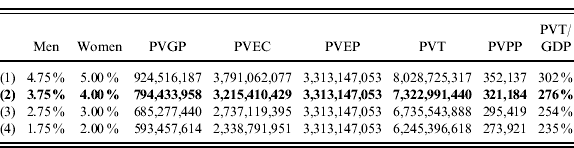
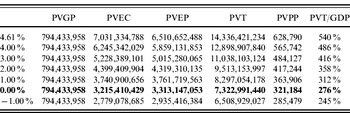
Another sensitivity test has been conducted to find out the fiscal impact of the real rate of indexation of individual pension benefits after retirement. The results are summarized in Table 7.
Sensitivity analysis for the rate of indexing the value of pension benefits

Our assumption in the base case is that the retirees’ pensions will not be increased in real terms. It can be seen from Table 7 that the present value of the deficit reaches a maximum value of 14.3 billion euros, or 540% of GDP, when the real growth rate of pension indexing is taken as 4.61%, the historical real growth rate of GDP. In fact, this is close to the real rate of indexation of civil servant pension benefits until 2008. The present value of the deficit has a minimum value of 6.5 billion euros, or 245% of GDP, when the real growth rate of pension indexing is taken as a minus 1%, that is, a cut in real pension benefits over timeFootnote 9.
It is clear from the results above that an increase in the real growth rates of wages for working civil servants and pensions for retirees amplifies the deficit, while decreasing the growth in real wages and pension benefits produces an opposite effect. However, in each case, the burden of the costs as compared to the annual GDP is enormous considering that we are discussing only one part of the publicly sponsored pension system in North Cyprus since the issue of the deficit of the social security system applicable to private sector employees is beyond the scope of the present paper.
A more immediate measure of the fiscal burden of the public sector pension deficit than its present values is the ratio of the annual deficit of the system to annual public sector tax revenues. In addition, a measure of the macroeconomic burden of these pension deficits is their ratio on an annual basis to the corresponding year's GDP.
As the civil service pensions plans are PAYGO systems, the assumptions on how the size of the civil service will change over time is a critical variable in determining their fiscal burden. At the present time, the employees of the public service number 11,000, which is a large number for a country with a population of only about 250,000 people. It is the current policy of the government to slow the grown of public sector employment, hence in these estimations, we assume that each person is replaced when they retire. In addition, it is assumed that the overall size of the public service employment will grow by 1% a year to correspond to the expected growth in population. Although these budgetary systems are no longer accepting new members, the significant deficit of these plans will continue to be a burden on future taxpayers’ shoulders and on the whole economyFootnote 10. At the same time, the pension plan contributions of the civil servants hired after 2008 to their new pension plan will help finance this PAYGO system overtime.
We are fortunate to have data on all the new hires since 2008, including their job classification, sex, salary and age. The average age of the new recruits is 25 years with 56% being males and 44% being females. New recruits entering the civil service after 2010 are given salaries that are significantly lower (about 35%) than the salary scales in 2009 (Civil Servants Law, 2010). The wages used to project future wage rates are these reduced salaries.
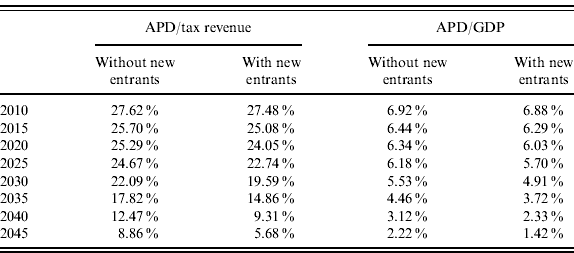
Table 8 shows the fiscal impact over time expressed as ratios of tax revenues and GDP North Cyprus.
Annual pension deficit (APD)/tax revenue and annual pension deficit/GDP
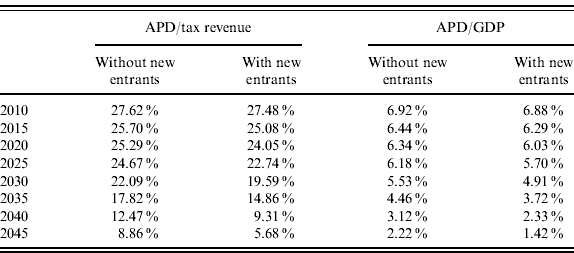
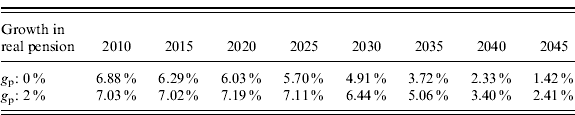
In the base case scenario, using the annual real historical annual growth rates for both government tax revenues and the GDP of 4.61%, it is estimated that the ratios of the total annual deficit of the civil service pension system to annual tax revenues and the GDP are about 27% and 6.9%, respectively. They gradually decrease through time to about 15% of tax revenue or 3.72% of GDP by 2035. However, the decrease is very slow, and these ratios approach 5.68% and 1.42%, respectively, only by 2045. It is important to remember that the average corresponding ratios for total spending on civil service pensions were 5% and 1.2% for the OECD countries in 2006 (Palacios and Whitehouse, Reference Palacios and Whitehouse2006). Hence, it will take North Cyprus approximately 34 years from now before the annual burden of the extraordinarily generous pension rights given over the past 37 years to public servants in North Cyprus will be brought into approximately the same relationship to GDP as is the current situation in Europe. Even at these similar long-term ratios, several countries, such as Greece and France, consider that their pension system is in a state of crisis.
7 Simulating alternative policy measures
Under the present rules of the grandfathering civil servant pension benefits for all existing members, only three variables can affect the future budgetary burden of these pension systems and hence alter the relative sizes of their final annual and present value liabilities compared to GDP and tax revenues.
First, how will the pension benefits be indexed in the future? Will they be indexed only for inflation hence preserving the real value set at the time of retirement? Alternatively, will they in practice be set at a positive real rate of growth as has been the past experience? Second, what rate of growth of GDP should be assumed in conducting these projections? The relative burden of these pension obligations are affected by the rate of real growth of GDP as tax revenues will tend to grow parallel to real GDP growth rate. The rate of growth of real GDP in turn will be a function of the growth of productivity changes, the growth in the labor force (population change) and the growth in country's capital stock. Third, what will be the rate of growth of real wages that will determine the defined benefit retirement payments received at retirement and beyond? Hence, we carry out a sensitivity analysis of the impact on the relative fiscal burden with alternative assumptions about the behavior of these three variables over time.
We begin by assuming that the economy in the future will grow at a real rate of 4.61%, which is the average historical rate over the past 32 years. Looking toward the future the two parameters that may vary are the growth rate of real wages for those still working (and determining the size of the gratuity payment and base year retirement benefit) and the real growth in the annual pension benefit after retirement.
In the base case scenario, as stated earlier, after retirement the real wage growth rate is assumed to be 2% plus the seniority increases of 1.75% for men and 2.00% for women for a total of 3.75% and 4.00%, respectively. This analysis is carried out until 2045, the first year that the new recruits to the new system are expected to retire.
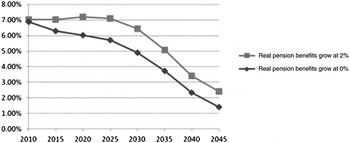
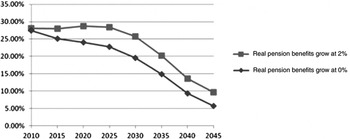
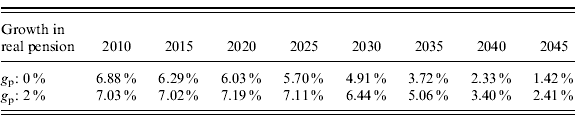
Estimates are now made of the annual burden when the real value of pension benefits is assumed to grow at a real rate of 2% per year. Figure 1 shows the movements of the annual pension deficit as compared to GDP in both the base case scenario and in the alternative scenario with a 2.00% real growth per year.
Pension benefit indexation and the ratio of annual pension deficit to annual GDP.

Although the two scenarios illustrate a similar trend in the annual deficit/GDP ratio over time, it can be clearly seen that the burden is more significant for the case where the real value of pension benefits are increased at the rate of 2% through time.
The present value of the additional budgetary outlays between the two cases is about 1.6 billion euros in 2009 valuesFootnote 11 The present value of these additional payment amounts is equal to 60% of the annual GDP of North Cyprus.
The importance of the economic problem that these pension promises have created is seen in Table 9. Whether indexed or not, it is certain that the pension benefit payments are a heavy burden on the economy. Pension payments to this group of citizens are eating up on a net of contribution basis between 6.9% and 5.7% of GDP for the next 15 years. Until 2045, the ratio is much higher than the OECD average. The gradual fall in the figures is primarily due to the decrease in the number of pensioners as they die and are replaced by new entrants who are earning significantly smaller salaries subject to the rules of the reformed pension system. The GDP that is used to finance pensions and hence consumption of the retired civil servants will not be able to finance investments by local residents to enhance growth of the economy. In such a case, economic growth will only be achieved by increasing foreign investment and hence, foreign ownership of the economy. In the political context of North Cyprus, this is a highly contentious issue.
Annual pension deficit/annual GDP ratios
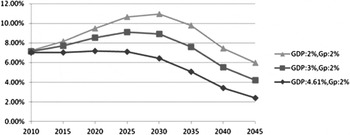
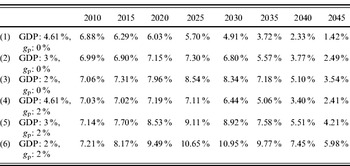
Suppose if instead of the real growth rate of GDP of 4.61% for North Cyprus, it is assumed to slow to 3%, while wages continued to grow at a real rate of 3.75% and 4.00% (Figure 2). When pension benefits were only indexed to inflation, the members of these pension plans would receive about 7% of GDP until 2025 and 5.6% until 2035 (Table 10, row 3). If they were indexed to the growth at a rate of 2% a year, they could be consuming more than 9.1% of GDP until year 2025 and 7.6% until 2035. This is shown in Figure 2 and the accompanying table (Table 10, row 5).
Impact of alternative growth rates of GDP on the ratio of annual pension deficit to annual GDP.

Annual pension deficit/annual GDP ratios

The situation is much worse if the real growth rate of GDP were to fall to 2% a year, while pensions would increase by 2% real each year. In this case, the historical pension commitments to those retired and currently employed civil servants would absorb 10.6% of GDP until 2025 and still over 9.7% by 2035 (Table 10, row 6). Even if the pensions were only indexed to the rate of inflation, our estimates show that the civil servants will be capturing in pension benefits of 8.5% of GDP until 2025 and over 7% as late as 2035 (Table 10, row 3).
8 Impact of civil service pension payments on the public sector budget in future years
When examining the impact of these past pension promises on the public sector budget, we assume that the tax revenues are a function of GDP and tax policies will be in place that will allow the ratio of tax revenues to GDP to remain fairly constant over time. We also assume that the real growth rate of GDP will be sustained at its historical rapid real growth rate of 4.61% per annum. Furthermore, indexation of future pension benefits to the rate of inflation is also among our assumptions (Figure 3 and Table 11).
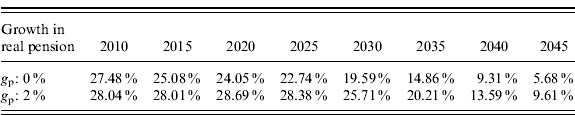
Impact of pension indexation on ratio of annual pension deficit to annual tax revenue.

Annual pension deficit/annual tax revenue ratios
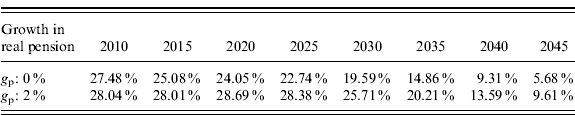
According to these estimations, with the indexation of pensions only to inflation (current stated policy of government), the share of current tax revenues in 2015 that would be paid out as pension benefits would be 25.08%. If the pension had been indexed to the real growth in wages (the historical practice), the share of tax revenues to be paid to civil service pensioners would have been 28.01%.
This share of the budget is quite close to the total expenditure made on primary and secondary education in the country (30.37% of tax revenues) and far above the total expenditure made on health care/tax revenues ratio of 14.84% (State Planning Organization, 2010). From Table 11, one can see the critical importance that the method of indexation of pension benefits has on determining the future burden of these pension payments on the public sector budget. By 2030, with indexation for only the rate of inflation, these payments will still account for about 19.6% of total government tax revenues. On the contrary, if indexation is made according to the growth in real wages of 2%, the burden will be about 25.7%.
9 Conclusions
Our estimations of the unfunded liabilities of the civil service pension systems in North Cyprus reveal that the existing problem is not likely to be solved by the type of traditional policy measures that have been implemented elsewhere in Europe. Various policy implications such as increasing the retirement age, decreasing the basic replacement rate, freezing the real wages and indexing pension benefits to only inflation resulted in only modest improvements in the fiscal burden to be borne over a long period of time. The problem of the civil service pension systems in Northern Cyprus is that generous pension promises were used to reward people for activities that had little or nothing to do with traditional government employment. Because the fiscal impact was not immediate, people could be rewarded with the bill only coming due years later, which happens to be now.
Overcoming this problem requires more fundamental measures. The collapse of the former Soviet Union and governments of Eastern Europe in the 1990s provide many examples of this kind of a solution to similar type of unfunded pension promises. Although labor relations in North Cyprus are dominated by strong unions, it is conceivable that current pensioners and contributors to these pension plans may also be forced to receive fewer benefits by the government breaking its pension promises. It is interesting to note that any political solution on the island is likely to require an approval by both sides through a referendum. Hence, it is questionable if any proposal would be agreed to by the residents of North Cyprus if it meant that a significant proportion of the population will suffer drastic losses of future pension benefits. Ultimately, it would appear that outside financial support will be necessary to get over this burden of the legacy of public sector pension promises before any political solution on the island of Cyprus is likely to be realized.