1. INTRODUCTION
Ever since the beginning of Romance linguistics, the morpho-syntactic status of phonologically weak or clitic subject pronouns in Modern French has been heavily debated.Footnote 2 In the context of this debate, two opposing approaches to the status of these elements have been put forward, namely an approach in terms of phonological clitics and one in terms of inflectional prefixes. Under the former approach, the elements under discussion are morpho-syntactically independent words, i.e. argumental subjects in their own right, which cliticise to the finite verb in the phonological component. According to the latter approach, these elements represent agreement marking affixes which combine with the finite verb in the morphological component.
While clitic subject pronouns in Standard French (SF) have been shown to constitute phonological clitics, the issue of whether or not these pronouns likewise represent phonological clitics in Colloquial French (CF) has not yet been settled.Footnote 3 This paper sets out to contribute to this ongoing debate by discussing an intriguing characteristic of CF which has seldom been addressed and which may prove to be of great(er) relevance for the eventual analysis of clitic subject pronouns: finite constructions without any subject. CF in fact features two such types of constructions, namely personal constructions such as in (1a) and impersonal constructions (ICs) such as in (1b) in which clitic referential and expletive, respectively, subject pronouns are non-expressed.
(1)


Contrary to the latter type of constructions, the former type constitutes a highly restricted conventionalised set, in that the non-expression of clitic referential subject pronouns is possible only with verbs such as connaître ‘to know’, croire ‘to think’, and savoir ‘to know’ when negated and in the 1st person singular (Gadet, Reference Gadet1997: 70).Footnote 4 In the following, constructions such as in (1b) will be looked into and their implications assessed with respect to the morpho-syntactic status of clitic subject pronouns in CF. We will show that the non-expression of expletive subject pronouns may not be readily considered evidence for the approach to the status of clitic subject pronouns in CF in terms of inflectional affixes. On the basis of the crucial findings that (i) the non-expression of the former pronouns represents the continuation of a grammatical trait of older stages of French and that (ii) it seems to be syntactically restricted, it will be tentatively argued that the non-expression of expletive subject pronouns in CF follows from the same reasons as the non-expression of subject pronouns in Medieval French, namely from the movement of the finite verb to the left periphery.
2. ICS WITH NON-EXPRESSED EXPLETIVE SUBJECT PRONOUNS IN CF
In comparison to SF in which the expression of the clitic expletive subject pronoun il ‘it’ (IL) in (finite) ICs is generally obligatory, the principal exception being fixed expressions showing characteristics of older stages of French (e.g. mieux vaut faire . . . ‘it is better to do . . .’), CF stands out due to the frequent non-expression of IL. This non-expression of IL is, however, not categorical, nor does it extend to constructions with all impersonal verbs. Resulting from a close examination of relevant indications in the literature (cf. (3) for pertinent references), constructions with the following set of impersonal verbs only may have IL non-expressed in CF:
(2) s'agir ‘to concern’, y avoir ‘to exist’, être ‘to be’ + noun, faire ‘to make’ + adjective (+ infinitive), faire ‘to make’ + de ‘of’ + article + noun, falloir ‘to have to’, s'en falloir ‘to be close to’, paraître ‘to appear’, sembler ‘to seem’, suffire ‘to be sufficient’, valoir mieux ‘to be better’
The examples in (3) illustrate the non-expression of IL in ICs with these verbs.
(3)
As far as the respective frequencies of the non-expression of IL in constructions with the impersonal verbs in (2) are concerned, it is generally stated that these show significant differences. Specifically, ICs with y avoir ‘to exist’ and falloir ‘to have to’ are argued to be most frequently encountered with non-expressed IL, ICs with faire ‘to do’ + adjective (+ infinitive) and valoir mieux ‘to be better’ are claimed to come second in frequency, while in ICs with paraître ‘to appear’, sembler ‘to seem’, and suffire ‘to be sufficient’, the non-expression of IL is said to be infrequent.Footnote 5
3. MORPHOLOGICAL CONCEPTIONS OF THE NON-EXPRESSION OF IL IN ICS
In the debate on the morpho-syntactic status of clitic subject pronouns in CF, the intriguing characteristic of CF to have IL non-expressed in ICs has been considered (further) evidence for approaching these pronouns in terms of inflectional affixes. We shall discuss these conceptions and will show that they fall short of adequately capturing the non-expression of IL. From this we shall conclude that the non-expression of IL may not be readily considered (further) evidence for the approach in terms of inflectional affixes.
3.1 ICs with non-expressed IL as arbitrary lexical gaps (Auger, Reference Auger, Ashby, Mithun, Perissinotto and Raposo1993)
Auger (Reference Auger, Ashby, Mithun, Perissinotto and Raposo1993) applies the set of criteria established in Zwicky and Pullum (Reference Zwicky and Pullum1983) to differentiate between phonological clitics and inflectional affixes to clitic subject pronouns in CF. In the context of this application, she claims that the non-expression of IL in CF represents a ‘morphological argument’ for an approach in terms of inflectional prefixes. Specifically, Auger (Reference Auger, Ashby, Mithun, Perissinotto and Raposo1993: 179) considers the observation that constructions with non-expressed clitic subject pronouns are encountered only with ‘a few impersonal verbs in Colloquial French’ an instantiation of Zwicky and Pullum's (Reference Zwicky and Pullum1983) criterion B and argues that such constructions constitute arbitrary lexical gaps. These are claimed by Zwicky and Pullum (Reference Zwicky and Pullum1983: 504) to be ‘more characteristic of affixed words than of clitic groups’.
Yet, there are good reasons to believe that ICs with non-expressed IL in CF do not constitute arbitrary lexical gaps. In their initial abstract definition, Zwicky and Pullum (Reference Zwicky and Pullum1983: 505) consider arbitrary lexical gaps ‘cases where [. . .] some single expected host-clitic combination fails to occur’. Later on, in the context of their discussion of the morpho-syntactic status of the English negative formative n't, Zwicky and Pullum (Reference Zwicky and Pullum1983: 507) expound on what exactly they consider to be arbitrary lexical gaps: combined forms which ‘do not exist at all’ such as *mayn't and *amn't. According to Zwicky and Pullum (Reference Zwicky and Pullum1983), then, arbitrary lexical gaps are instances in which one element categorically fails to combine with another one, and this on no principled grounds. Against this background, the non-expression of IL in ICs in CF may hardly be considered an instance of Zwicky and Pullum's (Reference Zwicky and Pullum1983) criterion B. For as follows both from section 2 and from the relevant indications given by Auger (Reference Auger, Ashby, Mithun, Perissinotto and Raposo1993) herself, in CF, the non-expression of clitic subject pronouns in finite constructions without any other subject is neither categorical, nor is it arbitrary.
It is widely acknowledged that in CF, clitic subject pronouns are never categorically non-expressed in finite constructions, but only optionally so (Koch and Oesterreicher, Reference Koch and Oesterreicher2011: 117). We shall provide independent empirical evidence, since the optionality of the non-expression of clitic subject pronouns is generally deduced from introspection only. Given that in the context of the approach to clitic subject pronouns in CF in terms of inflectional prefixes, the notion of (more or less constant) code-switching between CF and SF is generally adduced (Culbertson, Reference Culbertson2010; Zribi-Hertz, Reference Zribi-Hertz2011), the methodology of introspection is quite problematic in this context. In order to be able to give such empirical evidence, an independent morpho-syntactic device is needed which allows for the unequivocal classification of a given IC as either CF or SF. In fact, such a device is readily at hand, namely the (non-)expression of the preverbal negative particle ne in the context of sentential negation: while in SF, this particle is categorically expressed, usually together with the postverbal adverbial negative marker pas, it is generally non-expressed in CF, pas then being the sole marker of sentential negation (Söll, Reference Söll and Hausmann1985: 119; Rowlett, Reference Rowlett1998).
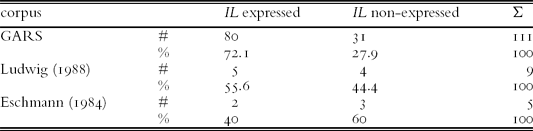
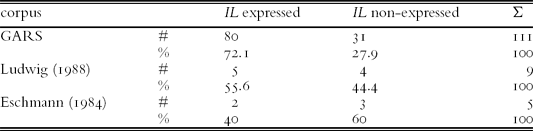
With this background in mind, we have searched three modern synchronic data corpora of spoken FrenchFootnote 6 for instances of negated finite constructions with the impersonal verb falloir ‘to have to’ and pas as the sole marker of sentential negation. The search results, given in Table 1 and illustrated in (4), show that all of the three data corpora feature instances of both the expression and the non-expression of IL in the constructions under investigation.
Sequences of ‘(IL +) finite form of falloir ‘to have to’ + pas ‘not’
(4)
We take this finding as an unequivocal indication that in CF, clitic (expletive) subject pronouns are never categorically non-expressed in finite constructions.
Note, furthermore, that with the exception of constructions such as in (1a) which are generally taken to constitute a highly restricted conventionalised set, the non-expression of clitic subject pronouns in finite constructions without any other subject is solely encountered with (certain) impersonal verbs. We take this as a clear indication that in CF, the non-expression of these pronouns is not arbitrary, but follows from principled grounds. In light of these considerations, then, the non-expression of IL in ICs in CF may be shown not to represent arbitrary lexical gaps.
3.2 ICs with non-expressed IL as precursors to a new change (Fonseca-Greber, Reference Fonseca-Greber2004)
Fonseca-Greber (Reference Fonseca-Greber2004: 86) considers the non-expression of IL in ICs in CF both a clear indication of the (near) completion of the morphologisation of clitic subject pronouns and the ‘leading edge of a new change’ (cf. also Haas, Reference Haas1909: 53; Seefranz-Montag, Reference Seefranz-Montag1983; Reference Seefranz-Montag and Fisiak1984; Culbertson, Reference Culbertson2010). Specifically, she conceives of this non-expression of IL as ‘the internal restructuring of the new prefixal verb paradigm through the emergence of a zero morph, restricted for the present to [a] communicatively clear subset of the 3Sg.: impersonal verbs’ (Fonseca-Greber, Reference Fonseca-Greber2004: 86). Both conceptually and empirically, however, this claim does not stand up to closer examination.
From a conceptual point of view, it is entirely unclear why, as noted by Fonseca-Greber (Reference Fonseca-Greber2004: 81) herself, ‘[a]t a time when clitic use is on the rise in most linguistic contexts [. . .] certain impersonal verbs appear sans clitic, apparently in flagrant violation of the general trend toward morphologised verbal prefixes’. Rather than being a consequence of the alleged morphologisation of clitic subject pronouns in CF, the non-expression of IL in ICs represents a clear contradiction, and this all the more so, since, as pointed out by Fonseca-Greber (Reference Fonseca-Greber2004: 84), ‘morphologization is approaching completion in the 3rd person’, while in the 1st and 2nd person, it is arguably complete. In fact, under the assumption that the non-expression of clitic subject pronouns is a consequence of the near completion of their morphologisation, one would naturally expect those pronouns to be the precursors to a subsequent change which have already been completely morphologised, namely those of the 1st and / or 2nd person; yet, this is not the case. Fonseca-Greber (Reference Fonseca-Greber2004: 84) tries to circumvent this conceptual objection by noting that ‘[m]orphologization is complete with 3Sg. verbs that disallow a referential subject, as in weather verbs [. . .] and impersonal verbs’. Even if one were to grant this circumvention, the proposed analysis is still conceptually problematic. For why should of all verbs (certain) impersonals be the precursors to a subsequent change? Since, Fonseca-Greber (Reference Fonseca-Greber2004: 83) argues, ‘impersonal verbs [. . .] (a) exist only in the 3rd person and (b) cannot take a referential subject’.Footnote 7 Rather than corroborating her analysis, however, this functional explanation severely undermines it.
First of all, if expletive subject pronouns were functionally that useless, it is unclear why they were integrated into the language earlier on. Second, under the view that clitic subject pronouns in CF are agreement marking prefixes, one would naturally expect these elements to be categorically expressed, since they evidently fulfill a specific functional role. Third, the non-expression of IL is not restricted to ICs with genuine impersonal verbs such as falloir ‘to have to’, but is also encountered in ICs with verbs such as suffire ‘to be sufficient’ whose conjugation is not restricted to the 3rd person singular and which also combine with subject elements other than IL. Fourth, among the constructions with genuine impersonal verbs, IL may be non-expressed with a small subset of these verbs only. Fifth, if IL was functionally useless in constructions with certain impersonal verbs, it is entirely unclear why in these very constructions, its non-expression is not categorical or, put differently, why IL is (still) expressed, indeed frequently, as follows e.g. from the data given by Fonseca-Greber (Reference Fonseca-Greber2004) herself.Footnote 8
In addition to these conceptual drawbacks, the claim that ICs with non-expressed IL constitute the precursor of a new change in CF also faces a severe empirical drawback, since such ICs are not recent phenomena. In fact, the non-expression of IL in ICs in CF is generally taken to represent the continuation of a grammatical trait of older stages of French in which all ICs may have ILnon-expressed (Brunot, Reference Brunot1891; Haas, Reference Haas1909; Brugmann, Reference Brugmann1917), as illustrated in (5a) for weather verbs, in (5b) for verbs whose conjugation is restricted to the 3rd person singular and which solely combine with IL, and in (5c) for verbs whose conjugation shows no such restrictions (Zimmermann Reference Zimmermann2012).
(5)
Note, however, that virtually no empirical evidence has been provided so far to corroborate this general claim, at least as far as the period from the mid-17th to the mid-19th century is concerned. In fact, Steinmeyer (Reference Steinmeyer1979: 219f.), referring back to relevant observations by grammarians, is the only researcher who provides a few scattered examples of ICs with non-expressed ILfor the second half of the 17th century as well as for the middle and end of the 18th century.
To compensate for this general lack of empirical evidence for the common claim of the continuation of the non-expression of IL in ICs in CF, we have, in light of the general absence of diachronic corpora of CF, sifted through numerous pieces of literary work from the mid-17th to the end of the 19th century in search of instances of constructions with the 3rd person singular present indicative impersonal verb form faut ‘must’ and non-expressed IL. The pieces of literary work we looked at principally constitute comedies which are generally considered most likely to contain instances of CF (Steinmeyer, Reference Steinmeyer1979: 219; Gadet, Reference Gadet1997: 11). For this literary genre stands out due to both its more or less consistent conversational / dialogical nature and its frequent recourse to characters representing members of the lower classes which are commonly associated by contemporary authors with a general lack of education and, more importantly in this regard, the occasional ignorance of SF. This ignorance is evidently a direct reflection of the lack of education and, to all appearances, a prominent means of illustrating this deficiency (Siede, Reference Siede1885: 1). Independent evidence for the soundness of such a conjecture comes from relevant rebukes by contemporary grammarians such as Chiflet (Reference Chiflet1659). Because of its relevance, his rebuke proves to be all the more pertinent in the present discussion, as it unequivocally indicates that the non-expression of ILis indeed a trait of the spoken language and continues right into spoken Modern French: ‘Never say Faut faire cela [‘One must do this’], Faut prendre garde [‘One must watch out’] without adjoining Il, as do the people from the Provence’.Footnote 9 (Chiflet, Reference Chiflet1659: 85).
Contrary to what one may expect, however, our examination of various pieces of literary work from the period under investigation exposes that the non-expression of ILwith faut ‘must’ is comparatively seldom encountered. In fact, relevant instances are few and far between, a state of affairs which most probably results from the general expectation that authors adhere to (the speech ideal of) SF (Diehl, Reference Diehl1895: 1; Rohlfs, Reference Rohlfs1928: 4). In any case, what is crucial in this regard is that instances of ICs with non-expressed ILare encountered from the mid-17th to the end of the 19th century, and this consistently so. Lack of space prevents us from listing all 113 pieces of literary work established in which at least one instance of constructions with faut ‘must’ and non-expressed ILis encountered as well as giving all of the 306 relevant instances. By way of illustration, we shall therefore only provide one example of the non-expression of IL in constructions with faut ‘must’ for every quarter of a century of the period under investigation.
(6)
In light of this unequivocal empirical evidence showing that ICs with non-expressed ILrepresent the continuation of a grammatical trait of older stages of French as well as in light of the conceptual drawbacks elaborated on above, the non-expression of IL in ICs in CF may be compellingly shown not to constitute the precursor of a new change.
3.3 Intermediate summary
The preceding discussion of the different conceptions of the non-expression of IL in ICs has shown that the linguistic reality of this intriguing characteristic of CF is even more intricate than previously assumed. Specifically, this non-expression of ILis neither categorical, nor arbitrary. What is more, it represents the continuation of a grammatical trait of older stages of French in which the non-expression of subject pronouns was generally possible. From these findings we shall therefore conclude that the non-expression of IL may not be readily considered (further) evidence for approaching the status of clitic subject pronouns in CF in terms of inflectional affixes.
4. SYNTACTIC RESTRICTIONS ON THE NON-EXPRESSION OF IL IN ICS
In this section, we shall present new insights into the non-expression of IL which seem to suggest that it in fact represents evidence against the approach to clitic subject pronouns in CF in terms of inflectional prefixes.
In the literature, it has been argued that a strict correlation holds between the (non-)expression of ILand the (non-)embeddedness of ICs. Specifically, it has been claimed that whenever these constructions are embedded, IL is consistently expressed, as illustrated in (7).Footnote 10
(7)
If this were indeed the case, it would imply that the non-expression of ILrelates, at least to some extent, to syntax, a state of affairs which would represent direct counterevidence to the approach to clitic subject pronouns in CF in terms of inflectional prefixes.
So far, no (extensive) empirical evidence has been provided which independently corroborates the claim presently discussed. Yet, on the basis of a search of a part of a modern synchronic data corpus of spoken French (CREDIF (Centre de Recherche et d'Etude pour la Diffusion du Français)), Barme (Reference Barme2012) refutes the claim under discussion. He does so by providing what he considers instances of embedded finite constructions with y avoir ‘to exist’ and falloir ‘to have to’ in which ILis non-expressed.
Note, however, with regard to the relevant instances with y avoir ‘to exist’ that in CF, finite constructions with this verb stand out due to a concurrence of two phonological specificities, namely the pronunciation of IL as [i] and haplology (cf. footnote 8). In this regard, then, it is in principle not possible to tell whether ILis actually (non-)expressed in finite constructions with y avoir. In light of this state of affairs, one had therefore better not draw on instances of embedded finite constructions with y avoir ‘to exist’ to refute the claim presently discussed. As for the relevant instances with falloir ‘to have to’, out of Barme's three counterexamples, given in (8), two represent root, rather than embedded constructions (cf. (8a‒b)). The total amount of unequivocal counterevidence provided by Barme (Reference Barme2012: 71) is thus eventually reduced to one single embedded finite construction with non-expressed IL, namely the one given in (8c).
(8)
In the literature on ICs, we have come across one further (isolated) embedded finite construction with non-expressed IL, namely the one in (9a); moreover, we have encountered another relevant construction in a movie title, given in (9b).
(9)
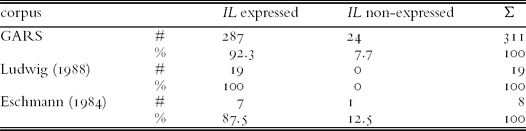
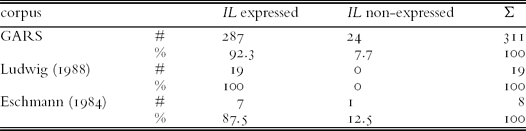
In light of the overall small number of counterexamples, we have searched the selected three modern synchronic data corpora of spoken French for instances of embedded finite constructions with falloir ‘to have to’. As can be seen in the results of this search, given in Table 2, two out of the three selected data corpora feature (a comparatively small number of) instances of such constructions with non-expressed IL(cf. (10) for relevant illustrations).
Embedded finite constructions with falloir ‘to have to’
(10)
From these findings as well as in light of the counterexamples in (8c) and (9) above, it appears that no strict correlation holds between the (non-)expression of ILand the (non-)embeddedness of the IC in CF.
Interestingly enough, the non-expression of IL in embedded finite constructions does not represent a recent phenomenon. This at least follows from a scrutiny of the 306 instances of constructions with faut ‘must’ and non-expressed ILestablished in the 113 pieces of literary work from the mid-17th to the end of the 19th century (cf. section 3.2). In fact, as the five relevant instances in (11) illustrate, the non-expression of IL in embedded finite constructions in CF may be shown to date back to (at least) the mid-18th century. This is a natural finding, given that the non-expression of IL in ICs in CF represents the continuation of a grammatical trait of older stages of French in which all ICs may have ILnon-expressed.
(11)
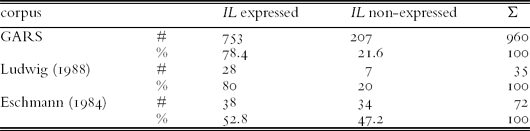
Note that these examples further substantiate the observation that no strict correlation holds between the (non-)expression of ILand the (non‑)embeddedness of the IC in CF. Yet, according to the search of the three modern synchronic data corpora of spoken French for instances of root finite constructions with falloir ‘to have to’ (cf. Table 3), the basic claim of a root-embedded-asymmetry regarding the (non‑)expression of IL seems to be corroborated.
Root finite constructions with falloir ‘to have to’
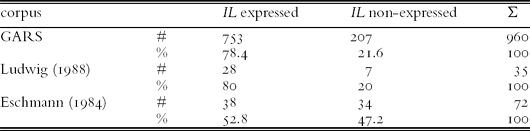
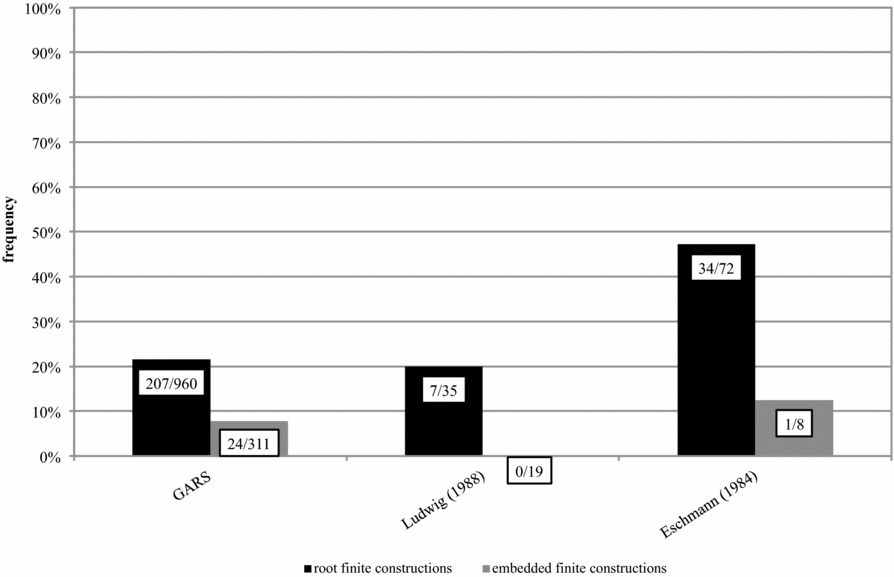
A comparison of the results of this search with those of the previous search (cf. Table 2 above), illustrated in Figure 1, clearly shows that IL is considerably more frequently non-expressed in root than in embedded finite constructions.
Finite constructions with falloir ‘to have to’ and non-expressed IL11

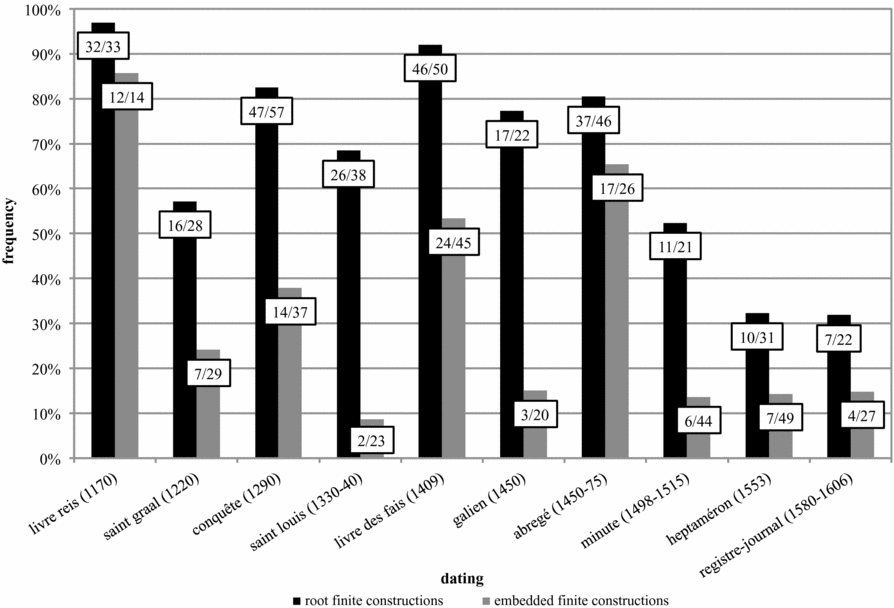
Intriguingly, the state of affairs established for CF is highly reminiscent of the one in Medieval French in which the (non-)expression of ILlikewise stands out due to a distinct root-embedded-asymmetry, as shown in Figure 2 for prose texts (Zimmermann, Reference Zimmermann2012).
Finite ICs with non-expressed expletive subject pronouns12
This similarity is all the more remarkable in view of the crucial finding that as shown in section 3.2, the non-expression of IL in ICs in CF represents the continuation of a grammatical trait of Medieval French.
To summarise, at least with regard to ICs with falloir ‘to have to’, the non-expression of IL in CF seems to be syntactically restricted, in that there is a distinct root-embedded-asymmetry. This crucial finding clearly indicates that this non-expression of IL represents evidence against, rather than for the approach to the status of clitic subject pronouns in CF in terms of inflectional affixes. What remains, however, fairly unclear – regardless of the analysis one eventually adopts with regard to clitic subject pronouns in CF – is what exactly lies behind the non-expression of IL. In the next section, we shall briefly turn to this yet again intricate issue and provide a tentative account of it.
5. ACCOUNTING FOR THE NON-EXPRESSION OF IL IN ICs
The intriguing nature of the non-expression of IL in ICs in CF stems from the fact that with the additional exception of a highly restricted conventionalised set of (personal) constructions (cf. section 1), finite constructions without any subject are otherwise illicit in CF. The crucial question in this regard is, why mayIL be non-expressed in constructions with the impersonal verbs in (2) (cf. section 2)? According to the discussion in section 3, functional, morphological and rhetorical approaches must be ruled out. Instead, a syntactic approach appears to be in order, especially in view of the major findings that (i) the non-expression of IL in CF evidently represents the continuation of a grammatical trait of older stages of French and that (ii), as in these stages, it is (to some extent) dependent on the (non-)embeddedness of the IC.
On the basis of these findings, we essentially argue that ICs with non-expressed IL in CF constitute a restricted set of residual Medieval French constructions contemporary speakers of CF may additionally resort to. It thus seems to be a natural step to assume that in CF, the non-expression of IL follows from the same reasons as the non-expression of subject pronouns in older stages of French. Regarding these stages, it is generally claimed in generative approaches that subject pronouns may be non-expressed in configurations of the type [V[+finite]pro] in which the finite verb, as the governing head, licenses the subject position and identifies, by means of its agreement features, the content of the subject. What is crucial in this regard is the central – and empirically well motivated – assumption that in cases of non-expressed subject pronouns, the finite verb must move to some head position in the left periphery to meet the required licensing and identification requirements. Note that if it is indeed the case that (i) in CF, the non-expression of IL follows from the very same reasons as the non-expression of subject pronouns in Medieval French and that (ii) this non-expression is a direct result of verb movement, then the non-expression of IL may be considered theoretical evidence against the approach to the status of clitic subject pronouns in CF in terms of inflectional affixes.
Even though the analysis just outlined generally underlies generative approaches to the non-expression of subject pronouns in older stages of French, almost all of these refrain from expounding on the exact reasons lying behind the left-peripheral movement of the finite verb. Those who have provided for an account do so by drawing on information structure. Specifically, the further movement of the finite verb has been motivated either in terms of a Topic Criterion (Vance, Reference Vance1997) or a Focus Criterion (Zimmermann, Reference Zimmermann2012; cf. also Kaiser and Zimmermann, Reference Kaiser, Zimmermann, Rinke and Kupisch2011). Under these accounts, the movement of the finite verb to a left-peripheral head position thus follows from the fulfillment of either one of these criteria, namely whenever some phrasal non-subject constituent or the finite verb itself is topicalised and focused, respectively. Given that the vast majority of ICs with non-expressed IL in CF constitute constructions in which the finite verb is in first position, we tentatively assume that in these constructions, the movement of the finite verb follows from either its topicalisation or focalisation. Under this assumption, then, ICs with non-expressed ILconstitute a restricted set of residual medieval French constructions contemporary speakers of CF may additionally resort to, whenever the impersonal verb either represents known information or brings into special prominence new information.
To illustrate, consider the sentence in (9b), repeated in (12), which features both a root and an embedded finite construction with falloir ‘to have to’.
(12)

With regard to the embedded construction, the impersonal verb faut ‘must’, together with its complement, may well be considered topicalised, since this construction represents a reiteration of the root construction. As for faut ‘must’ in the root construction, special emphasis may be argued to be on the notion of the urgent necessity that something is to be done, so that in this construction, the finite verb may be considered specially focused.
Note, finally, that under the present account of ICs with non-expressed IL in CF, the distinctly lower frequency in this non-expression of IL in embedded clauses may be argued to directly follow from functional specificities of clause types, in that topicalisation and focalisation are more marked in embedded than in root clauses (Price, Reference Price1961; Roberts, Reference Roberts1993). The present account, then, allows to capture both the non-expression of IL in ICs in CF and its overall distribution.
TEXT EDITIONS CONSULTED