




No CrossRef data available.
Jewish Occupational Selection: Education, Restrictions, or Minorities?
Published online by Cambridge University Press: 22 November 2005
Abstract
Before the eighth–ninth centuries CE, most Jews, like the rest of the population, were farmers. With the establishment of the Muslim Empire, almost all Jews entered urban occupations despite no restrictions prohibiting them from remaining in agriculture. This occupational selection remained their distinctive mark thereafter. Our thesis is that this transition away from agriculture into crafts and trade was the outcome of their widespread literacy prompted by a religious and educational reform in Judaism in the first and second centuries CE, which gave them a comparative advantage in urban, skilled occupations. We present evidence that supports our argument.
Information
- Type
- ARTICLES
- Information
- Copyright
- © 2005 The Economic History Association
Why since the ninth century have the Jews been engaged primarily in urban, skilled occupations, such as crafts, trade, finance, and the medical profession? Why were the Jewish people a minority in many cities and towns? Why did this occupational selection and demographic characteristics become the distinctive mark of the Jews? The distinctive occupational and residential structure of the Jews has been one of the central questions studied by scholars of Jewish history.
The most common explanation is the well accepted view that the Jews were not engaged in farming as was the rest of the population because of the restrictions and prohibitions imposed by the local rulers.1
See, for example, Abrahams, Jewish Life, p. 249; and Roth, Jewish Contribution, p. 228.
Simon Kuznets, who documented that at the beginning of the twentieth century, an overwhelming proportion (95 to 99 percent) of the Jews in eastern Europe and North America were engaged in urban, skilled occupations, suggested an alternative explanation.2
Kuznets, “Economic Structure” and Economic Structure of U.S. Jewry. See also Reich, “Economic Structure.”
We show that the existing historical evidence does not support these two explanations at the time when the occupational transition of the Jews occurred in the eighth and the ninth centuries, mainly in Mesopotamia and the entire Muslim Empire, and later in western Europe where the Jews migrated. At this time and in these locations, there were no restrictions on Jewish economic activities. Also, before the occupational transition, the Jews were farmers and also a minority in the lands of the Roman and Persian empires. Given that they were a minority even when they were farmers, Kuznets's theory would predict that they should stay in that occupation to preserve their group identity. Yet, the Jews did not remain farmers despite their minority status.3
Baron, Social and Religious History, 1st ed., vol. 2; Ben-Sasson, “Middle Ages”; and Gil, Kingdom, argued that deteriorating agriculture and urbanization in the Muslim Empire made almost all the Jews move into urban occupations. This argument leaves unexplained why many Jewish farmers moved into these occupations, whereas the rest of the population did not.
Our thesis is that the distinctive characteristic of the Jews was that by the six–seventh centuries CE, a significant proportion of Jewish farmers had basic literacy whereas the non-Jewish rural population was illiterate. As such, Jewish farmers had a comparative advantage in the skilled occupations demanded in the new urban centers (such as Baghdad) developed in Iraq by the Muslim rulers in the eighth century, and later in the entire Muslim Empire and western Europe where the Jews migrated as new trade opportunities opened from East (China and India) to the West.
Why at the beginning of the eighth century were many Jewish farmers literate whereas the rest of the rural population was illiterate? The main contribution of this article is to provide the historical evidence of the implementation of a religious and educational reform within Judaism that had started in the second–first centuries BCE, and underwent a big push after the destruction of the Second Temple in 70 CE when the power in the Jewish community shifted from the Sadducees to the Pharisees. The new religious leadership transformed Judaism from a religion based on sacrifices in the Temple in Jerusalem to a religion whose main rule required each male Jewish individual to read and to teach his sons the Torah in the synagogue. This reform was implemented in Eretz Israel, Babylon, and other locations where most Jews were farmers who would not gain anything from investing in education. In other words, this educational reform was not prompted by economic motives but was the outcome of an exogenous change in the religious leadership after the destruction of the Temple.
When urbanization expanded as it did in the early Muslim Empire, almost all Jewish farmers moved to the cities where the returns to their human capital were higher than in agriculture. Once they moved to the cities and entered urban occupations, Jewish households invested even more in their children's education. We present a lot of evidence from the documents of the Cairo Geniza and the vast rabbinic Responsa literature (described later), which show the almost full implementation of mandatory primary schooling for boys in the Jewish communities after the occupational transition.4
In Botticini and Eckstein, “From Farmers to Merchants,” we built a model in which an adult Jewish individual chooses the level of education for his children, his own occupation, and religion. The model predicts our main argument outlined above, and it also makes predictions on conversions out of Judaism.
One may question whether the change in the religious and social norm had economic returns. We show that the knowledge of Hebrew for religious purposes, the common Hebrew language regardless of the different local spoken languages, and the common Jewish law across all communities, in addition to the network externality highlighted by Avner Greif, provided high returns to Jewish merchants.5
Greif, “Contract Enforceability.”
The view that Jews (and other diasporas) invested in human capital because it is portable and cannot be expropriated (see the debate in Brenner and Kiefer, “Economics”; and Ayal and Chiswick, “Economics”) does not hold for the Jews because their decision to invest in human capital came centuries before their migrations and was motivated mainly by religious reasons.
Our article contributes to the growing literature on the long-term economic outcomes of changes in social norms, cultural values, and institutions.7
See, for example, Acemoglu, Johnson, and Robinson “Colonial Origins,” and “Reversal of Fortune”; Barro and McCleary, “Religion”; Berman, “Sect”; Carlton and Weiss, “Economics”; Chiswick, “Economics”; Greif, “Cultural Beliefs”; Temin, “Is It Kosher?”; Mokyr, Gifts; and North, Institutions.
COMMON EXPLANATIONS
The main common and widely accepted explanation for the occupational selection of the Jewish people is the restrictions argument proposed by the prominent scholar Cecil Roth who wrote “the Jew was driven by the unfortunate circumstances of his history to be predominantly a townsman. He had to seek an outlet, despairingly, in every branch of urban economy.”8
Roth, Jewish Contribution, p. 228.
Abrahams, Jewish Life, p. 249.
A less known view, the economics of small minorities, was proposed by Kuznets, who argued that the economic structure of the Jewish people is the result of an endogenous choice.10
Kuznets, “Economic Structure.”
Weber, Ancient Judaism, pp. 363–64.
OCCUPATIONAL TRANSITION
Do the common explanations hold for the time and locations where the occupational transition of the Jews occurred? Table 1 answers this question by summarizing the occupational distribution of the Jews in the first millennium.

Before 400 CE, the occupation of almost all Jews everywhere was farming. The information on their occupational distribution in the three main centers of Jewish life in the classical period—Eretz Israel, Mesopotamia, and Egypt—comes from these sources. For Eretz Israel there are the writings of the Jewish historian Flavius Josephus in the first century CE; the endless number of references to farming in the Mishna; the many discussions about agriculture in the Talmud of the Land of Israel (Talmud Yerushalmi); and the extensive archaeological evidence showing that most Jews lived in rural villages.12
An entire volume (Zeraim) of the six forming the Mishna is devoted to the rules that Jewish farmers had to follow. Also, almost all the holidays discussed in the volume Moed are related to the numerous agricultural tasks over the year.
Moshe Gil summarizes this wealth of evidence by saying that in the period before the eighth century, almost all Jews in Eretz Israel and most in the Diaspora earned their living from agriculture. Of course, in the cities, such as Alexandria, Babylon, Jerusalem, and Rome, the Jewish people were also engaged in crafts and trade.13
Gil, Kingdom, p. 593.
The transition away from agriculture into crafts, trade, and moneylending started in the Talmudic period, especially in Babylon. The Babylonian Talmud has many more debates and rulings regarding crafts and trade than the Talmud of the Land of Israel. In the fifth–sixth centuries the Jews abandoning agriculture moved to the towns and became small shopkeepers and artisans in the tanning, linen, silk, dyeing, and glassware-making industries.14
Baron, Social and Religious History, 1st ed., vol. 2, p. 244; and Jacobs, “Economic Conditions.”
Beer, Babylonian Amoraim.
The key period of urbanization occurred in the Muslim Empire during the Abbasid rulers' tenure from the mid-eighth to the early ninth centuries.16
Lewis, Arabs.
Ben-Sasson, “Middle Ages,” p. 393; and Gil, Kingdom, pp. 593–96.
Goitein, Mediterranean Society, vol. 1; and Gil, Kingdom, pp. 598–602.
Two impressive primary sources that illustrate the social and economic life of the Jewish communities in all the lands of the vast Muslim Empire, amply describe this occupational transition. The documents of the Cairo Geniza, which refer to thousands of contracts (sales, marriage deeds, loans, business partnerships), wills, letters, and court records, show that many Jewish people were no longer engaged in agriculture in the lands of the Muslim Empire because few documents refer to Jewish farmers. Given that the urban Jewish communities mainly wrote these documents, it is not surprising that the deeds, contracts, and letters overrepresent urban households.
In contrast, the other primary source does not suffer of this potential selection bias. It is known as the rabbinic Responsa literature and refers to the thousands of written replies (teshuvot) and rulings that the Geonim (the heads of the academies in Iraq from the sixth century on) sent in reply to the letters they received from the Jews living in rural and urban locations all over the world. Two key pieces of information come from the Responsa. First, in 787 CE the Geonim of the two academies of Sura and Pumpedita (the leading academies in Iraq) abrogated a Talmudic law and decreed that debts from orphans and women's dowries could also be exacted from movable property, whereas before that time creditors could claim only landed property.19
Mann, Responsa, p. 311.
Brody, Geonim, chapter 4.
Gil, Kingdom, pp. 593–96.
Ibid., pp. 598–602.
When in 1167–1170 Benjamin de Tudela wrote his travel itinerary describing the Jewish communities throughout the world of his time, the transition away from agriculture into urban occupations had reached a full-fledged stage. He found (or heard of) Jewish communities in small and large cities from Spain, France, Italy, and central Europe, all the way to Tibet, India, the Middle and Near East, Mesopotamia, and North Africa. The Jews described in de Tudela's book were officials of Pope Alexander in Rome, physicians in Amalfi, dyers in Brindisi, artisans in silk in Thebes and Salonika, merchants, tanners and physicians in Constantinople, glassmakers and owners of vessels in Antioch and Tyre, and handicraftsmen and dyers in Sidon, Jerusalem, Bethlehem, and Jaffa.
To sum up, all scholars agree that the vast majority of Jews were farmers in the first half of the millennium, whereas at the end of the millennium a small proportion of them remained in agriculture and the vast majority were craftsmen, artisans, merchants, doctors, moneylenders, and long-distance traders in the Muslim lands. These urban, skilled occupations remained the distinctive mark of the Jews thereafter.
RESTRICTIONS ON JEWISH ECONOMIC ACTIVITIES
Does the argument based on restrictions hold true during the Arab and Muslim expansion when the Jewish population moved away from agriculture into trade? The answer is no. In this period, there were no legal restrictions on any Jewish economic activity.23
Earlier, in the Roman Empire, some legal restrictions on Jewish economic activities were enacted after the revolts in the first and second centuries CE (e.g., the Jews could not enter the civil service or the law profession) (see Juster, Juifs). In contrast, there were no restrictions on the economic activities of the large Jewish community living in Babylon under the Parthian and the Sasanian rulers (see Neusner, History, vols. 1, 2, and 3).
Morony, “Landholding”; Lewis, Jews; Gil, History; and Cohen, Under Crescent. Non-Muslim people had also to pay the poll tax levied on each household head. In the eleventh century, it amounted to 3.4 dirhems per month, about 5 percent of a teacher's salary at that time. The poll tax, however, was levied regardless of the occupation of the household head (Goitein, Mediterranean Society, vol. 1).
One may object that the legal codes do not give a portrait of how people actually behaved and there might have been unwritten social norms that made it difficult for Jewish households to own land and to engage in agriculture. However, the contracts, land transactions, business partnerships, and wills of the Cairo Geniza and the letters from the rabbinic Responsa literature clearly show that any occupation was available and indeed chosen by the Jews in the Muslim Empire. At the same time, the same documents refer to land holdings belonging to Jews and land transactions among them, which is direct evidence that the Jews not only could but also did own land in the Muslim period.25
Goitein, Mediterranean Society, vol. 1; and Gil, History and Kingdom.
JEWISH DEMOGRAPHICS AND MINORITY STATUS
Information on demographic trends shows that Kuznets's explanation (the economics of small minorities) does not pass the test of historical facts for the first millennium. Table 2 indicates that in Mesopotamia, the Jews were a minority from the first to the third century when most of them were farmers, and they remained a minority in the eighth century when most became craftsmen and merchants.26
For the size of the Jewish and non-Jewish populations in the first millennium, we carefully read the works of leading historians and demographers (for example, Baron, “Population”, and DellaPergola, “Fundamentals”) and we greatly benefited from a very helpful discussion with Sergio DellaPergola. Although there is disagreement among scholars on specific numbers, there is a general consensus on the trends and the relative size of the populations in selected locations at given times. The numbers should be considered ranges of values, instead of exact figures.

At the same time, in Eretz Israel most Jews were engaged in agriculture regardless of whether they were the majority of the population (up to the end of the third century) or a minority (from the fourth century on and in the Byzantine period, when the Jews were living mainly in Galilee as farmers).27
Dan, “Byzantine Rule.”
The same pattern occurred in Egypt where a large Jewish community lived in the first century CE. They were a minority there—one of the many minorities—and yet most of them were engaged in agriculture (the only notable exception being Alexandria, which hosted a large urban Jewish community).28
During the first millennium there were many other minorities that kept their distinctive characteristics yet lived in villages as farmers (see Cohen and Frerichs, Diasporas). The related claim by Weber that the Jews voluntarily chose to segregate and to become an urban population in order to maintain their religious rules is contradicted by groups, such as the Amish in the United States, who remained farmers and yet maintained their religious cohesiveness and group identity.
EDUCATION IN JUDAISM
If restrictions on economic activities or the minority status of the Jews cannot explain their occupational transition in the eighth–ninth centuries, what is an alternative explanation? At the beginning of the first millennium, Jews dressed like, looked like, and spoke the same local languages as the non-Jewish populations. We argue that the key difference between Jews and non-Jews was that by the sixth–seventh centuries, a large fraction of the Jewish rural population was able to read (and some to write), whereas the non-Jewish rural population was illiterate. This comparatively higher literacy of Jews was the outcome of a religious and educational reform that had started in the second–first centuries BCE and became the central goal of the religious leaders from the third century CE on. This sweeping change completely transformed Judaism into a religion centered around reading, studying, and implementing the rules of the Torah, the Mishna, and the Talmud.
Judaism Before 70 CE
The development of Jewish educational institutions was a slow and long process that occurred between the third century BCE and the first century CE in Eretz Israel when the majority of the Jewish population was rural and illiterate.29
Bar-Ilan, “Illiteracy,” argues that the literacy rate among the Jewish population in Eretz Israel at this time was at most 3–10 percent given that most of the Jewish population was rural.
In early times (about 515–200 BCE), academies for higher learning were established in Jerusalem to prepare the priests for the Temple, but their access was restricted to a very small group of people. Schools for higher education were founded in Babylon, Jerusalem, and later in other towns but there is no direct information on how many students attended them.30
See Drazin, History; and Morris, Toldot.
In the first century BCE, the president of the Sanhedrin Simeon ben Shetah promoted the establishment of free secondary schools throughout Palestine, which were supposed to prepare young adults (16 or 17 years old). Later, the high priest Joshua ben Gamla (ca. first century CE) issued a religious ruling that “teachers had to be appointed in each district and every city and that boys of the age of six or seven should be sent.”31
See Demsky, “Literacy,” p. 368; and Greenberg, “Jewish Educational Institutions,” p. 1261. This is the quotation in the Talmud [Baba Batra 21a] that refers to the decree of Joshua ben Gamla: “However, that man is to be remembered for good, and his name is Joshua ben Gamla; for were it not for him Torah would have been forgotten in Israel. For at first he who had a father was taught Torah by him, and he who had no father did not study Torah. It was then decreed that teachers of children should be appointed in Jerusalem. However, he who had a father, the father would bring him to Jerusalem and have him taught, while he who had no father, would not come to Jerusalem to study. It was then decreed that teachers of the young should be appointed in every district throughout the land. But the boys would be entered in the school at the age of sixteen and seventeen and if the teacher would rebuke one of them, he would resent it and leave. Thus it was until Joshua ben Gamla decreed that teachers of children should be appointed in every district and every city and that boys of the age of six and seven should be entered.”
Flavius Josephus, Against Apion, Book I, sec. 12, and Book II, sec. 19.
Salo Baron attributed the increased emphasis on religious instruction to the competition for the leadership within the Jewish community between the Sadducees who accepted only the Written Torah and adopted the Hellenistic culture, and the Pharisees who aimed to expand the study of both the Written and the Oral Torah among all Jews, and strongly opposed the expansion of the Greek language and culture.33
Baron, Social and Religious History, 2nd ed., vol. 2, pp. 274–79. See also Feldman, Studies, and Baumgarten, Flourishing. At this time, the Oral Torah consisted of the rulings of rabbis and high priests regarding the implementation of the Written Torah.
Ebner, Elementary Education.
Hezser, Jewish Literacy, pp. 495–97.
The Mishna, the Talmudic, and the Early Gaonic Period (70–638 CE)
The destruction of the Second Temple in 70 CE deeply changed the Jewish religion. The Sadducees, who lead the rebellion against the Romans, disappeared after the destruction of Jerusalem, whereas the Pharisees, who did not actively participate in the revolt, left Jerusalem after its destruction and established the new center of religious life in the academy (yeshiva) and the Sanhedrin at Jabneh. Under their leadership, the core of Judaism no longer consisted of the rituals, sacrifices, and ceremonies that could only be performed by the priests in the Temple, but became centered around the reading and teaching of the Torah.36
Drazin, History, p. 25; Maller, “Role”; and Safrai, “Elementary Education.”
Instruction meant religious instruction to prepare the male children to read, once adults, in the synagogue, which became the center of reading and learning the Torah.37
A tractate of the Mishna (Megillah) is devoted to the rules of reading the Book of Esther and the Torah in the synagogue.
Flesher, “Palestinian Synagogues”; and Levine, Ancient Synagogue.
At the same time when many synagogues were built across Palestine, in the yeshiva at Jabneh, which functioned as an academy, a high court, and a parliament, the scholars (Tannaim) discussed religious, social, and economic matters submitted to them, interpreted the Bible and the sacred law, and issued rulings. They also systematically organized the vast body of Jewish Oral Law accumulated through the centuries, until rabbi Judah ha-Nassi completed their work by redacting the Mishna about 200 CE.39
Cohen, “Rabbinic Judaism”; and Neusner, Economics. The Mishna consists of six volumes of rules: Zeraim deals with the rules for farming, Moed with feasts, Nashim with marriage and divorce, Nezikin with civil and criminal law, Kodashim and Tohorot with sacrifices and other ritualistic issues.
Oppenheimer, Am ha'aretz; and Haas, “Am ha'aretz,” p. 149.
The transformation of Judaism with the core centered around reading and learning the Torah was prompted by the religious leaders in Eretz Israel where half of the world Jewish population lived and the vast majority were farmers, and was accepted and implemented by Babylonian Jews who were also mainly farmers. Given that the main goal was to make every male child able to read the Torah in the synagogue, it is hard to see an economic motive for a religious and educational reform that was promoted within a farming society.
From the third throughout the fifth century the Amoraim (the scholars in the yeshiva after the Tannaim) debated, discussed, and clarified the rulings in the Mishna. Their opinions were collected in the Talmud of the Land of Israel, redacted about 400 CE, which is mainly devoted to agriculture; a farming society was the target audience for whom the rabbis elaborated their rulings.
The implementation of the educational reform received a major push at this time. As Baron points out, “in the Talmudic period Jewish learning penetrated still deeper into the masses. This happened at a time when illiteracy was widespread throughout the Mediterranean world and when the Imperial City itself had only begun to establish public schools for the wealthy and the middle class.”41
Baron, Social and Religious History, 2nd ed., vol. 2, p. 279.
Safrai, “Financing,” pp. 77–78; and Gafni, Jews, pp. 107–09.
The second and independent source of evidence comes from the archaeological discoveries on synagogues. During the Talmudic period, the reading of the Torah became more spread among Jews through the attendance of the local synagogues. Many synagogues were built in the third–fifth centuries in Judaea, Galilee, and the Golan.43
Safrai, “Education”; Aberbach, Jewish Education, p. 41; Stern, New Encyclopedia; Safrai, “Communal Functions”; Urman and Flesher, Ancient Synagogues; and Schiffman, “Early History.”
Although Palestine remained important as the center for the yeshiva, Babylon (Iraq) grew in importance as the new center of Jewish religious and economic life. The scholars in the academies in Babylon collected their opinions and comments on the Mishna in the Babylonian Talmud, completed around 500 CE. Unlike the Talmud of the Land of Israel, the Babylonian Talmud has more material dealing with crafts and trade. Also, unlike the Talmud of the Land of Israel, which describes a communal organization of primary education, the Babylonian Talmud puts more emphasis on the parents' responsibility for paying for their children's education. For example, a ruling required a father to pay for his son's education and to teach him, or to have someone teach him, a craft.44
Goitein, Jewish Education, p. 121; Gafni, Jews, pp. 107–09.
The other source of information on the extent of religious instruction and primary education of children comes from the archaeological evidence on synagogues, which again provides information independently of the discussions in the Talmud. Many synagogues were also built in Mesopotamia and in all the lands of the Diaspora.45
Ovadiah, Ancient Synagogues”; Oppenheimer, Kasher, and Rappaport, Synagogues; Gafni, “Synagogues”; Oppenheimer, “Babylonian Synagogues”; and Levine, “Hellenistic-Roman Diaspora.”
The growth of the yeshiva in Babylon and the growing number of scholars and students in the academies indirectly show that more students must have gotten some primary education, without which they could not enter the academies. Related to the yeshiva, the institution of the kallah (apparently begun in Babylon in the third century) indicates that education was becoming more widespread among the Jewish rural population in Iraq from the fourth century. The months of kallah were two months a year (March and August, when there were no agricultural activities) when Jews from everywhere visited the academy where a specific section of the Talmud was read and discussed by scholars. An important event of Jewish life was scheduled to occur at a time of the year when (literate) farmers could attend it.46
Neusner, History, vol. 4, pp. 384–85.
See Alon, Jews. For more than five hundred years (from the mid-sixth to the eleventh century) the Gaonic Responsa are one of the main sources of information on the social, religious, and economic life of the Jews in all the lands of the Diaspora.
With regards to Jewish education, the rabbinic Responsa provide more information on the Babylonian academies than the primary schools. Yet, from the Responsa there is evidence that there were teachers who taught small children everywhere, even in villages, in Mesopotamia.48
Assaf, Mekorot, vol. 2, pp. 11–27.
The evidence from the early Gaonic Responsa is important because it comes before the Muslim period. By showing that more Jews educated their children in the period before the urbanization occurring in the Muslim Empire, the rabbinic Responsa support our claim that the Jews were investing in their children's religious literacy and education before the transition from agriculture into trade.
The Arab and Muslim Period (638–1170)
In the Arab and Muslim period, the Responsa of the Geonim and the documents of the Cairo Geniza confirm the common pattern among the Jewish communities: basic literacy among male Jews became almost universal in both rural and urban communities.
The rabbinic Responsa mention that there were teachers of small children everywhere.49
Ibid., pp. 21–22. For example, in the Responsa of Hai Gaon, he refers to “teachers (garsai) of the villages” who taught the Talmud despite not being well-versed in Scriptures.”
Mann, Responsa, p. 325.
Assaf, Mekorot, vol. 2, p. 27.
The thousands of letters, contracts, wills, and written transactions of the Cairo Geniza confirm the picture given in the rabbinic Responsa, but on a larger scale. These documents contain an endless number of references to school fees and teachers' salaries even from small towns and villages, such the little town of Damira, the provincial town of al-Mahalla, or the small village of Qalyub. 52
Goitein, Mediterranean Society, vol. 2, pp. 174, 187, 193.
Greenberg, “Jewish Educational Institutions,” p. 1270. The fees were also needed for the construction and maintenance of synagogues and for the purchase of books.
Goitein, Mediterranean Society, vol. 2, p. 186.
In the world described in the documents of the Cairo Geniza, primary instruction was given in the synagogue, in the house of the teacher, or in the house of the child's parents in the case of wealthy and prominent families. Small communities and villages had to invite a teacher by promising a minimum weekly salary, whereas in towns and cities teachers competed one against the other to attract students. In many elementary schools in Egypt, teachers were foreigner Jews who had migrated there from other countries.55
Cohen, “Foreign Jewish Poor,” p. 54.
After acquiring basic literacy in primary schools or synagogues, Jewish merchants, physicians, and government officials gained higher skills in both reading and writing to the extent that they could write and discuss sophisticated religious arguments, as shown in the many letters of the Cairo Geniza. Being a scholar and being a merchant were often the same thing among the most educated Jews.56
Goitein, Mediterranean Society, vol. 2, p. 195.
Ibid., pp. 205–06.
Schlomo Goitein summarized the wealth of evidence on the extent of Jewish primary education in the Muslim period saying that the documents of the Cairo Geniza show that in the Jewish communities everywhere, “elementary education was universal to a very remarkable degree, but its standards seem to have been rather poor.”58
Ibid., p. 174.
Thus, one thousand years after the religious and educational reform prompted by the Pharisees, most Jews had some basic literacy and a significant number of them, as merchants and scholars, had acquired higher levels of education and learning.
URBANIZATION, JEWISH EDUCATION, AND MIGRATIONS
Urbanization, Eighth to Ninth Centuries
Urbanization greatly expanded during the Arab and Muslim period.59
Lewis, Arabs.
Lapidus, “Arab Settlement,” p. 203.
De Long and Shleifer, “Princes and Merchants,” table 1; and Watson, “Medieval Green Revolution,” p. 56.
The growth of new cities, towns, and administrative centers increased the demand for urban and skilled occupations in the lands under Muslim rule. The literate Jewish rural population in Iraq, and later in all the Muslim Empire, moved to urban centers, abandoned agriculture, and became engaged in crafts and trade. In these cities, the Jewish population became very large.62
Using various sources, Gil, Kingdom, p. 458, maintains that many Jews lived in more than a hundred cities in Iraq and Iran during the Gaonic and Muslim period, and that at the time of the Mongolian invasion in 1258, there were about 200,000 Jews and about 30 synagogues in Baghdad.
Baron, “Population”; and DellaPergola “Fundamentals.”
Whereas the most educated Jews (the scholars in the academies) had left agriculture and become merchants well before the expanded urbanization in Iran and Iraq, the literate Jewish rural population left agriculture when the growth of cities in the Muslim Empire made available to them the urban and skilled occupations. Although some non-Jews also moved to the new urban centers and entered skilled occupations, most of them remained farmers.64
Baron, Social and Religious History, vol. 3; and Gil, Kingdom.
Gil, Kingdom, p. 57.
Returns to Jewish Education and Jewish Comparative Advantage
Our main thesis is that the educational reform that made the reading of the Torah the core of Judaism endowed the Jews with a comparative advantage in urban, skilled occupations. But how did the investment in religious education, prompted by the transformation of Judaism at the beginning of the first millennium, bring economic returns to the Jewish people centuries later?
Learning as children to read one language (Hebrew) enabled the Jews to read other languages (Aramaic, Greek, and Latin) that were used in the locations where the Jews were living in the first half of the millennium. Later, in the Muslim period, it enabled them to read and to write documents in Hebrew-Arabic, as the documents of the Cairo Geniza amply show, and to write with Hebrew characters the local languages of the locations in western Europe where they migrated (e.g., French, Italian, German, and Latin).66
Limor, Beginnings, p. 158.
The ability to read religious texts in Hebrew also enabled the Jews to read any other documents written in Hebrew, such as business letters, sale and purchase contracts, partnership deeds, and loans, even if the local languages they spoke were different.67
The growth of Hebrew as the common language among Jews living everywhere is also reflected by the fact that this period produced most of Hebrew poetry, prose, and translations of stories from Arabic and Latin into Hebrew.
Greif, “Reputation and Coalitions.”
In addition to basic literacy, those Jews who learned the Mishna and especially the Talmud, also acquired the rational thinking and the debating ability which is required to understand the Talmudic debates and is also helpful in commercial transactions and moneylending.69
Sombart, Jews, p. 149.
Literacy and education were valuable not only for merchants and moneylenders. Unlike today, the production of almost all goods was custom-tailored in the first millennium. Even for artisans and craftsmen such as goldsmiths, jewelers, blacksmiths, producers of weapons, shoemakers, dyers, and tailors, there was an advantage from being able to write contracts, which specified the characteristics of the raw materials and the finished products, in case disputes arose later on with either the customers or the merchants.70
Goitein, Mediterranean Society, vol. 1.
Ibid., vol. 2, p. 174.
Education and Migrations
Since the early ninth century, as many Jews became craftsmen and merchants, they voluntarily migrated to North Africa, Muslim Spain, Sicily, and towns in western Europe. During the tenth and eleventh centuries, they spread to Champagne and South Germany where fairs and the revival of trade started flourishing.72
Glick, Abraham's Heirs.
Ben Sasson, “Middle Ages,” pp. 393–402.
Kahn, “Economic History.”
The Jews who were engaged in long-distance trade had the highest human capital.75
Agus, Urban Civilization, p. 7; and Goitein, Mediterranean Society, vol. 1.
Both the documents of the Cairo Geniza and Benjamin de Tudela's travel itinerary show that in the Muslim period, the Jews were living in small communities everywhere from China and Aden in the East to Spain and Germany in the West, whereas only a few locations (such as Baghdad) hosted very large Jewish communities. In the tenth–eleventh centuries the Jewish Diaspora was at its height and continued throughout history. One implication of our thesis is that the Diaspora and the minority status of the Jews in many locations were not exogenous facts (as Kuznets postulated) but were the endogenous outcomes of their selection into urban and skilled occupations.
CONCLUDING REMARKS
The novel contribution of this article is to provide the historical evidence to support a simple economic rationale for the transition of Jewish people from farming to urban, skilled occupations from the eighth to the ninth century. The transformation of Judaism into a religion that required each Jewish man to be able to read the Torah, and later the Mishna and the Talmud, made the Jewish people during the first millennium a literate ethnic group in a world where the rest of the population was illiterate. This transformation occurred at a time when the vast majority of the Jews were farmers and, therefore, cannot be attributed to a human capital investment made in order to engage in a particular occupation or to enable migration. Education was an exogenous hedge in the formation of Jewish religion that we take as given. Based on this fact, we argue that the occupational transition was the outcome of an exogenous change in social norms prompted by a religious reform.
During the Middle Ages, and especially in Europe, a large proportion of the Jews specialized in moneylending. The conventional view is that this was the outcome of the prohibitions imposed on Jews from engaging in occupations except moneylending, and prohibitions on non-Jews from engaging in moneylending. Our work raises the possibility that alternative hypotheses related to acquired skills and social networking may provide a different explanation for the ethnic distribution of moneylending in the Middle Ages.
Special thanks to Claudia Goldin and Joel Mokyr for their insightful and detailed comments. We also had very helpful discussions with Robert Barro, Eli Berman, Robert Brody, Barry and Carmel Chiswick, Mark R. Cohen, Sergio DellaPergola, Stanley Engerman, Stefano Fenoaltea, Moshe Gil, Nachum Gross, Moshe Kasher, Steven Katz, Ephraim Kleiman, Bernard Lewis, Robert Margo, Rachel McCleary, Jacob Neusner, Aharon Oppenheimer, Yossef Rapoport, Kenneth Sokoloff, Peter Temin, and Jeffrey Williamson. Knick Harley, two anonymous referees, and participants in many seminars and conferences made the article a better one. Dan Goldenberg, Polina Kroik, Eliezer Moav, Claudia Rei, and Maria Cecilia Vieira da Silva provided outstanding research assistance. This research was supported by the National Science Foundation (grant SES-0318364), the Ministero dell'Istruzione, dell'Università e della Ricerca (COFIN-2003), and the Israel Science Foundation (grant no. 815-04), and for Botticini by a John M. Olin Junior Faculty fellowship (2000–2001) and an Alfred P. Sloan research fellowship (2002–2004). The data presented, the statements made, and the views expressed are solely the responsibility of the authors. The article contains a portion of our November 2002 draft ”From Farmers to Merchants,“ available as CEPR Discussion Paper #3718. The model and additional important historical evidence are now in the paper ”From Farmers to Merchants, Voluntary Conversions and Diaspora: A Human Capital Interpretation of Jewish History,“ Manuscript (August 2005) available at: http://www.tau.ac.il/~eckstein/
References
Aberbach Moses.
1982
Jewish Education in the Mishna and Talmud.
Jerusalem:
Reuven Mas,
(in Hebrew).
Abrahams Israel.
1896.
Jewish Life in the Middle Ages.
London:
Macmillan & Co.,
Acemoglu Daron,
Simon H. Johnson, and
James A. Robinson.
(December 2001):
“The Colonial Origins of Comparative Development: An Empirical Investigation.”
American Economic Review
91, no. 5
1369–
401.Google Scholar
Acemoglu Daron,
Simon H. Johnson, and
James A. Robinson.
(November 2002):
“Reversal of Fortune: Geography and Institutions in the Making of the Modern World Income Distribution.”
Quarterly Journal of Economics
117, no. 4
1231–
94.Google Scholar
Agus Irving A.
1965.
Urban Civilization in Pre-Crusade Europe.
A Study of Organized Town-Life in Northwestern Europe During the Tenth and Eleventh Centuries Based on the Responsa Literature.
2 vols.
Leiden:
E. J. Brill,
Alon Gedaliah.
1984.
The Jews in their Land in the Talmudic Age (70–640 CE),
vol. 2.
Jerusalem:
Magnes Press,
Applebaum Shimon.
1976.
“Economic Life in Palestine.”
In The Jewish People in the First Century:Historical Geography, Political History, Social, Cultural, and Religious Life and Institutions, edited by
Shmuel Safrai and
Menahem Stern,
vol. 2,
631–
700.
Assen:
Van Gorcum,
Applebaum Shimon.
1976.
“The Social and Economic Status of the Jews in the Diaspora.”
In The Jewish People in the First Century: Historical Geography, Political History, Social, Cultural, and Religious Life and Institutions, edited by
Shmuel Safrai and
Menahem Stern,
vol. 2,
701–
27.
Assen:
Van Gorcum,
Ashtor Eliyahu.
1976.
A Social and Economic History of the Near East in the Middle Ages.
London:
Collins,
Assaf Simha.
1925–1942
Mekorot le-toldot ha-hinukh be-Yiśra'el: mi-tehilat yeme ha-benayim ‘ad tekufat ha-haśkalah.
4 vols.
Tel Aviv:
Devir,
(in Hebrew).
Avi-Yonah Michael.
1984.
The Jews under Roman and Byzantine Rule. A Political History of Palestine from the Bar Kokhba War to the Arab Conquest.
Jerusalem:
Magnes Press,
Ayal Eliezer B., and
Barry R. Chiswick.
(1983):
“The Economics of the Diaspora Revisited.”
Economic Development and Cultural Change
31, no. 4
861–
75.Google Scholar
Bar-Ilan Meir.
1992.
“Illiteracy in the Land of Israel in the First Centuries CE.”
In Essays in the Social Scientific Study of Judaism and Jewish Society, edited by
Simcha Fishbane,
Stuart Schoenfeld, and
Alain Goldschläger,
vol. 2,
46–
61.
Hoboken, NJ:
Ktav Publishing House,
Baron Salo Wittmayer.
1937.
A Social and Religious History of the Jews.
1st Edition, 3 vols.
New York:
Columbia University Press,
Baron Salo Wittmayer.
1952.
A Social and Religious History of the Jews.
2nd Edition, 18 vols.
New York:
Columbia University Press,
Baron Salo Wittmayer.
1972.
“Population.”
In Encyclopedia Judaica,
vol. 13,
866–
903.
New York:
MacMillan,
Baron Salo Wittmayer.
1972.
“Economic History.”
In Encyclopedia Judaica.
New York:
MacMillan,
Barro Robert J., and
Rachel M. McCleary.
(October 2003):
“Religion and Economic Growth across Countries.”
American Sociological Review
68, no. 5
760–
81.Google Scholar
Baumgarten Albert.
1997.
The Flourishing of Jewish Sects in the Maccabean Era: An Interpretation.
Leiden:
E. J. Brill,
Beer Moshe.
1974
The Babylonian Amoraim: Aspects of Economic Life.
Ramat Gan:
Bar Ilan University Press,
(in Hebrew).
Benjamin de Tudela.
1907.
Sefer Masa' 'ot. The Itinerary of Benjamin of Tudela, edited by
Marcus Nathan Adler.
London:
Henry Frowde,
Ben-Sasson Haim Hillel.
1976.
“The Middle Ages.”
In A History of the Jewish People,”
edited by Haim Hillel Ben-Sasson,
393–
723.
Cambridge, MA:
Harvard University Press,
Berman Eli.
(2000):
“Sect, Subsidy, and Sacrifice: An Economist's View of Ultra-Orthodox Jews.”
Quarterly Journal of Economics
115, no. 3
905–
53.Google Scholar
Botticini Maristella, and
Zvi Eckstein.
August 2005.
“From Farmers to Merchants, Voluntary Conversions and Diaspora: A Human Capital Interpretation of Jewish History.”
Manuscript,
Available at: http://www.tau.ac.il/~eckstein.
Brenner Reuven, and
Nicholas M. Kiefer.
1981:
“The Economics of the Diaspora: Discrimination and Occupational Structure.”
Economic Development and Cultural Change
29, no. 3
517–
34.Google Scholar
Brody Robert.
1998.
The Geonim of Babylonia and the Shaping of Medieval Jewish Culture.
New Haven:
Yale University Press,
Carlton Dennis W., and
Avi Weiss.
2001:
“The Economics of Religion, Jewish Survival, and Jewish Attitudes toward Competition in Torah Education.”
Journal of Legal Studies
30, no. 1
253–
75.Google Scholar
Chiswick Carmel Ullman.
(1999):
“The Economics of Jewish Continuity.”
Contemporary Jewry
20
30–
56.Google Scholar
Clark Colin.
1968.
Population Growth and Land Use.
London:
Macmillan,
Cohen Gerson D.
1993.
“Rabbinic Judaism.”
In “Judaism,” The New Encyclopedia Britannica,
vol. 22,
393–
99.
Chicago:
University of Chicago Press
Cohen Mark R.
1994.
Under Crescent and Cross: The Jews in the Middle Ages.
Princeton, NJ:
Princeton University Press,
Cohen Mark R..
2003.
“The Foreign Jewish Poor in Medieval Egypt.”
In Poverty and Charity in Middle Eastern Contexts, edited by
Michael Bonner,
Mone Ener, and
Amy Singer,
53–
72.
Albany:
State University of New York Press,
Cohen Shaye J. D., and
Ernest S. Frerichs, eds.
1993.
Diasporas in Antiquity.
Atlanta:
Scholars Press,
Dan Yaron.
1990.
“The Byzantine Rule (395–640 CE).”
In The History of Eretz Yisrael. The Roman-Byzantine Period, The Mishna and Talmud Period, and the Byzantine Rule (70–640), edited by
Mosheh David Herr,
231–
374.
Jerusalem:
Keter Publishing,
DellaPergola Sergio.
2001.
“Some Fundamentals of Jewish Demographic History.”
In Papers in Jewish Demography 1997.
Jewish Population Studies, vol. 29,
edited by Sergio DellaPergola and
Judith Even,
11–
33.
Jerusalem:
Hebrew University Press,
De Long J. Bradford, and
Andrei Shleifer.
1993:
“Princes and Merchants? European City Growth before the Industrial Revolution.”
Journal of Law and Economics
36, no. 2
671–
702.Google Scholar
Demsky Aaron.
1997.
“Literacy.”
In Oxford Encyclopedia of Archeology in the Near East,
vol. 3,
362–
69.
Oxford:
Oxford University Press,
Drazin Nathan.
1940.
History of Jewish Education from 515 BCE to 220 CE.
Baltimore:
The Johns Hopkins University Press,
Ebner Eliezer.
1956.
Elementary Education in Ancient Israel During the Tannaic Period (10–220 CE).
New York:
Bloch Publishing Company,
Feldman Louis H.
1996.
Studies in Hellenistic Judaism.
Leiden:
E. J. Brill,
Flesher Paul V. M.
1995.
“Palestinian Synagogues before 70 CE: A Review of the Evidence.”
In Ancient Synagogue, Historical Analysis and Archaeological Discovery, edited by
Dan Urman and
Paul V. M. Flesher.
vol. 1,
27–
39.
Leiden:
E. J. Brill,
Gafni Isaiah.
1990
Jews of Babylonia in the Talmudic Era.
Jerusalem:
The Zalman Shazar Center for Jewish History,
(in Hebrew).
Gafni Isaiah.
1995.
“Synagogues in Babylonia in the Talmudic Period.”
In Ancient Synagogues, Historical Analysis and Archaeological Discovery, edited by
Dan Urman and
Paul V. M. Flesher,
vol. 1,
221–
31.
Leiden:
E.J. Brill,
Gil Moshe.
1992.
A History of Palestine,
634–
1099.
Cambridge:
Cambridge University Press,
Gil Moshe.
1997
In the Kingdom of Ishmael. Studies in Jewish History in Islamic Lands in the Early Middle Ages.
4 vols.
Tel Aviv:
Tel Aviv University Press,
(in Hebrew).
Glick Leonard B.
1999.
Abraham's Heirs; Jews and Christians in Medieval Europe.
Syracuse, NY:
Syracuse University Press,
Goitein Schlomo D.
1962
Jewish Education in Muslim Countries. Based on Records from the Cairo Geniza.
Jerusalem:
Hebrew University Press,
(in Hebrew).
Goitein Schlomo D.
1967,
A Mediterranean Society. The Jewish Communities of the Arab World as Portrayed in the Documents of the Cairo Geniza.
5 vols.
Los Angeles:
University of California Press,
1971, 1978, 1983, 1988.
Goodman Martin.
1998.
Jews in a Graeco-Roman World.
Oxford:
Clarendon Press,
Greenberg Simon.
1960.
“Jewish Educational Institutions.”
In The Jews, Their History, Culture, and Religion, edited by
Louis Finkelstein,
vol. 2,
1254–
87.
Philadelphia:
The Jewish Publication Society of America,
Greif Avner.
(1989):
“Reputation and Coalitions in Medieval Trade: Evidence on the Maghribi Traders.”
This JOURNAL
49, no. 4
857–
82.Google Scholar
Greif Avner.
(June 1993):
“Contract Enforceability and Economic Institutions in Early Trade: The Maghribi Traders' Coalition.”
American Economic Review
83, no. 3
525–
48.Google Scholar
Greif Avner.
(1994):
“Cultural Beliefs and the Organization of Society: A Historical and Theoretical Reflection on Collectivist and Individualist Societies.”
Journal of Political Economy
102, no. 5
912–
50.Google Scholar
Gross Nachum, ed.
1975.
Economic History of the Jews.
New York:
Schocken Books,
Haas Peter.
1989.
“The Am Ha'aretz as Literary Character.”
In From Ancient Israel to Modern Judaism. Intellect in Quest of Understanding. Essays in Honor of Marvin Fox, edited by
Jacob Neusner,
vol. 2,
139–
53.
Atlanta:
Scholars Press,
Hamel Gildas.
1990.
Poverty and Charity in Roman Palestine, First Three Centuries CE.
Berkeley and Los Angeles:
University of California Press,
Herr Mosheh David, ed.
1990
The History of Eretz Yisrael. The Roman-Byzantine Period, The Mishna and Talmud Period, and the Byzantine Rule (70–640).
Jerusalem:
Keter Publishing,
(in Hebrew).
Herr Mosheh David, and
Aharon Oppenheimer.
1990
“Social-Economic and Cultural-Religious History from the Destruction of the Second Temple to the Division of the Empire (70–395 CE).”
In The History of Eretz Yisrael. The Roman-Byzantine Period, The Mishna and Talmud Period, and the Byzantine Rule (70–640), edited by
Mosheh David Herr,
107–
229.
Jerusalem:
Keter Publishing,
(in Hebrew).
Hezser Catherine.
2001.
Jewish Literacy in Roman Palestine.
Tübingen:
Mohr Siebeck,
Issawi Charles.
1981.
“The Area and Population of the Arab Empire: an Essay in Speculation.”
In The Islamic Middle East, 700–1900. Studies in Economic and Social History, edited by
Abraham L. Udovitch,
375–
96.
Princeton, NJ:
Darwin Press,
Jacobs Louis.
1990.
“The Economic Conditions of the Jews in Babylon in Talmudic Times Compared with Palestine.”
In History of the Jews in the Second through Seventh Centuries of the Common Era. Origins of Judaism, edited by
Jacob Neusner,
vol. 8, part 1,
333–
43.
New York and London:
Garland,
Jones Arnold H. M.
1964.
The Later Roman Empire 284–602: A Social, Economic, and Administrative Survey.
2 vols.
Oxford:
Blackwell,
Josephus Flavius.
1998.
“Against Apion.”
In The Complete Works of Flavius Josephus,
translated by William Whiston.
Nashville:
T. Nelson Publishers,
Juster Jean.
1912.
La condition legale des juifs sous les rois visigoths.
Paris:
Paul Geuthner,
Juster Jean.
1914.
Les Juifs dans l'Empire Romain: leur condition juridique, economique et sociale.
2 vols.
Paris:
Paul Geuthner,
Kahn Arcadius.
1972.
“Economic History.”
In Encyclopedia Judaica.
New York:
MacMillan,
Kasher Aryeh.
1985.
The Jews in Hellenistic and Roman Egypt: The Struggle for Equal Rights.
Tübingen:
Mohr Siebeck,
Kuznets Simon.
1960.
“Economic Structure and Life of the Jews.”
In The Jews: Their History, Culture, and Religion, edited by
Louis Finkelstein,
1597–
666.
Philadelphia:
Jewish Publication Society of America,
Kuznets Simon.
1972.
Economic Structure of U.S. Jewry: Recent Trends.
Jerusalem:
Institute of Contemporary Jewry, Hebrew University of Jerusalem,
Lapidus Ira M.
1981.
“Arab Settlement and Economic Development of Iraq and Iran in the Age of the Umayyad and the Early Abbasid Caliphs.”
In The Islamic Middle East, 700–1900. Studies in Economic and Social History, edited by
Abraham L. Udovitch,
177–
208.
Princeton, NJ:
Darwin Press,
Levine Lee I.
1999.
“The Hellenistic-Roman Diaspora, 70–235 CE. The Archaeological Evidence.”
In The Cambridge History of Judaism,
vol. 3,
991–
1024.
Cambridge:
Cambridge University Press,
Levine Lee I..
2000.
The Ancient Synagogue: The First Thousand Years.
New Haven, CT:
Yale University Press,
Lewis Bernard.
1984.
The Jews of Islam.
Princeton, NJ:
Princeton University Press,
Lewis Bernard.
1993.
The Arabs in History.
6th Edition.
Oxford and New York:
Oxford University Press,
Limor Ora.
2003
Beginnings of Europe: Western Europe in the Early Middle Ages.
Tel Aviv:
ha-Universitah ha-petuhah,
(in Hebrew).
Maller Julius B.
1960.
“The Role of Education in Jewish History.”
In The Jews, Their History, Culture, and Religion, edited by
Louis Finkelstein,
vol. 2,
1234–
53.
Philadelphia:
The Jewish Publication Society of America,
Mann Jacob.
The Responsa of the Babylonian Geonim as a Source of Jewish History.
Philadelphia:
The Dropsie College for Hebrew and Cognate Learning,
1917–
1921.
Mann Jacob.
The Jews in Egypt and in Palestine under the Fatimid Caliphs.
London:
Oxford University,
1920–
1922.
McEvedy Colin, and
Richard Jones.
1978.
Atlas of World Population History.
New York:
Penguin,
Mokyr Joel.
2002.
The Gifts of Athena: Historical Origins of the Knowledge Economy.
Princeton, NJ:
Princeton University Press,
Morony Michael G.
1981.
“Landholding in Seventh-Century Iraq: Late Sasanian and Early Islamic Patterns.”
In The Islamic Middle East, 700–1900. Studies in Economic and Social History, edited by
Abraham L. Udovitch,
135–
76.
Princeton, NJ:
Darwin Press,
Morris Nathan.
1977
Toldot ha-hinukh shel am Yisrael.
Jerusalem:
R. Mas,
(in Hebrew).
Musallam Basim.
1981.
“Birth Control and Middle Eastern History: Evidence and Hypotheses.”
In The Islamic Middle East, 700–1900. Studies in Economic and Social History, edited by
Abraham L. Udovitch,
429–
69.
Princeton, NJ:
Darwin Press,
Neusner Jacob.
A History of the Jews in Babylonia.
5 vols.
Leiden:
E. J. Brill,
1965–
1970.
Neusner Jacob.
1990.
“Some Aspects of the Economic and Political Life of Babylonian Jewry, ca. 160–220 CE.”
In History of the Jews in the Second Century of the Common Era: Origins of Judaism, edited by
Jacob Neusner,
vol. 7,
165–
96.
New York and London:
Garland,
Neusner Jacob.
1990.
“New Perspectives on Babylonian Jewry in the Tannaitic Age.”
In History of the Jews in the Second through Seventh Centuries of the Common Era. Origins of Judaism, edited by
Jacob Neusner,
vol. 8, part 1,
430–
56.
New York and London:
Garland,
Neusner Jacob.
1998.
The Economics of the Mishna.
Atlanta:
Scholars Press,
Newman Julius.
1932.
The Agricultural Life of the Jews in Babylonia Between the Years 200 CE and 500 CE.
London:
Oxford University Press,
North Douglass C.
1990.
Institutions, Institutional Change, and Economic Performance.
Cambridge:
Cambridge University Press,
Oppenheimer Aharon.
1977.
The am ha-aretz: A Study in the Social History of the Jewish People in the Hellenistic-Roman Period.
Leiden:
E. J. Brill,
Oppenheimer Aharon.
1995.
“Babylonian Synagogues with Historical Associations.”
In Ancient Synagogues, Historical Analysis and Archaeological Discovery, edited by
Dan Urman and
Paul V. M. Flesher,
vol. 1,
40–
48.
Leiden:
E. J. Brill,
Oppenheimer Aharon,
Aryeh Kasher, and
Uriel Rappaport, eds.
1987.
Synagogues in Antiquity.
Jerusalem:
Yad Yitzhak Ben-Tzvi Publishers,
Ovadiah Asher.
1978.
“Ancient Synagogues in Asia-Minor.”
In Proceedings of the Xth International Congress of Classical Archaeology, edited by
Ekrem Akurgal,
857–
66.
Ankara:
Turk Tarih Kurumu,
Reich Nathan.
1960.
“The Economic Structure of Modern Jewry.”
In The Jews: Their History, Culture, and Religion, edited by
Louis Finkelstein,
1239–
67.
Philadelphia:
Jewish Publication Society of America,
Roth Cecil.
1938.
The Jewish Contribution to Civilization.
London:
Macmillan & Co.,
Roth Cecil.
1960.
“The European Age in Jewish History.”
In The Jews: Their History, Culture, and Religion, edited by
Louis Finkelstein,
216–
49.
Philadelphia:
Jewish Publication Society of America,
Safrai Shmuel.
(1968):
“Elementary Education, its Religious and Social Significance in the Talmudic Period.”
In Cahiers d'Histoire Mondiale
11, no. 1–2
148–
69.Google Scholar
Safrai Shmuel.
1976.
“The Era of the Mishna and Talmud.”
In A History of the Jewish People,”
edited by Haim Hillel Ben-Sasson,
307–
382.
Cambridge, MA:
Harvard University Press,
Safrai Shmuel.
1976.
“Education and the Study of the Torah.”
In The Jewish People in the First Century: Historical Geography, Political History, Social, Cultural, and Religious Life and Institutions, edited by
Shmuel Safrai and
Menahem Stern,
vol. 2,
945–
70.
Assen:
Van Gorcum,
Safrai Zeev.
1987.
“Financing Synagogue Construction in the Period of the Mishna and the Talmud.”
In Synagogues in Antiquity, edited by
Aharon Oppenheimer,
Aryeh Kasher, and
Uriel Rappaport,
77–
96.
Jerusalem:
Yad Yitzhak Ben-Tzvi Publishers,
Safrai Zeev.
1994.
The Economy of Roman Palestine.
London and New York:
Routledge,
Safrai Zeev.
1995.
“The Communal Functions of the Synagogue in the Land of Israel in the Rabbinic Period.”
In Ancient Synagogues, Historical Analysis and Archaeological Discovery, edited by
Dan Urman and
Paul V. M. Flesher,
vol. 1,
181–
204.
Leiden:
E. J. Brill,
Schiffman Lawrence H.
1999.
“The Early History of Public Reading of the Torah.”
In Jews, Christians, and Polytheists in the Ancient Synagogue; Cultural Interaction During the Greco-Roman Period, edited by
Steven Fine,
44–
56.
London:
Routledge,
Sombart Werner.
1913
The Jews and Modern Capitalism.
Glencoe (Illinois):
Free Press,
(First edition 1911).
Stern Ephraim.
1993.
The New Encyclopedia of Archaeological Excavations in the Holy Land.
4 vols.
New York:
Simon & Schuster,
Stern Menahem.
1974.
“The Jewish Diaspora.”
In The Jewish People in the First Century: Historical Geography, Political History, Social, Cultural, and Religious Life and Institutions, edited by
Shmuel Safrai and
Menahem Stern,
vol. 1,
117–
83.
Assen:
Van Gorcum,
Stern Menahem.
1976.
“The Period of the Second Temple.”
In A History of the Jewish People,”
edited by Haim Hillel Ben-Sasson,
185–
303.
Cambridge, MA:
Harvard University Press,
Tcherikover Victor.
1945.
The Jews in Egypt in the Hellenistic-Roman Age in the Light of the Papyri.
Jerusalem:
The Hebrew University Press,
Tcherikover Victor.
1961.
Hellenistic Civilization and the Jews.
2nd Edition.
Philadelphia:
The Jewish Publication Society of America,
Temin Peter.
(1997):
“Is it Kosher to Talk about Culture?”
This JOURNAL 57,
no. 2
267–
87.Google Scholar
Udovitch Abraham L., ed.
1981.
The Islamic Middle East, 700–1900: Studies in Economic and Social History. Princeton, NJ:
Darwin Press,
Urman Dan, and
Paul V. M. Flesher, eds.
1995.
Ancient Synagogues, Historical Analysis and Archaeological Discovery.
2 vols.
Leiden:
E.J. Brill,
Watson Andrew M.
1981.
“A Medieval Green Revolution: New Crops and Farming Techniques in the Early Islamic World.”
In The Islamic Middle East, 700–1900: Studies in Economic and Social History, edited by
Abraham L. Udovitch,
29–
58.
Princeton, NJ:
Darwin Press,
Weber Max.
1952
Ancient Judaism.
Translated and edited by Hans H. Gerth and
Don Martindale.
Glencoe, Illinois:
The Free Press,
(first edition in German 1917).
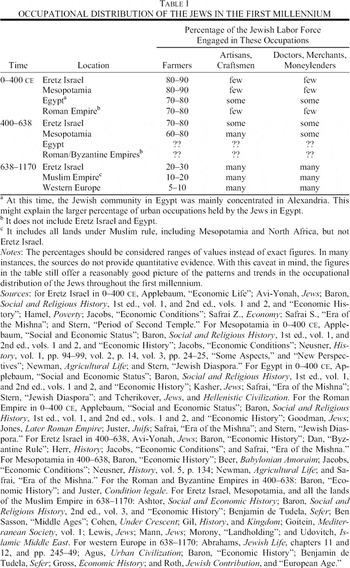
TABLE 1 OCCUPATIONAL DISTRIBUTION OF THE JEWS IN THE FIRST MILLENNIUM
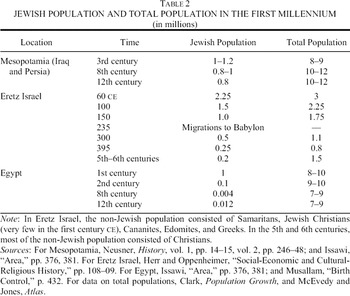
TABLE 2 JEWISH POPULATION AND TOTAL POPULATION IN THE FIRST MILLENNIUM
 You have Access
- 141
- Cited by