While the Portuguese sea-borne empire was a state enterprise, and the Dutch and English East India Companies were backed by the charters they received from the state, Armenian international trade in early modern times was organized instead by merchants in their private capacity. Organizing commerce on the basis of family connections was common in pre-modern societies in Europe and Asia, and historians are more or less unanimous in the contention that Armenian trade was carried on to a great extent by family firms. Edmund Herzig, for example, has shown that family firms belonging to extended patriarchal households were a major organ providing the foundation of Armenian business organization.Footnote 2
The other indispensable feature of Armenian trade was the sending out of commenda agents.Footnote 3 Both the family firm and the commenda functioned in a wider context that I shall be describing as ‘network’, a term often used by historians in their attempts to understand the working of different mercantile groups. For Braudel, a commercial network comprised a certain number of individuals or agents located at different points in a circuit or a group of circuits. The cooperation, connections, and communications among them ensured the continuity and prosperity of trade.Footnote 4
The quotation at the beginning of this essay suggests that the nodal centre of a thriving commercial community can always shift to a peripheral base in case the base at the nodal centre is shaken. Claude Markovits, in his study of the international trade of the Sindhi merchants, has defined network as a structure consisting of a locality or a cluster of localities and of dispersed colonies of merchants and commercial employees. A strong centre regulating the circulation of capital, information, credit, and men and women among the nodes is, following Markovits, a pre-condition for the successful operation of the network.Footnote 5
This centre–periphery dichotomy has been further highlighted in the recent researches of Sebouh Aslanian in his works on the organization of Armenian commerce in pre-modern times. Drawing especially on the archives of New Julfa, London, and Venice, Aslanian has shed new light on the multiple facets of the networks of the Armenians of New Julfa. Aslanian argues that the global trading network of the Armenian commercial magnates of New Julfa was a network of commercial settlements with NewJulfa/Isfahan as the principal ‘nodal centre’. It supplied the network with circulating merchants, vital information in the form of commercial correspondence, and a sophisticated system of transmitting commercial knowledge. It also supplied capital and credit and a prized commodity, namely raw silk from Iran. Moreover, as a religious centre with its own diocese, New Julfa also provided the Armenian diaspora with priests and clerics circulating within the network. This structure was intact until the middle of the 1740s when Nadir Shah conquered Persia and plundered New Julfa, among other places. It was only then that the international commerce centred round New Julfa received a severe blow it could not withstand, and the community dispersed once again.Footnote 6
Drawing on evidence from archives in India, this paper argues that the existence of multiple nodes was an important characteristic of the global network of Armenian commerce in the Indian Ocean. As the port-to-port trade in Asia flourished from the late seventeenth century onward, Armenian merchants settled outside New Julfa often acquired fabulous fortunes that were pumped into the network. Many of these nodes were, in their own capacity, a centre – big or small – of various circuits of commerce. An analysis of the trade of the Armenians between Madras and other ports in India on the one hand and Manila on the other shows that New Julfa was not the centre of this trade, in the sense that Armenians living elsewhere were not financially dependent on their counterparts in New Julfa. Places such as Madras and Calcutta, major ports of Indian Ocean trade in the eighteenth century, were equally, if not more, important than New Julfa as far as Armenian commerce was concerned. The picture that emerges from an analysis of this commerce suggests a structure where multiple complementary nodes co-existed with each other.
It is indeed true that New Julfa was the most important nodal centre in the network of Armenian commerce in Asia in the seventeenth century. Many Armenians coming to India were family members/agents of Armenian family firms in New Julfa. Circulation was an indispensable feature of this network characterized by the constant movement of credit, goods, human resources, and information.Footnote 7 The remarkably complex itineraries brought to light by Aslanian indicate the strength of this network.Footnote 8
However, compared to Safavid Iran, Mughal India at the end of the seventeenth century was far more prosperous and held a brighter prospect, inducing numerous political, military, and economic adventurers from the former to migrate to the latter.Footnote 9 Received literature on the Armenian community and trade in Persia points to the vicissitudes of the settlement of New Julfa in the late seventeenth and eighteenth centuries, though historians differ in opinion as to the period when the troubles began. According to Ghougassian, religious intolerance on the part of the Shi’ite Safavid state resulted in forced and voluntary conversion of Armenians to Islam. Consequently, quite a few wealthy Armenian families fled from Iran. This was accompanied by internal conflicts among the Armenians on issues of loyalty to the Apostolic and Catholic Church. Although all this led to a situation of insecurity and instability in the township, it was the Afghan invasion of Iran that, according to Ghougassian, dealt the final blow to Julfa.Footnote 10 Baghdiantz McCabe puts the date of the beginning of difficulties for Armenians in New Julfa back to the 1640s, when the political role of the Armenians in Iran changed, and when religious intolerance towards them became part of the policy of the state.Footnote 11 Edmund Herzig also noted the rigorous application of the shar’īa law and its impact on the life of the Armenians in New Julfa. While this law encouraged widespread conversion to Islam, the selection of women for the royal harem was an evil that Armenians had to learn to live with.Footnote 12 But, although the economic basis of Julfa was undermined at the turn of the seventeenth century, Herzig notes that, even in the early eighteenth century, Armenian churches in Julfa were functioning properly, and Armenians had been able to adjust to the hardships of Afghan rule as late as the 1720s. It was only Nadir Shah’s tyrannical rule after 1745 that ruined New Julfa and its trade.Footnote 13 Aslanian has confirmed Herzig’s view and has shown that it was only after 1745 that the ‘coalition’ of New Julfa merchants broke down.Footnote 14
Even if the base at New Julfa was unshaken until 1745, we know that from the sixteenth century at least there were a considerable number of Armenian merchants settled with their families at Agra, Delhi, Goa, Golconda, Hugli, Masulipatnam, San Thome, and Surat, among other places. Many of the Armenian families settling in India were from New Julfa. But there were also Armenians from other parts of Persia and elsewhere, trading side by side with them. Armenians buried at the cemeteries of Agra and Delhi had come from Arabkir, Astabad, Astrakhan, Bitlis, Constantinople, Julfa, Karabagh, Kabul, Kars, Tiflis, Van, Yerevan, and Venice, among other places.Footnote 15 We know next to nothing about the intra-group relations among these early settlers. Writing in the early twentieth century, Mesrovb Seth, the historian of the Armenians in India, noted three ‘classes’ among the Armenians of Calcutta. The first group consisted of those who settled in Calcutta during the eighteenth and nineteenth centuries; known as ‘Calcutta Armenians’, they had had an English education and were mostly professionals. The second group were the Julfa Armenians, who were mostly engaged in trade and commerce and had settled in Calcutta during the previous six decades. Finally, there were the recent emigrants from the Armenian villages in Charmahal in Persia during the first three decades of the nineteenth century – the ‘Charmahalis’ – known as rather ‘clannish people’.Footnote 16 While Seth thus referred to the possible formation of groups by the New Julfa merchants and other Armenians, there is more indirect evidence that confirms the scenario of a diaspora within the diaspora.
From the late seventeenth century onwards there was an enormous increase in the maritime trade in Asia. While the volume of trade carried on by the East India Companies saw an increase, the period is also known as a heyday of Indian maritime commerce.Footnote 17 The European settlements along the coastline of the Indian Ocean offered a pull-factor attractive to many aspiring Asian merchants. The authorities of the English East India Company, for example, induced the Council of Fort St George to attract Armenians to English ports in India.Footnote 18 The ‘White book of country trade’, written by Alexander Hume, the Scottish country trader and first chief of the Ostend Company’s lodge at Bankibazar in Bengal, noted in the 1720s that Madras was a place where credit was available. If one wanted to fit out a ship for China, one could send the ship first to Surat – the most important centre of country trade in the early eighteenth century – with coast and Bengal textiles, iron, sugar, coir, etc., in order to exchange them for silver. In case there was trouble, the goods could be left behind with a supercargo and the ship would sail back to Madras. Credit taken at Madras for the China voyage would be paid back with the returns of Surat trade. In Madras, one could gather information on China trade and exchange Surat or Bombay rupees for Spanish silver. The trade to Manila was, in many respects, similar to that in China.Footnote 19
The European, especially English, settlements offered a safe haven attractive to many Armenians seeking security and stability outside Persia. Some of these merchants knew the secrets of making the legendary East Indian fortunes, in that, within the span of one or two decades, they were able to increase the initial capital by two- or threefold. These merchants did not have to depend on their (original) principals in New Julfa for capital any longer. They circulated between all places of commercial interest and were abreast of the latest news, welcomed new migrants, and advanced capital to them. Even at a time when the centre at New Julfa is supposed to have been operating at its full strength, core members of the diaspora sought justice from the newly established English judicial system against their authoritarian principals back home. All these factors combined to create alternative centres of Armenian commercial capitalism in the Indian Ocean region (and beyond) even when New Julfa was flourishing.Footnote 20
Madras
Armenians were present in the Deccan in the sixteenth century, occupying an important position in the sultanate of Ahmadnagar.Footnote 21 From around the same time, if not earlier, they were visible in Coromandel, especially in San Thome – the place associated with the Portuguese – and in Masulipatnam, the most important port in the region in the seventeenth century.Footnote 22 It was a part of the policy followed by the English East India Company to attract merchants of different nationalities and allow them freedom of trade and religion so that the port would grow into a ‘famous emporium of trade’ and ‘mart of nations’.Footnote 23 Khoja Gregory, the ‘most eminent’ Armenian of Madras was to write to Julfa to invite his ‘poor countrymen’ to settle down at Madras.Footnote 24 It is interesting to note that, in their attempt to attract Armenians to Madras, the Company was contemplating creating separate quarters for them in Madras modelled after New Julfa:
We have discoursed Sir John Goldsborough about enlarging our Christian town to a quadrangle so as it may be done without detriment to the Company with handsome stone bridges over the river in which designed new moyety of the city one quarter of that moyety may be set apart for the Armenian Christians to build their new church … and convenient dwelling houses for their merchants … that quarter so set apart you may call Julpha, that being the town from whence Shah Abas the Great brought them when he conquered Armenia …Footnote 25
Armenian merchants were not only to enjoy the same privileges as English free merchants with regard to customs duty if they settled in Madras, they were to be allowed to ship any bale goods on the ships returning to Europe, could be used as Company’s factors,Footnote 26 could be employed in the garrison as soldiers, and were encouraged to buy small ships.Footnote 27
Needless to say, these measures were geared to augmenting the Company’s interests but nevertheless encouraged the growth of the Armenian community at Madras in the first half of the eighteenth century. As early as 1712, Armenians had a chapel in Madras for worship (moved to its present location in 1772). Once settled in Madras and other ports in India, these merchants became directly involved in the structure of the Indian Ocean commerce noted by Hume.
The most remarkable personality among these new settlers of Madras was khoja Petrus Woskan. Born in New Julfa in the year 1680, he moved to Madras in 1705. Petrus’s decision to leave Julfa for Madras has to be seen in the context sketched above; according to the testament that Petrus wrote before he died in 1751, he was not sent out as an agent. At the time of his death, Petrus left a considerable property of 95,000 pagodas.Footnote 28 He was by no means an exception. When khoja Khachik Aga came to India in 1740, Petrus Woskan advanced him Rs18,000 with which Khachik traded in Bengal; by 1748, this capital had increased to Rs42,000.Footnote 29 Another contemporary of Petrus was Miguel di Gregory, noted as merchant of Madras. When he died in September 1753, his son and heir Gregory di Miguel was in Manila. An account of Miguel’s estate after his death shows that the famous Sharimanian family of Venice, Julfa, and Madras owed him about 35,000 pagodas, which indicates that he was working with that family. The total amount of Miguel’s property was more than 97,000 pagodas.Footnote 30 Gregory the son continued to shuttle between Madras and Manila, owned a house in Madras, and, when he died in the mid 1770s, his estate was worth more than 250,000 pagodas.Footnote 31 They were by no means the only Armenians who found a place in Madras at the beginning of the eighteenth century. Khoja Zachary di Avetik, travelling between Isfahan, Amsterdam, and Madras settled down there at the turn of the century. Khoja Nazar Jacob Jan, who circulated between Bengal, Madras, and Persia, had settled at Madras in 1702.Footnote 32 Aga Piri and Brothers, sons of the well-known khoja Panous Kalantar, khoja Sarkies di Agavelli, David Marcus, Hakob Khachatoor, and khoja Simon were a few names mentioned in the deliberations of the Fort St George Council as residents of Madras.Footnote 33
The outstanding dues at the death of some of these merchants show that they were lending money mostly to fellow Armenians but also to Indian and European merchants on respondentia bonds and sending money and goods to Basra, Pegu, and Manila, among other places. It is very clear that, just like the capitalists in New Julfa, these merchants encouraged members of the family and kin and newcomers by advancing them capital.
From the early years of their settlement in Madras, Armenians contracted with the French to lend them money and supply goods at Pondicherry.Footnote 34 In their letters, the English Company repeatedly directed the Council of Fort St George to expel the ‘Native Inhabitants’ from the bounds if they carried the trade to San Thome or assisted the French in their trade to the prejudice of the customs of Madras. The Council of Fort St George, in its turn, issued notices for the violation of which merchants would be liable to pay a penalty.Footnote 35 But often they would have to waive this restriction, especially if no ship was sailing from Madras for Manila in a particular season, because the export of painted cloth and other kinds of textiles to Pegu and Manila by the Armenians contributed significantly to the land-customs at Madras.Footnote 36 As no English ship was being sent to Manila in 1742, Miguel di Gregorio, Hovannes Khojamal, Piri di Aratoon, Jacob di Gregorio, Hovannes David, and Petrus Woskan submitted a petition to the Council asking for the permission to send their goods on board a ship leaving Pondicherry (under cover). The Council agreed to grant this request because
We believe it better to permit them to freight on the French ship to Manilha than to lose the trade to that port [Pondicherry], and we see no prejudice but rather an advantage to the place in the present juncture, besides that we apprehend if we should deny the prayer of the petition, it might induce some of the most considerable freighters thither to move their Residence, a thing to be avoided, as many of them carry on a great trade from hence to other parts of India, the customs on which are considerable.Footnote 37
Two similar petitions were submitted in 1743 by Avieth di Aga Nazar, Thaddeus di Sarhad, Thaddeus Aga Piri, Johannes Khojamal and Hyranimo di Ita, Salazar (?), Narberg Pedro di Ita, Maruth Joseph, and Hovanjan seeking permission to freight goods for Malacca and Manila on the St Carlos, leaving San Thome for Manila.Footnote 38
This shows that the existence of more than one port in close proximity offered merchants based at these ports the possibility of using different ports depending on the exigencies of the situation. The Portuguese participated in the trade leaving Madras, but they used other ports too. In 1743, the Sta Catherina belonging to Johannes Baptista de Lisaboa and Capt. Andre Martin de Romes left San Thome for Manila with Hovannes Khachik as supercargo.Footnote 39 Porto Novo, a port under the nawab of Karnatak, also housed Armenians. In 1735, one ship belonging to the Armenian Mariam of Manila arrived at Porto Novo carrying 14 chests of Spanish mats, 20 bahars of resin, and 112 bahars of powdered sugar. The ship sailed back again for Manila with 480 bales of textiles.Footnote 40
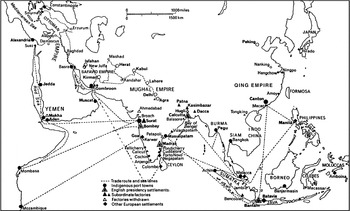
The Indian Ocean in the seventeenth and eighteenth centuries, showing European settlements and some of the places where Armenian merchants were active. Adapted from K. N. Chaudhuri, Trade and civilisation in the Indian Ocean: an economic history from the rise of Islam to 1750, Cambridge: Cambridge University Press, 1985, p. 96

Pondicherry and beyond
When the French sought to enter the world of Asian trade, their ‘courtier’ or go-between at Golconda was Markara, the Armenian with contacts in Venice and New Julfa, among other places. Markara’s contact in the court of Golconda was Aga Nazar Beg, the Persian-born Armenian merchant, jeweller of the Sultan of Golconda.Footnote 41 A few Armenians were settled in Pondicherry and, needless to say, the Armenians of Madras were not shy of using the French connection. French papers in the early 1720s referred to one khoja Safar, who was rather old by that time, having paid 1,000 pagodas for the construction of a chapel inside the fort in Pondicherry; he also promised to supply the workers. The foundation stone of this chapel dedicated to St Louis was laid on 10 March 1722 in the presence of the Archbishop of Heliopolis.Footnote 42 It was around this time that, short of resources, the French were seeking partnership with Asian merchants in order to finance their Asian trade. For their trade to Manila they consulted khoja Isaac Elias, who was experienced in trade to Macao and Manila. Isaac was perhaps the most prominent Armenian based at Pondicherry in the early eighteenth century. According to the arrangement made with him, the French would sell him the concerned ship (on paper), Isaac would invest money, sail on board the ship, and negotiate at Manila on behalf of the French.Footnote 43 The Pondicherry–Manila voyage under the command of Isaac Elias brought Petrus Woskan, then at Manila, into contact with the French, as he sailed to Pondicherry in 1722 on board the ship ‘owned’ by Elias.Footnote 44 Petrus, a seasoned hand in the Manila trade, advised the French to continue the lucrative voyage to Manila and lower the freight rate (then at 18%) to 14%. He himself would freight piece goods and encourage others in Madras to do the same: ‘it is absolutely necessary to send this ship [St Ignace] back to Manila to carry the fruits of commerce home’.Footnote 45 Petrus went on to Madras, returned to Manila the following year, and decided in favour of Madras, where he settled in 1724. Petrus and other Armenians of Madras continued their French connection and some of them owned real estate in Pondicherry.Footnote 46 The association that Dupleix started in 1732 for private trade to Manila included Armenian interests.Footnote 47
The Danes at Serampore and Tranquebar also made use of the services of the Armenians. Although Manila was opened to Danish ships in 1745, the fact that Governor Krog was trying to attract Armenians to settle at Tranquebar in the late 1750s indicates the importance of Armenian cooperation in Danish trade.Footnote 48
The commercial expeditions undertaken in one region often included interests of Armenians settled elsewhere. In 1721, St Ignace, for example, carried 1000 mans of iron bars belonging to Elias’s Armenian agent in Bengal as freight.Footnote 49 The same year, Elias sent back on board the L’Orient 3,152 piasters to his agent as profit from this freight.Footnote 50 The case of the Jerusalem illustrates how capital circulated within the community-based network of Armenians in different parts of south, south-east and east Asia. In 1742, Captain Petre, commanding the East India Company ship Tygris bound for Anjengo, encountered the Jerusalem east of Sri Lanka, flying a white flag with a red cross in the middle. Upon enquiry, Petre discovered that the ship belonged to Chandannagar in Bengal. The ship had been loaded in Hugli, also carried Armenian colours and a passport provided by the Council of Chalnagore (?Chandannagar), and was on its way from Manila to Pondicherry, Madras, and Bengal. The nakhuda was an Armenian, Melcomb di Jacob alias Melchior D’ St Yago. According to the statement made by Petre, the details on the pass did not match those supplied by the crew of the Jerusalem. As it was coming from Manila, he thought that the ship was possibly carrying some Spanish effects, and, as Petre had a letter empowering him to confiscate ships, goods, and effects belonging to any subject of the King of Spain, he seized the ship. All the cargo of the Jerusalem, consisting of cowries, sugar, and twenty-eight chests of gold and silver (the treasure valued at 83,396 Spanish dollars and 100 Surat rupees), was transferred to the Tygris, and both the ships entered the roadstead in Madras safely.Footnote 51 At Madras, khoja Melcomb submitted a petition for an inquiry into the reasons for the seizure of the Jerusalem. The investigation showed that the greater part of the twenty-eight chests of treasure shipped at Manila belonged to Armenian merchants. Out of the 24,469 Spanish dollars shipped in nine chests, 14,075.5 dollars were on account of the arrears of the Jerusalem and 10,393 dollars on account of khoja Melcomb. The thirteen chests containing 39,000 Spanish dollars shipped by khoja Pogos di Khachick were consigned to Madras merchants Petrus Woskan, Miguel di Gregory, and Hovannes Khojamal. One box of gold, valued at 4000 Spanish dollars, was shipped by Nazar Khojamal for Hovannes Khojamal at Madras. The remainder of the treasure was shipped at Malacca: one chest worth 2393 dollars in gold and silver by khoja Mathews consigned to himself in Madras; two chests with 7,534 dollars and 100 Surat rupees by Gregory di Aga Piri for Jacob di Gregory at Madras; and two chests with 6000 dollars by (?) Banak di Jacob for Mirza di Petrus at Hugli in Bengal.Footnote 52
Manila
Though geographically forming part of the fringes of the Pacific Ocean, Manila, the capital of the Philippine Islands, was drawn into the orbit of Indian Ocean commerce because of its traffic with the New World. It was a popular destination for merchants engaged in the country trade in Asia. Turks, Greeks, Africans from Angola and Congo, Persians, Indians, and a considerable number of Armenians, in addition to the Chinese, Japanese, and people from Southeast Asian countries, and Europeans were to be found in cosmopolitan Manila.Footnote 53 The traffic carried on by the Portuguese between Manila and ports in India in the period when the Spanish and Portuguese crowns were united continued even after the Habsburg period had ended.Footnote 54
The products of the Philippine Islands were rice, sugar, cotton, indigo, sulphur, sago, wax, pepper, coffee, tortoiseshell, mother-of-pearl, gold, iron, copper, tobacco, brazil wood, lead, coconuts, horses, deer, buffaloes, and rattan, all to be found in the country in abundance. The most important commodity taken from Manila to the Indian subcontinent was Spanish American silver brought through the galleon trade with Acapulco.Footnote 55 The amount of silver sent from Acapulco via Manila galleons seem to have equalled the silver sent from Europe to Asia overland and overseas.Footnote 56 According to one estimate, four to five thousand tons of silver reached Asia via the Pacific between 1570 and 1780.Footnote 57 It has been often claimed that almost half of this silver found its way to China, supplying silk for the commerce across the Pacific.Footnote 58 Flynn and Giráldez have emphasized the role of China as the world’s silver sink where, from the late sixteenth century onwards, the import of silver was huge – about two million pesos, – as the export of silk from China was worth that amount.Footnote 59 Recent research shows that some of the silver exported by the English East India Company to Asia in the late eighteenth century was appropriated by the authorities in India, although it was destined for China. Some of the silver exported by the Company to China was again carried to India by country traders.Footnote 60
The import of textiles from India and China in exchange for silver and export of the same textiles to Acapulco constituted indeed the lifeline of the trade of Manila.Footnote 61 Hume observed that, unlike on other routes, the profit from Manila trade was made on the outward journey.Footnote 62 This was because Indian textiles fetched immediate profit in Manila where they were purchased by the galleon traders paying in silver, commanding a high premium in India.Footnote 63 The eighteenth century witnessed a rapid increase in the demand for Indian cotton piece goods in Acapulco and these were considered, after Chinese silk, the second most important commodity for the galleon trade.Footnote 64 A source from the mid eighteenth century noted that the best quality piece goods sent to New Spain were from Bengal.Footnote 65 Ships from Coromandel carried silk, blue cloth, painted fabrics, calicoes, chintz and other sorts of textiles, iron anchors, and spices to that port. It has been estimated that the annual value of exports from Madras to Manila in the 1740s was approximately 300,000 pesos.Footnote 66 This trade increased in the second half of the eighteenth century: In 1787, six ships from Madras carried piece goods amounting to more than 618,000 dollars and, between 1785 and 1790, Indian piece goods worth 800,000 dollars on average were sent annually to Manila.Footnote 67
The other commodity that formed an important part of the cargo from south Asia to Manila was cinnamon, to be carried from there to the New World. Armenians could ‘smuggle’ cinnamon (a monopoly of the Dutch) out of Sri Lanka, or buy it, like other merchants, from the VOC at its various settlements. The Dutch factory at Malacca sold 145 bales of cinnamon in 1721 and 284 bales in 1726, both times to the Armenian Louis Sattur, nakhuda of the Triplicane.Footnote 68 In 1736, merchants from Manila bought 197 bahars of cinnamon and 8000 lbs of cloves at Malacca. The governor of Malacca asked for the supply of 150 bahars of cinnamon and 20 chests of cloves. Although known as Manila merchants, the Dutch noted,
these merchants are not originally from Manila, but they reside in the west [south Asia] under the protection of the English, French and the Muslims, and they are French, Indo-Portuguese, Armenians, Jentus and other heathens who are allowed to go to Manila and trade there in such goods which are wanted not only in Manila but also in New Spain … they purchase mostly cinnamon, and coarse textiles from Bengal and Coromandel. [They carry back] Spanish reals which are very much in demand in those Muslim countries where they are minted into rupees wanted all over the west for all kinds of transactions. This trade in silver is rather profitable. On their way, these merchants buy at Malacca whatever they can lay their hands on, cinnamon, clove, iron bars, and carry on further to the Manilas.Footnote 69
The growth of Madras–Manila voyages seems to have been linked with the activity of the Dutch in Southeast Asia.Footnote 70 As the Spanish commercial policy of forbidding direct trade with Europeans as ‘enemies of the state’ was officially in force, the port of Manila was open to merchants of Asian origin only. British and French investments from Coromandel were taken under Armenian, ‘Moorish’, and Indo-Portuguese cover.Footnote 71 Armenian vessels often flew their own flag: yellow and red, and emblazoned with the figure of the Lamb of God.Footnote 72 Spanish officials in Manila encouraged this trade and some of them even took part, in collaboration with Armenians and Portuguese.
Details for all years are not available, but the records of Fort St George indicate that between 1679 and 1745 and in 1771 at least 29 voyages were undertaken in collaboration with Armenian merchants. Khoja Petrus Woskan, khoja Melcomb di Jacob, khoja Louis Sattur, khoja Maruth di Markar, khoja Maruth di Joseph, and khoja Paulo di Khachik were some of the merchants participating in this trade. Between 1704 and 1730, the Sta Cruz was noted to have sailed four times to Manila, twice under the command of khoja Petrus Woskan. These did not include voyages starting at San Thome and other places. For example, in 1690 the Santa Cruz owned by an Armenian sailed under the command of Alvaro Carvalho for Goa, Surat, and then Manila and China.Footnote 73 In 1704, the Dutch at Malacca noted Steven Mark arriving on board his ship Nossa Senhora Piadady of 160 tons, carrying 2 cannon and 110 men, from Porto Novo, sailing for Manila, and declaring 450 bales of different kind of textiles.Footnote 74 According to another source, two ships left San Thome for Manila in 1742: the Sta Catherina and the St Carlos. On board the former was Khachik Hovannes, an inhabitant of Manila, and Maruth Joseph was the supercargo on the other.Footnote 75 The same source noted that during 1749–53 one ship left Madras for Manila annually and at least one French ship (Pondicherry and/or Chandernagar) left for Manila annually during 1742–44, in 1749, 1752 (two voyages), and in 1754.Footnote 76
As with all other places where they traded, some Armenian merchants had settled down in Manila, the port that linked the eastern seas with the New World. The Armenian Joan Domingo, visiting Malacca in 1679, seems to have been such a person. He owned the ship St Michiel (180 tons); sailing from the Coromandel ports of Cuddalore and Porto Novo, it reached Malacca on the way to Manila with 180 bales of various textiles, 100 pikuls of iron, and 60 pikuls of saltpetre.Footnote 77 Two days later it sailed for Manila, where it was based (‘daar hij thuijshoort’).Footnote 78 The fact that they were Christian must have made negotiating with Spaniards easier for Armenians in Manila. A decree issued in 1713 declared that, like ‘other enemies of the Holy Faith’, schismatic [read Apostolic] Armenians were to live together with the Muslims in the Chinese quarter of the Parián. Following Alexander Hume, it was desirable to have a Roman Catholic captain on the Manila run.Footnote 79 Therefore, it was perhaps strategic considerations that persuaded some Armenians to convert to Catholicism at Manila. Researches in the archives in Seville show that Armenians visiting the inquisition for such purposes had to supply their biography for the record.Footnote 80 Long association with the port enabled some Armenians (perhaps converts) to settle down at Binondoc, Tondo, Santa Cruz, and Quiapo, areas convenient for their business.Footnote 81
The hypothesis that nodes such as Madras were not peripheries of New Julfa but major links in a chain of multiple nodes is supported by the fact that some of the Armenians settling down in Manila were undoubtedly agents/family members of merchants settled in Madras. The Inquisition Lists of the Philippines refer to twenty-four Armenians visiting the inquisition office between 1734 and 1809.Footnote 82 Among them, Gregorio di Zacharias, Nazar di Khojamal, Philippus Agapiri, Nazar di Agamar (Agamal), and his son Zafras di Naurer (Nazar) can definitely be traced back to Madras.Footnote 83 Gregorio di Zacharias was the son of Zachary di Avetik of Madras and shuttled between Madras, Manila, and Batavia. The case of Philippus is very interesting as we have some more details about his family. He was one of the three sons ([Gregorio and Thaddeus being the other two) of Aga Piri of the kalantar family of New Julfa. Aga Piri was first active in Surat at the end of the seventeenth century, and some time at the turn of the century he moved to Madras. Settled in Madras, the Piri brothers were also engaged in the trade to Pegu and other places in Southeast Asia. The petition with regard to the Jerusalem above showed that Gregorio was in Malacca in 1742. Philippus died in Madras in 1775.Footnote 84 Thaddeus’s son Aratoon was sent out from Madras as agent to Bengal where he died at an early age.Footnote 85 Nazar di Khojamal was most probably a brother of Hovannes Khojamal of Madras/Pondicherry and brother of Safar di Khojamal, Petrus Woskan’s friend and agent at Basra. Nazar was a factor of Gregorio di Aga Piri and Gregory di Miguel – both of Madras – and died at Madras in the early 1770s.Footnote 86 Minas de Elias must be a member of the branch of the Minasian family settled in Bengal. In all probability, these merchants resided for a few years at a stretch in Manila, after which they would perhaps shuttle back and forth before finally settling down at Madras, as Petrus Woskan did.
Organization of trade
The Manila trade was clearly multinational in character. The existing records of the Mayor’s Court of Madras lend us a rare insight into the working of this trade. One could borrow money depending on one’s capacity from potential merchants on the coast, and could entrust a person sailing for Manila on board his own or another person’s ship. The respondentia bond seems to have been the most popular instrument for investment in overseas trade in Coromandel in the eighteenth century. Usually, money was lent to a ship-owner, or another person freighting merchandise, on the goods being carried. The name of the ship was mentioned in the bond. The rate of interest varied per destination and the duration of the voyage, and for Manila it was 16%. Since the onward voyage to Manila carried mostly piece goods, a freight charge of 14% (in Pondicherry it varied between 14% and 18% percent) was added to the cost of the goods. The borrower was supposed to sell the goods at Manila, for which he would get 7.5% (including a commission of 5%). If the borrower returned on the same ship on which the money was lent, no freight charge had to be paid for the returns, which were usually in silver. If he returned on another ship, a freight charge of 1.5% was calculated for the return cargo. The account had to be settled within twenty-one days of the return of the ship to Madras (the port of origin). In an interesting case, an Armenian ship-owner lent money to an Indian merchant and carried goods to Manila on the latter’s behalf.Footnote 87 When more than one ship was leaving Madras for Manila, it was possible for one merchant to have both the ships under his supervision, as seems to have happened in 1726, when khoja Sattur was mentioned in connection with both the Triplicane and the Trivatur. Considerable merchants, such as khoja Petrus and khoja Elias who owned ships, freighted goods on European Company ships. Spanish and local merchants of Manila were encouraged to freight goods to Coromandel. On arrival in Manila, the textiles could be sold directly for silver to individual galleon traders. The self-sustaining character of this trade remained unchanged until the establishment of the Royal Philippine Company in 1785.Footnote 88
The case of the Silliman gives some clue as to how this trade was organized. The Council of Fort St George had wished the owner, khoja Sarkies, to sail first to Surat and then to Manila without touching Madras, as otherwise the English ship would not have enough freight. Instead, the ship came to Madras from Surat, and rumour had it that secret arrangements were being made to obtain freight goods for Manila. The Council ordered that Sarkies should send the ship on his own, without procuring freight from others. Sarkies then claimed that there were 100 owners of the ship! Sarkies was not telling an outright lie, but he was not disclosing the whole truth either. Given the nature of overseas trade – carried on mostly by numerous big and small merchants making use of any ship leaving a port either travelling personally, or sending parcels of goods or bills through an agent to another agent – there was indeed some truth in what Sarkies maintained. All of them may not have owned the ship as claimed by him but, without goods freighted by many other merchants, the average ship-owner would not be able to fit out his ship. Fortunes of many small merchants were dependent on a successful voyage and safe return of a ship:Footnote 89
I Nazar’s son Yo¯vanēs took five hundred chalni hun … from the late Khojamal’s son, my master sahib Paron Yovanis. May God not give loss, the security is on the ship named Trevětur going from Madras to Manilla. May she weigh anchor from Madras harbour and nalmal go safely to Manilla and drop anchor in the harbour with the security upon her. And the same season let the ship weigh anchor from Manilla bar and nalmal come safely back to Madras and drop anchor with the security upon her, and on a 21 day usance I will pay the above sum with a 28 per cent avak’ charge to my above mentioned master Sahib Paron Yo¯vanis or his agent …
Recently, Sebouh Aslanian has put the total number of Armenian merchants in the New Julfa network at somewhere between 1,000 and 1,500. This is on the basis of the assumption that the twenty to thirty major Julfa families had on an average fifty agents, making a total of 1,000 to 1,500.Footnote 90 This is, of course, as Aslanian himself is aware, a rough assumption, and some points have to be taken into consideration before we can arrive at a tangible conclusion. As business was organized round the family, many of the family members – brother, son, son-in-law, nephew – were employed as agents. Thus there was some overlap between membership of a family firm and agency. Secondly, as this relationship was multiplex, even from the bits and pieces of information we have from different places, it is possible to trace the contacts of these merchants operating between Amsterdam, Venice, New Julfa, Madras, Malacca, and Manila in some way or other.Footnote 91 While firms with more than 100 agents were a real exception, most small firms seem to have depended on close members of the family. In addition, it can be judged from the accounts we have regarding Zachary Avetik, khoja Nazar, khoja Khachik Aga, and Nazar Khojamal that, when the agents started their business, more than one principal merchant advanced them money. If merchants A, B, and C could all individually employ D as their agent, then the merchant/agent ratio would be 3 : 1. Lastly, austere and harsh lifestyles associated with long journeys at a stretch and living under difficult circumstances had their toll on the life expectancy of the members in the diaspora. None of the old Armenian families settled in India in the eighteenth century – except for the Minasians and Shahmirians – mentioned more than five living male members at a time. When Petrus Woskan left New Julfa, both his brothers were dead. Many merchants such as khoja Sarhad and Minasakan of Bengal disappeared from the records after some time. Merchants such as Nazar Jacob Jan and Petrus Woskan had no issue. Out of the three Aratoon brothers of Bengal – Petrus, Gregory, and Basil – Petrus alone was survived by a son. Taking these factors into consideration and, in the absence of a census of any kind, I would roughly estimate the number of Armenian merchants in the diaspora at between 300 and 400 at any one time in the eighteenth century.Footnote 92 But Armenians were not important for their numerical strength.
Relationship with Europeans
European trade to Manila had to be carried under Indo-Portuguese or Armenian cover, and it has been argued that Armenians offering such cover were poor sailors and had no ships of their own.Footnote 93 There is no denying that providing cover facilitated Armenian engagement in this commerce as freighter, nakhuda, and supercargo, but it is not true that all these merchants were poor. Merchants such as Petrus Woskan, Isaac Elias, Markar, Gregory di Miguel, and the Piri brothers were potential merchants with established network of trade, and this often induced Europeans to approach these merchants to negotiate on their behalf. Some of these merchants were capable enough to own more than one ship and, if they chose not to own a ship, that was because they did not consider it necessary.
With hindsight, we are interested in the impact of this widespread collaboration on Asian–European relationships in the Indian Ocean. But merchants in pre-modern times were not intrigued by such questions. It was rational calculation on their part to move to Madras, freight goods on French ships, and lend expertise to the Danish. As Asians willingly camouflaged European trade by providing cover, it is almost impossible to disentangle Asian from European trade, though we know that within this construction merchants operated through their own networks. Since there were rival European settlements, Asians could take advantage of the situation to some extent by violating European regulations regarding collaboration with a rival power. That does not, however, imply that they were on a par with Europeans who offered them protection. This protection was different from the one that Armenians had received in Safavid Persia or Mughal India in the sense that the interests of Asian merchants could clash directly with the private interests of European Company servants. At no point did the latter forget that Armenians were shrewd merchants with contacts at all the important places. The French needed Isaac’s connections and expertise for their trade in Manila, but he would have to abide by the instructions of the French pilot and writer travelling on board. Isaac was to act like the owner of the ship, but an undertaking was taken from him to make sure that he would not have undue claims after the return of the ship from Manila.Footnote 94
Conflict between European powers took an obvious toll on Asian merchants. When the French captured Madras in 1746, they ruined forty-two houses of Petrus Woskan and plundered his warehouses. But after Madras was returned to the English, Armenians, suspected of connivance with the French, were (except for Woskan) forced to leave the White Town area. Worse consequences could be expected when one European power captured a ship under the pretext that it covered the commerce of the rival power.Footnote 95 In India, where English political power was gaining ground in Bengal and the Andhra Coast in the middle of the eighteenth century, Europeans had the upper hand, and Asians were often targets of oppression even in conflicts between different blocks of English private interests.Footnote 96
Armenian commerce to Manila continued into the second half of the eighteenth century. During the Seven Years’ War, a small English force sailed from Madras under the command of General William Draper and captured Manila in 1762 (to be returned to the Spanish after the Treaty of Paris was signed). It was Armenian merchants of Madras who carried the news of the British squadron being prepared at Madras to the Archbishop of Manila, in charge of the garrison at that place.Footnote 97 After they captured Manila, the victorious English borrowed money from Armenian and European merchants and issued bills of exchange in their favour on the Director and Council of Fort St George.Footnote 98 The trade in ordinary textiles carried on by Armenians and Chinese suffered during the war with the English. After the war, Filipinos were manufacturing them;Footnote 99 nevertheless, fine cambays and handkerchiefs from Madras, along with the cotton fabrics from China, continued to be imported even after the war. The unique and permanent colours used for dyeing Madras cottons – the colours did not fade and the more they were washed, the more lustrous they appeared – could not be manufactured by the Filipinos.Footnote 100 Meanwhile, the cottons from China were wanted for their cheap price. Consequently, Armenians and Chinese were the exclusive suppliers of these fabrics to the Philippines.Footnote 101 A memorial written in 1765 noted ‘Moros’, Armenians, Malabaris, Chinese, Siamese, and others sending ships to Manila for trade.Footnote 102 Until the liberalization of trade at Manila in 1789 opened the port to all European shipping, flags of convenience (and thus Armenian cover) remained indispensable at Manila. As it was observed by the Supreme Council of State in Madrid that year, ‘If the port of Manila remains closed to the European nations trading in Asia, it will amount to conceding Manila’s trade to the English through the hands of the Armenians, their creatures … who have monopolized it.’Footnote 103
Armenians seem to have traded in Manila until the end of the era of galleon trade. A proposal for reforms needed in the Philippines drafted at the beginning of the nineteenth century noted that cambays to the value of 300,000 to 350,000 dollars were annually taken from Madras to the Philippines by Armenians, among others. Chinese traders carried cotton fabrics to the value of 300,000 dollars. Returns in both cases were comprised of cash alone.Footnote 104
Conclusion
Expansion of a multi-nodal Armenian network of trade was facilitated by the expanding world trade that brought silver via Europe and via the Pacific to Asia. Entering different circuits of Indian Ocean commerce, this made credit available to ambitious and adventurous Armenians seeking fortune outside and/or independent of New Julfa. Petrus Woskan, who came penniless to Madras in the early eighteenth century, could borrow capital there. He was not the only one. The careers of Woskan and his fellow Armenians show that, by participating in different branches of profitable country trade, industrious merchants could build up a fortune within a short time. And industrious they were: by the middle of the eighteenth century, Armenians in Manila were advancing credit to the English.
It follows from this that nodes such as Madras were not part of the periphery of New Julfa but major nodal points, where Armenians not only from New Julfa, or Hugli, but also from places as far away as Amsterdam and Manila could meet face to face. Armenian settlement at Madras reached its climax at the end of the eighteenth century, when the merchant-capitalists there financed the publication of the first ever Armenian language journal. A better knowledge of the functioning of different nodes in the Armenian network, and their relationship with New Julfa, is required for a proper understanding of the functioning of this network. This paper has provided details solely with regard to Madras and its trade with Manila. The more empirical details we have about all the nodes in the Armenian diaspora, the clearer the picture will become.