

Over the past two decades, academic inquiry into the development of the Chinese people's congress system has increased. Early studies argued that, since the 1980s, people's congresses had begun to gain authority, expand jurisdiction and improve their law-making capacity.Footnote 1 Kevin O'Brien suggested that, in order to find a place in the already crowded power arena of the Chinese party-state, people's congresses have adopted a strategy of “embeddedness” to win political support and avoid conflicts in their interactions with other powerful political actors.Footnote 2 More recently, based on their investigations of legislative developments in local Chinese politics, several scholars, including Young Nam Cho and Ming Xia, contend that while local people's congresses (LPCs) secured their authority and enhanced their capacity for law-making in the 1990s, they have since endeavoured to expand their jurisdiction in a new area, legislative oversight. LPCs have become confrontational in exerting their oversight authority over government in areas such as examining law enforcement and appraising government bureaus and officials. Admittedly, these scholars have not said that LPCs have completely abandoned the “embeddedness” strategy – for example, Cho mentions that LPCs pursue both independence and cooperation, and Xia has coined the term “competition-cum-cooperation” to depict the LPCs’ strategy. Nevertheless, to highlight the emergence of a new stage in the development of LPCs, these scholars have based their depictions on particular incidents relevant to contestation.Footnote 3 The contestation literature has recently been questioned by O'Brien. For him, such a description is problematic in the sense that it has been overly centred on institutionalization and capacity building within the state. Consequently, it says little about elections and deputy-constituent ties, and thus responsiveness and changing state–society relations. Also, the contestation literature falls “prey to cherry-picking instances of assertiveness and downplay[s] the fact that most congresses remain pliant and passive.”Footnote 4
While both sides in the debate discuss the development of the legislative oversight of the LPCs, they have overlooked the development of budgetary oversight that began with the 1999 budget reform. If legislative oversight is an important accountability mechanism, it “is nowhere more important than in the budget process.”Footnote 5 Therefore, budgetary oversight may be the most appropriate area to assess whether LPCs have become confrontational.
This study will examine the development of the LPCs’ budgetary oversight since the 1999 budget reform. Specifically, our examination is centred on the following two questions: to what extent have LPCs begun to undertake the function of budgetary oversight? Have they become confrontational in this area? In addressing these questions, we draw heavily from our extensive fieldwork on local budget reforms and our recent nationwide survey of budgetary oversight in LPCs. Our fieldwork was conducted from 2003 to 2010 in seven provinces, including two in the rich coastal region (Guangdong and Fujian), three in the middle-income regions of central and northern China (Hebei, Hunan and Heilongjiang), and two in the poorer, western region (Yunnan and Gansu). At the same time, we also carried out fieldwork in four municipalities, including Taiyuan (the capital city of Shanxi province), Wuhan (the capital city of Hubei province), Guangzhou (the capital city of Guangdong province), and Xiamen 厦门 (in Fujian province). In each place, we interviewed financial officials from the finance departments, functional departments, audit departments, and the budget supervision organizations of the local people's congress. In each location, on average, we interviewed 16 respondents, and each interview lasted roughly 50 minutes.
The survey was carried out between the end of January and early April 2011. Localities investigated include 80 people's congresses with law-making authority, including 31 provinces or provincial-level entities, 27 provincial capital cities, five separate-plan municipalities, two special economic districts, and 15 large municipalities designated by the State Council. Sixty-seven legislatures responded, and 64 returned valid questionnaires. The respondents of this survey were legislative officials working in budgetary oversight branches of LPCs. Among these 64 respondents, 92.2 per cent of them hold college degrees, and 78.3 per cent of them have worked in budgetary oversight for at least five years. As respondents are legislative officials, it is feasible that they would over-evaluate their LPC's achievements. We used several methods to counter this problem. First, in most situations, the survey did not ask for the respondent's opinions, but rather asked for a report of relevant incidents or actions. Second, besides conducting a pilot survey, several double-check questions were built into the survey to assess the reliability of each questionnaire received. Third, qualitative sources were used for cross-checking data, including interview transcripts for those places where we conducted fieldwork; official documents – for example, LPCs’ working summaries; and case studies of individual LPCs. Finally, in certain cases, we directly consulted LPC insiders with whom we have close personal relationships. By using these methods, we rejected three questionnaires but classified the others are valid.
In the next section, we examine the evolution of the LPCs’ budgetary oversight since the budget reform. In the subsequent two sections, we analyse the extent to which LPCs have become confrontational in budgetary oversight. We found that LPCs continue to use an “embeddedness” strategy when exercising their budgetary oversight authority. In this context, although certain LPCs have begun to be more confrontational, they tend to contain any contestation within a form of internal bureaucratic negotiation. The penultimate section offers an explanation for this strategy. The article ends with a conclusion and discussion.
The Evolution of Budgetary Oversight of the People's Congresses
The Chinese people's congresses functioned as rubber-stamp institutions for many years during the Mao era. Then, beginning in the 1980s, people's congresses at all levels started to gain more authority in law-making and to play a more active role in China's political process. However, until the 1999 budget reform, they played no part in the budgetary process. This marginality was not because the people's congresses did not understand the importance of “the power of the purse,” but rather was owing to the fact that there was no coherent budget system at any level of government. The Chinese experience serves to illustrate that the lack of a functioning form of budgetary control within government will, in turn, frustrate the legislature's efforts to exert its budget supervision authority in a meaningful manner.Footnote 6
Prior to the budget reform, state finance was fragmented and decentralized, and consequently lacked effective budget controls within the government. The fragmentation of budgeting authority within the government was evident in three aspects. First, in addition to the finance bureau serving as the central budget agency (CBA), there existed several quasi-CBAs, such as the planning commission, which held allocative authority over certain areas of fiscal resources. Second, from the 1980s onwards, there was a rapid expansion of off-budget finance, wherein each bureau extracted and then spent off-budget funds with no supervision. Third, owing to a lack of departmental budgets, the finance department tended to allocate budgetary funds in a lump sum to each functional department, which held secondary budgetary authority to re-allocate these monies. At the same time, financial management was overly decentralized. There was no single treasury account; public monies were dispersed to a variety of accounts that were opened and tightly controlled by various governmental bureaus which would happily spend funds with no external supervision. In this context, even if the people's congresses decided to exercise their authority to oversee budgets, it was impossible for the governments to compile and handover a budget which was able to account for, in detail, all the actions planned by governmental bureaus or indeed the costs of these actions. Actually, while governments at each level would annually submit a budget to the people's congress for review and approval, this budget contained only part of the fiscal revenues and was always compiled in aggregate totals. Consequently, people's congresses could not oversee governmental budgets in a meaningful manner.Footnote 7
China's 1999 budget reform comprised three major parts: departmental budget reform (DBR), treasury management reform (TMR), and government procurement reform (GPR). The DBR requires governmental budgets to be compiled on a departmental basis. To compile departmental budgets, standardized budgetary formats and procedures are implemented. The principle of comprehensiveness, which requires departments to include all revenues and expenditures in their budgets, is strictly enforced. All expenditures must be justified with detailed objectives in order to present full information about planned activities and relevant costs. The aim of the TMR is to create a centralized treasury management system to replace the old, decentralized system. A single treasury account system was created which incorporated a new centralized system of fiscal direct disbursement (FDD). The GPR was designed to create a centralized procurement system to replace the previous decentralized system.Footnote 8
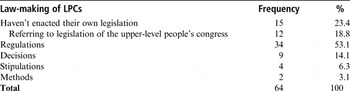
The installation of budgetary controls within the government laid the foundation for people's congresses to strengthen budgetary oversight. Facilitated by the DBR, governmental budgets are now submitted earlier to the people's congress for review. More importantly, budgets are more comprehensive and broken down into departmental details, which means the people's congress can substantially review governmental budgets. With the establishment of a centralized treasury management system, it is now easy for the people's congress to oversee budget execution.Footnote 9 In this context, by using the law-making authority which they have been steadily gaining since the 1980s, people's congresses have begun to empower themselves in the area of budgetary oversight. In December 1999, the Standing Committee of the National People's Congress issued its “Decision on strengthening central budget review and supervision,” which specified and expanded its power in budgetary oversight. In line with this, LPCs with law-making authority have enacted their own legislation in budgetary oversight. By the end of 2009, there was only one provincial-level people's congress which had not passed such legislation. As Table 1 shows, of the 64 responding LPCs, there are only 15 which have not enacted new regulations; of those 15, 12 have instead chosen to adopt the budgetary oversight legislation enacted by the upper-level people's congress.
Budgetary Oversight Law-making by LPCs

Source:
Compiled by the authors.
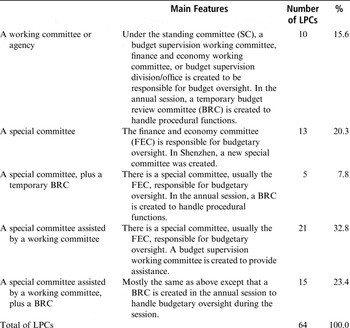
LPCs have also enhanced their organizational capacity in budgetary oversight. It has been widely recognized that a well-developed committee system for budget oversight is crucial for a legislature to exert “the power of the purse” effectively.Footnote 10 Since the budget reform, LPCs have established a preliminary committee system in this area, which falls into five major patterns (Table 2). Under the current people's congress system, usually a special committee (zhuanmen weiyuanhui 专门委员会) holds a higher legal status than that of a working committee (gongzuo weiyuanhui 工作委员会). As Table 2 shows, 84.4 per cent of LPCs (54) have established a special committee system to carry out the new function of budgetary oversight. Generally, the finance and economy committee is granted the power of budgetary oversight, but in Shenzhen a new special committee, named the Plan and Budget Committee, was created for this purpose. In the remaining ten LPCs, only a working committee or agency was created. Further, in 56.2 per cent of the LPCs (36) which have granted the power of budgetary oversight to their special committees, a working committee was created to provide assistance, and often the director of the working committee will serve as the vice-director of the special committee. The creation of a committee system, particularly the system of a special committee aided by a working committee, has enhanced the LPCs’ organizational capacities in budget oversight.
The Committee System of LPCs in Budgetary Oversight

Source:
Compiled by the authors.
Lastly, human and capital resources, which are indispensable for the development of organizational capacity, have been allocated to carry out the task of budgetary oversight.Footnote 11 According to the survey, 61 per cent of LPCs reported that they had sufficient financial resources to perform their functions, and only 6 per cent of them were short of funds in this respect. Nevertheless, LPCs in general are beset by human resource shortages and lack professional staff with expertise in budgeting. We received staff information from 60 LPCs. On average, there were only five full-time members of staff allocated to budgetary oversight work, although three LPCs had no full-time staff and 48 per cent of LPCs had fewer than five full-time members of staff allocated to the task.
The Progress of LPCs in Budgetary Oversight
After ten years of budget reforms, to what extent have LPCs made progress in budgetary oversight? Our survey drew from Schelder's re-conception of accountability to define LPC budgetary oversight using three elements: information, dialogue and enforcement.Footnote 12 Information concerns the extent to which the people's congress can access the necessary information for substantial budgetary oversight. Dialogue focuses on the degree to which regular budgetary dialogues have been institutionalized between the people's congress and the government. It is through these dialogues that the people's congress can question the government and its functional bureaus on issues regarding the budget, and the government can respond by providing justification for its actions. Enforcement concerns the extent of the people's congress’ power to punish bad actions and reward good ones. In total, there were 56 items in the survey related to information, dialogue and enforcement which were used to measure the LPCs’ budgetary oversight during the five stages of legislative budgetary oversight.Footnote 13 Specifically, 26 items are about information acquisition, 13 items are on the development of budgetary dialogues, and 17 items are on enforcement. Together, these items cover the whole budgetary process from compilation, to execution, and ultimately to the audit of the actual budget. The five-point Likert scale is used for measurement, in which 1 is the worst performance in budget oversight and 5 is the best.
We now give a brief summary of the measurement process. First, to measure an LPC's information acquisition, the following questions were asked:
a) Budget Compilation and Approval. To what extent can the LPC get information about fiscal revenues (including off-budget revenues)? To what extent can the LPC get information about debts and other contingent liabilities? etc.;
b) Budget Execution. To what extent can the LPC get information about the progress of budget execution? To what extent can the LPC get information about the implementation of special programmes? etc.;
c) Audit of the Actual Budget. To what extent does the submitted audit report cover the total actual revenues or expenditures? To what extent does the audit report present detailed information about actual revenues or expenditures? etc.
Second, with regard to budgetary dialogues, the following questions were asked:
a) Budget Compilation and Approval. To what extent have the government and the LPC carried out regular communications during budget compilation? To what extent has the government responded to the LPC's questions or suggestions? etc.;
b) Budget Execution. To what extent has the government submitted financial reports on budget execution to the LPC? etc.;
c) Audit of the Actual Budget. To what extent have standing committee members of the LPC conducted inquiries of the directors of governmental bureaus? etc.
Third, to measure the enforcement actions of the LPC, we asked the following questions:
a) Budget Compilation and Approval. To what extent has the LPC proposed to remove a programme from the budget? To what extent has the LPC recommended a change to budgetary requests? etc;
b) Budget Execution. To what extent must budgetary adjustment be approved by the LPC? To what extent must the government's use of fiscal revenues collected surplus to the amount approved in the budget go through an ex ante approval of the LPC? etc;
c) Audit of the Actual Budget. To what extent has the LPC initiated interpellations when a severe problem has been found by the audit? To what extent has the LPC vetoed the government's audit report? etc.
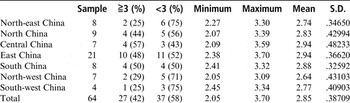
Since this is the first quantitative measurement of LPC budgetary oversight, there is no previous measurement which can be used as a reference. Therefore, to assess the progress of the LPC in budgetary oversight, qualitative studies which assess the LPC's budgetary oversight in the first year of budget reform are used. In the literature, there has been a consensus that before the reform LPCs were insignificant actors in the budgetary process. Using our measurement scale, this means that the budget oversight score in 1999 is, at best, 1. As Table 3 shows, after roughly ten years of reform, LPC budgetary oversight has evolved from nothing, and the mean value of budgetary oversight of all LPCs is 2.85.
Budgetary Oversight of LPCs by Region

Source:
Compiled by the authors.
Nonetheless, in general, the performance of LPCs in budgetary oversight still scores rather low. As Table 3 shows, the mean value of budgetary oversight scores for all LPCs is lower than 3, which is the middle level of performance in our measurement. Moreover, mean values are still lower than 3 in 58 per cent of LPCs (37). This suggests that more than half of LPCs have just started to test the waters of budgetary oversight.
That being stated, it is unfair to belittle the achievements that LPCs have made. After only ten years, 42 per cent of LPCs (27) have already achieved a performance score equal to or higher than the value of 3. This is an even more admirable achievement considering the political constraints associated with the Chinese party-state. To strengthen their budgetary oversight, LPCs, as latecomers to the well-entrenched power structure, are claiming a new legislative jurisdiction within the already crowded power arena of the party-state. LPCs, undoubtedly, encounter tremendous resistance from other state institutions.
The Continuation of Embeddedness
For the first time in China, LPCs have begun to utilize the power of the purse. Oversight, as we know, reveals inherent conflicts between the supervisor and those being supervised. This is especially true for budgetary oversight since money is a matter of life and death both for the government and the people's congress. However, in their efforts to strengthen budgetary oversight, LPCs, for the most part, continue to employ the strategy of “embeddedness” identified by O'Brien nearly 20 years ago. In other words, in general they have not been confrontational.
Three aspects of budgetary oversight
The LPC's budgetary oversight, as mentioned above, is measured in three aspects: information, dialogue and enforcement. Contestation can occur in each of these dimensions, but enforcement is the best place to observe whether or not the LPC has become confrontational. Since the budget reform, certain LPCs have begun to be more demanding in budgetary oversight. For example, some LPCs have begun to insist that the government, particularly its financial and functional bureaus, provide information which the LPC thinks important for carrying out effective budget oversight. According to one LPC interviewee, “previously, we review[ed] what they [the government] wanted us to look at, but now we tell them what we want to know.”Footnote 14 More noticeably, certain LPCs have started to take action related to enforcement. For instance, in the 2003 and 2004 annual sessions of the Guangdong Provincial People's Congress, the delegates, for the first time, began to question the misappropriation of public money for private means and demanded that the money be reallocated for public spending. In Shenzhen, the people's congress has implemented a “single-item voting” procedure, which means that all major government programmes have to be voted on by delegates in the annual session. In the 1999 annual session, three programmes were vetoed, and in the 2001 annual session one programme was vetoed. In the 2003 annual session of the Wuhan People's Congress, delegates vetoed one governmental programme viewed by many delegates as involving improper expenditures.Footnote 15 In Hebei province, the standing committee of the provincial people's congress has begun to conduct a meaningful review of budgets, which has included cutting budgetary requests, insisting that governmental departments remove programmes the standing committee considers to be improper, and demanding that certain departments re-compile their budgets.Footnote 16
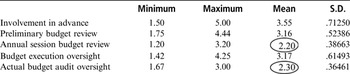
However, as the survey shows, encouraging progress has been made mainly in gaining information and installing a regular budgetary dialogue. As Table 4 shows, the mean values of these two dimensions are 3.14 and 3.64, respectively. This suggests that, compared to the situation before the reform, LPCs are now able to access more budgetary information in greater detail and that regular budgetary dialogue has been institutionalized between the people's congresses and corresponding governments. But, in enforcement, LPCs as a whole achieve only a mean value of less than 2, which in our measurement indicates a very poor performance.
Three Dimensions of LPC Budgetary Oversight

Source:
Compiled by the authors.
In sum, LPCs have not become confrontational in budgetary oversight, and progress has been moderate at best in the enforcement aspect. In our fieldwork, many interviewees from LPCs argued that at this early stage of utilizing the power of the purse, it is better for the LPC to concentrate its efforts on information gathering and institutionalizing a regular budgetary dialogue. It is expected that this will lay the foundation for the LPC to achieve more in the future.
The five stages of budgetary oversight
After a decade of budget reform, five major stages of budgetary oversight have been established by LPCs. The first stage is “involvement in advance” (tiqian jieru 提前介入). This means that oversight will begin as soon as the government starts to compile its budget, usually in June or July. At this stage, the LPC standing committee will ask the governmental finance bureau to report the government's policy priorities and main budgetary considerations for the next financial year and will inform the government of any major concerns. This stage evolved during the latter half of the past decade, roughly since 2006. The second stage is “preliminary review” (chushen 初审). According to the Budget Law, one month before the annual session of the people's congresses (usually in March at the national level, but one or two months earlier at the local level), the government must submit its budget to the LPC standing committee for a preliminary review. This is followed by the “annual session review” (dahuishen 大会审), during which all LPC delegates will review and vote on the budget. The fourth stage is “budget execution oversight” (yusuan zhixing jiandu 预算执行监督), during which the standing committee will supervise the execution of the budget. The final stage is the “actual budget audit oversight” (juesuan shenji jiandu 决算审计监督). Once the fiscal year (from January 1 to December 31) is closed, the audit bureau will be involved in auditing budget implementation, and then in the middle of the following year, it will submit its report of auditing results to the standing committee for approval.Footnote 17
As Table 5 shows, progress has been made primarily in the three stages overseen by the standing committee, i.e. involvement in advance, preliminary budget review, and budget execution oversight. All three stages have achieved a mean value of budgetary oversight greater than 3. With regard to the annual session budget review and the actual budget audit oversight, LPCs have only achieved a mean value of 2.2 and 2.3, respectively, which rates poorly in our measurement.
Different Stages of LPC Budgetary Oversight

Source:
Compiled by the authors.
The poorer performance of LPCs during the annual session is associated with several limitations of the current people's congress system. First, LPC delegates are not chosen through competitive elections and so may be less interested in actively overseeing budgets. Second, delegates serve only as part-time “legislators.” They only attend the annual session (which usually takes up no more than one week at the local level), during which no more than a half day is scheduled for budget review. Third, since the Budget Law has not granted delegates the power of budget revision, which is widely regarded as the most important procedural authority a legislature needs to have in budget oversight,Footnote 18 delegates have to make a decision between two extremes in annual session voting: approve or veto the budget as a whole, and almost without exception they will choose the first.
Unsurprisingly, as we found from our fieldwork, LPCs at present rely heavily on their standing committees rather than the annual session to conduct budget oversight work. Some interviewees from LPCs even contended that, at present, this may be a better strategy because, compared with the annual session, the standing committee is a formal organization and has an established committee system in budgetary oversight, and thus is able to wield more budgetary oversight power.Footnote 19 But, as a strategic matter, this reliance is closely associated with the LPCs' desire to avoid uncontrollable conflicts. In an environment where there is no budget revision procedure, if delegates take a more active oversight role during the annual session, the LPC would be forced into a confrontation with the government. This could result in dissatisfied delegates vetoing the budget in its entirety. However, if the majority of the budgetary oversight work is undertaken by the standing committee, all budgetary negotiations will be between the standing committee and the government. As several interviewees from LPCs pointed out, since both sides are bureaucratic organizations of the Chinese party-state, it is unlikely that conflicts will escalate.
The LPCs' deep concern with avoiding clashes is further evident in localities where a budget revision procedure has been put into place. During the past decade, six provincial-level people's congresses (i.e. Hebei, Shanxi, Guangdong, Guangxi, Hainan, and Chongqing) have legally granted their delegates this important power. But, as the survey shows, from 2006 to 2010, only in 4.7 per cent of LPCs were budget revision bills submitted by delegates. Furthermore, none of these bills came to the annual session for a vote. Where did they go? As we found in the fieldwork, whenever delegates submit their bills, the LPC standing committee and the finance bureau of the government will work together to persuade those delegates to take back their bills. In return, the government will satisfy their requests in budget execution. By burying revision bills in this way, the LPCs are able to keep control of the annual session. As one interviewee from an LPC pointed out, if delegates have the power of budget revision, “uncontrollable conflicts” would arise and be made public.Footnote 20 The self-restraint of the LPCs is even more evident in places where the annual session has vetoed governmental programmes. As mentioned above, in the 2003 annual session, Wuhan People's Congress vetoed one governmental programme. But, as one senior official there said, “This is a weapon you cannot use frequently. You must have a sword, but you should not wield it every day. Only when it is necessary should you take it out to let governmental bureaus know you are someone nobody can overlook.”Footnote 21
Avoiding unmanageable contention is such a deep concern for the LPCs that, during the past decade, more and more LPCs have added a new stage of “involvement in advance” in budget oversight. As one senior official from Guangdong Provincial People's Congress pointed out, it is already too late for the people's congress to propose changes to the budget at the annual session because that is when a final decision on the budget has to be taken. If the people's congress delegates insist on making changes at this point, it will cause significant political conflict. Therefore, according to this official, the earlier the people's congress becomes involved in the budget process, the less likely conflicts will arise and the government will be more likely to cooperate with the people's congress.Footnote 22
Lastly and noticeably, as Table 5 shows, although carried out by the standing committee, budget oversight in auditing the actual budget achieves a low score of 2.30. As many interviewees pointed out, this is primarily owing to the LPC's lack of organizational capacity in auditing, which demands a large and professional staff of accountants and auditors. The audit bureau, in the Chinese political system, belongs to the government although it must also report results to the LPC standing committee. Nevertheless, as these interviewees further highlighted, the LPC also reigns itself in during this process. The most pressing budgetary problem facing China today is that actual expenditures are larger than the amounts approved by the people's congress. Were the LPC to become serious and tough at this stage, it could lead to open conflict with the government.
Summary
To sum up, in their efforts to increase their budgetary oversight powers, LPCs in general follow a strategy of “embeddedness” by avoiding unmanageable conflict and thereby winning political support. At present, LPCs have concentrated their efforts on gaining information and institutionalizing a regular budgetary dialogue. With regard to enforcement, they have just started to test the waters. Meanwhile, to avoid open contention, LPCs have chosen to rely mainly on their standing committees rather than the annual session when exercising their oversight powers.
The Evolution of Controllable Contestation
Following an “embeddedness” route does not mean that LPCs will never openly contest the budget. During budget negotiations between LPC standing committees and government, some LPCs have taken a more contentious stance when they have become involved in enforcement actions.
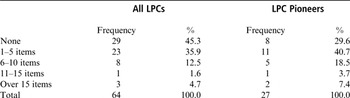
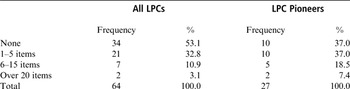
This contention can be seen at the preliminary review stage. Of the 64 LPCs we investigated, in 2010 more than half (54.7 per cent) of their standing committees had asked corresponding governments to add or remove expenditure programmes in their budgets (Table 6), and 46.9 per cent demanded that changes be made to the budget requests of certain programmes (Table 7). Contestation is even more in evidence among those 27 LPC pioneers which achieve a mean value of budget oversight equal to or higher than 3. As Table 6 shows, 70.4 per cent of them have demanded that their corresponding governments add or remove expenditure programmes, and 63 per cent have demanded cuts or increases to budget requests for certain programmes, as Table 7 shows.
Standing Committees Asked to Remove or Add Programmes in 2010

Source:
Compiled by the authors.
Standing Committees that Proposed Changes to Budgetary Requests in 2010

Source:
Compiled by the authors.
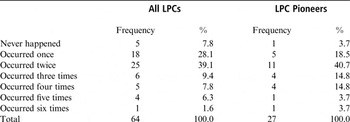
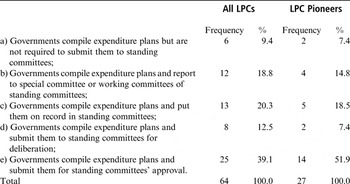
Contestation is also in evidence at the budget execution stage. One indicator used to measure the budgetary oversight of a legislature is the degree of discretion the executive enjoys in budget execution.Footnote 23 In China, the budget system was negatively impacted by the government having too much discretion. Since the budget reform, LPC standing committees have been struggling to tighten their control over executive flexibility in budget execution. To this end, a number of them emphasize that even those budgetary adjustments which do not require ex ante legislative approval according to the Budget Law must now be submitted to standing committees for approval.Footnote 24 As Table 8 shows, from 2006 to 2010, there were only five LPCs which do not insist that budget adjustments be submitted to the standing committee for approval. Of the 27 LPC pioneers, during the same period, only in one instance did a budget adjustment not need legislative approval. The most salient problem in this area is that, each year, the government collects revenues in excess of the budgeted amount approved by the people's congress, and then uses the surplus revenue as it sees fit.Footnote 25 During the past decade, LPCs have begun to tighten their controls over the government's discretionary use of this money. As Table 9 shows, 39.1 per cent of the LPC standing committees in our survey have succeeded in forcing the government to compile a budget for the use of this surplus revenue and submit it to the standing committee for approval. In another 12.5 per cent, such budgets must at least be deliberated upon by the standing committee. More than half (51.9 per cent) of the 27 LPC pioneers have succeeded in insisting that such budgetary adjustments be approved by the standing committee.
Budgetary Adjustments Approved by Standing Committees, 2006–2010

Source:
Compiled by the authors.
Legislative Requirements on the Use of Surplus Revenues

Source:
Compiled by the authors.
No matter how encouraging, contestation in the present form is no more than a form of controllable contestation. First, the contestation occurs within budgetary negotiations between the LPC standing committees and the government, and more often than not between the budgetary oversight committees of the former and the finance and functional bureaus of the latter. Second, within this context, the budget overseers from LPC standing committees tend to concentrate their fire on governmental bureaus. As we learned in our field work, they will never choose to challenge the Chinese Communist Party (CCP) or the executive leadership, and furthermore, they will not criticize the CCP standing committee bureaus’ budgets. Third, in most situations, it is unlikely that uncontrollable conflict will occur during these negotiations. In most instances, the government will follow the standing committee's self-constrained suggestions, and in those cases in which it finds the LPC standing committee's suggestions impracticable, the government will do its best to give acceptable reasons and ask for understanding from the standing committee. This demonstrates the government's respect for the legal status as well as the authority of the people's congress. Moreover, most members of the LPC standing committee are former senior officials from the government and the CCP standing committee; that is, before serving in their current positions in the LPC, they were the superiors of the incumbent officials now working in the government. Therefore, in budget negotiations, government officials will usually show deference to their former superiors.Footnote 26 Meanwhile, the LPC standing committee will not insist that its opinions or suggestions be taken up if the government strongly refuses to make the required budgetary changes. This is especially true when the government gives an explanation and asks for understanding from the people's congress. To both sides, the central concern is not only to give face to each other but also to avoid triggering conflicts.
Understanding the Logic behind the Strategy
To understand the strategy adopted by LPCs, it is vital to examine the incentive structure of the LPC system, which has been shaped concurrently by the new opportunity offered by the budget reform and by the institutional constraints set up by the Chinese party-state.
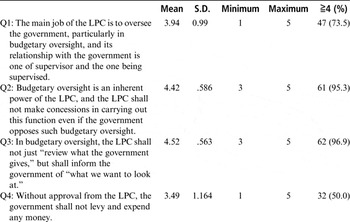
Budget reform indeed provides an opportunity for LPCs to expand their jurisdiction to an important new area, and they are not blind to it. In the survey, 93.7 per cent of LPC respondents agreed that budget oversight is vital for promoting the status of the LPC. Many LPC budget officials pointed out that only when the people's congress gains “the power of the purse” will it be able to control government spending effectively. Several of them even highlighted, jokingly, that under the current cadre management system, which keeps cadres under the tight control of the CCP, the people's congress had little to gain in the area of appointing officials (i.e. cadres); fortunately, the Party has never claimed that it would directly manage money. Since the LPC budget overseers’ perceptions of their role will affect their actions, four statements were developed in the survey to measure how they viewed the role of the people's congress in budget oversight. Table 10 shows that they have formed strong views on their role in budgetary oversight.
Perceptions of Budgetary Oversight Roles

Note:
Respondents were asked to give their opinions about these statements, 1 = strongly disagree, 5 = strongly agree.
Source:
Compiled by the authors.
However, this does not mean that budget overseers will act exactly according to their perceptions of the LPC's role in budgetary oversight. To what extent a legislature will carry out its function of budgetary oversight is determined less by the legislature itself than by the institutional context under which it undertakes its function and the interaction between the legislature and other actors in the budget process.Footnote 27 This is especially true for Chinese LPCs creeping forward under “institutional ceilings” set up by the party-state. With the introduction of budget reform, LPCs do indeed wish to dance up a storm in the new area of budgetary oversight, but they are dancing inside a straitjacket designed by the party-state. During the past three decades of economic reform, political support has steadily increased to allow the people's congresses to play a more active role. In other words, although the people's congresses still wear the straitjacket, the ties have gradually been loosened. Fundamentally, LPCs are not created through competitive elections and so lack sufficient political support or pressure from electoral constituencies for them to act authoritatively and legitimately in a contentious manner. Moreover, although the government has been legally subjected to legislative oversight, the legislative–executive relation in the party-state system was designed primarily as a division of labour rather than as a separation of powers, and in the actual power relationship, local governments always hold a higher position than LPCs.Footnote 28 Furthermore, under the current cadre management system, most LPC standing committee members as well as the legislative bureaucrats come under the control of the corresponding CCP standing committee. Lastly, but no less importantly, agenda setting within the people's congress is controlled by the party group established by the CCP within the LPC's standing committee. Altogether, it is unlikely that LPCs will act confrontationally in budget oversight.
In reality, as we found in our fieldwork, LPC budget officials fully recognize that the LPC is not ready to behave confrontationally. They know that if the LPC acts always and everywhere with confrontation in budget oversight, uncontrollable budgetary conflicts will be stirred, which are essentially political conflicts. When this is the case, the LPC's pursuit of “the power of the purse” will come to a premature end. First and foremost, if the LPC acts confrontationally, it will risk losing the political support of the CCP standing committee. Usually, the CCP leadership will not become involved in the routine affairs of budget compilation and implementation. However, in some places, the leader of the CCP standing committee also serves as the chair of the LPC's standing committee, and the CCP standing committee has the final say in every significant issue, including those relevant to budgeting. Therefore, in their efforts to strengthen their budgetary oversight, it is vital for the LPC to win political support from the CCP leadership or, at a lower level, to keep conflicts to a minimum so as not to be viewed as a trouble-maker by the CCP leadership. In sum, as one senior LPC budgetary official vividly put it, “What we can do, how much we can do, and to what extent we conduct our business of budget oversight are wholly dependent on what the boss asks us and allows us to do.”Footnote 29 “The boss” is, of course, the CCP leadership.
Second, if the LPC acts confrontationally and puts too much pressure on the government, the latter would cease to cooperate. In the early stages of the budget reform, there was a honeymoon period between the LPC and the government, particularly between the budgetary oversight committee of the former and the finance bureau of the latter. This was largely because, as respondents from several LPCs pointed out, at this stage, finance bureaus were encountering tremendous resistance from other governmental bureaus against their efforts to centralize budgetary power within the government, and they needed a political alliance with the people's congress, to which all governmental bureaus are legally accountable. However, in subsequent years, as soon as the people's congress sought to achieve more in budgetary oversight, the honeymoon was quickly over, and the finance bureau was no longer as cooperative as before. In such instances, the LPC faces tremendous difficulties in moving ahead, and struggles to obtain cooperation from the finance bureau. Consequently, in order to embed itself within the fiscal governance, which has been dominated by the government for many years, the LPC, as the newcomer to the power arena of the party-state, has to continue with its previous strategy of trying to garner political support as well as cooperation, and so must avoid stirring up conflicts and resistance.
But, in budgetary oversight, it is impossible to avoid clashes, and to do so is not the best strategy for the LPC anyway. Unlike other forms of legislative oversight such as investigating law enforcement, conflict is inherent in budgetary oversight. Furthermore, if the LPC decides to avoid clashes anytime and anywhere in its budgetary oversight responsibilities, the only choice is to do nothing. Obviously, this is not the stance that many LPCs would take because, after more than two decades of legislative development, LPCs have become more established in the Chinese political process than they were in the 1980s and 1990s. As we found in fieldwork, more and more LPC budgetary officials have come to realize that there is no hope for a docile legislature to embed itself successfully into the process of fiscal governance. In other words, for it to be embedded into fiscal governance, the LPC must make its own mark in budgetary oversight.
This poses an intractable problem for the LPC: how to act with contestation while avoiding uncontrollable conflicts. To observers outside the Chinese polity, this seems to be an impossible task. But, for LPC budget officials, especially senior officials, it is not. As CCP cadres working for many years within the party-state, they know where the institutional taboos or ceilings are, and where, when, and through which manner they can act contentiously. The current choice of LPCs is to confine their efforts to strengthen oversight powers to budgetary negotiations between their standing committees and corresponding governments. It is in this way that LPCs have deftly transformed budgetary oversight into a kind of closed-door or internal bureaucratic negotiation among different institutions of the Chinese party-state. As O'Brien's term contends, “[s]trengthened oversight, like lawmaking, is mainly a story of inside the bureaucracy reform.”Footnote 30 Thereafter, only within the internal bureaucratic negotiation will the LPC act with contestation, which is a form of controllable contestation. Whenever budgetary conflicts occur or are inevitable, they are essentially “small frictions” within the party-state machine and can be well contained within the current political system. In most situations, contestations are “silent conflicts” occurring between LPC budgetary oversight committees and government bureaus and are unknown to the general public and even to most delegates of the LPC.
Budgetary oversight that proceeds in this manner is, unsurprisingly, driven by budget officials from the LPC standing committees. It is reasonable to expect that some of these officials may be driven by their values or their beliefs about the proper role of the people's congress in the budgetary process. But, as several interviewees from government bureaus said, these legislative officials are generally motivated by the objective of increasing the degree of power wielded by the LPC standing committee and thus the power they themselves will enjoy as legislative bureaucrats. Several interviewees from the LPCs refuted this presumption about their motives: according to them, they are just taking back the powers granted to the people's congress by the Constitution and the Budget Law. Whatever the motives of these officials, it is undeniable that the progress of budgetary oversight during the past decade is, to a large extent, down to their efforts.
Conclusion and Discussion
The power of the purse is vital for democracy. But, for many years, LPCs had been insignificant in the budgetary process. Now, facilitated by the budget reform, they have begun to exercise the power of budgetary oversight. After ten years of budget reform, the basic institutional framework of budgetary oversight has been established, and a number of LPCs have begun to oversee, in a meaningful manner, government budgets. In their efforts to strengthen budgetary oversight, LPCs continue to maintain their strategy of “embeddedness” first identified by O'Brien, but have begun to act with contestation within a form of internal bureaucratic negotiation, as O'Brien has recently argued. Interestingly, although O'Brien has not as yet remarked on the recent development of budgetary oversight in LPCs, he does grasp with pinpoint accuracy the essence of China's transitional politics by pointing out that the LPCs’ efforts to strengthen oversight is in nature a form of inside-bureaucracy reform.
The development of budgetary oversight in LPCs is encouraging and promising. This is true for Chinese public budgeting reforms, since legislative and administrative controls are the two pillars of a modern public budgeting system. But, it also holds great implications for China's political development. As Willoughby clearly articulated in 1918, budget reform is essentially a political reform since it leads to a fundamental change of the power structure.Footnote 31 For many years, fiscal governance in China had been dominated by the government. Therefore, the development of budgetary oversight will, and has begun to, restructure the existing power relationship between the people's congresses and the government in China. Furthermore, with the development of budgetary oversight in LPCs, a form of horizontal accountability has begun to evolve in the Chinese non-election context, as some scholars have recently argued.Footnote 32
Yet, budgetary oversight in LPCs is, at best, in the early stages of development. For LPCs to exercise the power of the purse in a substantial and effective manner, tremendous challenges must be overcome. In order to activate the annual session, China needs to legally grant delegates the power of budget revision, to reform the way in which delegates are elected, and to transform delegates from part-time to full-time legislators. To improve the organizational capacity of the LPC standing committee, China needs to allow the LPCs to create other committees specializing in finance and budgeting affairs, for example, to establish a public accounting committee within the standing committee. It is also critical that China allows the LPC standing committee to hire more professional budgeting and auditing staff. Taken together, all of these reforms actually call for a fundamental restructuring of the power framework of the Chinese party-state, which undoubtedly would encounter huge political resistance. It is thus quite apparent that the future development of budgetary oversight is determined not only by the efforts of the LPCs but also the development of electoral democracy. Fundamentally, it is determined by the CCP leadership's attitude towards the proper role of the people's congress in the budgetary process.