On March 11, 2011, the Great East Japan Earthquake, with a magnitude 9.0 at the epicenter, hit the coastal areas along the northeastern part of Japan. More than 15 000 people died in the disaster. 1 In addition, more than 470 000 people were forced to stay in shelters. 1 Previous studies reported that strong earthquakes increased mortality from acute myocardial infarction,Reference Nakagawa, Nakamura and Oyama 2 stroke,Reference Kario and Ohashi 3 and pneumonia,Reference Takakura, Himeno and Kanayama 4 and the incidence of bronchial asthma,Reference Takakura, Himeno and Kanayama 4 peptic ulcers,Reference Takakura, Himeno and Kanayama 4 and hypertension.Reference Kario, Matsuo, Kayaba, Soukejima, Kagamimori and Shimada 5 The incidence of diseases and mortality increased not only in the first few weeks but also in the following few months, although major aftershocks had lessened.Reference Kario and Ohashi 6
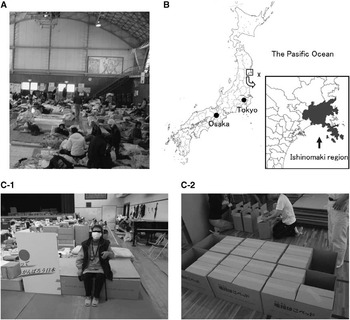
One reason for the increases in the incidence of disease and mortality could be the stress of the poor living environment in disaster shelters. After the Great East Japan earthquake, it was observed that most of the evacuees in shelters sat on the floor without chairs during the day and lay down on the floor during the night (Figure A). In addition, most of the shelters were so crowded that the residents had to live in very small spaces. Therefore, such poor living conditions in the Japanese shelters might have brought about sleep disturbance and emotional stress, resulting in the occurrence of disaster-related diseases, as described.
Inside the Shelter and the Makeshift Beds in the Shelters in Ishinomaki Region. A. Most of the refugees sit on the floor without chairs during the day and lie on the floor during the night. B. Location of Ishinomaki region in Japan. The epicenter of the Great East Japan Earthquake was 130 km off the Pacific Coast (X). C-1. The cardboard beds in the shelter. C-2. Each bed is 200 cm long, 90 cm wide, and 35 cm high.

To reduce stress, makeshift beds were introduced in the shelters. An earlier report indicated that the provision of bunks for sleeping could reduce the incidence of death from pulmonary embolism in air-raid shelters.Reference Simpson 7 A handbook describing standards in disaster responses also noted that the provision of mattresses or raised beds may be required. 8 Because the raised beds are 35 cm high, the evacuees could use them as chairs during the day, which probably provides some relief from lumbago. It was thought that the 35-cm distance from the floor reduced sleep disturbance from percussive noise and the inhalation of dust, although no direct evidence is available.
Beds were introduced in the Ishinomaki region, one of the areas most heavily damaged by the earthquake (Figure B). The beds, made of cardboard, were inexpensive (approximately $20 per bed), very easy to set up, and required little space. The aim of this study was to determine if makeshift beds could have good effects on the evacuees’ health condition, especially those with underlying disease such as hypertension and thrombotic disorders, or with symptoms such as cough, insomnia, and lumbago or mental features.
Methods
Makeshift cardboard beds were introduced for evacuees who agreed to use the beds and consented to be investigated for the utility of the beds in the shelters in the Ishinomaki region (Figure C-1). The beds were 200 cm long, 90 cm wide, and 35 cm high; they comprised 24 small parts (Figure C-2). Although made of cardboard, they were very sturdy, able to support an average weight of 9500 kg-force (written communication with Settsu Carton Co. Ltd., who denoted the beds).
Just before and 1 month after the introduction of the beds, blood pressure and blood D-dimer measurements were recorded. D-dimer values, a degradation product of fibrin,Reference Becker, Philbrick, Bachhuber and Humphries 9 are often used as a diagnostic test for venous thrombosis. Cardiac D-dimer (Roche Diagnostics), a rapid assay for the quantative point-of-care testing of D-dimer.Reference Dempfile, Schraml and Besenthal 10 was used for the measurement. The measurements were performed with heparinized blood (150 μL) using an analyzer (cobas h 232, Roche Diagnostics).
The timed Up & Go (TUG) test was also performed.Reference Podsiadlo and Richardson 11 The TUG test was begun with the participant sitting upright in a chair with armrests. A marker was placed on the floor 3 m from the chair so that it was easily seen by the participant. The participant then had to stand up at the word go, walk to the marker, turn around, walk back to the chair, and sit down. The time between standing up and sitting on the chair again was recorded. The purpose of this test was to assess functional mobility such as gait speed, balance, and the ability to move about.Reference Podsiadlo and Richardson 11
In addition, questionnaire surveys about the evacuees’ symptoms (cough, insomnia, and lumbago) and SF-8, a health-related quality of life survey,Reference Fukuhara and Suzukamo 12 were carried out just before and 1 month after introducing the beds. In the symptoms surveys, the symptoms were rated on a scale of 1 to 5 (cough: not at all 5, rarely 4, sometimes 3, often 2, frequently 1; insomnia (sleeping): excellent 5, good 4, fair 3, poor 2, very poor 1; lumbago: none 5, mild 4, moderate 3, severe 2, very severe 1). The higher the score, the milder the symptom. Then, the scores recorded just before and 1 month after introducing the beds were compared. This questionnaire was developed for this study.
The SF-8, an established and validated health survey,Reference Fukuhara and Suzukamo 12 has 8 questionnaire items. It yields a comparable 8-dimension health profile (general health, physical functioning, role physical, bodily pain, vitality, social functioning, mental health, and role emotional) and comparable estimates of summary scores for the physical and mental components of health.Reference Fukuhara and Suzukamo 12 The higher the score, the better the health. The standard form (4-week recall) was used.
No control was set up in this study for ethical reasons. The study received the approval of the Ethics Committee of Tohoku University School of Medicine. Written informed consent was also obtained from all of the evacuees.
All data are shown as means ± standard error of the mean. Statistical significance was determined using the Wilcoxon signed rank test. A value of P < .05 was considered statistically significant.
Results
Makeshift beds were introduced, and 43 evacuees who agreed to use the beds were assessed on July 9 or July 24, 2011 (4 months after the Great East Japan Earthquake), in 3 shelters in the Ishinomaki region. At the start of the survey, 7 of 71 evacuees opted to use the beds in the first shelter, 15 of 114 evacuees opted to use the beds in the second shelter, and 21 of 190 evacuees opted to use the beds in the third shelter. The 3 shelters had similar population densities and were almost the same distance from the seacoast.
The average age of the 43 evacuees was 63.1 ± 2.5 years (range, 30-90 years); 29 of the 43 were women. One month after the introduction of the beds (on August 7 or 30), records were obtained from 30 evacuees; 13 people had already moved from the shelters by then. The average age of the 30 evacuees was 64.2 ± 3.1 years old (range, 30-84 years); 21 of the 30 were women. None of the evacuees who were taking medicine changed their compliance during the 1 month. As shown in Table 1, both systolic and diastolic blood pressures significantly decreased 1 month after introducing the beds (systolic blood pressure: before, 145.8 ± 4.1 mm Hg; after, 131.3 ± 3.8 mm Hg [P < .001]; diastolic blood pressure: before, 84.6 ± 2.8 mm Hg; after, 76.8 ± 2.4 mm Hg [P < .001]). No significant differences were found in the D-dimer values before and after the introduction of the beds (before, 0.43 ± 0.08 μg/mL; after, 0.35 ± 0.05 μg/mL, Table 1).
The Effect of Beds on Blood Pressure, D-Dimer, and Timed Up & Go TestFootnote a

a Data shown are means ± standard error of the mean.
Five people had D-dimer values higher than 0.5 μg/mL, which is the conventional cutoff value,Reference Fukuhara and Suzukamo 12 among the 30 evacuees before the introduction of the beds. All of these evacuees had decreased D-dimer values 1 month after the introduction of the beds, although the difference was not significant (before, 1.14 ± 0.30 μg/mL; after, 0.67 ± 0.15 μg/mL [P = .063], Table 1).
The TUG test was performed to assess the functional mobility. As shown in Table 1, the walking time improved 1 month after introducing the beds (before, 8.15 ± 0.62 seconds; after, 7.69 ± 0.57 seconds; P < .01).
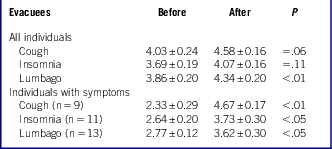
The questionnaire surveys about the evacuees’ symptoms (cough, insomnia, and lumbago) showed that for all 30 evacuees only the lumbago score had improved 1 month after the introduction of the beds (before, 3.86 ± 0.20; after, 4.34 ± 0.20; P < .01) (Table 2). However, of the evacuees who had these symptoms before the introduction of the beds each symptom score had improved significantly (cough: before, 2.33 ± 0.29; after, 4.67 ± 0.17; P < .01 [n = 9]; insomnia: before, 2.64 ± 0.20; after, 3.73 ± 0.30; P < .05 [n = 11]; lumbago: before, 2.77 ± 0.12; after, 3.62 ± 0.30; P < .05 [n = 13]) (Table 2).
Shift of Symptom Scores of All EvacueesFootnote a

a Data shown are means ± standard error of the mean.
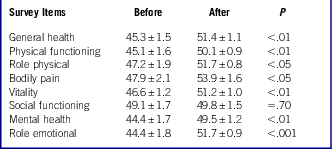
In addition, the changes of the health profiles were checked using the SF-8 health survey. As shown in Table 3, the scores of all profiles except for social functioning had significantly increased 1 month after the introduction of the beds.
Shift of SF-8 Health Survey Scores After the Introduction of BedsFootnote a

a Data shown are means ± standard error of the mean.
Discussion
Based on the observations of this study, the introduction of the makeshift bed could contribute to improve the health condition of evacuees in disaster shelters. Beds could improve not only the physical data but also the psychological consequences of living in this environment.
One of the reasons the incidence of disease and mortality increases after major earthquakes might be the stress of the poor living conditions in shelters. After the Hanshin-Awaji earthquake, it was reported that sleep problems were the most prevalent symptom in the shelters.Reference Stein, Hull and Patel 13 Kato and colleagues noted that disasters caused psychological stress such as fear, anxiety, and depression and changed the environment of the evacuees. These kinds of psychological stress and environmental changes resulted in poor sleep quality and physical inactivity.Reference Kato, Asukai, Miyake, Minakawa and Nishiyama 14 Such changes in the environment may include lying down on the floor and living in the very limited spaces of shelters.
Makeshift cardboard beds (Figure C-1, 2) can be produced in large numbers because they are inexpensive (approximately $20 per bed). They also are easy to store because they can be bundled together. In addition, they are very sturdy and could support an average weight of 9500 kg-force. Such characteristics could be useful in the preparation for disasters. However, as the bed was made for comfort, its size may be too large for some shelters. Therefore, their consideration should be done with care.
In this study, records were obtained from 30 evacuees 1 month after the introduction of the beds. At that time, 13 people had already moved from the shelter. The 30 evacuees were still in the shelter because of the government's shortage of temporary alternative housing. Both the systolic and diastolic blood pressures of these 30 evacuees had significantly decreased 1 month after the introduction of the beds (Table 1). Kario etal reported that blood pressure readings were temporarily increased after the huge earthquake and that it decreased to the pre-earthquake level within 4 weeks after the major aftershocks ceased.Reference Kario 15
The present study began about 4 months after the earthquake. Therefore, it was expected that the evacuees’ blood pressure before introducing the beds was near the pre-earthquake level, although data from immediately after the earthquake were not obtained. Alternatively, the evacuees’ blood pressure might have been high at that time because of the stress from living in shelters. Short sleep duration was reported to be a risk factor for hypertension.Reference Gangwisch, Heymsfield and Boden-Albala 16 In the present study, as discussed here, the evacuees’ insomnia was (seemingly) improved after introducing the beds (Table 2). Therefore, a reduction of insomnia might have contributed to the decrease in blood pressure.
After the Great East Japan Earthquake, one of us (S.U.) reported the high prevalence of deep vein thrombosis.Reference Ueda, Hanzawa, Shibata and Suzuki 17 In the present study, 5 of 30 evacuees showed high (>0.5 μg/mL) D-dimer values. In all 5, the D-dimer values tended to decrease 1 month after introducing the beds (P = .063, Table 1), although the difference in the D-dimer values of all 30 evacuees after the introduction of the beds was not significant (Table 1). These data suggested that the beds may have had a good effect for persons with underlying venous thrombotic disorders.
The results from the TUG test (Table 1) suggested that the beds may have had good effects on functional mobility such as gait speed, balance, and the ability to move about. As most of the evacuees sat on the floor without chairs during the day and lay down on the floor during the night (Figure A), staying at evacuation shelters reduced mobility. Such a lack of mobility can contribute to the increased vulnerability of older people.Reference Briggs 18 Moreover, beds are useful as chairs during the day (Figure C-1).
Questionnaire surveys about symptoms (cough, insomnia, and lumbago) showed that each of the evacuees who had these symptoms before the introduction of the beds had significantly improved scores 1 month after, although only the lumbago score improved in all 30 evacuees (Table 2). Regarding D-dimer values, the beds may have had a good effect for persons with underlying disorders. After using the beds, coughing by the evacuees appeared to have improved, possibly through the reduction in the inhalation of dust or particulate matter on the floor. The evacuees also showed improvement in insomnia, probably because they obtained relief from percussive noise from the floor.
In addition, the changes in the health profiles using the SF-8 health survey were evaluated. Both physical and mental components of health could be assessed using the SF-8.Reference Fukuhara and Suzukamo 12 Results from this study suggested that the beds had a good effect not only on the physical components (physical functioning, role physical, and body pain) but also the mental features (mental health, role emotional) (Table 3). It is speculated that the beds reduced the emotional stress caused by the poor living environment by improving the sleeping environment. However, other possible of improvement factors could be considered. For example, the living space for each evacuee may be increased as people leave for alternative housing and the population of the shelters decreases. Larger spaces may have improved the health conditions. Another factor is that many volunteers have been helping the evacuees. Their contributions also may have improved the evacuees’ health status. Further research is needed to clarify these issues.
Limitations
The present study was an observational study with limited conditions; it was not a randomized control study. In addition, as the total number of subjects in this study was small, the validity of the statistical analysis has been somewhat restricted. Further research, therefore, is needed to understand fully the benefits of such beds.
In Japan, each prefecture has at least 1 cardboard factory. Therefore, large numbers of makeshift beds can be supplied anywhere and in good time. Moreover, as these beds are inexpensive, easy to set up, and require little space, they should be very useful in disaster shelters. After the earthquake, we have asked local governments in Japan to introduce the beds. Currently, a few governments have decided to introduce them for disasters. We hope the beds will play a role in future disasters.
In conclusion, makeshift cardboard beds may have good effects on evacuees’ health conditions, especially those with underlying diseases such as venous thrombotic disorders or with symptoms such as cough, insomnia, and lumbago. Beds may also have good effects on mental and well as physical components. Considering the characteristics of cardboard, the beds can be useful in disaster shelters.
Funding and Support
Grant-in-Aid for Scientific Research 24659342 (M.N.) from the Ministry of Education, Culture, Sports, Science, and Technology of Japan, and Grant-in-Aid for Research (M.N.) from Japan Vascular Disease Research Foundation. J Packs Co Ltd and Settsu Carton Co Ltd donated cardboard makeshift beds.
Acknowledgment
Brent Bell, BA, reviewed the manuscript.