Starting points in Latin American urban history: from awareness of the historicity of the city to recurrent crises
Urban historiography is considered to have begun in the second half of the nineteenth century, when the effects of growth and industrialization became apparent, primarily in European and American cities, generating acute awareness of differences between old cities and new, and thus their historicity.Footnote 1 This awareness came mixed with horror and fascination, misery and splendour.Footnote 2
In Latin America, there were various starting points, and awareness of urban historicity may have evolved with less drama. Rapid demographic increases occurred in cities such as Buenos Aires, Rio de Janeiro, Sao Paulo, Montevideo and Mexico City, among others. The population of Sao Paulo, for example, was 16 times greater in 1930 than it had been in 1890, while Mexico City's multiplied by nearly five between 1880 and 1930.Footnote 3 It is also true that physical expansion, regional economic growth and in some cases industrialization, along with implementation of major public works and other projects, substantially changed the face of large and medium Latin American cities, and quite often even small ones. In these cities, the contrast between splendour and misery was also registered. Early twentieth-century journalists, criminologists, jurists and government officials roamed the slums of major cities to ‘explain the degradation and criminality of the people, and encourage social reform’. In 1901, Julio Guerrero described the ‘miserable people’ in the slums of Mexico City, ‘covered with rags. . .the dust and mud of all the neighbourhoods of the city accumulating in the matted hair of their heads’.Footnote 4
Despite notable evidence, we may discern from the work of Félix Martínez in ‘Escrituras de las historias de ciudades’ (Writings on the stories of cities) that more systematic exploration of the stories of Latin American cities arose not from any fundamental change, but rather from a process of seeking national identity. Until the 1930s and 1940s, the mood was often Hispanist, honouring the Spanish founders and highlighting the grid plan as the conquest’s own imprint, a legacy worthy of study and of linking with the living city.Footnote 5
While starting points were different on either side (European-American / Latin American cities), similar paths were followed. In both regions, city histories are almost always written by amateurs, not always aware of prevalent ideas in academia: inspired by astonishment, love or nostalgia for the city, they often produced long-winded narratives. The genre par excellence was the biography of the city, but there were also novels, stories and legends, sometimes set on old streets and typical neighbourhoods. These, according to Eric H. Monkkonen, understood a given city as an anthropomorphic entity, ‘with a unique personality, owner of his individual destiny’.Footnote 6 While historiography in general moved toward becoming institutionalized, urban history was held back due to valuable yet insufficient scholarly studies. It was not until the 1960s, when urban history was consolidated into a specific field of study, that ‘the trickle became a river’.Footnote 7 The final impetus was not unique to any one country, and Latin American cities appeared in the context of renewed research.
When the term ‘new urban history’ was coined in the US, it was less a concerted project and more the result of changes and sub-disciplines within the professionalization process, moving away from old practices. There was a strong claim for a quantitative history, which came accompanied by requirements for a new history, based in France.Footnote 8 Despite these developments, evident in historians’ books, journals, institutions and associations, the urban history of the 1980s and 1990s was full of gaps and silences. Eric Hobsbawm noted that the city ‘reflects the urgency of urban problems which have increasingly become the major, or at least the most dramatic, problems of social planning and management in modern industrial societies’. However, for Hobsbawm, urban history was ‘a large container with ill-defined, heterogeneous and sometimes indiscriminate contents. It includes anything about cities.’Footnote 9
It seems that criticism from ‘outside’, as shown in the position of a British historian like Hobsbawm, was insufficiently informed, but still indicated a general idea. From ‘within’, along the same lines, a Spanish urban historian, Fernando de Terán, wondered in 1996 whether ‘it is lawful to expand the panorama of urban history in this way, including in it all kinds of studies only because they look into the past and refer to some aspect of the city?’.Footnote 10 Some of the controversy is indeed rooted in a confusion, as urban history is not intended to study ‘everything that fits’ in the city, but to understand it as a historically constructed object; not a recipient but a socially produced entity, not the stage upon which things happen or a backdrop but, as Handlin hoped more than 50 years ago, as an entity that is ‘epistemologically different from the social and economic fabric in which it had been inserted’.Footnote 11
As for viewpoints offered in the second decade of the twenty-first century, a review of the main urban history journals founded after 1970 shows that many of them are still extant. Moreover, in the United Kingdom, the United States of America, Romania, France, Italy, Germany and many other countries, more periodical publications have emerged in recent years to enhance this sub-discipline.Footnote 12 It seems that, as Hobsbawm concluded, urban history ‘remains a key concern of historians of society, at least because it highlights – or may highlight – the specific aspects of social change and social structure’.Footnote 13
Latin America: many cities, few but grand stories
The somewhat lateFootnote 14 and controversial experience of urban history in Europe and the United States has different nuances in Latin America. Historiography has emphasized the eminently urban character of the subcontinent and the imprint the Spanish left upon it. The possession of territories was not only for exploitation but as an effective material and spiritual conquest in the name of honour, glory, laws, institutions and religion: and all this was most possible in the cities.
Nonetheless, the extended disinterest in the city shown by professional historians found reinforcements in Latin America between 1950 and 1970, because the focus was on problems and agrarian reforms. At that time, novelists were skilfully reading social and urban change,Footnote 15 but sociologists and other researchers were doomed to investigate and find solutions to rural problems.
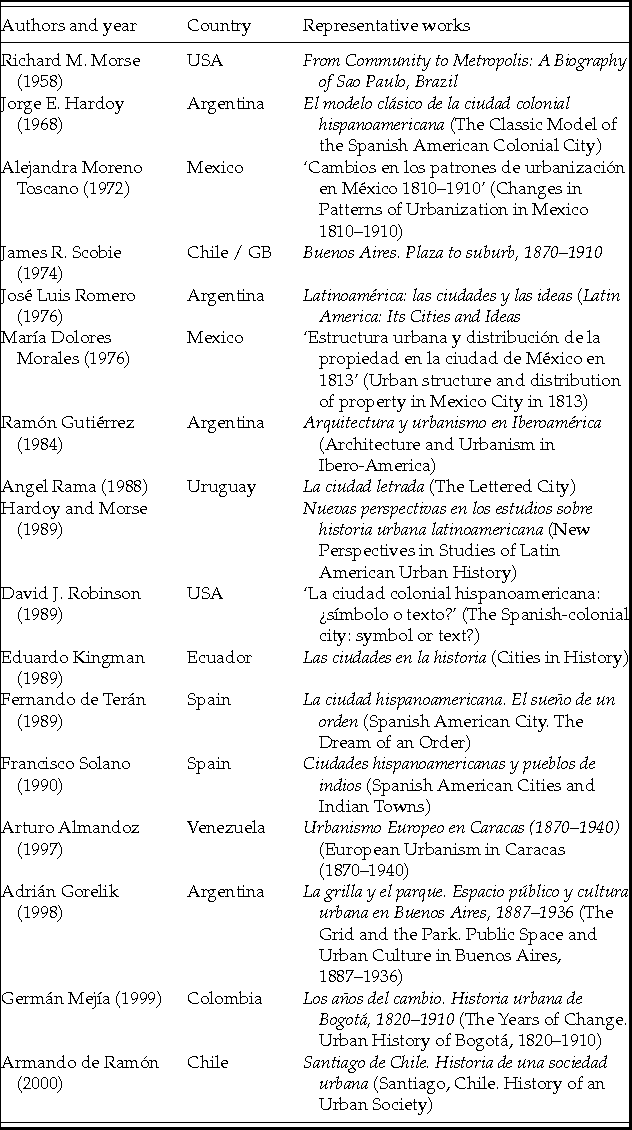
Beyond that, the path urban history followed in the United States and Europe has broad parallels with what occurred in Latin America. Though scarce, works and authors from the 1960s (the time of their American and European counterparts) are significant for their quality, as well as the range of approaches and nationalities represented by the authors. In Table 1, we note the continuity over decades, and the participation of authors from the United States, Argentina, Mexico, Chile, Uruguay, Ecuador, Venezuela, Colombia, Spain, and Brazil. The table contains only certain authors and some of their early works, but provides multiple possibilities for interpretation. It is known, for example, that until recently historical research in this field was often conducted by architects and urban and town planners. Certainly, there is no clear dominance by the physical city – urbs – because although it is permanently present, the idea of the city pursued in these works is mixed with many intellectual influences, and does not always – fortunately – coincide with academic fashions.
Authors and representative works of urban historiography in Latin America, decades from 1960 to 2000

Source: bibliographic sweep and selection of representative works by the author.
As in other European and North American cases, the 1960s and 1970s were pioneering and productive decades. One of the compelling figures was Argentinian Jorge Hardoy, architect and urban planner, who published Las ciudades precolombinas (1964) (Pre-Columbian Cities), El modelo clásico de la ciudad colonial hispanoamericana (1968) (The Classic Model of the Hispano-American Colonial City), and a later article in which he studied the transfer of European urbanist ideas to Latin America (1988), among many others.Footnote 16 He was also an active promoter of symposia on Latin American urbanization, which sought to ‘facilitate a broad exchange of ideas between archaeologists, architects, anthropologists, art historians, social historians, and urban planners’.Footnote 17 Largely from Hardoy's momentum, the Congreso Internacional de Americanistas (International Congress of Americanists) became a meeting place for many researchers exploring the field of urban history. In 1972, for example, during the XL Congress in Rome, the ‘Urbanization in Latin America’ symposium saw 18 papers presented, and published in the book Las ciudades de América Latina y sus áreas de influencia a través de la historia (Latin American Cities and their Spheres of Influence throughout History).Footnote 18
Hardoy often worked closely with Richard McGee Morse, who was at the time developing an intensive study of Latin American urban history. Frank Tannenbaum, ‘the founding father of Latin American Studies’ in the US, was a figure known for having ‘travelled by mule the peasant surface of our countries’, while Morse lived and studied ‘the major cities with intensity’.Footnote 19 In 1958, Morse published From Community to Metropolis: A Biography of Sao Paulo, Brazil, and in 1971, The Urban Development of Latin America, 1750–1920, a compilation of his own and others’ essays in which he outlined a ‘preface to the urban history of Latin America’ and approaches to ‘patterns of Latin American urbanization’.Footnote 20
The pioneering works of Hardoy and Morse were distinguised by their quantity and quality. However, many other urban historians of this and the following decade were on a crusade to promote the ideas of the Escuela de la Dependencia, ‘School of Dependence’, a current that would explain Latin American backwardness in terms of dependence on foreign powers, thereby linking the development of cities to the positions they occupied in an economic game in which they were only subsidiary partners. This historiography focused attention on large cities, well located for raw materials and industrial production, while ignoring the history of other, smaller cities.
Romero: the city as historical life, as an engine of history
Latinoamérica: las ciudades y las ideas deserves particular mention as Latin America's most influential work to date, and for being both panoramic and comprehensive. It is not merely anecdotal to say that the author, José Luis Romero, distanced himself from academia and prevailing fashions, which allowed him to eschew the dominant dependency perspective (his ideas about autonomy and heteronomy for configuring and continuous urban change are noteworthy), and to achieve a social and cultural history within a framework that could be said to dovetail with the work of Asa Briggs, for example.
His specialization in the Middle Ages and explorations of the western world led Romero to write a book to ‘answer the question of what role cities have played in the Latin American historical process’.Footnote 21 He argued that it was the cities of Latin America ‘which sparked changes’, and to understand them in the long run he wanted to make a ‘thorough investigation of how societies formed and changed, of the different urban cultures within each period in each city, and the outlook of different social groups at times of intense change’.Footnote 22
Romero sought order in chaos, in diversity and complexity, following the thread of urban society and its ideas, or, rather, he followed the ideas that ruling elites successively imposed upon the city. First, it was the sixteenth-century ‘cycle of foundations’, the cities of conquerors inculcated with the ‘mentality of European expansion’. Then came the noble cities (ciudades hidalgas), dominated by a class with pretensions to nobility (hidalguía), feeding an illusion of ‘old wealth as lords of the metropolis’. In these cities, according to Romero, two ways of life co-existed between the seventeenth and eighteenth centuries: sometimes they were noble, sometimes commercial, ‘because neither the noble classes could avoid commercial activities, nor could the mercantile sector stop cherishing the hope of someday achieving the lustre of the idle classes’.Footnote 23 In urban terms, noble culture left its imprint on religious buildings and the desire to reproduce the model of the peninsular court. It was the baroque city which began to fade in the mid-eighteenth century with the rise of the creole bourgeoisie. Creole cities, born ‘under the sign of the Enlightenment and philosophy’, increased from c. 1750 to 1820. Then cities of the patricians (c. 1820–80), a class between urban and rural, which arose from the struggle to organize new nations and ‘dominated political life in the long mid-century after Independence’. Later came the bourgeois city (1880–1930), and finally the city of the masses (1930–70).
Contrary to what might be supposed, when reading Romero, social transformations are not always translated into physical transformations. The key to understanding the city in this author's work is not really explicit in Latin America: Its Cities and Ideas, but in the text ‘The historic structure of the urban world’, ‘A city is primarily historical life, or rather a form of historical life and not a physical enclosure nor a society surprised at a given point in its development; not a certain spirit or tradition, nor a rigid structure. The city exists as a continuity in flux because it is essentially historical life.’Footnote 24 Romero's proposal is sophisticated and must be viewed within his wider project of understanding the western world. Empirical and theoretical readings that can be made from it are manifold: in the forefront, Latin America: Its Cities and Ideas contains innumerable references, images and ideas in which Latin American cities are explored from a social and cultural perspective, fundamental to this region's urban studies. At the theoretical level, while many social scientists at the time claimed that cities were unable to change anything, Romero aimed to show how the city (from the eleventh century onward, in line with Pirenne) has been the place where ‘a historical way of life’ has taken shape, and that the historical life of its ruling classes has driven not just the city itself, but their entire countries.
The city thus conceived, primarily as civitas, found itself on a rugged, perhaps somewhat disconcerting path, to the extent that the urbs – among the key components of the city in urban history's various theoretical stances – becomes ethereal. Pursuing less the city than the ideas generated within it, the important thing to Romero when viewing the physical entity, independent of size or characteristics, is ‘how a social group was integrated into a limited urban space and was consubstantial with it’.Footnote 25 Nonetheless, he paid considerable attention to the physical city during certain eras in the history of Latin America. In key passages, such as those related to what he called the ‘bourgeois city’, social and urban change are intimately related: ‘If the time lapse between 1880 and 1930 had a definite and unmistakable physiognomy it was above all because the ruling classes of the cities imposing their views on the development of regions and countries possessed a very organized mentality based upon on a few unshakeable principles which enjoyed extensive consent.’Footnote 26
Generations and influences: a diverse overview
If Hardoy, Morse, James Scobie,Footnote 27 Romero and others may belong to a ‘first generation’ of urban historians in and of Latin America (the bulk of their publications falling between 1950 and 1970), then Ramon Gutiérrez, Roberto Segre, Mariano AranaFootnote 28 and Alejandra Moreno represent the ‘second’. The ‘third’ generation applies to authors like Adrian Gorelik, Arturo Almandoz, Germán Mejía and Hira de Gortari, who have published since the 1990s. The presence of Hardoy, Morse and Scobie in the first generation imposed a link to North American academia, which became more complex in the second when there also arose strong connections to Marxism, structuralism, dependency theory and certain quantitative influences, but, also, direct knowledge borne of travel and close study of Latin America, as in the case of Gutiérrez, for example.
Published in 1984, Arquitectura y urbanismo en Iberoamérica (Architecture and Urbanism in Ibero-America) by Ramón Gutiérrez is an erudite and wide-ranging study, indispensable reference material for any historical research into Ibero-America cities.Footnote 29 His work as a whole, alongside that of Romero, is a fundamental source. Situated in the urbs, the work of Gutiérrez symbolically occupies the highest point within the domain of architects and urban planners writing the history of the Ibero-American city, a trend that, while still significant, has declined in favour of a greater plurality of disciplinary, theoretical and methodological sources, and questions of urban history perspectives.
Indeed, in the late 1980s we may clearly identify a move toward the social and cultural in urban historiography, recognizing José Luis Romero as a direct antecedent. Germán Mejía, for example, in Los años del cambio. Historia urbana de Bogotá, 1820–1910 (The Years of Change. Urban History of Bogotá 1820–1910) concerned himself with understanding the city as a historically constructed place where nature and geography mattered to the extent that inhabitants moulded their activities, desires and needs to them.Footnote 30 A year later, Armando de Ramón wrote Santiago de Chile. Historia de una sociedad urbana (Santiago, Chile. History of an Urban Society), and Adrián Gorelik titled his book: La grilla y el parque. Espacio público y cultura urbana en Buenos Aires, 1887–1936 (The Grid and the Park. Public Space and Urban Culture in Buenos Aires, 1887–1936).Footnote 31 By then, the work of Arturo Almandoz was already known, and in 2002, he published an article which despite its simplicity has had significant influence, advocating an urban cultural history, the tendency already dominant in general historiography.Footnote 32 With training, connections and dialogue established by those we call the third generation, others interested in urban history came once again to highlight plurality and possible convergence between European, American and Latin American urban historiography; there are no doubt differences and distances, but also parallels, and, increasingly, similar interests and concerns.
Germán Mejía, who studied in the United States, has pondered the comparative successes of American and French historiography;Footnote 33 Almandoz, educated in England, has become a promoter of a ‘new urban cultural history’ which owes some ideas to Anthony Sutcliffe's works.Footnote 34 In Mexico, at the personal level as well the institutional, the most formal relationship was established with French and Spanish academics in the 1970s and 1980s, particularly at the Instituto Nacional de Antropología e Historia (National Institute of Anthropology and History) and Instituto Mora (Mora Institute).
Any proposed balance is of course limited, but still indicative of certain trends. In Table 1, and in reviewing and interpreting the selected authors and titles, we highlight the representativeness of countries and have therefore chosen works of considerable scope. Additional emphasis should be on the importance of researching the entire range of Latin American cities.Footnote 35 Another crucial factor, with both advantages and disadvantages, is the predominance of large cities in Latin American urban historiography: ‘the prime cities’, capitals, major ports, metropolitan areas with periods of spectacular growth.Footnote 36 But in addition to these studies, we can and should identify and review notable efforts by urban historiographers with an interest in medium-sized and even small cities – particularly those conducted by and incorporated into mainstream academic historiography since the 1990s.
Mexico, a non-existent urban history?
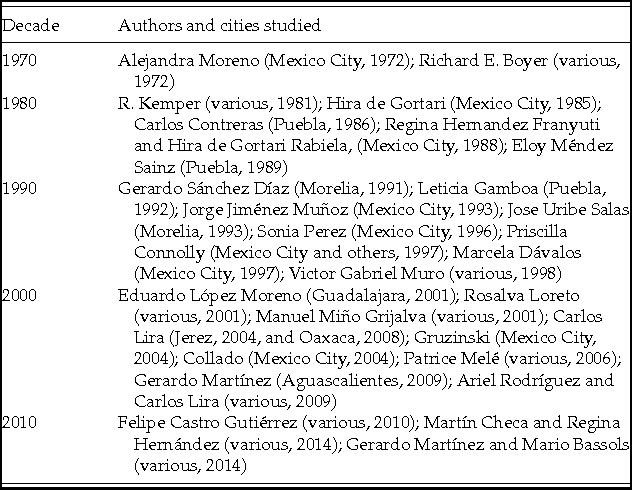
A relevant measure of trends, types, characterizations and expressions of urban history in Latin America can be seen in the case of Mexico. Again, morphology and architecture, city layouts and buildings reveal the extensive impact of architects and urban planners on changing ideas of ‘doing urban history’, while showing both a complex situation and less scarcity of material than is customarily thought (see Table 2). In Mexico during the 1970s, a group of historians and individuals interested in the city formed a Seminar on Urban History, housed at the National Institute of Anthropology and History. One of the most visible leaders was Alejandra Moreno Toscano, who had been closely involved in the efforts of Hardoy and Morse. From her own group in Mexico emerged the texts ‘Cambios en los patrones de urbanización en México 1810–1910’ (Changes in Patterns of Urbanization in Mexico 1810–1910) (1972), and El sector externo y la organización espacial y regional de México (1521–1910) (The External Sector and the Spatial and Regional Organization of Mexico (1521–1910)),Footnote 37 which indicated two main lines, one entailing urban morphology and real estate property and the other urbanization patterns, with the latter understood from the theoretical perspective of dependency. The same group published Fuentes para la historia de la ciudad de México (Sources for the History of Mexico City),Footnote 38 along with English translations of authors such as Morse.Footnote 39 From the second half of the 1970s on, the seminar managed to attract a corps of young undergraduate and graduate researchers from economics, sociology and related disciplines, focusing on historical issues in Mexican cities.Footnote 40
Urban histories in Mexico, 1970–2010

Source: bibliographic sweep and selection of representative works by the author.
For several decades, though, France was the base for relationships between practitioners of urban history in Mexico. It had partially been for the group trained at the National Institute of Anthropology and History and in the 1980s but was perhaps more decisively so at the Mora Institute. Hira de Gortari, one of its directors, encouraged research in this field: he was interested, and had studied in, France. Opening positions for new historians trained at various schools (the University of Barcelona under the tutelage of Horacio Capel, for example), he also generated initiatives, projects and collaborations with leading French historians such as Bernard Lepetit. Dominant ideas in the historical training that some of these researchers acquired in France led to the addition of a demographic component to urban history in the 1980s. This went with a strong interest in Mexico City and other major Pre-Hispanic cities, in the morphology of Novo-Hispanic cities and in the impact of liberal reform on urban property through the second third of the nineteenth century. It was the golden age of Novo-Hispanic urban history,Footnote 41 tracing patterns of population and economic activities, generating sources which are certainly still useful but now largely forgotten.
At the turn of the 1990s, Mexican urban historiography reached its full force. Not only did the number of interested scholars multiply, but also publications and joint projects. It is important to emphasize that historians were by this time able to concentrate, with unprecedented clarity, upon the late nineteenth and early twentieth centuries: not erasing but reducing interest in the colonial era and examining not only Mexico City but also Puebla, Guadalajara, Oaxaca and Morelia, followed soon after by Orizaba, San Luis Potosi, Jerez, Tampico, Zacatecas, Aguascalientes, Mérida and others.Footnote 42
It is worth comparing the dynamism of the 1990s with what occurred in the context of Latin America generally (very identifiable since 1989, one of the standout years: Table 1), and contrasting it with the landscape of later years, which may give a first impression of it having settled down. Sergio Miranda has argued that in Mexico urban historiography is non-existent. While this critical and provocative mood is understandable, the evaluation is unfair and disregards any review of the literature: works may be few, but they effectively address concerns and methods in urban history, from training to emphases on social history, cultural history, architecture and urbanism, or political history of cities and administrative management.
Miranda's evaluation has two sides. One is grosso modo correct, and we may stress that he criticizes historians’ lack of reflection ‘on the foundations of urban history’, a widely recurring fashion, not only in Mexico, which ‘had led to the city being that store of historical curiosities, where practitioners of various historiographic genres came to buy something’.Footnote 43 The city in these works is reduced ‘to a place, an environment, a social practice, a phenomenon or economic activity, an architectural way and discourse, a mentality, an imaginary idea or representation’.Footnote 44 On the other hand, it is also absolutely incorrect. Miranda seems to have limited his analysis to what has occurred over the past 40 years, and to have considered only texts about Mexico City, ‘as this is what historians have directed most attention to'. Such a restriction leads inevitably to a huge distortion, easily constrasted by the remarkably victorious investigation of urban history of other Mexican cities since the 1990s.
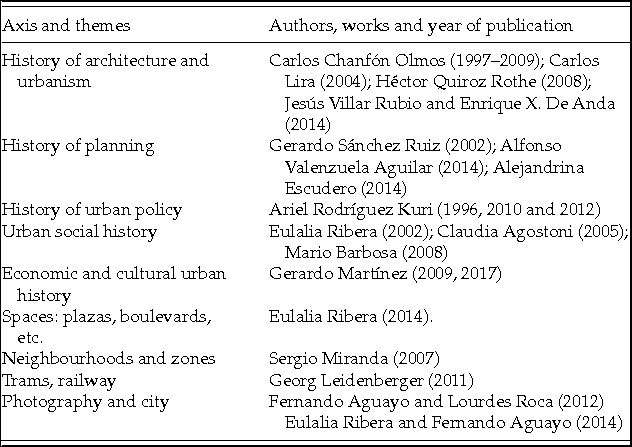
Faced with this very partial evaluation, we should seek and refine the most carefully selected indicators for measuring Mexican urban historiography. Table 3 incorporates a new means for collecting and classifying representative titles from recent years. The history of architecture, urbanism and planning merit particular attention. As in the past, university departments in these disciplines have produced some of the most significant historical studies when it comes to cities. Furthermore, as shown by Marco Sifuentes and Alejandro Acosta, if architects and urban historians were until recently still tied to positivist traditions, they have lately been following contemporary historiographical trends, departing from ‘the historification of the observed space’ to study also ‘the living space and represented living space’.Footnote 45 The monumental work co-ordinated by Carlos Chanfón Olmos, Historia de la arquitectura y el urbanismo mexicanos (History of Architecture and Mexican Urbanism), could be catalogued within the long tradition of architectural histories, but it is much more than that because it participates in and contributes to the fuller understanding of cities.Footnote 46
Urban historiography in Mexico from 2000 to date

Source: own data.
The same is true for the history of planning (an area that in Latin America could be described as a ‘sub-discipline’ of the history of urbanism),Footnote 47 which has had a noticeable effect in the last decade, as the most visible figures of planning in Mexico, such as Miguel Ángel de Quevedo and Carlos Contreras, have been re-evaluated. We should not forget that architects like Contreras and Mario Pani, actively working during important periods of the twentieth century, belonged to a tradition in which architects were the great creators of towns and cities: the future seemed to lie in their knowledge and experience, so studying their work was to study the entity of the city itself.
Attention to the urban heritage that had been Mexico's since at least the 1930s was not always reflected in academic studies of urban history. Many years later, however, the work of authors like Patrice Melé stand as a sign of maturation. In La producción del patrimonio urbano (The Production of Urban Heritage),Footnote 48 for example, Melé makes an interesting link between cities’ present and past, the production of heritage and the invention of the city: what it has been, how it has been imagined and what it is now. Two case-studies of Guadalajara and Monterrey – the country's largest cities after the capital – highlighted the clash of forces between different levels of government and local elites, projects at the city centre and the periphery, legal possibilities for protecting heritage and governments’ negotiating capacities, ideal operating plans and adjustments imposed by the daily lives of inhabitants.
The shaping of political urban historiography in Mexico is less clear, but consistent efforts along the way, like those of Ariel Rodríguez, should not be underestimated. In Historia del desasosiego (History of Disquiet), for example, the city appears and fades, is both setting and protagonist, but the main argument is that the Mexican Revolution was a decisive experience in Mexico City's history: in its day-to-day life through times of crisis, shortages, administrative disorganization, in the vulnerability of the city authorities. According to Rodríguez, the political culture of its people changed: after experiencing the revolution, they would learn new ways, more direct and active, of relating to power.Footnote 49
Social and urban cultural history have undeniably formed a large umbrella that covers much of the most recent research. The works of Sonia Pérez Toledo and Mario Barbosa can be placed more clearly in social history.Footnote 50 The works of Eulalia Ribera and Claudia Agostoni tend toward socio-cultural history, without losing sight of the city as an urbs. Footnote 51 More recently, Cambio y proyecto urbano. Aguascalientes 1880–1914 (Change and Urban Project. Aguascalientes 1880–1914) presented a perspective that is gaining support, one which favours tearing down barriers imposed by disciplinary fields and subfields, labels and fashions, in order to understand the complexity of certain objects of study (among these, cities). Thus, the book proposes a history of physical change in a medium-size city, not losing sight of the social whole but highlighting the participation of elites and the development of urban projects, commonly held cultural expectations throughout Latin America and western cities in general.Footnote 52
Another part of this effort is Ciudades poscoloniales en México. Transformaciones del espacio urbano (Post-Colonial Cities in Mexico. Transformations of Urban Space), the work of 16 researchers trained in geography, architecture, history, urban planning, sociology and anthropology and brought together to formulate questions from a historical perspective. Together, they offer views on the complex and varied transformations of Mexican cities over the past 200 years. The authors belong to the past two generations, at least, of researchers dealing with history and urban studies in Mexico, and provide a gauge of the current state of Mexican urban history. Along with many other individual and collective studies, they seem to contradict the ‘non-existence’ of this historiography.Footnote 53
The framework of possibilities
Another way to assess the state of urban historiography in Mexico is to consider the framework of options for actually practising urban history: the university's infrastructure and capacity, and how researchers are organized. In principle, the question should be ‘Whom do we consider to be an “urban historian” in Mexico today?’ In a setting where academic specialization may be overshadowed by fragmentation and a researcher must adopt multiple identities, the answers are not conducive to calm reflection. Unlike Europe, North America and such countries as Colombia, with its own recently formed urban history association, there is no organization in Mexico that even aspires to list a membership of urban historians.
A short review of networks and journals shows sparse but sustained efforts with a lack of project continuity. The National Network for Urban Research, which will soon be 30 years old, has been a valuable means of bringing together ‘the effort of 93 institutions located in 32 Mexican states’, but the profile of its members, the research it follows and the results published quarterly in its magazine Ciudades all focus on contemporary problems and realities of the cities, while keeping a distance from historical perspectives.Footnote 54 Entorno Urbano was a viable space for the co-ordination and promotion of research in urban history; it nevertheless lasted for only six editions, with institutional support from the Mora Institute, Universidad Autónoma Metropolitana-Iztapalapa (Metropolitan Autonomous University) and Veracruzana University, until disbanding just before 2000. Nowadays, the Anuario de Espacios Urbanos (Annual of Urban Spaces) and Andamios. Revista de investigación social (Platforms. Journal of Social Research) are alternatives for urban studies and urban theory. Regarding conferences and events, they are also limited. Symposia organized in Latin America in the 1970s have already been noted; in the 1980s, at the Seventh Meeting of Mexican and North American Historians, the central theme was the city and countryside in the history of Mexico, with multifarious papers presented.Footnote 55 As part of its annual colloquia, the College of Michoacan in 1994 organized an academic meeting entitled ‘Ciudades provincianas de México: historia, modernización y cambio cultural’ (‘Mexico's provincial cities: history, modernization and cultural change’), with contributions published in a book of the same title and results, again, mixed but not without merit.Footnote 56
Following the thread of the International Congress of Americanists, we find a relatively constant group of researchers interested in the urban history of Mexico and Latin America. In the 53rd issue (2009), for example, seven symposia explicitly addressed themes concerning the city and urban history. Several round tables may be highlighted: La ciudad retratada: hacia una construcción de la historia latinoamericana desde y con las imágenes fotográficas (Portraying the City: Towards a Construction of Latin American History from and with Photographic Images) and Las ciudades modernas en América Latina. Construcciones históricas e identitarias en el espacio urbano (Modern Cities in Latin America. Historical and Identity Constructions in Urban Space). At the next congress (54th, 2012, Vienna) groups met in symposia titled: La ciudad como práctica y como representación. Historias culturales urbanas en América Latina, siglos XIX y XX (The City as Practice and Representation. Urban Cultural Stories in Latin America, Nineteenth and Twentieth Centuries); Ciudad–campo, salud y enfermedad en América Latina, siglos XIX y XX (City–Country, Health and Disease in Latin America, Nineteenth and Twentieth Centuries), and Ciudades poscoloniales en América Latina: repensando la historia urbana (Post-Colonial Cities in Latin America: Rethinking Urban History.Footnote 57 In 2016, the First Ibero American Urban History Congress met in Santiago, Chile.
As for institutions, the Mora Institute has maintained a particularly strong academic presence in the field, though not without its ups and downs. The Seminario Interinstitucional de Historia Urbana (Inter-institutional Seminar of Urban History) has recently produced a book on Mexican plazasFootnote 58 and is preparing another on alamedas (public promenades). In addition, researchers from various disciplines and institutions join forces in the Seminario ciudad de México y el distrito federal (Mexico City and Federal District Seminar). Individuals and small research bodies also come together at universities and research centres: some such as the INAH (National Institute of Anthropology and History) have preserved venerable legacies. Others have branched out from the Faculty of Architecture, and from the Programa universitario de estudios sobre la ciudad (PUEC, University Programme for Studies in the City) which hosts a permanent seminar titled El centro histórico de la ciudad de México (The Historical Centre of Mexico City). Others take place at Universidad Nacional Autónoma de México's (National Autonomous University of Mexico) Geography Institute, or at Metropolitan Autonomous University campuses Iztapalapa, Azcapotzalco and Cuajimalpa or the Universidad Autónoma de la Ciudad de México (Autonomous University of Mexico City); along with various institutions in Puebla, Guadalajara, San Luis Potosi, Zacatecas, Aguascalientes, Guanajuato, Michoacán, Veracruz and other states.
As may be seen, this is far from a discussion of the city's epistemological status, its scope, periodization, criteria, methodology and sources.Footnote 59 Efforts are more or less isolated but they do exist; despite a dearth of associations and journals, urban history's trajectory in Mexico has been constant, with steady efforts, undeniable strengths and fine publications as proof of its existence.
A route out of the labyrinth? An eclectic and polycentric urban history
Urban historiography has been around for over half a century, and has traversed many paths. Both internally and externally, the impression has been that it advances without finding a way out of its conceptual and disciplinary imprecision, without gauging the validity and clarity of its efforts. In some academic areas, its practice has been less than considerable, and interest in medium or small-sized cities as objects of study has often been negligible, but urban historiography can now glimpse results. While reviewing routes, this article has in fact also taken notice of obstacles that have been cleared away in all areas. Today, there neverthless seems to be a new labyrinth: labels applied by academia, affecting not only urban history but other fields as well. To navigate this one we must first establish better relations with scholars of urban studies, and let them contribute their understanding of the present to an overall view of urban phenomena.
To exit the labyrinth, a fundamental condition should be to eschew labels and recapture this enduring lesson of every Annales generation: history as a problem and urban history as a starting point to pose questions to the city, extending beyond the narrow confines of the disciplines. It is therefore useful on balance not to forget Pirenne or Briggs, Romero or Sutcliffe, Hardoy or Lepetit: the city viewed from an economic, social, political or cultural vantage; a plurality, without limiting orthodoxies.
The balance of recent urban historiography in Mexico is also helpful in this regard as it can lead to rethinking old questions: should we continue distinguishing and separating the history of architecture from the history of urbanism and from planning and urban history? Are urban history and urbanistic history two different things? Is urban cultural history alone valid today, and not social, economic or political perspectives on the city? Recently, Sifuentes and Acosta wrote about the history of architecture:
note the repeated and pernicious belief that what should and must be recorded in architectural history are just the objects, products: the building, the monument, the work, regardless of the processes of those who devised, built and inhabited it, and its relations with territory, urban environment, nature, body, imagination; or unaware that the object is not only not the event (though part of it), much less historical fact, but that the latter is something that is also built.Footnote 60
To study not only objects (urbs), but their history, ways of living and appropriating space (civitas), their builders, agents and administration (polis); to study their relationship with territory, with imagination, with the body; that is more or less the same aim that current urban history might have. Perhaps unwittingly, the authors reveal alleged epistemological differences between the history of architecture and urban history, providing a certain argument for tearing down the walls dividing one from the other. The current historiographical practice, they themselves note, ‘is eclectic, divergent, heterogeneous, diverse, polycentric’.
Some time ago, Anthony Sutcliffe reflected on urban history and urban planning history: ‘We have gone too far in history to separate these different compartments.’Footnote 61 The problem, we insist, is specialization, so widespread in history and other scientific disciplines. In fact, some recent proposals for the direction that urban history might take seem to favour more separation, building new walls to make their individuality more evident. An ‘empire’ of ‘urban cultural history’ runs the risk of forgetting the economic importance of the city, or the relevance of political or social currents to understanding it.
We must resist the kind of ‘professional imperialism’ that has existed in science, particularly in urban history, dominated sometimes by architects, sometimes by sociologists. We must instead advance a horizontal dialogue between disciplines, softening borders. Does this lead to a hopelessly labyrinthine scenario? Will it allow, as Sutcliffe himself said, any paper to be presented at an urban history congress? No, disciplinary labels may adopt secondary terms but what is called ‘urban history’ continues to provide a good reason for thinking about the problems of cities, as long as we follow the old formula where the city is the study's central concern, and we understand it as a historically built object. It is true that knowledge is fragmentary by definition, and that it is difficult to achieve an (urban) history in all its complexity. In this context, while ‘disciplinary’ histories of architecture, sociology or economics may function as cogs in a larger machine, it is certainly advisable to continue looking for comprehensive, more open and less orthodox efforts.