Introduction
Experimental studies of mate-finding behaviour of buprestid beetles (Coleoptera: Buprestidae) under field conditions are rare. Lelito et al. (Reference Lelito2007) demonstrated the primary use of visual cues by males of one species to locate females from about 1 m away. In males of another species, Gwynne and Rentz (Reference Frost1983) demonstrated the involvement of visually mediated attraction to man-made objects. Carlson and Knight (Reference Carlson and Knight1969) suggested that buprestids, particularly species of Agrilus L., first locate host plants through olfactory cues or other means and then locate conspecifics by visual, vibratory, or tactile cues. Dunn and Potter (Reference Dunn and Potter1988) observed greater attraction of male Agrilus bilineatus (Weber) to cages containing females than to cages containing only host logs, suggesting the use of female host-feeding volatiles or a female-produced pheromone to locate females. No long-range pheromones have been identified in buprestids. A contact sex pheromone, however, is involved in emerald ash borer (Agrilus planipennis Fairmaire) mating behaviour (Lelito et al. Reference Lelito2007, Reference Lelito, Fraser, Mastro, Tumlinson and Baker2009; Silk et al. 2009). Application of synthetic pheromone components to solvent-washed female models caused emerald ash borer males to attempt to copulate with the models (Lelito et al. Reference Lelito, Fraser, Mastro, Tumlinson and Baker2009; Silk et al. 2009).
Here, through extensive field observations and experimentation, we report on the mate-finding behaviour of two species of Agrilus, A. subcinctus Gory (a native North American species) and A. cyanescens Ratzeburg (a Eurasian species introduced to North America) that use species of ash (Fraxinus L. (Oleaceae)) and honeysuckle (Lonicera L. (Caprifoliaceae)), respectively, as host plants (Jendek and Grebennikov Reference Gwynne and Rentz2009; Petrice et al. Reference Lelito, Böröczky, Jones, Fraser, Mastro, Tumlinson and Baker2009). Agrilus cyanescens was first recorded in North America in 1922 (Jendek and Grebennikov Reference Gwynne and Rentz2009). Adults of both species fly in early summer in ash stands in the Great Lakes region of the United States of America (Lelito et al. Reference Lelito, Fraser, Mastro, Tumlinson, Böröczky and Baker2008).
We tested three hypotheses to determine the roles of visual and chemical cues in mate-finding and assessment behaviour of these two species. Our first hypothesis was that dead males and females would attract conspecific male A. subcinctus and A. cyanescens in a manner similar to that observed in A. planipennis (Lelito et al. Reference Lelito, Fraser, Mastro, Tumlinson, Böröczky and Baker2008). For A. cyanescens, we further hypothesized that visually similar heterospecific insects might also elicit some or all of the mate-finding behaviour elicited in male A. cyanescens by conspecifics. Finally, our third hypothesis was that male A. cyanescens utilize cuticular hydrocarbons as close-range sex pheromones to promote or inhibit copulation when a female or male is encountered, as has been demonstrated for A. planipennis (Lelito et al. Reference Lelito, Fraser, Mastro, Tumlinson and Baker2009).
Materials and methods
Insects used in bioassays
Individual A. subcinctus that were used as lures were captured by hand from the foliage of infested ash trees in Brighton (approximately 42°32′N, 83°47′W) and Pinckney (approximately 42°27′N, 83°57′W), Michigan, in May 2007, placed into separate glass vials for transport to the laboratory, and then separated by gender with the aid of a binocular microscope. Gender identification was made by holding a specimen with forceps and applying gentle pressure to the lateral portions of the abdomen to cause extension of the genitalia. Male A. subcinctus also have tell-tale green iridescence on the frons, a narrower abdomen, and are usually smaller than females. Specimens were only used if gender identification did not damage them. Otherwise, specimens of each gender were killed by freezing and then randomly assigned to one of two treatments: (1) washed for 5 min by gentle agitation in a 5 mL vial containing 1 mL dichloromethane, or (2) unwashed. Beetles were placed in vials segregated by treatment and gender and stored in a freezer (−20°C) until use in experiments. All experiments involving A. subcinctus were conducted from 0800 to 1400 eastern standard time (EST) between 24 May and 6 June 2007.
Individual A. cyanescens were captured by hand from the foliage of infested honeysuckle bushes near Pinckney, Michigan, in May 2008, and separated by gender as described above. The beetles were then placed into gender-segregated vials, frozen for 1 h, pinned through the elytra with a size 0 steel insect pin, and either gently washed for 5 min in dichloromethane and dried for 30 min, or left unwashed but similarly allowed to stand for 30 min. All pinned insects were stored separately by gender and wash treatment in a freezer (−20°C) until use in experiments. All experiments involving A. cyanescens were conducted between 0900 and 1400 EST between 29 May and 23 June 2008.
Experiment 1: Response of A. subcinctus males to dead conspecifics
To create the lure setups for this experiment, we harvested undamaged ash leaves from epicormic shoots on ash tree stumps and cut each leaf such that only the lowest pair of leaflets remained attached to the petiole; this two-leaflet ash substrate was then placed into a plant wick with fresh water. We placed two equally spaced drops of Tangle-Trap (The Tanglefoot Company, Grand Rapids, Michgan) onto the mid-vein of each of the two ash leaflets. We then affixed one dead A. subcinctus to each of the Tangle-Trap droplets for a total of four beetles per setup. Each of these setups contained one individual randomly selected from each of the following four treatments: (1) unwashed female, (2) unwashed male, (3) washed female, and 4) washed male. Finally, we pinned each leaf-plus-beetle-lure setup to a live ash twig adjacent to a leaf and observed the behaviour of wild A. subcinctus individuals. We used each setup only once for 2 h. The mean length in millimeters (± SE) of the dead beetle lures marginally differed between males (3.84 ± 0.05) and females (3.95 ± 0.05) (t test, t = 1.757, df = 78, P = 0.083).
For three replicates of the experiment, an observer actively recorded A. subcinctus behaviour. Observers used a sweep net to capture samples of A. subcinctus that responded to the various models to determine gender. In seven replicates, approach and behaviour of individual A. subcinctus were recorded during the 2 h observation period using a video camera (Model DCR-TRV350, Sony Corporation of America, New York City) on a tripod focused on the lure setup.
Flight behaviour toward models and behavioural interactions close to models were scored for videotaped and directly observed beetles. Beetles were scored on whether or not they executed a “direct” airborne landing onto a model from 0.3 to 1 m above the model, in a manner similar to the “paratrooper copulations” described for A. planipennis males onto conspecific models (Lelito et al. Reference Lelito2007). Beetles that landed on the leaf surface adjacent to models rather than directly upon them were scored as having performed an “indirect” approach. Indirect approaches were further scored as to whether a responding beetle “pounced” onto a model from the leaf surface to initiate a copulation attempt or “antennated” the model and then flew off without mounting. The frequency of these behaviours, as well as the duration of copulatory pair formations or antennation behavior, was noted. The term “copulation” refers to the period a wild beetle remained mounted on a model, during which intermittent attempts at aedeagus insertion were often observed.
Experiment 2: Response of A. cyanescens males to dead conspecifics
Each of 10 replicates of this experiment were performed as follows: one dead A. cyanescens from each of the four treatments (male and female, washed and unwashed) was pinned to the mid-vein of a honeysuckle leaf in random order at a height of about 1.5 m. Pinned beetles were separated from each other by 10–15 cm. The mean length (mm) of the females (6.89 ± 0.07) was greater than the males (6.35 ± 0.07) (t test, t = 6.35, df = 38, P < 0.0001). The pinned beetles were observed for 1 h, during which time the number of approaching A. cyanescens and the number and duration of copulation attempts with each of the pinned beetles were recorded. At the end of each hour of observation, the pinned beetles were removed and new lures were pinned on a honeysuckle bush located at least 100 m from the first to prevent the accumulation of possible positional biases and to ensure relative consistency of the condition of beetles and the chemical nature of the cuticle. In addition, we performed six replicates of this experiment using nonhost blackberry (Rubus L. (Rosaceae)) and oleaster (Elaeagnus L. (Elaeagnaceae)) plants growing 2–4 m (mean of 2.32 m) from infested honeysuckle bushes. Each replicate of the videotaped observations was performed on a different day and with a fresh set of lures. We recorded the frequency of direct landings on the pinned models, as well as the duration of subsequent copulation-related behaviour. Data were recorded in a similar fashion in all subsequent experiments involving A. cyanescens.
Experiment 3: Response of A. cyanescens males to dead heterospecifics
To further understand the visual mate-finding process in A. cyanescens, we videotaped the responses of individuals to the following dead heterospecific insects or body parts: (1) an intact green immigrant leaf weevil, Polydrusus sericeus (Schaller) (Coleoptera: Curculionidae); (2) an intact male six-spotted tiger beetle, Cicindela sexguttata F. (Coleoptera: Carabidae); (3) a single elytron of a male C. sexguttata; (4) a head of a male C. sexguttata; (5) the dorsal thorax and abdomen (wings and legs removed) of a blue-bottle fly, Calliphora Robineau-Desvoidy (Diptera: Calliphoridae); (6) an intact wood boring beetle, Brachys ovatus (Weber) (Coleoptera: Buprestidae); and (7) an intact male emerald ash borer. We placed one of each of the heterospecific lures onto an individual leaf of an A. cyanescens-infested honeysuckle bush and recorded the behaviour of approaching wild A. cyanescens for approximately 1 h. This was repeated four times with lures rearranged each time to prevent development of positional biases.
Experiment 4: Response of A. cyanescens males to conspecific and C. sexguttata lures with and without cuticular washing and reapplication of wash from A. cyanescens
After determining that C. sexguttata elytra could be used to elicit the approach behaviour preceding mating attempts by male A. cyanescens, another experiment was performed to determine whether additional aspects of the mating sequence could be induced by applying cuticular surface compounds of A. cyanescens onto C. sexguttata elytra. We reapplied dichloromethane cuticular washes of male and female A. cyanescens to heterospecific C. sexguttata lures as potential contact cues. A wash was prepared from each gender of A. cyanescens by placing 10 A. cyanescens of the same gender into 150 μL of dichloromethane in a 4 mL glass vial, and gently agitating the vial for 5 min. There were eight lure treatments: (1–4) one for each of the four A. cyanescens treatments (washed and unwashed, male and female), as described previously; (5) an unwashed C. sexguttata elytron; (6) a C. sexguttata elytron washed in dichloromethane; (7) a C. sexguttata elytron washed in dichloromethane, dried for 30 min and then treated with 10 μL of the female A. cyanescens wash; and (8) a C. sexguttata elytron washed in dichloromethane, dried for 30 min, then treated with 10 μL of the male A. cyanescens wash.
Six replicates of this experiment were performed on infested honeysuckle bushes and six on blackberry and oleaster plants at a mean distance of 2.05 m from the nearest honeysuckle bush. Each replicate consisted of 1 h of observations of eight lure treatments using the same spacing between lures, placement guidelines, and periodic rearrangement as above. Fresh lures were prepared for each observation period and were discarded afterward.
Statistical analyses
Behavioural choices among males were observed as numbers of responses to different available models. In such cases a log-linear maximum likelihood was fit to the data using the PROC CATMOD feature of SAS version 9.2 (SAS Institute Inc. Reference Petrice, Haack, Strazanac and Lelito2006), assuming a multinomial model in which responses are distributed over unordered treatments. When appropriate, experimental factors such as sex of models and cuticular washing were tested in a manner analogous to factorial ANOVA.
In one case for the A. subcinctus experiment, the data were assumed to fit a binomial distribution concerning the probability of pouncing during an indirect approach given different model characteristics. A logit link function was fit to the data, using PROC GENMOD in SAS, to model the effect of sex and cuticular washing on this behaviour. Wald χ2 tests were computed and evaluated to test for significant effects of these factors.
In many cases we performed an ANOVA for assessing differences in the duration of behaviour such as copulation-related contact with, or antennation of, models. In most cases assumptions of normality (PROC UNIVARIATE, Wilks— normality, ∞ = 0.05) and heterogeneity of variance (PROC DISCRIM Bartlett's likelihood ratio test, ∞ = 0.05) across treatments were violated. Thus Friedman's nonparametric test was performed using rank-transformed data. Depending on the experiments, host versus nonhost plant location, cuticular washing, reapplication of cuticular washes, species, and sex of models were tested as possible factors affecting behaviour. When appropriate, post hoc comparisons were made using the Tukey–Kramer adjustment.
Results
Experiment 1: Response of A. subcinctus males to dead conspecifics
A total of 448 indirect or direct flight approaches toward the models were observed and nearly all of these were likely to have been males. Of the nine wild A. subcinctus captured after performing direct “paratrooper copulation” attempts on these models, all were identified as males. Furthermore, 91% of beetles that were captured after an indirect leaf landing plus pounce behaviour were males (30 males out of 33 A. subcinctus netted).
There were no significant differences in choices made among the four types of models when attempting a paratrooper approach (χ2 = 2.19, df = 3, P = 0.53), which ranged from 23% to 27% for each model. However, across the different types of lures, 86% of approaches were indirect. Thus, if flight approach type is included in the multinomial model, there are no significant differences with respect to “sex” (χ2 = 1.38, df = 1, P = 0.24) and cuticular “washing” (χ2 = 0.12, df = 1, P = 0.73), but a strongly significant effect of indirect versus direct “approach” (χ2 = 174, df = 1, P < 0.0001). None of the possible interactions between sex, washing, and approach were significant at ∞ = 0.05 if included in the model (details not shown).
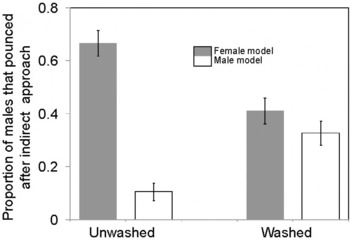
The proportion of A. subcinctus males that pounced on a dead conspecific after landing differed among the lure treatments (Fig. 1). These differences were marked by significant interaction effect in sex and sex × washing. Thus, unwashed females were most likely to be pounced upon after an indirect approach; whereas, unwashed males were least likely to be pounced upon.

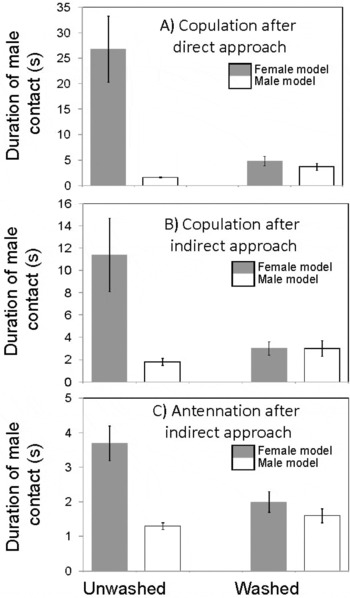
There were similar patterns of differences among the sex and cuticular wash treatments with respect to copulation duration after direct or indirect approaches, and antennation duration after indirect approaches (Fig. 2). For each of these classes of behaviour, longer durations were dedicated to responses toward unwashed females than to other treatments if compared individually (∞ = 0.05, Tukey's adjustment). Unwashed males elicited the shortest durations of each class of behaviour. The duration of copulation behaviour on unwashed males after direct approach was significantly shorter than that on both washed treatments (∞ = 0.05, Tukey's adjustment).

Experiment 2: Response of A. cyanescens males to dead conspecifics
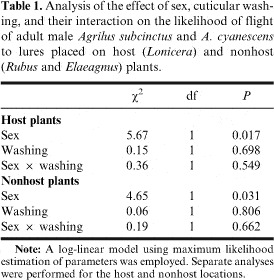
All approaches by wild A. cyanescens toward models involved direct aerial landings onto the backs of models, followed by copulation attempts. There were 269 observations (26.9/h) of direct approaches to models on honeysuckle and 61 (10.2/h) on nonhost plants. Examining the distribution of flights to the models using the log linear choice analysis, there was a significant effect of sex but not washing or sex × washing interaction in host and nonhost observations (Table 1). In both locations there were more flight attempts to females in comparison to the males (57% in hosts, 64% in nonhosts).

Note: A log-linear model using maximum likelihood estimation of parameters was employed. Separate analyses were performed for the host and nonhost locations.
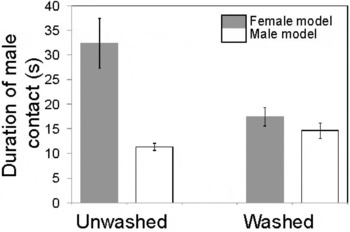
Data from host and nonhost plants were combined to perform an ANOVA of ranked copulation durations. A comparison of treatment means depicting this interaction is shown in Figure 3. Unwashed females elicited the longest copulation durations, unwashed males the shortest, and washed treatments of either sex were intermediate. Interactions involving host versus nonhost location, sex, and washing were also considered, but were not included in the final model because they were never significant at ∞ = 0.05 and there is little a priori expectation that host-plant location would affect copulation duration.

Experiment 3: Response of A. cyanescens males to dead heterospecifics
A total of 86 wild male A. cyanescens performed direct aerial landings onto the tops of heterospecific lures in the field before flying away without sustained attempts at copulation. Numbers of flights by males onto models were P. sericeus, 1; whole C. sexguttata, 19; C. sexguttata elytra, 42; C. sexguttata heads, 7; B. ovatus, 3; A. planipennis, 14; and Calliphora, 0. This distribution is statistically significantly different from that expected if the probabilities of selecting each model were equivalent (χ2 = 115, df = 6, P < 0.0001).
Experiment 4: Response of A. cyanescens males to conspecific and C. sexguttata lures with and without cuticular washing and reapplication of wash from A. cyanescens
We observed 120 direct aerial landings onto models (20 per period) on host (honeysuckle) plants and 81 (13.5 per period) on nonhost plants. There were no significant differences in the proportion of flights to the eight types of A. cyanescens and C. sexguttata lures when the models were placed on honeysuckle, (χ2 = 3.55, df = 7, P = 0.83) or nonhosts (χ2 = 2.42, df = 7, P = 0.93).
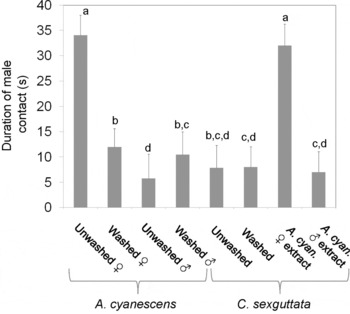
Unwashed A. cyanescens females, as well as C. sexguttata elytra, dosed with cuticular extract from A. cyanescens females elicited copulation durations of similar length, which were significantly longer than the durations evoked by the other models (Fig. 4). Male mating behaviour, including aedeagus extension and prolonged copulation attempts, were strongly evoked by C. sexguttata elytra dosed with cuticular extract (Fig. 5).


Discussion
These results demonstrate that mate location and assessment by male A. subcinctus and A. cyanescens are mediated by visual cues and contact pheromones, respectively, which is similar to what has been recorded for A. planipennis, the invasive pest of ash. Flying male A. subcinctus and A. cyanescens located and descended on female models via a visually guided aerial approach from up to 1 m above a female, similar to behaviour recorded for A. planipennis (Lelito et al. Reference Lelito2007, Reference Lelito, Fraser, Mastro, Tumlinson, Böröczky and Baker2008). Dead female conspecifics with intact cuticular hydrocarbons (“unwashed”) evoked more prolonged contact and copulatory behaviour from male A. subcinctus and A. cyanescens than dead female conspecifics from which the cuticular hydrocarbons had been removed (“washed”) (Figs. 1, 2, 4). Moreover, males of both species flew away from unwashed dead males significantly faster than they did from washed dead males (Figs. 1, 2A, 4). These results are again similar to those of A. planipennis that demonstrated that the presence of contact sex pheromones causes males to increase their persistence in copulating with females (Lelito et al. Reference Lelito2007, Reference Lelito, Fraser, Mastro, Tumlinson and Baker2009; Silk et al. 2009) and deter their efforts to copulate with other males (Lelito et al. Reference Lelito2007) after contact.
One difference in their visually mediated airborne descent and landings is that male A. cyanescens always landed directly on female models; whereas, male A. subcinctus landed significantly more often on the leaf surface immediately adjacent to female models, and then performed antennal assessment of chemical cues followed by pounce behaviour onto the models. Again, the persistence of contact by a male with a model following the pounce was increased significantly when female cuticular compounds were present, indicating the presence of a female-produced contact sex pheromone. Another difference between A. cyanescens and the other two species is that male A. cyanescens approached and landed onto conspecific female models more frequently than onto conspecific male models. This may be because the female models were nearly 10% longer than the males.
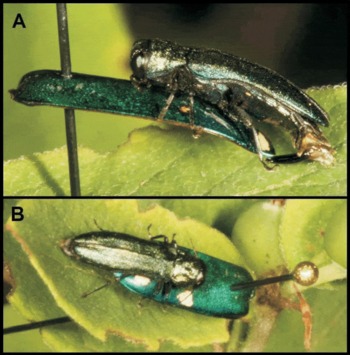
Male A. subcinctus and A. cyanescens conducted aerial approaches to other insect species as well, especially if the size and colour of those insects were similar to those of the approaching males. This was illustrated most strikingly in our results with A. cyanescens, whose males were attracted most strongly to single elytra from the tiger beetle species, C. sexguttata (Fig. 5). When these elytra had a solvent extract from female A. cyanescens applied to them, males were more likely to remain in contact and attempt to copulate with them. The tendency for male A. cyanescens to approach and land on any like-coloured insect in our study is consistent with the high rate of capture of A. cyanescens on visual-lure traps that used dead A. planipennis beetles as models, reported by Lelito et al. (Reference Lelito, Fraser, Mastro, Tumlinson, Böröczky and Baker2008).
The similarities between the mate location and assessment systems of A. subcinctus, A. cyanescens, and A. planipennis raises the possibility that many other Agrilus species may use similar systems in which males visually locate and descend upon females basking on upper surfaces of leaves, and then assess their pheromonal composition by contact chemosensory means. Similar behaviour has recently been observed for European Agrilus species that feed on oak (Quercus L. (Fagaceae)) (Domingue et al. Reference Domingue, Csóka, Tóth, Vétek, Pénzes, Mastro and Baker2011) and that could pose a threat to North American oaks should they expand their ranges.
For all Agrilus species, host volatiles likely play an initial role in attracting adults of both sexes to stressed trees. Field trapping has provided evidence of this: the addition of various plant-extracted oils to monitoring traps for detecting A. planipennis resulted in significant increases in trap capture (Crook et al. Reference Crook, Khrimian, Francese, Fraser, Poland, Sawyer and Mastro2008; Lelito et al. Reference Lelito, Fraser, Mastro, Tumlinson and Baker2009). Further experiments aimed at clarifying the role of tree volatiles in increasing capture rates of Agrilus beetles should be helpful in improving strategies for the detection and monitoring of Agrilus species, many of which pose serious threats to tree species in North America.