INTRODUCTION
Anti-NMDA-receptor encephalitis is a severe and under-recognized form of subacute encephalitis that can present with psychiatric symptoms (Barry et al., Reference Barry, Hardiman and Healy2011). Psychosomatic Medicine (PM) or Consultation-Liaison (CL) psychiatrists might come across a patient with anti-NMDA receptor encephalitis in general hospital settings and cancer centers and should have a fundamental understanding of the clinical features, differential diagnosis and available treatment options for this neuropsychiatric condition.
PM psychiatrists are usually asked to consult on a person who is later found to have anti-NMDA receptor encephalitis on the assumption that the patient is experiencing the first episode of schizophrenia or a drug-induced psychosis. The diagnosis is often difficult because the clinical picture is often vague. The symptoms often precede the diagnosis of ovarian teratoma or other tumor (Posner, Reference Posner1995).
We describe two cases of anti-NMDA receptor encephalitis. The first case is of a young woman with mutation in two tumor suppressor genes (BRCA 1 and BRCA 2) in the absence of new identifiable tumor who presented to a cancer center with a clinical picture that initially resembled delirium and later appeared to be a conversion reaction. The second case is of a young woman without any previous medical history who initially presented to a psychiatric hospital with “first break” psychosis following a prolonged psychiatric hospitalization. She was subsequently transferred to a medical floor and then to an ICU with a clinical picture resembling neuroleptic malignant syndrome with catatonia. Neither patient had a previous history of psychiatric problems or recreational drug use but both were perceived by the primary hospital team as having a primary psychiatric disorder.
These cases illustrate the diagnostic and treatment challenges associated with anti-NMDA receptor encephalitis and underscore the role of CL psychiatrists in diagnosing this neuropsychiatric condition.
CASE #1
A 22 year old female with mutations in two tumor suppressor genes (BRCA 1 and BRCA 2), who was status post bilateral prophylactic mastectomy at the age of 18, and who had a history of papillary carcinoma treated with total thyroidectomy at the age 20 had been fully functioning (living on her own and working fulltime in demanding position) until she began to experience anxiety, difficulty concentrating, fatigue, and headaches. She was seen by an outpatient psychiatrist who prescribed clonazepam which was discontinued after one week because of sedation. Three days after discontinuation of clonazepam the patient developed her first seizure episode and was admitted to a cancer hospital for three days.
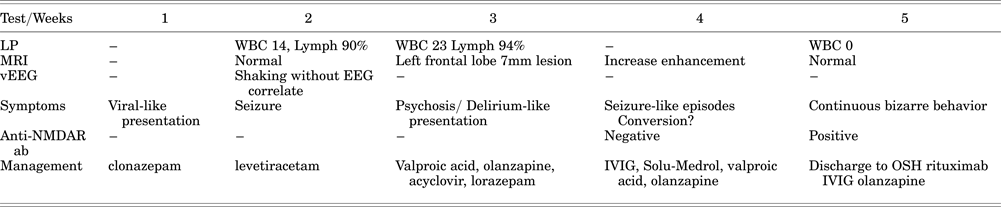
Neurological work up which included CT scan and MRI of the brain was negative. A lumbar puncture showed white blood cells (WBC) of 14 with 90% lymphocytes and no malignant cell. An infectious work up for human immunodeficiency virus, cytomegalovirus, herpes simplex virus, varicella zoster virus, Cryptococcus, Lyme disease, and syphilis was negative. The patient was started on levetiracetam and discharged home based on family request with minimal improvement.
After her discharge her mental status progressively worsened. She became increasingly confused and unsure of herself. She had difficulty concentrating, was not eating, was wandering in her house, lost interest in her computer, and could not initiate conversation.
She was readmitted to a neurology floor eight days later. MRI of the brain was repeated and showed a 7 mm enhanced lesion in the left frontal lobe. Lumbar puncture (LP) showed lymphocytic pleocytosis with 23 WBC with 94% lymphocytes and mildly elevated protein.
While the neurological work up continued, a PM psychiatry consult was requested to evaluate the patient's bizarre behavior.
By observation she found to be confused, distractible, inattentive, and difficult to engage in the evaluation. At times she was pulling her IV lines and wrist-tag and was picking at her skin; at other times she was lethargic. On mental status examination, her speech was hesitant with pronounced words-finding difficulties. Her thought process was sluggish and disorganized with thought blocking. There was evidence of paranoid delusions and she reported visual hallucinations. On cognitive assessment, she was oriented only to person, had short-term memory deficit, and failed the clock-drawing test.
The patient was diagnosed by the psychiatry team as having delirium of multifactorial etiology likely secondary to the lesion in her left frontal lobe, possible leptomeningeal disease, or ongoing seizures.
She was started on olanzapine 2.5 mg at bed time to address psychotic symptoms. Levetiracetam switched to valproic acid and lorazepam was added. Acyclovir was started empirically to treat possible HSV infection.
Despite treatment the patient's condition progressively deteriorated. She became more confused, was disoriented to time, displayed short-term memory loss, and had seizure-like episodes with bizarre movements of her legs and arms resembling conversion reaction. She often would be mute, catatonic, and occasionally unresponsive. EEG video monitoring registered shaking however with no EEG correlate.
Diagnosis of paraneoplastic limbic encephalitis, in particular anti-NMDA receptor encephalitis was strongly considered. Work up included pelvic MRI and ultrasound to search for possible ovarian teratoma; a right parovarian mass was found on ultrasound, however exploratory laparoscopy and subsequent biopsy demonstrated hemorrhagic cysts without evidence of teratoma.
A paraneoplastic panel was sent to a non-commercial laboratory. While the paraneoplastic studies were pending, empiric treatment for limbic encephalitis was started: intravenous immunoglobulin (IVIG) and Solu-Medrol. This treatment led to resolution of contrast enhancement in T2 hyperintensity lesion in the left frontal lobe and clearing lymphocytic pleocytosis in CSF.
Extensive work up was done over a month including three LP (1st showed 14 WBC with 90% lymphocytes, and 2nd showed 23 WBC with 94% lymphocytes, and mildly elevated protein, 3rd was normal), 4 MRIs (1st showing subtle L frontal/parasagittal 7 mm subcortical frontal lesion with enhancement on the 2nd and 3rd, with enhancement much diminished on the 4th MRI).
Despite resolution of the lesion (see Table 1) the patient's behavioral abnormalities persisted. She continued to have seizure-like episodes, confusion, word-finding difficulties, short-term memory impairment, and executive function deficit. Due to the fact that it was difficult to manage the patient's behavioral abnormalities the patient was transferred to inpatient psychiatry after four weeks of hospitalization on a neurology unit with paraneoplastic labs pending.
Work up and management

Due to ambiguity of the patient's psychiatric symptoms, a neurologist in the psychiatric hospital recommended transfer to a neurology department and the care of a neuropsychiatrist. Additional autoimmune tests not available commercially were again sent for evaluation. Diagnosis of anti-NMDA receptor encephalitis was confirmed by detection of antibodies against glutamate receptors of type NMDA in serum and CSF in the second set of specimens despite the fact that the first set had came back negative.
The patient was treated with second-line therapy including rituximab, plasmapheresis, high dose steroids and IVIG again. She gradually improved and was discharged home after three weeks to the care of her family. A month after discharge her symptoms had improved significantly. She started using her computer, reading, and communicating with her family. However, four months after initial presentation she still demonstrated difficulties in cognition and executive function.
CASE # 2
A 19 year old female without any psychiatric, medical, or neurological history started exhibiting bizarre behavior and incoherent speech two weeks after a viral infection and after a death of a relative. Because she had persecutory delusions, auditory hallucinations and violent outbursts toward family members, she was admitted to an acute psychiatric hospital with diagnosis of “psychosis NOS”. Blood work, urine toxicology and MRI of the brain did not reveal any abnormalities. She was initially started on risperidone. Despite the treatment with risperidone, her status gradually deteriorated. She continued to display symptoms of acute psychosis with manic-like episodes and aggression toward other patients and medical staff requiring treatment with multiple neuroleptics and benzodiazepines such as haloperidol, chlorpromazine, olanzapine, and lorazepam. Oral neuroleptic medications were optimized without any signs of improvement in her mental status. Six weeks after admission she began to display bizarre movements of her arms and legs, speech impairment and mutism, confusion and dyskinesia which was perceived as a possible side effect of antipsychotic medications such as neuroleptic malignant syndrome. She was transferred to a medical floor. Laboratory investigations were repeated and included blood count, inflammatory markers, comprehensive metabolic panel, urine and blood culture, virology, and antinuclear antibodies. Blood work was positive only for mild leukocytosis (12,000) and increased CPK (5800 UI/L). Despite medical treatment, she soon developed stupor, catatonia, autonomic instability, fever, hypertension, mutism and cycling-like movements of her legs. Because of her life-threatening symptoms, she was transferred to an intensive care unit. Both CL psychiatrist's and neurologist's opinion were requested as the patient's clinical picture was ambiguous.
Neurological work up included MRI of the brain which was reported as normal and electroencephalography which showed diffuse slow waves. CT scan of the abdomen was performed and showed a parovarian tumor. Diagnosis of anti-NMDA receptor encephalitis was suspected and the patient was transferred to the care of neuropsychiatrist with special expertise in limbic encephalitis. Diagnosis of anti-NMDA receptor encephalitis was confirmed after finding antibodies in CSF. She was treated with laparoscopic oophorectomy for ovarian teratoma and immunotherapy including IVIG, plasma exchange and steroids. After improvement on small doses of risperidone she was discharged to the care of her family. Cognitive sequelae diminished and ultimately disappeared within 10 months.
LITERATURE REVIEW AND DISCUSSION
The association between subacute encephalitis and a distant tumor was first described by Brierley et al. in 1960. Dalmau et al. (Reference Dalmau, Tüzün and Wu2007) coined the term of anti-NMDA receptor encephalitis in a patient with ovarian teratoma.
Since 2007 Dalmau reported more than 500 cases of encephalitis often associated with tumors and neuropsychiatric issues.
The typical patient is a young woman with no significant past medical or psychiatric history who demonstrates prodromal symptoms of viral-like process. Subsequently the patient develops rapidly progressive confusion, short-term memory deficit, depression, visual and auditory hallucinations, delusions and paranoia; and is often evaluated by a psychiatrist. (Day et al., Reference Day, High and Cot2011). Patients are often misdiagnosed as having new onset of psychosis and are admitted to psychiatric centers.
Anti-NMDA receptor encephalitis is caused by an autoimmune reaction against NR 1 and NR 2 subunits of NMDA receptors. These receptors play a role in synaptic transmission and plasticity and are highly expressed in the forebrain, limbic system, and hypothalamus. An immune response is initiated against neuronal antigens expressed by an ovarian teratoma or another tumor. In many cases however a tumor cannot be identified at the time of the presentation of illness.
Overactivity of the NMDA receptors with resulting excitotoxicity is the underlying process implicated in acute ischemic stroke and traumatic brain injury, while underactivity might produce symptoms of schizophrenia.
In anti-NMDA receptor encephalitis, antibodies selectively occupy NMDA receptors and this lead to a rapid selective loss of cell-surface NMDA receptors in postsynaptic dendrites which can also manifest with psychotic-like symptoms. According to multiple studies, this effect can be reversed with removal of offending antibodies and early medical intervention may significantly improve outcome in some cases (Dalmau et al., Reference Dalmau, Gleichman and Hughes2008).
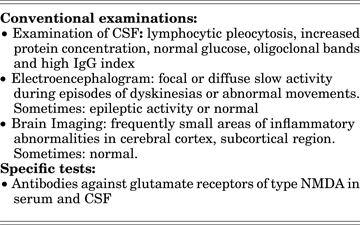
Diagnosing anti-NMDA receptor encephalitis is a very challenging task. Recognition of this neuropsychiatric disorder by psychiatrists is extremely important as the majority of patients initially present with severe psychiatric symptoms. (Pollak et al., Reference Pollak, Lennox and Vincent2012). When a clinical picture comprises rapidly progressing psychosis, delirium, short-term memory deficit, seizures, catatonia and resistance to treatment with neuroleptics and anticonvulsants in a young woman without any previous history of psychiatric or drug related problems, diagnosis of anti-NMDA receptor encephalitis should be strongly considered. Diagnosis of anti-NMDA receptor encephalitis is supported by characteristic findings on MRI and CSF studies (see Table 2).
Diagnostic tests in anti-NMDA receptor encephalitis
This table is based on case reports, case series, and retrospective review of current literature
In regards to treatment, primary emphasis has been placed on eradication of associated malignancy or suppression of the immune reaction. These interventions, when instituted promptly after diagnosis, have been shown to decrease morbidity and mortality and reduce the risk of irreversible neuronal damage. (Chapman et al., Reference Chapman and Vause2011)
Useful immunotherapies included corticosteroids, IVIg, plasmapheresis, rituximab, cyclophosphamide, and azathioprine.
A number of psychotropic medications have been used in an attempt to modify or control behavioral and psychotic symptoms: conventional antipsychotics (haloperidol, chlorpromazine) and atypicals (olanzapine, quetiapine, risperidone) all have modest effect on decreasing symptoms.
Usage of conventional antipsychotics may potentially worsening dystonia and other abnormalities of movement. Periodic surveillance for at least 2 years using MRI and ultrasound of the abdomen and pelvis has been recommended for women of all ages who have been diagnosed with anti- NMDA receptor encephalitis.
CONCLUSIONS
Anti-NMDA receptor encephalitis can manifest with a variety of psychiatric conditions including delirium, schizophrenia, schizoaffective disorder, neuroleptic malignant syndrome, and conversion reaction.
These two cases emphasize the need for increase awareness among PM psychiatrists in regards to possible anti-NMDA receptor encephalitis in the young women with atypical psychiatric presentation resembling delirium, conversion disorder, psychosis, and neuroleptic malignant syndrome. The first case illustrates the importance of follow up test for NMDA receptor antibodies because an initial negative test for NMDA receptor antibodies in the CSF or serum does not always exclude a diagnosis since antibody levels may not develop quickly despite the presence of clinically active disorder. This observation can bring us to a conclusion that routine screening for NMDA receptor antibodies might be indicated for atypical presentation and treatment resistant cases and first-episode of psychosis or delirium. Both of the presented cases demonstrate that immune-mediated mechanisms may be involved more frequently in atypical psychosis than currently thought. This can also apply to delirium in cancer patients which is multifactorial by definition. Patient care requires an interdisciplinary approach including PM psychiatrists, neurologists and oncologists as early recognition and treatment of anti-NMDA receptor encephalitis associated with better outcome.
ACKNOWLEDGEMENTS
The authors thank David Gregory for his contribution to editing the manuscript and Isabel Sulimanoff for her help with literature search.