Introduction
Background
Over recent years, most of physicians and patients are adopting the use of accelerated partial breast irradiation (APBI) for the treatment of breast cancer due to its acceptable outcomes reported by both patients and physicians.Reference Njeh, Saunders and Langton 1 In this respect, patients with early stage breast cancer (ESBC) who have also experienced breast conserving surgery (BCS) after sessions of whole breast irradiation are one of the target groups that can receive APBI.Reference Arthur and Vicini 2 After the BCS, the existence or absence of cancerous cells from the excised tumours can be ambiguous. Also, the presence of wound fluids in the tumour bed after the BCS is likely to bring about concerns regarding future recurrences.Reference Arthur and Vicini 2 , Reference Vaidya 3 Therefore, almost all patients will undergo additional treatments after the BCS to ensure the eradication of any residual tumour cells. Observations, in recent years, have also shown that the APBI can be considered more desirable than traditional whole breast radiation for the ESBC patients due to reduced treatment time and also better cosmesis (preservation of physical appearance).Reference Shah, Holzwanger and Khwaja 4 Studies have similarly suggested that recurrences in breast cancer patients after the BCS can mostly occur in the index quadrant of their breast mass.Reference Bartelink, Horiot and Poortmans 5 These observations have consequently raised the question whether the whole breast irradiation is necessary after the BCS for the prevention of recurrences or not. In fact, this procedure can lead to an increase in the possibility of further complications.Reference Gunderson, Willett, Calvo and Harrison 6 Following the APBI, unnecessary irradiation to normal adjacent tissues around the tumour bed is decreased; thus, the risk of further complications such as skin reactions can be lowered to a desirable level. The APBI is also regarded to be an accepted procedure compared with the conventional whole breast radiation therapy referring to the delivery of 50 Gy dose in 2 Gy fractions 5 days a week during 6 to 6·5 weeks. In return, the APBI refers to delivery of, for example, 32 Gy in about 2 weeks, which can facilitate the possible chemotherapy if needed.Reference Arthur and Vicini 2 Besides; the targeted intraoperative radiation therapy (TARGIT) refers to intraoperatively radiation therapy of cancer patients using low energy (50 kV) X-ray, which can get rapidly attenuated in the tissue surrounding the tumour bed.Reference Vaidya 3 , Reference Keshtgar, Pigott and Wenz 7 The TARGIT can be also considered as a modified and still progressing approach of the APBI.
Some approaches of APBI delivery
Low-energy therapeutic X-ray machines mainly include Intrabeam™, Axxent™ and Papilon™ that are extensively used for breast cancer treatment due to possessing spherical applicators providing a good coincidence with the tumour bed with an acceptable adherence which can be important to prevent dosimetric uncertainties during the treatment.Reference Vaidya, Baum, Tobias, Morgan and D’Souza 8 , Reference Hensley 9
The purpose of this study was to evaluate the incidence of skin reactions among 250 breast cancer patients treated via Intrabeam™ device at Pastorno Hospital in the city of Mashhad, Iran, over 18 months. Actually, it should be noted that the Intrabeam™ treatment planning system (TPS) is used for skin dose measurement of each patient and the Radiation Therapy Oncology Group (RTOG) skin reaction grading system can be implemented for describing probable skin reactions of the treated patients. However, the present study particularly focused on physical aspects of Intrabeam™ TPS as a dose-measuring tool of the device. A comparison was also made between the results of the present study and some other investigations about skin reactions or other reverse treatment outcomes of breast cancer patients treated using the Intrabeam™ device or some other devices like the MammoSite™ radiation therapy system (Proxima Therapeutics Inc., Alpharetta, GA, USA).
The low-energy therapeutic X-ray machine, Intrabeam™ (Carl Zeiss Surgical, Oberkochen, Germany) has been also introduced in some previously published studies.Reference Gunderson, Willett, Calvo and Harrison 6 , Reference Vaidya, Baum, Tobias, Morgan and D’Souza 8 , Reference Schneider, Greineck and Clausen 10 – Reference Park, Yom and Podgorsak 12 In summary, the system is able to produce low-energy photons through striking 40 µA current of accelerating electrons irradiated from an electron gun with a 40 or 50 keV of maximum energy to the concave end of a drift tube (probe) with 10 cm length and 3·2 mm diameter. The electrons are then guided via the hollow probe by two pairs of beam deflectors until striking the concave area at the probe end. Therefore, an isotropic distribution of photons with the maximum energy of 50 kV (or 40 kV) is expected to radiate from the probe tip by bremsstrahlung coincidence. The probe tip is also worn with a spherical applicator almost for breast therapeutic purposes. It should be noted that the spherical applicators are available with eight diameters between 1·5 and 5 cm with 0·5 cm increments which can provide an isotropic dose distribution around the applicator with rapid dose attenuation in terms of the inverse cube of distance. The given feature has been always considered as one of the most desirable characteristics of the Intrabeam™ device which leads to minimising unnecessary doses to normal adjacent tissues. As an example, heart and lung will not be exposed to significant amounts of radiation in breast treatments.Reference Vaidya 3 The possibility of launching the procedure in a normal operating theatre without having any additional structural shielding is a further advantage of the rapid beam attenuation.
Materials and Methods
Skin dose measurement and skin reaction evaluation of early breast cancer patients were performed, respectively, using the Intrabeam™ TPS and RTOG skin reaction grading system in this study. One of the objectives was to have an overall assessment of the effect of the treatment process on the incidences of skin reactions among patients. In addition, the function of the TPS as a dose-measuring instrument along with comparison of the incidence of skin reactions in patients treated with Intrabeam™ device and the MammoSite™ system were discussed.
In this regard, 250 ESBC patients, aged 33–86 years, treated with a single fraction of 20 Gy using 50 kV photon beam were selected. Then, the spherical Intrabeam™ applicators with a diameter range of 3 cm (for two patients) to 5 cm (for 131 patients) were used for intraoperatively treating the tumour bed after the tumour removal. Following the tumour excision by the surgeon, a purse string suture was made on the surgical cavity and the tumour depth was measured as the applicator to skin distance (ASD) for further skin dose calculations according to the TPS. Then, the applicator was placed within the breast to trigger the treatment. After the personnel exited from the operating room and a window lead apron was placed at the theatre room entrance, the radiation procedure was initiated by the physicist. Most of the patients received the treatment as a boost, but there were also some cases receiving it as radical or definitive treatment. The patients were then clinically evaluated 1 week after the treatment and before the external beam radiation therapy procedure initiation, in order to specifically evaluate the incidence of the intraoperative radiation therapy (IORT) related skin reactions. The patients’ skin reaction evaluation was also performed using the RTOG grading system as mentioned.Reference Porock and Kristjanson 13 , Reference Warnock and Lee 14
Results
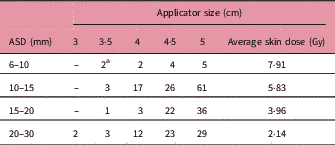
The ASD values were measured between 6 and 30 mm with an average of 14·6 mm. The ASD for 13 patients was less than 10 mm; that was 10–15 mm for 107 patients and 15–20 mm for 62 patients, and finally 68 patients had an ASD range of 20–30 mm. The average skin dose for four ASD ranges was calculated between 1·38 and 9·08 Gy as illustrated in Table 1. The average skin dose of all patients was also calculated equal to 4·9 Gy. As shown, the first column of the table represented the ASD range in terms of mm, middle columns were associated with the number of patients treated with various applicator sizes and the mentioned ASD ranges, and the last column showed the average skin dose of patients. The average skin doses represented a downward trend with an increasing ASD, as shown in the Table 1. Absorbed skin doses are calculated according to Intrabeam™ TPS based on the measured ADS value and applicator size used for each patient. It is noteworthy to know that the TPS represented the depth dose data by half millimetre increments for each patient according to the applicator size and the source output. The mentioned data root in calibration data of the Intrabeam™ device was verified in periodic quality assurance using Zeiss water phantom and ion chamber (type PTW 23342 used for low-energy therapeutic beams).Reference Keshtgar, Pigott and Wenz 7 Among all the patients, only three of them developed low-grade skin reactions with the RTOG 1 score 1 week after the IORT procedure in which, one of them received 9·08 Gy with 6 mm ASD and two other patients received 6·92 Gy both with 10 mm ASD.
The data of the patients intraoperatively treated using Intrabeam™ device

Note:
a Number of patients treated with each four ranges of ASD and various applicator sizes.
Abbreviation: ASD, applicator to skin distance.
Discussion
Measured skin doses
Measured skin doses mentioned in this study were obtained from the Intrabeam™ TPS, which were based on commissioning and quality assurance measurements using Zeiss water phantom. However, some considerations were required to be accurately considered as follows. Measuring the depth dose in Zeiss water phantom consisted of a full scatter condition due to its dimensions of 58×40×52 cm which was filled up with 6 L of water.Reference Keshtgar, Pigott and Wenz 7 The backscatter radiation also plays a significant role for dose deposition at this energy range.Reference Kim, Hill, Mackonis and Kuncic 15 , 16 In return, due to lack of tissue in a real treatment procedure, particularly for low ASD values, there is a considerable reduction of backscatter exposure compared with the procedure performed in the Zeiss water phantom. In that way, the lower the ASD or the less tissue around the applicator surface could lead to a reduction of backscatter radiation and subsequently under dose in the breast skin. According to a Monte Carlo study, this effect could lead to 20–40% dose reduction in comparison with measurements performed at corresponding distances in the Zeiss water phantom.Reference Ebert and Carruthers 17 , Reference Eaton 18 Furthermore, the higher density of the breast tissue compared with waterReference Hubbell and Seltzer 19 could lead to a steeper dose fall in a real treatment procedure. Such calculations showed 3–5% lower amounts of absorbed doses in tissues adjacent to the applicator surface compared with the corresponding distances in water.Reference Hensley 9 , Reference Ebert and Carruthers 17 Also, the inhomogeneous tissue of the breast could make much more dose measurement uncertainties somehow that the isotropic dose absorption could not necessarily occur in breast tissue similar to the dose measurements in quality assurance procedure in the Zeiss water phantom.Reference Ebert and Carruthers 17 Considering these points, the measured doses using the Intrabeam™ TPS involved a huge uncertainty which could be up to 45%. In fact, there was so much pleasure about it, because the mentioned uncertainties led to a considerable dose reduction in the sensitive nearby tissues, particularly in the skin. In other words, the results of the present study verified this claim since only three patients showed low grade skin reactions. If that was not the case, most probably more cases of skin toxicities even with higher grades of complications would be observed. From another point of view, this issue would bring about some concerns about enough dose absorption in the target tissue and further probable recurrences of the malignancy.
Regarding the skin dose reduction in real procedures, particularly in shallow treatments due to lack of backscatter, wrapping the Intrabeam™ shield (equal to 0·1 mm lead)Reference Keshtgar, Pigott and Wenz 7 over the breast during treatment could lead to a dose increase due to the more backscatter production.Reference Hensley 9 , Reference Ebert and Carruthers 17 In the same vein, it seemed that implementing at least 1 cm ASDReference Hensley 9 , Reference Lee, Choi and Ahn 20 , Reference Eaton, Best and Brew-Graves 21 without wrapping any shields on the patients was enough for skin sparing, in case of proper personnel shielding availability like the lead apron at the entrance of the operating theatre.
According to the surgeon’s declaration, a noticeable factor which could affect the ASD was the initial tumour region in the breast mass. In which, insertion of the applicator within the upper areas of breast could lead to a lower ASD value compared with areas around the nipple or the breast centre. Therefore, much attention is required to be paid to make the ASD at least 1 cm before the initiation of radiation for such cases. In addition, insertion of a wet piece of sterilised gauze between the applicator and the thin layer of breast tissue, before tightening the purse string suture, could protect the skin from receiving high dose radiation.Reference Eaton, Best and Brew-Graves 21 , Reference Fogg, Das, Kron, Fox, Chua and Hagekyriakou 22
A comparison between electronic and radionuclide brachytherapy
The incidences of skin reactions following breast cancer treatment using the Intrabeam™ device and the MammoSite™ system, each one respectively as representative of electronic and radionuclide brachytherapy systems, were compared as follows. Some studies about breast cancer treatment outcomes using the MammoSite™ therapeutic system have been published between 2005 and 2016 aimed to reveal treatment outcomes like skin reactions or any other possible complications following receiving 34 Gy at 1 cm depth per 10 fractions. Almost all of the authors have considered the MammoSite™ machine as a completely acceptable therapeutic system for treating breast cancer, which can be also promising.Reference Shah, Holzwanger and Khwaja 4 , Reference Vicini, Beitsch and Quiet 23 – Reference Cuttino, Keisch and Jenrette 25 In more detail, Sadeghi et al.Reference Sadeghi, Prestidge, Lee and Rosenthal 24 reported that 44% of 67 patients had experienced skin complications at various levels from erythema to moist desquamation. Vicini et al.Reference Vicini, Beitsch and Quiet 23 also reported good/excellent outcomes among 92% of 1,084 patients of an intra-institutional trial. Such outcomes included various factors like skin reactions, recurrence rates, developing infections in breast, etc. Besides, Cuttino et al.Reference Cuttino, Keisch and Jenrette 25 observed skin reactions from erythema (40%) to moist desquamation (4%), infections (10%), telangiectasia (17%), hyperpigmentation (16%) and desquamation toxicity from merely palpable changes (28%) to surgical interventions (2%) among 483 patients treated with MammoSite™ machine between 2000 and 2004. Finally, Shah et al. reported some reverse outcomes among 120 treated patients including fibrosis (24%), hyperpigmentation (20%), radiation skin reactions (7%), as well as accumulation of seroma in breast cavity (7%) considered by some researchers as a natural APBI outcome but not as a complication necessarily,Reference Patel, Yan and Trichter 26 sense of pain in breast (7%), etc.Reference Shah, Holzwanger and Khwaja 4 Additionally, other search results and literature reviews showed lack of information about skin reactions in breast cancer patients treated using Intrabeam™ device at least relative to the high dose rate (HDR) therapeutic systems like the MammoSite™ machine, particularly in the Asian countries expectedly due to being newer. In this regard, some complications are often reported in patients treated with Intrabeam™ device including skin complications such as oedema, erythema or accumulation of seroma in treatment cavity, etc.Reference Lee, Choi and Ahn 20 in which the occurrence of any of the outcomes can depend on many individual or demographic characteristics such as breast volume, tumour depth, etc. In this respect, Lee et al.Reference Lee, Choi and Ahn 20 accounted for breast size importance in dose absorption of breast skin in breast cancer patients treated with Intrabeam™ device. Their study demonstrated higher levels of complications among Korean women than those in Iranian individuals mentioned in the present study. It was stated that smaller breast size could lead to less amount of tissue around the applicator and a lower ASD value, which could result in the increased skin absorbed dose. Therefore, the incidence of skin reactions among Iranian women with breasts larger than East Asian women’s 27 was less likely; so the results of the present study and those in the investigation conducted in Korea were in agreement in terms of this statement. For this reason, it was argued that small-sized breast patients should be treated cautiously. Subsequently, Western women, specially the American ones with larger breasts than Asian women’s were expected to be more resistant against potential skin complications after radiation treatment via Intrabeam™ device. 27 – 29
Conclusion
The high dose gradient of the Intrabeam™ applicatorsReference Hensley 9 , Reference Ebert, Carruthers and Lanzon 30 beside the significant uncertainties mentioned made it challenging to achieve a proper dose distribution without any under dose to the target and over dose to the skin. In addition, establishing an optimised ASD (if surgically possible) was in the same way, particularly in shallow treatments. However, most of the authors have recommended at least 1 cm ASD to prevent over dose to the skin.Reference Hensley 9 , Reference Eaton, Best and Brew-Graves 21 Also, implementing the zero depth on the Intrabeam™ TPS as the prescribed depth is preferred rather than 1 cm or 2 cm in order to minimise the dose uncertainties particularly in the first few millimetres of the applicator surface. Overall, due to various treatment parameters of patients including breast size, tumour size, tumour depth and its location in the breast, as well as lack of a reliable TPS, the best possible treatment outcomes with the least probability of skin reactions could be achievable through specialisation of treatment procedures for each patient.
Totally, the observations revealed that breast cancer treatment using the Intrabeam™ device was well tolerated by the patients recruited in the given institute and also the level of skin reaction incidence was acceptable. However, the application of a practical method for skin dosimetry like the TLD measurement or employing radiochromic films such as the EBT2 or the EBT3 would seem more reliable. Actually, a similar project is ongoing in the present institute using the TLDs for in vivo dosimetry in order to obtain an accurate understanding of dose distribution in the target and normal adjacent tissues such as skin, thyroid, contralateral breast and eyes in breast cancer patients who are being treated with the Intrabeam™ device. Since the IORT using the Intrabeam™ device for breast cancer treatment consists of the incidence of less skin reactions compared with using the HDR machines like MammoSite™, it would be preferred for delivering the APBI.
Acknowledgements
The authors, hereby, would express their gratitude to the personnel of the Surgery Department of Pastorno Hospital in the city of Mashhad and those involved in Radiotherapy Department of Mashhad University of Medical Sciences for all supports and helps.
Financial support
This research received no specific grants from any funding agency, commercial or not-for-profit sectors.
Conflicts of interest
None.
Ethical standards
The authors assert that all procedures contributing to this work comply with the ethical standards of the relevant national guidelines on human experimentation (patients who contributed to this study) and the Declaration of Helsinki (DoH) in 1975, as revised in 2008, and finally approved by Mashhad University of Medical Sciences.