


Introduction
For the past four years, my work on the antiquities dealer Ibrahim Elias Gejou (1868–1942, Fig. 1) has focused on examining his correspondence to uncover provenance information on the artefacts he sold, and on his life trajectory and career (Ait Said-Ghanem Reference Ait Said-Ghanem2023; Reference Ait Said-Ghanem2025a; Reference Ait Said-Ghanem2025b; Reference Ait Said-Ghanem2025c). But these documents are so rich in content, that they can also be read in many other ways. The Nahrein Network’s Forgotten City of Kish project (2021–2025), led by Professor Eleanor Robson, has opened an additional avenue of research, one focused on sites rather than objects.Footnote 1 To test how Gejou’s documents can widen our knowledge of the circulation of artefacts from Kish on the antiquities market and, by extension, the history of archaeology at Kish, I have turned to three groups of “Gejou letters” held in the archives of the British Museum, the Yale Babylonian Collection, and the Louvre Museum. My aims were twofold: first, to identify explicit references to Kish artefacts on the antiquities market; second, to integrate the dates of those transactions within the chronology of the well-known foreign-led missions at Kish. The overarching goal is to rebuild an inclusive history of archaeology at sites such as Kish, one which recognises and features Iraqis’ independent archaeological work at the site.
Portrait of Ibrahim Georges Elias Gejou (undated, probably 1920s)
Source: Gejou’s private papers. Reproduced with the kind permission of his family

The corpus of letters
In the body of correspondence I have gathered since 2021, three groups of letters seemed particularly suited to this experiment: 1) Gejou’s letters held in the Central Archive of the British Museum (BM), 2) those preserved by the Yale Babylonian Collection (YBC), and 3) a small group in the Louvre Museum’s “centre d’études et de documentation, Antiquités Orientales” (DOA). My selection was based on two considerations: first, the number of letters held in each archive; and second, the time period they cover. With regards to size, the BM and the YBC preserve the two largest sets of Gejou letters that I have come across so far. By my count, the BM holds 593 documents, primarily letters. They cover a period of forty-five years, from October 1895 to March 1940. Except for an interruption in communication in 1916–17, due to World War One, Gejou wrote to the BM every year. The YBC holds 312 documents by my count, covering a period of twenty-six years between February 1911 and January 1937. There are several breaks in this correspondence, due in part to administrative delays such as holidays and changes in curators, but mostly to disagreements between Gejou and YBC curator Albert T. Clay (1866–1925). The two of them incessantly bickered and fell into ill-tempered silences.
At the opposite end of the size spectrum, I know of only five letters written by Gejou, scattered through the acquisition files of the Louvre Museum.Footnote 2 This number stands in sharp contrast to the length of the Louvre’s relationship with Gejou. According to file cards, Gejou sold artefacts to this museum for 39 years, between 1898 and 1937, a timeframe impossible to reconstruct from letters alone. But the Louvre’s DOA also preserves a surprising group of thirty-five letters which feature conversations between Assyriologist Henri de Genouillac (1881–1940), Gejou and three other antiquities dealers, Antone Samhiry, Alexander Messayeh, and George Khayat, between 15 March 1912 and 9 April 1913. These enrich the “Gejou set”, bringing the total of letters written by or sent to Gejou in this museum to fourteen. The entire group of thirty-five is not a corpus of Gejou letters strictly speaking because they are not all sent by or addressed to him, but I have included them because of the role he played, as we will see later. These letters are also of interest because they begin when Genouillac was excavating at Kish in early 1912, and end in April 1913 a year after he left. Surprisingly, they also fill a gap in Gejou’s exchanges with the BM and YBC. Between 1912 and 1913, Gejou barely mentioned Kish to these two museums, even though, as will be seen below, he was receiving hundreds of tablets from the site.
When I talk about “a corpus of Gejou letters”, I refer to exchanges that typically involve him and one other party. Gejou’s letters in the BM and the YBC are the prototype. In these exchanges, the “other” is a curator or someone who writes on their behalf. From 1895, Gejou primarily corresponded at the BM with Ernest Wallis Budge (1857–1934), Keeper of Egyptian and Assyrian Antiquities. After Budge’s retirement in 1924, Gejou’s contact became Budge’s successor Henry Reginald Hall (1873–1930) until the latter’s death in 1930. During this transition, Gejou and Assyriologist Cyril John Gadd (1893–1969) corresponded briefly, until Sidney Smith (1889–1979) took over discussions when he assumed the Keepership in 1931. At the YBC, meanwhile, Gejou was in direct contact with Albert T. Clay from 1911. After Clay’s death in 1925, he corresponded with Ettalene Grice (1887–1927) until 1927, when Raymond P. Dougherty (1877–1933), the gentlest correspondent of them all, took over correspondence until his death in 1933. For the remainder of Gejou’s relationship with the YBC, Gejou corresponded with Ferris J. Stephens (1893–1969).
The main actors
Because the Louvre letters preserve discussions between several individuals, I will briefly introduce the writers and context. Many of the documents I quote were written in French; here I give English translations in the main text with the original in the footnotes. In essence, the Louvre letters preserve arrangements made by four antiquities dealers to assist Genouillac in buying cuneiform tablets from Kish (and other sites), which they then smuggled to Paris for him. In his final report, Genouillac (Reference Genouillac1924: 20 n. 1) openly acknowledged purchasing tablets and other objects which had come from his own excavations.
In 1912, these arrangements were in direct violation of the Ottoman Antiquities Law of 1906, Article 27, which extended the exportation ban on all archaeological artefacts adopted in 1884 (Article XXVII).Footnote 3 Exceptional permissions to export were regularly given to foreign expeditions, but the French-funded mission did not benefit from any. The permit delivered only allowed for “drawings and stamps” of objects found.Footnote 4 Genouillac acknowledged the Ottoman government’s ownership of his finds, when he prepared eleven cases of tablets and other artefacts for the Imperial Museum of Istanbul before leaving the site, as required by law (Genouillac Reference Genouillac1924: 1).
To divert the tablets from the Ottoman authorities, each correspondent had a specific task. When he was at Kish, Genouillac chose objects and sent his selection to the antiquities dealer Alexander Messayeh in Baghdad. This was done through a middle man named Haim Mochi:
The 2 small parcels sent by Haim Mochi are well received, I forwarded them to Mr Gejou of Paris in one case marked OMB no. 21, informing him to keep them with him and to wait until your arrival or your instructions, if you have others please send them to me right away.Footnote 5
I am still looking for information on Mochi, but based on Messayeh’s other letters, he seems to have assisted with the organisation of the Kish excavation, helping with tasks such as deliveries and even luggage.Footnote 6 Messayeh’s letter does not specify what was in the parcels, but a letter sent months later confirms that archaeological pieces were sent by Genouillac from Kish:
The case containing one part of the merchandise purchased by me, and another part purchased by others such as the barrel from Ounna and Sedoun [i.e., Marad], tablets from Ounna and Sedoun, cylinders, etc, in addition to a few pieces sent by you from El-Oheymer [i.e., Uhaimir, ancient Kish], as a result I considered that the case half belonged to me and half to your special merchandise.Footnote 7 [my emphasis]
The role of the antiquities dealers Alexander Messayeh, Antone Samhiry, and George Khayat, who were all operating from Baghdad at this time, was to be on the lookout for any Kish tablets making an appearance on the antiquities market. These were not sent by Genouillac. I assume that they were brought to Baghdad by Genouillac’s team members, who sold their finds to dealers for reasons that Robson (this volume) discusses. I have found no explicit reference to Genouillac’s men in these dealers’ letters, but in his published report he mentions that he gave a pay supplement to those who brought him their discoveries (Genouillac Reference Genouillac1924: 17). I interpret this as an incentive to declare objects instead of selling them.
Once these three dealers had gathered enough tablets and other objects from Kish (and from other sites), they sent everything to Gejou in Paris. The latter’s role was to keep these collections at his atelier until Genouillac’s return, or until he gave instructions. As far as I can make out, this mostly involved sending some pieces to the Royal Museums of Art and History (MRAH) in Brussels, while others went to the Louvre in Paris.Footnote 8 After shipping a consignment to Paris, each dealer then wrote to Genouillac to let him know that it would soon be waiting for him at Gejou’s premises.
No Assyriologist will be surprised to learn that all four dealers knew each other well. Ibrahim Elias Gejou is now relatively well known to Assyriologists (Ait Said-Ghanem Reference Ait Said-Ghanem2023; Dessagnes Reference Dessagnes2017; Lassen Reference Lassen, Frahm and Wagensonner2019; Reade Reference Reade2002; Fig. 1), so I will briefly introduce Samhiry, Messayeh, and Khayat.
Alexander Messayeh was an antiquities dealer from Baghdad who was in business with his two younger brothers Rizouk and Emile (Ait Said-Ghanem & Robson Reference Ait Said-Ghanem and Robson2025a; Eppihimer Reference Eppihimer2022: 12–14). The Messayehs were contemporaries of the Gejou brothers, Ibrahim and Isaac and, like them, they specialised in trading cuneiform tablets. Elias Gejou, the father of Ibrahim and Isaac Gejou, was a merchant of foodstuffs such as wool, wheat and liquorice (Ait Said-Ghanem Reference Ait Said-Ghanem2022a; Reference Ait Said-Ghanem2022b). But the father of the Messayeh brothers, Daoud Messayeh, ran an antiquities trading business with his partner N. Ghanima. Some of their letters survive in the rich archive of the British Museum. The Messayeh and Gejou brothers became family when Alexander Messayeh married Ibrahim’s younger sister Sara Gejou (1873–1943?). As competitors, colleagues, and family, the Gejous and Messayehs often quarrelled, but regardless of arguments, they helped each other sell their respective collections, often hiding the fact, it seems.
In terms of operations, both families followed the same pattern. Initially based in Iraq, the Gejou brothers split up in the late 1880s, when Ibrahim moved to Paris and Isaac stayed in Baghdad. By 1894, they were selling archaeological artefacts to the British Museum. Much later, the Messayehs also split up but chose a different location to branch out to. Rizouk seems to have been the first to relocate, probably because his work at the US Consulate in Baghdad between 1906 and 1912 opened up an opportunity.Footnote 9 He left Iraq for New York in late 1912 and, upon his arrival in January 1913, he started to contact museums to sell cuneiform tablets. The collections he sold were sent from Baghdad by his brothers and from Gejou, who sent them from Paris or Baghdad. Alexander Messayeh followed Rizouk ten years later, in 1923, without Sara. Once settled in New York, Alexander Messayeh continued to trade artefacts from Iraq, making references to a brother in Baghdad, whom I assume was Emile.
The second dealer who appears in the Louvre letters is Antone Samhiry. Like the Messayehs, Samhiry came from a family of antiquities dealers. He was a nephew of the (in)famous Thoma brothers, Daud, Abdulkerim, Abdelahad, and Pierre. The Thoma brothers had long worked as archaeologists and antiquities dealers with Hormuzd Rassam on the many excavations he led for the British Museum. When Rassam returned to Britain in 1882, he appointed Abdelkarim and Daud as watchmen, for which they received payment from the British Museum until 1888 (Ismail Reference Ismail2021: 127–128). Abdulahad is also known to have worked at Sippar (Svoboda Diaries 23: 91). The brothers were undoubtedly skilled. They were probably trained by their father Thoma Shishman, Henry Layard’s right-hand man at Nineveh, who also worked with George Smith (Clancier Reference Clancier2009: 134). Shishman’s expertise and trustworthiness were such that Layard even wrote about leaving his excavations in Shishman’s hands when absent (Layard Reference Layard1853: 287). The brothers were also influential figures in Baghdad due to their social position. In the late nineteenth century, Abdulkerim Thoma was a French consular agent for a time, and Daud Thoma a German agent (Ismail Reference Ismail2021: 229). The brothers excavated for others and themselves, and they sold the objects they found. Because Antone Samhiry does not bear the Thoma patronym, he must have been the son of one of the Thoma sisters. As shown by letters in the British Museum archive, Samhiry worked with his uncles Daoud and Abdulerkim at the beginning of his career. But it was his aunt Ferida Antone Shamas who took him under her wing from 1896.Footnote 10 The pair sold tablets to the British Museum until 1904, after which Samhiry continued to trade in his own name. Unlike the Gejous and the Messayehs, Antone Samhiry does not seem to have operated with a brother, at least none that he mentions. He remained in Iraq his whole career.
The third dealer involved is George Khayat, who also specialised in selling archaeological artefacts. George was the cousin of Monseigneur Joseph B. Khayat, the Vicar General of the Archdiocese of Syrian Catholics in Mosul, who chased Clay for the payment of a cylinder in the 1920s.Footnote 11 I have found no links between George Khayat and the two brothers Azeez and John Khayat who had a gallery in New York.Footnote 12 George Khayat was well acquainted with the Gejou brothers. His letters, dispersed across several archives, show he too was based in Baghdad, though from the late 1920s, he was also sending offers from Paris (France), London (UK), and Hamadan (Iran).Footnote 13 Receipts kept by Genouillac when he returned to excavate at Tello, Iraq, in 1929–1931, and now in the Louvre’s DOA, indicate that in this period, George Khayat was still active in Baghdad.
Now that the actors have been introduced, let us focus on Kish.
British Museum and Yale Babylonian Collection letters, 1909–11
This section presents evidence of the circulation of artefacts from Kish on the antiquities market, through the corpus presented above. This examination follows a chronological order, and will highlight the number of cuneiform tablets and other artefacts that each dealer mentions.
124 tablets from Kish
In Gejou’s letters to the BM, the earliest mentions of Kish occur in 1909 (Reid & Wagensonner Reference Reid and Wagensonner2025: 2). In a letter dated 24 November 1909, Gejou informed Budge that he had just received 124 tablets from “a new site” called “Hum-mer”, located “north of Abu Haba” [i.e., Abu Habba, ancient Sippar].Footnote 14 The tablets were sent on the Edenhall steamship, and belonged to a “client” who wanted £200 for the lot. The selling price, as Gejou explained, was set by the unnamed owner, who based it on the price at which he bought each tablet, namely 1.50 Turkish liras. To allow Budge to assess this material, Gejou packed and sent four tablets as “samples” by mail, trusting the splendid postal service of the time. As a result of this offer, eighty Old Babylonian letters from Kish ended up in the BM collection, as discussed recently by Reid and Wagensonner (Reference Reid and Wagensonner2025: 2).
“Hum-mer” is of course Tell Uhaimir, “the red tell”, the location of the ancient city of Kish. Gejou’s use of the adjective “new” to qualify the site is of interest. Did he mean that the site was new to him? Or that it was new to local explorers? It is unlikely that dealers in Baghdad did not know that previous explorations had taken place at the site, as Daoud Thoma had excavated there with Hormuzd Rassam in 1879–1880 (Gibson Reference Gibson1972: 68). Given that Gejou was receiving tablets from Uhaimir in November 1909, Iraqi teams must have resumed excavations at the site from early 1909 at the very latest.Footnote 15
The year 1909 is also the year in which Assyriologist François Thureau-Dangin (1872–1944) published his article on the location of Kish (Thureau-Dangin Reference Thureau-Dangin1909). In this study, he showed that Kish was once on the banks of the Euphrates, by using the date of the unpublished cuneiform text AO 3972, a contract, in the collection of the Louvre Museum. Although his article gives no provenance history for this tablet, the Louvre Collection online indicates that the museum had purchased the tablet in 1902 from none other than Gejou.Footnote 16 Thureau-Dangin and Gejou knew each other well. They often met in person to discuss Gejou’s collections. In addition to meeting and writing to Gejou, scholars often sent him their publications, which, as he reports, he was fond of reading.Footnote 17 Hence, whether through print or a meeting in person, Gejou would have known about this breakthrough. I therefore wonder if Gejou sought out artefacts from Kish when he heard about this study, or if he was asked for tablets from this site, which sparked his interest.
700 to 800 tablets from Kish and Sippar, December 1910
In 1910, Gejou continued to offer Kish tablets to Budge at the BM. In December 1910, he now had “700 to 800” tablets from “Ahemir” (i.e., Uhaimir) and “Abu Habba.” Unfortunately he did not specify how many came from each site (letters of 14 and 19 December 1910). The BM records show that Gejou was paid £435 for over 806 objects in January 1911, so I am assuming that this lot was bought.Footnote 18 The arrival of this new material signals that local excavations were continuing. Earlier in the year, Gejou had spoken about tablets “from the new find made near Nippur”, which might hide a reference to Kish.Footnote 19
5,200 tablets from Borsippa, Babylon, Sippar, Purzish-Dagan, Umma, and Kish, February 1911
In 1911, Gejou took one of the greatest leaps of his career. He expanded his operations to the USA. Selling to American buyers was nothing new in itself. He was already selling to financier J.P. Morgan (1837–1913), and in Baghdad his brother Isaac would also have met and sold to American collectors. But selling from within the USA was a novel enterprise. To do this, Gejou sent thousands of artefacts to Albert T. Clay, newly appointed Professor of Assyriology and Babylonian Literature at Yale University thanks to an endowment made by J.P. Morgan. With this funding, Morgan had requested that Clay be appointed first recipient of this professorship (Foster Reference Foster2023: 191–201). Gejou’s plan was that the entire collection would remain under Clay’s care, at the university, until buyers were found. Clay’s dream at this stage was to build a “Museum of Oriental Antiquities” (Foster Reference Foster2023: 191 n. 76), and he was happy to accommodate Gejou’s ambitions. But Clay’s lack of funds would soon turn him into a bitter buyer, who regularly defaulted on payments. Yet despite their incessant arguments over money, Clay helped Gejou find many buyers over the years.
To put this plan in motion, Gejou shipped an astonishingly large number of cuneiform tablets to Yale “via American Express” in February 1911, packed in six crates, presumably so that he and Clay had something concrete to negotiate when they met.Footnote 20 The shipment is described in a list dated 16 February 1911 and includes 5,200 tablets from “Birz Nimrod, Babel, Abu Haba, Dreham, Geokha, and Ahémir”, priced at £2,500.Footnote 21
Once again, proportions per site are not given, but whether there were one or one hundred, Kish tablets were now making their appearance in the USA through Gejou, ready to be dispersed across institutions on the American continent.
Mathematical tablets from Kish, May 1911
Gejou mentioned Kish to Clay again on 3 May 1911. This time, he wrote he had received “some unbaked tablets of mathematics from Ahimer”, and asked “are you interested in them?”Footnote 22
As a result of this slow trickle of Kish material into museum collections, the Assyriological community became increasingly interested in the site. As Chevalier (Reference Chevalier2002: 97) recounts, in the summer of 1911, France’s Ministry of Public Instruction (the former name of the Ministry of Education), requested the intervention of the Ministry of Foreign Affairs to send Henri de Genouillac to excavate at Kish and Warka (Uruk). An official decree allowing excavations at Kish was granted on 11 October 1911, and the permit followed two months later (Chevalier Reference Chevalier2002: 97–98). In that same year, while giving a presentation at the Académie des inscriptions et belles lettres, Assyriologist Père Vincent Scheil spoke about the importance of Kish and of discoveries made during “recent clandestine excavations” by Iraqis at “Oheimir” (Scheil Reference Scheil1911: 611). As Genouillac would later write, this talk encouraged him to go to Kish all the more (Genouillac Reference Genouillac1924: 10).
Louvre letters, 1912–1913
Genouillac was supposed to leave France in October 1911, accompanied by architect Raoul Drouin, in order to begin work at Kish in November. But Italy’s declaration of war on Turkey on 29 September delayed their departure and the men eventually arrived in Baghdad in January 1912. Little did they know that they would barely stay three months, closing the excavation in April (Genouillac Reference Genouillac1924: 1). Drouin and Genouillac left Baghdad for Hillah on 21 January, with a core team made of a “dragoman” and a foreman, and camp equipment (Genouillac Reference Genouillac1924: 15). Work began on 28 January, with a team of over eighty men and children (Genouillac Reference Genouillac1924: 17).Footnote 23 The number would soon increase to over two hundred (Genouillac Reference Genouillac1924: 16–17). The Louvre letters preserve an understudied chapter in the history of this mission (see Robson in this volume), and I will discuss Messayeh’s role in particular elsewhere.Footnote 24 For the purpose of this article, these documents are used for what they tell us about the circulation of Kish tablets.
The earliest letter in the Louvre corpus dates from 15 March 1912. Written by Alexander Messayeh in Baghdad, the letter is addressed to Genouillac at Kish. Messayeh discusses a number of topics related to the excavation, including the payments he issued to the families of the men and children employed on site, as well as advice on how to deal with “Ab”, an abbreviation for the Ottoman superintendent Abdul-Settar Effendi (Genouillac Reference Genouillac1924: 15; Robson, this volume).
Messayeh’s letter of 15 March is of particular interest because he responds to remarks made by Genouillac in previous exchanges (which were not amongst the correspondence I was shown), writing: “I am well aware that you can easily make almost everything that is good disappear without him realising it and that you prefer this, and that you are acting according to my suggestions.”Footnote 25 The “him” (“il”) can only have been Abdul-Settar Effendi, from whom they were preparing to hide objects. “Ab” had his mind on other matters, however, as Messayeh states:
I am writing to you in strict confidence that Ab has again asked me for five pounds, begging me to settle his allowance with me and not with you, and he promised me to be extremely accommodating with you and to do everything possible to obtain your consent on condition that I do not tell you he has received the five pounds, I therefore had to send him the five pounds.Footnote 26
It was during these exchanges that Messayeh confirmed he had received the tablets that Genouillac had previously sent from Kish, as mentioned above.
The head of a statue from Kish, March 1912
Meanwhile, Antone Samhiry was also keeping a close eye on the antiquities market for Kish artefacts. In March, he had the head of a statue from “El-Oheimir” in his possession, for which he wanted at least 800 francs. On this subject, he writes: “With regard to the other objects, I am ready to send them as soon as I receive the counter value through Reverend Father Léon; but I regret that I cannot let you have the head from El-Oheimir for less than 800 francs”.Footnote 27 The object was not sold to Genouillac and I have not yet found any clues as to its whereabouts.
12,500 tablets from Umma, Puzrish-Dagan, and Kish, April 1912
In Paris, Gejou was receiving so many shipments from Kish and other sites that, in April, he wrote to Budge from the Charing Cross Hotel in London that he had a staggering 12,500 cuneiform tablets in his possession from “Geokha, Dreham, & Ahemir” (i.e., Umma, Puzrish-Dagan and Kish).Footnote 28 He did not specify how many tablets came from each site, but his offer shows that Kish tablets were circulating in France and Britain at the time.
In that same month, the Kish mission suddenly closed after Genouillac whipped site inspector Bedry Bey’s muleteer, an event he himself recounted several years later (Chevalier Reference Chevalier2002: 98; Genouillac Reference Genouillac1926). The confrontation had occurred after Bedry Bey complained about the French flag he was flying by his tent (see Robson in this volume). During his journey back to France, Genouillac kept in touch with Messayeh. The latter’s letter from 7 May 1912 responds to one received from Aleppo: “I am delighted to have received your letter from Aleppo accounting your good journey, I immediately shared the news with the priests and everybody was happy, wishing that your journey continues well”.Footnote 29
474 tablets from Kish, May 1912
Once Genouillac was back in Paris, all four dealers began to write to him at 118 rue du Cherche-Midi, Paris. It is to this address that George Khayat wrote in May 1912 to advise he had sent 474 Kish tablets to Gejou:
Tablets: I invite you in particular to examine my tablets from Oheymir, at I. Gejou, among which there are 132 pieces at his place which are in the name of Mr David Fetto of Baghdad and 342 pieces in the name of Mr David Nohmé of Marseille, while these tablets are in the names of my aforementioned friends, they actually all belong to me.Footnote 30
The use of friends to export tablets is worth examining. David Fetto was not an antiquities dealer but a successful pharmacist in Baghdad who regularly exported and imported medical supplies.Footnote 31 Fetto’s name appears in several antiquities dealers’ letters, probably because he was happy to help friends. Slipping their collections into his cargo from time to time was undoubtedly an easy way for dealers to avoid customs officers’ questions and seizures. So far, I have gathered little information about David Nohmé, but I believe him to be the Daoud Nohmé who wrote to Budge in 1911 from 124 Cours Leitaud in Marseille, to sell cuneiform tablets.Footnote 32 But I cannot tell how using Nohmé’s name helped Khayat to export tablets in secrecy. For once, this letter provides us with a specific number of Kish tablets: 474 were making their way to Paris in May 1912.
Whose money did these dealers use to buy tablets? Their exchanges suggest that Genouillac was paying dealers from his allocated excavation budget, a part of which was received in May 1912. Messayeh speaks about this on 7 May 1912: “I have learnt that Mr Petit has opened a credit of 9000 francs for you, and I would be very grateful if you could send me a part of it via the bank.”Footnote 33 Samhiry echoes this figure on 14 June 1912: “PS. It is a real shame that the credit of 9,000.— francs arrived just after your departure. You can still buy a few rare pieces.”Footnote 34 It cannot have been easy to have one’s financial affairs known by so many. Chevalier (Reference Chevalier2002: 422) mentions that the funds for the Kish excavation were issued in three instalments. The sum received in May probably represents one of them. It had come just as Genouillac was leaving because the mission’s closure was entirely unplanned.
These references indicate that dealers purchased artefacts with their own money, as they usually did, and then sent invoices to be reimbursed. Messayeh, who was closer to the fund’s management given his position in the excavation mission, simply kept a tab: “I was delighted to note that you received a credit before you left Baghdad. Here enclosed is the statement of your account. The total of fr. 7,092 is in my favour.”Footnote 35
100 tablets from Kish and elsewhere, June 1912
Based on the number of tablets and other objects that dealers continued to buy, it seems that excavations at Kish continued in Genouillac’s absence. After his sudden departure, his former team members still needed to support themselves, and as previously shown, they had been curious about the site long before 1912. Writing on 21 June 1912, Samhiry reported to Genouillac that since sending his last letter of 17 June,Footnote 36 he had purchased “about 100” cuneiform tablets from three sites, including “El-Oheimir”:
After sending my letter of the 17th (current), I had the chance to again purchase a very important collection of tablets which contains about a hundred pieces from 3 locations. Abu Nakhla, Çletehich[?] or Djgheiman and mainly from El-Oheimir. There are about fifty tablets from this latter place which are remarkable, large and of a clay entirely red, and I think of selling them for 30 francs each at least. My intention is to send them to Mr Naaman.Footnote 37
Here, Samhiry was deviating from the usual plan. He would not be sending the tablets to Gejou but to the antiquities dealer J.J. Naaman in London instead. The reason was simple. He was upset with Gejou.
90 tablets from Sippar, Nippur or Kish, 1910–11
Samhiry explained that in early 1910, he had sent Gejou “90 tablets from Sippar, Nippur or El- Oheimir”, but eighteen months on, they were still unsold.Footnote 38 “Please nudge him”, he asked Genouillac:
I hope that you will not fail to nudge Mr Gejou to arrange for the placement of my collection of tablets which has been with him for so long and consists of 90 pieces which are very remarkable, [and] come from Sippar & Nippur or El-Oheimir, with the exception of 19 pieces from Drehem.Footnote 39
Because Gejou received these tablets in 1910, I believe that they must have been part of his huge shipment to Clay in February 1911 (see above). Clay took over two years to pay for a selection of the enormous number of objects he had been sent, leading to Gejou’s delay in paying the collections’ owners.
It is amusing to read that to avoid Gejou, Samhiry turned to J.J. Naaman. Did he not know who he was? Jacques Joseph Naaman was Gejou’s cousin in London.Footnote 40 He too sold cuneiform tablets and other archaeological artefacts, but he seems to have been especially fond of trading manuscripts. Naaman and Gejou were competing within the same field, but they were family and, businesswise, it made sense to help each other circulate their respective collections. If Samhiry sent these tablets to ensure they would be sold without Gejou’s meddling, he must have been ignorant or misled about the cousins’ relationship.
In this same letter, Samhiry goes on to say to Genouillac: “If he [Naaman] presents them to you, I would be grateful if you gave them the most advantageous price possible, and I thank you in advance. In the event I come by new pretty tablets from El-Oheimir or from other places would you like me to send them to you directly?”Footnote 41 The tablets were probably going to be offered to Genouillac, but Samhiry’s use of “if” suggests that Naaman, as the agent, could turn to someone else to find other potential buyers. Unfortunately, Samhiry does not say how many tablets came from each site. His use of “or” could be an error for “and”, but he may also have been unsure about the tablet’s findspots. His uncertainty about Nippur and Kish echoes Gejou’s own confusion about these two sites in his letter to the BM noted above. This letter nonetheless indicates once again that if new material was appearing on the antiquities market, archaeological work was presumably continuing at the site.
Nine tablets from Kish, June 1912
In June 1912, Messayeh was also buying tablets from “El-Oheymir”, which he continued to send to Gejou. His letter of 28 June 1912 informed Genouillac that on 24 June he had sent tablets from various locations, including “9 tablets from el-Oheimir”, as well as “an image: from “el-Oheymir” (perhaps a plaque), which was part of a group of three, the other two having come from “Tell Nekhala”, and “Tell Jureiman”, the same locations he mentioned in his letter of 21 June 1912.Footnote 42
From 19 July 1912 until 28 March 1913, all five men continued to discuss tablets, but Kish no longer featured in their exchanges. Instead, their focus switched to several other sites including Uruk, Marad (Wanna Sadoun), and Ur. Kish is mentioned once in a letter sent by Messayeh, dated 7 November 1912, but it deals with the nine tablets sent in June. In this letter, Messayeh noted that if Genouillac found the asking price of 1,000 francs too steep, he was open to negotiations.Footnote 43
94 tablets from Kish, October 1913
Toward the end of 1912, Rizouk Messayeh, Alexander’s brother, began to make his way to New York. He first headed for Paris, where he met with Gejou. To ensure that he would not leave empty handed, Alexander Messayeh had previously written to Genouillac asking him to pay Rizouk the money he was owed:
Upon receipt of this present letter, if you have not yet paid the 2,692 francs to Mr Gejou, please pay them to the bearer of this letter, my brother Mr. R.D. Messayeh who has decided to pass through Paris on his way to America.Footnote 44
It was Gejou who arranged the meeting with Genouillac: “My dear abbot, Alex. Messayeh’s brother has just arrived from Baghdad and wishes to pay you a visit. I am planning to bring him tomorrow around 2.30 in the afternoon, unless instructions to the contrary from you.”Footnote 45
Gejou also gave Rizouk tablets to take to the USA. A clue that Rizouk left with Kish tablets is found on a postcard that he sent Clay in October 1913, nine months after his arrival, and in which he offered a collection of tablets from Kish: “I am offering 94 tablets from Ohemir […]. The tablets from Oheimir are fragmentary as all tablets are always from Ohemir.”Footnote 46
The Louvre’s DOA letters stop on 28 March 1913,Footnote 47 but I suspect that all five men kept in touch for many years. They were still writing to each other in 1929–1931 when Genouillac was excavating at Tello, as indicated by a few letters in the DOA not included here. These later letters do not reference Kish, and more might have survived in the museum’s files.
British Museum and Yale Babylonian Collection letters, 1914–1935
196 tablets from Kish, April 1914
Except for the 12,500 tablets discussed above, I have found no references to Kish in Gejou’s letters to Wallis Budge in 1912 or 1913. But the site resurfaces in April 1914. A three-page list of tablets dated 4 April 1914 carries a note that these objects were purchased in 1913 and 1914. The list is arranged in a table, with the abbreviations of sellers’ names next to the number of cases they sold, the number of objects in these cases, and a summary at the end of the list arranged by sites. This section states that out of all the tablets offered, 196 tablets were from “Ahemir.” This collection, sent in five cases which respectively contained twenty-nine, forty-four, forty-five, forty-nine, and twenty-nine tablets, belonged to an owner whose name is abbreviated as “GG.” The use of abbreviations to identify collections’ owners is common in Gejou’s letters. He regularly used the abbreviation “I.E.G” for his and his brother’s collections, although when it was not to his advantage, he did not disclose ownership. The offer of these tablets in France in 1914 indicates again that archaeological work was still continuing at Kish, and that new discoveries were being made at the site.
Silence, 1915–1930
When World War One broke out, it naturally became very difficult for Gejou to operate his business. The war’s impact also extended to Iraq, where the British were preparing to protect their interests in West Asia. By November 1914, British troops had seized Basra. In this period, Gejou was of course worried for his family in Iraq. On 10 November 1914, he wrote to Clay that the last letter he had received from his brother Isaac dated from October 1914.Footnote 48 It would take until June 1917 for him to hear from Isaac again, three months after Baghdad was invaded by British troops on 11 March 1917.Footnote 49 Based on the absence of letters to the BM in 1916 and 1917, it would seem at first glance that correspondence with London became impossible. However, the content of his earliest surviving letter to Budge in 1918 (dated 2 February 1918) shows that the two of them had resumed their correspondence earlier. Despite being cut off from the British Museum, Gejou was able to write to Clay throughout the war. Between 1914 and 1918, their discussions were mostly about the objects sent in 1911 and 1912, but do not mention Kish.
In 1917, once back in touch, the brothers immediately attempted to salvage their business. First, they needed to understand how the British occupying forces were going to regulate the circulation of antiquities. Eager to see his family, Gejou prepared to go to Iraq, but not for a mere visit. This time, he planned to live in Iraq for a few years.Footnote 50 On 7 May 1921, he and his wife Ernestine Picardat left Marseilles and headed for Basra. Budge had given him a letter of introduction, and after showing it to Oriental Secretary Gertrude Bell and High Commissioner Sir Percy Cox, Gejou was seemingly given free rein to travel across Iraq, to reconnect with colleagues and, more importantly, to export the artefacts he bought.Footnote 51 These were immediately sent to London for the BM, with a few redirected to France, so he could sell them to other clients.Footnote 52 As far as I can tell, Kish does not feature in Gejou’s correspondence of this period.
By 1923, Kish was about to be excavated again. This time it would be by a British-American mission funded jointly by the Field Museum of National History in Chicago, and the British philanthropist Herbert Weld Blundell (1852–1935). The Oxford-Field Museum Expedition (OFME) took over the site for ten years, from 1923 until 1933 (see Robson in this volume). Given the number of men and children who worked at the site once again, I had assumed that Kish artefacts would have found their way into Gejou’s hands, but I have found no explicit mention of Kish in his letters to the BM and YBC until 1931.
BM and YBC letters, 1931–1935
In the summer of 1930, Isaac Gejou suddenly died. Aside from the emotional impact of losing his younger brother, Isaac’s death had severe consequences for Ibrahim’s operations. Who could be trusted to send him artefacts now? By 1930, many of the dealers that Gejou knew had died. As he recounted to Budge already in 1921, Samhiry was the only member of the Thoma family who was still alive.Footnote 53
The number of objects that Gejou received from Iraq after his brother’s death greatly diminished, but Kish is mentioned twice in his offers to the BM and YBC. In March 1931, Gejou offered a cylinder seal from Kish to Sidney Smith at the British Museum: “I have a very rare cylinder seal that comes from Kish, the photograph of which I enclose. It is in hard black stone veined with white. I ask £50 for it and if you are interested I will place it at your disposal.”Footnote 54 Unfortunately, the photograph is not in the files, but it is probably the cylinder seal reportedly stolen from the site that year (see Robson in this volume).
Four years later, in December 1935, Gejou had a vase from Kish, which he offered to Ferris Stephens at the YBC for $750.Footnote 55 After this date, I have found no other mentions of Kish to either museum.
It is worth noting that these latter two offers were only for single objects. This reduction in volume is no doubt linked to Isaac’s death, but it must also be due to political transformations in Iraq. In 1932, the Kingdom of Iraq was declared an independent and sovereign state, and four years later, in 1936, the country promulgated its own Antiquities Law (Bernhardsson Reference Bernhardsson2005: 183–197). A new era for dealers and excavations was beginning, one in which Gejou would no longer be present. He would die in 1942.
Conclusions
In reference studies on the history of archaeology at Kish (Gibson Reference Gibson1972: 67–111; Moorey Reference Moorey1978: 1–19; Zaina Reference Zaina2020: 1–12), this large archaeological site is known to have been excavated in 1852 by Austen Henry Layard and Julius Oppert, in 1879–1880 by Hormuzd Rassam and Daoud Thoma, in 1912 by Henri de Genouillac, and from 1923 to 1933 by the OFME. The circulation of Kish artefacts on the antiquities market in Europe and the USA points to a few more dates. Iraqis led independent excavations at the site in 1909, 1910, 1911, in 1912 (after Genouillac left), 1913, and possibly even in 1914 (see also Robson Reference Robson2025). These local missions are not usually part of the historical record because they are considered clandestine and undocumented. These qualifications and approaches have long been challenged (Bahrani et al. Reference Bahrani, Çelik and Eldem2011). The assumption that Iraqis’ excavations were undocumented is unsupported by the evidence. Leaving aside dealers’ letters in museum archives, which represent an abundant source of information on the history of local excavations, dealers who funded archaeological missions must have corresponded with their team leaders on site for years. Khayat (Reference Khayat, Crouzet and Miller2025) discusses this process for Aziz Khayat in Palestine. Memoirs written in Arabic by people who saw or participated in these missions must still survive in Iraq, waiting to be reread and acknowledged. As Erhan Tamur (Reference Tamur2023a: 138) has recently stated, “expanding the range of sources is imperative” to the current study and reexamination of the history of archaeology in West Asia (see also Tamur Reference Tamur2023b; 2026). It is untenable to differentiate between local and foreign excavations on the basis of their legality given the colonial environment in which they were conducted. The two approaches, whether labelled “official”, “legal”, “illicit”, or “clandestine”, were close at least in aim, when examined. As demonstrated in depth by Gibson (Reference Gibson1972), Moorey (Reference Moorey1978), and Zaina (Reference Zaina2020), excavations at Kish before World War Two, were primarily aimed at extracting artefacts, with results barely recorded or published (see Robson in this volume).
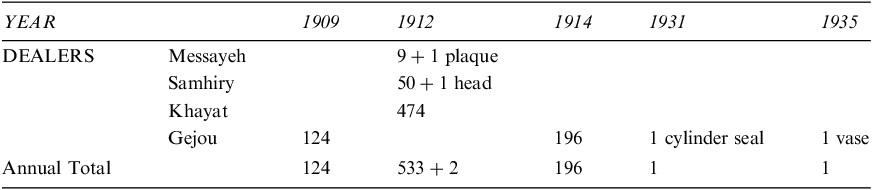
Gejou’s letters about Kish also raise several questions. I will mention only two here. The first is about numbers. Based on the explicit numbers of Kish objects discussed, a total of 853 cuneiform tablets and four other artefacts made their way to Paris, London and New York between 1909 and 1935 (Table 1). I have not counted the ninety-four tablets in Rizouk’s possession in 1913 as they might have been those already waiting at Gejou’s atelier. Excluded are also Gejou’s shipment of 5,200 tablets to the YBC, and his offer of 12,500 to the BM as there are no definite numbers for Kish.
Numbers of cuneiform tablets and other artefacts from Kish mentioned in dealers’ correspondence, 1909–35

Table 1: Long description
A table showing the numbers of cuneiform tablets and other artefacts from Kish mentioned in dealers’ correspondence from 1909 to 1935. The table has 5 columns and 5 rows, including the header row. The columns are labeled as YEAR, DEALERS, 1909, 1912, 1914, 1931, and 1935. The row labels under DEALERS are Messayeh, Samhiry, Khayat, Gejou, and Annual Total. Row 1: Messayeh, 9 + 1 plaque. Row 2: Samhiry, 50 + 1 head. Row 3: Khayat, 474. Row 4: Gejou, 124, 196, 1 cylinder seal, 1 vase. Row 5: Annual Total, 124, 533 + 2, 196, 1, 1.
To try to understand this total, I have compared it to the total number of Kish tablets known to be in museums across Europe and the US by using data collected by Eleanor Robson from the Cuneiform Digital Library Initiative’s database in early 2025. According to the information collected, which we believe to be incomplete because the CDLI can only give the information communicated to it, museums worldwide collectively hold at least 3,475 tablets whose provenance is identified as Kish. Among these, 279 are said to come from informal excavations, that is to say, purchased on the antiquities market by these institutions. If Gejou and his colleagues collectively refer to 853 tablets, one wonders where are the other 574? Are they unidentified in museum records because provenance information initially provided by dealers has been lost?
This question leads to a second one: what did dealers talk about when they talked about Kish? In their letters, Messayeh, Samhiry and Khayat reference Tell Uhaimir, the mound which preserves the remains of the ancient city of Kish, spelling it in Latin letters in a variety of ways (e.g., Ahemir, El-Oheymir, El-Oheimir). But tablets must have also come from Hursagkalama – Tell Ingharra by its modern name. Local teams excavated at Tell Ingharra with Genouillac when they found what would later be known as the Temple of Ishtar. They may also have excavated on this mound before that brief mission. But Tell Ingharra does not appear in the letters I have examined, although the name seems to have been in use for many decades already, having been reported by William Hayes Ward in 1885 (Gibson Reference Gibson1972: 68).
The locations that dealers referenced represent valuable data, and a closer look at disclosed provenience is necessary. As noted above, besides referring to Tell Uhaimir, Messayeh and Samhiry spoke about several other locations including “Abu Nakhla” or “Tell Nekhala” in 1912 and 1913.Footnote 56 In an object list dated 24 June 1912, Messayeh speaks about Abu/Tell Nekhala and of Jureiman, giving their locations: “Tablets from Tel Nekhala near Djassian and from Tel Jéreiman near Seledjia.”Footnote 57 I have found no references to these locations in Gejou’s letters to the BM, nor on the BM online collections catalogue which contains a wealth of acquisition information including findspots.Footnote 58 Gejou refers to Abu Nekhla once to the YBC, in the postscript of a letter dated 28 November 1912.Footnote 59 As kindly shared with me by Dr Jacob Jawdat, Tell Nekhala is a mound located a few kilometres away from Tell Uhaimir.Footnote 60 I therefore wonder whether once received, objects were simply labelled as “tablets from Kish”, even though collectors like Messayeh and Samhiry were clear about site names. As tablets hopped from one hand to another, provenance information seems to have got lost along the way. It will be no surprise to Assyriologists that tablets said to have come from “Kish” may instead have come from a nearby site, close enough geographically to be bundled under the same name at a time when all eyes were on Kish.
Acknowledgements
This research was conducted for The Forgotten City of Kish project in 2025 funded by the Nahrein Network at University College London. I am very grateful to Professor Eleanor Robson for her support, and for her editorial comments on this paper. I could not have written this article without the invaluable assistance of Francesca Hillier at the British Museum Central Archive, Dr Agnete Lassen and Dr Klaus Wagensonner at the Yale Babylonian Collection, and Marianne Cotty at the Louvre Museum. This paper was researched and written without the use of AI.


 Open access

