Introduction
Corn silage is one of the primary feeds used in intensive ruminant production systems due to relative high productivity and nutritive value. However, corn silage usually contains crude protein (CP) concentrations below the requirements of many ruminant categories (NRC, 2001), requiring supplementation with protein sources to supply the animal needs (Riday and Albrecht, Reference Riday and Albrecht2008). As the legumes have a high protein concentration (Iqbal et al., Reference Iqbal, Hamid, Hussain, Siddiqui, Ahmad, Khaliq and Ahmad2019), corn intercropping with legume species for silage production could be an excellent solution to minimize protein supplementation need (Adesogan et al., Reference Adesogan, Salawu, Williams, Fisher and Dewhurst2004; Soleymani et al., Reference Soleymani, Shahrajabian and Naranjani2012).
Among various legume species, Crotalaria spp. has excellent potential for intercropping with corn under tropical conditions (Souza et al., Reference Souza, Valadão, Valadão Júnior, Guimarães and Paula2019). Crotalaria species are less demanding on soil fertility, require simple management, have a deep root system, control nematode populations and contribute to soil nitrogen fixation (Sangakkara et al., Reference Sangakkara, Liedgens, Soldati and Stamp2004; Tavares et al., Reference Tavares, Cruz, Silva, Figueiredo, Ramalho, Serrão and Zanucio2011). Crotalaria juncea and Crotalaria ochroleuca are the main species used for intercropping with corn in Brazil (Garcia and Silva, Reference Garcia and Silva2019). Crotalaria juncea has a high growth speed and high production of fibrous stem mass. In contrast, C. ochroleuca has a slower growth speed and lower fibre concentration in the stems (Pfüller et al., Reference Pfüller, Bueno Santos, Ferreira Aires and Galeano Samaniego2019).
The advantage of intercropping corn with legume species is increased forage accumulation and nutritive value (Kappes and Zancanaro, Reference Kappes and Zancanaro2015). However, a study has also shown that competition between the two crops may reduce forage mass and corn grain yield (Seran and Brintha, Reference Seran and Brintha2010). According to Zhang and Li (Reference Zhang and Li2003), legume species with a high growth rate (C. juncea) that are sown in the same row as the main crop may impair the productivity of both species, and legume species with lower growth rates (C. ochroleuca) would be recommended in such cases.
Therefore, the present study was conducted to evaluate forage agronomic characteristics, chemical composition and digestibility of the corn as monocropping or intercropping with two crotalaria species (C. juncea and C. ochroleuca) in two spacing arrangements (cultivation in the same row or alternate rows). The current study was based on two hypotheses: (i) intercropping corn with a fast-growing legume, sown in between corn rows, will result in less competition among species, leading to high forage mass, and (ii) intercropping corn with slow-growing crotalaria, sown in the same row, will produce forage with better nutritive value.
Materials and methods
The experiment was conducted at Embrapa Agropecuária Oeste – CPAO, in Dourados, MS, Brazil (22°16′S, 54°49′W at an altitude of 408 m a.s.l) from February to July 2018 and 2019. Chemical composition analyses were performed at the Laboratory of Agricultural Residues Utilization belonging to the Federal University of Grande Dourados (UFGD).
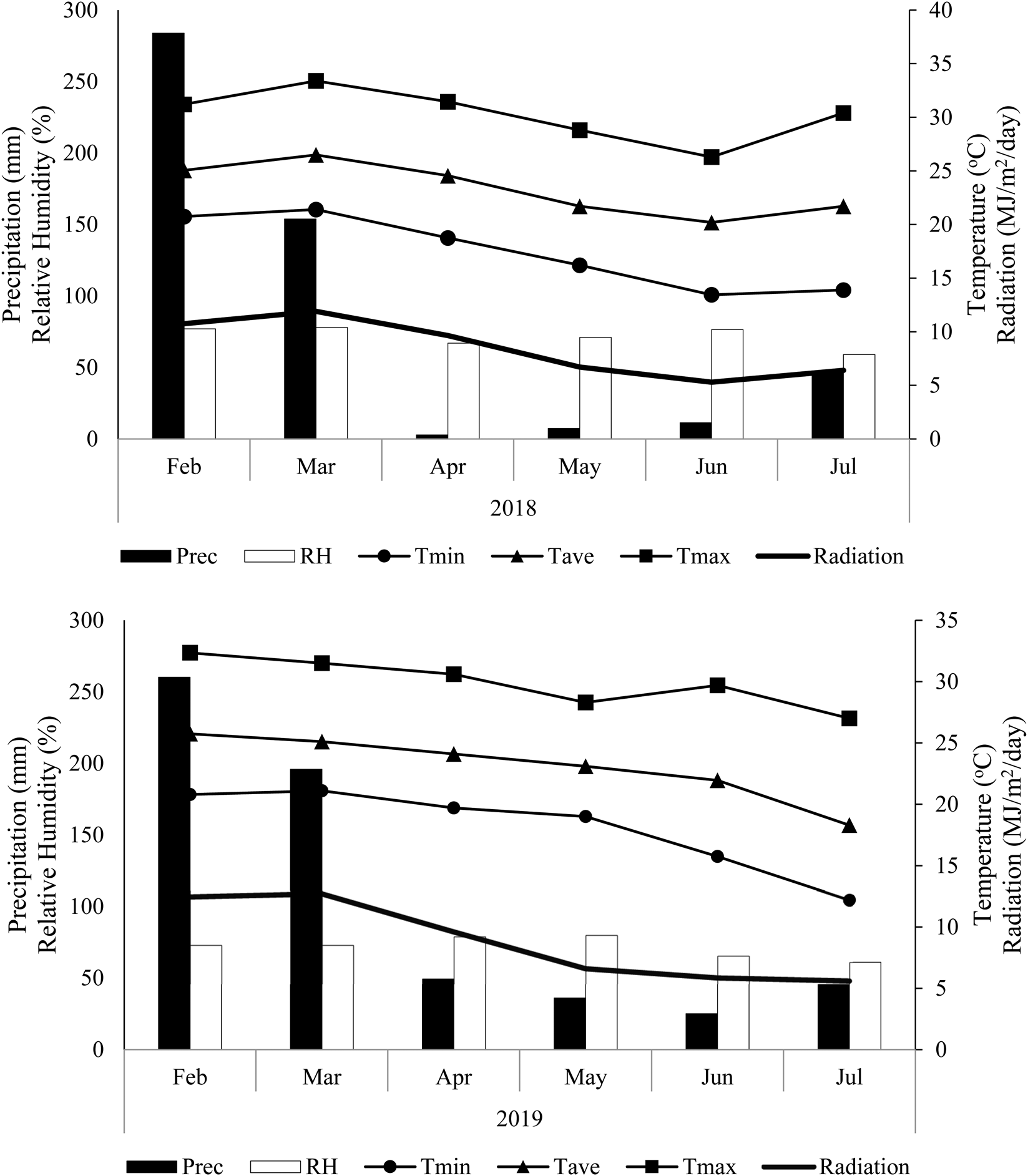
According to the Köppen classification, the region climate is Cwa (humid mesothermal with rainy summer; Fietz and Fisch Reference Fietz and Fisch2008). Figure 1 gathers the temperature, relative humidity, precipitation, and radiation data observed during the experimental period.
Average air temperature (T ave), maximum (T max) and minimum (T min), relative humidity (RH), precipitation (Prec) and radiation, observed during the two experimental years (2018 and 2019).

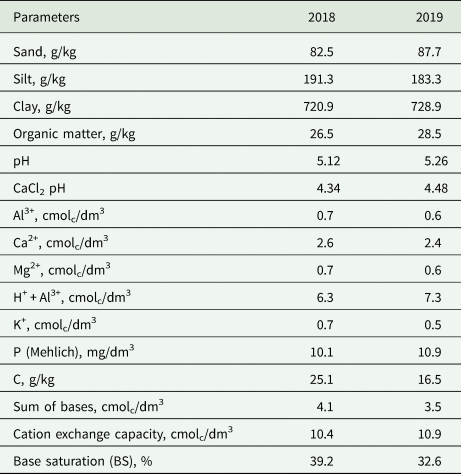
The soil at the experimental area is classified as distroferric dark red latosol with very clayey texture according to the Brazilian System of Soil Classification (Santos et al., Reference Santos, Jacomine, Anjos, Oliveira, Lumbreras, Coelho, Almeida, Araújo Filho, Oliveira and Cunha2018). Soil characteristics of the experiment areas during 2018 and 2019 are presented in Table 1.
Soil characteristics of the experiment areas during 2018 and 2019

The lime application and fertilization were performed based on the recommendation of Pereira Filho (Reference Pereira Filho2015). Initially, 2300 kg/ha of lime (ECCE 80%; dolomitic limestone) was applied in the first year and 3000 kg/ha in the second year. Regarding sowing fertilization, 190 kg/ha of NPK formula 04-18-18 (corresponding to 7.6 kg/ha of N, 14.9 kg/ha of P and 28.3 kg/ha of K) was applied in 2018, and 200 kg/ha of NPK formula 04-20-20 (corresponding to 8 kg/ha of N, 17.4 kg/ha of P and 33.2 kg/ha of K) in 2019. Additional fertilization was performed 20 days after germination, with 75 kg/ha of protected urea and 60 kg/ha of potassium chloride (corresponding to 33 kg/ha of N and 31.4 kg/ha of K) applied in both years.
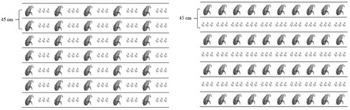
Treatments were a factorial arrangement among two intercropping cultivation systems (corn + Crotalaria juncea (CCJ) intercropping, and corn + Crotalaria ochroleuca (CCO) intercropping) and two spacing arrangements (A1 (corn and crotalaria sown in the same row, with 45 cm of inter-row spacing) and A2 (corn and crotalaria in alternate rows, with 45 cm of inter-row spacing)) plus a control treatment (single corn monocropping (CSC)), distributed in a randomized complete block design with six replicates (Fig. 2).
Sketch of the spatial arrangements, A1 (left) = 45 cm between rows, with corn and crotalaria in the same row; A2 (right) = 45 cm between rows, with corn and crotalaria in alternate rows.

The corn hybrids used were BRS 1010 in the first year and RB9789 VIP3 in the second year. The plants were sown in February of each year, using a SHM 1517 planter. The target corn plant population was 60 000 plants/ha. For the intercropping, 25 and 13 kg/ha of seeds of C. juncea and C. ochroleuca were used, approximating populations of 222 222 and 444 444 plants/ha, respectively. The experimental plots consisted of 14 rows, each 8 m long, excluding 1 m in each final row defining the useful area.
The harvest was performed manually at 15 cm above ground level using a hand-held sickle when the corn reached the doughy-farinaceous phenological stage (approximately 100 days after sowing). Nine samples were collected per plot (plants contained in two linear meters), which were used to determine the morphological composition and forage dry matter (DM) concentrations. Corn plants were separated into stem, leaf, tassel and ear. Crotalaria species were separated into the stem, leaf blade plus petiole, inflorescence and pods (when present). Forage mass was estimated by the total number of plants in each plot (corn or corn plus crotalaria), multiplied by the average dry weight of each plant, and expressed in kg of DM/ha.
For the chemical composition of the intercropping cultivation system, a sample from each plot (4 m from two central lines) was collected and milled in a stationary grinder and the intercropped plants were homogenized to facilitate sampling. A sample of approximately 300 g of each treatment was pre-dried in a forced-air oven at 55°C for 72 h. Then, samples were milled in a Wiley-type mill with a 1.0 mm mesh sieve. The concentration of DM, OM (method 942.05) and CP (method 976.06) was determined according to AOAC (Reference Helrich2005). For the evaluation of neutral detergent fibre (NDF), we use thermostable amylase. The NDF include hemicelluloses, cellulose, lignin and fibre-bound proteins. The acid detergent fibre (ADF) mainly consists of cellulose, lignin and insoluble proteins. Lignin was determined by ash-free acid extraction, with the assumption that the fraction of lignin-bound nitrogen is insignificant. Cellulose was determined by calculating the difference between ADF and lignin, and hemicellulose was determined by the difference between ADF and NDF. The in vitro true DM digestibility (ivDMD) was determined according to the methodology described by Tilley and Terry (Reference Tilley and Terry1963) and modified by Holden (Reference Holden1999).
Data were analysed using the mixed model procedure of RStudio (R, 2009). The years were analysed separately because of the different corn hybrids and locations. Since the additional treatment is randomized in with others, we perform the standard ANOVA considering all treatments (including the additional) without the factorial structure; and then perform the factorial analysis (without the additional treatment) (Healy, Reference Healy1956). When an interaction occurred (α ≤ 0.05), the spacing arrangement was analysed within each intercropping cultivation system, and the results were presented in figures. In the case of non-significance of the interaction, both factors were analysed independently, and the results were presented in tables. The means were compared using the Scott–Knott test at a significance level of 5%. Data related to agronomic aspects in the factorial structure were analysed according to the following model:

where Yijk = dependent variable, μ = overall mean, βk = block effect (random effect; k = 1, 2, 3, 4, 5 and 6), Si = effect of different intercropping cultivation system (fixed effect; i = CCJ and CCO), SAj = effect of spacing arrangement (fixed effect; j = A1 and A2), S × SAij = effect of the interaction between intercropping and spacing arrangements, and εijk = random error associated with each observation.
Results
First-year of assessment
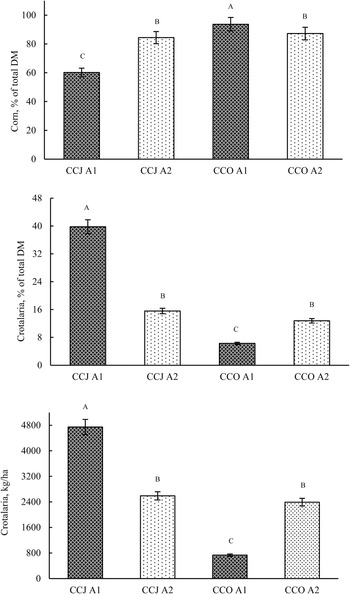
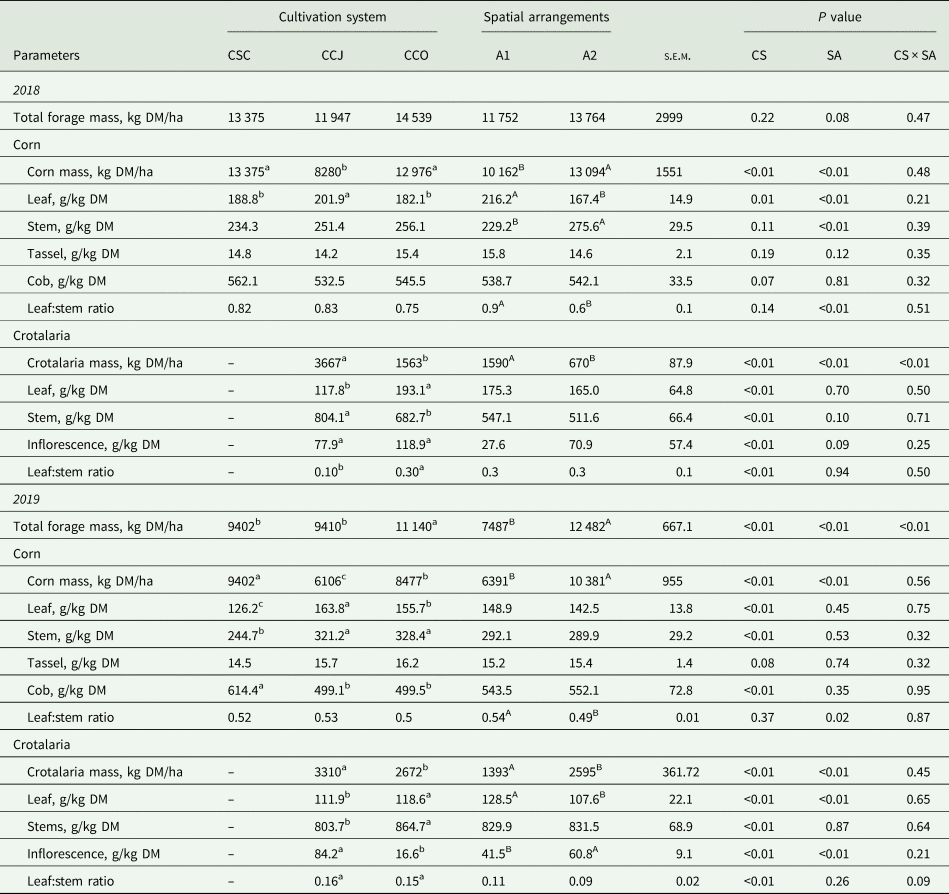
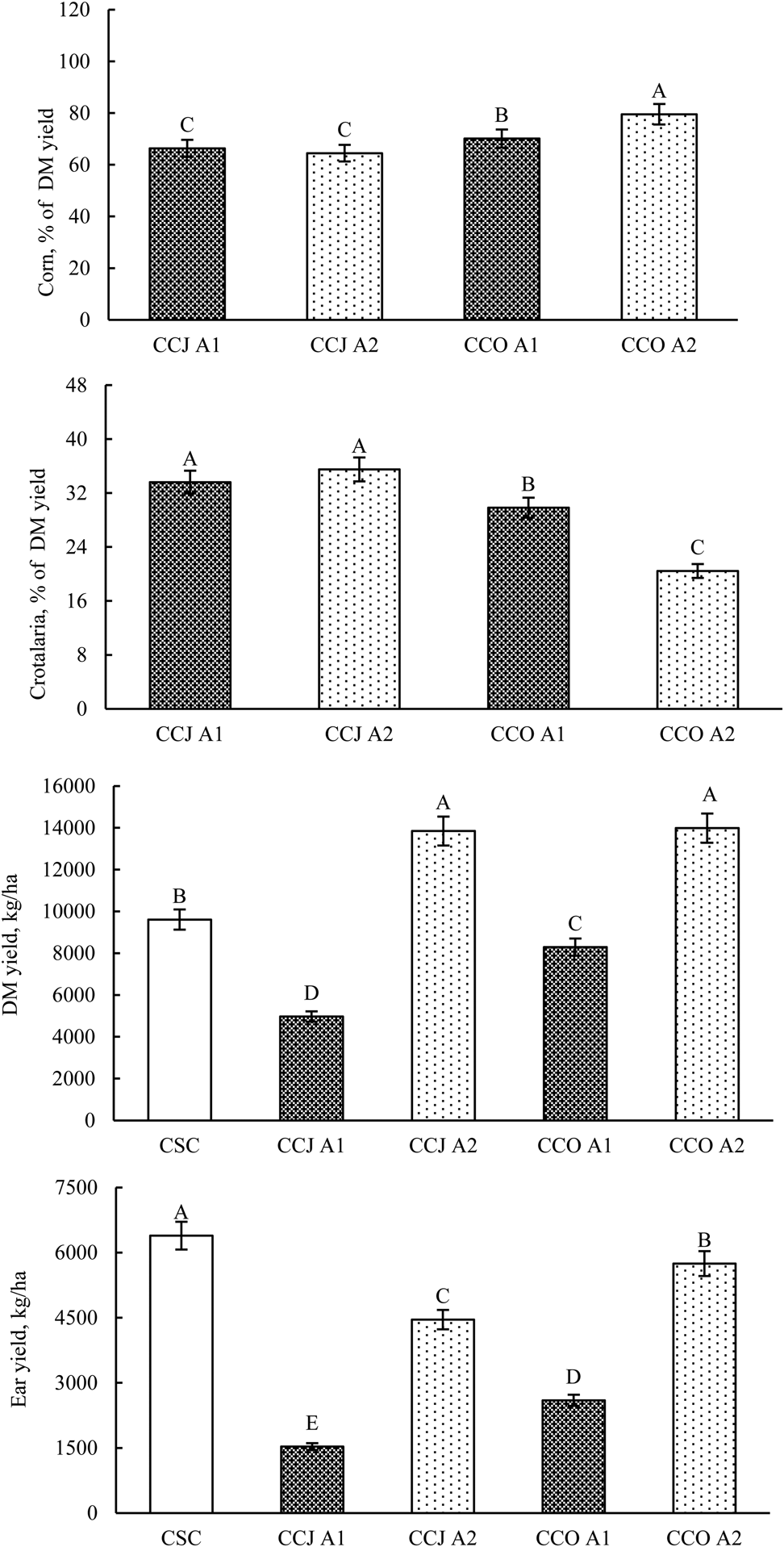
For the first year of evaluation, there were no differences in forage mass among intercropping cultivation system or spacing arrangement. However, differences were observed between corn and crotalaria mass (Table 2). The CCJ intercropping had the lowest corn mass when compared to CSC and CCO intercropping, which did not differ from each other. Planting both cultures (corn and crotalaria) in the same row resulted in corn yields lower than those obtained in A2 spacing. Conversely, the CCJ treatment had greater herbage mass when the A1 spacing arrangement was adopted (Fig. 3).
Percentage of corn and crotalaria in the total forage mass, and crotalaria mass from corn in monocropping and intercropping with two crotalaria species in two spatial arrangements in 2018. CSC, single corn monocropping; CCJ, corn + C. juncea intercropping; CCO, corn + C. ochroleuca intercropping; A1 = 45 cm between rows, with corn and crotalaria in the same row; A2 = 45 cm between rows with corn and crotalaria in alternate rows. Averages with different letters indicate significant interaction between spatial arrangements and crotalaria species according to the test of Scott Knott at 5%.

Forage mass and plant morphological characteristics from corn in monocropping and intercropping with two crotalaria species (C. juncea and C. ochroleuca) in two spatial arrangements (cultivation in the same row or alternate rows) for the years 2018 and 2019
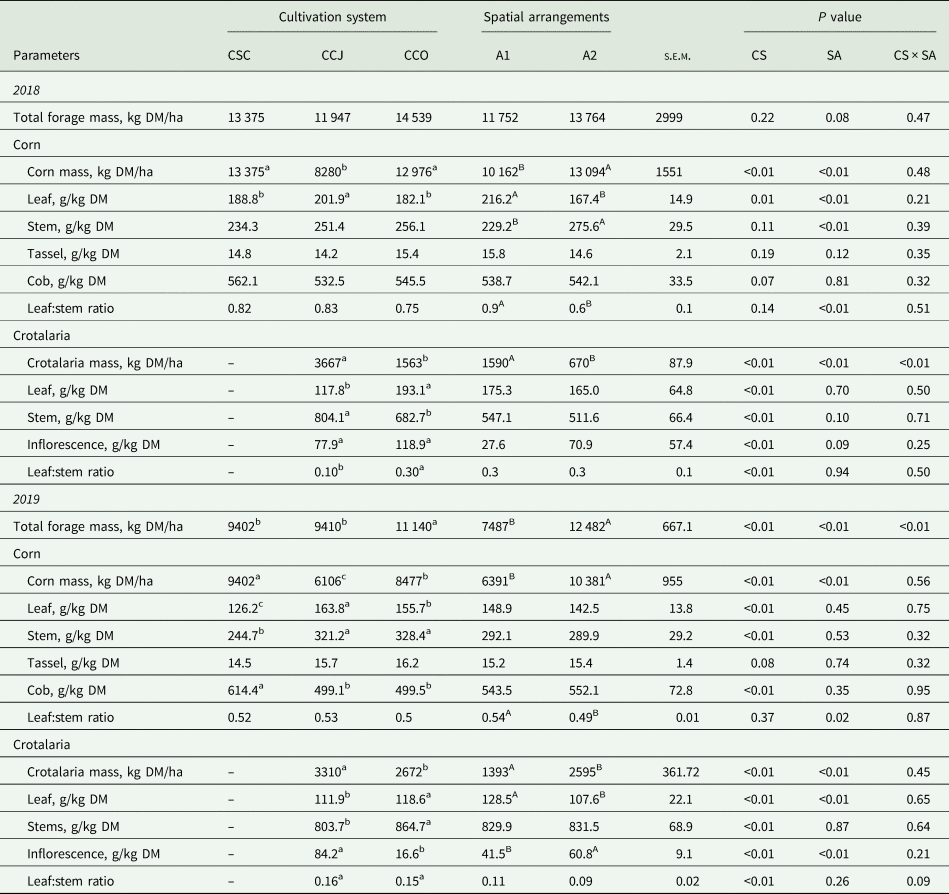
CSC, single corn monocropping; CCJ, corn + C. juncea; CCO, corn + C. ochroleuca; A1 = 45 cm between rows, with corn and crotalaria in the same row; A2 = 45 cm between rows with corn and crotalaria in alternate rows; s.e.m., standard error of the mean; DM, dry matter. Averages followed by different letters differ by Scott Knott test at 5% probability; capital letter represents the difference between the spatial arrangements (SA) and lowercase letters the difference between cultivation system (CS).
Corn leaf mass was higher in the CCJ intercropping than in either CSC or CCO. There was also a difference between the spacing arrangements, with the highest leaf mass between spacing arrangements observed in A1 compared to that obtained in A2. The corn stem mass did not differ among the crotalaria species used in the intercropping. Still, concerning spacing arrangements, the highest corn stem mass was obtained in A2 compared to that observed in A1 (Table 2). The difference obtained in leaf mass among crotalaria species used in the intercropping did not reflect in the corn leaf:stem ratio. However, there were differences observed in the corn leaf:stem ratio regarding spacing arrangements with the highest values observed in A1. Tassel and cob mass did not differ among the species of crotalaria used in the intercropping or spacing arrangements.
Crotalaria leaf and inflorescence mass differed among the species intercropping, with the highest values reported for CCO (Table 2). Regarding stem mass, CCJ intercropping had the highest average when compared to CCO. These results led to a higher crotalaria leaf:stem ratio of legumes for CCO. No differences were observed for leaf:stem ratio, the mass of leaf, stem and inflorescence between the spacing arrangements A1 and A2 (Table 2).
There was an interaction between intercropping cultivation system and spacing arrangement in the forage mass proportion (%) of each crop culture (corn and crotalaria; Fig. 3). The higher corn mass proportion was at CCO intercropping in the spacing arrangement A1. The lowest corn mass proportion was obtained in the CCJ intercropping and A1 spacing arrangement, which consequently resulted in the highest crotalaria mass in this treatment. However, there was no difference between CCO and CCJ at A2 spacing arrangement.
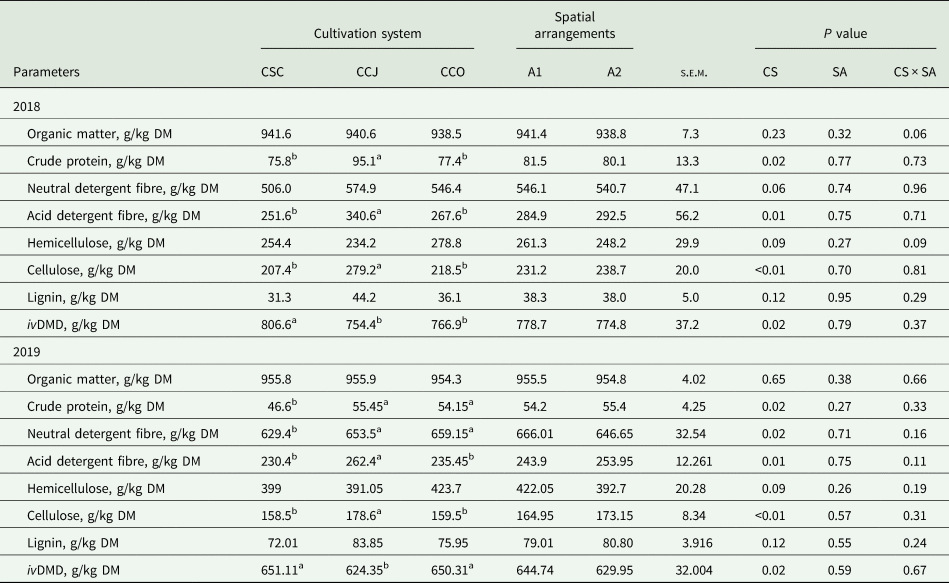
There were no differences among treatments in OM concentration. Corn intercropped with crotalaria had a higher CP concentration than corn monocropping. The highest CP was found in CCJ intercropping (95.1 g/kg DM), followed by CCO (77.4 g/kg DM; Table 3). Regarding fibrous fractions, differences were observed in ADF and cellulose concentration, in which CCJ had higher values compared to the other treatments. However, there were no differences in NDF or lignin concentration among treatments. The highest ivDMD was observed in CSC (average of 806.6 g/kg DM), with no difference in ivDMD in CCJ and CCO. No differences were observed between the A1 and A2 spacing arrangements regarding forage chemical composition and ivDMD in the first year.
Chemical composition of forage derived from single corn monocropping and intercropping with two crotalaria species (C. juncea and C. ochroleuca) in two spatial arrangements (cultivation in the same row or alternate rows) for the years 2018 and 2019

CSC, single corn monocropping; CCJ, corn + C. juncea; CCO, corn + C. ochroleuca; A1 = 45 cm between rows, with corn and crotalaria in the same row; A2 = 45 cm between rows with corn and crotalaria in alternate rows; s.e.m., standard error of the mean; DM, dry matter; ivDMD, in vitro true DM digestibility. Averages followed by different letters differ by Scott Knott test at 5% probability.
Second year of assessment
In the second year of evaluation for forage mass, the interaction was observed between the intercropping cultivation system and spacing arrangements tested (Table 2, Fig. 4). The highest forage mass was obtained in CCO and CCJ intercropping, both cultivated in A2 spacing arrangement. The lowest forage mass was observed in CCJ intercropping grown in A1 spacing arrangement. The CCJ intercropping had the lowest corn mass in both spacing arrangements; the higher corn mass was at CCO at A2 spacing arrangement. The planting of both crop cultures (corn and crotalaria) in the same row resulted in a corn mass of 6391 kg DM/ha, which was lower than that obtained in the A2 spacing arrangement. Results opposite to these were obtained for legume mass, whereas the highest mass was observed in CCJ with an A1 spacing arrangement.
Percentage of corn and crotalaria in the total forage mass, forage mass and cob mass from corn monocropping and intercropping with two crotalaria species in two spatial arrangements in 2019. CSC, single corn monocropping; CCJ, corn + C. juncea intercropping; CCO, corn + C. ochroleuca intercropping; A1 = 45 cm between rows, with corn and crotalaria in the same row; A2 = 45 cm between rows with corn and crotalaria in alternate rows. Averages with different letters indicate significant interaction between spatial arrangements and species of crotalaria according to the test of Scott Knott at 5%.

Corn leaf and stem mass were lower in CSC than either CCO or CCJ, which resulted in a higher proportion of cob in CSC than in the intercropping cultivation systems (Table 2), with no differences in tassel mass. Interactions among factors were observed in corn cob production (Fig. 4). Higher cob mass was observed in CSC monocropping, followed by CCO and CCJ in A2, and then in CCO and CCJ in A1. Corn leaf:stem ratio did not differ among the tested intercropping cultivation systems. However, there was a higher leaf:stem ratio with corn grown in the A1 spacing arrangement.
Crotalaria leaf mass and leaf:stem ratio did not differ between CCO and CCJ intercropping. However, the stem mass was higher for CCO, which also had lower inflorescence mass (Table 3). The spacing arrangement also altered crotalaria leaf mass, with higher values being observed in the A1 spacing arrangement. The highest inflorescence mass was observed in the A2 spacing arrangement.
Regarding the chemical composition of the intercropped forages, spacing arrangements did not influence the parameters evaluated (Table 3). The crotalaria species used in intercropping did not influence the OM, hemicellulose and lignin (Table 3). The highest CP concentration was observed in CCJ and CCO intercropping. The lowest NDF concentration was found in CSC intercropping. Regarding ADF and cellulose, the lowest values were found in CSC and CCO intercropping. No differences were observed among the other nutrients (P > 0.05). The CCJ intercropping presented the highest values of fibrous fractions, which was reflected in the ivDMD coefficients (Table 3). The highest ivDMD coefficients were observed in CSC and CCO intercropping. Similar to the first experimental year, no differences were observed in the second experimental year between the spacing arrangements in the forage chemical composition or digestibility.
Discussion
We used different corn hybrids in each experimental year, so years were evaluated separately. In the first year, hybrid BRS 1010 was used, followed by hybrid RB9789 VIP3 in the second year. Thus, corn mass was not equivalent between 2018 and 2019. Factors including climatic variations and different experimental areas also affected the difference in the corn mass. The lower performance of the corn plants in the second experimental year may have contributed to the greater crotalaria mass.
Based on data from the second experimental year, the use of C. juncea and C. ochroleuca in inter-row planting (A2) increased the forage mass per area. However, the use of these legumes in the same row as corn did not provide benefits in terms of forage mass production when compared to CSC. When two different species are planted in the same area, there is a natural competition for nutrients, water and light (Soleymani et al., Reference Soleymani, Shahrajabian and Naranjani2012). However, when planting occurs in the same row, competition for light becomes the most decisive, especially when taller species are intercropped because of the more accentuated shading (Kappes and Zancanaro, Reference Kappes and Zancanaro2015).
The forage mass observed in this current study differs from the report of Kappes and Zancanaro (Reference Kappes and Zancanaro2015), who found higher forage mass when C. juncea and C. ochroleuca were grown in the same row as corn. This probably occurred because the authors measured the mass at the end of the production cycle (the ideal phase for grain harvesting), while this current study measured the forage mass at the doughy-farinaceous phenological stage of corn. According to Zhang and Li (Reference Zhang and Li2003), after the main crop reaches maturity, the subordinate species recovers the growth rhythm, thus increasing the total forage mass. In a field trial conducted by Zhang and Li (Reference Zhang and Li2003), the mass accumulation rates of corn intercropped with wheat were significantly lower than those observed for the corn monocropping during the early stage. However, in the final stage, the rates of mass accumulation were significantly greater for corn intercropped with wheat in comparison to corn monocropping.
In the current study, the CCJ and CCO intercropping in the A2 arrangement produced on average 4400 kg DM/ha more forage mass than that in CSC. According to Paz et al. (Reference Paz, Gallo, Souza, Oliveira, Cunha and Silva2017), the higher forage mass obtained in some corn intercropping with legumes is due to sowing area optimization, in which the secondary crop interferes less in corn growth (lower competition for light, water and nutrients).
The higher corn biomass is due to tropical grasses (corn) having C4 metabolism, which results in plants with higher growth rates and larger size than legumes such as crotalaria that have a C3 metabolism (Lempp, Reference Lempp, Reis, Bernardes and Siqueira2013). Although it was the dominant plant in the intercropping, the corn biomass and grain yield were impaired when C. juncea was used in the intercropping (observed in both experimental years). This could be related to the growth rate of C. juncea. According to Lepcha et al. (Reference Lepcha, Naumann, Fritschi and Kallenbach2019), among the crotalaria species, C. juncea is the one with the highest growth rate, which may lead to greater competition with the main crop. The influence on the leaf production, quantity and quality of the CCJ biomass at harvest could be a result of the emergence rate, plant density and apical dominance. This occurs because these factors strongly affect the canopy architecture, which in turn regulates the leaf/stem size, heterogeneity and number (Parenti et al., Reference Parenti, Cappelli, Zegada-Lizarazu, Sastre, Christou, Monti and Ginaldi2021). The competitive effects among the species were more evident when the legumes were sown in the same row as the corn crop (A1 spacing arrangement), in which both crops had less spacing between plants, which resulted in greater competition for water, nutrients and sunlight.
Due to its direct link to the plant photosynthetic rate, the radiation intercepted by the plant can interfere with the plant morphology in intercropping (Caron et al., Reference Caron, Schmidt, Manfron, Behling, Eloy and Busanello2014). In a competitive scenario, plants can direct photoassimilates and their derivatives towards the production of stems (Baumann et al., Reference Baumann, Bastiaans and Kropff2001; de Paula Leonel et al., Reference de Paula Leonel, Pereira, Costa, Marco Júnior, Lara and Queiroz2009), thus modifying their structural characteristics. This behaviour was evident in the second experimental year, when greater stem mass was observed in both crotalaria and corn.
Legumes normally have higher CP concentrations when compared to grasses (Lepcha et al., Reference Lepcha, Naumann, Fritschi and Kallenbach2019). According to Lempp (Reference Lempp, Reis, Bernardes and Siqueira2013), this higher legume CP concentration is explained by the forage leaf anatomy (the proportion and arrangement of mesophyll cells). In legume leaves, the mesophyll cells compose a great part of leaf tissue and have a loose arrangement, which results in a great CP concentration and higher ruminal degradation rates. On the other hand, C4 grass leaf is mostly composed of bundle sheath cells which are poor in protein and rich in fibre, resulting in lower ruminal degradation rates. Hence, the treatments that contained higher legume proportions were those that had higher CP concentrations. The higher CP concentration observed in the intercropping during the first experimental year is possible due to the type of corn hybrid used, which besides being more productive, also has a higher CP concentration as a characteristic. Even so, the CCJ provided, for both years, forage with a great CP concentration (on average 22% higher than with CSC) that was close to the concentrations obtained by Zavala et al. (Reference Zavala, Valencia, Randel and Ramos-Santana2011) with the same type of intercropping (an increase of 15.7% in CP concentration).
In contrast, the high fibrous stem production, which is a characteristic of C. juncea (Morris and Kays, Reference Morris and Kays2005), provided a high concentration of forage fibrous fractions in both experimental years. The increase in fibre concentration of the forage mass was also described by Zavala et al. (Reference Zavala, Valencia, Randel and Ramos-Santana2011), who found values on average of 389.0 g ADF/kg DM in the intercropping of corn with C. juncea, which corresponded to an increase of 23.6% in comparison to the corn monocropping. According to the authors, the phenological stage (flowering) of C. juncea at the time of cutting favoured that result. The same behaviour was observed in the current study, where great pod mass was observed in CCJ (the plant at the end of the life cycle).
Fibre plays a fundamental role in ruminant nutrition because it is an important energy source, which stimulates chewing and salivation, rumination, gut motility and health, buffers ruminal acidosis, regulates feed intake, and produces fat milk precursors. Cellulose and hemicellulose, the main fibre components, are potentially digestible in the rumen (Adesogan et al., Reference Adesogan, Arriola, Jiang, Oyebade, Paula, Romero, Ferraretto and Vyas2019). However, their close association with lignin and hydroxycinnamic acids (mainly the ferulic acid) in the plant cell wall is the greatest hindrance to complete feed digestion. Thus, according to Beauchemin (Reference Beauchemin1996), forage ADF concentration is an accurate way to estimate the digestible energy content of the diet. Based on this, we can conclude that CCJ intercropping presented lower digestible energy in comparison to the others.
In the second experimental year, the beneficial effect of intercropping between corn and C. ochroleuca was more evident, as CP was numerically higher, without resulting in a significant increase in the forage fibrous fractions in comparison to that found in CSC. According to Parentoni et al. (Reference Parentoni, Gomes Gama, Dos Santos, Patto Pacheco and Correa2004), C. ochroleuca has a lower fibre concentration in the stems than C. juncea, which contributes to this forage being more digestible and more palatable to animals.
The ivDMD observed in this study demonstrated that the CCO intercropping has the potential to raise the CP concentration without reducing its digestibility (the second experimental year). Niderkorn et al. (Reference Niderkorn, Baumont, le Morvan and Macheboeuf2011) found that the association between legumes and grasses can lead to a synergistic response with a positive effect on DM digestibility.
Conclusions
It can be concluded that Crotalaria ochroleuca, sown between corn rows, has greater forage mass productivity per area and is associated with higher CP concentrations (than those observed in corn) without influencing digestibility. The intercropping of corn with crotalaria may be a viable alternative for the farmer due to the productivity and forage quality. In both years of study, the intercropping that had the greatest potential was corn with C. ochroleuca.
Acknowledgements
Appreciation is extended to the Coordination for the Improvement of Higher Education Personnel (CAPES; Brasilia, DF, Brazil) and the National Council of Technological and Scientific Development (CNPq; Brasilia, DF, Brazil) for their investments in the authors.
Conflict of interest
None.
Ethical standards
Not applicable.