Introduction
A national survey commissioned in 1997 by the Australian Commonwealth Government reported that older, community-resident Australians were less prone than younger adults to anxiety disorders and depression (Henderson et al. Reference Henderson, Andrews and Hall2000; O'Connor, Reference O'Connor2006). Anxiety and depressive disorders both peaked in mid-life and then declined to such an extent that only 4.6% of people aged ⩾65 years met ICD-10 criteria for an anxiety disorder in the previous 12 months and only 1.5% met criteria for major depression or dysthymia. By contrast, rates in the age band 45–54 years were 12.9% and 6.9% respectively.
Similar age-related falls in mental disorder have been reported in other countries (ESEMed/MHEDEA 2000 Investigators, 2004; Kessler et al. Reference Kessler, Berglund, Demler, Jin and Walters2005; Wells et al. Reference Wells, Oakley Browne, Scott, McGee, Baxter and Kokaua2006; Lee et al. Reference Lee, Tsang, Zhang, Huang, He, Liu, Shen and Kessler2007) and persuasive arguments have been marshalled by way of explanation. Older people might be less vulnerable to mental disorder because they were reared in tough times and cope better with adversity; their coping skills have been honed over decades, and they face fewer daily hassles (Henderson, Reference Henderson1994; Lindesay et al. Reference Lindesay, Baillon, Brugha, Dennis, Stewart, Araya and Meltzer2006; Villamil et al. Reference Villamil, Huppert and Melzer2006; Yang, Reference Yang2007).
It is striking, however, that most surveys reporting sharp falls in mental disorder with age have relied on lengthy, structured interviews such as the Diagnostic Interview Schedule (DIS), which generates DSM diagnoses (Robins et al. Reference Robins, Helzer, Croughan and Ratcliff1981), and the related Composite International Diagnostic Interview (CIDI), which generates both DSM and ICD diagnoses (WHO, 1994).
The CIDI is very complex indeed. In Version 1.20 used in Australia, the screening question for generalized anxiety disorder reads as follows: ‘In the past 12 months, have you had a period of a month or more when for most of the time you felt worried, tense or anxious about everyday problems such as work or family?’ A positive response prompted two supplementary questions: ‘Has that period of feeling worried, tense or anxious been going on for six months or longer?’ and ‘In the past 12 months, did you have a time when you worried a lot more than most people would in your situation?’ Positive responses to both these questions then prompted queries about 24 specific symptoms, their severity and persistence, and the content of worrisome thoughts. The process for depression follows a similar pathway.
Such questions require analysis of multiple symptoms, time-frames and attributions, and might therefore present a challenge to very old respondents. The ageing process, even in healthy older people, is associated with reduced attention span, working memory and information processing speed, all of which can impact on the capacity to respond quickly to batteries of multi-faceted questions (Anderson, Reference Anderson, Jacoby, Oppenheimer, Dening and Thomas2008). In general, cognitive tasks that require the rapid manipulation of large quantities of complex new information become progressively more difficult with age. Physical frailty, pain, deafness and other age-related morbidities impose an additional burden.
Diagnostic interviews developed specifically for use with older people, including those with dementia, are typically less demanding. In the depression section of the Cambridge Examination for Mental Disorders of the Elderly (CAMDEX), for example, the question about low mood is simple: ‘Do you feel sad or depressed or miserable?’(Roth et al. Reference Roth, Huppert, Tym and Mountjoy1988). The Geriatric Mental State Schedule (GMS) takes a semi-structured approach with room for probes if required (Copeland et al. Reference Copeland, Kelleher, Kellet, Gourlay, Gurland, Fleiss and Sharpe1976). It is still much easier to complete than the CIDI and typically generates relatively high rates of ‘depression syndrome cases’. In a small Australian study, 6.3% of the subjects aged 70–74 years who were assessed using the GMS met criteria for major depression, in contrast to 2.4% in the survey described here (Kay et al. Reference Kay, Henderson, Scott, Wilson, Rickwood and Grayson1985).
Psychiatric glossaries such as ICD-10 divide respondents into ‘cases’ of mental disorder and ‘non-cases’. The results are clinically useful but somewhat arbitrary because ‘caseness’ can hinge on responses to a single question. Continuous ratings of mental health, by contrast, shed light on the whole community, including ‘subthreshold cases’, that is respondents who fail to meet criteria for diagnosis but might still be disabled and worthy of attention. Scales of mood and morale are typically brief and easy to complete with short time-frames, simple questions and small numbers of predetermined responses. They are therefore less subject to influence by age-related changes in cognition, sensory capacity and physical health.
It is of interest, therefore, to compare responses across the lifespan to simple and complex questions regarding mental health. The Australian national survey included two brief mental health scales, the Kessler Psychological Distress Scale (K-10; Kessler et al. Reference Kessler, Andrews, Colpe, Hiripi, Mroczek, Normand, Walters and Zaslavsky2002) and the General Health Questionnaire (GHQ-12; Goldberg, Reference Goldberg1972). We focused on K-10 in this study because its questions map better against CIDI.
Method
The Australian Bureau of Statistics surveyed a representative sample of residents of private dwellings throughout the country. Non-private dwellings such as hospitals and aged care facilities were excluded. One person aged ⩾18 years from each of 13 600 eligible residences was invited to participate, of whom 78% agreed to be interviewed, giving a total of 10 641 respondents. All respondents completed the K-10, GHQ-12 and CIDI in that order. Respondents aged ⩾65 years completed a cognitive scale, the Mini-Mental State Examination (MMSE; Folstein et al. Reference Folstein, Folstein and McHugh1975), and those who scored ≤18 points were not interviewed further.
Instruments
The CIDI anxiety and depression screening questions were put to all respondents and only those who endorsed them were questioned further. It is not possible, therefore, to compare the full suite of CIDI responses with other measures. The analyses below focus just on the screening questions for generalized anxiety disorder and major depression.
K-10 checks whether 10 mental symptoms have been present in the past 4 weeks ‘for all, most, some, a little or none of the time’. Scores range from 10 to 50, with higher scores denoting greater psychological morbidity.
Analysis
We compared responses to simple and complex questions about anxiety and low mood to test the proposition that older people were more likely to endorse simple questions, which require less cognitive processing, than complex ones. The closest matches were as follows. The CIDI screen question for generalized anxiety disorder, ‘In the past 12 months, have you had a period of a month or more when for most of the time you felt worried, tense or anxious about everyday problems such as work or family?’, was contrasted with the K-10 item, ‘In the past four weeks, about how often did you feel nervous?’ The CIDI depression screen question, ‘In the past 12 months, have you had two weeks or longer when nearly every day you felt sad, empty or depressed for most of the day?’, was contrasted with its closest K-10 match, ‘In the past four weeks, about how often did you feel depressed?’
Logically, a person who endorses a K-10 symptom as present ‘all or most of the time’ in the previous 4 weeks will also endorse the related CIDI item that refers to ‘most of the time’ for a month or more within the past 12 months. However, the interview takes 1 to 2 hours to administer and covers multiple social, mental, physical and service domains so complete consistency is unlikely. We explore in this paper the relative inconsistency in responses to selected K-10 and CIDI items of younger and older subjects, using logistic regression analysis to control for covariates or their proxies that could plausibly impinge on cognitive processing skills.
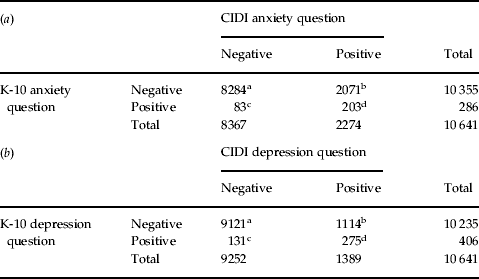
Only the 286 respondents who responded positively to the K-10 anxiety question were considered in the analysis concerning anxiety and only the 406 respondents who responded positively to the K-10 depression question were considered in the analysis concerning depression. Patterns of response to the K-10 and CIDI anxiety and depression questions are shown in Table 1(a, b) respectively. Note that the CIDI questions concerned a 12-month period and therefore generated more positive responses.
Cross-tabulation of numbers of positive and negative responses to (a) selected K-10 and CIDI anxiety questions and (b) selected K-10 and CIDI depression questions
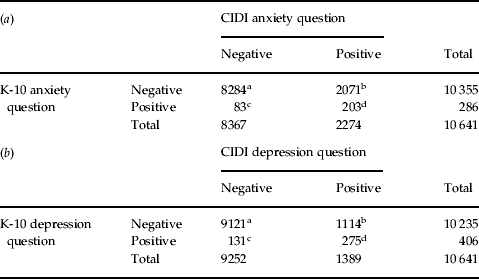
Superscript letters a–d denote table cells.
Our analyses concern only respondents who responded ‘yes’ to K-10 (Table 1, cells c and d). Within these restricted classes, agreement (yes/no) with the related CIDI screen question was taken as the dependent variable. Covariates in the regression equation included age (18–44, 45–64, ⩾65 years), gender, country of birth (English speaking; non-English speaking), educational qualification (none or basic; skilled or tertiary) and self-rated health (excellent to good; fair to poor). Covariates were entered simultaneously in the regression equation. MMSE scores could not be used as the test was not administered to all respondents.
Results
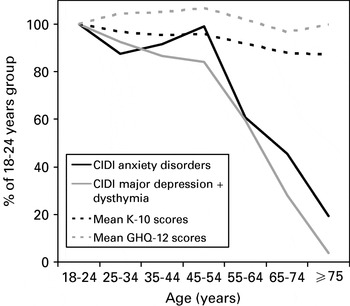
Mean K-10 scores fell from 15.2 (s.d.=5.1) in the age group 18–24 years to 13.2 (s.d.=3.9) in the ⩾75-year band, a difference of 2.0 points out of a maximum of 50. Fig. 1 maps K-10 scores, GHQ-12 scores and ICD-10 disorders across the lifespan, using age band 18–24 years as the index group. For respondents aged ⩾75 years, 12-month prevalence rates were 19.2% of those in the index group for ICD-10 anxiety disorders and 3.7% for major depression and dysthymia. K-10 showed much less change. For respondents aged ⩾75 years, mean scores were 87.0% of those in the index group.
The 12-month prevalence of CIDI-diagnosed ICD-10 anxiety and depressive disorders, and mean scores on K-10 and GHQ-12, as a percentage of the index age group 18–24 years.

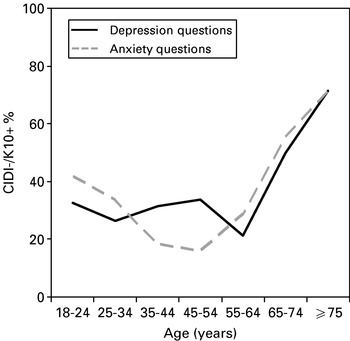
Of the 286 respondents who endorsed the K-10 item ‘In the past four weeks, about how often did you feel nervous?’ as ‘all or most of the time’, 83 denied the CIDI anxiety screen question ‘In the past 12 months, have you had a period of a month or more when for most of the time you felt worried, tense or anxious about everyday problems such as work or family?’ Disagreement rates (CIDI–/K10+) increased from 29% in the 55–64 years band to 71% in those aged ⩾75 years (Fig. 2).
Disagreement rates (%) between K-10 and CIDI anxiety and depression questions.

On logistic regression analysis, disagreement rates were significantly higher for the age group ⩾65 years [odds ratio (OR) 1.61, 95% confidence interval (CI) 1.07–2.44, p=0.02] and for those in good health (OR 2.34, 95% CI 1.33–4.11, p=0.003). Gender, country of birth and education made no significant contribution.
Of the 406 respondents who endorsed the K-10 item ‘In the past four weeks, about how often did you feel depressed?’ as ‘all or most of the time’, 131 denied the CIDI depression screen item ‘In the past 12 months, have you had two weeks or longer when nearly every day you felt sad, empty or depressed for most of the day?’ Disagreement rates (CIDI–/K10+) increased from 21% in the 55–64 years band to 71% in those aged ⩾75 years (Fig. 2). On logistic regression analysis, the findings for age were OR 1.50 (95% CI 1.09–2.05, p=0.01). Other variables played no significant role.
Discussion
The National Survey has met its objective of generating interest in the prevalence and consequences of mental disorder in Australia. Its findings are shaping public policy and it is important to subject them to critical analysis because errors of fact or interpretation could have onerous consequences.
Although a decline in mental disorder with age makes sense, its rate may be exaggerated by dint of the length and complexity of structured mental health surveys. It is possible that aged respondents reply ‘no’ to questions when they exceed a certain, individually determined level of complexity. We cannot prove this, of course, but our hypothesis is supported by the observation that older people were more likely than younger ones to give answers to simple questions that failed to match their answers to convoluted questions concerning anxiety and depression (this trend might have been greater still had not low scorers on the MMSE been excluded). It also helps to explain why scores on K-10 and GHQ-12 showed much less attenuation with age than CIDI-generated psychiatric diagnoses.
Additional support for our hypothesis comes from a small, carefully controlled experimental study in which 31 older respondents endorsed CIDI depressive symptoms just as frequently as 32 younger ones but were more likely to attribute their symptoms to physical illness, thus reducing the likelihood of qualifying for a depressive syndrome. On regression analysis, physical attribution was associated more with reduced working memory than with age or objective markers of physical ill-health (Knäuper & Wittchen, Reference Knäuper and Wittchen1994). If this finding is upheld in larger naturalistic and experimental studies, and in various clinical and cultural contexts, it will be important to reflect on ways in which structured interviews can be made more ‘age friendly’.
Our analysis is limited. K-10 and CIDI questions do not tally exactly, especially in time-frame, and our match of questions is approximate. Alternative explanations for the rise in inconsistency of responses with age include fatigue (the mental health scales were administered earlier in the interview), a cohort effect (e.g. lower levels of psychological introspection in earlier generations) and reduced salience. In addition, it is likely that some younger people (e.g. those with limited language skills) will find CIDI a greater challenge than older people do.
We had expected to find that education and language skills also contributed to rates of inconsistency but this proved not to be the case, perhaps through lack of statistical power. People who rated their health as ‘good to excellent’ were more likely to respond differently to simple and complex questions about anxiety but not depression, perhaps because those in poor physical health are so chronically anxious that symptoms remain to the front of their minds, irrespective of the complexity of the questions put to them.
The fact that scores on K-10 and GHQ-12 show limited change with age sends a warning not to ignore the symptoms and disability experienced by older people as a result of anxiety and depression. Both scales have robust psychometric properties and show close convergence with DSM and ICD diagnoses in younger adult age groups. There is a good argument for including at least one such scale in epidemiological surveys.
Declaration of Interest
None.