Introduction
Worldwide many people with mental illness related disability have little or no access to supportive systems that provide talking therapies, pharmacological and/or social assistance (World Health Organisation, 2005). Although such disabilities are difficult to define, many such people live in conditions outside the purview of the local, national or international communities. In many countries, laws facilitate exclusion and stigmatization against people with disabilities. In 2006, the United Nations General Assembly adopted the Convention on the Rights of Persons with Disabilities (CRPD) (United Nations, 2006). This Convention represents a paradigm shift in the perspective on human rights for people with disabilities, and it uses a social model of disability, one that sees disability as not something which a person embodies but rather as one variation on the spectrum of human experiences. The Convention is based on the view that people are not disabled, but it is society that fails to enable them. As such, individuals are seen not as recipients of charity but as subjects of human rights who are entitled to assert their rights autonomously and where needed, with reasonable accommodation or support by others. The Convention also makes clear that its provisions extend to people with mental health problems as well as people with intellectual disabilities (Article 1 CRPD). Although the CRPD does not include any new rights, it does explicitly define the protections and entitlements for the estimated 800 million people with disabilities worldwide (Mont, Reference Mont2007). The CRPD served as the normative framework for the development of the Institutional Treatment, Human Rights and Care Assessment (ITHACA) Toolkit. This toolkit is developed at a time when a series of initiatives have produced related assessment methods including DEMoBINC (Killaspy, Reference Killaspy, King, Wright, White, McCrone and Kallert2009), QuIRC (Killaspy, Reference Killaspy, White, Wright, Taylor, Turton and Schutzwohl2011) and QualityRights (World Health Organization, 2012).
The regulatory bodies within each European country vary widely and are beyond the scope of this paper. However, various mechanisms exist within Europe to monitor and document the human rights of people in psychiatric and social care institutions, including the right to health (Bartlett et al. Reference Bartlett, Lewis and Thorold2006; Council of Europe, 2009). The Committee for the Prevention of Torture (CPT) and Inhuman or Degrading Treatment or Punishment is a body of the 47-member organization, the Council of Europe. The CPT visits the States each year and carries out a mission during which it monitors several places of detention including prisons, police stations and psychiatric and social care institutions. Its mandate is to prevent torture and other forms of ill-treatment. After each visit, it writes a report to the relevant government on its findings. The government may authorize publication of the report, and if this happens the report is uploaded to the CPT's website (see http://www.cpt.coe.int/en/). Governments may issue a response. Some European countries have ratified the optional protocol to the UN Convention against Torture, which obliges the States to establish a national preventive mechanism independent of the government to carry out visits to places of detention. Little information is available on the coverage, in terms of psychiatric and social care institutions and the effectiveness of these mechanisms (Niveau, Reference Niveau2004). The European Court of Human Rights has ruled on several seminal cases involving human rights violations in psychiatric facilities. Most notably are Shtukaturov v. Russia 2008 and Kucheruk v. Ukraine 2007. In order for the cases to be heard at this level, all local and national legal avenues must be exhausted. This makes litigation and advocacy through these mechanisms a lengthy and arduous process. More localized and immediate mechanisms are needed to introduce real change in a system that can oftentimes be rife with violations and poor practice.
There is now a clear impetus to build the effectiveness of independent human rights monitoring. Paul Hunt, the former UN Special Rapporteur on the right of everyone to the enjoyment of the highest attainable standard of physical and mental health, has pointed out, ‘[a] lack of monitoring of psychiatric institutions and weak or non-existent accountability structures allow these human rights abuses to flourish away from the public eye’ (Hunt, Reference Hunt2005; Hunt & Mesquita, Reference Hunt and Mesquita2006).
Methods
This project, co-funded by the European Agency for Health and Consumers of the European Commission, was implemented by a consortium including 15 countries (Austria, Belgium, Bulgaria, Czech Republic, Finland, Germany, Hungary, Greece, Italy, Lithuania, The Netherlands, Romania, Slovakia, Turkey and UK). The project began in May 2007 and was completed in April 2010. All the collaborators provided feedback on the toolkit structure, methods and content. Each country conducted monitoring visits to collect information on the human rights and general health care conditions in Europe to test the feasibility of the toolkit.
Toolkit development
The toolkit is available for download from the project website (www.ithacastudy.eu), and it was developed directly with relation to the CRPD framework and is also informed by the Right to Health Framework as set out in Article 12 ‘The right to the highest attainable standard of health’ of the International Covenant on Economic, Social and Cultural Rights (Office of the United Nations High Commissioner for Human Rights, 1966). This framework refers to the following key criteria to monitor the extent to which rights are being protected, respected and fulfilled. Availability explores whether the programme or service is available or open to the entire population. Accessibility explores whether it is geographically convenient and easily accessible, economically feasible for the average consumer or client. It further determines whether the information regarding the service or programme is freely available and accessible without discrimination. Acceptability further investigates whether these services or programmes are appropriate, culturally congenial and acceptable to people regardless of ethnicity, race, religion, sex, sexuality or other prohibited grounds of discrimination. The final aspect explores whether these programmes are of good quality and how that is measured, monitored and evaluated over time.
Consultation with service users
From March to July 2008, 15 focus groups were organized in 15 countries, gaining the perspectives of 116 individuals with a range of experiences in psychiatric care. They were invited on the basis of their expertise through experience to discuss what they felt were the necessary issues to cover with regard to human rights and health care as well as to feedback on the first draft of the toolkit. The topics discussed included perspectives on human rights, perspectives on general health care, feedback on the ITHACA tool and advice for conducting monitoring visits. The focus groups with service users provided rich insights into the varied experience of human rights and general health care across Europe. Some of the issues raised and direct quotes are listed in the results below.
The outcome of these discussions provided an important and enlightening perspective to the development of the toolkit. A social science researcher with a personal experience of receiving institutional psychiatric treatment (Russo) was in charge of developing the topic guide, facilitating three focus groups, performing the qualitative analysis and issuing the report on the outcomes. The remaining focus groups were facilitated by local researchers employed on the ITHACA project. This participatory approach was purposely chosen to ensure the input of those best informed on the most salient issues for their particular local context. The analysis was conducted using English translation of the transcripts with the help of NVivo software (Version 2). Beyond its task to inform the ITHACA project, the report of the focus groups' outcomes offers a valuable source for any empirical research on human rights in psychiatric care. The participants in these focus groups ranged across the 15 sites. Some were recruited through psychiatric facilities, while others were recruited through user groups or local support networks. Exclusion and inclusion criteria, as such, were not explicitly outlined because of the variable contexts across Europe. The intention of the focus groups was to capture the range of experiences and opinions across the 15 countries represented. As such, these focus groups were recruited through mechanisms most appropriate for the given site.
Human rights monitoring training
In 2008, a training meeting was held in Budapest led by the Mental Disability Advocacy Centre (MDAC) and the Institute of Psychiatry. A leading human rights expert, psychiatrist and Member of the European CPT was one of the trainers. The training focused on the principles and methods involved in the monitoring of psychiatric and social care institutions. The training prepared participants to monitor institutions with the (at that time first draft of the) ITHACA Toolkit; introduced and allowed participants to practice interviewing, observational and document-review skills necessary to carry out effective human rights monitoring; fostered a deeper insight into the complex nature of human rights; encouraged a network of support and exchange between local and international collaborators; taught the necessary background material to carry out monitoring visits and engaged participants in discussions with people from different perspectives and backgrounds.
Using the Toolkit
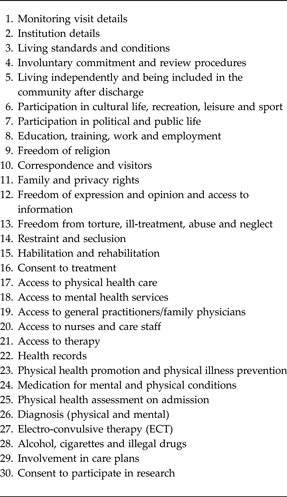
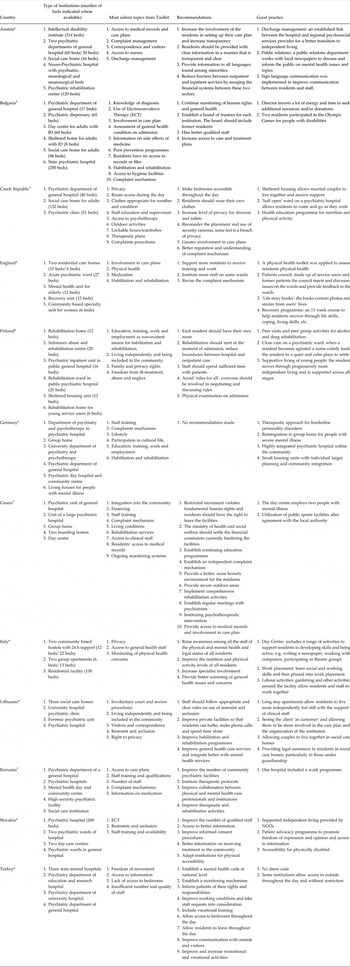
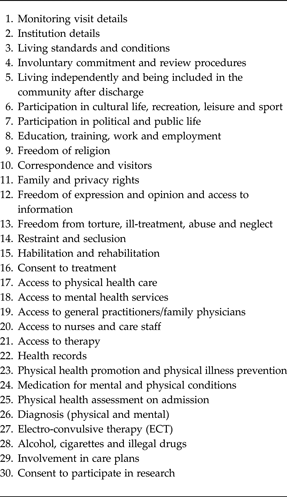
The toolkit is divided into nine sections referring to: aims, what are human rights, what is general health care, why conduct human rights monitoring, principles of human rights monitoring, methods of human rights monitoring, steps in conducting human rights monitoring, a guide to the ITHACA Toolkit prompt questions and the prompt questions for monitoring visits. These prompt (aide memoire) questions cover 30 topics as specified in Table 1 below, where these topic headings are directly grounded in the sections of the Convention on the Rights of Persons with Disabilities (CPRD). The toolkit is written for human rights monitoring teams, which should include a service user, a health care practitioner and a person with a human rights background. The toolkit also states that human rights monitoring requires familiarity with the international human rights standards, the various topics to be addressed, the methods of gaining information in an institutional setting and the principles of human rights monitoring – including regular monitoring, demonstrating independence from the service being visited, not doing harm and collecting credible data. Applying rapid ethnographic assessment techniques (Trotter et al. Reference Trotter, Needle, Goosby, Bates and Singer2001), the toolkit requires the monitors to enter an institution and rapidly but effectively uncover how the institution works, who has power and who does not, and to bring together the experiences of the staff (clinical and support) with those of the clients or service users. For example, if discussing the issue of food, what do the clinical staff say, what do support staff say and what do the service users and family members say and where are they in agreement or disagreement? Indeed, if families are estranged, their whereabouts unknown, or not consulted then these may also be human rights issues.
Topics covered in the ITHACA Toolkit prompt questions
The overall procedures is set according to the following 10 steps: (1) set objectives for monitoring; (2) build the monitoring team; (3) train the monitors; (4) gather background information; (5) plan the visits; (6) carry out the visits; (7) write the report; (8) disseminate the report; (9) evaluate the process and (10) plan future visits. The method of conducting monitoring, therefore integrates three types of data (i) interviews with staff and with residents (separately); (ii) observation of the institutional setting and (iii) review of relevant documentation.
To conduct the monitoring visit each team must meet before the visit and roughly divide the tasks for the day of the visit. All monitors should be familiar with the institution to be monitored and should have conducted as much background research as possible on the institution. Arguably, the gold standard for human rights monitoring is to conduct a several day visit that is unannounced, appreciating that this may not always be possible and that important information can be collected in announced visits as well.
During the visit, the monitoring team should try to cover all topics covered in the toolkit but should have a degree of flexibility to follow the topics that are most important to the residents and/or staff who work there as well as any gross negligence, violations or good practice. The questions outlined in the toolkit are to be used as prompts for inquiry and not as specific questions all of which need to be asked. Rather they are aide memories to ensure that all the key areas of enquiry are considered by members of the monitoring team. The monitors should use all their senses when conducting monitoring: combined, they need to see, hear, smell, touch and taste. They need to triangulate information to gain the perspective of patients/residents, management, clinical and support staff and families or their proxies.
The monitors should ask questions, listen, follow up with more probing questions, ask to see documentation, make observations and absorb the circumstances they are witnessing. Directly following the visit, each monitor should write and reflect on their findings and prepare the notes in as much detail as possible. The team should then meet and discuss their findings and reflections. The process of identifying the key issues with respect to both human rights observation (good practice) and human rights violations (poor practice) is carried out by the monitoring team. This is based on the data gathered from all sources, examines the extent to which any concerns identified can be verified and uses the different perspectives, expertise and experience of the members of the review team to form judgements on where the concerns need to be identified, and the specific evidence available to justify each issue raised as any such point may be challenged by the organization concerned. Specifically, during the staff interviews, staff are asked to indicate why they consider their institutions to be examples of good practice (related to human rights) in their institution. The information is then compiled in a report that outlines the process of the monitoring visit, the findings for each of the topics and any recommendations or suggestions with relation to identified good or poor practice. The findings should be discussed in the final report that outlines the process of the visit as well as the outcomes and findings of the visit. These reports are then made public to draw attention to problem areas as well as better practice.
Results
Focus groups
The selection of the statements below illustrates the range of experiences and perspectives on this topic in Europe:
‘If you're admitted to a hospital, you are not able to see your rights […]What rights are you thinking of? The right to smoke, right to take a bath, receive visitors, the right to spiritual care and social work. And very important is the right to freedom. You must work hard to earn that back’. Netherlands
‘What do I think of when I think of human rights? For me one of the key issues was forced medication. I don't know enough about human rights legislation really and I wonder how much the staff on acute wards or in any settings do. I wonder very much’. UK
‘I think that it is very important that patients know rights, at least those indicated in the mental health laws, and see them implemented, i.e. how the staff follows them. For instance, there is a rule that it is forbidden to restrain someone longer than for 2 hours without the break. From my own experience, I can testify that this rule is not followed. I was kept in restraint for the whole night, and the whole day. So, the staff itself badly knows the rights’. Lithuania
‘I was told, you know, unless you take this medication there's nothing we can do for you, you know, you'll just have to leave and […] I just find the whole totally dehumanising really and it has only really hit me, you know I think I have been really affected by the system even more than actually my own traumas have affected me’. UK
‘Briefly speaking, there is no way to describe what is happening in our psychiatric services otherwise than calling it genocide against personality’. Bulgaria
With relation to human rights, across all the focus groups the three main areas of concern were: treatment methods, interaction with the institution staff and access to information. Some treatment methods or interventions were perceived as violation of human rights (such as detention, forced pharmacological treatment, involuntary electro-convulsive therapy (ECT), physical restraint and seclusion). Of equal importance to service users was scarce communication with the staff or their attitude towards patients. Furthermore, the lack of information about diagnosis and treatment, about one's own rights as well as available complaint mechanisms was raised as a human rights issue. Although socio-economic differences among countries did define some of the issues addressed (such as the issues of privacy and amount of personal space and places to secure one's own belongings) most themes remained consistent regardless of the socio-economic context.
General health concerns
With regard to the composition of the monitoring teams, participants felt it was important for service users to be employed because of the unique perspective their experiences within the psychiatric services bring and this is particularly true when discussing general health care. The quotes below highlight some of the themes generated in the focus groups: availability, being taken seriously, staff competence, institutional rules and living conditions and smoking and weight gain.
‘When I went to the hospital I was so healthy, when I left it, I was ill’. Hungary
‘I came to the hospital with some let's say problems like mental, physical problems, health problems but I left with worse ones’. Slovakia
‘Always used to be the saying – about the worst place to have a cold is in a psychiatric acute ward’. UK
‘If, by any chance, you'll get cold there, get a kidney crisis or some other physical malady, which is not directly connected to the psychic one, you are at the death's door. For sure you are at the death's door’. Bulgaria
‘I remember quite often being admitted and not ever having any physical check-up at all. And I think that may happen quite a lot particularly if people are coming in on section […] and brought in by the police or whatever. I think it's quite, quite often that the initial physical check-up doesn't actually happen’. UK
‘Psychiatry paves the way to excessive smoking. Enormously. Terrible. Because you only get… when you're in a closed regime, you have only two rooms to sit in: one regular room and one smoking room. And then you meet people and sometimes more people who smoke and then you sit together the whole time and you smoke more and more. And yes that's actually really bad. There's sometimes nothing else to do’. Belgium
‘Within the framework of the one's whole therapy and due to medication one has many occasions where one has to sit for a long time. This is also a reason why many patients then tend to put on weight. I think this is not something inevitable. I find that one should look out for something like some sport or some physical activity. I also think that it is necessary for the therapy and putting on weight is harmful’. Germany
Monitoring visit results
Our 87 visits included monitoring of institutions from a six-bed hostel facility in Italy to a large psychiatric hospital in Austria with 670 beds, and the ITHACA Toolkit was therefore used with relation to residents in institutions with a wide range of conditions across Europe. The data collected through the monitoring visits demonstrate the need for further monitoring of these institutions not only to expose and prevent violations and inadequacies but also to identify and share in better practice. Table 2 provides a summary of the types of institutions visited, the salient issues in each context and the key findings for better practice across all sites. For reasons of local approval, the visits presented here include some countries that were only able to test the general health care component of the toolkit. Some collaborators were not able to gain access to institutions to monitor human rights due to their status or relationship with those organizations and institutions.
Summary of main findings from monitoring visits conducted using the ITHACA Toolkit
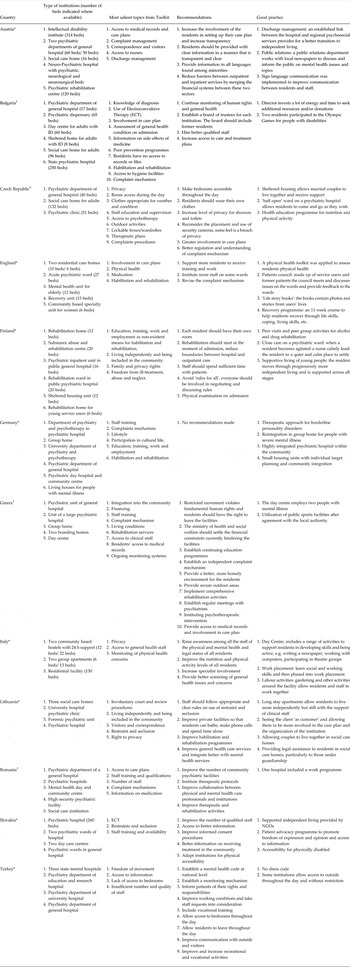
* General health care and human rights assessment completed.
† General health care assessment only.
Data were not available for Hungary.
Discussion
The international, interdisciplinary project produced a comprehensive yet flexible toolkit to monitor human rights and general health care across a range of contexts. The toolkit draws on the skills and strengths of a range of disciplines. With relation to capacity building and service user involvement, throughout this project, service users actively engaged in the development, evaluation and utilization of this toolkit. Their involvement was imperative to the development of a toolkit that can assess the reality of those living in or being treated in psychiatric care systems. In this capacity and through structured activities including the focus groups, researcher training and monitoring visits, a new group of service user researchers have been engaged, trained and energized (Sayce & O'Brian, Reference Sayce and O'Brian2004). As one of the service user researchers from Finland states, ‘The experience has been very rewarding and we have learned a lot. The starting point was to combine human rights monitoring with trying to have an effect on developing the services as well…I am even more convinced that it is really necessary to have users monitoring, evaluating and researching’.
This project had several limitations. Of all the 15 sites, four were unable to test the human rights component of the Toolkit as this necessitated making the findings publicly available which they were not willing to do, as they were either employed or otherwise had a close relationship with the institution(s) which were to be monitored. In other countries, e.g. Finland, monitoring results were published and led to improvements in human rights of residents in the institutions monitored (Salo, Reference Salo2010). The aim of the project was not to perform international comparisons, but to examine, document and comment on human rights, with relation to international standards and develop a participatory and service user led toolkit. Longitudinal monitoring with the ITHACA Toolkit in future will show whether human rights conditions and access to health care improves over time in Europe. The institutions in this project were not selected to be representative for all such institutions within or across countries, but to include a mixed selection of large and small health and social care facilities for the purpose of establishing the feasibility of the toolkit. Furthermore, the pragmatic nature of the project was reflected in the fact that not all sites followed the training and manual instructions precisely: one site simply used the toolkit prompt questions without referring to the manual. Another limitation of the development of the toolkit is that the training meeting provided human rights training only and not training on the general health care part of the toolkit, the content of which was finalized at a later point. It is also quite often the case that non-availability of data is a limiting factor, for example key staff who are not available for interview on the day of the monitoring visit, or poor or missing documentation. It could be considered a limitation that the identification of the human rights issues in each monitoring visit is the product of the judgements of the monitoring group members, working together, based upon their experience and the verifiable evidence for each concern.
Recommendations
Based on the experience of the ITHACA staff in data collection from all 87 monitoring visits, we recommend that European Union (EU) Member States: (1) align laws and policies to bring them into compliance with the CRPD; (2) ratify the CRPD; (3) ensure that all facilities and programmes designed to serve persons with disabilities are effectively monitored by independent authorities (see Article 16(3) of the CRPD); (4) ensure that persons with disabilities and their representative organizations are involved and fully participate in the monitoring process (see Article 33(3) of the CRPD) (Mental Disability Advocacy Center, 2011 17046/id); (5) ensure that people with disabilities, and their representative organizations, are actively involved in the development and implementation of legislation and policies to implement the CRPD (see Article 4(3) CRPD); (6) ensure that resources are made available to fully implement the CRPD and to ensure good quality general health care, for example, by the progressive development of community-based services, consistent with Article 19 of the CRPD and the 2005 Helsinki Mental Health Declaration and Action Plan for Europe (World Health Organisation, 2005; Thornicroft & Rose, Reference Thornicroft and Rose2005).
For clinical and social care staff we recommend that, among other activities, they co-operate with independent human rights monitoring bodies to: (1) advocate that their national policy makers ratify and implement the CRPD; (2) develop, use and improve monitoring systems, for example, the ITHACA Toolkit with continuing input and development from service users (Sweeney et al., Reference Sweeney, Beresford, Faulkner, Nettle and Rose2009); (3) support local advocacy and support groups for service users; (4) support the development of mental health care that progressively develops community based services (Thornicroft et al., Reference Thornicroft, Alem, Antunes Dos, Barley, Drake, Gregorio, Hanlon, Ito, Latimer, Law, Mari, McGeorge, Padmavati, Razzouk, Semrau, Setoya, Thara and Wondimagegn2010).
For service users and carers/family members we recommend that they: (1) speak out about observed and known human rights violations; (2) collaborate with non-governmental organizations, governments, international bodies and monitoring organizations to gain access to, and participate in monitoring institutions; (3) ensure that the results of the monitoring visits are disseminated to those who are in positions to enact improvement in policy and/or care provision; and (4) petition local, national and international bodies to protect, respect and fulfil human rights.
Finally, the development and initial implementation phases of the ITHACA Toolkit, as briefly described here, and in more detail in the full toolkit (www.ithacastudy.eu) have shown that the CPRD can be used as the framework for a practical method of data collection related to human rights of people with mental health problems, and that this method can be successfully applied in institutions to gather, collate and report upon specific good and poor practices that can be used as a guide for mental health service improvement.
Acknowledgements
The ITHACA project was funded by the European Union, in the framework of the Public Health Programme. DR and GT are members of the NIHR Biomedical Research Centre at the South London and Maudsley NHS Foundation Trust/Institute of Psychiatry (Kings College London), and receive support for an Applied Research Programme from the National Institute for Health Research, UK. GT is an Honorary Professor at the University of KwaZulu Natal in Durban. The ITHACA Project and the development of the Toolkit was led by staff in five centres: Institute of Psychiatry, King's College London, England: Graham Thornicroft, Jennifer Randall, Tamara Shaw, Diana Rose (responsible for project co-ordination). Ludwig Boltzmann Society, Institute for Social Psychiatry, Vienna, Austria: Heinz Katschnig, Gisela Hagmair, Livia Mutsch, Christa Strassmayr, Gabriele Niedermayer, Traude Izaak (responsible for project dissemination). Mental Disability Advocacy Center, Budapest, Hungary: Oliver Lewis, Csilla Budai, Jasna Russo, Anna Hornyik (responsible for developing the human rights elements of the Toolkit) Section of Psychiatry and Clinical Psychology, University of Verona, Italy: Lorenzo Burti, Antonio Lasalvia, Sara Bernardelli, Elisa Berti, Irene Fiorini, Massimo Garatti, Cinzia Papa (responsible for developing the general health care elements of the Toolkit) National Institute for Health and Welfare, Helsinki, Finland: Susanna Hietala, Jukka Hiissa, Matti Järvelä, Hannu Lindholm, Anne-Marita Ruuska, Kaisa Saavalainen, Sarianna Sallamaa, Markku Salo, Tom Stenman, Raimo Urpilainen, Kristian Wahlbeck. In addition the following European partners collaborated in the ITHACA Project: Belgium Chantal Van Audenhove, Marian De Groof, Sofie Taeymans, Else Tambuyzer. Bulgaria Valentina Hristakeva, Dimitar Germanov Czech Republic Barbara Wenigova, Pavla Selepova, Jan Stuchlik, Michal Balaban. Germany Harald Zaske, Maria-Adelheid Stelzner Greece Marina Economou, Eleni Louki, Eleonara Kanellopoulou, Maria Charitsi, Natassa Vasilaki. Lithuania Arunas Germanavicius, Dovile Juodkaite, Giedrius Sadzevicius. Netherlands Jaap van Weeghel, Judith Hasker, Annette Plooy. Romania Radu Teodorescu, Iuliana Radu, Claudia Damian, Moraru Ortansa. Slovakia Janka Hurova, Peter Lalik. Turkey Alp Ucok, Serap Serbest, Gulsah Karaday.
Declaration of Interest
This publication arises from the project ITHACA, which has received funding from the European Union, in the framework of the Public Health Programme. The authors have no conflicts of interest to declare.