Introduction
Hoarseness is a term often used by patients to describe changes in their voice quality. The American Academy of Otolaryngology–Head and Neck Surgery Foundation guideline defines hoarseness or dysphonia as a disorder characterised by altered vocal quality, pitch, loudness or vocal effort, which impairs communication or reduces voice-related quality of life.Reference Schwartz, Cohen, Dailey, Rosenfeld, Deutsch and Gillespie 1 Hoarseness is a common symptom affecting up to one-third of patients at some point in their lives.Reference Schwartz, Cohen, Dailey, Rosenfeld, Deutsch and Gillespie 1 In the UK, approximately 50 000 patients with voice problems are referred to ENT departments every year.Reference Carding 2
There are a variety of aetiologies for hoarseness. It is often caused by benign or self-limiting conditions such as voice over-use or gastroesophageal reflux disease.Reference Ulis and Yanagisawa 3 A recent study suggested that up to 55 per cent of patients with hoarseness have laryngopharyngeal reflux.Reference Hopkins, Yousaf and Pedersen 4 However, hoarseness may also be the presenting symptom of a more serious and progressive condition such as malignancy.Reference Rosen, Anderson and Murry 5 Differentiating subtle vocal fold pathologies and treating often ill-defined voice disorders remains a challenge.
We report a rare case in which a patient's hoarseness was caused by haemodialysis.
Case report
A 62-year-old man was referred to the ENT clinic by his general practitioner. He presented with a two-month history of chronic, intermittent voice hoarseness related to the onset of haemodialysis. He had suffered renal failure secondary to hepato-renal syndrome and acute tubular necrosis, and thus required three sessions of haemodialysis a week. He described the onset of hoarseness at the end of each dialysis session, which persisted until just before the next dialysis session.
The patient was a non-smoker and had comorbidities including atrial fibrillation and alcoholic liver disease. He had never suffered any hoarseness prior to the commencement of haemodialysis. He had not undergone previous head or neck surgery and was not taking any medication that could alter his voice.
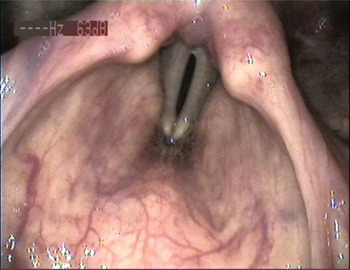
Fibre-optic nasendoscopy performed after a dialysis session showed incomplete glottis closure due to bowing of the vocal folds (Figure 1). Both vocal folds appeared thin. There were no vocal fold lesions, paralysis, laryngeal mass or signs of laryngopharyngeal reflux. There was no cervical lymphadenopathy on examination. The patient's Voice Handicap Index was 32. A computed tomography scan of the neck and thorax found no physical cause for the patient's hoarseness.
Pre-operative nasendoscopic photograph showing vocal fold bowing on vocal fold adduction.

A diagnosis of hoarseness secondary to haemodialysis was made.
The patient underwent speech therapy for a period of three months, with little improvement. Discussion with the renal physicians concluded that it was not possible to make any changes to the patient's dialysis regime in order to give his voice a chance to recover.
The patient subsequently underwent injection laryngoplasty with calcium hydroxylapatite, (Radiesse; Lambsmead Limited, Thames, Surrey, UK.) to both vocal folds, under local anaesthesia.
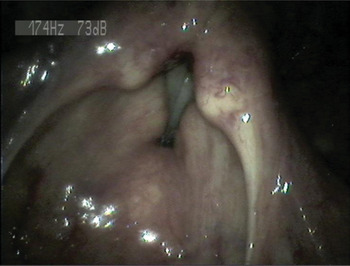
He was reviewed 10 days following injection laryngoplasty, and reported marked improvement in his voice. His Voice Handicap Index after the procedure was 10. He reported no further voice fluctuation before or after haemodialysis. Further review after three weeks, three months and six months showed sustained voice improvement. Repeated nasendoscopy showed complete glottis closure on adduction (Figure 2).
Post-operative nasendoscopic photograph showing complete glottis closure.

Discussion
Haemodialysis is an unusual cause of hoarseness. However, there appears to be a plausible explanation for this occurrence. Haemodialysis is a process of waste and excess fluid removal. Post-dialysis symptoms such as dizziness, fatigue, muscle cramps and headaches are well documented, and are associated with the volume of fluid removed.Reference Fisher, Ligon, Sobecks and Roxe 6
Systemic dehydration has been known to affect phonation.Reference Solomon and DiMattia 7 , Reference Verdolini, Min, Titze, Lemke, Brown and van Mersbergen 8 In a double-blinded, placebo-controlled trial, Verdolini et al. induced systemic dehydration in patients taking diuretics, and found a 23 per cent phonatory threshold pressure increase from baseline.Reference Verdolini, Min, Titze, Lemke, Brown and van Mersbergen 8 Yurdakok and Ozmert also noted that dehydration causes a weak and hoarse cry in babies.Reference Yurdakok and Ozmert 9 In a study involving vocally untrained adults, Solomon and DiMattia showed that increased systemic hydration delayed voice fatigue.Reference Solomon and DiMattia 7
In an observational study by Ori et al., the incidence of post-dialysis hoarseness was as high as 60 per cent.Reference Ori, Sabo, Binder, Weinstein, Korzets and Ori 10 In an effort to demonstrate the mechanism of this occurrence, these authors measured the vocal fold thickness of patients before and after haemodialysis, and found that up to 72 per cent of patients had reduced vocal fold thickness after haemodialysis. Ori and colleagues postulated that dialysis caused dehydration of Reinke's space, thereby affecting vocal fold thickness and the patient's voice. However, these authors could not demonstrate a significant association between dry weight, blood pressure and the occurrence of hoarseness, owing to their limited sample size.
-
• Hoarseness associated with haemodialysis is poorly understood
-
• Preliminary studies suggest it may be due to fluid shift from Reinke's space during fluid removal
Fisher et al. also studied the effect of dialysis on patients’ phonatory effort.Reference Fisher, Ligon, Sobecks and Roxe 6 Participants with renal failure underwent ultrafiltration and were brought from a hypervolaemic to a grossly normovolaemic state. Following volume reduction, these patients experienced increased phonatory threshold pressure. From this study, it was deduced that patients’ hoarseness was caused by a fluid shift from the extracellular matrix of the vocal folds, rather than by systemic dehydration. Fisher et al. postulated that this process was mediated by the autonomic nervous system.
For most patients, hoarseness tends to resolve a few hours after haemodialysis.Reference Ori, Sabo, Binder, Weinstein, Korzets and Ori 10 However, for our patient the problem was more persistent, requiring intervention in the form of injection laryngoplasty with calcium hydroxylapatite.
Injection laryngoplasty was an ideal interim intervention for our patient, given that its effect is lasting but not permanent. Studies have demonstrated that the effect of calcium hydroxylapatite injection laryngoplasty lasts for between 12 and 24 months.Reference Kwon, An, Ahn, Kim and Sung 11 , Reference Rosen, Gartner-Schmidt, Casiano, Anderson, Johnson and Remacle 12 In our patient, injection laryngoplasty was performed under local anaesthesia, thereby avoiding the extra risks of general anaesthesia due to his multiple comorbidities. The procedure is a temporary intervention as the injection material is absorbed over time. However, this has the advantage of allowing time for vocal fold recovery and re-examination, before subjecting the patient to a more permanent procedure such as thyroplasty.
Conclusion
There is very limited literature on hoarseness caused by haemodialysis. More research is required to examine the pathophysiology of hoarseness associated with haemodialysis, and its risk factors. In doing so, strategies may be developed to relieve symptoms and to improve the quality of life of haemodialysis patients. Further research is currently under way to determine the prevalence of this condition and the factors leading to its occurrence.