THE PROBLEM
Morbidity and Mortality
Malaria is a major cause of morbidity and mortality in Mozambique. Approximately 6 million cases are reported each year. Malaria accounts for approximately 40 percent of all outpatient visits and 60 percent of pediatric hospital admissions. It is the leading cause of death among children admitted to pediatric services. Malaria transmission takes place year round with a seasonal peak extending from December to April. More than 18.5 million people in Mozambique are considered to be at-risk of malaria, including an estimated 3.6 million children less than 5 years old and almost 1 million pregnant women (13). The Presidential Malaria Initiative (PMI) -supported Malaria Indicator Survey, conducted in 2007, found the national prevalence of malaria parasitemia among children 6 to 59 months old to be 38.5 percent, with a range by province from 60.4 percent in Nampula to less than 10 percent in Maputo. Among pregnant women, the parasite prevalence was 16.3 percent, with 30.1 percent of women in their first pregnancy demonstrating parasites on blood slides (Reference Mabunda, Casimiro, Quinto and Alonso11).
Since 2006, the Ministry of Health (MoH) declared malaria a national emergency. The national control strategy gives high priority and aims to reducing morbidity and mortality due to malaria in pregnant women and children under 5 years of age by 25 percent by 2010 compared with the 2006 levels. This is to be achieved by scaling up the use of long-lasting insecticidal nets (LLINs), diagnosis including with rapid diagnostic tests (RDTs), and treatment of uncomplicated malaria with the artemisinin combined therapy (ACT)—specifically, artesunate plus sulfadoxine-pyrimethamine (AS+SP)—as the first-line treatment (14).
Weak Health Information System
These alarming figures are incomplete and do not reflect the country-wide situation, due to the weakness of the health information system. Collection of data on outpatient attendance only started in 1998, and most health facilities are not yet included in this system. The cases occurring at the community level are not reported in a consistent and timely manner (13). The National Institute of Statistics and National Institute of Public Health conducted a country-wide survey in 2008 on causes of deaths in children under 14 years old and the results showed that malaria is the leading cause of death in all ages (29 percent). In children under 5 years of age, this figure is as high as 42 percent (16).
Access
Early recognition and treatment of the disease can prevent severe morbidity and mortality. However, this is not always possible in Mozambique where the key challenge for malaria control is the limited access of much of the population to adequate and prompt diagnosis and treatment, as well as to preventive interventions. Currently, treatment is provided mostly by the public sector health services, with coverage limited to roughly half of the population. Access to health services, particularly in rural areas is difficult, with two thirds of the population having to walk more than 30 minutes to arrive at the nearest health facility. The private for-profit sector is developing gradually, especially in large cities, but it is not well regulated and costs represent a barrier to access as 54 percent of people are living in poverty (15). The 2007 survey found that only 4.5 percent of children less than 5 years old with fever had received an ACT within 24 hours of onset of symptoms (13).
Another problem restricting maximum use of the health network by those with malaria is the fact that seeking treatment for children with fever relies upon diagnosis in the home and how a child responds to whatever household treatment is used.
Diagnosis, Case Management With ACT, and Drug Supply
Appropriate diagnosis and management of malaria cases are cornerstones to the Malaria Control Program, as they allow significant reduction of morbidity (duration and degree of complications) and mortality due to malaria. However, effective management of noncomplicated malaria cases may significantly reduce incidence of severe malaria. Appropriate hospital care and appropriate management of malaria cases will lead to a reduction of mortality due to malaria.
In Mozambique, the control of malaria relies largely on treatment with effective, safe, and affordable drugs. To combat the spread of resistance, it was decided to use combinations of antimalarial drugs that include an artemisinin derivative with preparations formulated in a single tablet. However, other combinations and derivatives of artemisinin are still available in the private sector, and consequently the national guidelines often are not followed.
Antimalarial treatment in MoH facilities is free of charge, although patients do have to pay a minimal fee for drugs other than antimalarials, such as paracetamol. MoH lacks a clear policy on user fees, which often vary from one facility to another.
The treatment, when available, in the private sector is not affordable for the majority of the population, although a considerable proportion of the population uses the private sector, including the poor. Several private firms offer workers private health service plans for a monthly fee, increasing the use of private clinics.
POLICY OPTIONS
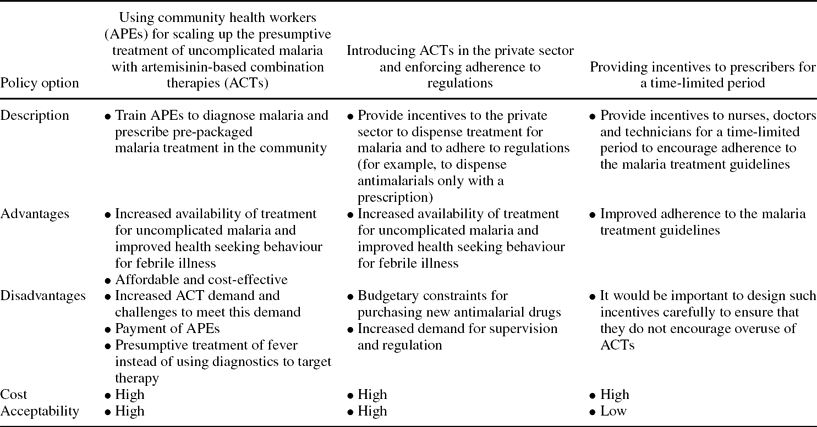
Three policy options that could improve access to ACTs are (i) using APEs for scaling up the presumptive treatment of uncomplicated malaria with ACTs, (ii) introducing ACTs in the private sector and enforcing adherence to regulations, and (iii) providing incentives to prescribers for a time-limited period. These three options are described in Table 1.
Policy options

Using Community Health Workers (APEs) for Scaling Up the Presumptive Treatment of Uncomplicated Malaria With ACTs
As argued by Buchan and Dal Poz (Reference Buchan, Dal Poz, Ferriho and Dal Poz5), skills substitutions, or improving use of available skills, appears to be a practical response to the shortage of human resources. Community health workers act as the first line of contact with the health system in many low and middle income countries (Reference Hongoro and McPake8).
Mozambique had good experience with community health workers during its first years of independence. The increase in training and use of community health workers (APEs and ativistas comunitarios) could improve diagnosis and access to malaria treatment at an earlier stage of the disease, particularly benefiting women and children. There is evidence that the “use of community health workers in maternal and child health programs shows promising benefits compared with usual care or no intervention in reducing mortality in children under 5 years and reducing morbidity from common childhood illness” (Reference Lewin, Dick and Pond10). A large study conducted in Ethiopia found a reduction of 38 percent in the mortality rate of malaria in children under 5 years of age cared for by community health workers and mothers, compared with usual care or no care (Reference Kindane and Morrow9).
Evidence from elsewhere suggests that community health workers enhance the performance of community-level health programs (Reference Buchan, Dal Poz, Ferriho and Dal Poz5) and that they can be cost-effective (Reference Gericke, Kurowski, Ranson and Mills6). Robust evidence shows that community health workers can deliver several interventions (Reference Haines, Sanders and Lehmann7); especially for conditions such as acute respiratory infections, malaria, perinatal care, and neonatal sepsis (Reference Bang, Bang, Baitule, Reddy and Deshmukh1;Reference Bang, Reddy, Deshmukh, Baitule and Bang2;Reference Bhutta, Darmstadt, Hasan and Haws3;Reference Lewin, Dick and Pond10;Reference Sazawal and Black18;Reference Winch, Gilroy and Wolfheim20). At least in some settings, these interventions are cost-effective (Reference Walker and Jan19). Furthermore, there is growing research evidence about the cost-effectiveness of at least some components of primary health care with the participation of community health workers. For example, community participation has been assessed with rigorous designs and has been shown to improve neonatal and maternal mortality in Nepal (Reference Borghi, Thapa and Osrin4;Reference Manandhar, Osrin and Shrestha12).
Introducing ACTs in the Private Sector and Enforcing Adherence to Regulations
Recent years have seen increasing interest in the role of the private sector in health service provision in low- and middle-income countries. The private for-profit sector in Mozambique is small, but is growing fast, particularly in big cities, and the law regulating private medicine is under revision in Parliament. The private sector may be an important source of care for poor and disadvantaged groups in Mozambique. For these reasons, the private sector represents an important potential partner in efforts to scale up coverage of effective health interventions among the poor.
Nongovernmental organizations (NGOs) do not appear to be involved in providing treatment with ACTs currently, although many do work with APEs. The use of the formal private sector for malaria treatment of children in Mozambique is uncommon and concentrated primarily in urban areas, where most private health facilities and pharmacies operate. The number of informal drug sellers is thought to be low, but this has not been systematically assessed. Private pharmacies are regulated by the national Pharmacy Department and must be registered with the MoH to operate. Pharmacies are not allowed by Mozambican statute to dispense antimalarials without a prescription. PSI conducted a survey in private pharmacies in Maputo in 2007, which looked at the availability of antimalarials and prescribers’ reported treatment practices for malaria. This survey showed that artemether-lumefantrine (AL) was not available in private pharmacies in Maputo.
There is sparse evidence of the effectiveness of interventions for working with the private for-profit sector to improve the utilization and quality of health services for the poor (Reference Patouillard, Goodman, Hanson and Mills17). Therefore, implementation of this policy option should be accompanied by rigorous monitoring and evaluation. However, given that the private for-profit sector is growing in Mozambique and is likely to provide care to low-income people with malaria, it is important to enable them to provide effective treatment (ACTs) and ensure that they adhere to guidelines (21).
Providing Incentives to Prescribers for a Time-Limited Period
Providing incentives (training, supervision, and subsidies) to prescribers—including nurses, doctors and technicians—for a time-limited period could help to encourage adherence to the malaria treatment guidelines. It would be important to design such incentives carefully to ensure that they do not encourage overuse of ACTs. However, this option may not be feasible because of financial constraints and health workers are already encouraged to follow treatment guidelines.
IMPLEMENTATION OF THE POLICY OPTIONS
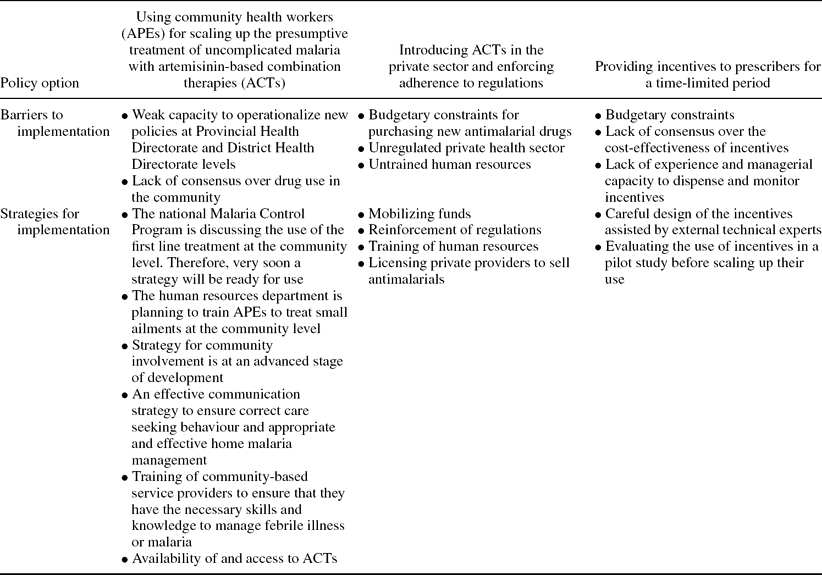
Barriers to implementing the three policy options and strategies for addressing these are summarized in Table 2.
Implementation of the Policy Options
DISCUSSION
New malaria treatment guidelines were released in Mozambique in September 2009. It took a long time to develop these, and it was decided that a policy dialogue should be postponed until after the new guidelines were in place. Therefore, a dialogue to discuss this policy brief is planned for March 2010. However, informal meetings have been held with policy makers from the National Directorate of Public Health and Planning to discuss the policy options. The first option (using APEs) is envisaged in the National Malaria Control Strategic Plan, and they determined that further attention should now be focused on implementation of that option. Their reactions to the second option (introducing ACTs in the private sector) were less positive because of limited resources and concerns about the cost of this option. Their views were that more attention should be given to nonfinancial incentives, training, and supervision. They did not consider the third option (providing incentives to prescribers for a time-limited period) to be feasible in Mozambique.
CONTACT INFORMATION
Francisco Mbofana, MD, MIH (mbofana98@yahoo.com), Chief, Department of Health Systems Research, Instituto Nacional de Saúde, 1008, Eduardo Mondlane Avenue, Maputo, P.O. Box 264, Mozambique
Gertrudes Machatine, MD, MIH (mgertrudes@tropical.co.mz), Director, Planning and Cooperation Directorate, Ministry of Health, Av. Eduardo Mondlane 1008, Box 264, Maputo, Mozambique
Celeste Moreira, MD (celestemoreira48@yahoo.com), Director, Health Woman and Social Welfare Services, Av. 5 of February 812, Matola, Maputo Province, Mozambique