Introduction
The preimplantation development of mammalian embryos is affected by several nutritional and environmental factors. Soluble growth factors and cytokines produced by the preimplantation embryo itself (Rappolee et al., Reference Rappolee, Brenner, Schultz, Mark and Werb1988; Sharkey et al., Reference Sharkey, Dellow, Blayney, Macnamee, Charnock-Jones and Smith1995; Werb, Reference Werb1990) and the epithelial cells of the fallopian tube (Minami et al., Reference Minami, Utsumi and Iritani1992; Sakkas & Trounson, Reference Sakkas and Trounson1990) and of the uterus (Brigstock et al., Reference Brigstock, Heap and Brown1989; Pampfer et al., Reference Pampfer, Arceci and Pollard1991; Sakkas & Trounson, Reference Sakkas and Trounson1990) have been reported to control early embryonic development.
The liver synthesizes and secretes serum and serum fractions, some of which are known to affect the early development of mammalian embryos (Ogawa & Marrs, Reference Ogawa and Marrs1987; Ogawa et al., Reference Ogawa, Ono and Marrs1987; Saito et al., Reference Saito, Berger, Mishell and Marrs1984). However, the effects of substances synthesized by hepatocytes on the development of preimplantation embryos have not been fully elucidated. The effects of medium conditioned with rat hepatoma Reuber H-35 cells were investigated previously and a compound, Fr.B-25, was purified from the Mr <10000 fraction of the conditioned medium (CM) that inhibited the development of mouse zygotes obtained from both 2-cell cleavage blocking and non-blocking strains at the 2-cell stage (Kobayashi et al., Reference Kobayashi, Hirako, Minato, Sasaki, Horiuchi and Domeki1996). Furthermore, it was also reported that Reuber CM had beneficial effects on the in vitro development of mouse 2-cell embryos fertilized and developed in vivo; Reuber CM improved the cell number per embryo and zona hatching (Kobayashi et al., Reference Kobayashi, Hirako, Minato, Sasaki, Horiuchi and Domeki1997). In hepatocyte-derived cells, in addition to Reuber H-35 cells, Yoneda et al. (Reference Yoneda, Okada, Wakayama, Ueda and Watanabe2006) reported that CM from BRL cells fractionated below Mr 30000 supported the development of mouse zygotes obtained from a 2-cell blocking mouse strain, AKR/N.
In this paper, the effect of BRL CM on the development of mouse zygotes obtained from a 2-cell blocking strain, CD-1, was investigated by focusing on the progression of development from the 2-cell stage to the 4-cell stage in comparison with that of CM from rat hepatoma Reuber H-35 cells.
Materials and Methods
Media
M2 (Quinn et al., Reference Quinn, Barros and Whittingham1982) was supplemented with 4 mg/ml BSA (A4378, Sigma Chemical Company) and modified Whitten's medium (WM) (Hoppe, Reference Hoppe and Dixon1985) was supplemented with 3 mg/ml BSA (A7030, Sigma). Phenol red was not added to M2 or WM. Dulbecco's modified Eagle's medium (DMEM) was purchased from Nissui Pharmaceutical.
Embryo collection
Induction of superovulation and subsequent mating of 6- to 12-week-old virgin female CD-1 mice (random bred, Swiss, Charles River Japan) were performed as described previously (Kobayashi et al., Reference Kobayashi, Hirako, Minato, Sasaki, Horiuchi and Domeki1996). Zygotes were flushed from excised oviducts using M2 at 21–22 h after hCG injection. Cumulus cells were removed from the zygotes by hyaluronidase treatment (150 units/ml in M2 without BSA, Type I-S, Sigma). All animal procedures conformed to the Guidelines for the Care and Use of Laboratory Animals of Akita Prefectural University.
Culture of hepatoma cells and embryos
Rat hepatoma Reuber H-35 cells provided by Dr Akira Niwa (Dokkyo University School of Medicine) and BRL cells obtained from the RIKEN Cell Bank were routinely maintained in DMEM supplemented with heat-inactivated 2% and 10% fetal calf serum (HyClone), respectively.
The zygotes were cultured in 1 ml of hepatoma cell – CM and its subfractions containing 3 mg/ml BSA with or without 50 μM EDTA in 4-well dishes (Nunc). EDTA (50 μM) was added because low concentrations (10–50 μM) of this compound have been demonstrated to promote the development of CD-1 zygotes cultured in vitro (Abramczuk et al., Reference Abramczuk, Solter and Koprowski1977). Development to 2-cell, 4- to 8-cell and morula to blastocyst stages was observed at 24, 48 and 72 h, respectively, after the start of in vitro culture. Less than 25 embryos were cultured in each well.
Preparation, ultrafiltration and column chromatography of medium conditioned with hepatoma cells
Cell-conditioned WM without BSA was obtained by culture with hepatoma cells as described previously (Kobayashi et al., Reference Kobayashi, Hirako, Minato, Sasaki, Horiuchi and Domeki1996). Briefly, confluent Reuber H-35 or BRL cells in 80 cm2 dishes were cultured with 20 ml of WM without BSA for 24 h to produce CM. CM was separated by centrifugal ultrafiltration (Ultracent-10, <10000 Mr cut-off; Tosoh) into two fractions, i.e. the retained fraction as Mr >10000 and the pass-through fraction as Mr <10000. These fractions were stored at −20 °C before use.
A portion of the Mr <10000 fraction without the addition of BSA was further applied to reversed-phase column chromatography in accordance with the method described previously (Kobayashi et al., Reference Kobayashi, Hirako, Minato, Sasaki, Horiuchi and Domeki1996) with slight modifications. A reversed-phase column RESOURCE RPC (1 ml, GE Healthcare Bio-Sciences) was used.
Reverse-transcription polymerase chain reaction (RT-PCR) analysis
After a 24 h-culture with WM in the absence of BSA, total RNA fractions were prepared from Reuber H-35 and BRL cells. Complementary DNAs were synthesized as described previously (Kobayashi et al., Reference Kobayashi, Hirako, Minato, Sasaki, Horiuchi and Domeki1997). Amplification of cDNAs for activin family genes (activins β-A and β-B) was performed in accordance with the PCR method of Lu et al. (Reference Lu, Matsuyama, Nishihara and Takahashi1993) with 31 cycles. The primers used for amplification of the cDNA for glyceraldehyde 3-phosphate dehydrogenase (GAPDH) were 5′-TTGTCAGCAATGCATCCTGC-3′ and 5′-CATACTTGGCAGGTTTCTCC-3′. The amplified cDNA fragments were visualized by ethidium bromide staining after 1.5% agarose gel electrophoresis. Subsequently, nucleotide sequences of the resulting cDNA fragments were determined to confirm their original mRNAs.
Statistical analysis
The results of each experiment were analyzed by a modified chi-squared test using a CATMOD (categorical data modeling) procedure using Statistical Analysis System software (Cary, Reference Cary1993).
Results
Dual effects of BRL-cell conditioned medium on the development of CD-1 zygotes from the 2-cell stage to the 4-cell stage
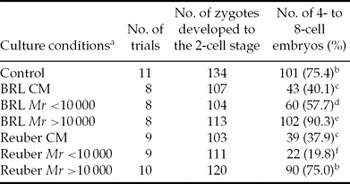
First of all, the experiment was conducted in the presence of 3 mg/ml BSA and 50 μM EDTA (Table 1). When a 2-day culture with fresh WM was used as a control, 75.4% of the 2-cell embryos cultured from zygotes developed to the 4- to 8-cell stage. Both Reuber CM and its Mr <10000 fraction inhibited the cleavage of embryos at the 2- or 3-cell stage, i.e. only 37.9% (p < 0.05) and 19.8% (p < 0.05) of the 2-cell embryos developed to the 4- to 8-cell stage. An inhibitory effect was also observed with BRL CM and its Mr <10000 fraction. With the BRL Mr <10000 fraction, the rate of development was repressed to 57.7% (p < 0.05) compared with that of the control. However, inhibition by the BRL Mr <10000 fraction was much weaker than by the original BRL CM (40.1%, p < 0.05) and Reuber Mr <10000 (19.8%, p < 0.05) fractions. On the other hand, a very high developmental rate was obtained in a group of zygotes cultured with the BRL Mr >10000 fraction (90.3%, p < 0.05). The Reuber Mr >10000 fraction retained the control level (75.0%) of development of the 2-cell stage to the 4- to 8-cell stage.
The effects of media conditioned with BRL cells, Reuber H-35 cells and their subfractions on the development of CD-1 zygotes in the presence of 50 μM EDTA

aCD-1 zygotes were cultured with one of the cell-conditioned media (CM) or its subfractions (Mr <10000 or Mr >10000) in the presence of 3 mg/ml BSA and 50 μM EDTA. As a control, embryos were cultured in fresh medium containing 3 mg/ml BSA and 50 μM EDTA.
b–f Percentages with different superscripts in the column differ significantly (p < 0.05).
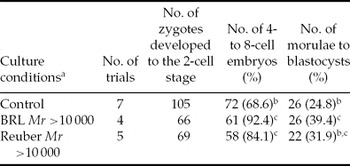
A similar experiment was carried out in the absence of EDTA (Table 2). As a result, stimulatory development was also observed with the BRL Mr >10000 fraction, i.e. more than 92% (p < 0.05) of the 2-cell embryos developed to the 4- to 8-cell stage, while the control showed 68.6%. The development of CD-1 zygotes to the morula to blastocyst stage was supported effectively by the BRL Mr >10000 fraction (39.4%, p < 0.05) compared with that of the control (24.8%). It should be noted that stimulation of development from the 2-cell stage to the 4- to 8-cell stage was also seen by cultivation with the Reuber Mr >10000 fraction (84.1%, p < 0.05).
The effects of the Mr >10000 subfraction of medium conditioned with BRL cells or Reuber H-35 cells on the development of CD-1 zygotes in the absence of EDTA

aCD-1 zygotes were cultured with the Mr >10000 subfraction obtained from BRL or Reuber cell-conditioned medium in the presence of 3 mg/ml BSA. As a control, embryos were cultured in fresh medium containing 3 mg/ml BSA alone.
b, c Percentages with different superscripts in the column differ significantly (p < 0.05).
BRL cell-conditioned medium contains a 2-cell stage specific inhibitor, Fr.B-25, at a low level
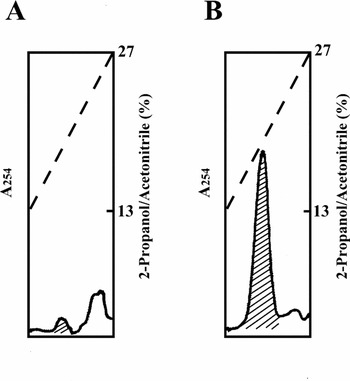
The Mr <10000 fractions obtained from both BRL CM and Reuber CM were further separated using reversed-phase column chromatography (Fig. 1). A small peak, corresponding to Fr.B-25 (Kobayashi et al., Reference Kobayashi, Hirako, Minato, Sasaki, Horiuchi and Domeki1996), was detected in the elution profile of the BRL Mr <10000 fraction. It was calculated that the BRL Mr <10000 fraction had a 19-fold lower content of Fr.B-25 compared with the Reuber Mr <10000 fraction.
Elution profile of the Mr <10000 fraction by reversed-phase column chromatography. Medium conditioned with BRL (A) or Reuber H-35 (B) cells was ultra-filtrated. Then, the flow-through fractions (Mr <10000) were further separated on a reversed-phase column equilibrated with 0.1% trifluoroacetic acid. As shown by the broken line, the column was eluted with a linear gradient of 2-propanol/acetonitrile (1:1, v/v) containing 0.1% trifluoroacetic acid. The elution profiles between 13% and 27% 2-propanol/acetonitrile are shown. The closed area indicates a 2-cell stage specific inhibitor, Fr.B-25, for the cleavage of mouse embryos. Fr.B-25 was eluted with 17% 2-propanol/acetonitrile (1:1, v/v).

Expression of mRNAs for activin family genes in BRL cells
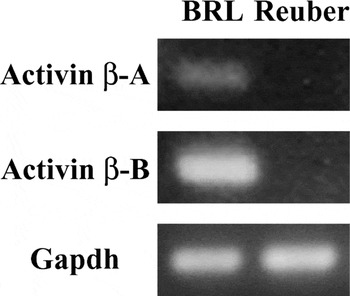
The expression of specific mRNAs in BRL and Reuber H-35 cells was examined by RT-PCR. As shown in Fig. 2, mRNAs for subunits β-A and β-B of activins were apparently expressed in BRL cells but not in Reuber H-35 cells. Using the same cDNA preparations for the mRNAs of activin family genes, the expression of GAPDH mRNA was confirmed to be at comparable levels in both BRL and Reuber H-35 cells.
Reverse-transcriptase polymerase chain reaction (RT-PCR) analysis of the specific mRNAs expressed in BRL cells (BRL) and Reuber H-35 cells (Reuber). RT-PCR was conducted with specific primers for activin β-A and for activin β-B. After 1.5% agarose gel electrophoresis, the products of amplification were visualized by ethidium bromide staining. The complementary DNA fragments of activin β-A, activin β-B and GAPDH were 214, 206 and 330 bp, respectively, in size.

Discussion
This study clarified the effect of BRL CM on the development of CD-1 zygotes, especially in the progression from the 2-cell stage to the 4-cell stage in comparison with that of CM from Reuber H-35 cells. The BRL Mr >10000 fraction significantly stimulated zygote development. Although the BRL Mr <10000 fraction inhibited the development of zygotes, the inhibitory effect was weaker than by the Reuber Mr <10000 fraction. In addition, BRL cells produced Fr.B-25 (Kobayashi et al., Reference Kobayashi, Hirako, Minato, Sasaki, Horiuchi and Domeki1996) at a low level and expressed mRNAs for activins β-A and β-B.
Activins are homo- or heterodimers of β-A (Mr ~14700) and β-B (Mr ~14000) subunits (Esch et al., Reference Esch, Shimasaki, Cooksey, Mercado, Mason, Ying, Ueno and Ling1987). Lu et al. (Reference Lu, Matsuyama, Nishihara and Takahashi1993) reported that activins β-A and β-B are developmentally expressed in both preimplantation mouse embryos and oviductal epithelium cells. Because activin A releases the 2-cell block in CD-1 zygotes cultured in vitro (Lu et al., Reference Lu, Shiota, Toyoda and Takahashi1990, Reference Lu, Ikeda and Takahashi1994), it is considered that activin A is physiologically involved in the process of the early development of mouse embryos. Furthermore, in this study, it was shown that the mRNAs for activins β-A and β-B were expressed in BRL cells but not in Reuber H-35 cells. Judging from the Mr of activins (~29000), it seems likely that the Mr >10000 fraction of BRL CM contains activins and contributes to the progression of the cell cycle from the 2-cell stage to the 4-cell stage during the in vitro development of CD-1 zygotes. Yoneda et al. (Reference Yoneda, Okada, Wakayama, Ueda and Watanabe2006) reported that the 2-cell block of ARK/N embryos was rescued by culture with BRL CM, and suggested that proteins with Mr 10000 to 30000 might be specific factors to support the development of ARK/N embryos. These results strongly suggest that one of the substances promoting the development of zygotes obtained from the blocking strains may be activin. In the case of bovine embryos cultured in vitro, many researchers (Myers et al., Reference Myers, Broussard, Menezo, Prough, Blackwell, Godke and Thibodeaux1994; Reed et al., Reference Reed, Tae-kwang, Bunch and White1996; Rehman et al., Reference Rehman, Collins, Suh and Wright1994) have reported the beneficial effects of co-culture with BRL cells or cultivation with BRL CM on preimplantation development. Yoshioka et al. (Yoshioka & Kamomae, Reference Yoshioka and Kamomae1996; Yoshioka et al., Reference Yoshioka, Suzuki and Iwamura1998, Reference Yoshioka, Suzuki and Iwamura2000) showed the stimulatory effect of activin A on the subsequent development of bovine zygotes to the morula and blastocyst stages in vitro. The results presented here also support the favorable effects of BRL cells on the development of bovine embryos.
It was reported previously (Kobayashi et al., Reference Kobayashi, Hirako, Minato, Sasaki, Horiuchi and Domeki1997) that the Reuber Mr >10000 fraction had a beneficial effect on the in vitro development of CD-1 2-cell embryos fertilized and developed in vivo and that Reuber H-35 cells expressed mRNAs for transforming growth factor (TGF) β1 (23–25 kDa (Massague et al., Reference Massague, Kelly and Mottola1985)) and stem cell factor (SCF, 28–35 kDa (Zsebo et al., Reference Zsebo, Wypych, McNiece, Lu, Smith, Karkare, Sachdev, Yuschenkoff, Birkett and Williams1990)). In the present study, the stimulatory effect of the Mr >10000 fraction of Reuber CM was observed only in the absence of EDTA. It was suggested that these growth factors, which are well known as embryotrophic factors (Babalola & Schultz, Reference Babalola and Schultz1995; Dardik & Schultz, Reference Dardik and Schultz1991; Marquant-Le Guienne et al., Reference Marquant-Le Guienne, Gerard, Solari and Thibault1989; Taniguchi et al., Reference Taniguchi, Harada, Nara, Deura, Mitsunari and Terakawa2004), might contribute synergistically and/or additively to overcome the 2-cell block of CD-1 zygotes by exerting a similar effect(s) to EDTA. It was also reported that at least nine proteins (18–76 kDa) in the Reuber Mr >10000 fraction specifically bound to or accumulated in the embryos (Kobayashi et al., Reference Kobayashi, Hirako, Minato, Sasaki, Horiuchi and Domeki1997). It is possible that a factor(s), other than TGF β1 or SCF, synthesized by Reuber H-35 cells possessed a similar function(s) to EDTA in the 2-cell block (Abramczuk et al., Reference Abramczuk, Solter and Koprowski1977).
Fr.B-25 was sufficient to inhibit the development of zygotes from the 2-cell stage to the 4-cell stage in both blocking and non-blocking strains (Kobayashi et al., Reference Kobayashi, Hirako, Minato, Sasaki, Horiuchi and Domeki1996). In this study, the whole BRL CM showed a similar inhibitory effect at the 2-cell stage of CD-1 zygotes at comparable levels to that of the whole Reuber CM. However, inhibition by the BRL Mr <10000 fraction was not effective compared with that by the whole BRL CM, the BRL Mr >10000 fraction and the Reuber Mr <10000 fraction. Because the content of Fr.B-25 in the BRL Mr <10000 fraction was only ~5% of the Reuber Mr <10000 fraction, the significant difference was observed in the inhibitory effects of these subfractions. These results also suggest that BRL CM contains compound(s) separable into the Mr >10000 fraction, which could act synergistically with a lower content of Fr.B-25, to inhibit the development of CD-1 zygotes in the whole CM. It was also reported that the whole BRL CM supported the development of ARK/N zygotes by overcoming the 2-cell block without any detrimental effects (Yoneda et al., Reference Yoneda, Okada, Wakayama, Ueda and Watanabe2006). Therefore, the compound(s) in the BRL Mr >10000 fraction might be a new type of inhibitor acting in a strain-specific manner.
In conclusion, this study demonstrated the involvement of activins as positive effectors of BRL CM on the 2-cell block of CD-1 zygotes cultured in vitro. It is also proposed that BRL cells synthesize Fr.B-25 at low levels; therefore, the inhibitory effect of the Mr <10000 fraction on the development of CD-1 zygotes at the 2-cell stage was weak. In view of the present findings, it is considered that both BRL and Reuber H-35 cells are useful to study factors that affect the development of mammalian embryos cultured in vitro.
Acknowledgements
We thank Dr Akira Niwa (Dokkyo University School of Medicine, Tochigi, Japan) for providing Reuber H-35 cells. Part of this study was supported by a Grant-In-Aid to M. K. for the Promotion of Scientific Research from the President of Akita Prefectural University, Japan.