Introduction
Colorectal cancer (CRC) is the second leading cause of cancer mortality among older Canadians (Canadian Cancer Society’s Steering Committee on Cancer Statistics, 2011). Despite the complex etiology of CRC, chronic inflammation is a fundamental risk factor (Demarzo et al., Reference Demarzo, Martins, Fernandes, Herrero, Perez and Turatti2008). This is evidenced by elevated CRC risk among persons with inflammatory bowel disease (IBD), an increase proportional to the extent and duration of colitis (Kulaylat & Dayton, Reference Kulaylat and Dayton2010). Canadians have among the highest IBD incidence rates worldwide (Bernstein et al., Reference Bernstein, Wajda, Svenson, MacKenzie, Koehoorn and Jackson2006). IBD is particularly debilitating among seniors, as 10-15 per cent of incident cases are diagnosed in patients aged 60 or older (Softley et al., Reference Softley, Myren, Clamp, Bouchier, Watkinson and de Dombal1988), and the presence of age-related co-morbidities may interfere with effective diagnosis and treatment (Swaroop, Reference Swaroop2007).
Researchers have hypothesized that CRC pathogenesis may be influenced by inflammatory immune mechanisms (Terzić, Grivennikov, Karin, & Karin, Reference Terzić, Grivennikov, Karin and Karin2010). Two inflammatory cytokines, tumour necrosis factor-alpha (TNF-α) (Grimm et al., Reference Grimm, Lazariotou, Kircher, Höfelmayr, Germer and von Rahden2010) and interleukin-1 beta (IL-1β) (Szkaradkiewicz et al., Reference Szkaradkiewicz, Marciniak, Chudzicka-Strugała, Wasilewska, Drews and Majewski2009), are elevated in the bowel of CRC patients, and elevated TNF-α predicts both the extent of carcinogenesis and likelihood of tumour recurrence (Grimm et al., Reference Grimm, Lazariotou, Kircher, Höfelmayr, Germer and von Rahden2010). Furthermore, immunosenescence (age-related immune changes) may increase cancer risk as a result of increases in chronic low-grade inflammation (Singh & Newman, Reference Singh and Newman2010). Even healthy, aged individuals have demonstrated increased expression of interleukin-6 (IL-6), TNF-α, and IL-1β in peripheral mononuclear cells (Fagiolo et al., Reference Fagiolo, Cossarizza, Scala, Fanales-Belasio, Ortolani and Cozzi1993) and increased IL-6 and TNF-r1 in plasma (Stowe, Peek, Cutchin, & Goodwin, Reference Stowe, Peek, Cutchin and Goodwin2010).
Colorectal cancer has a long asymptomatic period, and physical symptoms typically appear only in advanced stages of disease when the prognosis is largely predetermined and treatment is limited (Gonzalez-Hermoso, Perez-Palma, Marchena-Gomez, Lorenzo-Rocha, & Medina-Arana, Reference Gonzalez-Hermoso, Perez-Palma, Marchena-Gomez, Lorenzo-Rocha and Medina-Arana2004). Accordingly, screening programs and strategies for risk factor reduction are critical avenues to reduce disease burden in aged individuals (Edwards et al., Reference Edwards, Ward, Kohler, Eheman, Zauber and Anderson2010). Since 40–50 per cent of CRC patients die within five years of initial diagnosis (Compton et al., Reference Compton, Fielding, Burgart, Conley, Cooper and Hamilton1999), even a modest delay in disease onset could significantly improve individual and population health outcomes (Luo, Bradley, Dahman, & Gardiner, Reference Luo, Bradley, Dahman and Gardiner2010).
Physical activity is a promising lifestyle intervention identified to reduce CRC incidence (Colditz, Cannuscio, & Frazier, Reference Colditz, Cannuscio and Frazier1997) with a relative risk reported of 0.76 (95% CI 0.72 – 0.81) (Wolin, Yan, Colditz, & Lee, Reference Wolin, Yan, Colditz and Lee2009) and 0.79 (95% CI 0.72 – 0.87) (Samad, Taylor, Marshall, & Chapman, Reference Samad, Taylor, Marshall and Chapman2005) among regular exercisers compared to inactive individuals. The relationship between increased physical activity and lowered CRC risk follows a strong dose-response curve (Thune & Furberg, Reference Thune and Furberg2001), and it is possible that regular exercise may reduce the risk of CRC recurrence (Halle & Schoenberg, Reference Halle and Schoenberg2009).
The mechanisms whereby regular physical activity protects against inflammatory bowel diseases and CRC in older people are not well-known. One possibility is that physical activity prevents age-related increases in inflammation by altering the intestinal inflammatory cytokine and apoptotic milieu. In young animals, long-term voluntary physical activity reduces intestinal TNF-α expression (Hoffman-Goetz, Pervaiz & Guan, Reference Hoffman-Goetz, Pervaiz and Guan2009). This finding has recently been confirmed in aged humans: long-term (8.6 ± 0.3 months) resistance training reduced plasma TNF-α levels (Córdova et al., Reference Córdova, Lopes-E-Silva, Pires, Souza, Brito and Moraes2011). Moreover, Gomez-Merino et al. (Reference Gomez-Merino, Drogou, Guezennec and Chennaoui2007) found that exercise training reduced IL-1β in rat adipose tissue and skeletal muscle (Lira et al., Reference Lira, Koyama, Yamashita, Rosa, Zanchi and Batista2009). In response to long-term physical activity, IL-6 increases in the intestinal compartment (Hoffman-Goetz, Pervaiz, Packer, & Guan, Reference Hoffman-Goetz, Pervaiz, Packer and Guan2010) and in skeletal muscle (Pedersen et al., Reference Pedersen, Steensberg, Keller, Keller, Fischer and Hiscock2003) of young animals but decreases in older individuals (Nicklas et al., Reference Nicklas, Hsu, Brinkley, Church, Goodpaster and Kritchevsky2008).
The intestinal compartment is populated by a number of immunologically active cells. Lamina propria (LP), and intraepithelial (iIEL) and intestinal (IL) lymphocytes, play an important role in homeostasis (Lefrançois & Lycke, Reference Lefrançois and Lycke2001), thereby modulating the inflammatory process (Iliev, Mileti, Matteoli, Chieppa, & Rescigno, Reference Iliev, Mileti, Matteoli, Chieppa and Rescigno2009) and regulating the secretion of key cytokines (Powrie, Reference Powrie2004).
It is difficult to evaluate the extent of lymphocyte involvement in intestinal homeostasis in healthy adults. Utilizing an animal model, however, circumvents the problem of invasive tissue sampling from healthy people. Moreover, tissue biopsies are typically limited to individuals with intestinal pathologies and are restricted anatomically to the large intestine (Pironti et al., Reference Pironti, Tadeu, Pedroni, Porcu, Manca and Massarelli2010). Major advantages of using an animal model include: (1) the ability to obtain healthy intestinal tissue for analysis; (2) sufficient tissue collection for assessment of multiple biomarkers and mediators; and (3) detailed physiological measurement and validation of “training” status. An animal model also allows precise age determination, a key consideration when examining the effects of training in an “aged” cohort.
The purpose of this study was to describe the effects of long-term voluntary physical activity on the expression of inflammatory cytokines and apoptotic proteins in intestinal lymphocytes of healthy older adult animals. The cytokines chosen were the classic pro-inflammatory (TNF-α, IL-1β) and pleiotropic (IL-6) cytokines implicated in intestinal inflammation, IBD, and CRC progression. In addition, the expression of two apoptotic proteins (caspase-3 and -7) in intestinal lymphocytes was assessed because they are activated by TNF-α, IL-1β, and IL-6 (Wyllie, Reference Wyllie2010) and induce cell death. We hypothesized that long-term, low-stress physical activity in mice would decrease the intestinal expression of pro-inflammatory (TNF-α, IL-1β) and pleiotropic (IL-6) cytokines and apoptotic proteins (caspase-3, caspase-7) relative to untrained (sedentary) age-matched controls.
Materials and Methods
Animals
Female C57BL/6 mice (n = 40) (Harlan, Indianapolis, IN, U.S.), 11–12 months old, were individually housed at 21 ± 1 °C on a 12hr/12hr reversed light/dark cycle. Mice had ad libitum access to standard rodent diet (Lab Rodent Chow, PMI Feeds, IN, U.S.) and tap water throughout the experiments. All experiments were conducted in accordance with the ethical guidelines and protocols of the Canadian Council on Animal Care and were approved by the University Animal Research Ethics Committee.
Exercise-Training Protocol
Mice were matched by weight and randomized to an exercise-training condition: access to in-cage running wheels (wheel running, WR; n = 20) or to a control cage (no wheel running, NWR; n = 20) for 4 months. A magnetic switch attached to each wheel (23 cm in diameter) and an automated computer monitoring system (Vital View Application software, Mini-Mitter, Sunriver, Oregon, U.S.) captured the number of completed revolutions. Activity during the dark cycle was recorded as the number of revolutions completed per 15-min interval, converted to distance run (km), and summed by day, week, and month. Total running volume was monitored as an indicator of training status, in combination with skeletal muscle cytochrome c oxidase activity and body weight. All WR mice were sacrificed 24 hours after the last training session as in-cage running wheels were locked in order to prevent any carry-over effects of voluntary exercise.
Skeletal Muscle Cytochrome c Oxidase (CO) Activity
Cytochrome c oxidase (CO) plays an important role in determining the mitochondrial respiratory capacity of skeletal muscle as it constitutes the last step of ATP generation. Following sacrifice by sodium pentobarbital (0.6 – 0.8 cc per mouse, i.p.) overdose, soleus (SOL), and plantaris (PLANT) muscle samples were isolated from WR and NWR mice, frozen in liquid nitrogen, and stored at –80 °C until assayed. Muscles were cut into 5–10-mg segments, mashed and homogenized in buffer [glycerol (50%), sodium phosphate buffer (20 mM), 2-mercaptoethanol (5 mM), ethylenediaminetetraacetic acid (EDTA, 0.5 mM), BSA (10%)] to yield a 50:1 dilution, and sonicated (using a 3-m tip, 2 sec on, 5 sec off for a total of 20 sec at 60 Hz; Vibra Cell, Sonics and Materials, Danbury, Connecticut, U.S.). Protein content was determined by Lowry assay (Lowry, Rosebrough, Farr, & Randall, Reference Lowry, Rosebrough, Farr and Randall1951). Muscle homogenates were diluted to 1:500 dilutions in a 10-mM potassium phosphate buffer. Next, 20 μL of reduced cytochrome c and 10 μL of diluted homogenate were combined with 970 μL of warmed (37 °C) phosphate buffer. Cytochrome c absorbance was determined spectrophotometrically at 550 nm.
Biomarkers of Stress (Plasma 8-iso-PGF2α and Corticosterone)
We measured plasma 8-iso-PGF2α and corticosterone as biomarkers indicative of oxidative and psychogenic stress respectively. This procedure and rationale have been described extensively elsewhere (Hoffman-Goetz et al., Reference Hoffman-Goetz, Pervaiz, Packer and Guan2010). In brief, immediately following sacrifice, we used a 1-mL syringe containing heparin to collect blood via cardiac puncture. Plasma was separated by centrifugation (6 min at 400 rpm) and frozen at –80 °C. Plasma 8-iso-PGF2α was assessed by a commercially available kit using direct enzyme immunoassay (EIA) as per the manufacturer’s specifications (Cayman Chemical, Ann Arbor, Michigan, U.S.). Samples (100-μL sample, 25 μL of 10N NaOH) were hydrolyzed for 2 hr at 45 °C, neutralized to pH 6-8 with 12N HCl, centrifuged at 14,000 g for 5 min, and incubated with 8-iso-PGF2α antibody for 24 hr at 4 °C. Per cent absorbance was read at 412 nm at room temperature using a PowerWave 340 microplate spectrophotometer (Biotek Instruments, Winooski, Vermont, U.S.). The intra-assay percent coefficient of variation (% CV) was 11.7 per cent.
We measured corticosterone using a commercially available EIA kit, according to the manufacturer’s instructions (Cayman Chemical). The cold spike protocol was used for the purification of plasma samples and corticosterone concentrations measured using a PowerWave 340 microplate spectrophotometer (Biotek Instruments) at 412 nm. The intra-assay coefficient of variation (% CV) was 12.5 per cent.
Determination of Cytokines and Apoptotic Proteins Expression in Intestinal Lymphocytes
Intestinal Lymphocyte (IL) Isolation
Intestinal lymphocyte (IL) isolation was performed as described (Hoffman-Goetz & Quadrilatero, Reference Hoffman-Goetz and Quadrilatero2003). Following sacrifice by sodium phenobarbital overdose, we used cold phosphate buffered saline (PBS) to wash the excised intestinal compartment; Peyer’s patches and visible fat were removed and single-cell IL suspensions prepared by isolation over a pre-washed nylon wool (0.3 g) column. The eluted cells were layered over a Lympholyte-M density gradient medium (Cedarlane Laboratories, Burlington, Ontario) and centrifuged to remove debris. The remaining cell pellet (containing IEL and LP lymphocytes) was suspended in 400 μL of PBS. Turk’s staining solution (99 μL) was used to enumerate intestinal lymphocytes (1 μL) by light microscopy. This technique yields high lymphocyte recovery (i.e., 90.9 ± 0.5% CD45+ by flow cytometry analysis).
Western Blot Analysis of Cytokines and Apoptotic Proteins
Intestinal lymphocytes (IL) were fractionated in lysis buffer on ice for 45 min. Lysates (1 × 10⁵) were centrifuged (15 min, 10,000 g) and supernatant extracted. A BCA assay was used to determine protein concentration (Lowry et al., Reference Lowry, Rosebrough, Farr and Randall1951). Protein (40 μg) and selected molecular weight markers (Full Range Rainbow, Amersham Biosciences, Pittsburgh, Pennsylvania, U.S.) were electrophoresed on a 12 per cent SDS-PAGE gel before transfer to PVDF membrane. Membranes were stained with Ponceau S to confirm quality of transfer and equal loading. After electrophoresis, membranes were incubated for 1 hr with primary antibody (1:200 in 10% milk-TBST): TNF-α (clone: N-19; goat anti-human polyclonal IgG), IL-1-β (clone: Fx02l; mouse anti-rat monoclonal), IL-6 (clone: M-19; goat anti-rat polyclonal IgG), caspase-3 (clone: H-277; rabbit anti-human polyclonal IgG), caspase-7 (clone: 10-1-62; mouse anti-human monoclonal IgG1), and Bcl-2 (clone: C-2; mouse anti-human monoclonal IgG1) (Santa Cruz Biotechnology, Santa Cruz, California, U.S.). Membranes were incubated for 1 hr with secondary antibody: biotin-conjugated rabbit anti-goat IgG-B (TNF-α; IL-6), and horseradish peroxidise-conjugated goat anti-mouse IgG-HRP (IL-1β, caspase-7, Bcl-2), or goat anti-rabbit IgG-HRP (caspase-3) IgG at a concentration of 1:2000 in 10% milk-TBST. ECL Plus detection reagent (Amersham Biosciences) and the ChemiGenius 2 Bio-imaging System were used for protein determination. We used a biotinylated protein ladder to identify the molecular weight of selected proteins (Cell Signalling Technology, Millipore [Canada] Ltd., Etobicoke, Ontario). Recombinant standards (Cedarlane Laboratories) were run on each gel. We ran samples from the two exercise conditions on each immunoblot and normalised band densities to control bands on each immunoblot (reported as arbitrary densitometric units [A.U.]) for each group.
Experimental Design and Statistical Analysis
All variables were analysed by one-way ANOVA with exercise training (i.e., WR, NWR) as the independent factor, and cytokine and apoptotic proteins as the dependent factors (SPSS for Windows Version 19; SPSS Inc, Chicago, Ilinois, U.S.). Running volumes (distances) by month were analysed by repeated measures ANOVA. Levene’s test was used to check for homogeneity of variance. Significant differences were accepted if p < 0.05. Values are group means ± 1 SEM for respective units (e.g., μmol/min/g; arbitrary densitometric units [A.U.] ; g).
Results
Physiological Indicators of Training and Exercise
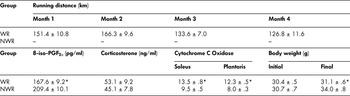
Table 1 shows the physiologic characteristics [distance run (km), body weight (g), cytochrome c oxidase (μMol/min/g protein) activity in soleus and plantaris muscles] of healthy older C57BL/6 female mice after 4 months of low-intensity exercise training. WR and NWR mice did not differ in initial body weights (p > .05). However, after 4 months of exercise training, WR mice were significantly lighter than NWR mice (p < .05). Over the 4 months of wheel running activity, the mean distance run per animal was 578.1 km. The average monthly distance run per mouse remained steady for the first two months and thereafter declined by 20–30 km per month. WR mice also had significantly higher cytochrome c oxidase activity in SOL and PLANT compared to NWR mice (p < .05).
Body weight (g), running distance (km), 8-iso-PGF2α (pg/ml), corticosterone (ng/ml), and cytochrome c oxidase activity (μMol/min/g protein) in C57Bl/6 of healthy older adult mice after 4 months of exercise trainingFootnote a

a Values reported as group means ± one standard error
* denotes significant (p < .05) group effects
WR = wheel running
NWR = no wheel running
Biomarkers of Stress
Plasma 8-iso-PGF2α and Corticosterone
Table 1 also shows the plasma concentration of 8-iso-PGF2α and corticosterone in trained and untrained aged mice. WR mice had significantly lower plasma 8-iso-PGF2α levels compared with NWR mice [F (1, 29) = 9.36, p < .05]. WR mice did not differ from NWR controls in their plasma corticosterone levels [F (1, 31) = 0.423, p > .05]. Given that plasma 8-iso-PGF2α is an indicator of oxidative stress, it can be inferred that exercise training was associated with lower resting levels of cellular oxidant stress (Roberts & Morrow, Reference Roberts and Morrow2000). The lack of a difference in corticosterone levels between the two groups suggests that voluntary low-intensity wheel running did not significantly influence psychogenic stress in the animals (Girard & Garland, Reference Girard and Garland2002).
Western Blot Analysis of Cytokines and Apoptotic Proteins
Pro-inflammatory and Pleiotropic Cytokines
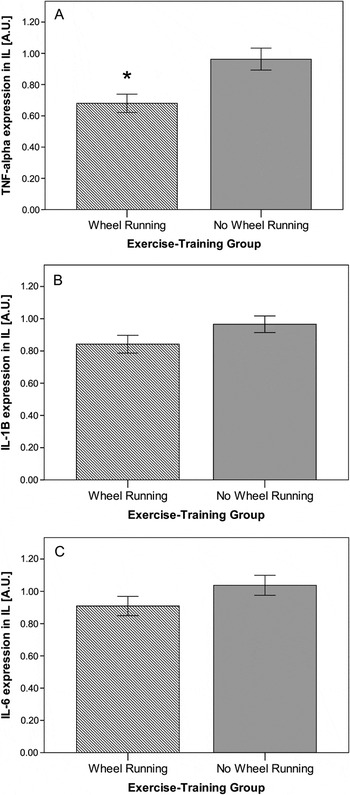
Figure 1 (Panels A-C) shows the effect of long-term (4 months) voluntary wheel running (i.e., exercise training) on mouse intestinal lymphocyte expression of two pro-inflammatory cytokines, TNF-α and IL-1β, and the pleiotropic cytokine IL-6 (units expressed in arbitrary densitometric units [A.U.]). Long-term physical activity was associated with significantly lower expression of TNF-α [F (1, 29) = 9.51, p < .05] in WR compared to NWR mice. Training was also associated with non-significant decreases in IL-1β [F (1, 34) = 2.63, p = .12] and IL-6 [F (1, 37) = 2.21, p = .15] expression in the intestinal lymphocytes of older mice.
Pro-inflammatory and pleiotropic cytokine production in intestinal lymphocytes (IL) of aged mice.

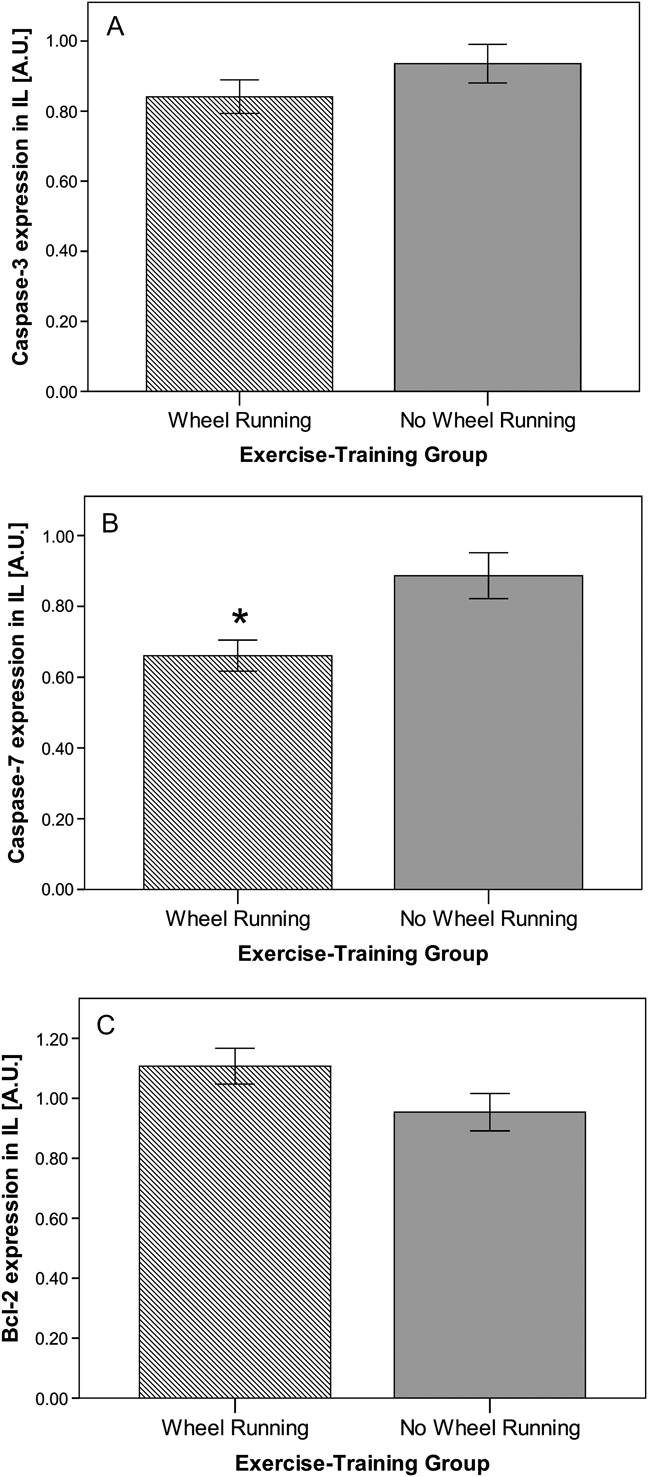
Figure 2 (Panels A-C) shows the effect of long-term (4 months) voluntary wheel-running (i.e., exercise training) on intestinal lymphocyte expression of the pro-apoptotic proteins caspase-3 and caspase-7, and the anti-apoptotic protein Bcl-2. Long-term physical activity was associated with a significant reduction in caspase-7 [F (1, 34) = 7.19, p < .05] and a non-significant decrease in caspase-3 [F (1, 33) = 1.62, p = .21] expression in intestinal lymphocytes of healthy older mice. Voluntary wheel running for 4 months also led to a non-significant increase of the expression in intestinal lymphocytes of the anti-apoptotic protein, Bcl-2, [F (1, 36) = 3.17, p = .08] in healthy older animals.
Pro- and anti-apoptotic protein expression in intestinal lymphocytes (IL) of aged mice.
Discussion
The purpose of this study was to describe the effects of long-term, voluntary aerobic exercise training on inflammatory cytokine and apoptotic protein expression in the intestinal tract of healthy older adult mice. We hypothesized that intestinal lymphocytes of trained mice would display lower levels of apoptotic proteins (caspase-3, caspase-7) and pro-inflammatory (TNF-α, IL-1β) and pleiotropic (IL-6) cytokines, and higher levels of anti-apoptotic proteins (Bcl-2) compared to “untrained” age-matched sedentary controls. We found that 4 months of wheel running was associated with decreased intestinal lymphocyte expression of the pro-inflammatory cytokine TNF-α and the apoptotic protein caspase-7 in this aged cohort. To our knowledge, no other studies have examined the effect of voluntary long-term physical activity on the intestinal lymphocyte expression of pro-inflammatory and pleiotropic cytokines and apoptotic proteins in healthy aged individuals (either animals or people). Collectively, the results suggest that regular physical activity may protect against senescent increases in intestinal inflammation though a mechanism of decreased expression of TNF-α and caspase-7 in lymphocytes resident in the bowel. Caspase-7 is preferentially activated by caspase-1 inflammasomes within an inflammatory environment; therefore, reduced caspase-7 expression supports the anti-inflammatory effects of regular physical activity. In addition, Lamkanfi and Kanneganti (Reference Lamkanfi and Kanneganti2010) have shown that caspase-7 deficient mice are resistant to endotoxemia, suggesting that interference in caspase-7 activation may be of benefit in conditions where inflammation contributes directly to disease.
The cytokine TNF-α, a potent mediator of inflammation and carcinogenesis, induces the inflammatory effects of IL-6 (and increases production of IL-1β) by up-regulating the transcription factor NFkβ (Wilson, Reference Wilson2008). Elevated TNF-α is found in the bowel of CRC patients (Grimm et al., Reference Grimm, Lazariotou, Kircher, Höfelmayr, Germer and von Rahden2010), and therapeutic application of anti-TNF-α antibodies prevents CRC development in animal models of colitis (Popivanova, Kitamura, & Wu, Reference Popivanova, Kitamura and Wu2008). IL-1β is a pro-inflammatory cytokine that promotes tumour formation by inducing cellular proliferation (Jung, Isaacs, Lee, Trepel, & Neckers, Reference Jung, Isaacs, Lee, Trepel and Neckers2003), apoptosis (Wang, Zhang, Zhao, & Fei, Reference Wang, Zhang, Zhao and Fei2009), and vasculogenesis (Jung et al., Reference Jung, Isaacs, Lee, Trepel and Neckers2003). IL-6 has been shown to prevent apoptosis in myeloid LP cells (Grivennikov et al., Reference Grivennikov, Karin, Terzic, Mucida, Yu and Vallabhapurapu2009) and to promote tumour progression in animal models of colitis (Strassmann et al., Reference Strassmann, Jacob, Fong and Bertolini1993). Although IL-6 demonstrates both pro- and anti-inflammatory functions (Pedersen et al., Reference Pedersen, Steensberg, Keller, Keller, Fischer and Hiscock2003; Pedersen & Fischer, Reference Pedersen and Fischer2007), its effects are primarily pro-inflammatory with increasing age (Dobbs et al., Reference Dobbs, Charlett, Purkiss, Dobbs, Weller and Peterson1999) or in the presence of inflammatory disease conditions (Ridker, Rifai, Stampfer, & Hennekens, Reference Ridker, Rifai, Stampfer and Hennekens2000). Thus, decreased intestinal lymphocyte expression of these cytokines (TNF-α, IL-1β, IL-6) in response to long-term freewheel training contributes to our understanding of how regular physical activity in older people may decrease the risk of inflammatory diseases of the bowel and colorectal cancer.
Intestinal lymphocyte TNF-α expression was markedly lower in the trained, older animals. Regular physical activity may also decrease intestinal inflammation by reductions in adipose tissue, a major tissue source of non-immune-cell-derived endogenous TNF-α (Coppack, Reference Coppack2001), or via suppression of TNF-α transcription or translation. Intestinal TNF-α levels are thought to be predictive of risk for later CRC development (Popivanova et al., Reference Popivanova, Kitamura and Wu2008). Thus, lower TNF-α may reduce the risk of developing intestinal pathology. This training-induced reduction in TNF-α is remarkable given the reported elevated expression of TNF-α and TNF-r1 in peripheral mononuclear cells (Fagiolo et al., Reference Fagiolo, Cossarizza, Scala, Fanales-Belasio, Ortolani and Cozzi1993) and plasma (Stowe et al., Reference Stowe, Peek, Cutchin and Goodwin2010) of healthy older individuals.
Despite the older age of our animals, the results mirror those of previous studies demonstrating that training decreases baseline intestinal lymphocyte expression of TNF-α in young animals (Hoffman-Goetz et al., Reference Hoffman-Goetz, Pervaiz and Guan2009). This was observed despite the fact that young and old mice also differ markedly in their physiologic response to training. In response to 4.5 weeks of resistance exercise (i.e., 14 sessions of electrically evoked training), young (3 months) rats showed a 15.6 per cent increase in wet muscle (tibialis anterior) weight, whereas old (30 months) rats showed no increase (Murlasits et al., Reference Murlasits, Cutlip, Geronilla, Rao, Wonderlin and Always2006). Although both young and old rats showed increased (+968.8% and +409.1% respectively) HSP72 expression in tibialis muscle in response to prolonged resistance exercise, old rats demonstrated an augmented training response in spite of equal resistance-training conditions. Moreover, since TNF-α has been shown to promote carcinogenesis (Grimm et al., Reference Grimm, Lazariotou, Kircher, Höfelmayr, Germer and von Rahden2010), our novel finding may explain, in part, the nature of the protective effect of regular exercise, even at advanced ages. Specifically, exercise training may reduce or buffer against intestinal inflammation in aged individuals despite age-related increases in inflammation and TNF-α expression (Fagiolo et al., Reference Fagiolo, Cossarizza, Scala, Fanales-Belasio, Ortolani and Cozzi1993).
No differences in the intestinal lymphocyte expression of IL-1β or IL-6 were observed although there were non-significant decreases among exercise trained older mice. This is an important observation given the lower TNF-α expression in response to training and the role of TNF-α in inducing IL-1β and IL-6 production (Wilson, Reference Wilson2008). The direction of the trends for both IL-1β and IL-6 support the possibility that TNF-α may be functioning in this manner. Further, the direction of these exercise training effects, albeit not significant, must be considered in light of the observation that healthy elderly adults have elevated expression of IL-6 and IL-1β in immunologically active blood cells (Fagiolo et al., Reference Fagiolo, Cossarizza, Scala, Fanales-Belasio, Ortolani and Cozzi1993) and a higher concentration of IL-6 in plasma (Stowe et al., Reference Stowe, Peek, Cutchin and Goodwin2010). Previous studies show that exercise training decreases baseline expression of IL-1β (Gomez-Merino, Drogou, Guezennec, & Chennaoui, 1997) in white adipose tissue of healthy young mice, while long-term resistance training reduces circulating IL-6 in healthy older people (Córdova et al., Reference Córdova, Lopes-E-Silva, Pires, Souza, Brito and Moraes2011).
Inflammation induces both the intrinsic and extrinsic pathways of apoptosis (cell death). The former (intrinsic) is mediated by mitochondrial activation of caspases and cytoplasmic translocation, subsequently leading to cell lysis (Wyllie, Reference Wyllie2010). These effects are antagonized by cellular anti-apoptotic proteins, such as Bcl-2, which prevent the release, activation, and translocation of mitochondrial caspases (Kuwana & Newmeyer, Reference Kuwana and Newmeyer2003). Alternatively, the extrinsic pathway proceeds via cytokine (i.e., TNF-α, IL-1β) induced activation of membrane death receptors (Mignini, Traini, Tomassoni, Vitali, & Streccioni, Reference Mignini, Traini, Tomassoni, Vitali and Streccioni2008). Collectively, these biological processes may help to explain how cytokine and apoptotic dysregulation can contribute to gastrointestinal pathology and uncontrolled inflammation. Nevertheless, whether apoptotic dysregulation in the bowel is “beneficial” or “harmful” to the individual depends on the specific physiological situation and cell types involved. For example, resistance to apoptosis is a hallmark of colorectal cancer cell survival (Liu, Reference Liu2010) whereas excessive apoptosis of intestinal epithelium may contribute to the etiology of inflammatory diseases such as ulcerative colitis (Levine, Reference Levine2000).
Our study shows that there was a significant reduction in the expression of the pro-apoptotic protein, caspase-7, in the intestinal lymphocytes of “trained” older mice. This training-induced reduction in caspase-7 may be protective in buffering aging-associated increases in the expression of this apoptotic mediator (Zhang, Chong, & Herman, Reference Zhang, Chong and Herman2002). Furthermore, lower caspase-7 expression may be protective, as elevated caspase-7 predicts a higher likelihood of oral squamous cell carcinoma recurrence (Coutinho-Camillo, Lourenço, Nishimoto, Kowalski, & Soares, Reference Coutinho-Camillo, Lourenço, Nishimoto, Kowalski and Soares2010). However, the contribution of elevated caspase-7 as a risk factor for other cancers, such as colonic adenocarcinoma, remains to be determined. We did not find a significant reduction in the expression of caspase-3 in intestinal lymphocytes of older healthy animals; however, the direction of the difference between trained and untrained mice was supportive of the finding in young mice given long-term exercise training (e.g., Hoffman-Goetz & Spagnuolo, Reference Hoffman-Goetz and Spagnuolo2007). The reason for this lack of a significant training effect on caspase-3 expression is not clear from our data; age-dependent kinetics of the caspase cascade may be involved (Jiang, Walker, & Steinle, Reference Jiang, Walker and Steinle2009).
Similar to observations others have made in young animals (Davidson, Burnett, & Hoffman-Goetz, Reference Davidson, Burnett and Hoffman-Goetz2006), we confirmed that 4 months of low intensity, voluntary wheel running was sufficient to induce physical, physiological, and biochemical changes indicative of “training” in aged mice. The skeletal muscles of “trained” mice showed increased cytochrome c oxidase enzyme activity. Cytochrome c oxidase plays a crucial role in cellular energy regulation and directly influences mitochondrial ATP production (Fontanesi, Soto, Horn, & Barrientos, Reference Fontanesi, Soto, Horn and Barrientos2006). The enzymatic activity of cytochrome c oxidase is reduced with increasing age (Bagh, Thakurta, Biswas, Behera, & Chakrabarti, Reference Bagh, Thakurta, Biswas, Behera and Chakrabarti2011) but, in young animals, has been shown repeatedly to increase in response to long-term training (Hoffman-Goetz et al., Reference Hoffman-Goetz, Pervaiz, Packer and Guan2010).
Training-induced increases in skeletal muscle cytochrome c oxidase can also provide an antioxidant function “buffering” against the damaging effects of aging (De Lisio et al., Reference De Lisio, Kaczor, Phan, Tarnopolsky, Boreham and Parise2011). During the first two months of training, the total running distances of aged mice increased before falling sharply during the third and fourth months. In young mice, there was a sequential increase in running distances across the entire training duration (Hoffman-Goetz et al., Reference Hoffman-Goetz, Pervaiz, Packer and Guan2010). The decrease in wheel running volume over the 4 months among the aged cohort confirms the findings of Turner, Kleeberger, and Lightfoot (Reference Turner, Kleeberger and Lightfoot2005) and may reflect an age-related loss of aerobic capacity (Waters et al., Reference Waters, Renner, Pringle, Summers, Britton and Koch2008) or an impaired endocrine response to environmental, psychological, or physiological stressors (Waters et al., Reference Waters, Renner, Summers, Watt, Forster and Koch2010).
Plasma 8-iso-PGF2α is derived from membrane-derived arachidonic acid, a reaction catalyzed by reactive oxygen intermediates (Roberts & Morrow, Reference Roberts and Morrow2000). Corticosterone is a steroid hormone produced by the adrenal gland in response to acute physiological or psychological stress. It has a crucial role in the “fight or flight” response by stimulating gluconeogenesis and, thereby, in the capability of a subject’s accessing energy reserves (Girard & Garland, Reference Girard and Garland2002). Both plasma 8-iso-PGF2α and corticosterone increase throughout the lifespan (Garrido, de Blas, Del Arco, Segovia, & Mora, Reference Garrido, de Blas, Del Arco, Segovia and Mora2010; Montine et al., Reference Montine, Peskind, Quinn, Wilson, Montine and Galasko2011). We observed that WR and NWR mice did not differ in baseline stress as measured by the biomarker plasma corticosterone. Moreover, since corticosterone did not differ between WR and NWR, the observed lower levels of plasma 8-iso-PGF2α in WR mice suggests that regular exercise lowers baseline oxidative or cellular stress in older individuals. Given that 8-iso-PGF2α is a biomarker of inflammation, it possible that this phenomenon might be one mechanism whereby the beneficial effects of exercise are realized, particularly since elevated 8-iso-PGF2α predicts chronic disease progression – including some cancers (Dai & Zhu, Reference Dai and Zhu2009).
Collectively, our study findings of decreased TNF-α, caspase-7, and 8-iso-PGF2α in response to long-term wheel running activity support the hypothesis that regular physical activity can modulate inflammation, even in aged individuals. Moreover, given that TNF-α is a cytokine that “regulates” the function of other cytokines – and, indirectly – apoptosis, training may confer protection against disease initiation and progression by disrupting the harmful activity of this key cytokine. The effects of exercise on TNF-α appear to influence the direction of the caspase-7 and 8-iso-PGF2α effects particularly since (1) TNF-α binding to tumour necrosis factor-related apoptosis-inducing ligand (TRAIL) increases pro-caspase-7 cleavage and apoptosis (Zauli et al., Reference Zauli, Milani, Rimondi, Baldini, Nicolin and Grill2003), and (2) reductions in TNF-α reduce baseline oxidative stress, which is reflected in lower levels of 8-iso-PGF2α in plasma (Rizzo et al., Reference Rizzo, Abbatecola, Barbieri, Vietri, Cioffi and Grella2008).
This study has five important limitations. First, we are limited by the extent to which these results can be generalized to a human population. However, animal models are appropriate to identify basic “biomarkers of aging” and improve the understanding of human disease mechanisms (Huber & Sierra, Reference Huber and Sierra2009). Accordingly, gerontological research using animal models is an important step in establishing scientific evidence to guide clinical geriatrics and future practice recommendations. Second, 15- to 16-month-old C57BL/6 mice were not extremely aged; however, given a life expectancy of 23 months for this strain (Anisimov, Reference Anisimov2009) and an average age of 63 years in humans for initial diagnosis of sporadic CRC (Lynch & de la Chappelle, Reference Lynch and de la Chapelle1999), this age cohort should provide a useful basis for comparison. A third study limitation is that we measured protein expression and not intestinal lymphocyte mRNA for the cytokines and apoptotic proteins selected for analysis; it is possible that some proteins may have originated, not from lymphocytes, but from other cells in the intestinal tract (such as epithelial cells). Fourth, this study was done in healthy animals in order to investigate possible mechanisms contributing to the effects of “training” in a healthy population. Future research will be needed to determine if this physical-activity-associated “beneficial” effect applies in animal models of human IBD. Finally, our study population comprised only female mice. Female C57BL/6 mice have been shown to be better runners than males (Turner et al., Reference Turner, Kleeberger and Lightfoot2005); additional studies with male C57BL/6 mice will be necessary to ensure that gender does not confound the protective effect of training.
In summary, freewheel running for 4 months in healthy aged female C57BL/6 mice was associated with decreased intestinal lymphocyte expression of the pro-inflammatory cytokine TNF-α, the apoptotic protein caspase-7, and the plasma marker of oxidative stress 8-iso-PGF2α. These “anti-inflammatory” effects of regular exercise raise the possibility that physical activity is protective against the development of intestinal pathology and colorectal cancer, even at later ages. This study used an animal model to explore potential biological mechanisms between physical activity and inflammatory mediators known to be involved in the etiology of chronic intestinal diseases. This animal research should be considered as hypothesis-generating, and future research, focused on biomarkers of aging and IBD, will be needed to determine if physical activity reduces inflammatory cytokines in the bowel of older, healthy humans.