Implications
In nature, piglets are born in a nest, while in modern production systems, piglets are often born on bare concrete or slatted floor. Pigs’ ability to thermoregulate is not developed at birth, leading to an increase in heat loss after birth, causing a drop in body temperature, which increases the risk of dying. To reduce the piglets’ heat loss, heat should be supplied immediately after birth, when the piglet is wet with amniotic fluid. Adding radiant heat at the birth site reduced the drop in body temperature, which may have a positive effect on piglets’ chances of survival.
Introduction
Sustaining a normal body temperature within the first hours of a piglet’s life has been reported to be a critical biological indicator, combined with birth weight for the piglet’s chances of survival in both indoor (Tuchscherer et al., Reference Tuchscherer, Puppe, Tuchscherer and Tiermann2000; Pedersen et al., Reference Pedersen, Berg, Jørgensen and Andersen2011) and outdoor farrowing systems (Baxter et al., Reference Baxter, Jarvis, Sherwood, Robson, Ormandy, Farish, Smurthwaite, Roehe, Lawrence and Edwards2009). Although hypothermia is rarely recorded as cause of death in commercial pig herds, it might be the primary cause of starvation, crushing and disease (Edwards, Reference Edwards2002; Pedersen et al., Reference Pedersen, Berg, Jørgensen and Andersen2011). Therefore, it is important to find ways that protect piglets from hypothermia immediately after birth.
Piglets are born without fur, with no brown adipose for metabolic heat production and low amounts of mobile lipids/glycogen reserves, thus their thermoregulatory capacity is poorly developed during the first days after birth (Berthon et al., Reference Berthon, Herpin and Le Dividich1994; Herpin et al., Reference Herpin, Le Dividich, Berthon and Hulin2002). At birth, piglets usually experience a sudden 15°C to 20°C decrease in their thermal environment (Berthon et al., Reference Berthon, Herpin and Le Dividich1994). In most commercial herds, none or inadequate amounts of nesting material are provided to the sow and her litter. Piglets wet from placental fluids are exposed to ambient conditions below body temperature and experience rapid cooling (Baxter et al., Reference Baxter, Jarvis, Sherwood, Robson, Ormandy, Farish, Smurthwaite, Roehe, Lawrence and Edwards2009) that results in a decrease in rectal temperature (RT) of between 2°C and 4°C within the first hour after birth (Malmkvist et al., Reference Malmkvist, Pedersen, Damgaard, Thodberg, Jørgensen and Labouriau2006; Pedersen et al., Reference Pedersen, Malmkvist, Kammersgaard and Jørgensen2013). Other important factors for the decrease in RT are the air (Pedersen et al., Reference Pedersen, Malmkvist, Kammersgaard and Jørgensen2013) and floor temperatures (Malmkvist et al., Reference Malmkvist, Pedersen, Damgaard, Thodberg, Jørgensen and Labouriau2006) in the farrowing house. Malmkvist et al. (Reference Malmkvist, Pedersen, Damgaard, Thodberg, Jørgensen and Labouriau2006) reported that floor heating at the birth site in pens with loose housed sows, caused a faster recovery of body temperature in new-born piglets, resulting in earlier colostrum uptake and reduced pre-weaning mortality. Using floor heating in the farrowing area requires pens designed with solid floor at the birth area, as it is difficult to supply heat in a slatted floor. However, the most commonly used farrowing system worldwide is to crate the sows between bars that prevent the sow to turn around. Such crates are normally designed with a slatted floor behind the sows to assure easy manure handling, meaning that, in crates, piglets will be born on a slatted floor. Thus, to provide heat at the birth site in farrowing crates, other methods than floor heating have to be considered. An alternative method could be radiant heat, which works by sending out IR waves. When the waves touch an object (e.g. a piglet or the floor), heat energy is released to the object. This heating method is therefore independent of floor type in the birth area, leading to the hypothesis for this experiment: providing radiant heating at the birth area in farrowing crates reduces the drop in piglet body temperature at birth and assures early colostrum uptake, thus providing better conditions for pre-weaning survival.
Material and methods
Animals and housing
Data were collected from litters of Danish Landrace×Yorkshire parity two sows (n=36) housed at the research farm at the Department of Animal Science, Aarhus University, AU-Foulum, Denmark, in 2010. Three farrowing batches of 12 sows each were used. Sows within a batch had a maximum span of 3 days of expected farrowing, and all batches were run during the autumn from mid-September to mid-December. All sows had farrowed in crates previously.
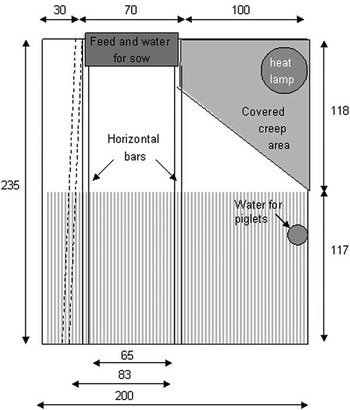
Sows were moved to the farrowing unit between 5 to 7 days before expected farrowing and thus provided at least 5 days to be accustomed to the farrowing house. Sows were randomly distributed to farrowing crates. The farrowing house consisted of 14 farrowing pens, measuring 2.35 m in length and 2.00 m in width (Figure 1). Half of the floor was concrete, whereas the remaining half at the hind part of the sow had a slatted metal floor. Sows were confined by horizontal iron tubing. Crates measured 2.00 m in length and were adjustable in width from 0.65 to 0.83 m. A covered piglet creep area was situated in the corner next to the sow’s feed trough (Figure 1). The creep area was heated by an IR heating lamp, and the heating lamp was turned on by the staff the day before expected farrowing. The air temperature in the farrowing room was kept constant at ~20°C throughout the experiment. Sows were fed twice daily with a standard lactating sow meal containing 8.40 MJ of NE/kg. Before farrowing, sows were fed a diet of 2.6 kg daily, and after farrowing, the feed of the sows was gradually increased according to the appetite of the sow over the next 2 weeks until they were fed for ad libitum intake. There was free access to water from a snout valve in the feed trough. In addition, sows and piglets were provided with chopped straw each day for nest building and enrichment; pens were cleaned daily before allocation of fresh straw.
Design of the farrowing pen (200×235 cm) used for housing sows in the radiant heat treatment and the control group. The striped area indicates a cast-iron slatted floor; the remaining floor is solid floor.

Experimental design
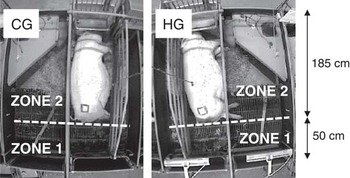
Each batch was divided into two groups of six sows; a control group (CG) and a heating group (HG). In HG pens, two IR radiant heating panels (Burda Term 2000 IP65, Burda, Eschborn, Germany; 0.62×0.13 m, scaled down to 450 W) were mounted with metal brackets on the back wall of the pen with the panels pointing downwards. To cover the entire width of the rear part of the pen, the panels were mounted one after another in parallel to the rear wall of the pen (Figure 2), 25 cm from the rear wall of the pen and 90 cm above floor level. The heating panels were chosen based on their high effect (450 W), a uniform heat distribution and their size (covered a large area). Traditional heat lamps generally have an effect between 150 to 250 W, often a more uneven heat distribution and cover a smaller area (~0.20 m2) (Davis et al., Reference Davis, Xin and MacDonald2008). Based on thermography, the heated area was defined as the area where the floor (slats) surface was heated to a temperature of between 26°C and 34°C 0.5 h after the heating panel was turned on. This area – covering 1 m2 – was assumed to be the area where the piglets had direct effect of the radiant heat and was defined as zone 1 (Figure 2). The heating panels were placed in every second pen on one side of the room, and in the opposite pens on the other side of the room. The location of heating panels in the pen was decided based on a pilot study in which the sow’s surface temperature along with its location in the crate was recorded, in order to ensure that the heater did not harm the sow.
Definition of zone 1 in the control group (CG) and the group with two radiant heating panels mounted at the back of the pen (HG). Zone 1 covered 1 m2 and corresponds to the area where the radiant heating panels had a direct effect on the piglets in the HG.

In each pen the heating panels were turned on at birth of first piglet (BFP) and were turned off 12 h after BFP. A rather short period of heating was chosen as the intention was to avoid that piglets stayed longer than necessary behind the sow with an associated risk of delayed colostrum intake. Before the experiment started, a smoke test was conducted using a smoke cartridge to ensure that the radiant heat did not change the air pattern so air of poor quality from the slurry channel was pulled up into the birth area. The smoke test showed no signs of manure ventilation.
Data sampling
All farrowings were attended by a trained technician who made all sampling and behavioural observations of the new-born piglets by direct observations. Of the original 36 farrowings, three litters had to be excluded since no experimenter was present at the time of birth. For observations, the pen was divided into two zones: zone 1, the first half metre of the rear end of the pen (equal to the area covered by radiant heat in the HG); and zone 2, which covered rest of the pen (see Figure 2). Time of birth for each individual piglet was recorded by the observer present. Each piglet was weighed (Ranger, Ohaus, Nänikon, Switzerland; capacity 6 kg, accuracy ±2 g) at 15 min after birth (BW), marked with birth number on the back and its RT was recorded with a handheld rectal thermometer (DIGI-TEMP Digital Thermometer; KRUUSE, Langeskov, Denmark, accuracy ±0.10°C). The piglets were individually weighed again 24 and 48 h after birth and on day 7 after BFP. The RT of piglets was recorded at 15, 30, 60, 120, 180, 240 min after birth and 720, 840 and 1440 min after BFP. Rectal temperature was measured by gently confining the hind part of the piglets by hand to minimise interferences and inserting the thermometer in the rectum. In most cases, the piglets continued with their previous behaviour immediately after being released; however, in a few cases, it was necessary to lift the piglet up from the pen for sampling, afterwards it was placed back into the pen in the same location. In between each sampling, the thermometer was cleaned with ethanol and lubricated with a gel.
In addition, birth zone of each piglet (zone 1 or zone 2, Figure 2), and the latency from birth to the piglet: (1) leave zone 1 first time, (2) reach udder (defined as first time the piglet is in contact with the udder or in contact with another piglet which is in contact with the udder) and (3) suckle for the first time (defined as the piglet is suckling at the teat for >5 s, Pedersen et al., Reference Pedersen, Damm, Marchant-Forde and Jensen2003) was observed for each piglet by direct observation. In a few cases where the observer missed a behavioural observation, the observation was made from digital video recording, recorded by a camera placed above each pen. All cameras were connected to a PC that stored the video files (using MSH-video software; M. Shafro & Co., Riga, Latvia). Continuous lighting was present in the farrowing house to allow manual visual observations throughout.
If the sow had >14 live pigs at 24 h postpartum, the litter was reduced to 14 piglets. The surplus piglets were chosen randomly and moved to non-experimental foster sows and were not included in the data set. The number of total born piglets per litter was 15.84, and after litter equalisation the litter size was 13.64 piglets. Out of the total 523 born piglets, 42 were stillborn, 31 were moved to non-experimental sows and 66 died during the experimental period (day 0 to 7). All piglets treated with antibiotics were registered including date, medication and cause. The RT of the sow was registered at the 24 h weighing of the piglets and again on the following day. If the temperature exceeded 39.5°C and the sows had a low appetite, the sow was treated with antibiotics. All treatments of the sow were registered including date, medication and cause.
Statistical analysis
For each piglet, the following variables were statistically analysed: RT 15, 30, 60, 120, 180, 240 min after birth and 720, 840 and 1440 min after BFP; time to leave zone 1; time to first contact with udder; time to first suckling; BW and weight gain (g) from birth to 24 h (gain 24 h), 48 h (gain 48 h) and 7 days (gain 7 days).The variables were analysed using PROC MIXED of SAS (Littell et al., Reference Littell, Miliken, Stroup and Wolfinger1996) using the following model:
 $$\eqalignno{Y_{{ijklm}} {\,=\,}&\mu {\plus}\alpha _{i} {\plus}\beta _{j} {\plus}{\rm X}_{k} {\plus}(\alpha \beta )_{{ij}} {\plus}(\alpha {\rm X})_{{ik}} {\plus}(\beta {\rm X})_{{jk}} \cr &{\plus}(\alpha \beta {\rm X})_{{ijk}} {\plus}\gamma _{{\rm l}} {\plus}\nu _{m} {\plus}{\varepsilon}_{{ijklm}} $$
where Y ijklm is the response variable of the individual piglet, µ the expected mean value of response variable, α i the effect of the ith treatment (HG, CG), β j the effect of the jth zone born in (Z1, Z2), Χ k the covariate birth weight of the kth piglet, (αβ) ij the interaction between treatment and zone born in, (αΧ) ik the interaction between treatment and birth weight, (βΧ) jk the interaction between zone born in and birth weight, (αβΧ) ijk the interaction between treatment, zone born in and birth weight, γ l the random effect of the lth batch, ν m the random effect of the mth sow within treatment and ε ijklm the residual error. For time to leave zone 1, time to reach udder and time to first suckling, a logarithmic transformation was used. If systematic effects were not significant (P>0.05), the model was reduced accordingly and the analysis was repeated.
Results
Rectal temperature
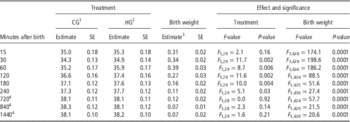
The RT was higher in HG than in CG at 30 min (P<0.01), 60 min (P<0.01), 120 min (P<0.01), 180 min (P<0.01) and 240 min (P<0.05) after birth, whereas no difference was found between HG and CG in RT measured 15 min after birth (P=0.16) and 720 min (P=0.92), 840 min (P=0.14) and 1440 min (P=0.21) after BFP (Table 1). Birth weight had a positive effect on RT, as piglets with a heavier BW had higher RT at all measuring points (P<0.001; Table 1).
The effect of radiant heat at the birth area (first half metre of the rear end of the pen, where the piglets are born) of new-born piglets and the piglets’ birth weight on the piglets’ rectal temperature (°C) during the first 24 h postpartum

1 The control group.
2 The group with radiant heat covering the birth area.
3 Differences in rectal temperature (±) per 100 g difference in birth weights compared with the average birth weight of 1226 g.
4 Minutes after birth of first piglet.
Behaviour
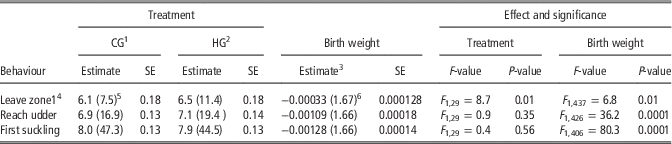
Time to leave zone 1 was 4 min longer in HG than in CG (P<0.01; Table 2). Whereas time to reach udder (P=0.35) and time to first suckling did not differ between treatments (P=0.56). Time to leave zone 1 was also affected by BW, as piglets with a low BW stayed longer in zone 1 for both treatments (P<0.01; Table 2). Piglets with a low BW took longer to reach the udder (P<0.001) and to first suckling (P<0.001).
Effect of radiant heat at birth site of new-born piglets on time (log (s)) from birth of piglet to: leaving zone 1 (first half metre of the rear end of the pen, where the piglets are born), reaching the udder and first suckling

1 The control group.
2 The group with radiant heat covering the birth area.
3 Differences in time (±) per g difference in birth weight compared with the average birth weight of 1226 g.
4 Calculated for the piglets born in zone 1.
5 Back-transformed value in minutes.
6 Back-transformed value in minutes per 100 g difference in birth weight compared with the average birth weight of 1226 g.
Birth weight and weight gain
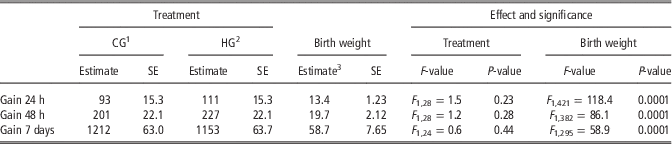
There was a tendency for higher BW in CG v. HG (CG: 1270±37.0 g v. HG: 1181±38.1 g, F 1,29=3.2, P=0.08). Weight gain did not differ between treatments at gain 24 h (P=0.23), gain 48 h (P=0.28) or gain 7 days (P=0.44; Table 3). Birth weight had a positive effect on gain 24 h (P<0.001), gain 48 h (P<0.001) and gain 7 days (P<0.001; Table 3.)
The effect of radiant heat at birth site of new-born piglets and the piglets’ birth weight on weight gain (g) from birth to 24, 48 h and 7 days after birth of first piglet in the litter

1 The control group.
2 The group with radiant heat covering the birth area.
3 Differences in weight gain (±) per 100 g difference in birth weight compared with the average birth weight of 1226 g.
Discussion
Results of the present study showed that radiant heat at the birth site decreased the drop in RT shortly after birth and RT remained higher until 4 h after birth. Previous studies have shown that RT 1 to 2 h after birth are biologically important postnatal survival indicators for piglets (Tuchscherer et al., Reference Tuchscherer, Puppe, Tuchscherer and Tiermann2000; Baxter et al., Reference Baxter, Jarvis, Sherwood, Robson, Ormandy, Farish, Smurthwaite, Roehe, Lawrence and Edwards2009; Pedersen et al., Reference Pedersen, Berg, Jørgensen and Andersen2011), thus the results of the present study indicate that providing radiant heat at the birth site is favourable for the survival of the piglets.
Effect of treatment
It is known that RT shows an initial drop immediately after birth (e.g. Le Dividich and Noblet, Reference Le Dividich and Noblet1981), even when piglets are placed in a climate chamber heated to 38°C to 40°C (Kammersgaard, Reference Kammersgaard2013). The extent of the initial drop and the rate of the subsequent rise depend on the external environment (Le Dividich and Noblet, Reference Le Dividich and Noblet1981; Malmkvist et al., Reference Malmkvist, Pedersen, Damgaard, Thodberg, Jørgensen and Labouriau2006; Pedersen et al., Reference Pedersen, Malmkvist, Kammersgaard and Jørgensen2013) and are negatively correlated to the chance of survival of the piglets (Tuchscherer et al., Reference Tuchscherer, Puppe, Tuchscherer and Tiermann2000; Baxter et al., Reference Baxter, Jarvis, Sherwood, Robson, Ormandy, Farish, Smurthwaite, Roehe, Lawrence and Edwards2009; Pedersen et al., Reference Pedersen, Berg, Jørgensen and Andersen2011). The first critical step to avoid hypothermia is to reduce the initial fall in RT as much as possible (Lossec et al., Reference Lossec, Herpin and Le Dividich1998). The lowest RT was measured 30 min after birth in the present study, corresponding to the time frame found in previous studies with air temperature around 20°C (Malmkvist et al., Reference Malmkvist, Pedersen, Damgaard, Thodberg, Jørgensen and Labouriau2006; Pedersen et al., Reference Pedersen, Malmkvist, Kammersgaard and Jørgensen2013). RT_0.5 h in CG (34.3°C) was close to the lower limit (~34°C) where thermoregulatory responses and carbohydrate metabolism are seriously impaired (Lossec et al., Reference Lossec, Herpin and Le Dividich1998). Adding radiant heat at the birth place reduced the drop in RT_0.5 h, even though the piglets left the heated zone after 11.4 min on average.
At birth, piglets are covered by ~23 g foetal fluid/kg BW (Christison and Thomason, Reference Christison and Thomason1997). Evaporation of the foetal fluid starts immediately after birth. Christison and Thomason (Reference Christison and Thomason1997) found that 50% of the foetal fluid is lost during the first 5 min, and 30 min after birth the piglets are virtually dry (air temperature ~21°C, % relative humidity ~70, air speed<0.01 m/s). A part of the foetal fluid is rubbed off, for example, against the penning, whereas the rest has to be evaporated. The part rubbed off depends on the piglet’s activity level, where inactive piglets will remove less foetal fluid and thus have to evaporate more (Christison and Thomason, Reference Christison and Thomason1997). If the heat of evaporation of foetal fluid is set at the heat of evaporation of water at 30°C (~2430 kJ/kg), it requires 56 kJ to evaporate 23 g foetal fluid, or if 50% of the foetal fluid is rubbed off, as suggested by Christison and Thomason (Reference Christison and Thomason1997), it requires 23 kJ to evaporate the foetal fluid. This energy has to be taken from the piglet or its environment. At air temperature around 22°C to 24°C, piglets’ heat production decreases from ~40 kJ/kg per h to a stable level of ~30 kJ/kg per h during the first 1.5 h after birth (Herpin et al., Reference Herpin, Damon and Le Dividich1994; Kammersgaard, Reference Kammersgaard2013). This means that if no extra heat source is given, the piglet’s heat production during the first half hour after birth just covers the energy needed for evaporation of 50% of the foetal fluid. In the same period, the piglet experiences a drastic change in temperature from about 39°C in the sow’s uterus to an air temperature around 20°C, which also increases the piglet’s thermal need. Thus, evaporation of foetal fluid is an important cause of hypothermia in new-born piglets and emphasises the importance of providing heat at the birth place, where the evaporation starts, to avoid hypothermia. Since the heat loss of low BW piglets is enhanced, this may be particularly important in high prolific sow lines as used in the present study.
Adding extra heat at the birth site, such as floor heating (Malmkvist et al., Reference Malmkvist, Pedersen, Damgaard, Thodberg, Jørgensen and Labouriau2006), has previously been shown to reduce postnatal hypothermia and increase survival rate. However, even though many authors have recommended positioning a heat lamp behind the sow during farrowing to reduce postnatal hypothermia (review, Kirkden et al., Reference Kirkden, Broom and Andersen2013), the effect on postnatal hypothermia has, to our knowledge, not previously been documented.
Andersen et al. (Reference Andersen, Haukvik and Bøe2009) found that placing piglets under a heat lamp in the creep area immediately after birth or after drying reduced postnatal mortality, which supports the findings by Christison et al. (Reference Christison, Wenger and Follensbee1997). In contrast, Ogunbameru et al. (Reference Ogunbameru, Kornegay and Wood1991) found no effect on piglet mortality of placing a heat lamp behind the sow during farrowing. They reported a high survival rate for both groups (above 93%, day 28), which may be the reason why they did not see an effect of the heat. However, also differences in the experimental setup between the studies may explain the differences in the results. During the piglet’s attempt to stand up, there is a risk that it moves away from the small area that a heat lamp covers and only achieves a very short effect of the heat. The radiant heater used in the present study covered a larger area, and in the studies by Andersen et al. (Reference Andersen, Haukvik and Bøe2009) the piglets were placed under the heat lamp in the creep area immediately after birth, where the sides of the creep area help keeping the piglet within the warm area during its attempts to stand up. In the study by Christison et al. (Reference Christison, Wenger and Follensbee1997) the piglets were placed under a heat lamp in the corner of the pen immediately after birth. None of the previous studies measures the actual time spent under the heat lamp, but Christison et al. (Reference Christison, Wenger and Follensbee1997) found the same time to reach the udder as in the present study. The present study and the studies by Andersen et al. (Reference Andersen, Haukvik and Bøe2009), and Christison et al. (Reference Christison, Wenger and Follensbee1997) indicate that a relatively short period with radiant heat, immediately after birth, is enough to reduce the initial fall in RT, and thus reduce postnatal mortality. Radiant heat is an effective way of providing energy for evaporation of the foetal fluid, thus the piglet loses less energy. Radiant heat may dry the piglet faster than floor heating.
A concern for providing radiant heat at the birth site was that it may delay time to first colostrum intake. However, even though the piglets in HG stayed longer in zone 1, there were no differences in time to reach udder or time to first suckling between the two groups. This is in agreement with the results by Christison et al. (Reference Christison, Wenger and Follensbee1997), who found no difference in time to reach udder or time to first suckling between a control group and piglets placed under a heat lamp immediately after birth. Malmkvist et al. (Reference Malmkvist, Pedersen, Damgaard, Thodberg, Jørgensen and Labouriau2006) also found no difference in time to reach the udder between piglets born on a heated floor compared with piglets born on a non-heated floor; however, their results showed that floor heating had a favourable effect on the initiation of suckling in particular for a group of apparently weaker pigs that otherwise took >1 to 2 h to suckle. The heat in the present study only covered zone 1, which means after the piglet had left the zone, no extra heat was obtained in comparison with CG (unless the piglet returned to zone 1). Allocation of additional heat in other areas of the pen may be advantageous to further avoid hypothermia (Morrison et al., Reference Morrison, English and Lodge1983). Pedersen et al. (Reference Pedersen, Malmkvist, Kammersgaard and Jørgensen2013) found no favourable effect on piglet RT of increasing duration of floor heating from 12 to 48 h after BFP in loose housed sows, indicating that piglets’ need for extra heat at birth is restricted to a few hours.
Effect of birth weight
The initial fall in RT was strongly influenced by BW. Heavier piglets had a lower drop in RT than lighter piglets in the present study, which is in agreement with previous findings (e.g. Herpin et al., Reference Herpin, Vicent and Damson2004; Pedersen et al., Reference Pedersen, Malmkvist, Kammersgaard and Jørgensen2013). The impaired ability of lower BW piglets to maintain homoeothermic balance in the cold is usually explained by their greater surface area-to-body mass ratio, which results in greater heat loss (Herpin et al., Reference Herpin, Le Dividich, Berthon and Hulin2002). In addition, BW affects the maximum cold-induced metabolic rate per kg weight, described by a broken line model with an impairment of thermogenic capacities below a BW around 1100 g (Herpin et al., Reference Herpin, Vicent and Damson2004), which is only ~100 g below the average BW of the currently used genetic breed. Birth weight below 1100 g was shown to result in piglets reaching their maximal heat producing capacities at a higher ambient temperature than heavier litter mates (Herpin et al., Reference Herpin, Vicent and Damson2004). In addition, low BW piglets also have a lower energy reserve at birth (Herpin et al., Reference Herpin, Le Dividich, Berthon and Hulin2002). These circumstances make low BW piglets more prone to experiencing deep hypothermia. Le Dividich and Noblet (Reference Le Dividich and Noblet1981) showed that RT depended on BW in a cold environment but not in a warm environment. Based on that, we expected that low BW piglets would have benefitted more from the heat treatment than high BW piglets, but no interaction between treatment and BW was found in the present study. The general low BW of the genetic breed used in our study compared to the previous studies may explain why all piglets benefitted from the extra heat. In accordance with the present study, neither Christison et al. (Reference Christison, Wenger and Follensbee1997) nor Malmkvist et al. (Reference Malmkvist, Pedersen, Damgaard, Thodberg, Jørgensen and Labouriau2006) found effects of heat treatment on daily gain. Malmkvist et al. (Reference Malmkvist, Pedersen, Damgaard, Thodberg, Jørgensen and Labouriau2006) suggested that the lower mortality in the heat treatment found in their study could have blurred the potential positive treatment’s effect on daily gain. The tendency to lower BW in the HG litters may also have counteracted a possible difference in weight gain and may also have underestimated the effect of adding the radiant heat at the birth site on hypothermia.
Conclusion
Providing radiant heat at the birth site reduced the initial drop in piglet RT and RT remained higher until 4 h after birth compared with a control group. In addition, more time was spent in the area behind the sow when radiant heat was provided there, while no effect on time to reach udder and to suckle for the first time was found. The results suggest that placing a radiant heat panel at the birth site in pens for crated sows may reduce the likelihood of piglets experiencing hypothermia and through that potentially reduce risk of early piglet mortality.
Acknowledgements
This study was funded partly by The Danish National Advanced Technology Foundation J.nr. 006-2008-1 and partly by ‘Svineafgiftsfonden’ as part of the project ‘Pattegriseoverlevelse 0-3 t efter fødsel. Effekt af varmekilde til nyfødte pattegrise i løsdriftsstier med spaltegulve’.