

Introduction
Does economic and social development depend upon the bold visions of leaders, the wisdom of technocrats, or the patience, work, and commitment of common people? The intellectual history of development studies is more closely allied to top-down planning and heroic reform that to the study, or agency, of ordinary citizens, hence the huge impact of Chambers'sFootnote 1 participatory development model from the 1970s onwards, which challenged not just the policy prescriptions, but the methods, ideas, and underlying approach of so much development thinking.
In a broadly similar vein, decentralization captured the policy agenda in the late 1970s, and has never really let go since.Footnote 2 In 1999, the World Bank estimated that more than 80 per cent of the world's countries had recently experimented, or were currently experimenting, with some form of decentralization.Footnote 3 Since then, new or deepening decentralization reforms have been announced in several dozen developing and developed countries.Footnote 4 As a useful approximation, we can say that decentralization is happening essentially everywhere.
What explains such broad and sustained enthusiasm? Unusually amongst development fashions, decentralization unites the urge for bold, top-down reform of so much development thinking with a focus on grass-roots development and the rights and agency of ordinary individuals. It allows both politicians and researchers to have their cake and eat it. Also, the claims made on its behalf are powerful.
Decentralization has been promoted across the world as a way to improve the efficiency and responsiveness of government, and hence the quality of public services.Footnote 5 Multilateral and bilateral development agencies, alongside non-governmental organizations (NGOs) of various types, adopted decentralization as a potential solution to a diversity of ills, from improving schools and health clinics to deepening democracy and raising the rate of growth. Meanwhile, detractors argue that local governments naturally suffer from less probity than national government, which additionally benefits from the best human resources available to the public sector. Hence, decentralization will tend strongly to increase corruption and decrease the quality of policymaking in countries that adopt it.Footnote 6
Which camp is right? As Faguet demonstrates,Footnote 7 both are. Decentralization is not a simple, linear reform that should be expected to have homogeneous effects across any country in which it is implemented. It is, rather, a complex reform that alters the rules, structures, and norms by which a society is governed. Its effects will vary as according to the underlying characteristics of the sub-national units (for example provinces, localities) affected. Hence we should expect decentralization to have heterogeneous effects across any country, and for this heterogeneity to increase as countries’ underlying diversity increases. The more interesting questions are: In any country that decentralizes, why do some local governments perform better in terms of accountable, responsive governance, and others worse? And as a result, why do some municipalities achieve better human development outcomes than others?
I explore these questions with detailed evidence from Bangladesh. I begin reviewing national-level evidence of decentralization's effect on primary services, before delving deep down into the local political economy and social dynamics that underpin the behaviours that, in the aggregate, comprise such national results. Micro-level evidence comes from two upazilas, which I analyse through the lens of Faguet's (2012) model of local government responsiveness and accountability, in order to shed light on the causal relationships that lead to better and worse local development outcomes. The ultimate goal is to better understand both how decentralization works, and how governance reform can help accelerate development in South Asia. The experience of working in this way will additionally provide deep insight into how questions of deep institutional reform should be studied.
The empirical literature to which this article seeks to add is enormous, including literally hundreds of published journal articles; add the ‘grey literature’ of policy studies and agency reports, and the number ascends into the thousands. Only a brief overview of some of the most relevant works can be provided here. Galiani, Gertler, and SchargrodskyFootnote 8 find that decentralization of school control from central to provincial governments had a positive impact on student test scores in Argentina, although the poorest did not gain and may have lost ground. Barankay and LockwoodFootnote 9 find that greater decentralization of education to Swiss cantons led to higher educational attainment, allowing boys to close the gender gap with girls. Eskeland and Filmer,Footnote 10 Faguet and Sánchez,Footnote 11 and ParryFootnote 12 also find that decentralization led to improvements in educational outcomes in Argentina, Colombia, and Chile, respectively. Johnson, Deshingkar, and StartFootnote 13 present evidence that India's recent decentralization empowered the rural poor in Andhra Pradesh and Madhya Pradesh through such instruments as rice subsidies and credit for women. But their enthusiasm is limited: the pro-poor outcomes achieved, they argue, were due to central and state governments’ ability to counterbalance the elite capture that decentralization tends to spawn.
ParkerFootnote 14 disputes the notion that decentralization naturally abets elite capture, arguing that reform is associated with better substantive outcomes as well as improved government processes. In various case studies, he finds evidence that decentralization increased beneficiary participation in decision-making in rural development schemes throughout Brazil, Colombia, and Mexico, leading to superior outcomes. Parker also relates the suggestive story of decentralization in Bangladesh, where extremes of wealth and power allowed local elites to capture nascent local governments.Footnote 15 Subsequent elections overcame this distortion, and over 90 per cent of local councilmen were ejected from office. Along similar lines, RowlandFootnote 16 and BlairFootnote 17 show how decentralization improved the quality of democratic governance in both large cities and small towns in India, Bolivia, Mali, Mexico, Honduras, the Philippines, and Ukraine. Shankar and ShahFootnote 18 find that the political competition spurred by decentralization decreased levels of regional inequality in a sample of 26 countries.
Huther and ShahFootnote 19 find positive correlations between decentralization and indices of social development, political participation, and an overall quality of government index in a sample of 80 countries, for which they infer causal relationships. CampbellFootnote 20 goes further, highlighting the huge scope of authority and resources that have been decentralized throughout Latin America. This is, he argues, a ‘quiet revolution’ that is generating a new model of governance based on high popular participation, innovative, capable leadership, and a new implicit contract governing local taxation. Such results are possible, according to Petro,Footnote 21 because decentralization affects not only formal, official institutions of government, but also spurs changes in the very fabric of society—its values, priorities, and social capital.
As for most questions that can be asked of decentralization, the evidence against is also compelling.Footnote 22 Much evidence points to decentralization's harmful effects on public services. Using subjective characterizations of the degree of ‘publicness’ of different health activities, Akin, Hutchinson, and StrumpfFootnote 23 find evidence that Ugandan local governments are allocating declining proportions of their budgets to public goods, and increasing shares to publicly financed private goods. Bardhan and MookherjeeFootnote 24 test for elite capture in 89 villages in West Bengal. Although they find little evidence of capture in the allocation of private goods, public goods projects do exhibit capture. They theorize that this is because public goods are inherently less transparent—it is less clear than for private goods who gets how much.
There is bad news on poverty and the environment as well. Decentralization will fail to improve access of the poor to natural resources, predicts Woodhouse,Footnote 25 and will fail to reduce ecological damage. Casson and ObidzinskiFootnote 26 go further: decentralization in Indonesia spurred depredatory logging by creating bureaucratic actors with a stake in its environmental degradation. Why do decentralized governments perform so poorly in terms of policy outputs? According to Ellis and BahiigwaFootnote 27 and Ellis and Mdoe,Footnote 28 the policy processes that it creates are to blame. Both find that decentralization propagated rent-seeking behaviour down to the district and lower levels in Tanzania and Uganda. Francis and JamesFootnote 29 and Bahiigwa, Rigby, and WoodhouseFootnote 30 similarly show that decentralization in Uganda has not led to independent, accountable local governments, but rather to elite capture. Decentralization has thus failed as a tool for poverty reduction in sub-Saharan Africa.Footnote 31
Montero and SamuelsFootnote 32 explain the empirical link between elite capture and decentralization, arguing that the political motives of reformers often combine with ex-post vertical imbalances to worsen both elite capture and regional inequality. Smith,Footnote 33 Solnick,Footnote 34 and Crook and SverrissonFootnote 35 go further, arguing that local government's lack of human, financial, and technical resources will prevent it from providing effective public services under decentralization, regardless of whether policies are ‘tailored’ to local conditions or not. Using similar language, SmithFootnote 36 and Crook and SverrissonFootnote 37 argue that power should remain in the hands of relatively resource rich central governments, as local government's lack of financial, technical, and human resources will cripple its production of local public goods.
A large set of results showing that decentralization can improve the quality of governance and policymaking are thus more or less counterbalanced by a smaller but still compelling set of results showing the opposite, leaving it hard to conclude whether reform improves or degrades governance. But perhaps this selection of studies is skewed? We can check for this by consulting the broadest surveys of the literature. These take a more positive view of decentralization, but are ultimately inconclusive. Rondinelli, Cheema, and NellisFootnote 38 note that decentralization has usually disappointed its supporters. Most developing countries implementing decentralization experienced serious administrative problems. The few comprehensive evaluations of costs and benefits conducted indicate limited success in some countries but not others. A decade and a half later, surveys by Manor,Footnote 39 Piriou-Sall,Footnote 40 and SmokeFootnote 41 are slightly more positive, but with caveats about the strength of evidence in decentralization's favour. Manor notes that the evidence, though extensive, is still incomplete, but ends his study with the opinion that ‘while decentralisation . . .is no panacea, it has many virtues and is worth pursuing’. Smoke, by contrast, finds the evidence mixed and anecdotal, and asks whether there is empirical justification for pursuing decentralization at all. Given the sheer size of the literature, our inability to answer even simple questions is striking.
Understanding decentralization
Before delving into new empirical evidence, it is useful to consider why the literature finds itself at such an impasse. As I have noted in more detail elsewhere,Footnote 42 this is largely due to a highly centralized (ironically) intellectual approach to the study of decentralization. Explicitly or implicitly, the majority of empirical studies of decentralization treat it as a top-down reform with simple, linear effects on the variables analysed. Decentralization is like ‘flipping a switch’, the effects of which flow symmetrically through a political and administrative system. Such a view is not only incorrect, but downright odd. As Beer,Footnote 43 Boone,Footnote 44 Grindle,Footnote 45 and PutnamFootnote 46 have noted, our first-order expectations for the effects of democratic decentralization should be heterogeneity. The point of decentralization is to devolve power, authority, and resources to sub-national officials with independent electoral mandates whom the centre cannot control. In such a situation, it is possible that elected officials in hundreds or thousands of local authorities would behave similarly. But it is highly, highly unlikely. It is far more reasonable to expect local governments’ reactions to decentralization to vary as much as their underlying social, economic, and political characteristics do.
Put another way, the question ‘Does decentralization improve service delivery?’ has two obvious answers:
-
1 Yes. Of course services will improve. In at least some localities, resources will be spent and decisions taken in such a way that education, health, and other services improve compared to what central government provided.
-
2 No. Of course services will worsen. In at least some other localities, resources will be spent and decisions taken in such a way that education, health, and other services worsen compared to what central government did before.
In a third set of localities, which in many countries may be the majority, services will continue much as before, neither significantly better nor worse, and decentralization will have little effect. This is true not by assumption, but by the very definition of decentralization, which even in relatively homogeneous countries should lead to a greater diversity of outcomes, in both type and efficiency. The ‘outputs’ of decentralization are thus the simple aggregation of all of the local outputs that reform produces. Each of these local outcomes is, in turn, driven by interactions of the underlying actors and characteristics of each place. The necessary implication is that, for much of the past four decades, researchers have been asking the wrong sorts of questions, of a type: ‘Is decentralization good or bad for policy variable X?’ A far better approach is to admit from the outset that decentralization leads to a broad heterogeneity of response, and ask: ‘Why are the good outcomes good, and why are the bad outcomes bad?’ To understand the effects of decentralization on any political and administrative system, we must begin our analysis at the grass roots. To understand decentralization, we must first understand how local government works.
A theory of (local) government responsiveness
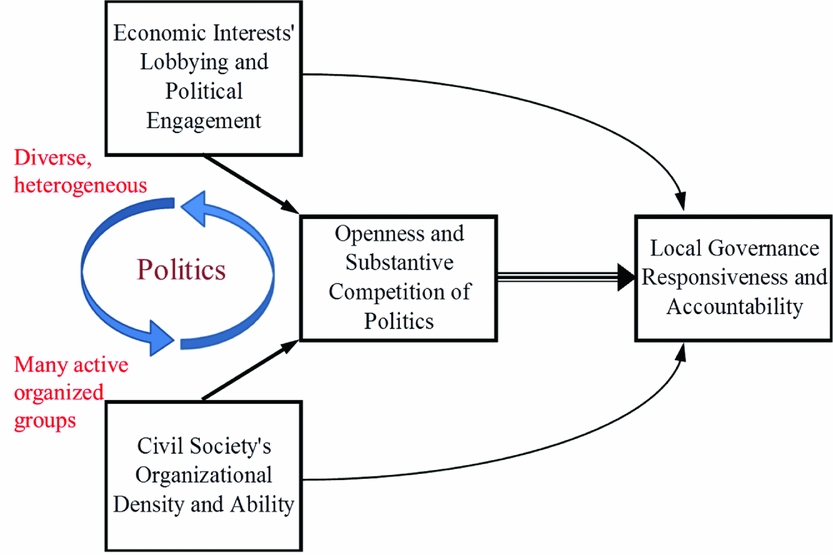
Why do some local governments work well and others badly? Consider Faguet's model of local governanceFootnote 47 depicted in Figure 1. Our goal is to understand the determinants of responsiveness and accountability in local governance. As the figure implies, the first-order determinant of a responsive, accountable government is an open, substantively competitive politics. Where politics is open to new entrants and focuses on issues of substance, as opposed to appearance, political competition will produce a strong inclusive tendency in the sense of not leaving significant groups of voters unrepresented. Political platforms will tend to focus on the real needs of voters and firms, rather than descending into beauty contests. Hence, the best predictor of governments that are accountable and responsive is open political systems where competition is substantive and political entrepreneurialismFootnote 48 possible.
A theory of (local) government responsiveness. Source: Reproduced from Faguet (2012), with permission from the University of Michigan Press.

But open, competitive politics is not a fixed municipal characteristic. Rather, it emerges endogenously through the interaction of local economic interests and civic organizations. Where the firms and other economic interests that comprise the local economy are diverse and heterogeneous, and where civil society is organized into many, active groups, and where these two sets of actors interact with one another through local politics, proposing needs, debating competing priorities, and searching for avenues of mutual benefit, local politics will tend strongly towards openness and competition as described above.
Where, by contrast, the local economy is dominated by a single large actor, the diversity of political forms that supports broad representation will tend not to emerge. And where civil society is atomized into individuals, and the intermediating organizations that aggregate preferences and organize collective action are missing, politics will tend to become divorced from society's needs.Footnote 49 In either case, politics will tend to be less open and less competitive, or competitive in dimensions orthogonal to the needs of voters and the economy. As the figure also implies, economic interests and civic organizations are capable of exerting direct effects on responsiveness and accountability, too. But evidence suggests that these effects are weak, and hence firms’ and civic organizations’ primary channel of influence is through the political system.
I apply this model to evidence from two local governments in Bangladesh with very different levels of performance. But first it is both useful and interesting to review national-level evidence on the effects of decentralization there, in the context of Bangladesh's recent development success.
Decentralization in Bangladesh
Bangladesh's decentralization programme began in 1997 with the Local Government Act, followed by the Upazila and Zilla Parishad Acts of 1998 and 2000. These reforms decentralized power and resources from central government to division, district, sub-district, and union levels, bringing forth a new era of decentralized government. In so doing, they took government ‘closer to the people’ and opened many new spaces for Bangladesh's vibrant civil society to participate in local decision-making.Footnote 50 It is nonetheless important to note that decentralization in Bangladesh falls short of the standard set in other countries, such as India, Colombia, and Bolivia, in terms of both the quantity of resources, and the scope of public authority devolved.Footnote 51
The past generation has brought significant progress to Bangladesh, which will come as a surprise to those who still view the country through the lens of the crises that attended its birth. At independence, observers described the country as a site of recurrent natural disasters, and a crowded labour reserve with few prospects for development.Footnote 52 But, in 1990–91, the country achieved a significant break in its growth and development trends, and moved onto a higher growth path averaging 3.2 per cent per capita between 1990 and 2005.Footnote 53 Economic growth was accompanied by impressive rates of poverty reduction and improvements in other social indicators. Between 2000 and 2005, for example, the share of population living in poverty declined from 49 per cent to 40 per cent, and that living in extreme poverty fell from 34 per cent to 25 per cent.Footnote 54
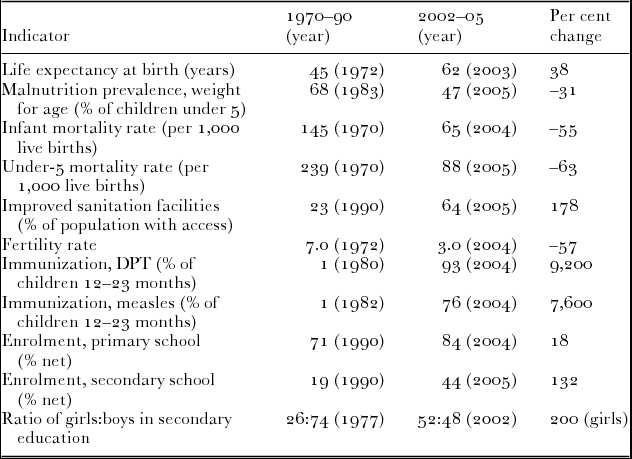
Longer-term trends in social development indicators show even faster progress. Table 1 details how such indicators have improved, often dramatically, between the 1970s and 1980s versus the 1990s and 2000s. Driven by such improvements, Bangladesh met its Millennium Development Goal (MDG) on gender parity in primary and secondary schooling a decade ahead of time, with current girl/boy ratios of 1.03 in primary schools and 1.14 in secondary schools.Footnote 55 Amongst 11- to 12-year-olds, slightly more girls than boys have been completing the five-year cycle for over a decade.Footnote 57 The MDG target of halving the population living in poverty was met in 2012. Bangladesh also met MDGs on reducing the poverty gap ratio, reducing under-five mortality, containing HIV infections, children under five sleeping under insecticide-treated bed nets, and the detection and cure of tuberculosis. Indeed, it is notable that, despite a GDP/capita only half that of India, ‘Bangladesh is doing better in all aspects of human development than India’.Footnote 58 In such key social indicators as life expectancy, infant mortality, under-five mortality, total fertility, infant immunization, and a number of indicators of women's well-being, Bangladesh has raced ahead of its giant neighbour despite slower economic growth.Footnote 59
Improvement in Bangladesh's social development indicators.

Source: World Bank (2007); Library of Congress (2008)Footnote 56
But other MDGs, such as maternal mortality and health, child malnutrition, women's employment generation, adult literacy, and forestry cover, were not met.Footnote 60 Accelerating progress in these areas is an important priority for both donors and the government. One contribution of this article is to analyse the locally specific institutional underpinnings of rapid social development.
Impressive as these changes are, closer examination reveals persistent, striking variation across space in key social indicators. For example, primary completion and enrolment rates are respectively 62 per cent and 54 per cent higher in the highest regions of the country than the lowest. Trends diverge even within the same city: the ratio of girls to boys in school is 30 points lower in ‘Standard Metropolitan Area’ Dhaka than ‘Other Urban’ Dhaka. Infant mortality, measles vaccination coverage, and child malnutrition also vary significantly across Bangladesh's regions. And even these large differences—essentially amongst different parts of the public service provision system—are trumped by variation between public and non-governmental service providers. Chaudhury, for example, uses data from 1994–2004 to show that areas of the country served by a pioneering NGO in health care, Gonoshasthaya Kendra (GK), reduced infant mortality consistently to levels of 32 per 1,000 live births in 2004, while the country as a whole remained above 50.Footnote 61
How can we explain such large differentials? Following North, Williamson, Olson,Footnote 62 and other institutional theorists, my analysis is based on the notion that differences in social indicators are explained by the wide variations in primary service provision (for example, health care, education) across Bangladesh. And variations in service provision are explained by the different patterns of accountability and objective incentives that local officials face. And incentives and accountability are largely explained by the underlying understandings and dispositions that individuals must share if formal and informal institutions are to work effectively.Footnote 63
Hence, to understand decentralized outcomes, we must go beyond the organizations that produce successes and failures in public service delivery, beyond the institutions in which they are enmeshed, and beyond even the informal rules and conventions that govern incentives. We must go down to the underlying dispositions, understandings and beliefs that drive social behaviour, and so help determine whether a particular set of organizations and policies can successfully meet citizens’ needs, or not. By focusing our analysis at this level, we can better understand the incentives faced by both the users and producers of public services, and hence the degree of accountability faced by public servants. And, institutional theorists tell us, when we understand incentives and accountability, we are a long way towards understanding public-sector effectiveness.
This article investigates the operation of such a pathway in Bangladesh via close examination of the institutional and social underpinnings of service provision in two upazilas. Upazilas are the third of four levels of sub-national administration in Bangladesh, with an average population of 250,000, and are roughly similar to municipalities elsewhere.Footnote 64 The two cases were chosen purposively from the extremes of high- and low-performers in terms of social development outcomes, focusing especially on child and maternal mortality. I focus on extremes of performance in the hope of gaining analytical richness and insight into the object of this research: the causes of bad and good social development outcomes. I dwell mostly on the health sector in the interest of focus and brevity. Rajnagar is the low-performing upazila, and Saturia is the high-performer.
My evidence is based on extensive qualitative and quantitative fieldwork by a team from the Bangladesh Institute of Development Studies. It indicates that two factors are responsible: (1) services are in much higher demand in Saturia, with greater knowledge of the benefits of health care, greater acceptance of modern clinical methods, and fewer barriers to access due to traditional customs and beliefs; and (2) health-care provision is systematically better in Saturia, with services more suited to the needs and characteristics of the local population made available to more villages more frequently than in Rajnagar. I explain these differences as a function of the deeper social and institutional context in which services are demanded, and provided, in each upazila.
Local government at the extremes: Saturia and Rajnagar
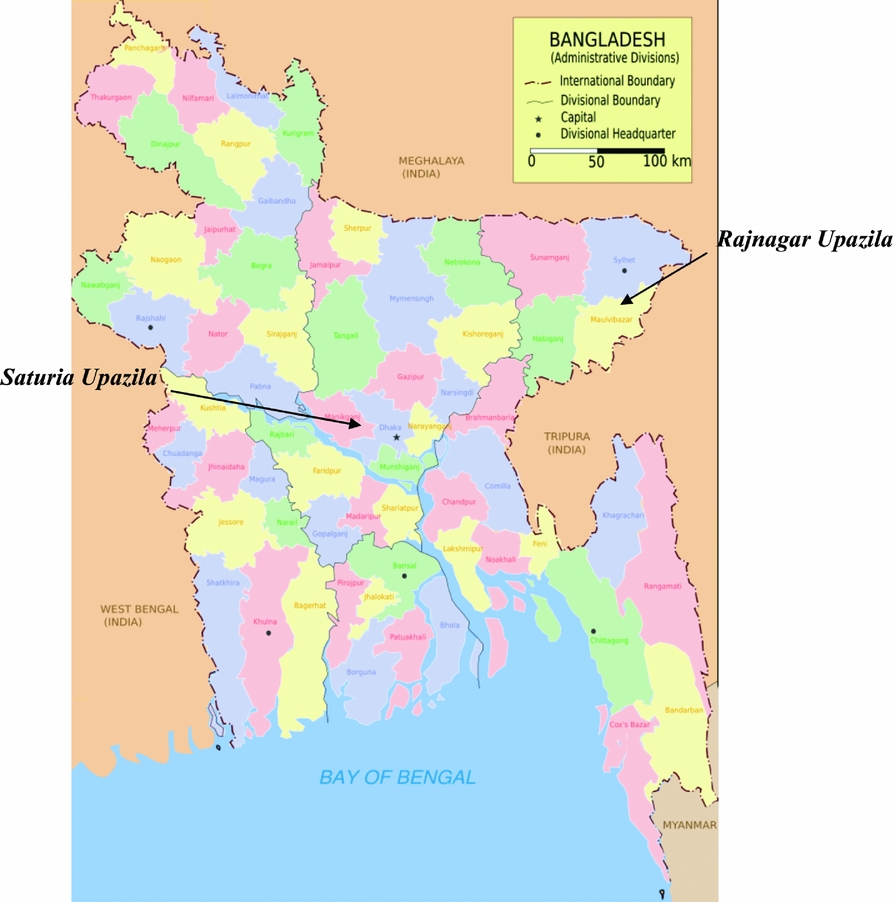
Rajnagar upazila is located in Moulvibazar district on Bangladesh's eastern border with India, while Saturia upazila is located in Manikganj district west of Dhaka. Figure 2 locates them on a map of Bangladesh. Despite being farther from the capital, Rajnagar is wealthier, with more livestock assets per family and an average household income of Tk. 7,081/month compared to Saturia's Tk. 5,831/month. Average landholdings are lower in Saturia, at 137 decimalsFootnote 65 per household, versus 182 in Rajnagar. And Saturia's literacy rate of 58 per cent is also lower than Rajnagar's 64 per cent. This is at least partly due to Rajnagar's large diaspora in the United Kingdom, and the remittances they send home. Indeed, it is possible to fly directly to the United Kingdom from the nearby airport in Sylhet. But inequality is also higher in Rajnagar, with more households in both the extreme rich and poor categories, while 86 per cent of Saturia's population lies in the middle two categories.
Rajnagar and Saturia. Source: Map courtesy of Armanaziz and Wikipedia, under a GNU free documentation licence.

Paradoxically, Rajnagar has systematically worse health indicators than Saturia. Under-five mortality in 2005 was 40 per 1,000 in Rajnagar, compared to 13 per 1,000 in Saturia; the notional maternal mortality rate over the previous five years was 791 per 100,000 live births in Rajnagar, compared to 0 in Saturia; and the prevalence of illness in Rajnagar was 36 per cent, compared to 25 per cent in Saturia. Data on complications during childbirth tell a similar story: mothers in Saturia suffered less from long labour, excessive bleeding, high fever, and convulsions than mothers in Rajnagar. In light of this, it is not surprising that Rajnagar has had considerably less success in reducing its maternal and child mortality rates over the past few years than Saturia.
It is also not surprising that much of this is due to Saturia's better infrastructure and superior provision of health services. Pregnant mothers receive less antenatal care in Rajnagar (73 per cent), for example, than Saturia (91 per cent). Fewer mothers are informed about the signs of pregnancy complications in Rajnagar (63 per cent), and where to go when they occur (73 per cent), than Saturia (83 per cent and 87 per cent). Access to sanitary toilets is lower in Rajnagar (69 per cent) than Saturia (90 per cent). Fewer mothers receive nutritional supplements and vaccinations during pregnancy in Rajnagar, and fewer have a post-partum check-up, and less quickly, than in Saturia. Additional data on child-health interventions and outcomes in the two sub-districts are summarized in Table 2.
Selected child-health indicators by upazila

If local wealth does not explain these divergent health outcomes, what does? The answer cannot relate to the structure of the health sector nor of local government, nor to the design nor quantity of the physical infrastructure available, as these are common to both upazilas. Both Rajnagar and Saturia benefit from similar administrative apparati, with similar levels of resources and staffing. And both are served by the Ministry of Health and Family Welfare, which uses a standardized, homogeneous model of health provision in Bangladesh that allocates resources mechanically, deploys assets uniformly, and is as a result insensitive to local characteristics or variations in local demand.Footnote 66 Both upazilas have benefited similarly from health reforms implemented over the past 30 years, especially in the fourth and fifth five-year plans, which launched important efforts to reduce maternal and infant mortality, and introduced a basic package of primary services called the Essential Services Package (ESP).Footnote 67 While experts agree that these reforms have helped improve Bangladesh's health indicators,Footnote 68 their impact in Rajnagar and Saturia has not differed. Hence the variations described above must be due to something else.
If the answer is not local health ‘hardware’, can differences in performance be explained by aspects of the health system's ‘software’? Visits to the two upazilas reveal differences in the maintenance and operation of health facilities that are striking and systematic. Saturia's Upazila Health Complex (UHC) was clean and well maintained, with more bathrooms available, all in working order and clean, the operating room used regularly and in good repair, and staff absenteeism of only 1 per cent. Contrast this with Rajnagar, where staff absenteeism was ten times greater, toilets were so dirty they had become unusable, most of the rooms, wards, windows, and doors were damaged, and the operating room was abandoned. Health workers made far fewer community visits in Rajnagar than Saturia, leaving residents more reliant on this degraded infrastructure. In detailed interviews, patients in Saturia reported being quite happy about the quality of services they received, while in Rajnagar opinions were far more negative.
Such differences grow sharper at lower (‘more local’) levels. The Union Health and Family Welfare Centre (UHFWC) visited in Rajnagar had no doctor in charge and was badly understaffed. When staff attended at Satellite Clinics (SCs) in the villages, it was forced to close, leaving it open only three days a week. By contrast, the UHFWC in Saturia was fully staffed and open five days a week. Facilities were badly maintained and dirty in Rajnagar, with the toilets once again unusable, but well maintained and clean in Saturia. In Saturia, medicines were well stocked and regularly replenished, whereas Rajnagar received no medicines from the Ministry. Saturia's water infrastructure was in good repair, but in Rajnagar the tubewell did not function, and water supply lines were damaged. Both have electricity but, while in Saturia the operating room was in good order and regular use, very few fans or lights worked in Rajnagar, making it unusable.
Not surprisingly, performance indicators were higher in Saturia than in Rajnagar. In 2005, the Saturia facility treated 8,000 patients, while the Rajnagar facility, which served a larger overall population, treated only 4,400. This occurred at the village level too—on the day each was visited, only 24 patients were treated at the Rajnagar SC compared to 85 at the Saturia SC. This helped reduce costs in Saturia. Better functioning of each element of the health services pyramid not only extended services to more patients, but treated many conditions at lower-cost installations, such as SCs, effectively reducing unit costs throughout the upazila.
Objective differences between the two upazilas in health services translate directly into subjective measures of the quality of care received. Patients in Rajnagar reported far lower satisfaction with a number of important factors, including: availability of doctors, availability of drugs, physical infrastructure, utilities, quality of food, waiting time, cleanliness and hygiene, the attitudes of their doctors and other service providers, attitudes of office staff, privacy of treatment, availability of medical supplies, and the quality of treatment received. Patients in Rajnagar reported much longer waits for treatment than those in Saturia, where 72 per cent thought they would be able to follow doctors’ instructions, versus 56 per cent in Rajnagar.
In summary, Saturia and Rajnagar were endowed with structurally identical public health systems, and a similar quantity and design of assets. But these assets were used in very different ways, leading to significant differences in the quantity and quality of services provided in each. Such differences led to significant differences in real health outcomes, and explain why people in Rajnagar suffered from more diseases, and had less healthy mothers and children, than those in Saturia.Footnote 69
Theorizing the transformation of governance
The contours of this contrast are all the more remarkable when we consider how recent it is. As Ali and RahmanFootnote 70 point out, until the late 1990s, attitudes and behaviours towards health were quite similar across the two upazilas, resulting in similar outcomes. ‘It was not like this ten years ago,’ observed one interviewee, recalling Saturians’ fears and superstitions concerning modern health care, especially maternal health. But now attitudes have changed, and performance has followed. How do we explain these changes?
To answer, we must dig deeper into the underlying incentives and behaviours at work in local government. Following the examples of Evans, Ostrom et al., and Tendler,Footnote 71 we must understand how these incentives and behaviours arise out of people's beliefs and social relations. Consider first focus group evidence on the important differences in how public services were monitored in the two upazilas. In Saturia, health authorities reported extensive monitoring by their superiors at the district level, with frequent visits to the area; in Rajnagar, their similars reported no such monitoring. Monitoring establishes upwards accountability in Saturia's health system, and no upward accountability in Rajnagar.Footnote 72
The active involvement of union parishad (UP) officials in health-delivery issues makes downward accountability binding in Saturia. UP chairmen take steps to facilitate proper implementation of health programmes in Saturia, and union officials regularly monitor service quality in towns and villages. Our research team corroborated this in many specific ways in Saturia, but found no evidence in Rajnagar, where health officials operated in an institutional vacuum, disconnected from both their superiors and elected representatives.Footnote 73 In such a context, it is not surprising that performance was unresponsive. This echoes Chaudhury's findings on the health NGO GK.Footnote 74 He attributes GK's remarkable success in improving basic health-care indicators to the community-level upwards and downwards accountability it is able to generate.
The attitudes and behaviours of ordinary citizens also differed remarkably in Saturia versus Rajnagar. Saturia's citizens were extensively involved in the delivery of health services, and interactions between health workers and citizens were regular and often intense. As a result, health workers maintained quite close relationships with the people they were meant to serve, and involved them closely in decision-making. By contrast, ordinary people were kept at arm's length by Rajnagar's authorities. Popular involvement in health-service planning and delivery was almost nil. Citizens were far less informed about local problems, and far less likely to contribute to their solution.Footnote 75
Consistently with its more vigorous institutions and more responsive public services, citizens in Saturia hold different ideas and attitudes about these services, which supported a higher level of demand and more active engagement. Men encourage women to participate in health programmes and immunization drives. Traditional social norms no longer intervene. ‘Everyone realizes now that having more children is the cause of poverty,’ explained one respondent. Women visit the hospital alone if required, pregnant mothers are vaccinated, and women use birth control. Such behaviours span the social ladder.
New attitudes and dispositions that are conducive to better health, and the information on which they are based, operate not just at the individual level, but are reinforced and magnified through social interaction. New ideas circulate, and new health-care standards are adopted by the group, which can then mobilize in aid of needy members, further reinforcing the importance of medical care. Institutions do not operate in a psychological vacuum, as Bourdieu, Brett,Footnote 76 and others have pointed out, but rather rely on attitudes and dispositions compatible with their core ideas. In Saturia, a dense web of social and institutional relationships powerfully reinforce health-compatible attitudes. Elsewhere in Bangladesh, GK anchors its health programmes in local communities, relying on natural authorities and village workers, and so exploiting their local knowledge and credibility.Footnote 77 Significantly, BRAC—another large NGO with notable success in the health sector—uses a similar model.Footnote 78
In Rajnagar, such relationships unfortunately do not exist. The ideas and attitudes towards health care that dominate locally lead, instead, to poor health. Faith in traditional and spiritual healers is much more apparent than in Saturia, and contraceptive use lower. Villagers report pregnant mothers’ suspicion of antenatal care, because ‘when mothers take those tablets, the baby becomes too healthy. As a result, child delivery is not possible without surgery. So we do not like to give mothers those free tablets provided by the government’.Footnote 79 In the home as well, nutritional supplements are spurned as families choose to rely instead on traditional diets. Villagers shun visits to health centres and medical staff, and so pregnant women requiring interventions tend to arrive at the UHC in a near-critical state. In some villages, pregnant women may not venture out of the house even if gravely ill. And in most cases, a close male relative must accompany mothers. There is some evidence suggesting attitudes are beginning to change. But change in Rajnagar is painfully slow.
How do we explain these systematic differences in attitudes, and the personal and institutional relationships in which they are enmeshed, that characterize our two districts? This article argues that they are tied to two exogenous factors: history and geography. Consider first geography: Saturia lies about 50 kilometres west of Dhaka, and is well connected to it by high-quality transport, telecommunication, and media links, as well as a dense network of personal and professional contacts. The last is key. Saturians can easily commute to work in Dhaka, while officials, academics, and NGO professionals from Dhaka can easily make day trips to Saturia, often in search of a more ‘typical’ Bangladeshi context (i.e. not Dhaka) for fact-finding missions, pilot projects, studies, and so on. Hence the presence in Saturia of Dhakan ideas, attitudes, and dispositions is readily apparent. Rajnagar is some 300 kilometres north-east of Dhaka, and none of this holds true there. Access to Dhaka is typically by air plus road travel via Sylhet, or a long trip overland. Regular contacts with the capital are accordingly fewer and less intense. Rajnagar sits where the broad Bangladeshi plain meets the north-eastern foothills, producing a geography that is quite different from the rest of the country. Residents report feeling ‘special’ within Bangladesh, and ‘isolated’ from the capital. Such feelings inform their behaviour and their identity.
Second, Rajnagar's history makes it more religiously conservative and observant than Saturia. In 1303, Hazrat Shah Jalal, a messianic Muslim saint from Mecca, arrived in the region and helped defeat the local ruler. With the aid of 300+ companions, he spread Islam throughout the region before dying in nearby Sylhet around 1350. Sylhet thereby became a centre of Islam in Bengal. Shah Jalal's shrine in the main mosque complex is highly revered, and a holy destination for pilgrims from across South Asia. The example of conservative, militant Islam championed by a local saint and the presence of his shrine as a place of pilgrimage and veneration reinforce a conservative religious orthodoxy in Rajnagar in a way that has no parallel in Saturia. This orthodoxy underpins a set of ideas and behaviours that translate into specific health-care practices and outcomes.Footnote 80 Modern medicine is suspect in Rajnagar, its women are not allowed to venture out of doors unaccompanied, and they have much less power to make important decisions about their lives than in Saturia. Such ideas and behaviours are crucial drivers of the inferior social development outcomes identified in Rajnagar.
The third important factor is a combination of history and geography: Rajnagar has a much lower intensity of NGO interventions than Saturia—a difference sustained over several decades. NGOs have played a significant role in raising awareness amongst the rural poor and women in Bangladesh since the 1970s, changing attitudes towards health care and education, and promoting economic empowerment and participation. As a result, women in Saturia are informed about, seek, and even participate in the provision of maternal and child health care, birth control, and education, to name three key services. Economic empowerment has benefited a large share of Saturia's men as well, and income-earning activities—such as weaving, pottery-making, and the transformation of foods for market—are commonplace in many households. In Rajnagar, none of this is true. Proximity to Dhaka undoubtedly facilitates a greater NGO presence in Saturia. But it is the intensity of NGO engagementFootnote 81 —and its persistence over decades—that has permitted their interventions to transcend infrastructure and skill-building, to reach the deeper beliefs and behaviours of the population.
Conclusions
The study of decentralization has for too long assumed that local government reforms are a sort of ‘switch’ that is thrown from on high, producing symmetric effects throughout a country. But if governments are autonomous, and local officials freely elected and beholden to local constituencies, then this idea is absurd. This article argues that decentralization leads, instead, to a heterogeneous response. This is because what decentralization does is to set loose a large number of local political economy dynamics that are as diverse as the underlying characteristics of all a country's localities. Hence, the way to understand decentralization is from the ground up, not as a disturbance in government from above, but rather as the onset of governance from below.
Adopting this view, what do we find? Saturia and Rajnagar have similar health-service administrations, similar infrastructure and equipment, similarly qualified staff employed by a common central ministry, and similar local government administrations, but very different social outcomes. Why? Because their assets and personnel were deployed in very different ways, resulting in different levels of service outputs. How did this come about? The answer lies in deep changes in Saturians’ dispositions and understandings towards the value of health care and other primary services. These are a product of rising education levels described above, plus public authorities’ implementation of a primary health-care model at district and upazila levels. These elements came together to make Saturians seek out modern health care, and hold their authorities accountable for its effective provision. Considerable evidence not documented here implies that similar dynamics have occurred in education and water, and with respect to local government more generally.
But both education improvements and a new model of primary health care are national phenomena in Bangladesh. Why did Saturia take advantage of them to improve social outcomes while Rajnagar did not? Because such advances were like seeds planted in an institutional soil that nourished them in Saturia, allowing them to take root. This ‘soil’ consists of a dense web of relationships between the upazila's natural and legal authorities, service providers, and its citizens, which enmeshed such advances—and the reformers driving them forward—in local systems of legitimacy and authority. As a result, both reforms and reformers were strengthened, and society made more susceptible to change. Saturia's institutional soil was made fertile by a history of sustained NGO involvement, its proximity to the capital, and a relatively open, tolerant religious tradition. Similar institutional underpinnings, by contrast, were missing in Rajnagar. Citizens felt less connected to their authorities and less empowered. Geography and history made barren the soil on which the seeds of change fell, and social development stalled.
In terms of the model, the key difference concerns civil society's complement of organizations and internal dynamics. Indeed, one of the most interesting advantages of applying the model to Bangladesh is how the evidence allows us to peer into the black box of civil society's organizational dynamic and focus on the web of relationships, and the attitudes and behaviours it supports. In Saturia, civil society was more densely populated by organizations, including but not limited to NGOs, and by social connections both amongst Saturians and between Saturia and Dhaka. These organizations use this denser web of connections to alter traditional behaviours and impart new information in ways that raised human capital there. The immediate effect was more responsive, accountable local government. The longer-term, and more interesting, effects were not only improved levels of social development, but also deep changes in Saturia's social norms and culture. In Rajnagar, by contrast, civil society was dominated by the mosque and by religiously inspired beliefs regarding health and the role of women. Penetration by NGOs and other outsiders was far lower, and nonreligious civic organizations fewer and less influential. This organizational structure of society supported a local government that was less accountable and less responsive to citizens’ needs. As a result, traditional ideas and behaviours reproduced themselves far more easily in Rajnagar, and social development lagged.
This article has interesting implications for both the study of local democracy and our understanding of the recent Bangladeshi experience. Regarding local democracy, the model presented above was originally developed to explain diverging municipal performance in Bolivia. But it can explain differences in local government outcomes—measured in different ways—in Bangladesh as well, and so travels well across very different economic, political, social, and geographic contexts. It further allows us to understand why a common policy reform, producing a common local government framework, can nonetheless have radically different outcomes in different municipalities. Outcomes will differ as a function of the underlying social and economic characteristics of each locale, and the political dynamics they generate.
The model also helps to demystify what has become known as the ‘Bangladesh paradox’. This flows from the empirical observation that a very poor country with low levels of public-sector effectiveness and probity has nonetheless made rapid strides in social development since the early 1990s. The answer it suggests is that central government ineffectiveness can be overcome by successful governance from below. In a country with a weak central state, a strong, organizationally dense civil society can partner with active, technically capable NGOs to deploy private and public resources in ways that improve local government services, and hence social development outcomes. In effect, civic organizations and NGOs can empower local authorities to effect powerful change, not just in public services, but in the underlying beliefs and behaviours that comprise culture. At the limit, the Bangladeshi experience suggests, these effects allowed Bangladesh to leapfrog much richer India in terms of social development.