

Archaeology has long relied on a broad, stratified, and uneven labor force, whose contributions remain largely unacknowledged. Beneath the formal outputs of the discipline (excavations, reports, publications, museum collections, and archaeological sites open to the public) lie the sustained efforts of field technicians, students, translators, and community collaborators, who undertake crucial manual and intellectual tasks without receiving commensurate recognition, compensation, or authority. In Latin America, these forms of labor constitute the epistemic and material infrastructure of archaeological knowledge, yet their visibility is systematically limited by disciplinary conventions and institutional hierarchies.
This long-standing inequality is now intersecting with a period of rapid technological transformation. Digital platforms, interactive mapping tools, new technologies such as lidar, automated transcription systems, and emerging forms of artificial intelligence are reshaping how archaeological data are produced, preserved, and circulated. However, in Mexico, these technologies enter a field already marked by extraction, precarious labor conditions, and a narrow definition of “legitimate” archaeological practice. As a result, archaeology finds itself at a critical juncture.
It is within this context that the present article intervenes. We ask: how can archaeology confront the politics of labor in the digital age, and what insights emerge from MONARO (Modeling Oral Narrative in Central Veracruz, Mexico)—a long-term collaborative project with Nahua communities in Mixtla de Altamirano? Drawing on this ongoing initiative, we examine how digital practices (ranging from deep interactive mapping to automated and manual transcription, translation, and annotation of Nahua oral narratives) constitute substantive forms of archaeological labor. Although these practices are indispensable to the preservation and interpretation of cultural memory, they remain unrecognized within Mexico’s state-defined boundaries of archaeological legitimacy. MONARO therefore reveals both the intellectual depth of these tasks and the structural conditions that marginalize them, offering a framework for rethinking labor, value, and technological practice in contemporary archaeology.
The Invisible Work: The Political Economy of Archaeology
These structural inequalities take concrete form in how archaeological labor is organized, valued, and rendered visible within the discipline. Rather than being incidental, the uneven distribution of recognition, compensation, and authority reflects a broader political economy that shapes who is acknowledged as a producer of knowledge and who remains invisible. A relatively small circle of credentialed professionals (typically affiliated with state agencies, universities, or museums) receives primary credit for discoveries and interpretations, whereas a much larger and largely invisible workforce of students, technicians, and community members performs much of the physical and analytical labor with limited recognition. This division is not incidental; it is rooted in the nineteenth-century colonial formation of the discipline and its political economy. Archaeological labor hierarchies have historically intersected with gendered and racialized divisions of work, consigning women and Indigenous workers to undervalued and insecure tasks while professional credit accrued elsewhere (Hardy and Hardy Reference Hardy2014; Ortiz Brito Reference Ortiz-Brito2024).
In Mexico, these hierarchies are deeply embedded in how archaeological value is produced and distributed. Project directors, professors, and institutional archaeologists accumulate academic capital (publications, prestige, and job security) through the surplus labor of lower-level workers, who are paid little or nothing. Local workers (often hired as peones or jornaleros) are typically employed only seasonally and at low wages, a practice that systematically devalues manual labor and Indigenous knowledges while obscuring their central role in research production (Ortiz Brito Reference Ortiz-Brito2024). The disconnection between those who perform archaeological labor and those who benefit from it is a defining feature of the discipline’s political economy.
Marx’s concept of surplus labor is instructive here, given that much of the value generated through excavation, documentation, and interpretation is captured by institutions and project leaders rather than by the workers themselves. Early career archaeologists frequently move between short-term contracts without benefits or job security, a condition that mirrors precarious labor regimes in commercial archaeology worldwide. Indigenous and local collaborators, who also participate with landscape knowledge, are rarely credited as intellectual contributors. Their work is often acknowledged, if at all, as manual assistance. In Mexico, this dynamic is reinforced by national heritage regimes that centralize control over archaeological practice and effectively dispossess Indigenous communities of authority over their own heritage in the name of preservation (Flores Reference Flores2010).
These extractive dynamics are not limited to community labor. Archaeological training itself often institutionalizes unpaid work under the guise of professional formation. Globally, students are expected to “pay to play” through field schools or to work without compensation in exchange for experience (Ribeiro and Giamakis Reference Ribeiro and Giamakis2023). In Mexico, thesis students routinely perform essential analytical, cartographic, and documentation work without remuneration, while their academic progression depends on project directors’ control over data access, permits, and evaluation. This structure normalizes exploitation as pedagogy and reproduces asymmetrical power relations within the discipline.
After graduation, labor precarity intensifies. Those with family resources or minimal economic responsibilities may continue working on poorly paid projects or internships in the hope of securing long-term employment, whereas others are forced to leave the field. Academic teaching positions are similarly precarious, typically part time, poorly paid, and geographically demanding. These conditions are compounded by gendered inequalities and documented patterns of harassment, particularly affecting women during fieldwork and early career stages (Espinosa-Severino Reference Espinosa-Severino2025).
Despite growing awareness of these conditions, much of the debate has remained largely diagnostic, cataloguing injustices without fully interrogating the political economic structures that sustain them. Questions of who funds archaeological work, who benefits from it, and how value is distributed remain underexamined. Situating archaeology within broader regimes of precarious labor under global capitalism reveals a familiar pattern: a passion-driven field in which overqualification coexists with underpayment, and advancement is often possible only for those who can afford prolonged economic insecurity. In Mexico, structural constraints (extended degree requirements, mandatory unpaid social service, and limited funding) further disadvantage local students relative to their international counterparts.
Understanding this invisible labor is essential for rethinking archaeology’s future. A more critical approach must examine how resources, credit, and infrastructure are allocated, and how definitions of “legitimate” archaeological work exclude significant forms of knowledge production. This analysis does not claim that all archaeological practice is uniformly extractive. Rather, it identifies structural tendencies that become especially visible under conditions of institutional monopoly, precarity, and limited accountability. By confronting these dynamics directly, we set the stage for examining how alternative forms of collaboration and technological practice might support more equitable and dignified archaeological labor relations.
“Legitimate” Archaeology in Mexico
In Mexico, the power to decide what counts as archaeology, and therefore what counts as knowledge of the past, has been centralized in the hands of the state. The Instituto Nacional de Antropología e Historia (INAH) was created to protect the nation’s patrimony (heritage), but over the decades, this mission has been eroded and translated into a narrow definition of archaeological legitimacy: excavation, cataloguing, and exhibition of monumental remains inside fenced sites and state museums. This also often translates into the focus of study and preservation of Mesoamerican archaeology. For instance, the role of historical or industrial archaeology—although recognized—seldom figures, and everything else (such as oral histories, practices of translation, and the small acts of care that communities exercise over memory) has been relegated to the margins, considered within the realm of anthropology, and, in the case of archaeology, is regarded as secondary or even irrelevant.
This narrowing of vision has consequences that are both epistemic and material. By restricting the meaning of archaeology to monumental stone and state-sanctioned sites, INAH dislocates history from the communities that live with it and from the languages that give it continuity. The history of archaeology in Mexico shows that the archaeologist—once imagined as a social scientist—has increasingly become a bureaucrat, a servant of political and market logics rather than of collective memory (Flores Reference Flores2010; Flores-Muñoz Reference Flores-Muñoz2011); some even describe archaeologists as compliance contractors clearing sites ahead of development, a dynamic produced by a “disaster capitalism” (Hutchings and La Salle Reference Hutchings and Salle2015). This dynamic is evident in sites such as El Tajín, where archaeological heritage has been transformed into a cultural rent, detached from scientific inquiry and community governance, and subordinated to neoliberal tourism economies (Flores-Muñoz Reference Flores-Muñoz2011).
The rent extracted from these sites flows not to the students, technicians, or community members whose labor makes archaeology possible—nor to the descendants of those who created and sustained these histories—but to developers, entrepreneurs, and even some state bureaucracies (Flores Reference Flores2010). The archaeologists caught in this system often find themselves torn between critical commitments and institutional demands, oscillating between the role of public servant and that of cultural broker in a market of heritage. This critique does not deny the existence of critical, reflexive work conducted by archaeologists within INAH or other state institutions. Instead, it highlights how institutional frameworks constrain the recognition and support of nonmonumental, community-centered forms of archaeological labor.
This “legitimate” archaeology, with its emphasis on monuments and rent, silences the everyday form of knowledge that Indigenous and rural communities continue to cultivate. These forms of labor are excluded, not because they lack rigor but because they do not fit the extractive framework that turns heritage into capital. It is precisely here, in this tension between the “legitimate” archaeology of the state and the living practices of preservation in Indigenous communities, that the next section takes shape. For if, even by inertia, INAH has come to define archaeology as excavation and exhibition, the Nahua of the Zongolica Mountain Range remind us that history lives beyond monumentality in the materiality of their oral narratives, in their understanding of their space, and in the fragile infrastructure of their digital archives. Their work unsettles what has become the official definition and opens the possibility of another archaeology—one of care, listening, and accompaniment, but overall, of sovereignty over their materials and knowledge.
Nahua Knowledge: Modeling Oral Narratives
MONARO (Modeling Oral Narratives in the Mountains of Veracruz, Mexico) is a multilayered interdisciplinary project that positions oral narratives as the foundational epistemic layer for understanding the long-term relationship between people, landscape, and material change. At its core lies the recognition that Nahua oral narratives (their history) are not merely cultural expressions but sophisticated accounts of territorial knowledge, memory practices, and social transformation. Although Indigenous oral traditions have long ensured the survival of historical consciousness in Mesoamerica, they have been systematically undervalued as archaeological evidence (Whiteley Reference Whiteley2002). MONARO, by contrast, begins with the premise that these narratives are essential for reconstructing postconquest material dynamics, and that they often illuminate forms of movement, inhabitation, and social complexity that written colonial sources render static or opaque.
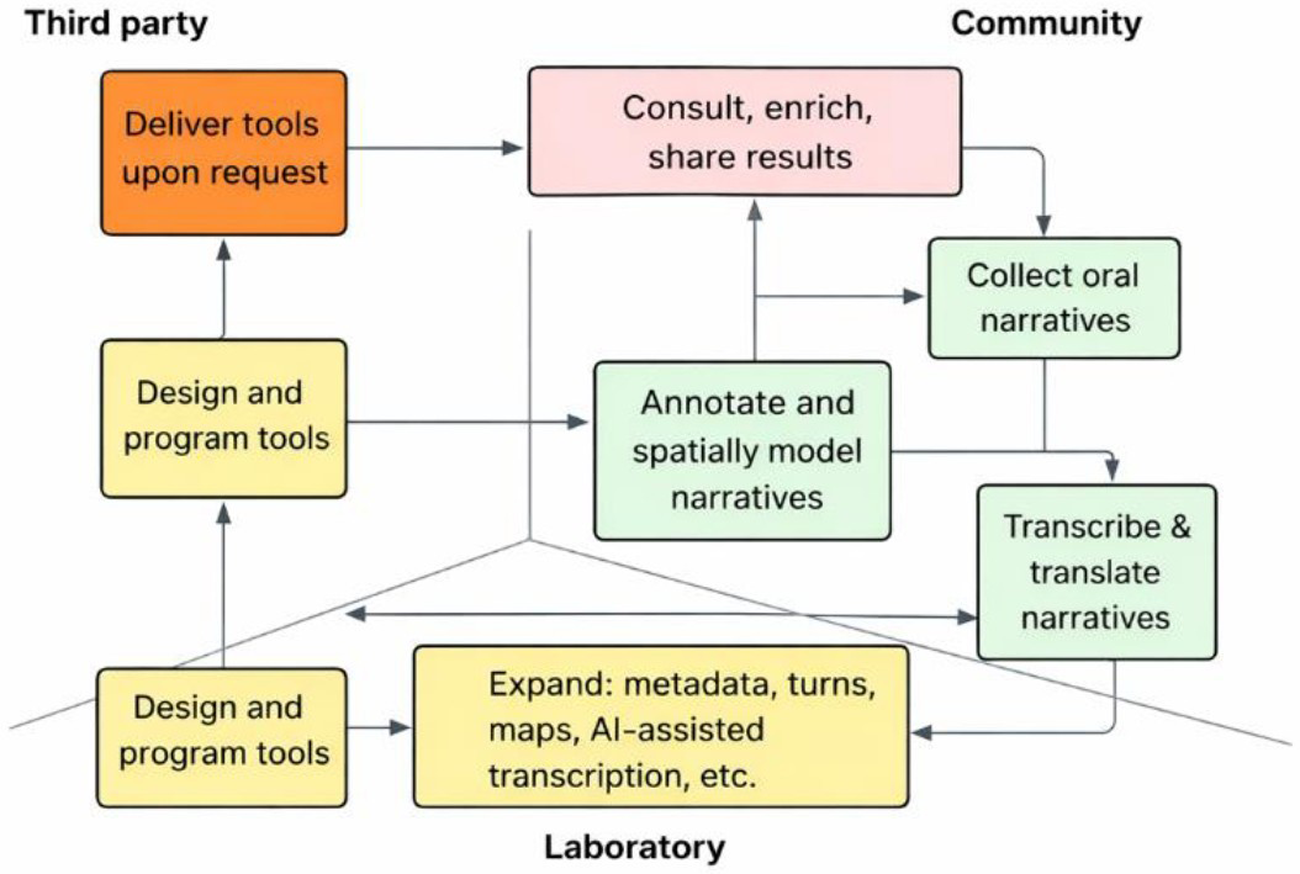
Methodologically, the project brings archaeology into sustained dialogue with anthropology, linguistics, geography, and digital humanities. Although such conversations are not new, they reopen long-standing debates about whether our ethnographic material can inform archaeological interpretation without reproducing static or essentialized accounts of Indigenous cultures (David Reference David1992; Edgeworth Reference Edgeworth and Edgeworth2006; Garcia-Piquer et al. Reference García-Piquer, Carracedo-Recasens, Vila-Mitjà and Estévez2018; Graeber and Wengrow Reference Graeber and Wengrow2021; Hodder Reference Hodder2012; Ingold Reference Ingold2007). Recent Indigenous calls for inclusion and methodological respect have shifted this terrain, toward multivocal, coproduced, and relational approaches to history (Cruz Reference Cruz and Goldman2021; Flores-Muñoz et al. Reference Flores-Muñoz, Sallum and Balanzátegui2025; Gray Reference Gray2022; Krenak Reference Krenak2015, Reference Krenak, Cohn and Kadiwel2016; Tuxá et al. Reference Tuxá, Gambrell, Apiká, Morseau, Silliman, Balanzátegui and Sallum2024). MONARO also draws on geographical distinctions between Euclidean space and place as lived and practiced, approaching narration and movement as spatial operations that shape interpretation. As shown in Figure 1, these processes are iterative and collectively produced rather than being linear workflows.
Workflow of narrative processing in the MONARO project, illustrating how oral narratives move through transcription, translation, annotation, and spatial modeling as forms of archaeological labor. The diagram emphasizes the iterative and collaborative nature of these processes.

Figure 1 Long description
The flowchart illustrates a process involving three main entities: Third party, Community and Laboratory. Starting with the Third party, 'Deliver tools upon request' leads to 'Design and program tools'. This step connects to the Laboratory's 'Design and program tools', which then leads to 'Expand: metadata, turns, maps, AI-assisted transcription, etc.'. From the Community side, 'Consult, enrich, share results' connects to 'Collect oral narratives', which then leads to 'Transcribe and translate narratives'. This step connects to 'Annotate and spatially model narratives' in the Laboratory. The Laboratory's 'Annotate and spatially model narratives' also connects back to 'Consult, enrich, share results' in the Community. The flowchart shows a collaborative and iterative process among the three entities.
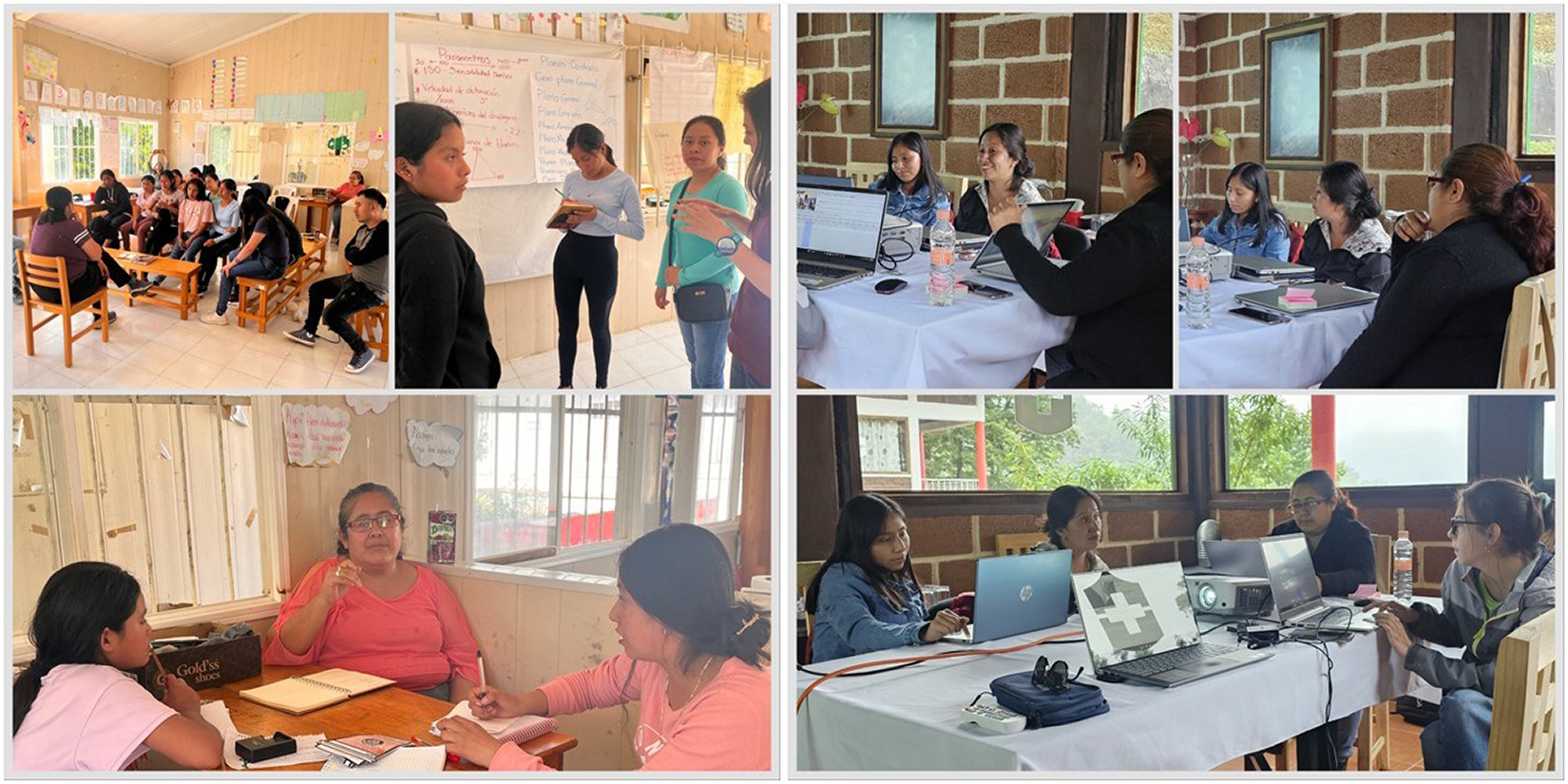
Empirically, the analysis draws on long-term collaborative ethnographic research conducted between 2015 and 2026 in Mixtla de Altamirano, Veracruz. Methods included participant observation; semi-structured interviews with elders, women, men, and students; and a series of codesigned workshops, the last two of which were dedicated mainly to the transcription, translation, interpretation, and digital annotation of Nahua oral narratives. Because the project did not involve excavation, intervention on archaeological sites, or the production of primary archaeological materials, no formal archaeological permit was required under Mexican heritage regulations. At the same time, the collaborative and community-based nature of this work (centered on oral narratives, annotation practices, and local archival initiatives) falls outside the narrow institutional definition of “legitimate” archaeology, which is typically governed through state permitting structures. Similarly, although the project did not undergo a formal Institutional Review Board (IRB) process, participation and circulation of materials were negotiated through ongoing informed consent, long-term collaboration, and continuous dialogue with community participants regarding the recording, interpretation, and use of narratives and digital materials for education purposes. Copies of collected recordings and related materials such as photos were returned to participants and circulated within the communities, and additional physical copies were deposited at the Universidad Veracruzana Intercultural (UVI Grandes Montañas campus) and the local community radio station (Flores-Muñoz Reference Flores-Muñoz2020). The later loss of these materials within the radio archive due to flooding became an important moment of reflection for the project, underscoring both the fragility of community-based archival infrastructures and the need to develop more sustainable and collectively managed forms of preservation and circulation. These experiences directly informed the development of collaborative workshops dedicated to transcription, annotation, and spatial interpretation, which in turn support the creation of deep maps and semantic cartograms designed to visualize intergenerational knowledge, spatial memory, and narrative relationships. Given the accelerated loss of language and oral traditions in the region, the project also sought to reengage local youth through digital and community-based forms of cultural transmission capable of sustaining Indigenous memory practices into the future. As Figure 2 shows, annotation and interpretation are embedded within collaborative workshop settings involving students from UVI and community participants, where knowledge is negotiated collectively rather than simply extracted or recorded.
Participants engaged in annotation exercises during a MONARO workshop, illustrating how transcription, translation, and interpretation function as collective forms of archaeological labor. All photos courtesy of the MONARO Project.

In one annotation workshop, participants debated how to represent a spring that survived primarily in the memories of elders. Initial attempts sought to assign it a fixed geographic coordinate, but community members insisted that the spring could not be reduced to a static point. Instead, the group explored alternative representations through a drawing exercise, in which students proposed different visualizations of the spring based on seasonal cycles, stories, and spatial relations. These drawings became a way of negotiating how the spring should exist within the digital archive—not as a fixed location but as a shifting relational zone. This moment illustrates how spatial data in MONARO is not extracted but produced collectively, challenging conventional assumptions about fixity, representation, and evidence in archaeological mapping, as well as pointing out the diverse ways of understanding space and place in the Global South (Murrieta-Flores et al. Reference Murrieta-Flores, Favila-Vázquez, Flores-Morán, Bodenhamer, Corrigan and Harris2022).
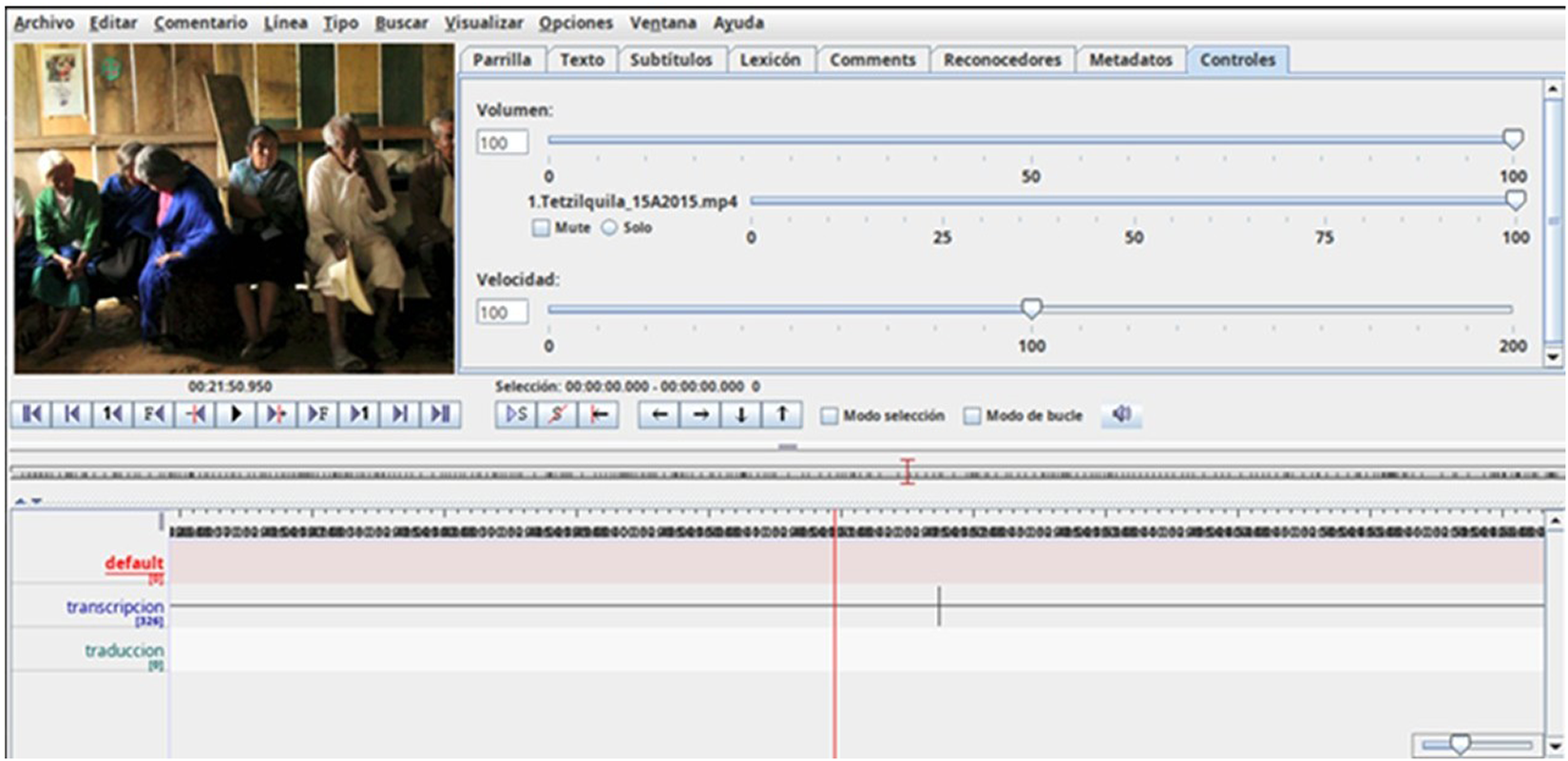
Field activities take place across community and domestic spaces, producing a multilingual and multimedia corpus of video recording, transcripts, annotations, and metadata. Following principles of community-based archaeology and Indigenous data sovereignty—particularly the CARE Principles for Indigenous Data Governance (Collective benefit, Authority to control, Responsibility, Ethics; Carroll et al. Reference Carroll, Garba, Figueroa-Rodríguez, Holbrook, Lovett, Materechera and Parsons2020)—all research priorities, ethical decisions, and circulation protocols were defined collaboratively with participants. These materials form the empirical foundation for the core analytical concerns of this article: labor, digital precarity, and archival sovereignty. Figure 3 illustrates how annotation operates as a site of interpretation rather than data entry.
Annotation of oral narratives using ELAN (EUDICO Linguistic Annotator, a tool for time-aligned transcription and annotation of audio and video material), showing the layering of linguistic, spatial, and relational metadata. Annotation functions as a core interpretive practice rather than as technical support.

Figure 3 Long description
The interface displays a video editing software with a video preview in the top left corner showing several people seated indoors. The top section includes tabs labeled Parrilla, Texto, Subtitulos, Leccion, Comments, Reconocedores, Metadatos and Controles. Below, there are sliders for volume and speed adjustments. The timeline at the bottom shows tracks labeled default, transcription and translation, with a red vertical line indicating the current position. Playback controls are located beneath the video preview.
During transcription sessions, students working between Nahuatl and Spanish frequently paused to discuss the meaning of key terms related to land, water, and memory. These discussions often extended beyond translation and into interpretation, as participants debated how concepts should be represented within annotation platforms. In this context, transcription emerges not as a mechanical task but as analytical labor that produces knowledge.
An important component of this work will be the development of an itinerant community-based library-museum, conceived as a mobile and community-controlled archive that will circulate narratives, recordings, and annotations within and between communities. Rather than a centralized repository, this itinerant model will respond to local conditions of access, infrastructure, and governance, allowing materials to remain embedded within social and territorial relations. It also provides a concrete example of how digital infrastructure in MONARO is designed not for extraction or external visibility but for local continuity and intergenerational transmission.
Mixtla as a Counterexample: Another Archaeology Is Possible
The Sierra de Zongolica, where Mixtla is located, is not merely a landscape but a dense weave of voices, stories, and places. Here, the past is not an inert layer buried beneath the ground; it is alive in the fogón (hearth/stove), in the milpa (traditional farming system that includes corn), or on the paths that connect families and mountains. The hearth functions as a living archive—a site where stories are passed down, where advice circulates, where memory is continuously reheated.
During walks, conversations, and shared meals, narratives surface that articulate deep-time relationships between people and place. As one participant explained, “We feed the springs, so they continue giving water,” describing a practice of reciprocity that links ecological care with memory. Another narrative recounts how lime production was embedded in everyday life, revealing forms of labor and knowledge transmission that are absent from official archaeological records.
Since 2015, MONARO has accompanied these practices not as extractive observers but through collaborative acts of documentation and digital care. Students from UVI sit with elders to transcribe stories in both Nahuatl and Spanish; teachers, young adults, and students have participated in annotation workshops, adding metadata that ties narratives to rivers, hillsides, medicinal plants, among much other knowledge. These forms of labor are as rigorous as any excavation log, and they constitute the infrastructure of a living digital archive.
Yet the conditions under which this work unfolds reveal the structural neglect that shapes Indigenous heritage preservation. Electricity is inconsistent; internet connectivity is fragile; hard drives serve as the only repositories of years of storytelling. Borrowed laptops, notebooks, and USB drives become vessels of a fragile heritage. Above all, the project depends on unpaid labor and communal dedication.
From this emerges an archaeology that unsettles state definitions of legitimacy. It is an archaeology built from voice, listening, care, and companionship. It is an archaeology grounded in fire, land, and water, in the infrastructure of scarcity and solidarity. It demonstrates that cultural memory does not—and should not—survive only in museums but through collective, intergenerational labor.
The fragility is not incidental; it is what Precarity Lab (2019) calls digital precarity: the conditions in which memory depends on unstable technologies, chronic underfunding, and improvisation. And yet, each moment of documentation and data transfer is an act of resistance against silence. The Mixtla experience shows that to move beyond extractive archaeology, the discipline must confront not only preservation but sovereignty. Mixtla is therefore not a field site; it has become a model for a different archaeology—one rooted in relational, coproduced, layered epistemologies and in the political commitment to sustaining memory under precarious conditions.
Digital Precarity and Archival Sovereignty
In Mixtla de Altamirano, oral narratives often exist only as audio or video files stored on students’ laptops or as transcripts circulating via USB drives or DVDs. A decade ago, distributing stories on DVDs was one of the few ways to ensure local access. These practices exemplify digital precarity. In several instances, annotated narratives were stored temporarily on USB drives due to lack of stable internet access, and they moved between laptops, drives, and local devices as part of everyday archival practice. These transfers are not merely technical but constitute a form of labor required to sustain the archive under conditions of infrastructural instability.
Digital precarity reveals that archival survival is unevenly distributed. State-sanctioned archaeological projects benefit from climate-controlled repositories, permanent servers, and secure budgets. Community-led projects, by contrast, must navigate scarcity, creating archives that are materially vulnerable and epistemically undervalued. As explained before, this disparity is not accidental. It is a direct consequence of institutional frameworks that privilege monumental remains and museum collections while considering oral narratives and visual representations as secondary (or even nonarchaeological) practices. The resulting silences are therefore political.
Critical archival studies offer conceptual tools for unpacking these dynamics by foregrounding archives as sites where power is actively produced rather than neutrally stored. Caswell’s (Reference Caswell2014) notion of “archival power” highlights how decisions about inclusion, exclusion, and circulation shape collective memory as much as preservation itself. In Mixtla, such decisions (which narratives are recorded, who transcribes and translates them, and how digital files circulate) are governed not only by technological capacity but by relationships of trust, authority, and responsibility within the community. At the same time, Christen’s (Reference Christen2015) emphasis on cultural protocols underscores that access to archival materials is inseparable from ethical and relational frameworks. In the Sierra de Zongolica, this principle is articulated in the assertion that “not all words are for everyone,” a reminder that knowledge circulation is culturally situated and conditional. Digital infrastructures that ignore these protocols risk reproducing extractive dynamics by treating Indigenous knowledge as open data to be mined rather than as cultural heritage governed by community authorities and local systems of accountability.
These discussions align with Duarte’s (Reference Duarte2017) formulation of Indigenous data sovereignty, which insists on the right of Indigenous people to control the collection, management, and use of their data. From this perspective, archival sovereignty extends beyond content to encompass the infrastructures of preservation themselves (servers, metadata standards, passwords, and circulation protocols). In Mixtla, sovereignty implies that decisions about whether a narrative circulates publicly need to remain local or—if it is encrypted for restricted use—must reside with the community that produces it. Without such sovereignty, digital projects risk perpetuating colonial hierarchies by relocating control of memory from communities to external institutions.
Taken together, digital precarity and archival sovereignty reveal the contemporary stakes of archaeological labor. On the one hand, precarious infrastructures highlight the vulnerability of community-driven projects to technological failure and institutional neglect. On the other, assertions of sovereignty articulate alternative models of preservation grounded in community control and relational ethics, but overall collective responsibility. If archaeology is to address its historical complicity in extractive practices, it must engage these frameworks seriously (Hudson et al. Reference Hudson, Carroll, Anderson, Blackwater, Cordova-Marks, Cummins and David-Chavez2023). This entails moving beyond rhetorical commitments to “community collaboration” toward material support for infrastructure that are governed by—and accountable to—the communities whose knowledge they hold. This collaboration necessarily needs to keep on asking the following questions: Archaeology for whom? Archaeology in service of what, and for whom does archaeological labor endure?
Recognizing digital precarity and the parallel demand for sovereignty compels archaeology to reconsider its relationship with technology. Digital infrastructures are not neutral conduits of preservation; they actively shape how knowledge is produced, circulated, and controlled. In contexts such as Mixtla, fragile archives reveal the structural neglect of Indigenous knowledge systems at precisely the moment when narrative practices are most endangered. These conditions prompt broader questions about the labor economy of archaeology. Debates around automation and artificial intelligence are often framed in terms of efficiency or displacement, but such framings obscure the deeper issue: technological innovation redistributes labor, authority, and value within the discipline.
If archival sovereignty insists that communities must govern their own cultural data, then rethinking technology requires attention to how tools are deployed, who is trained to use them, and under what conditions. It is within this political and methodological terrain that we can begin to imagine an archaeology in which digital tools do not reinforce hierarchies but contribute to more equitable, dignified, and collaborative forms of work. The next section turns to this challenge by examining how annotation platforms, semantic ontologies, and artificial intelligence might be mobilized not to displace labor but to dignify it, aligning archaeological practice with relational and sovereign forms of digital heritage.
Rethinking Technology and Labor: A Framework
The preceding sections have shown how archaeological labor is structured through unequal institutional recognition, fragile digital infrastructure, and state-defined regimes of legitimacy. In Mixtla de Altamirano, these conditions are not abstract: they shape who records oral narratives, who maintains archives, who bears the costs of digital preservation, and whose labor remains invisible. The MONARO project does not resolve these structural tensions; rather, it operates within them, revealing both their constraints and their possibilities. It is from this situated experience (working under conditions of digital precarity, limited funding, and long-term community collaboration) that the following framework emerges.
Rather than proposing a universal model or technological solution, this framework distills a set of principles developed through practice: moments where digital tools, governance decisions, and collaborative labor either reproduced existing hierarchies or opened space for more equitable arrangements. In this sense, the framework is not aspirational but diagnostic and pragmatic. It asks how technology might be mobilized within archaeology to redistribute recognition, authority, and care instead of intensifying extraction or displacing labor. Although grounded in MONARO, these principles speak to broader challenges faced by other community-based archaeological projects.
Concrete strategies for rethinking the role of technology in archaeology are beginning to emerge, though they are often uneven in practice. Although open-source and open-science frameworks (such as the widespread adoption of FAIR principles) have advanced substantially the ways in which data and knowledge can be managed and shared, there is still much to be done. As the Global Indigenous Data Alliance (GIDA 2016; see also Carroll et al. Reference Carroll, Garba, Figueroa-Rodríguez, Holbrook, Lovett, Materechera and Parsons2020) points out,
The current movement toward open data and open science does not fully engage with Indigenous Peoples’ rights and interests. Existing principles within the open data movement (e.g., FAIR: findable, accessible, interoperable, reusable) primarily focus on characteristics of data that will facilitate increased data sharing among entities while ignoring power differentials and historical contexts [GIDA 2016].
Protocols for ethical data use, such as restricting access to sensitive recordings or embedding community-defined categories into metadata systems, provide one model for aligning digital infrastructures with local priorities. Training initiatives that position Indigenous collaborators not merely as assistants but as digital experts help make visible the crucial role of people in the future of archaeology. Likewise, community-controlled repositories, even when improvised on low-cost servers or shared laptops, represent attempts to materialize archival sovereignty in practice. These efforts, in the context of archaeology, point toward a practice where digital tools could be mobilized not to displace human labor but to dignify it, redistributing recognition and authority across a wider network of contributors. However, the precarity afflicting community-based archaeological work demands systematic reform rather than incremental adjustment. Drawing from the MONARO project and related collaborative initiatives, we outline a transferable framework that (1) reconceptualizes archaeological labor, (2) addresses structural inequalities through resourcing and capacity building, (3) includes Indigenous data governance, (4) guides ethical deployment of digital tools and AI, and (5) sustains collaborative infrastructures through co-ownership and interoperable systems. This framework emerges from documented critiques of archaeological practice and proven models of community collaboration, offering actionable pathways for projects operating across diverse contexts. In MONARO, these principles take concrete form using annotation platforms, semantic categorization systems, and experimental approaches to AI-assisted transcription, all of which are shaped by local decision-making and infrastructural constraints.
Reconceptualizing Archaeological Labor
Archaeological labor must be redefined to encompass the full spectrum of digital and community-based work that produces knowledge. Transcription, translation, deep mapping, and oral-narrative documentation constitute primary research outputs deserving recognition, remuneration, and citation equivalent to traditional excavation or survey data. The CARE Principles for Indigenous Data Governance provide theoretical grounding for this reconceptualization by foregrounding collective benefit and authority to control, creating conceptual space to acknowledge previously hidden labor and repositioning Indigenous peoples as active stewards rather than passive subjects of data collection.
Treating community contributions as legitimate scholarly outputs requires operational changes at project inception. Co-creation protocols must establish negotiated authorship, attribution, and consent workflows before fieldwork begins, ensuring that digital contributors receive recognized credit and retain rights over their intellectual labor. The Nunalleq Digital Museum demonstrates how multivocal, co-curated platforms can operationalize this approach, with community members authoring and contextualizing materials so that transcription and storytelling become central rather than auxiliary products (Hillerdal et al. Reference Hillerdal, Watterson, Strunk, Cleveland and Anderson2025). This model shows that community labor produces not merely data but interpretation; consequently, these are curatorial products that carry scholarly authority.
Capacity building transforms recognition into sustained community ownership. Embedding training pathways through workshops, apprenticeships, and paid positions enables community members to lead digital tasks and interpretation instead of serving as informants or assistants. These investments can address power imbalances inherent in extractive research models while building local infrastructure for ongoing heritage work. When community contributors control technical processes—from database design to AI model selection—the labor they perform gains visibility and value within institutional frameworks that have traditionally excluded such work from definitions of “legitimate” archaeology. In Mixtla, this took the form of continuous workshops in GIS, transcription, annotation, and photography, among others.
Addressing Digital Precarity and Structural Inequalities
Structural inequalities in archaeology are reproduced through uneven resource distribution, placing the hidden costs of data production, curation, and long-term maintenance disproportionately on Indigenous communities. Digital precarity is not a technical failure but a political condition that reflects these shifted burdens. Addressing it requires explicit recognition of community labor as professional work, supported by fair compensation, sustained training, and investment in long-term archival infrastructure rather than short-term, project-based outputs.
Equitable resourcing extends beyond wages to include technological choices aligned with community access and governance needs. Low-bandwidth, mobile-ready, and open-source tools reduce dependence on proprietary platforms and allow participation under conditions of unstable connectivity. Such choices challenge funding models that assume collaboration to be cost-free or that rely on unpaid labor to sustain digital heritage over time.
Comparative cases illustrate the importance of these strategies. The Westbank First Nation archaeology office combined accessible StoryMaps with structured training to distribute technical skills and governance capacity locally, sustaining infrastructure beyond individual funding cycles (Gupta et al. Reference Gupta, Bonneau and Elvidge2022). Similarly, the Mongolian “transmethodology” integrated community input with remote sensing to mitigate data loss while supporting long-term stewardship (Milek Reference Milek2018). In Mixtla, low-bandwidth conditions similarly shaped decisions about storage, access, and circulation, reinforcing the need to treat infrastructure as a social and political commitment rather than a neutral technical choice.
Together, these cases underscore that addressing digital precarity requires institutional shifts that remove barriers to Indigenous ownership and participation in digital research, challenging the gatekeeping dynamics that continue to structure archaeological practice.
Data Governance and Archival Sovereignty
Indigenous data sovereignty is enacted through governance mechanisms that align legal, ethical, and technical controls with community protocols, rather than defaulting to open-access archival models. Principles such as authority to control and collective benefit allow communities to determine how their heritage data are accessed, reused, and stewarded—a concern that is especially acute for spatial data that may expose sacred sites, burial grounds, or resources to exploitation (Gupta et al. Reference Gupta, Bonneau and Elvidge2022).
In practice, sovereignty is operationalized through layered access systems, negotiated permissions, and metadata structures that record provenance, community consent, and conditions of reuse. Rather than treating archaeological data as universal public goods, such frameworks recognize that not all information is meant for unrestricted circulation. Embedding these decisions within metadata under community control ensures that archival actions remain accountable across the data lifecycle (Mengoni Goñalons and Figuerero Torres Reference Mengoni Goñalons and Figueroa Torres2023). These approaches align with international legal instruments such as the United Nations Declaration on the Rights of Indigenous Peoples P and established Indigenous data protocols such as Ownerwhip, Control, Access, and Possession principles, which provide adaptable governance templates.
Effective data governance also requires institutional form. Community-led stewardship bodies or local data offices, supported (but not controlled) by research partners, create mechanisms to maintain repositories and enforce access rules beyond individual project timelines. Although Mexico has national initiatives such as the Agenda Cultural Digital and INAH’s Mediateca, these remain largely centralized and insufficiently responsive to local governance. By contrast, the Westbank First Nation archaeology office illustrates how community-based structures can anchor archival sovereignty in daily practice, including consent negotiation, permission management, and steward training. In Mixtla, similarly, decisions about circulation and access are ongoing, relational processes rather than one-time agreements, underscoring sovereignty as a lived and continuously negotiated practice.
Ethical Digital and AI Deployment
Although it could be argued that in the Mexican context the use of AI in archaeology is still in its infancy, ethical deployment of digital tools and AI should begin with community control over which technologies enter collaborative projects, what datasets train models, and how outputs are shared. This governance principle reflects growing recognition that algorithmic systems carry embedded assumptions and biases that may conflict with community knowledge systems or priorities. Opening conversations around digital methods at project inception, rather than presenting tools as neutral or inevitable, enables communities to assess appropriateness and negotiate terms of use (Watrall and Goldstein Reference Watrall and Goldstein2022).
Transparency and interpretability matter, especially when algorithmic outputs might affect community interpretation or rights. Preferring explainable workflows over opaque, black-box AI systems will allow community knowledge holders to evaluate results, identify errors, and integrate computational findings with local expertise. In the specific case of technologies such as generative AI, there is still a major problem to address in terms of the racial, gender, and geographic biases its models introduce. Nevertheless, projects that combine machine learning with local oversight might provide practical templates: (1) the Mongolian transmethodology, which paired ML site detection with community feedback to validate results and incorporate contextual knowledge that algorithms alone could not capture (Milek Reference Milek2018), or (2) the Fleets of New Spain project, where Nahua scholars and speakers are working together using handwritten text recognition to transcribe Classical Nahuatl historical texts (Murrieta-Flores et al. Reference Murrieta-Flores, Terras, Gooding, Ames and Nockels2026).
Consent protocols for model use must extend beyond initial data collection to encompass training datasets and automated analyses. Requiring explicit, documented consent with feasible revocation pathways operationalizes the CARE principles of Authority and Responsibility, acknowledging that community permissions may change as projects evolve or as communities gain fuller understanding of how their data function in computational systems. Codesign processes in which algorithms serve locally defined research questions and validation involves community knowledge holders, making AI tools support rather than supplant expertise.
Current literature advocates transparency and community governance but does not yet provide standardized, community-tested AI governance templates. This gap reflects the emerging nature of AI deployment in collaborative archaeology and the diversity of community protocols that resist universal prescription. Projects must therefore develop governance mechanisms iteratively, documenting decisions and outcomes to contribute to evolving best practices while remaining responsive to specific community contexts. These proposals do not assume technological parity across contexts; in many regions, including rural Mexico, AI remains aspirational rather than operational.
Sustaining Collaborative Infrastructures
Long-term collaboration requires infrastructural commitments that outlast individual projects and enable knowledge transfer across contexts. Adopting interoperable open-source toolchains and data standards allows portability between communities and institutions while reducing vendor lock-in that can strand data when commercial platforms change terms or cease operation. Well-documented technical stacks enable communities to maintain systems independently or transition to alternative tools as needs evolve, supporting rather than constraining local agency.
Co-ownership and stewardship should formalize shared governance through mechanisms such as community repositories and local archaeology offices where infrastructure stewardship and decision-making rest with or explicitly include community representatives. These institutional arrangements challenge archaeological conventions that locate authority only in governmental institutions, universities, or museums, redistributing power through legal agreements, memoranda of understanding, and organizational structures that embed community voice in ongoing operations.
Sustained funding models should be created to ensure that maintenance and training costs are built into project cycles, rather than treated as one-time capital investments. Creating succession plans for technical roles and establishing training pipelines can prevent data abandonment and labor precarity when key personnel leave or project funding ends (Gupta et al. Reference Gupta, Blair and Nicholas2020).
Transmethodological workflows that integrate cross-disciplinary methods responsive to local needs demonstrate infrastructure sustainability in practice. The already mentioned Nunalleq Digital Museum’s co-curation model has shown how digital platforms can remain anchored in community when governance and capacity are embedded rather than externally imposed, with museum content evolving as community priorities shift. These examples reveal that sustainable infrastructure emerges not from technical specifications alone but from governance arrangements that distribute authority, build local capacity, and commit resources to long-term stewardship.
Toward a Political Archaeology
To speak of archaeology today is to speak of power. The discipline is shaped by uneven labor relations, state-defined regimes of legitimacy, and market-oriented pressures that determine whose knowledge is valued and whose work remains invisible. These dynamics place archaeology at a crossroads. One path reproduces extractive models in which heritage becomes rent, communities are reduced to “stakeholders” or informants, and students provide undercompensated labor in exchange for access and credentials. Another path—less stable but increasingly articulated—insists that archaeology must be understood as a political practice concerned with dignity, accountability, and collective care (Flores-Muñoz et al. Reference Flores-Muñoz, Sallum and Balanzátegui2025; Fryer Reference Fryer2023; Kelvin and Hodgetts Reference Kelvin and Hodgetts2020; McGuire Reference McGuire2008; Morgado et. al. Reference Morgado, Abalos, Berdejo, García-González, García-Franco, Jiménez-Cobos and Rodríguez-Sobrino2017; Supernant et al. Reference Supernant, Baxter, Lyons and Atalay2020; Woynar Reference Woynar, Laporte Molina, Arroyo and Mejía2003; Zimmerman Reference Zimmerman2024; Zorzin Reference Zorzin2021).
A political archaeology begins by asking questions that are not merely technical but structural: Who controls archaeological knowledge? Who benefits from archaeological labor? Under what conditions are memory and heritage preserved, and at whose expense? These questions challenge the assumption that archaeology can remain neutral while operating within systems that commodify the past and externalize the costs of preservation onto communities and early career researchers. They also foreground the ways in which institutional definitions of “legitimate” archaeology privilege monumental remains and formal archives while marginalizing oral, linguistic, and relational forms of knowledge.
The collaborative work in Mixtla de Altamirano offers a grounded counterpoint to these dominant models. There, archaeology is enacted through transcription, translation, annotation, and the maintenance of fragile digital archives sustained by elders, students, and families under conditions of material precarity. This labor is not recognized by state institutions as archaeological work, yet it is precisely through these practices that cultural memory is preserved and transmitted. Rather than romanticizing resistance, the Mixtla case demonstrates how political archaeology emerges through everyday acts of care, documentation, and governance carried out within constrained infrastructures.
Political archaeology, in this sense, is not defined by rhetoric alone but by concrete commitments. It demands recognition of forms of labor that exceed excavation, investment in infrastructures that are accountable to communities rather than institutions, and the deployment of digital tools in ways that support sovereignty rather than extraction. This does not imply a rejection of technology but a reorientation of its use toward redistributing authority, credit, and responsibility. To approach archaeology politically, then, is to treat preservation not as a neutral technical task but as a collective practice embedded in struggles over labor, resources, and the right to narrate the past.
Conclusions
Archaeology’s contemporary crossroads makes visible how the discipline is structured by unequal labor relations, state-defined hierarchies of legitimacy, and the uneven distribution of technological resources. Through the case of the Nahua communities in Mixtla de Altamirano, this article has demonstrated that transcription, translation, interpretation, and digital annotation of oral narratives constitute rigorous forms of archaeological labor that extend well beyond excavation. Yet these practices unfold under conditions of digital precarity and institutional neglect—conditions that shape who can preserve cultural memory, how it circulates, and under what circumstances it can endure.
At the heart of MONARO lies the recognition that oral narratives form the core epistemic layer of archaeological knowledge. Built on this foundation are additional, interrelated layers (annotation, semantic modeling, deep mapping, and cartographic visualization) that together enable a relational approach to interpretation. These layers do not operate linearly; instead, narrative grounds spatial understanding, spatial annotation informs modeling, and cartograms reveal connections across generations and territories. This layered methodology offers a concrete way to rethink archaeological evidence as relational, processual, and situated.
These collaborative practices demonstrate that technological infrastructures can be reoriented toward sovereignty rather than extraction. When embedded within community-governed archives, cartographic practices, and ethical data protocols, digital tools can support more equitable and accountable forms of archaeological work. Conversely, when left within existing institutional hierarchies, they risk intensifying extractive dynamics and further obscuring labor.
The analysis presented here leads to three broader conclusions. First, archaeological labor must be reconceptualized to include intellectual, collaborative, affective, and cartographic work undertaken by Indigenous collaborators and students. Second, legitimacy in archaeology must expand beyond monumental and material paradigms to encompass oral, digital, and spatial practices. Third, a political archaeology committed to dignity, care, and sovereignty requires not only new technologies but clear frameworks governing their ethical and collective use.
Fragile digital archives, stories carried on USB drives, and maps drawn in notebooks point simultaneously to the vulnerability and the possibility of archaeology’s future. They remind us that preservation is not merely technical but profoundly political: an assertion that memory belongs first and foremost to the communities that sustain it. Only by embracing layered, collaborative, and sovereign approaches can archaeology move beyond extractive models and become a practice oriented toward continuity, responsibility, and collective endurance.
Acknowledgments
This work emerges from the collective efforts, knowledge, and generosity of the Nahua communities of Mixtla de Altamirano, Veracruz. We are especially grateful to the elders who shared their time, memories, and narratives, and whose knowledge sustains the ongoing life of the MONARO project. Their trust and collaboration make this work possible. Although this article focuses on archaeology, the MONARO project has been shaped by a broader interdisciplinary and collaborative research team—including students, translators, community participants, and colleagues working across anthropology, history, digital humanities, and computer science. Their contributions (intellectual, technical, and relational) have been central to the development of the project and to the reflections presented here. We also thank the students and participants involved in workshops, transcription, translation, and annotation processes, whose work constitutes an essential part of the project’s scholarly labor. No archaeological permits are required for the MONARO project, given that it does not involve excavation or the generation of primary archaeological material subject to national heritage regulation. However, the research has been conducted within a rigorous ethical framework grounded in long-term, collaborative engagement with Nahua communities in Mixtla de Altamirano. Fieldwork and workshops were carried out with the knowledge and permission of local authorities; however, independence from political parties and local electoral structures was maintained. The project has also been developed in collaboration with the Universidad Veracruzana Intercultural, whose community-based educational and ethical frameworks have guided much of the work conducted in the region. Participation in interviews, workshops, recordings, and annotation activities was negotiated continuously throughout the project rather than treated as a one-time procedure. Before conducting interviews or recordings, participants were informed about the aims of the project, including the preservation of oral knowledge, the documentation of regional historical transformations, and the collaborative development of community-based archival initiatives (that came after). Participants were able to decide how narratives and materials could be recorded, translated, shared, archived, or withheld from circulation. Copies of recordings and related materials were returned to participants and circulated within the communities, and additional copies were deposited at the Universidad Veracruzana Intercultural and local community institutions as part of a broader effort to maintain community access and collective accountability. Over the course of a decade, the project has evolved through multiple stages and collaborations involving elders, students, teachers, translators, and community participants, and it has always emphasized care, dialogue, and permission as central principles of the research process.
Funding Statement
Support for fieldwork by Flores-Muñoz has been provided by grants from the Instituto Politécnico Nacional (IPN-SAPPI 20230107; 20241334; 20250727).
Data Availability Statement
The materials that support the findings of this study consist of oral narratives, annotations, and related documentation generated through collaborative work with Nahua communities in Mixtla de Altamirano, Veracruz. Due to ethical considerations—including community governance, consent agreements, and the protection of culturally sensitive knowledge—these materials are not publicly available. However, copies of recordings and related materials have been circulated within participants’ communities and deposited at the local community radio station and the Universidad Veracruzana Intercultural (UVI Grandes Montañas campus) as part of the project’s collaborative archival practices. Access to selected materials may be considered on a case-by-case basis and in consultation with community participants, in accordance with principles of Indigenous data sovereignty and the CARE Principles for Indigenous Data Governance.
Competing Interests
The authors declare no competing interests.
AI Use Disclosure
In preparing this manuscript, AI Tools (ChatGPT, OpenAI) were used in a limited capacity to assist with language editing and clarity. All analytical claims, interpretations, and conclusions are the authors’, and all sources and citations were independently verified. No AI tools were used to generate or analyze empirical data.

 Open access

