

Mencius' portrayal of Yang Zhu who was “not willing to pull out one hair to benefit the world” 拔一毛而利天下 不為也, is well known in the field of Chinese philosophy.Footnote 1 The Later Mohists weighing a finger against an arm, and an arm against a whole body are not as famous. But even less studied is a set of stories collected in the Lü shi chunqiu and one Zhuangzi chapter, involving various body parts assessed in terms of their weight—being considered light or heavy (qing zhong 輕重). In one of them, the audience is invited to imagine a man who would cut off his head in exchange for a hat, or allow his body to be killed in order to receive a piece of clothing. In another story, the marquis of Han is asked to consider trading his left or right hand for the possession of the whole world.Footnote 2 These stories contain a rhetorical mechanism that has been overlooked in studies of the weighing metaphor in early Chinese texts. They, moreover, constitute the largest and most consistent set of textual material illustrating one type of metaphorical weighing. And they may provide the intellectual background against which other fragments such as Mencius' criticism of Yang Zhu and the Later Mohists' weighing experiments should be read.
This article first summarizes the prevalent scholarly characterizations of the weighing metaphor, then considers the sources to be used for an adequate description of this metaphor, and finally analyzes their argumentation in terms of things differing in weight. This selection of stories and their analysis not only enriches our understanding of the weighing metaphor in early Chinese persuasions but also clarifies the connection with other fragments referring to body parts and scattered throughout the corpus of masterly persuasion.
Weighing for Choosing
A. C. Graham's study of the dialectical chapters of the Mozi 墨子, the “Mobian” 墨辯 (chapters 40–45), published in 1978, has generally been considered “a landmark in the study of classical Chinese thought.” Not only does it contain “by far the most thorough, disciplined, and systematic reconstruction and interpretation of the later Mohist texts ever published,”Footnote 3 it also inspired reflection on the ramifications of this technical knowledge on early Chinese argumentation and thought. One example is the weighing metaphor. Graham called attention to the emergence of this rhetorical figure in materials from later Mohists and authors whom he deemed “Yangists.” One decade ago Griet Vankeerberghen further distinguished between different rhetorical uses of the weighing metaphor in early Chinese texts. Her contribution for Early China, “Choosing balance: Weighing (quan 權) as a metaphor for action in early Chinese texts,” is, to my knowledge, the most subtle analysis of this rhetorical trope in the field.Footnote 4 I begin by summarizing these two scholars' views on the weighing metaphor in early arguments.
Graham about Weighing Body Parts
For Graham, early Chinese philosophy only becomes lively and sophisticated “with the appearance of rival doctrines,” when the idea of “choice moves to the conceptual foreground.”Footnote 5 Metaphors that he finds attesting to this new topic are crossroads and scales for choosing between alternatives. The lesser-known master Yang Zhu 楊朱 (fl. c. 350 b.c.e.)Footnote 6 figures prominently with both metaphors. To Graham, “it seems that his intervention provoked a metaphysical crisis which threatened the basic assumptions of Confucianism and Mohism and set them on new courses.”Footnote 7 While the image of Yang Zhu wailing at a forked road is a common trope in the early sources,Footnote 8 according to Graham, his contribution as the inventor of the weighing metaphor may have been even more influential: the “procedure for weighing relative benefits and harms in relation to what one is ‘for’ may well have originated with the school of Yang Zhu.”Footnote 9 The Mohists as well as those persuaders presumably inspired by Yang Zhu—Graham calls the latter “individualists,” “Yangists,” and sometimes “egoists”—subjected traditional morality to a utilitarian test by weighing relative benefit and harm.Footnote 10 According to Graham, the principle behind their choices is the sacrifice of the part for the whole: a finger for saving an arm, an arm for one's life, and one man's life for the whole world.Footnote 11 To have one finger cut off in order to save your whole arm, or to lose one arm in order to save your life, is a matter of deliberately weighing the relative benefit and harm of both options and going for the better one.Footnote 12
But as soon as Graham has traced the weighing metaphor back to what he considers Yangist circles, he points out an intriguing inconsistency in their thought:
An interesting feature of the scheme is that even if the individualists invented it they have to stop half way in applying it. The egoist can give a reason for preferring an arm to a finger, that the choice is for the sake of the whole man. But there is nothing for the sake of which he prefers himself to others; he can do so only by an arbitrary choice. If he admits that there can be reasons for preferring one man to another the scheme forces him to proceed as before, choosing between the members or individuals for the sake of the total, the world.Footnote 13
In short, the priority that the individualist gives to his own life rather than to the whole world does not accord with his own reasoning in terms of considering the relative weight of (lighter) parts versus (heavier) wholes. Graham speculates that the Mohists, who promoted the sacrifice of individuals for the sake of the larger community, may have pointed out this inconsistency in a section of the Mozi that has not been preserved.Footnote 14 But I will argue that Graham's criticism of the so-called Yangist position was guided by a misinterpretation of the weighing metaphor, at least in the texts that he attributes to them.
Vankeerberghen about Three Types of Weighing
Graham's characterization of weighing in Mohist and Yangist circles coincides with one of the types of metaphorical weighing distinguished by Griet Vankeerberghen in her study of the metaphorical uses of the verb quan “weighing.” She identifies three metaphors related to different uses of the scales. The first (quan A) expresses the making of a “true assessment”: by balancing something on a well-adjusted scale against a certain norm, one can correctly determine its weight. This can be pictured as a simple beam with two even arms keeping in balance the standard weight on the one hand and the thing weighed on the other. Guanzi “Ming fa” 明法, for example, refers to weights and beams as a means to make correct assessments and thus avoid cheating and deceit. Warning against the reliance on mere criticism and praise in politics, the author makes a plea for the use of laws analogous with that of scales. “Somebody with the weighing device of scales and beams cannot be cheated in respect to heavy and light” 有權衡之稱者不可欺以輕重; similarly, a ruler “with a system of laws and directives cannot be cheated by ruses and deceit” 有法度之制者不可巧以詐偽.Footnote 15
Chapter “Ming fa jie” 明法解 explains:
權衡者所以起輕重之數也. 然而人不事者非心惡利也, 權不能為之多少其數; 而衡不能為之輕重其量也.Footnote 16
The scales and beams are the means to come up with the number of a weight. The fact that people do not try to work on it is not that at heart they dislike profit, but rather that the scale cannot for their sakes increase or decrease its numbers; and a beam cannot for their sakes make its measure lighter or heavier.
The perfect balance of the beam indicates the exact weight of the things that are measured against the norm.Footnote 17
The second metaphor, which Vankeerberghen calls “deciding by comparative weighing” (quan B), can also be represented by a simple scale with equal-length arms, but not aiming at a balance. On the contrary, by weighing two options against each other, the scales are expected to tip in one direction and thereby show the winner. In this case, quan does not mean to determine the exact weight of something by balancing it carefully against a fixed norm, but rather to find out which option “outweighs” the alternative. The Late Mohist definition of quan attests to this use: “To weigh light and heavy among the things that one treats as units, is what we call ‘weighing’” 於所體之中而權輕重 之謂權.Footnote 18 Moreover, the beam (heng 衡) is explained as: “If you add weight to one side of it, that will necessarily decline” 加重於其一旁必捶.Footnote 19 Metaphorically quan B can express the choice of priorities in life and relate to decision making in terms of action.Footnote 20 That is the case in Mencius' urging King Xuan of Qi (r. 319–301 b.c.e.) to consider the possible alternatives before engaging in war, since “only after weighing one knows light from heavy” 權然後知輕重.Footnote 21 The metaphor of a scale with even arms suggests that weighing is a matter of choosing between two different or even exclusive options. By weighing these options against each other, one determines the best choice and goes for it. A perfect balance of the two arms (as in quan A) would merely amount to a stalemate and hence to indecision.
The third type of metaphor identified by Vankeerberghen aims at aequitas or “achieving balance” (quan C). Like quan A, it can be imagined as a scale brought into balance, not permanently tilting into one direction; like quan B, it indicates the correct choice of action by occasionally tilting in one direction. But unlike both, the outcome of quan C is expected to be momentary and flexible. The metaphorical agent tries to bring into balance existing norms and the changing exigencies of place and time. By carefully adding and subtracting items from the two baskets, and occasionally letting the scale tilt into one direction, he always returns to a state of balance between the various “weights.”Footnote 22 The example that Vankeerberghen quotes is the conversation in which Mencius, while respecting the ritual that forbids men and women to touch each other, nevertheless argues that in some circumstances a man has to touch his sister-in-law if he can thereby save her from drowning. “That men and women should not touch each other, is a matter of ritual; to reach out one's hand helping a sister-in-law who is drowning, is a matter of weighing” 男女授受不親 禮也; 嫂溺援之以手者權也.Footnote 23 Even though Mencius' act of weighing momentarily allows the balance to tilt in one direction, in casu that of saving a life, he also firmly holds on to its tilting toward ritual in normal circumstances. Likewise, Mencius argues elsewhere that ritual outweighs (li zhong 禮重) eating (shi 食) except when one risks starvation.Footnote 24 Such weighing acts thus always lead to a tilting in one direction, depending on the specific gravity and proportion of the respective goods. By identifying quan C with aequitas, I believe that Vankeerberghen underestimates the tilting that is still crucial in this act of weighing. The aequitas which she finds specific for quan C, is actually the attitude between those instances of choice, namely the balance achieved when reverting to the ritual prescription while nevertheless allowing for its occasional suspension. For the advocates of quan C, appropriate action is not sticking to well-considered priorities or values, but requires one to retain a point of equilibrium in every new circumstance, taking its complexity into consideration. Failing to do this “is the hallmark of mediocre persons, proper behavior demands creative adjustment.”Footnote 25 In her typology of quan, Vankeerberghen does not consider the stories that argue in terms of heavy and light.
What Are the Textual Sources for the Weighing Metaphor?
Vankeerberghen's quan B “deciding by comparative weighing” largely coincides with Graham's characterization of quan as guided by the principle of sacrificing the part for the whole. And this, in turn, is based on two short fragments from the most corrupt and problematic part of the Mozi, namely the “Mobian”.Footnote 26 Aside from these two, Graham adduces three more references, two of which he attributes to Mohists and one to what he calls Yangists.Footnote 27 The former do not use the weighing metaphor and will not be discussed here.Footnote 28 The so-called Yangist story is recorded in the Lü shi chunqiu (c. 240 b.c.e.), a source that contains a small treasure of “body part weighing” arguments largely unexplored by Graham and Vankeerberghen. By switching our focus away from the “Mobian” toward the qing zhong stories, we not only see how the Later Mohists may have created a minor variation on a more general trope, but also what determined Graham's and Vankeerberghen's views on the weighing metaphor.
Weighing in the “Mobian”
The major textual fragment quoted by Graham occurs in Mozi, 44, “Da qu” 大取 containing the Later Mohist definition of quan 權: “To weigh light and heavy among the things that one treats as units, ti 體, is what we call ‘weighing’.”Footnote 29 The definition might contain a hint that the “countable unit” (ti) in Later Mohist jargon was related to a “body part.” What follows is an illustration in terms of fingers and arms:
斷指以存腕Footnote 30 , 利之中取大,害之中取小也. 害之中取小,子非取害也,取利也. [...] 遇盜人而斷腕Footnote 31 以免身 利也; 其遇盜人 害也.Footnote 32
Cutting off a finger to save an arm is choosing the larger among benefits and the smaller among harms. Choosing the smaller among harms is not that you choose the harmful but that you choose the beneficial. [...] When you run into a robber, to save your life by cutting off an arm is a matter of benefit, the fact that you run into a robber is a matter of harm.
Since your body outweighs your arm, you are willing to offer the latter in order the save the former; the same goes for the sacrifice of a finger to save an arm. This is the only textual fragment in the book Mozi explicitly relating the act of quan to body parts.Footnote 33
As a further illustration of the mechanism of weighing, Graham refers to the only other instance in the Mozi where body parts are weighed against each other. It occurs in chapter 42 “Jingshuo shang” 經說上, more specifically in the explanation to the definition of wèi 為 “in favor of” or “to be for.” The definition also contains a weighing metaphor, namely xuan 縣:Footnote 34 “with full understanding give most weight to what you want” 窮知而縣於欲也. The explanation mentions a body part and begins as follows: “If you want to cut off your finger but your understanding does not recognize the harm in it, this is your understanding being at fault” 欲蔪Footnote 35 其指,智不知其害, 是智之罪也.Footnote 36 The rest of the fragment is so corrupt and contested that even Graham's own interpretation is not very enlightening. But what we can deduce is that the act of sacrificing a body part demands a thorough understanding or knowledge of the cost–benefit balance.
Despite the notoriously corrupt state of the text and the different scholarly restorations,Footnote 37 a combination of these two fragments may be tentatively used to support Vankeerberghen's further characterization of quan B. First, deciding by comparative weighing is a “cost-benefit analysis,” “a utilitarian calculus of benefit.” Since the choice is between two similar things—body parts of merely different size or importance—the decision amounts to a calculus (large 大 versus small 小) on the scale of benefit versus harm.Footnote 38 Secondly, quan B is meant to lure the audience “toward adopting a more objective, more rational attitude” against immediate desires and emotions.Footnote 39 A third characteristic of quan B is that it works slowly, asking the agents “to pause and ponder, before acting, the long-term consequences of their actions.”Footnote 40 The Later Mohists indeed explicitly distinguish quan from zheng (正), the latter being “justified in acting upon the dictates of one's desires.”Footnote 41 A fourth and final characteristic of quan B is that it expresses an awareness of the inherent impurity and imperfection of opposite options, so that a careful negotiation is necessary.Footnote 42 In these two Later Mohist fragments, physical losses of different proportion indeed seem to be placed against each other. The desire for self-preservation is assumed; but if you want to save your life, you will have to use your understanding thoroughly, and weigh almost literally similar items on the basis of this assumed end. Graham's and Vankeerberghen's characterization of respectively quan and quan B seem to fit these textual fragments well.
The qing zhong Stories
The Lü shi chunqiu stories consist of a relatively consistent set of short persuasions defending life and health. They have been preserved in mainly four chapters: 1/2 “Ben sheng” 本生, 1/3 “Gui ji” 重己, 2/2 “Gui sheng” 貴生, and 21/4 “Shen wei” 審為. The last two contain some overlap with Zhuangzi 28 “Rang wang” 讓王,Footnote 43 a chapter that is generally dated around the late third century b.c.e.Footnote 44 The original—oral or written—version of these or similar stories may very well have predated these two collections of presumably the third century b.c.e.
Since the figure of Yang Zhu does not occur in any of these dialogues, and in order to avoid the pitfalls entailed by such labels as “Yangism,” I will dispense with the term except when referring to other scholars' explicit claims about it. All the dialogues use the “light versus heavy” metaphor in relation to body parts in order to promote the value of health, longevity, and physical integrity. They may have figured in persuasions by like-minded people. But this does not necessarily mean that the authors were organized in a group or school.Footnote 45
I start by quoting in full a story that Graham refers to. It consists of a hypothetical trade presented by the persuader to his lord. The dialogue goes as follows:
韓魏相與爭侵地. 子華子見昭釐侯,昭釐侯有憂色. 子華子曰: “今使天下書銘於君之前, 書之言曰: ‘左手攫之則右手廢, 右手攫之則左手廢,然而攫之者必有天下’ 君將攫之乎?亡其不與?” 昭釐侯曰: “寡人不攫也.” 子華子曰: “甚善.自是觀之,兩臂重於天下也. 身又重於兩臂. 韓之輕於天下遠矣. 今之所爭者,其輕於韓又遠. 君固愁身傷生以憂戚不得也.” 昭釐侯曰: “善. 教寡人者眾矣,未嘗得聞此言也.” 子華子可謂知輕重矣. 知輕重, 故論不過.Footnote 46
Han and Wei were fighting with each other over an invaded piece of land. When our Master Hua went to see marquis Zhaoxi [of Han], the marquis had a worried look. Our master Hua said: “Suppose the world's people drew up an agreement and placed it in front of your lordship, and the inscription said: ‘Whoever grasps this inscription with his left hand will lose his right hand; whoever grasps this inscription with his right hand will lose his left hand; but whoever grasps it will definitely gain possession of the world.’ Would my lord pick it up? Or rather not?”
The marquis answered: “I would not pick it up.”
“Excellent” said our Master Hua: “From this one can see that your two arms outweigh the world. Your whole body, moreover, outweighs your two arms. And the state of Han is far lighter than the world. Moreover, what you are now fighting for is much lighter than the state of Han. But your lordship obstinately troubles your body and harms your life with the worry that you may not get it.”
The marquis said: “Good! Many others have instructed me, but never have I heard this line of thought.”
We can say that our Master Hua knew heavy from light. And since he knew this, his assessments were never erring.
This story—like all others from the Lü shi chunqiu selection—contains a weighing mechanism that differs from Graham's characterization of quan and Vankeerberghen's quan B based on the Late Mohist fragments.
In Response to Graham's Characterization of the Weighing Act
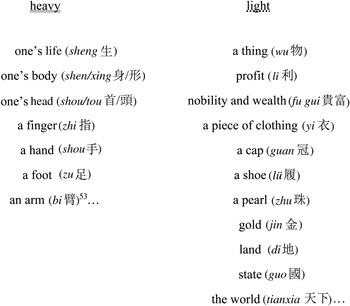
In the story above, Graham's claim that the crucial choice in weighing is between smaller or larger parts of the body, is not warranted. The consecutive weighing acts presented by Master Hua to marquis Zhaoxi of Han consistently oppose the body (parts) to other things. Relinquishing an inscription that promises him possession of the world tianxia 天下 in order to save one's arms liang bi 兩臂Footnote 47 (at the outset of the dialogue) or stopping the fight for a piece of land to prevent the harm done to the marquis's health (in the conclusion). The same holds for the whole set of Lü shi chunqiu stories: the trade is never between two different members of the body. They all create a clear opposition between matters related to “life” on the one hand and mere “things” on the other, with items that can almost blindly be placed in the opposite categories of heavy versus light. Figure 1 shows that in the Lü shi chunqiu weighing stories body parts are consistently weighed against material things and not against other body parts.
Light versus heavy items in weighing stories.

A selection from the various stories illustrates this simple opposition between the body and things: Master Zhan, for instance, teaches Prince Mou of Zhongshan that “if you give weight to life, you will treat profit lightly” 重生則輕利.Footnote 48 The reason why “some people in antiquity were not obliging toward nobility and wealth, was because they were motivated by the weight they gave to life” 古之人有不肯貴富者矣,由重生故也.Footnote 49 The great King Danfu of Bin, for instance, was a person who did not endanger anyone's life—including his own—for the sake of possessing a piece of land. “Even though poor, he would not for the sake of profit ensnare his physical integrity” 雖貧賤不以利累形.Footnote 50 A hermit like Yan He shied away from his rulers' kind attentions, “not because he disliked wealth and nobility per se, but he disliked them because he gave weight to life” 非惡富貴也, 由重生惡之也.Footnote 51 In the Zhuangzi version of this story, the narrator adds: “How sad that many gentlemen of today endanger their body and throw away their life to pursue things!” 今世俗之君子多危身棄生以殉物. 豈不悲哉!Footnote 52 Indeed, “deluded people often cultivate things by means of their inborn nature, which shows that they do not know how to recognize light from heavy. Then the heavy will function as light and the light as heavy. In that case, every action will lead to defeat” 惑者多以性養物, 則不知輕重也. 不知輕重, 則重者為輕, 輕者為重矣. 若此則每動無不敗.Footnote 54
In all these stories the audience is invited to first seriously consider how valuable possessions really are for risking one's health and physical integrity in order to obtain them. There are some exceptions to the clear bifurcation presented above,Footnote 55 but the trade is never between two different members of the body. Moreover, the “world” is consistently weighed against the body. In his criticism of Yangism, Graham assumed that for them body parts and the world could successively lie on both sides of the scales: a finger versus an arm, an arm versus a whole life, a life versus the world, etc. Even though Graham suggested that the weighing metaphor was introduced by the defenders of life and health, he nevertheless relied exclusively on some Later Mohist fragments to characterize its working mechanism and attribute it to the so-called Yangists.
In Response to Vankeerberghen's Characterization of quan B
Even though the word quan does not occur in the selected set of Lü shi chunqiu stories, they undeniably present an interesting variation of the metaphorical weighing act, determining the lightness and heaviness of a head versus a cap, a foot versus a shoe, a hand versus the world, one's health versus a position, one's life versus a state, etc. Since the balance is expected to tilt into one direction, indicating the heavy option and letting the lighter one dangle from its upper arm, the weighing act clearly resembles quan B: without exception, the body (part) always outweighs the mere thing, however precious and valuable.Footnote 56 Many qing zhong stories perhaps also somewhat resemble quan C in that they seem to portray adjustments to the initial weighing act: in the dialogue between Master Hua and the marquis of Han, the opposite weighing baskets are first filled with, respectively, a hand zuo/you shou 左/右手 and the world tianxia; then the two arms liang bi are replaced by a whole body 身, while the world makes place for the state of Han 韓, which in turn is replaced by the contested territory suo zhengzhe 所爭者. Instead of one weighing act that firmly indicates a decision, the movements in both baskets could suggest attempts to adjust the scales and find a balance. But in the end and despite these adjustments, all the stories convey a decisive choice for life, a clear preference for some values as opposed to others; they do not promote the moral ability to creatively reconsider and adjust one's values according to the specific situation. They clearly belong to quan B.
And yet, the weighing metaphor in these stories also exhibits a remarkable cluster of differences from Vankeerberghen's four characteristics of quan B described above. To begin, since the choice is never posed between two similar things—body parts of merely different size—the decision is less typically a calculus, but rather between more fundamentally different options that cannot easily be determined by mere comparison: health versus status, life versus luxury, etc. Secondly, the audience is, at least initially, not invited to adopt a more objective or rational attitude. On the contrary, the rhetorical force of the stories thrives on a spontaneous response, the desire to remain unharmed, and hence the spontaneous unwillingness to sacrifice one's head for a cap. Whatever reasoning goes on further down in the dialogue, it would lose all persuasive force if that initial emotion lost its force. A third characteristic of quan B, according to Vankeerberghen, is that it wants the agents to pause and ponder. But that is not exactly expected in the weighing stories: were a ruler to ponder a while before preferring his own head to a cap, he would not be the most adequate addressee for these persuasions. A final characteristic of quan B is that it expresses an awareness of the inherent impurity and imperfection of opposite options. Again, the Lü shi chunqiu stories do not express such complexities: the choice expected from the first weighing act (the hands outweighing the world) is straightforward; the final acts (one's health outweighing a contested piece of land) are supposed to retain this spontaneous choice. The qing zhong stories thus most resemble quan B, but they clearly differ from it: not only in the adjustment of successive weighing acts, but also in their reliance on a spontaneous, immediate, and uncompromised reaction instead of objective, calculating, and negotiating reasoning. They do not appear in Vankeerberghen's typology.
To conclude, my disagreement with both Graham and Vankeerberghen largely relies on the fact that one set of stories has been overlooked. Graham first encountered the weighing metaphor in his study of the “Mobian” and was thoroughly influenced by two of its textual fragments. His characterization of the metaphor was not shaped by the Lü shi chunqiu stories, even though he refers to one of them and attributes the emergence of the metaphor to Yangist thinkers. Vankeerberghen does not touch upon these stories because the quan does not occur in them. But the mere absence of this term does not make them irrelevant to a typology of types of weighing in early Chinese texts. The weighing stories in the Lü shi chunqiu not only represent a relatively large and consistent set of materials, they are also textually more reliable than the Later Mohist fragments, and I believe that they may have functioned as part of a common lore of which various other transmitted fragments are variations or adaptations. An analysis of their functioning may therefore be relevant for a better understanding of similar stories and related metaphors in other sources.
Analysis of Some qing zhong Stories
How does the scale function in these qing zhong stories? They all endorse the priority given to health and physical integrity. But aside from a general preference for life, they also share a rhetorical scheme. Despite the variation in the stories, two different parts can be roughly distinguished: a narrated dialogue and a reflection on the choices that are made in life. The weighing metaphor occurs in the narrative part. While the reflective section of these stories may have given rise to broader philosophical ideas, especially the notion of an “inborn nature” (xing 性),Footnote 57 my focus lies with the rhetorical trope of the hypothetical weighing.
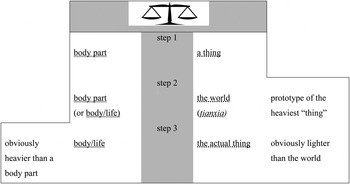
The prototypical steps of these narratives can be described as follows. The first is the suggestion of a concrete, down-to-earth and yet ridiculous exchange, such as one's head for a cap: nobody in his right mind would agree with this, however valuable a cap may have been in those days. At this point the persuasion does not rely on rational argument nor on moral principles, but simply on people's spontaneous and unmediated choice. The idea of trading a head for a cap naturally evokes such a powerful aversion that the balance definitely tilts in the direction of the head. The argumentative force of the argument relies to a considerable extent on the arousal of this wholesome reaction. In a second step, a remarkable adjustment is made: the “world” is thrown in the balance; if that cannot make it tilt to the side of “things” then what else possibly could? But, as the author points out, the balance does not budge. Even though possession of the world was not a realistic option for most human beings, tianxia came to function as an impressive and inspiring stock example of the heaviest possession imaginable and yet not heavy enough to sacrifice one's life for. But there follows a third step, since the target of the persuasion is not a potential Son of Heaven, but fellow humans risking their health for wealth or status: on the side of things, the weight is diminished by placing something lighter than the world (a state, a territory, a position, some benefit); on the side of life, something heavier than a member or limb is put on the scale: nothing less than one's complete body or life. In this last move, the weight on the side of things is diminished to the actual object at hand, while the body part is considerably enhanced. Due to these adaptations on both sides of the balance, the audience is induced to enforce the preference for health as opposed to an object much lighter than the world. Schematically, this ideal type of the body part trader's persuasion is shown in Figure 2, which contains the three steps in the ideal type of persuasion in the weighing stories.
Three steps in the weighing argument.

Horizontally, the basket on the left, containing physical items that are risked, consistently outweighs the material things to be gained on the right. In the first step this is only natural;Footnote 58 but in the conclusion it is induced by a careful manipulation of the initial reaction through analogies of similar things with different weight. As for the vertical weighing act, in the basket on the left, a mere member of the body (in step 1 or 2) is outweighed by the whole body or one's life (in step 2 or 3); on the right, a mere item (in step 1) is replaced by the world (in step 2), and finally by something between them (in step 3). This vertical weighing act on the side of the body parts is indeed more technical, one-dimensional, rational, and calculating, as is the Later Mohist quan between a finger and an arm, or an arm and the whole body.
The persuasion in terms of weighing and trading body parts is thus not a one-shot argument, but takes the audience through various steps—e.g. a hand for the world, a life for a piece of land, etc. Even though starting out from an emotional reaction, it reasons the audience through various analogies toward the correct conclusion, namely a choice for life and health. The initial weighing act is meant to arouse a strong reaction, which should eventually be transmitted to the relevant case. To do this successfully, the persuader has to show that the final case is not only analogous with the initial trade, but also gradually different in a way that it warrants the spontaneous response even more. Therefore, on top of the primary, horizontal weighing act between the two opposite baskets dangling on both sides of one beam, there occurs also a secondary, vertical type of weighing one each side. This adjustment of the balance happens in two or three consecutive steps of adding and subtracting weight. In this vertical weighing act, body parts are indeed compared to each other, as Graham noticed on the basis of the Later Mohist fragments. But in the stories that he labels Yangist, this does not constitute the primary argument.
Admittedly, none of the actual stories makes explicit reference to all three steps of this ideal type. But most of them contain at least two of them and some individual variations. For instance, to begin with the story quoted in full above, Master Hua's persuasion begins with step 2: when presented with a hypothetical trade, the marquis of Han resolutely rejects sacrificing his hands for the world: his arms tilt downward, the world goes up 兩臂重於天下也. Then Master Hua adds more weight to the winning side by replacing the arms with the whole body, which is even heavier 身又重於兩臂; to diminish the losing side he replaces the world by the state of Han, which is by far lighter than the world 韓之輕於天下遠矣. But this step contains one more move: what the marquis is actually fighting for turns out to be only a part of Han, which makes the thing dangling in the air even lighter 今之所爭者其輕於韓又遠. Thus, starting from the marquis's own spontaneous preference for his hands or arms compared to the world, Master Hua leads him, by replacing weights on both sides, to the conclusion that he should stop “troubling his body and harming his life by worrying and grieving about not getting” this contested piece of land 愁身傷生以憂戚不得也. This conclusion is the point that Master Hua wants to make.
In another persuasion, the first step is fully present: “Suppose there was a man who cut off his head in exchange for a cap, and let his body be killed in exchange for a piece of clothing. His fellowmen would surely think him deluded” 斷首以易冠, 殺身以易衣, 世必惑之. Moving to the third step, the persuader goes on: “Those in our age running after profit, resemble this: they endanger their bodies and harm their life, cut their throats and chop off their heads in the pursuit of profit” 世之走利, 有似於此: 危身傷生, 刈頸斷頭以徇利.Footnote 59 The fragment is presented as an illustration of how one's body/person can be opposed to the world, which brings tianxia into the picture, but here not rhetorically as a second step. Even though I believe that the possession of the world was originally not really the issue at stake, in the early literature it clearly became an appealing topic: stories about wise men renouncing the throne or wanting to abdicate in order to preserve their health attest to this fascination.Footnote 60 In yet another story, when the ancient sage king Yao wanted to abdicate, his favorite candidate for succession rejected the offer, claiming health problems. Even though “the world is a very heavy thing” 天下重物也, even “the heaviest of all” 夫天下至重也,Footnote 61 “he would not harm his life for it” 而不以害其生. The following line, “How much less for any other thing!” 又況他物乎 could be considered a third step, a hint at the concrete thing to be considered light in a vertical comparison with the “world” and thus even lighter when horizontally compared to one's health.Footnote 62 But like in various stories, that “other thing” remains unspecified: the story ends with the rejection of sacrificing one's health for possessing the world.
To recapitulate, although the body part trade-off stories differ in length and structure, their narrative section usually contains an argument using at least two of the following three weighing steps: first, a very concrete and physical proposal of which the rejection is spontaneous and straightforward; second, an analogous but more political case in which even the most valuable possession imaginable (the world) is also rejected; and third, a concrete application in which the analogous weighing act should be even more convincing than with the preceding stock example. The persuaders largely trust the argumentative power of these hypotheses that naturally steer the inborn reaction of their audience in certain straightforward situations toward a similar reaction in less obvious but more important cases. This argumentative mechanism of three more or less explicit steps constituted a powerful tool for persuasion.
Conclusion
The weighing stories have been preserved in sources that are generally dated to the third century b.c.e.: four Lü shi chunqiu chapters and Zhuangzi “Yielding the Throne.” The emergence of these or similar stories in oral or written form is not easy to determine. But occasional echoes in other late Warring States sources discussing choices in terms of body parts suggest that they belonged to a larger pool of arguments. Given the relative simplicity of their structure, the similarity of the stories, and their rhetorical force, I tend to agree with Graham that they might have initiated the debate. It is a common argumentative strategy to accept the opponent's example and adapt it for one's own purpose. The body part weighing trope may have had such appeal. Even the Later Mohists, who disagreed with the priority given to one's own life over political sacrifice, fell for its charm. The collection of simple stories such as those analyzed above may have functioned as a common lore surrounded or followed by more complex variations and adaptations in various directions. Without going into detail here, I will indicate three directions in which this metaphor may have evolved. First, the two “Mobian” fragments estimate the possible loss of different body parts against each other and thereby make the (secondary) vertical weighing act their primary concern. The Later Mohist thereby reduced an originally vital choice to a mechanical calculus. A second evolution or variation is that other items are introduced which are neither a thing nor a body part. For instance, Mencius as well as some Mohists used the rhetoric of choice and body parts to argue that yi 義 (justice, righteousness) trumped both life and things. In those arguments, the explicit weighing metaphor was often absent.Footnote 63 It is also interesting to note, thirdly, that most of these variations or adaptations argue against the priority given to health, or dissuade the reliance on a spontaneous reaction. Some of those opponents, recorded in the Mencius and Hanfeizi,Footnote 64 introduced a new body part into the metaphor: the one hair (yi hao 一毫, yi mao 一毛) as the stock example of the lightest member of the body.Footnote 65 While the defenders of health used the idea of tianxia as the heaviest possession not even worth ensnaring one's health for, their critics referred to the ridiculously light member of the body to show that these people did not want to compromise any bit of their health to benefit (from) others.Footnote 66 It is therefore not surprising that this extremely light body part does not occur in the Lü shi chunqiu dialogues. I believe that it belongs to the adaptations leading away from the set of relatively simple stories into a much more complex variety of different arguments dispersed in other sources.
But returning to the more narrow topic of this article, I conclude that Graham's criticism of the Yangists was influenced by his focus on the “Mobian.” When he characterized the weighing metaphor, he referred to five fragments of which four belong to the group of what I consider variations or adaptations; two of them (not discussed here) do not even contain the weighing metaphor. Even though he did refer to one Lü shi chunqiu story, it did not determine his view. In his criticism of the so-called Yangist position, Graham claimed that there was an inconsistency in their preference for their own body as opposed to the world; he thought that the individualists' concern for their own health and survival “outweighing” their concern for the world did not match with their own metaphorical use of the balance comparing parts to the whole. But his characterization of the weighing mechanism was based on two Later Mohist fragments and did not seriously take into account this and other Lü shi chunqiu stories that he labeled Yangist. Vankeerberghen followed him in her typology of quan B “deciding by comparative weighing.” I have argued that the relatively consistent set of dialogues collected in four Lü shi chunqiu chapters always gives weight to the body parts as opposed to mere things, and that tianxia is the prototypical “thing” which never outweighs the body. Two or three adjustments on both sides of the balance are meant to manipulate the initial spontaneous reaction and to guide the audience toward the best choice in less straightforward situations. This analysis not only does justice to the selection of stories that weigh body parts in terms of light and heavy, but it also offers valuable hints on the variations and adaptations of this simple mechanism in other more complex arguments, such as found in the Mozi, the Mencius, the Hanfeizi and the Liezi.Footnote 67