





Introduction
“Stimming, dancing, gyrating—it is all permitted”, says the narrator in the experimental documentary The Stimming Pool (Neurocultures Collective & Eastwood Reference Collective and Eastwood2025). This neuro-affirmative statement aptly highlights the fact that autistic ways of expressing emotion and engagement require ‘permission’ and are thereby often framed as inappropriate or deficient. This marginalisation extends into professional contexts, where rigid expectations of verbal fluency systematically exclude limited-speaking or nonspeaking individuals (Donaldson, corbin, & McCoy Reference Donaldson and McCoy2021). It also underlies social media environments which privilege phatic interactions that autistic people report as alienating (Van Driel, Vines, Barros Pena, & Koteyko Reference Van Driel, Vines, Barros Pena and Koteyko2023; Koteyko, Van Driel, Billan, Barros Pena, & Vines Reference Koteyko, Van Driel, Billan, Barros Pena and Vines2025). While language ideology scholarship, drawing on Miyako Inoue’s (Reference Inoue2003) concept of the ‘listening subject,’ has documented how listeners perceive speech through ideological expectations that project racialised and gendered personae onto speakers (Flores & Rosa Reference Flores and Rosa2015; Calder Reference Calder, Coons, Chronis, Pierson and Govindarajan2021; Rosa & Flores Reference Rosa and Flores2023), the role of neurotypical norms in organising the perception of autistic communication remains largely unmapped. To address this gap, this article develops the concept of the ‘neurotypical listening subject’ through analysis of autisticFootnote 1 young people’s metapragmatic accounts of interaction with non-autistic and autistic interlocutors in digital settings.
Autism is a neurodevelopmental and neurological difference involving distinctive patterns of sensory experience, including hyper and hypo sensitivities, through which environments and social encounters are perceived and navigated (Murray Reference Murray and Volkmar2018; Fletcher-Watson & Happé Reference Fletcher-Watson and Happé2019). Approximately one-quarter to one-third of the autistic population is non-speaking, often relying on Augmentative and Alternative Communication (AAC) systems (Rose, Trembath, Keen, & Paynter Reference Rose, Trembath, Keen and Paynter2016). Auditory processing variances and difficulties in task-switching shape interactional dynamics, for example divergence is often noted in how interactions are initiated and maintained, including through linguistic features such as echolalia (repetitive vocalisation). These conditions can make communication that allows additional time for thinking and that provides a more explicit structure especially valuable for autistic individuals, which helps explain a preference for text-based, asynchronous modalities over synchronous spoken channels, such as the telephone (Howard & Sedgewick Reference Howard and Sedgewick2021).
While there is a vast heterogeneity in definitions and understandings of what autism is and the degree to which it is considered (non)normative in various cultures, in Westernised contexts autism has been historically framed as a disease or disorder. Autistic individuals, however, often reject this medicalised view in favour of alternative self-understandings (Kapp, Gillespie-Lynch, Sherman, & Hutman Reference Kapp, Gillespie-Lynch, Sherman and Hutman2013). In parallel, psychology (Heasman & Gillespie Reference Heasman and Gillespie2019; Crompton, Ropar, Evans-Williams, Flynn, & Fletcher-Watson Reference Crompton, Ropar, Evans-Williams, Flynn and Fletcher-Watson2020) and linguistics research (Sterponi & de Kirby Reference Sterponi and de Kirby2016; Van Driel et al. Reference Van Driel, Vines, Barros Pena and Koteyko2023; Jagodziński Reference Jagodziński2026) are mounting the critique of the models that frame autistic speech patterns and atypical sensorimotor experiences as ‘deficits’ by demonstrating the coherence and reciprocity that emerge within autistic interaction. Linguistic anthropology offers a complementary analytic lens to such critiques by approaching communicative conduct as accountable to metapragmatic norms that define what counts as appropriate or competent. Work on raciolinguistic ideologies (such as by Flores & Rosa Reference Flores and Rosa2015), in particular, demonstrates how appropriateness operates as a historically sedimented evaluative regime, structured through perceptual expectations and moralised judgments.
This study examines how autistic young people orient to such evaluative frameworks in their own terms when they engage online with their focused interests which include art, media fandom, animals, and autism itself. Drawing on survey-based metapragmatic reflections about participation in digital ‘affinity spaces’—online environments such as gaming communities or Facebook groups where individuals interact around shared interests and exchange knowledge (as defined by Gee Reference Gee2004)—we analyse how respondents describe and contest the conditions under which their communication is (mis)recognised or disciplined. In doing so, we attend to how participants anticipate evaluation through neuronormative listening positions, and how they construe affinity spaces as configurations of visibility and assessment to which they adjust their communicative conduct. Our discussion considers how these reflections provide evidence of the ways systemic frameworks of evaluation shape interaction across contexts.
Autistic communication and the neurotypical listening subject
Why do autistic communicative practices so often attract social penalties or require explicit permission in institutional and everyday interactions? Deficit models of autistic communication are being increasingly challenged, most prominently through Damian Milton’s (Reference Milton2012) formulation of the double empathy problem which attributes communicative breakdowns in autistic–non-autistic interaction to mismatched dispositions and expectations. The theory clarifies the relational character of misunderstanding but leaves open the question of how particular interactional orientations become the unmarked baseline for evaluation. In what follows we draw on the notion of the ‘listening subject’ in language ideology scholarship (Inoue Reference Inoue2003; Flores & Rosa Reference Flores and Rosa2015; Smalls Reference Smalls, Alim, Reyes and Kroskrity2020) to examine the conditions under which autistic communication has come to index diminished social capacity.
Our starting point is Flores & Rosa’s (Reference Flores and Rosa2015) analytic shift to treat linguistic normativity as a problem of listening rather than speaking. In this account adapted from Inoue (Reference Inoue2003), language is evaluated through historically formed habits of perception that shape what listeners hear as appropriate or marked. Inoue (Reference Inoue2003:157) points out that ‘perception (whether auditory or visual) is never a natural or unmediated phenomenon but is always already a social practice’. Ways of hearing and seeing interaction therefore carry a history of how voices and bodies have been evaluated within particular social orders. Within such listening regimes, particular interactional features acquire what Silverstein (Reference Silverstein2003) terms ‘indexical value’, whereby linguistic and embodied forms come to signal socially recognisable meanings. Calder’s analysis of the cisgender listening subject directs attention to the listener’s position within such processes of indexical interpretation, asking ‘for whom signs carry social meaning’ (Reference Calder, Coons, Chronis, Pierson and Govindarajan2021:40, original emphasis). Here we ask this question in relation to autism by examining how and why practices such as eye contact or backchanneling come to acquire indexical value as signs of engagement, whereas autistic interlocutors may orient to interaction through forms of involvement that do not foreground such cues.
To do this, we conceptualise the neurotypical listening subject as an effect of clinical, academic, and educational discourses that have shaped normative expectations for how engagement is displayed. Clinical pragmatics has played an influential role here by treating deviations in prosody, register, or bodily coordination as diagnostic signs of communicative deficit. Autistic sensory sensitivities to visual, tactile, or auditory stimuli become clinically salient only insofar as they are evaluated through normative frameworks that treat particular ways of speaking and moving as evidence of social competence. These interpretive practices inform clinical descriptions of pragmatic impairments in autism and contribute to diagnostic categories such as ‘flat affect’ or ‘topic persistence’ (e.g. Colle Reference Colle, Schneider and Ifantidou2020), which refers to repetition of facts or topics or detailed monologues about a topic. As explained by Sinclair (Reference Sinclair2010), some autistic communities, by contrast, value extended monologues as a sign of interest and respect, show greater comfort with silences, and maintain flexible expectations around eye contact.
Instruments such as the DSM-5 reinforce neurotypical listening practices by situating judgment with the listener, for example, by asking autistic individuals whether ‘other people frequently tell me that what I’ve said is impolite’ (quoted in Jagodziński Reference Jagodziński2026). Experimental work further demonstrates the operation of these interpretive expectations in everyday perception. Sasson, Faso, Nugent, Lovell, Kennedy, & Grossman (Reference Sasson, Faso, Nugent, Lovell, Kennedy and Grossman2017), for example, show that neurotypical observers evaluate autistic speakers as less socially desirable within seconds of exposure, and that these ‘thin sliced’ judgments hinge, inter alia, on cues such as eye contact.
Interactional research has described these widely circulating expectations concerning how involvement may be displayed in spoken and written interaction in Anglophone cultures. Goffman’s account of ‘focused encounters’ positions face-to-face interactions, where interlocutors monitor each other’s reactions through, for example, gaze, timely backchannels, or modulation of prosody as ‘the natural unit of social organization’ (Reference Goffman1961:8). Conversation analytic work on turn-taking (e.g. Sacks, Schegloff, & Jefferson Reference Sacks, Schegloff and Jefferson1974) further shows how attention becomes publicly accountable through the sequential organisation of turns, where the timing and design of a next action displays participants’ orientation to a prior turn, whereas frameworks such as audience design (Bell Reference Bell1984) and accommodation theory (Giles, Taylor, & Bourhis Reference Giles, Taylor and Bourhis1973) position speakers as shifting their linguistic input to converge with an audience. At the same time, there are studies that examine participation formats in which attention is organised differently. Bergmann & Peräkylä (Reference Bergmann, Peräkylä, Mondada and Peräkylä2023) describe outward-focused gatherings such as lectures or public performances in which participants orient jointly to an object or activity without continuous alignment toward one another. Work by Mondada (Reference Mondada2013) and Goodwin (Reference Goodwin2018) demonstrates that attention can be organised through embodied participation in shared practical activity, including coordinated manipulation of objects or tactile engagement.
Ethnographic and interactional research on autism describes communicative practices that align with such participation formats. Ochs & Solomon (Reference Ochs and Solomon2010) posit that autistic sociality involves ‘object-mediated coordination’ based on the use of artifacts and a focus on objective knowledge. By allowing participants to align side-by-side focusing on the artefact, interaction proceeds ‘without the overwhelming visual stimuli produced by the corporeal interlocutor’ (2010:82). Heasman & Gillespie’s (Reference Heasman and Gillespie2019:915–16) analysis of such object-focused interaction (autistic participants playing a video game) demonstrates that shared understanding is achieved despite frequent topic shifting and fragmented turns through what the authors call ‘generous assumption of common ground’ and ‘a low demand for coordination’. This resonates with accounts of on autistic ‘interest-based sociality’ (Bertilsdotter-Rosqvist Reference Rosqvist and Hanna2019) and monotropism (Murray Reference Murray and Volkmar2018), that is, a tendency to focus attention on a limited number of interests or stimuli at any one time. Murray’s description of monotropism foregrounds how autistic forms of engagement contrast with the expectation to attend to both the interlocutor and the topic.
In contrast to the notion of reading other individuals’ minds in order to guess what they are thinking, or where you stand in relation to them and using language effectively to manipulate others’ interest systems, this way of sharing experience is not about presentation of self to self but about a freedom of shared joy and wonder that entirely transcends self. (Murray Reference Murray and Volkmar2018:2)
Difficulties arise when such object-centred orientations are evaluated through frameworks that privilege the orientation to the interlocutor. When gaze and other signs of recipiency are treated as default indices of involvement, practices such as extended monologues, direct or information-dense language, and repetitive movement become available for negative interpretation. Stimming, for example, has frequently been framed as disruptive or excessive, despite autistic accounts that describe it as integral to social connection within autistic groups (Morris, Sykes, Paulus, Dameh, Razzaque, Esch, Gruenig, & Zelazo Reference Morris, Sykes, Paulus, Dameh, Razzaque, Esch, Gruenig and Zelazo2025) and to sensory regulation (Kapp, Steward, Crane, Elliott, Elphick, Pellicano, & Russell Reference Kapp, Steward, Crane, Elliott, Elphick, Pellicano and Russell2019). For listeners oriented toward interactional expectations derived from what Goffman (Reference Goffman1961) called a ‘focused gathering’, such movements disrupt the enregistered association between bodily stillness and recipiency. Deviations from this association therefore become interpretable as breaches of involvement obligations and may be heard as disrespect or incompetence.
We introduce the notion of ‘attentional asymmetry’ to capture this unequal normative valuation of how attention is organised and displayed in interaction. Due to sensorimotor differences and divergent ways of organising attention (described in Gernsbacher, Stevenson, Khandakar, & Goldsmith Reference Gernsbacher, Stevenson, Khandakar and Goldsmith2008) autistic speakers may orient to social engagement through continuous focus on objects or informational content, yet such practices can be assessed against criteria that privilege orientation toward co-participants. The neurotypical listening subject names this ideological position through which focused-interaction norms are naturalised as default in particular institutional and everyday contexts. Within settings where these norms prevail, autistic ‘object-mediated co-ordination’ becomes available for interpretation as ‘rigid’, ‘meaningless’, or ‘hostile’ (Rodas Reference Rodas2018:73), rather than as an alternative organisation of interaction.
Crucially, as work on racialised and sexed embodiment reminds us, the evaluative practices underlying attentional asymmetry are layered with gendered, racialised, and age-specific assumptions. For example, young autistic girls’ reduced eye contact may be read as rudeness (Bargiela, Steward, & Mandy Reference Bargiela, Steward and Mandy2016), whereas similar behaviours in neurotypical adult men may go unnoticed. Black children are disproportionately apprehended through listening regimes shaped by histories of surveillance and discipline, in which deviations in gaze or movement are heard as indicators of wilful defiance rather than as variations in attentional organisation (Mandell, Ittenbach, Levy, & Pinto-Martin Reference Mandell, Ittenbach, Levy and Pinto-Martin2007). In both cases, gendered and racialised expectations pre-structure how involvement is perceived and moralised.
Masking practices emerge as linguistic and semiotic responses to attentional asymmetry. Hall & Parish describe masking as ‘targeted towards styling oneself in order to “pass” as neurotypical’, for example, using social scripts or suppressing stigmatised behaviours such as stimming (Reference Hall and Parish2024:5). Research on autistic masking consistently documents its impact on mental health (e.g. Hull, Petrides, Allison, Smith, Baron-Cohen, Lai, & Mandy Reference Hull, Petrides, Allison, Smith, Baron-Cohen, Lai and Mandy2017; Pearson & Rose Reference Pearson and Rose2021), yet its significance extends beyond individual burden. Masking reorganises interactional responsibility by shifting the adaptive work onto autistic participants while leaving normative listening practices unexamined.
Rather than disappearing in contexts perceived as safe or accommodating, masking has been described as a habitualised and anticipatory orientation to social exposure, shaped by prior experiences of evaluation and sanction (Pearson & Rose Reference Pearson and Rose2021). Even in autistic-only environments, the expectation of evaluation may therefore remain embedded in embodied conduct. Consequently, we argue against approaching autistic-oriented spaces as operating outside the reach of the neurotypical listening subject in any simple sense. The authority of the regime may be reduced, but it persists as a structuring background that autistic speakers continue to navigate through internalised modes of self-monitoring.
It is particularly important to interrogate neurotypical listening practices in environments where language and ‘media ideologies’ (to use the term of Gershon Reference Gershon2010) intertwine. Digital participation has been described as inherently enabling for autistic people (e.g. Alon-Tirosh & Meir Reference Alon-Tirosh and Meir2023) despite little systematic research into interactions between autistic and non-autistic users. Emerging research based on interviews and linguistic analysis of posts demonstrates that autistic social media users continue to mask online as their direct communication, inter alia, is interpreted as rudeness, and some users report being banned from groups on this basis (Koteyko et al. Reference Koteyko, Van Driel, Billan, Barros Pena and Vines2025). We therefore view accounts of participation in affinity spaces as a vantage point for examining how autistic users navigate or resist the listening subject in environments organised around shared topics but designed around neurotypical expectations of interaction.
Methodology
Data
Between December 2023 to March 2024, we administered an online survey. To be eligible, participants had to be sixteen to twenty-six years of age, live in the UK, have the ability understand and communicate in English, have no intellectual disability, and identify as autistic. We retained the category of ‘young people’ across the sixteen to twenty-six age span because the transition to adulthood for autistic people is frequently extended and non-linear, particularly in relation to further education, employment, independent living, and support systems. Rather than concluding at legal adulthood, transitions often continue through the early and mid-twenties, with movement into postsecondary education, work, and adult services occurring unevenly and at different temporal rhythms from non-autistic peers (Hendricks & Wehman Reference Hendricks and Wehman2009). Recent transition research correspondingly treats autistic ‘transition-age youth and young adults’ as extending into the late twenties in recognition of the prolonged and overlapping nature of educational, vocational, and social transitions (Roux, Chvasta, McLean, Carey, Perez Liz, Tomczuk, Lopez, Assing-Murray, Shattuck, & Shea Reference Roux, Chvasta, McLean, Carey, Liz, Tomczuk, Lopez, Assing-Murray, Shattuck and Shea2024).
Participants who do not have a clinical diagnosis were included in recognition of the systemic barriers which can prevent or delay diagnosis for marginalised groups (see Botha & Gillespie-Lynch Reference Botha and Gillespie-Lynch2022). The inclusion of self-identified autistic participants is an increasingly common practice in autism research and has not been shown to negatively impact results (Fletcher-Watson Reference Fletcher-Watson2024). The study received approval from the ethical review board at Queen Mary University of London (QMERC23.117). All participants provided informed consent; for participants under eighteen, we sought both assent from the individual and consent from a guardian.
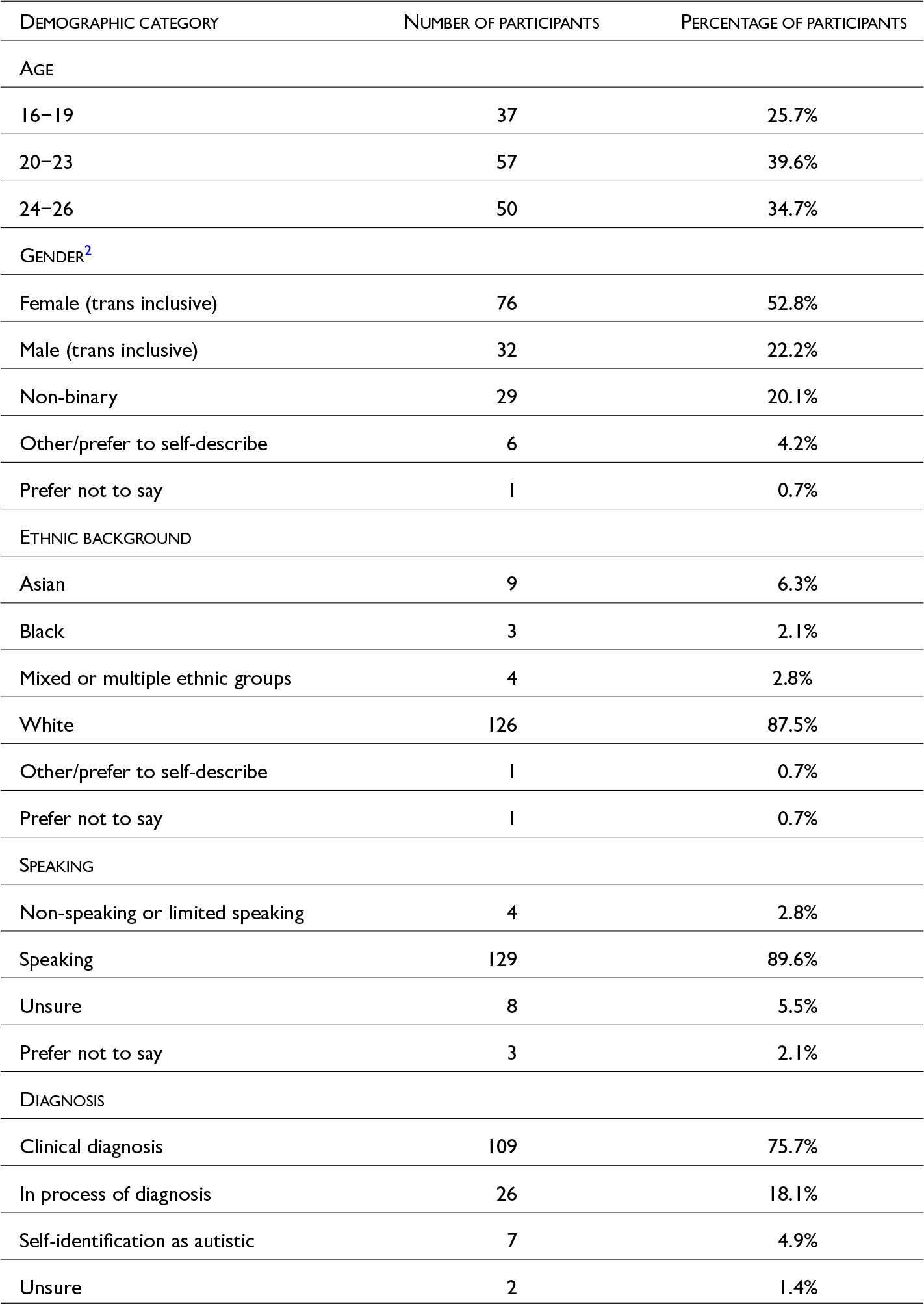
The survey comprised closed and open-ended questions regarding social media practices for engaging with interests, including preferred platforms and modes of engagement (e.g. scrolling, writing), feelings or emotions, and experiences with masking. We worked with an advisory board of autistic young people to develop the questions, produce consent forms and information sheets, and analyse findings. After filtering out incomplete and ineligible responses, our final sample comprised open-ended responses from 144 participants (see Table 1). We approached these open text responses as an opportunity to examine how autistic young people themselves reflected on the conditions under which autistic communication is (mis)recognised.
Demographic breakdown of survey participants.

Table 1 Long description
A table showing the age, gender, ethnic background, speaking status, and diagnosis status of participant. Age: 37 (25.7%) are 16-19, 57 (39.6%) are 20-23, and 50 (34.7%) are 24-26. Gender: 76 (52.8%) are female (trans-inclusive), 32 (22.2%) are male (trans-inclusive), 29 (20.1%) are non-binary, 6 (4.2%) preferred to self-describe and 1 (0.7%) preferred not to say. Ethnic background: 9 (6.3%) were Asian, 3 (2.1%) were Black, 4 (2.8%) had mixed ethnicity, 126 (87.5%) were White, 1 (0.7%) preferred to self-describe, and 1 (0.7%) preferred not to say. Speaking: 4 (2.8%) were non-speaking or limited speaking, 129 (89.6%) were speaking, 8 (5.5%) were not sure, and 3 (2.1%) preferred not to say. Diagnosis: 109 (75.7%) had a clinical diagnosis, 26 (18.1%) were in the process of being diagnosed, 7 (4.9%) self-identified as autistic without a diagnosis, and 2 (1.4%) were not sure.
Method
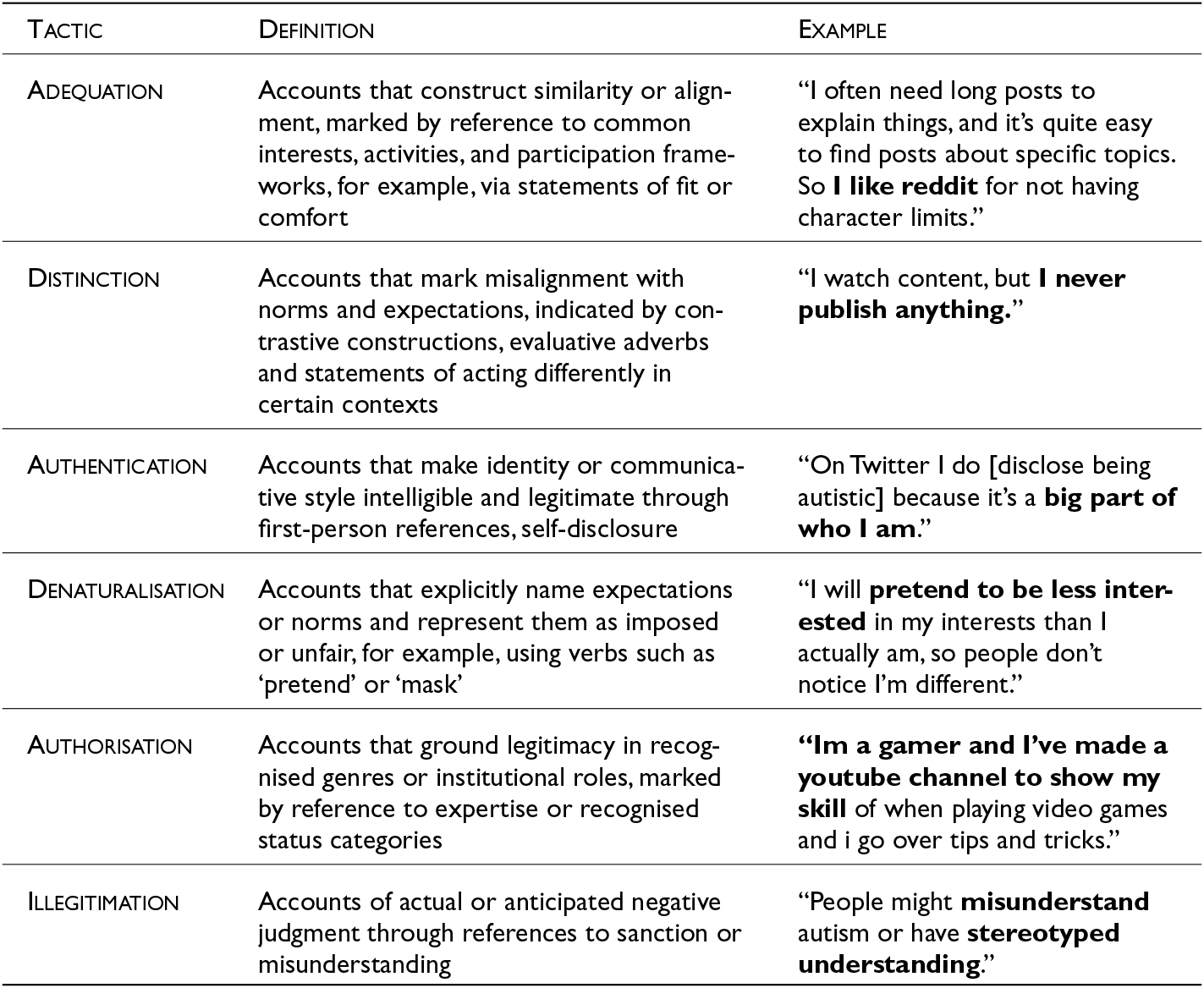
To examine orientations to the neurotypical gaze, we use Bucholtz & Hall’s (Reference Bucholtz and Hall2005) framework of the tactics of intersubjectivity. Recognising that identity construction is ‘always rooted in ideology as well as in practice’ (Bucholtz & Hall Reference Bucholtz and Hall2004:495) the authors specify three paired tactics—adequation and distinction, authentication and denaturalisation, and authorisation and illegitimation—which describe how speakers position themselves and others in relation to similarity, genuineness, and social legitimacy. In our analysis of survey responses, these tacticsFootnote 3 allow us to trace how young people expect to be, or report having been, heard by the neurotypical listening subject, and how they imagine and interrogate the listening practices of this ideological hearer (see Table 2 below). Our aim is not to isolate specific listening practices that can be labelled neurotypical; rather we are concerned with how this group characterises listening practices and their consequences. In other words, we are interested in how attentional asymmetry becomes visible in the metapragmatic accounts, for example when respondents describe how their ways of displaying engagement are misrecognised or pre-emptively managed.
Operationalisation of intersubjectivity tactics.

Table 2 Long description
First, Adequation is defined as “Accounts that construct similarity or alignment, marked by reference to common interests, activities, and participation frameworks, e.g. via statements of fit or comfort." For example, “I often need long posts to explain things, and it’s quite easy to find posts about specific topics. So I like reddit for not having character limits." Second, Distinction is defined as “Accounts that mark misalignment with norms and expectations, indicated by contrastive constructions, evaluative adverbs and statements of acting differently in certain contexts," for example “I watch content, but I never publish anything." Third, Authentication is defined as “Accounts that make identity or communicative style intelligible and legitimate through first-person references, self-disclosure," for example “On Twitter I do [disclose being autistic] because it’s a big part of who I am.” Fourth, Denaturalisation is defined as “Accounts that explicitly name expectations or norms and represent them as imposed or unfair, e.g. using verbs such as “pretend” or “mask”" for example “I will pretend to be less interested in my interests than I actually am, so people don’t notice I’m different.” Fifth, Authorisation is defined as "Accounts that ground legitimacy in recognised genres or institutional roles, marked by reference to expertise or recognised status categories," for example “Im a gamer and I’ve made a youtube channel to show my skill of when playing video games and i go over tips and tricks”. Finally, Illegitimation is defined as “Accounts of actual or anticipated negative judgment through references to sanction or misunderstanding," for example “People might misunderstand autism or have stereotyped understanding.”
Not all accounts of interest-based engagement fall within the scope of these tactics. Several brief descriptions of pleasure and calm derived from reading about interests, together with one account of excitement during solitary engagement (e.g. “When I’m thinking about my special interest I tend to get so excited I tend to jump around the place or slam by [sic] body on my bed sometimes”; female, Black, speaking) did not contain metapragmatic commentary that would establish orientation to legitimacy or evaluative frameworks and therefore were excluded from coding. Survey responses have been trimmed for length but are otherwise quoted verbatim.
Our study is situated within a larger participatory project conducted in close collaboration with the autistic community and national autism charities.Footnote 4 Autistic researchers constitute the majority in the research team, and while the engagement with autistic community enriched the analysis, it may also reflect specific advocacy positions or dominant voices. We sought to mitigate this through critical reflexivity, the recruitment of a diverse advisory board, and collaborative analysis. While the bigger project also includes ethnographic observation and interviews, this article focuses on participants’ retrospective reflections and the findings therefore do not reflect in situ practices. As UK-based researchers, we recognise the limitations of our institutionally privileged and Western standpoint.
It should be also noted that our predominantly speaking and largely White sample constrains the scope of claims in this article. Non-speaking autistic individuals employ creative multimodal strategies (see Mavritsakis Reference Mavritsakis2024 for an example) that may challenge normative listening in distinct ways, and future research should examine how their practices encounter or reshape perceptual regimes in digital spaces. Greater racial diversity would also permit analysis of how racialised and neurotypical listening co-constitute normative expectations around language and digital participation.
Analysis
We develop three main points in our analysis of the tactics. First, we show that awareness of negative social meanings attachable to autistic practices, together with experiences of autism being treated as a marker of linguistic incompetence, shape which semiotic practices young people adopt or avoid (illegitimation and denaturalisation). Second, the tactics of adequation/distinction demonstrate how attentional asymmetry structures platform and group choices as participants select formats and venues that reduce the risk of being judged by displays of engagement they cannot or will not perform. Third, we analyse how some autistic users repurpose platform features to signal epistemic expertise and structure engagement around topics or objects (authorisation) whereas others explicitly refuse to organise their conduct around the anticipated negative judgment (authentication).
Illegitimation and denaturalisation as structuring conditions of participation
Participants’ accounts consistently indicate that participation in online affinity spaces is shaped by the anticipation of illegitimation. Illegitimation in our accounts refers to the projected denial of communicative legitimacy, where actions are expected to be treated as inappropriate or unintelligible. The data show that such expectations shape participation prior to interaction and constrain what kinds of semiotic displays are treated as permissible.
This is evident in accounts that orient to overt sanction, including ridicule or harassment. In the following response in (1), stimming and the use of communication aids are treated as recognisable signs whose interpretation is anticipated in advance.

What is at stake is not a potential for misunderstanding, but evaluation of such practices as markers of deviance in line with research on how signs associated with minoritised bodies are reinterpreted through dominant semiotic ideologies that foreground deficiency (Smalls Reference Smalls, Alim, Reyes and Kroskrity2020). Autism here functions as an already ‘enregistered category’ (to use the term of Agha Reference Agha2007), indexical of deficit before communicative conduct is encountered, as example (2) makes explicit.

Participants also foreground illegitimation that operates less through overt hostility than through anticipated categorisation. Examples (3) and (4) reflect how autistic speakers expect their contributions to be treated as less credible or less relevant once autism becomes salient.

The anticipation that their contributions will be judged according to categorical assumptions aligns with Flores & Rosa’s (Reference Flores and Rosa2015) account of appropriateness as a regulatory framework in which certain speakers are heard through perceptual habits, and where dominant narratives delimit how participants and their actions can be interpreted before interaction occurs. The following response in (5) shows how dominant narratives about autism position communicative competence as fundamentally incompatible with autistic identity.

Here the respondent makes clear that the issue does not reside in performance, as others compliment her on how she comes across, but in a listening practice that treats autistic identity as misaligned with communicative competence (“people are unfortunately often surprised”). Alignment with dominant norms through masking therefore does not secure authority. As Chapman & Carel (Reference Chapman and Carel2022) argue, such narratives produce a double bind in which autistic self-reports are rendered unintelligible: expressions of difficulty are read as evidence of pathology, while fluency is seen as an exception that calls into question the autism diagnosis.
Across responses coded under illegitimation, participants describe anticipating sanction when their ways of showing engagement do not match what interlocutors expect. In the following account in (6), repetition and an in-depth engagement with content are reported to be perceived as disruptive or excessive.

Within the ideological frame of the neurotypical listening subject (invoked metonymically through “some people”), involvement is often recognised through interpersonal cues. Pursuing a topic at length or repeating information, as reported in (6), is therefore heard as failure to meet expectations about appropriate participation (Goffman Reference Goffman1961) whereas in autistic communities these same practices may index engagement and enthusiasm (Hillary Reference Hillary, Rosqvist, Chown and Stenning2020). In Jaffe’s (Reference Jaffe and Coupland2016) terms, this metapragmatic commentary maps the boundary between competing indexical fields. By pitting the external evaluation (“too much”, “too in-depth”) against their own epistemic stance (“assume are basic”), the participant demonstrates how the social value of a practice, in this case topic elaboration, shifts depending on the interpretative framework of the listener.
In this context, denaturalisation emerges where participants expose the normative framework itself as a contingent, constructed regime. From the perspective of attentional asymmetry that we described earlier, heightened affect or body movement that is not sequentially occasioned or ratified risks being treated as disruptive or inappropriate. Conversely, stillness is treated as the index of attentiveness. The following account in (7) disrupts this link by indicating that ‘attentiveness’ can be a carefully choreographed performance.

Here, the participant denaturalises the display of engagement by framing it as something she must ‘try to look like’. While the embodied act (sitting still) aims for compliance, the metapragmatic account exposes such behaviour as inauthentic. By defining ‘normalcy’ as a performance of stillness, the participant reveals the expectation of stillness to be an arbitrary constraint of the listening subject.
Although our analysis is qualitative, we observed during coding and interpretive review that accounts of implicit illegitimation appeared more frequently in responses by female and non-binary participants, compared to responses by male participants (cf. Sauntson Reference Sauntson, Kjaran and Sauntson2019). Furthermore, in accounts of masking, gender becomes visible at the level of how participants anticipate and comment on potential uptake. Female and non-binary respondents provide detailed accounts of masking practices and explicitly articulate the disparity between their communicative intent and the interpretive framework of the neurotypical listening subject.
In the following account in (8), a participant denaturalises the normative expectation for ‘friendliness’ by presenting it as a specific semiotic requirement, which she fulfils by appending affective markers to otherwise concise language.

By distinguishing the capacity to “say everything in a short and concise way” from the effort to “appear friendly and good natured,” she exposes a mismatch between her goal of informational efficiency and the expectation to mitigate the force of an imposition in the framework of Anglophone middle-class politeness (as described by Mills Reference Mills2017). The use of ‘hyper awareness’ further describes these politeness expectations as an interpretive framework that she recognises and deliberately accommodates. Emoji become a mechanism for guiding that interpretive process by aligning the utterance with the affective cues expected by the listening subject.
A similar metapragmatic critique appears in accounts by non-binary participants, who describe adjusting their register in anticipation of negative evaluation, as shown in (9).

Here the participant also locates impoliteness in the interpretive acts of a listening subject. The clause “I know some people interpret” restricts the attribution of impoliteness to a subset of listeners and positions the evaluation as contingent upon particular interpretive practices rather than as a stable property of ‘direct wording’ or reduced eye contact. The participant’s transition to being “overly polite” is a calculated effort to prevent the ideological listener from mapping their style onto a negative moral category.
By contrast, it is our impression that male accounts of masking focus more on avoiding specific behaviours such as stimming (example (1) above) or avoiding interaction altogether (“I don’t interact with people I don’t know”). In such accounts, withdrawal and selective participation are presented without accompanying metacommentary on what it takes to secure a ‘positive’ reading. This shows, with a caveat for the qualitative scope of this study, that expectations of displaying attentiveness and affective alignment may not be uniformly enforced, as some speakers (positioned closer to dominant social norms) appear to anticipate fewer interpersonal sanctions for withdrawal or atypical conduct, a pattern that may reflect the uneven moralisation of communicative behaviour across gendered (Bargiela et al. Reference Bargiela, Steward and Mandy2016; Cage & Troxell-Whitman Reference Cage and Troxell-Whitman2019;) and racialised positions (Benedetto Reference Benedetto2026).
Our respondents also referred to sexism and racism directly when describing their experiences of witnessing or anticipating exclusion, consistent with findings that interest-driven communities often reproduce dominant hierarchies (Ito, Martine, Pfister, Rafalow, Salen, & Wortman Reference Ito, Martine, Pfister, Rafalow, Salen and Wortman2018). As one participant commented in (10):

Similarly, reference to the use of anonymous accounts or secondary accounts (“I’d probably make a second account. Partly because im a woman and some of the spaces aren’t that welcoming”; female, White, speaking) indicate that affinity spaces are embedded within wider semiotic economies that privilege hegemonic modes of participation. For those navigating racialised and gendered marginalisation as well as non-speaking or minimally speaking positions, these conditions further constrain how communicative practices can be framed and recognised.
Overall, while affinity spaces may appear to offer more inclusive environments through a focus on shared interests and support for the forms of ‘object-centred coordination’ described in studies of autistic interaction (Ochs & Solomon Reference Ochs and Solomon2010), instances of illegitimation and denaturalisation in our participants’ accounts suggest otherwise. Our respondents’ decisions not to disclose autism or hide autistic traits and communicative preferences reflect assessment of the risks attached to displaying engagement in ways that do not align with normative expectations.
Adequation and distinction as orientations to evaluative environments
Against the backdrop of anticipated exclusion and negative evaluation, adequation appears in participants accounts of where and how “object-centred co-ordination” (Ochs & Solomon Reference Ochs and Solomon2010) becomes possible without sanction. One social media user describes feeling most comfortable interacting in a crab-focused subreddit and Facebook autism support groups.

This account explicitly links the feeling of comfort to the environment where topic-focused exchanges are expected (“other people on there are interested in crabs too”) or where technical detail and extended exposition is a legitimate mode of social engagement (“infodumping in Facebook autism support groups”). Importantly, infodumping is not unique to autistic people as studies of online affinity spaces show that users of platforms such as Reddit routinely circulate extended informational posts (Messerli, Dayter, Leuckert, Liimatta, Mahler, Bohmann, Kozma, & Tosin Reference Messerli, Dayter, Leuckert, Liimatta, Mahler, Bohmann, Kozma and Tosin2025). The participant’s comfort therefore likely emerges from the alignment of autistic communicative preference and epistemic norms of interest-based online publics. Similar orientations appear in multiple other accounts that describe feelings of happiness and calm in groups related to music, crystals, or animals. Here the reports of “joy” and “calm” mark moments of engagement where a focus on one’s interest is not treated as a problem to be managed, and where an orientation to a topic takes precedence.
Participants’ contrasts between platforms further demonstrate sensitivity to these differences in participation formats.

In this account, distinction is enacted through the rejection of Snapchat as an interactional environment structured around rapid turn-by-turn exchange, where rhythms of posting messages can be interpreted indexically as socially meaningful (Busch Reference Busch2025). Adequation is achieved through alignment with a mode of participation in Instagram, which is organised around user-selected visual and topical content, and where replies are possible but not immediately expected.
Distinction is also articulated through orientations away from environments which presuppose simultaneous engagement with multiple channels or stimuli.

Social media platforms such as TikTok structure participation in ways that require users to coordinate both the creation of content and embodied presence in explanatory videos. One participant contrasts the requirement for such self-presentation with practices of object-focused sharing.

The phrase “a lot of pressure” identifies a normative demand embedded in ‘platform cultures’ (van Dijck Reference Van Dijck2013) where participation frequently entails performance of a socially legible persona, for example, by coordinating camera-facing gaze and object-directed gesture and manipulation. In these environments, posts that foreground the body and face of the user invite interpretation through interpersonal stance markers. By contrast, the participant’s preference for sharing images of games resonates with Murray’s (Reference Murray and Volkmar2018) account of monotropic engagement where social connection is achieved through the shared immersion in the object of interest.
Overall, awareness of the negative indexical meanings attached to their communicative styles shapes how our participants navigate digital spaces as they orient to settings which allow engagement to be organised primarily around topics or activities, and distance themselves from platforms where participation is organised around continuous availability and self-presentation. Tactics of adequation and distinction therefore illustrate how online affinity spaces do not suspend but rather re-organise normative expectations in platform-specific ways.
Authorisation and authentication vis-à-vis the neurotypical listening subject
Authorisation denotes contexts in which communicative conduct is accepted as legitimate because it conforms to established modes of contribution recognised within a practice. These modes depend on the intersection of platform affordances and discursive genres (Costa Reference Costa2018), and on the participants’ positioning within a community of practice.
In one account, authorisation is grounded in domain-specific expertise articulated through the instructional genre of YouTube gaming content.

In Bucholtz & Hall’s (Reference Bucholtz and Hall2005) terms, this is authorisation through the positioning of the self as a knowledgeable participant within a recognised practice. By emphasising “skill” and “tips and tricks”, the participant aligns with the conventions of the gaming tutorial genre on YouTube, where extended exposition with technical details, stepwise demonstration, and the provision of procedural knowledge are treated as appropriate and expected modes of engagement. As the tutorial YouTube genre is asynchronous and largely monologic, the creators produce extended demonstrations of skill without managing turn-taking or audience reactions. Other users evaluate such contributions by visible indicators, for example, view counts, likes, and channel subscriptions, which act as public signals of uptake and usefulness. In this sense, legitimacy is anchored in genre-based displays of expertise that limit the reach of neurotypical listening practices.
Another form of authorisation appears in accounts where participants describe their contributions being taken up by recognised figures within an interest community. One participant details public interactions with professional wrestlers (WWE in this example stands for ‘World Wrestling Entertainment’).

The account foregrounds repeated instances of being “noticed” by named professional wrestlers, with numerical detail functioning as evidence that her contributions are taken up by recognisable figures within the fan community. Here the genre is that of fan discourse where the platforms’ affordances (hashtags, @-mentions, likes, follower counts) create one-to-many broadcast channels oriented around status. The account treats legitimacy as something demonstrated retrospectively, through visible acknowledgement made possible through the platform’s archival capacity, that is, storing and displaying a history of interactions (“88 notices from Natalya”).
Both cases in (15) and (16) address attentional asymmetry by exploiting platform formats that organise participation on a one-to-many basis. Although interactional norms on social media often presuppose responsiveness and mutual acknowledgment, some platforms also support genres in which contributors speak or write without direct obligation to respond to individual others. Our participants identify and leverage such structural features to secure legitimacy as can be seen from the above instances of tutorial videos and fan posts.
Authentication, as the semiotic process by which a social actor claims a ‘genuine’ identity, appears in accounts where participants explicitly refuse to organise their conduct around anticipated judgments of appropriateness. As Bucholtz & Hall (Reference Bucholtz and Hall2004:499) maintain, the tactic reflects how the speaker might use common associations between identities and speech practices toward their interactional goals. In our data, respondents acknowledge potential meanings attachable to their speech or writing as they reflect on their habitual interactional style, as shown in (17) and (18) below.

In (17) the participant acknowledges that their conduct may be evaluated as hostile and then designates the potential negative judgement as non-consequential, which is a metapragmatic reflection contradicting clinical assumptions that autistic individuals fail to perceive social norms (the DSM-5 question quoted earlier in this article). In (18) the participant positions her offline interactions as sites of denaturalisation, where the expectation to “sound more casual” is represented as a deliberate performance. Conversely, she treats the Reddit platform as a site where her habitual writing counts as legitimate within autistic communities.
This position becomes especially clear in accounts that foreground anonymity and indeterminate audiences, as shown in (19).

The participant contrasts two interactional settings. In school, face-to-face interactions presuppose shared norms about relevance and monitoring of each other’s turns; here, an extended monologue is framed as a potential imposition on identifiable others, captured in the verb “plague”. By contrast, the anonymous platform is described as a space where such obligations do not apply due to absence of specific addressees (“the void”) whose interest must be anticipated and maintained.
Overall, participants rely on platform affordances that attenuate the expectation to orient to audience reactions. Anonymity allows them to maintain habitual interactional styles and/or treat anticipated judgment as peripheral, while asynchronous text-based genres provide the opportunity to engage in topic-focused monologues that are typically negatively evaluated in co-present interactions. Prior research has sometimes interpreted these practices as compensatory responses to deficits in face-to-face interaction (e.g. Alon-Tirosh & Meir Reference Alon-Tirosh and Meir2023). By contrast, authentication and authorisation tactics demonstrate that such practices represent an active and strategic shaping of communicative space to support neurodivergent ways of being as autistic individuals negotiate social identities in environments that marginalise them (Wolf-Meyer Reference Wolf-Meyer2020). In other words, it is the skilful deployment of semiotic resources that enables participants to demonstrate engagement on their own terms vis-à-vis the neurotypical listening subject.
Discussion
The present study engaged with the question of how evaluative norms operate in the case of autistic communication, where differences in attention and sensorimotor coordination are routinely subject to institutional scrutiny. We have argued that normative assumptions privileging the display of interpersonal alignment operate to deny legitimacy to autistic communicative styles. By shifting the analytic focus from the speaker’s performance to the historically formed habits of perception through the concept of the neurotypical listening subject, we aimed to show that, when applied to neurodivergence, ‘appropriateness’ becomes a regulatory regime that moralises specific indices of social engagement, such as gaze and stillness, while delegitimising autistic practices associated with object-mediated coordination.
Our analysis of young autistic people’s metapragmatic reflections supports this argument through reports of how their ways of displaying engagement are subject to ‘regimes of hearing’ (Inoue Reference Inoue2003) that privilege interpersonal alignment across interactional settings. In physical and online co-present settings, participants report suppressing stimming, limiting extended talk about preferred topics, and ensuring they maintain eye contact to signal attentiveness. Written asynchronous exchanges, in turn, are presented as requiring careful monitoring of tone and response length to avoid being read as rude. Hybrid platforms that emphasise ‘in-the-moment’ sharing where users signal interest and involvement to each other through interpersonal stance and the timing of posts are described as overwhelming, and some report avoiding these environments altogether.
The listening practices emerging from these metapragmatic accounts are gendered and racialised. Our sample was predominantly White, and Whiteness operates as an unmarked perceptual norm within affinity spaces (Harper-Nichols Reference Harper-Nichols2023). However, as indicated in accounts of Black and Asian participants, for example in (3) and (6) above, who described pressures to mask and concerns about social judgement, racialised listening and neurotypical listening may intersect in structuring whose communicative styles are heard as appropriate. As Benedetto (Reference Benedetto2026) demonstrates, racialised autistic subjects face additional pressures to assimilate normative forms of conduct associated with Whiteness in order to secure recognition and avoid misreading. Gendered practices surfaced in the accounts of how young people anticipate and attempt to pre-empt sanction and exclusion, with female and non-binary participants elaborating extensive efforts to come across as friendly and polite. Importantly, participants went beyond descriptions of masking in their accounts by identifying ‘friendliness’ and ‘impoliteness’ as the product of interpretive practices of the listening subject.
Flores & Rosa (Reference Flores and Rosa2015) argue that since assessments of linguistic competence are anchored in the listener’s perceptual field, even recognisable proficiency can be recoded as deficit when filtered through racialised expectations. Metapragmatic commentaries in this study point to a comparable evaluative process. Participants describe occasions in which skilful masking practices or demonstrable expertise failed to secure legitimacy once interlocutors oriented to autism as a relevant category. These instances illustrate how the ableist assumptions that autism is incompatible with linguistic proficiency and social competence (Yergeau Reference Yergeau2018) pre-structure interactions involving autistic people.Footnote 5
Under this ideological frame, platform choices reflect strategic navigation of attentional asymmetry as young people select spaces where their modes of attending (e.g. text-based, asynchronous, and object-oriented) are less likely to be questioned or sanctioned. Accounts of adequation and distinction therefore show how online affinity spaces change the conditions for when and how normative expectations and evaluation are encountered—for example, ‘always on’ platforms such as Snapchat intensify expectations to respond promptly, whereas the option of switching off camera in video-based interactions removes the pressure to remain still or maintain eye contact. When young people reject synchronous environments or networked, performative spaces such as TikTok, they are resisting a focus on self-presentation and/or monitoring of the interlocutors’ reactions. These strategic choices, alongside the accounts of establishing epistemic expertise in one-to-many digital genres, highlight that for autistic social media users legitimacy may be granted or withheld based on whether the platform’s affordances allow the neurotypical listening practices to be bypassed.
The need to develop a ‘crip linguistics’ that recognises a more flexible understanding of language and of how evaluative interpretations of languaging are situated within ableist regimes has been repeatedly articulated (e.g. Henner & Robinson Reference Henner and Robinson2023). This study extends that critical lens to digital interaction. By enabling object-centred coordination and delayed response via specific genre-based practices, some digital environments allow autistic users to reduce their exposure to the normative expectations of displaying engagement and therefore enable alternative forms of competence to become salient. Other accounts of digital participation, however, illustrate the persistence of conventional forms of social signalling and highlight the selective pressures on users whose engagement is organised through different attentional patterns. Future research should therefore examine how digital platforms institutionalise expectations of displaying engagement across environments, ranging from professional remote workplaces to AI-moderated social spaces, and how such expectations affect inclusion of neurodiverse populations. Advancing this programme requires building analytical frameworks through reflexive collaboration with autistic researchers and participants as partners in conceptual design and analysis (as we argue in Aiston, Koteyko, & Van Driel Reference Aiston, Koteyko and Van Driel2025). This approach will position autistic communities as epistemic actors and enable sociolinguists to ask which modes of attending are legible as engagement, and by whom, in ways that align with broader critical inquiries into race, gender, and sexuality.
Acknowledgements
We would like to thank all of our participants, as well as our lay advisory board, for sharing their insights and experiences with us. We are also grateful to the editors and anonymous reviewers, especially the reviewer whose suggestion prompted our development of the concept of the neurotypical listening subject. This work was supported by the Welcome Trust under grant 225185/Z/22/Z.
Competing interests
Nelya Koteyko has received grants from Economic and Social Research Council and Wellcome Trust. All other authors declare none.


 Open access

