I. INTRODUCTION
Al-7075 (an Al–Zn–Mg–Cu alloy) has been widely used in the aerospace industry due to its desirable specific mechanical properties. Reference Hu, Ma, Topping, Schoenung and Lavernia1–Reference Marlaud, Deschamps, Bley, Lefebvre and Baroux4 Until the spray formed method has been used on Al–Zn–Mg–Cu alloys in 1990s, the strengths are elevated to over 730 MPa. Reference Jeyakumar, Kumar and Gupta5–Reference Shi, Yan, Su, Chen, Zhu and Chen8
Many papers have reported the effects of heat treatments on Al–Zn–Mg–Cu alloys which belong to aging strengthening aluminum alloy. Papers have reported the effects of heat treatments on Al-7075, i.e., strength was improved in Al-7075 after T6 treatment, Reference Ricker, Lee, Taylor, Lei, Pregger and Lipnickas9–Reference Silva, Rivolta, Gerosa and Derudi11 the loss of strength of about 10–15% after T73, T74, or T76 treatment due to looking for fine corrosion resistance. Reference Arnold, Schubbe, Moran and Bayles12–Reference Wang, Ni and Ma15
For the contradiction between strength and corrosion resistance, Cina Reference Cina16 (Israel Aircraft Industries Ltd., 1974) presented a three-stage treatment (retrogression and re-aging, RRA). In next researches Reference Peng, Chen, Chen and Fang17,Reference Reda, Abdel-Karim and Elmahallawi18 it is found that the strength maintains at T6 level by RRA treatment and the corrosion resistance is close to that at T7. Su et al. Reference Su, Qu and Li19,Reference Su, Qu, You and Li20 report that the RRA treatment also can improve the mechanical properties of spray formed Al-7075.
RRA treatment consisted of pre-aging, retrogression, and re-aging. Reference Ohnishi, Ibaraki and Ito21 The common retrogression is always treated at high temperature for a short time, which is only dozens of seconds and even several seconds. Reference Oliveira, De Barros, Cardoso and Travessa22,Reference Marlaud, Deschamps, Bley, Lefebvre and Baroux23 Wu et al. Reference Wu, Raizenne, Holt, Poon and Walllace24 found that the sufficient retrogressed effects can be received by long-time retrogressions at a temperature below 200 °C but the mechanical properties are lost at the same time.
Some differences on the microstructure of an alloy (e.g., solid solubility or grain size) between spray forming and traditional casting have been proved by results. Reference Bai, Hou, Zhang, Zhao and Xing25–Reference Salamci27 Those differences also influence stress corrosion cracking (SCC) resistance after RRA treatment and the regularity needs to be studied.
So to offer data to optimize aging treatments on spray formed Al-7075 and references for the next step research, this paper studies the retrogression on the intergranular corrosion (IGC), exfoliation corrosion (EXCO), SCC behavior, and microstructure of spray formed Al-7075 by a scanning electron microscope (SEM), a transmission electron microscope (TEM), slow strain rate test (SSRT), and EXCO and IGC test.
II. EXPERIMENTAL
Al-7075 with alloying elements of 5.48 wt% Zn, 2.21 wt% Mg, 1.48 wt% Cu, 0.189 wt% Cr, 0.371 wt% Fe, and 0.121 wt% Si was spray formed with the atomization gas of nitrogen. The test samples were cut from the as-extruded bar for the two-stage solid solution, i.e., 450 °C for 1 h and 475 °C for 2 h, respectively, after which the samples were water quenched to room temperature. Specimens were pre-aged at 120 °C for 16 h, retrogressed at 200 °C for 4, 8, and 12 min, and re-aged at 120 °C for 24 h.
EXCO tests refer to the ASTM G34-2001 standard test method. In the EXCO solution, the dissolvant was distilled water, and the concentrations of NaCl, KNO3, and HNO3 were 4.0 mol/L, 0.5 mol/L, and 0.1 mol/L, respectively. The specimen in a solution was maintained at 25 ± 3 °C for 48 h. EXCO ratings established by reference to standard photographs were N (No appreciable attack), P (Pitting: discrete pits, sometimes with a tendency for undermining and slight lifting of the metal at the pit edges), and EA through ED (Exfoliation: ratings established by reference to standard photographs).
IGC tests refer to ASTM G110-1992 standard practice (2009). The test solution was prepared as follows: 57 g of sodium chloride and 10 mL of hydrogen peroxide (30% add just prior to initiation of exposure) diluted to 1 L with reagent water. The specimen in a solution was maintained at 30 ± 3 °C for 6 h. Examine the unetched polished surface with a SEM at magnifications of 500 times.
SSRT by SCC-1 stress corrosion experimental system refers to international standard ISO 7539-7:2005, and the strain rate was 10−6 s−1 in dry air or 3.5 wt% NaCl solution at 35 ± 1 °C until cracking.
The 3 mm diameter disks for TEM observation were punched out directly from samples which were mechanically ground down to 60 μm thickness after aging. These disks were electropolished using a DJ-2000 twin-jet electropolisher (Dedongtech Ltd., Beijing, China) with a 30% nitric acid solution in methanol at −30 °C. Microstructure examinations were performed using a JEM-2100 TEM (JEOL Ltd., Tokyo, Japan).
III. RESULTS
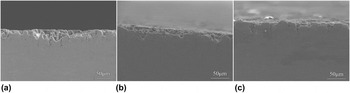
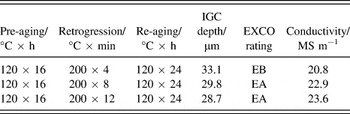
Figure 1 shows the cross sections for the samples after RRA treatments with different retrogressions to reveal the IGC resistance of spray formed Al-7075. The RRA treatment can improve the IGC resistance. Figure 1(a) shows some pits on the surface of a sample after RRA treatment with retrogression at 200 °C for 4 min. The corrosive can infiltrate into the matrix with the help of some pits and the IGC depth reaches 33.1 μm. When the retrogression time increases to 8 min, the pits become shallow and the IGC depth is 29.8 μm as shown in Fig. 1(b), which indicates that retrogression time can alleviate the IGC depth. It also can be found from Fig. 1(c) that the pits on the surface of a sample decrease after RRA treatment with retrogression at 200 °C for 12 min, and the IGC depth is reduced to 28.7 μm.
IGC images of spray formed Al-7075 after RRA treatments with different retrogressions: (a) retrogression at 200 °C for 4 min, (b) retrogression at 200 °C for 8 min, (c) retrogression at 200 °C for 12 min.

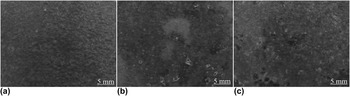
Figure 2 shows the EXCO morphologies of spray formed Al-7075 under RRA treatments with different retrogressions. It can be seen form Fig. 2(a) that the surface of the sample after RRA treatment with retrogression at 200 °C for 4 min emerges with notable layering and penetration, and the EXCO rating is EB. When the retrogression time is extended to 8 min and the re-aging is finished, thin slivers and flakes with slight separation appear on the surface for the sample as indicated in Fig. 1(b), and the EXCO rating is EA. From Fig. 1(c), the sample surface emerges with notable layering and penetration, and the EXCO rating of spray formed Al-7075 after the RRA treatment with retrogression at 200 °C for 12 min is EA.
EXCO morphologies of spray formed Al-7075 after RRA treatments with different retrogressions: (a) retrogression at 200 °C for 4 min, (b) retrogression at 200 °C for 8 min, (c) retrogression at 200 °C for 12 min.

According to the experiments, the IGC and the EXCO for the spray formed Al-7075 after various RRA treatments can be established by referring ASTM G34-2001 (2007) and ASTM G110-1992 (2009), which are shown in Table I, including the conductivities of the alloy.
Corrosion properties and conductivities of the alloy after various RRA treatments.

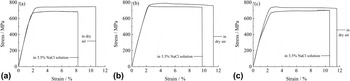
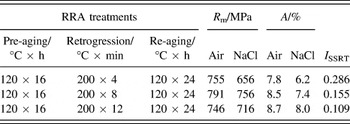
Figure 3 shows the stress and strain curves of the samples with three different degrees of RRA treatment in dry air and 3.5% NaCl solution at a slow strain rate. It can be seen from the figure that the effect of different degrees of retrogression on the slow strain rate tensile properties of the alloy is more obvious. As shown in Fig. 3(a), the mechanical properties after aging are not fully reflected due to the lack of adequate retrogression treatment, and the tensile strength and elongation rate of the RRA process are not fully able to reflect the characteristics. In dry air, the tensile strength and elongation of the alloy can reach a high level, which are 755 MPa and 7.8%, respectively. However, the tensile strength and tensile elongation of the slow strain rate in 3.5% NaCl solution were significantly degraded to 656 MPa and 6.2%, respectively. But as shown in Fig. 3(b), the tensile strength and elongation rate of the alloy in 3.5% NaCl solution can be maintained at a high level after the re-aging treatment following the full retrogression treatment. The strength of the alloy in dry air can reach 791 MPa, while in 3.5% NaCl solution, the tensile strength of the alloy also reaches 756 MPa. The difference of elongation rate in the two environments is not significant. However after RRA treatment of 12 min retrogression, as shown in Fig. 3(c), the tensile strength of the alloy after RRA treatment of 12 min retrogression was slightly lower than that of the same treatment of 8 min, while the elongation rate is increased, and the tensile strength and elongation rate of the alloy are not obviously decreased with SSRT in 3.5% NaCl solution, which shows that the alloy under this condition has a high stress corrosion resistance.
Stress–strain curve of SSRT on spray formed Al-7075 after RRA treatments with different retrogressions: (a) retrogression at 200 °C for 4 min, (b) retrogression at 200 °C for 8 min, (c) retrogression at 200 °C for 12 min.

To judge the SCC resistance, SCC index I SSRT was defined by processing various mechanical properties with SSRT
 $${I_{{\rm{SRRT}}}} = 1 - {{{R_{{\rm{m ‐ NaCl}}}} \times \left( {1 + {A_{{\rm{NaCl}}}}} \right)} \over {{R_{{\rm{m ‐ air}}}} \times \left( {1 + {A_{{\rm{air}}}}} \right)}}\quad ,$$
where A NaCl is the elongation in 3.5 wt% NaCl solution (%), A air is the elongation in dry air (%), R m-NaCl is the tensile strength in 3.5 wt% NaCl solution (MPa), and R m-air is the tensile strength in dry air (MPa). The SCC resistance increases with I SSRT close to 0. The SSRT properties of spray formed Al-7075 after RRA with different retrogressions are listed in Table II.
Properties and the corrosion behavior of spray formed Al-7075 after various RRA treatments.

From Table II, it can be found that the difference of the SCC resistance of spray formed Al-7075 with the three degree of RRA treatment is relatively obvious. After RRA treatment of 4 min, the SCC resistance of spray formed Al-7075 is not high, I SSRT is 0.286, which was much higher than the RRA value of the 8 and 12 min of the retrogression treatment. The SCC resistance of spray formed Al-7075 is not well reflected in the case of insufficient retrogression treatment. But with the increasing degree of retrogression, the SCC resistance of spray formed Al-7075 is also constantly strengthened, I SSRT gradually decreased to 0.155, and even reached to 0.109 after the treatment of RRA for 12 min. At the same time, it can be seen that the tensile strength of spray formed Al-7075 decreases with a certain extent after retrogression treatment for 12 min.
IV. DISCUSSION
The strength of Al-7075 mainly relies on matrix precipitates (MPs) during the whole aging process, and the strength of the alloy changes with the characteristics of GP zone, η′, and η. Reference Sha and Cerezo28,Reference Berg, Gjønnes, Hansen, Li, Knutson-Wedel, Waterloo, Schryvers and Wallenberg29 The best strength depends on the fine homogeneously dispersive MP. Plasticity, toughness, and corrosion resistance of the alloy are remarkably influenced by the structure and chemical property of grain boundary precipitates (GBPs). There is a popular belief that a continuous GBP is harmful to properties of the alloy. Because the relative movement of crystalline grains in the deformation process has been impeded by the continuous GBP, plasticity and toughness of the alloy are completely injured. On the other hand, the continuous GBP is preferentially dissolved as anodes in anodic dissolution. Because the potential of the GBP, precipitate free zones (PFZs), and the matrix is −1.05 V, −0.85 V, and −0.75 V, respectively, the potential difference between the GBP and PFZ is less than the potential difference between the GBP and matrix. With regard to the corrosion resistance of the alloy, widening the PFZ can remit the corrosion sensibility and improve corrosion resistance of the alloy. Reference Jiang and Faulkner30,Reference Jiang and Faulkner31
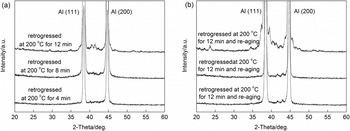
Figure 4 shows the x-ray diffraction (XRD) patterns of spray formed Al-7075 after retrogression at 200 °C for different time and re-aging. As shown in Fig. 4(a), it is shows that the XRD patterns of spray formed Al-7075 retrogressed at 200 °C for 4, 8, and 12 min. The XRD analyses show that the MPs are decreased at the beginning of the retrogression treatment (at 200 °C for 4 min). When the retrogression time is increased to 8 min, the precipitates were obviously dissolved into the matrix. With the retrogression time over 12 min, some large stable phases were grown up. Therefore, during the early stage of the retrogression treatment, the strength of the 7075-Al is decreased with the reduction of precipitates of the alloy. Retrogression treatment is a dynamic process, and dissolution and precipitation behaviors of the alloy elements are more complex in the whole process. The solubility of the solid solution is varied with the different temperature and the solid solubility of the alloy is increased with the temperature rising. Spray formed Al-7075 has a lower solid solubility with the pre-aged temperature at 120 °C. When the retrogression temperature reaches 200 °C, the solid solubility of the alloy is increased. A few of the precipitates (such as GP zones and η′ phases) are dissolved back into the matrix. However, a high temperature of the retrogression treatment needs a short retrogression time. If the retrogression time is too short, the retrogression treatment will not affect the strengthening phase of the alloy too much, but not enough dissolution will reduce alloy elements dissolve back into the matrix, resulting the strengthening phase reduction in re-aging treatment after the re-precipitation, thus affecting the mechanical properties of the alloy. If the retrogression time is too long (at 200 °C for 12 min), the solid solution of the alloy has been saturated and the precipitates have been coarsened during subsequent treatment. The large size precipitates appear in the alloy and these precipitates will continue to grow in the subsequent treatment, which will affect the properties of the alloy. As shown in Fig. 4(b), the precipitates of the alloy after RRA treatments are influenced by different retrogression time. When the retrogression is not sufficient (at 200 °C for 4 min), precipitates in the matrix is a little after the re-aging. It is indicated that the precipitated phase of pre-aging is not well dissolved back into the matrix during the retrogression treatment, so the precipitates are less during re-aging.
XRD spectra of spray formed Al-7075 after retrogression at 200 °C for different time and re-aging: (a) retrogression at 200 °C for 4, 8, 12 min, (b) retrogression at 200 °C for 12 min and re-aging.

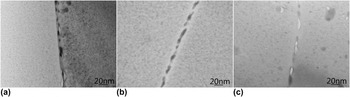
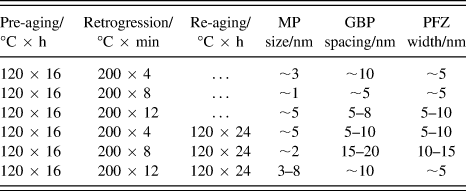
Figure 5 is the TEM microstructure of spray formed Al-7075 after different degree retrogression treatments and corresponding aging treatment. As shown in Fig. 5(a), only a part of MPs solute into the matrix in the initial stage of retrogression, the effect of retrogression treatment is general, whose sizes are within 3 nm and one or two are 5 nm above. There is a certain width of the PFZ at the grain boundary, which is about 5 nm, and the GBPs appear in the intermittent state. As shown in Fig. 5(b), MPs are essentially dissolved back into the matrix. It can be seen that without aging pretreatment, MPs are dissolved obviously after retrogression treatment at 200 °C for 8 min and GBPs are partially dissolved during the retrogression processing, while the other parts of the GBPs at grain boundaries are grown up and formed either continuous or discontinuous GBP. Those GBP spacing is about 5 nm. However, after 200 °C retrogression treatment for 12 min, as shown in Fig. 5(c), MPs are better, but a part of the MP becomes bulky due to too long retrogression treatment, and the size of the bulky MP is up to 5 nm. The GBP size at the grain boundary is about 15 nm and the distribution is not the same; PFZ is more obvious whose width is about 5–10 nm.
TEM images of spray formed Al-7075 with different retrogression treatments: (a) retrogression at 200 °C for 4 min, (b) retrogression at 200 °C for 8 min, (c) retrogression at 200 °C for 12 min.

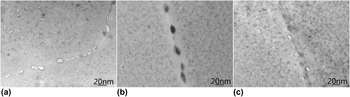
There were also some differences in the microstructure of the samples treated by three different retrogression time after the aging treatment. As shown in Fig. 6(a), if aging treatment processed under the condition that the retrogression treatment is not enough, the GBPs at the grain boundary are coarsen, and the distribution is obviously broken. A large number of the dispersed MP are precipitated in the crystal, but the size of the precipitates is only about 5 nm, which was not very small. It is the reason for the precipitate size is a litter big that the MPs were not redissoluted with the insufficient retrogression treatment and growing up during the re-aging treatment. With a sufficient retrogression treatment, see Fig. 6(b), the MPs are thin, homogeneous, and dispersed, while the GBPs are obviously rounded and discrete. The MP size is about 2 nm. The average size and spacing of the GBP is 5–7 nm and 15–20 nm, respectively, and the PFZ width is 10–15 nm. However, if retrogression time is too long, the MPs are coarsen and grown during re-aging treatment, whose sizes are obviously increased from about 1–5 nm to 3–8 nm. GBPs are still in an intermittent arrangement, and the GBP spacing is small, only about 10 nm. The PFZ size compared with the above two kinds of retrogression processing becomes narrow (only 5 nm), as shown in Fig. 6(c).
TEM images of spray formed Al-7075 with different retrogressions and re-aging treatments: (a) retrogression at 200 °C for 4 min and re-aging treatment, (b) retrogression at 200 °C for 8 min and re-aging treatment, (c) retrogression at 200 °C for 12 min and re-aging treatment.

The characteristic sizes of the MP, GBP, and PFZ of spray formed Al-7075 under the above states are listed in Table III. It can also be seen from the size characteristics of the precipitated phase in Table III that the MP, GBP, and PFZ can be adjusted to an ideal state by the reasonable retrogression process. For example, the MPs after RRA treatment with the retrogression at 200 °C for 8 min are all small, and the GBP spacing is large and PFZs are wide, so the comprehensive performance of spray formed Al-7075 is excellent.
Characteristic sizes of the MP, GBP, and PFZ of the alloy after various RRA treatments.

V. CONCLUSION
The tiny MPs distributed homogeneously can increase the ultimate tensile strength (UTS), and the disconnected GBPs and wide PFZs can improve the corrosion resistance of spray formed Al-7075.
The MPs are redissolved in the matrix after retrogression for a suitable time (8 min), and the GBPs are discrete and the obvious PFZs are left at the grain boundaries. After RRA with suitable retrogressed time, thin homogeneous dispersive MPs are separated out again in the matrix.
After the RRA process with the retrogression at 200 °C for 8 min, the UTS, elongation, IGC depth, EXCO rating, and SCC index of spray formed Al-7075 are 791 MPa, 8.5%, 29.8 μm, EA, and 0.155, respectively.
ACKNOWLEDGMENTS
This research was financially supported by the National Natural Science Foundation of China (51574167), China Postdoctoral Science Foundation (2016M601334), Program for Innovative Research Team in University of Liaoning Province (LT2015020), and Science and Technology Program of Liaoning Provincial Department of Education (LGD2016003).