I. INTRODUCTION
SnBi, as one of the most promising low-melting point lead-free solders, has the fatal drawback of Bi embrittlement for SnBi/Cu joints aged at 120 °C for 7 days.Reference Liu and Shang1 Bi embrittlement seriously deteriorates the mechanical properties of the joints and thus restricts the application of SnBi solder in the electronic packaging field.Reference Liu and Shang1, Reference Liu and Shang2 In order to extend the application of eutectic SnBi solder, the Bi segregation mechanism and the elimination of Bi embrittlement have been widely explored.Reference Liu and Shang2–Reference Zhang, Zou and Zhang5 Some effective methods were successfully proposed to restrict the interfacial embrittlement of SnBi/Cu joints, such as the electrodeposition of Ag or Ni film on the Cu substrate, or alloying the Cu substrate.Reference Zhu, Zhang, Wang and Shang3–Reference Zhang, Zou and Zhang5
Concerning the Bi segregation mechanism, several models have been proposed; however, there are still some arguments at present. Based on the in situ Auger fracture analysis, Liu et al.Reference Liu and Shang2–Reference Zou, Zhang and Zhang4 thought that the Bi segregation at the Cu/Cu3Sn interface came from the precipitation of supersaturated Bi atoms of the Cu-Sn IMC.Reference Liu and Shang2 It has been speculated that Bi would have no such evident difference in solubility between the Cu6Sn5 and Cu3Sn layers.6 If this is the case, then it is more probable that Bi has been frozen into the IMC layers during the initial formation of the IMC layers.Reference Laurila, Vuorinen and Kivilahti7 Then the Bi atoms segregate at the Cu3Sn/Cu interface to reduce the surface free energy of the whole system, because Bi is known to have low surface free energy.Reference Laurila, Vuorinen and Kivilahti7, Reference Keene8 In addition, it is considered that the source of Bi segregation might mainly originate from the diffusion of Bi atoms in the SnBi solder during the reflow or aging procedure.Reference Zou, Zhang and Zhang4 But none of these mechanisms can explain all the observed phenomena. Therefore, in the search for more economical and practical technology, it is necessary to further explore the main Bi segregation mechanism using a different procedure.
II. EXPERIMENTAL PROCEDURE
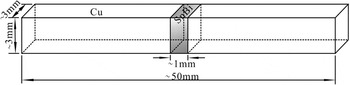
In this study, pure Cu was used as the substrate and eutectic Sn-58wt%Bi (afterward denoted as SnBi) alloy was used as the solder. Cu and SnBi alloy were spark cut and ground with 400#, 800#, and 1200# SiC paper and then carefully polished with the 2.5 μm and 1.0 μm polishing pastes. All the prepared samples were kept in an oven with a constant temperature for different times, and then were cooled in air to room temperature, as shown in Fig. 1. In order to investigate the effect of reflow temperature on the Bi segregation in the SnBi/Cu couple, six reflow temperatures were selected: 180 °C, 200 °C, 220 °C, 260 °C, 280 °C, and 300 °C. After reflow, all tensile samples of the soldering joints were carefully ground with 400#, 1000#, and 2000# SiC paper and carefully polished with the 2.5 μm and 1 μm polishing pastes. Tensile tests were performed with an INSTON 8871 testing machine at an average strain rate of about 5 × 10⁻⁵ s−1 at room temperature in air. All fracture surfaces were observed by LEO Supra 35 field emission scanning electron microscope (SEM) to reveal their fracture mechanism and fractography morphologies. The interfacial microstructure of these couples was also observed by the SEM.
Schematic diagram of as-prepared SnBi/Cu couple.

III. EXPERIMENTAL RESULTS AND DISCUSSION
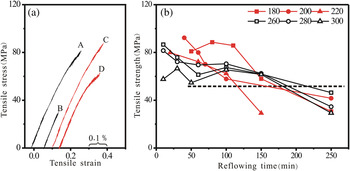
Figure 2(a) shows the tensile stress-strain curves of the SnBi/Cu joints reflowed at different reflow temperatures. The tensile strength of the SnBi/Cu joints reflowed at 220 °C is strongly affected by the reflow time (see curves A and B). After a reflow of 10 min, the tensile strength is 80 MPa, but this deceases to 30 MPa after a reflow of 150 min, as displayed in Fig. 2(a). As shown in Fig. 2(b), the tensile strength of the SnBi/Cu joint has a dramatic decrease with increasing reflow time when the reflow temperature is below 220 °C.
(a) Tensile stress-strain curves (A, B: reflowed at 220 °C for 10 min, 150 min; C, D: reflowed at 260 °C for 10 min, 150 min) and (b) tensile strength-reflowing time curves of the SnBi/Cu joints reflowed at different temperatures.

However, it is interesting to note that the tensile stress-strain curve of the SnBi/Cu joint has no obvious change when the reflow temperature is 260 °C [see curves C and D in Fig. 2(a)]. While the drop in tensile strength at the 220 °C reflow temperature fell to 30 MPa, the tensile strength fell to 25 MPa when the SnBi/Cu joint was reflowed at 260 °C for 150 min. Meanwhile, at higher reflow temperatures of 280 °C and 300 °C, the same downward trend was observed with increasing reflow time, as presented in Fig. 2(b). This finding implies that the tensile strength of the SnBi/Cu joint has no sharp decrease with increasing reflow time when the reflow temperature is above 260 °C. However, when the reflow time is 250 min, it is found that all joints break in brittle mode, and the tensile strength has a dramatic decrease, as displayed in Fig. 2(b).
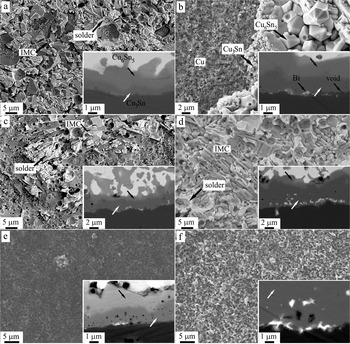
These experimental results confirmed that the reflow temperature and time have a strong effect on the tensile strength of the SnBi/Cu joints. In addition to the tensile strength, the fracture mode of SnBi/Cu joints changed greatly, as illustrated in Fig. 3. Many solder beads and IMCs were observed on the fracture surface of SnBi/Cu joints when the joints were reflowed at 220 °C for 20 min, which is similar to the previous results about SnAgCu/Ag, SnPb/Cu, and SnAgCu/Cu couples,Reference Zou, Zhu and Zhang9, Reference Wu, Zhong, Chan and Alam10 as displayed in Fig. 3(a). Based on the cross-section of the Cu3Sn/Cu interface, a spot of Bi particles was detected, indicating that the Bi segregation has occurred, as displayed by the inset picture of Fig. 3(a). In comparison with solid-state aging, no void was observed around the Bi particles.Reference Zou, Zhang and Zhang4 This might be why the joint did not break in brittle mode even if Bi segregation occurred at the Cu3Sn/Cu interface under the liquid state condition. After a reflow time of 100 min, the fracture surface has a dramatic transition. On the fracture surface, there was exposed Cu, which is an implied result of Bi embrittlement, as displayed in Fig. 3(b). Compared with the Bi segregation at the Cu3Sn/Cu interface aged at 120 °C,Reference Zou, Zhang and Zhang4 only a small amount of voids and a great deal of Bi particles were observed on the Cu3Sn/Cu interface, as displayed by the inset image in Fig. 3(b).
Fracture surface and interfacial microstructure (the inset pictures) of SnBi/Cu joints reflowed at (a) 220 °C for 20 min; (b) 220 °C for 100 min; (c) 300 °C for 10 min; (d) 300 °C for 50 min (Cu6Sn5,Cu3Sn layers were marked by the black, white arrows in the inset pictures, respectively); (e) 200 °C for 250 min; and (f) 300 °C for 250 min.

Figure 3(c) shows the fracture morphologies of the SnBi/Cu joint reflowed at 300 °C for 10 min. Solder and IMC can be easily distinguished from the fracture surface, which is similar to the joint reflowed at 220 °C for 20 min, as displayed in Figs. 3(a) and 3(c). However, it is surprising that the SnBi/Cu joint reflowed at 300 °C for 50 min did not break in a brittle mode even if more Bi particles segregated at the Cu/SnBi interface compared with the joint reflowed at 220 °C for 100 min, as shown in Fig. 3(d). Through careful observations on these SnBi/Cu interfaces, one of the important findings is that the Bi particles mainly segregated at the Cu3Sn/Cu interface for the SnBi/Cu couple reflowed at 220 °C, while the Bi particles segregated in the interior of the Cu3Sn layer rather than the Cu3Sn/Cu interface for the SnBi/Cu couple reflowed at 300 °C, as displayed by the inset images in Figs. 3(b) and 3(d). This should explain why the Bi embrittlement did not occur for the SnBi/Cu joint reflowed at 300 °C for 50 min. Meanwhile, combined with the variation in the tensile strength of the SnBi/Cu joints, it can be concluded that there should be some changes about the Bi segregation mechanism with rising reflow temperature. Figures 3(e) and 3(f) show the fracture surface of the Cu/SnBi reflowed at different temperatures for 250 min. It is obviously found that Cu was exposed on the fracture surface, indicating that all joints would break in brittle mode once these joints were reflowed for 250 min. Meanwhile, it has been found that the Bi particles still segregated at the Cu3Sn/Cu interface for the SnBi/Cu couple reflowed at 200 °C for 250 min; while the Bi particles should segregate in the interior of the Cu3Sn layer and the Cu3Sn/Cu interface for the SnBi/Cu couple reflowed at 300 °C for 250 min, as displayed by the inset picture in Figs. 3(e) and 3(f). Based on the above experimental results, the fracture mode of the Cu/SnBi joints would be affected by the reflow temperature when the reflow time is below 150 min; but the reflow temperature would have slight effect on the fracture mode of the Cu/SnBi joint when the reflow time is above 250 min. It is further implied that the Bi segregation would be controlled by the reflow temperature and the reflow time.
Concerning the Bi segregation mechanism, Shang et al. presented the precipitation of supersaturated Bi atoms from the Cu-Sn IMC.Reference Liu and Shang1, Reference Liu and Shang11, Reference Shang, Liu, Li and Shang12 They considered that the Bi segregation was mainly confined to a monolayer along the interface.Reference Liu and Shang1, Reference Liu and Shang11 But Laurial et al. did not agree with Liu’s viewpoint because it is not likely that Bi would have marked solubility to Cu6Sn5 or Cu3Sn6; and they further put forward a more probable reason that Bi has been frozen into the IMC layer during the formation of the IMC layers.Reference Laurila, Vuorinen and Kivilahti7 In fact, many Bi particles have been observed at the Cu3Sn/Cu interface, which is not consistent with the conclusion that a Bi monolayer exists along the interface.Reference Zou, Zhang and Zhang4, Reference Zhang, Zou and Zhang5 Recently, it is interesting to find that some Ag in the Cu-18.7Ag alloy was almost replaced by Bi when the Cu-18.7Ag alloy was completely saturated in the liquid Bi at 500 °C for 6 h.Reference Zou, Zhang and Zhang4 Based on these results, the diffusion of Bi atoms in the SnBi solder has been brought forward.Reference Zou, Zhang and Zhang4 However, the current experimental results have suggested that the Bi segregation mechanism would have a significant transition with increasing reflow temperature, as presented by the inset pictures in Figs. 3(b) and 3(d). In order to better understand the Bi segregation, three special samples were designed, denoted as samples I, II, and III.
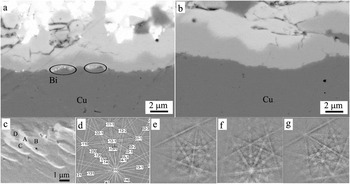
For sample I, pure Sn solder first reacted with the Cu substrate at 260 °C for 10 min to form Bi-free Cu-Sn IMC layers at the interface. Afterward, some excess Sn was removed by grinding to keep ~100 μm Sn and IMC layers on the Cu substrate. Next, an excess of SnBi solder was put on the residual Sn layer to further react with Cu at 200 °C for 90 min. In this case, the Bi atoms cannot be detected at the interface if the Bi segregation only originates from the supersaturated Bi atoms between the two Cu-Sn IMCs or the frozen Bi atoms in the IMCs. In contrast, the Bi atoms are easily observed at the Cu3Sn/Cu interface if the Bi segregation mainly comes from the diffusion of the Bi atoms. Actually, the Bi particles can be easily seen at the Cu/Cu3Sn interface of sample I, which is consistent with the previous results,Reference Zou, Zhang and Zhang4, Reference Zhang, Zou and Zhang5 as shown in Fig. 4(a). The experimental results have demonstrated that the Bi particles mainly originate from the diffusion of Bi atoms when the reflow temperature is 200 °C.
Interfacial morphologies (a) sample I; (b) sample II; (c) sample III; and the Kikuchi bands of (d)–(g) points A, B, C, D in (c), respectively.

For sample II, the SnBi solder first reacted with the Cu substrate at 200 °C for 10 min to form one Cu-Sn IMC layer at the interface. Then the excess SnBi solder was removed by grinding. The IMC layer and the SnBi solder (~100 μm) remained on the Cu substrate. Next, pure Sn was put on the SnBi solder and reacted with the Cu substrate at 260 °C for 90 min, as shown in Fig. 2. Based on the results from Shang et al.Reference Shang, Liu, Li and Shang12 and Laurila et al.,Reference Laurila, Vuorinen and Kivilahti7 the Bi atoms should be dissolved or frozen in the initial Cu6Sn5 layer, respectively, because Cu first reacted with SnBi solder. In this case, the Bi particles should be easily observed at the Cu/Cu3Sn interface. However, the Bi particles were not detected at the Cu/Cu3Sn interface of sample II, which is similar to SnAgCu/Cu the SnPb/Cu couples,Reference Zeng and Tu13 as displayed in Fig. 4(b).
The above two experimental results proved that the Bi particles should mainly originate from the diffusion of Bi atoms when the couples were reflowed at 200 °C. However, it is impossible that many such Bi particles segregated at the interface were fully provided by the diffusion of Bi atom at 260 °C, because the reflow time is only 10 min, as displayed in Fig. 3(c). Further, Tu proposed that the initial formation process of IMC is controlled by the interfacial reaction between Sn solder and Cu under the solid-liquid interfacial reaction.Reference Tu14 Based on this theory, the initial formation of IMC in the SnBi/Cu couple should be governed by the interfacial reaction during the initial reflow stage. Then the growth rate of the IMC should be determined by the diffusion rates of Cu and Sn atoms in liquid solder. In the liquid-state solder, the differences in diffusivity of Bi, Cu, and Sn should be very small. In combination with Laurila’s suggestion,Reference Laurila, Vuorinen and Kivilahti7 the Bi particles should be easily frozen in the grain boundary of the IMC layer during the initial reflow stage when the reflow temperature is above 260 °C. In order to find more evidence, a cross-section of sample III (the SnBi/Cu couple reflowed at 280 °C for 150 min) was prepared, and then at this interface, four points of the SnBi/Cu interface were selected to determine the orientation of grains, denoted as A, B, C, and D in Fig. 4(c). Figure 4(d) shows the orientation of Bi particles by using the electron backscattered diffraction, but the orientation of Cu3Sn cannot be obtained because Cu3Sn is a superlattice structure. Under the circumstances, the difference in the Kikuchi bands is a unique method to distinguish the orientation of Cu3Sn. It is clear that the Kikuchi bands of Cu3Sn grains (three points B, C, D) around the Bi particles are completely different, as displayed in Figs. 4(e)–4(g). This result implies that some Bi particles have already been frozen at the Cu3Sn grain boundary when the reflow temperature is above 260 °C. As the reflow time is lengthened, the size of the Bi particles gradually increases, but the particles do not randomly dissolve into the bulk IMC layer, as illustrated in Fig. 3(d). If the Bi particles did dissolve in the bulk IMC, then the thickness of the IMC layer would gradually increase with increasing reflow time. In that case, the growth rate of the IMC should not be determined by the interfacial reaction and the diffusivity of Cu atoms in the IMC layer would decide the growth rate of the IMC layer. Compared with the diffusivity of Bi atoms in liquid solder, the growth rate of the IMC layer is slower. As a result, the Bi would not be frozen at the later reflow stage. The increment of the Bi particles should be attributed to the diffusion of the Bi atoms during the later reflow stage. Therefore, when the reflow temperature is rather high, the procedure of Bi segregation should be as follows: the Bi particles are first frozen around the Cu3Sn grain boundary during the initial reflow stage; these Bi particles serve as nuclei for growth during the later reflow stage because of the diffusion of Bi atoms.
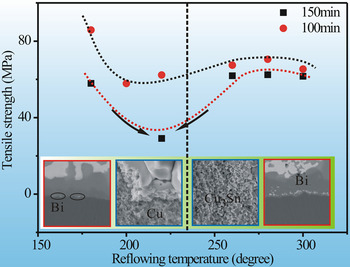
In combination with the above results, the tensile strength-reflow temperature curve can be drawn. Obviously, the tensile strength has a minimal value in the whole reflow temperature range, as presented in Fig. 5. For the same reflow time (below 150 min), the dots shown in Fig. 5 (the tensile strength values) are separated into two parts in the total reflow temperature range by the vertical dot line, which would clearly perform the transition of the Bi segregation mechanism. At the low reflow temperature range, the above experimental results confirmed that the Bi particles should mainly come from the SnBi solder and then segregate at the Cu3Sn/Cu interface because of the diffusion of Bi atoms, as shown in Figs. 3(b) and 5. Further, the diffusion rate of Bi atoms gradually increases with increasing reflow temperature, leading to an increase of the Bi diffusion flux into the Cu3Sn/Cu interface. Therefore, the amount of Bi atoms segregated at the Cu3Sn/Cu interface increases. As a result, the tensile strength of the SnBi/Cu joint decreases with increasing reflow temperature in the low temperature range (180–220 °C), as illustrated in Fig. 5.
(a) Tensile strength-reflow temperature curves of the SnBi/Cu joints reflowed at different reflow times (the data of 180 °C for 100 min indeed are at 110 min).

However, in the high reflow temperature range, the Bi particles mainly appear in the interior of Cu3Sn layer, indicating that the Bi particles should mainly come from two sources: Bi particles that were frozen around the Cu3Sn grain boundary during the formation of the IMC; and the diffusion of the Bi atom of the SnBi solder, as illustrated in Fig. 3. Note that the Bi particles frozen in the Cu3Sn layer would only appear at the initial reflow stage, which should not particularly vary with increasing the reflow temperature. In this case, the tensile strength of SnBi/Cu joint would not have a significant decrease as the reflow temperature increased in the high temperature range (260–300 °C).
Considering an increased reflow time of 250 min, the above experimental results indicate that all Cu/SnBi joints would break in the brittle mode at an arbitrary reflow temperature, as illustrated in Figs. 2 and 3. At low reflow temperature, this phenomenon is easy to understand because the Bi diffusion flux would increase with increasing reflow time, leading to the brittle fracture of the SnBi/Cu joint. But at high reflow temperature, this phenomenon becomes more puzzling. The above experimental results indicate that the Bi particles should originate from the frozen Bi atoms in the IMC and from Bi diffusion when the temperature is above 260 °C. At the initial reflow stage, the Bi particles should be frozen in the Cu3Sn layer, which is a stable nucleus, as displayed in Fig. 3(c). Then the Bi diffusion atom would be attracted by the stable nucleus (Bi particle), as displayed in Fig. 3(d). Considering that the Cu/Cu3Sn interface is not stable, in this case, the Bi atoms would still diffuse into the Cu/Cu3Sn interface with further increased reflow time for the SnBi/Cu couple, as displayed by the inset picture in Fig. 3(f). As a result, the joint reflowed at high temperature will break in brittle mode when the reflow time is above 250 min. Therefore, the frozen mechanism of Bi will appear with increasing reflow temperature; the frozen mechanism cannot eliminate Bi embrittlement, but it can delay its occurrence.
As mentioned previously, this study only involves the effect of Bi segregation on the mechanical properties of SnBi/Cu joints. But in fact, the Bi segregated at the Cu3Sn/Cu interface would induce two negative effects: to weaken the Cu3Sn/Cu interface and to form some voids at the Cu3Sn/Cu interface.Reference Shang, Liu, Li and Shang12 In this paper, the formation of voids was not discussed because the cross section of samples was uniformly prepared by mechanical polishing, which destroys the partial voids. However, the formation of voids would also affect the mechanical properties of the SnBi/Cu joint. In this case, the relationship between the amount of voids at Cu3Sn/Cu interface and the mechanical properties of SnBi/Cu joints should be investigated. In order to obtain the amount of voids, the cross section of SnBi couple should be prepared by using focused ion beam (FIB), and then be observed by SEM. Based on the SEM pictures, the amount of voids can then be obtained. Unfortunately, it is impossible for us to use FIB, as a result, the effect of voids was not discussed in the current study.
IV. CONCLUSIONS
Both the reflow temperature and reflow time play important roles in the tensile strength and fracture mode of the SnBi/Cu joint couples. Bi embrittlement of the SnBi/Cu joint occurs with increasing the reflow time when the reflow temperature is below 220 °C. However, Bi embrittlement of the SnBi/Cu joint does not occur with increasing reflow time when the reflow temperature is above 260 °C for 150 min. The main reason is that the diffusion of Bi atoms from SnBi is the source of the Bi segregation under the low-temperature reflow condition (below 220 °C); and the Bi particles frozen around the Cu3Sn grain boundary are the source of Bi segregation under the high-temperature reflow condition (above 260 °C). When the reflow time further increases to 250 min, the SnBi/Cu joints reflowed at above 260 °C break in the brittle mode.
ACKNOWLEDGMENTS
The authors would like to acknowledge Q.Q. Duan, H.H. Su, L.X. Zhang, and W. Gao. This work was financially supported by National Basic Research Program of China under Grant No. 2010CB631006, and the National Outstanding Young Scientist Foundation under Grant No. 50625103.