In March 1998 a group of men were discussing their feelings about Namibia, the political situation and democracy in the country over snacks and soft drinks at Anamulenge in the Ombalantu District of Owambo in northern Namibia. For more than an hour they happily listed, for the researcher's benefit, the numerous changes for the better that had taken place since the country's day of independence eight years earlier: peace and stability, freedom of movement, access to better schooling and health care, and many others. Then, suddenly, one elderly man contested this amiable consensus with an angry comment:
The problem is that they ‘empower’ [in English] only those of us that went across the borders into exile. But the fact that we remained here does not mean that we did not help to liberate the land. We gave them food, shelter and information to prevent floggings and imprisonment. If our cries were to be weighed up, they would probably weigh more than theirs.
This single moment sparked off my intense curiosity. Had I listened without hearing? Since 1990 I had been constantly in and out of Owambo, conducting research and running adult education programmes with a wide range of residents living in this former main theatre of the Namibian liberation war. Occasionally, people had spoken about ‘the war’, always emphasizing their suffering caused by the atrocities of the boers.Footnote 1 They had never said much about their own actions, though. I suddenly realized that I had heard nothing but narratives of victimhood – in informal conversations as much as in the national public discourse – where the war-time experience of civilians in Owambo was concerned. While there was a common acknowledgement that the local population had provided logistical and intelligence support for the PLANFootnote 2 guerrillas, this remained rather vague. I had never heard recollections of civilians’ specific actions. Had I not heard them, or were there really no narratives of agency to supplement the representations of victimhood? And if there were indeed no audible narratives of local agency, why had they remained muted?
This discussion at Anamulenge was the starting point of a decade-long project, during which I investigated how the experience of war and violence is remembered and refashioned in current social and cultural practices in Namibia. My interests have been directed towards a range of ‘acts of transfer that make remembering in common possible’, following Paul Connerton's seminal study of social memory (1989: 39). Connerton singles out commemorative ceremonies and bodily practices as salient acts of transpersonal and transgenerational transfer – but there are numerous other spatial, visual and narrative modes through which we can access the mediated archive of memory and explore how the past is constructed and contested by different societal actors.Footnote 3
The question I ask is, how do people in post-colonial Namibia, in particular those who lived through the war as civilians in Owambo, negotiate identifications through liberation war memories, and how are these related to the narratives evoked in nationalist public memory? Starting on that day in Anamulenge, I became particularly interested in those embodied, spatial and performative practices that potentially subvert the dominant narrative of the liberation war in post-colonial Namibia, which prioritizes the armed struggle from exile. This master narrative of national liberation, having become the foundation myth of post-colonial Namibia, legitimates and authorizes the power of the post-colonial elite as the sole, heroic liberators from apartheid and colonialism. Yet the discourse that ‘SWAPO brought us freedom through the barrel of the gun’ has not remained uncontested (cf. Kössler Reference Kössler2007).
In this article, I develop the complex transfigurations of liberation war memory, culture and citizenship in post-colonial Namibia around a discussion of two memory sites: the National Heroes’ Acre near Windhoek and the Heroes’ Memorial Shrine at Eenhana in Owambo. My argument significantly goes beyond the mere investigation of social processes of remembering and forgetting political resistance. It also draws on a second register of contemporary Namibian public discourse: cultural reinvention. While these two registers of anti-colonial nationalism in the post-colony (du Pisani Reference du Pisani, du Pisani, Kössler and Lindeke2010) are ostensibly incongruent, I argue that in reality they are profoundly connected, and that both these registers of imagining the nation, and their entanglements, have shifted over the two decades since Namibian independence.
MONUMENTS AND THE PRODUCTION OF MEMORY AND IDENTITY
I have chosen sites that anchor liberation war memory in the Namibian landscape as the focus of this article because, as Johannes Fabian (Reference Fabian1999) reminds us, recognition often relies on a visual element. Fabian's observation is important in that it connects the politics of recognition with the politics of heritage and its aesthetics (cf. de Jong and Rowlands Reference de Jong and Rowlands2008: 1). ‘Heritage’ – quite a buzzword in contemporary Namibia – understood as what connects us with the past, thus incorporates memorial sites as a form of material-social embodiment. The Heroes’ Acre and the Eenhana Shrine are key sites for the production of social memory, embedded in narrative; they significantly contribute to self-reflection and the making of post-colonial futures in Namibia. The sites’ visual and iconic signifiers are crucial for developing a deeper understanding of the underlying discursive practices and the contestations surrounding them.
As scholars of commemoration and heritage have pointed out, memorials are designed to encode selected memories and historical narratives (Marschall Reference Marschall2005). The function of memorials, contrary to a widely held belief, is not to preserve the memory of the past; rather, they facilitate the preservation of particular interpretations of the past. Connerton (Reference Connerton1989) has shown, furthermore, that encoding is central to the understanding of collective memory; memorials encode specific narratives through visual and/or iconic signifiers.
Analysing national memorial sites as objectified forms of social memory and as spaces of ritual commemoration provides a window into how ruling elites constitute a nation's collective memory. Jan Assmann (Reference Assmann1992) argues that memorials belong to the tangible, material world, and thus assume permanence as part of a ‘memory of things/objects’ (Gedächtnis der Dinge), as well as being symbolically enacted. Where memorials like those I discuss here venerate the departed, they may facilitate processes of mourning; more importantly, they create a visible link to the dead. The erection of a memorial to commemorate the dead of past violence may thus prove to be a potent strategic move to legitimize the emergence of a new socio-political order, as Sabine Marschall (Reference Marschall2008) has argued for South Africa.Footnote 4
Remembering and commemorating the dead pose special challenges in contexts where an ostensibly new nation state imagines itself to be founded on a past violent conflict. Werbner famously observes a post-colonial memory crisis across the African continent. The challenges are not merely about what is to be publicly remembered or forgotten; instead, ‘the challenge in everyday life, in major public occasions and in disruptive events of terror and civil unrest is to the very means and modes of remembrance’ (Werbner Reference Werbner and Werbner1998a: 1). He particularly problematizes liberation war violence as a ‘volatile, festering memory for the nation, more specifically for members of a new post-colonial nation’ where the post-colonial regime has come to memorialize itself elaborately (Werbner Reference Werbner and Werbner1998b: 76–8).
Werbner's work provides an invaluable resource for an analysis of memory as a contested social process in post-colonial contexts. He identifies the existence of a conflict between state and popular memorialism at the root of contestation over citizenship and nationhood, which includes the very right of a citizen to have a recognized memory in public:
Who owns the birth of the nation and the deaths of its deliverers, martyrs and even victims? The dynamic answer becomes an unfolding of the social and cultural contradictions of nation-building which foregrounds a national birth from the barrel of a gun. (Werbner Reference Werbner and Werbner1998b: 99–100)
Werbner (Reference Werbner and Werbner1998b: 78) reminds us, with reference to Zimbabwe, that ‘in the cause of remembered national liberation, the post-colonial regime has come to memorialize itself elaborately’. In Namibia, too, local and national political authorities regularly launch memorializing events through which the post-colonial state explicitly claims continuity with the past struggle. Mystically venerated historical ‘truths’ are presented as fundamental constants of struggle, victory and, above all, sacrifice, rehearsed as formulaic historical narratives of the ‘national liberation struggle’. They are performed on the three days of the nationalist liturgical year, starting with Independence Day (21 March). Cassinga Day (4 May) recalls the South African Defence Force's 1978 raid on a SWAPO refugee and military training camp in Angola, when hundreds of exiles died; Heroes’ Day (26 August) marks the first armed contact in 1966 between SWAPO guerrillas and the South African forces at Omgulumbashe in remote north-western Owambo. Commemorating the nationalist struggle in contemporary Namibia is, in Connerton's words, ‘more than a story told and reflected on; it is a cult enacted’ (1989: 70).
‘SWAPO BROUGHT US FREEDOM THROUGH THE BARREL OF THE GUN’: THE MASTER NARRATIVE
The silence surrounding local people's agency – which the man in Anamulenge more than a decade ago so angrily contested – appears to be in line with the foundation myth of post-colonial Namibia. Public memory narrations, the country's ritual political calendar and monumentalization all celebrate the armed struggle from exile as the foundation of national liberation. While recently the narrative of the Namibian liberation struggle has begun to open up, if tentatively, to more inclusive perspectives (Kössler Reference Kössler2007), for most of Namibia's post-independence period, the country's public history discourse emphasized the role played by the exile-based armed liberation politics. In contrast, the part played by the civilian population during the liberation war has been, at best, contingent to the hegemonic discourse (Becker Reference Becker, Baines and Vale2008).Footnote 5 This sanctified memory has been a crucial component, in turn, of an aggressive nationalism, which in the early years of post-colonial Namibia de-emphasized (cultural and regional) difference in favour of an authoritarian nation-building policy.
At independence in 1990, the SWAPO government adopted a ‘Policy of National Reconciliation’, which centred on an approach of ‘forget and forgive’. Officially sanctioned forgetting has been the cornerstone of this policy, partly, as critics have argued, because SWAPO feared a public examination of the past that would force the former liberation organization, now the country's ruling party, to account for human rights violations that occurred within the organization in exile (cf. Saul and Leys Reference Saul and Leys2003). The deaths of hundreds of the organization's members in exile, and the detention and torture of many more, are officially portrayed as a deplorable yet inevitable side-effect of the war against apartheid colonialism.
My research, particularly several stints of fieldwork in Owambo between 2001 and 2004, showed that residents who had lived through the war in northern Namibia largely recognized and, to some extent, had internalized the post-colonial state's foundation myth as a master signifier. This was rather unsurprising since many Owambo residents experienced in person the actions of the SWAPO guerrillas, and those of eembulu and Koevoet.Footnote 6 Yet I also found that a different set of memories existed alongside, and sometimes contested, the hegemonic discourse. Contrary to the dominant discourse of victimhood I heard innumerable proudly told tales of bravery, and ‘cunning trickster’ tales of local residents’ actions during the war.
On the other hand, people's recollections expressed ambiguous memories. War-time residents of Owambo narrated complex histories, of betrayal and killings by both the boers and the SWAPO guerrillas, as well as detailing strife within the local community and within families, which had been caused by the strains of the war situation. It is noteworthy that the counter-discourse of local people's agency emerged, mostly, in the context of local practices of remembrance, which were linked to space and place, such as burial sites, as well as through a ‘photovoice’ project, through which I invited Owambo residents to visualize their war-time memories (cf. Becker Reference Becker2011).
As we got to know each other better, conversations about these memories of the past were repeatedly complemented by expressions of grief about the lack of recognition that the local population's agency received in the official historical narrative. During a visit to Ombalantu in 2003, for instance, an elderly Lutheran pastor, who had been intimately involved in political activities and support of the guerrilla struggle from SWAPO's inception in 1960, poignantly described the discourse that ‘freedom fighters are only those who were outside the country’ as a ‘smell that is not good’.
HEROES' ACRE
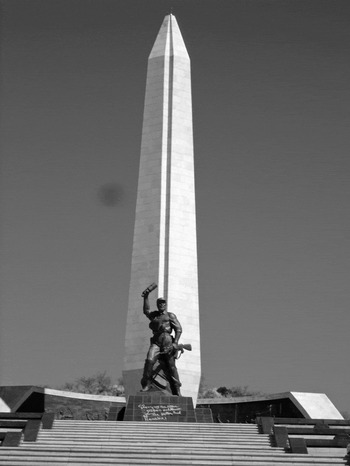
The Namibian master narrative of national liberation has found its most potent symbol in the national Heroes’ Acre, located on the outskirts of Windhoek (Figure 1). The site was inaugurated in 2002 on the public holiday designated as ‘Heroes’ Day’. At the time, the SwapoFootnote 7 leadership officially announced that Heroes’ Acre would be made the centre stage of the annual political rituals to commemorate the official milestones of the liberation struggle. For the purpose of national public events, the grounds provide seating space for 5,000 people, and can accommodate up to 20,000 visitors at a time. A restaurant and entertainment complex has been built on the site. Future plans include an educational centre, to complement the Independence Memorial Museum currently under construction in central Windhoek.
Heroes’ Acre: obelisk and statue of the Unknown Soldier (Photo: H. Becker)

From the day of its inauguration, the SWAPO leadership made it clear that the site was intended to establish the ‘heroes’ of the liberation struggle as national symbols. The Master of Ceremonies, Nahas Angula, told the crowd that the memorial was ‘a symbol of the Namibian people's determination throughout the struggle’, while former President Sam Nujoma emphasized that it was built to honour the fallen heroes and heroines (The Namibian, 27 August 2002). When I first visited the Heroes’ Acre in July 2002, shortly before its inauguration, I was struck immediately by how the narrative encoded in the site had its origins in, and reconstituted, the dominant national narrative that emphasized the glorious past of a victorious armed struggle. Although it ostensibly serves as a burial ground, the site and the ceremonies for which it provides a physical and social space do little to facilitate remembering the dead as a process of identification.
Heroes’ Acre was built by a North Korean company, Mansudai Overseas Projects, which was awarded the contract for the project without having to follow open tender procedures (The Namibian, 6 May 2005). In the early 1980s, the same company had built Zimbabwe's Heroes’ Acre, west of Harare. On the occasion of the official inauguration of Namibia's Heroes’ Acre, Swapo and government representatives made it clear that the site was directly inspired by and modelled on the Zimbabwean archetype.Footnote 8 Constructed at a cost of approximately 60 million Namibian dollars (up from an initial budget of 34 million),Footnote 9 Heroes’ Acre is monumental in proportion: a white obelisk 34 metres high towers over a six-metres-high statue of a soldier in action. The male, bearded PLAN combatant is about to launch a hand grenade, which he lifts up with his right hand. In his left hand he carries an AK47 machine gun. He wears a dagger on the belt, and his upper body is covered with loads of ammunition.
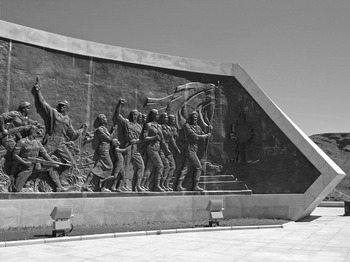
Located behind the obelisk is an eight-metres-high bronze relief mural (Figure 2). The panels feature scenes presenting a historical narrative that runs from romanticized images of the pre-colonial Namibian past through to scenes of early anti-colonial struggles, the different phases of the nationalist struggle and, finally, the victorious, heroic army striding boldly ahead, led by a soldier who triumphantly bears the new nation's flag. Both the statue and the mural were fabricated in North Korea and shipped to Namibia.
Heroes’ Acre: mural art (Photo: H. Becker)

A long straight staircase leads up to the artwork. On either side of the steps are walls of black granite and white marble. They are awaiting inscription with the names and particulars of the ‘heroes’ to be identified officially. The burial site can accommodate a maximum of 172 actual graves. By 2010, however, only a few ‘heroes’, mostly leading Swapo politicians, had been buried at Heroes’ Acre.
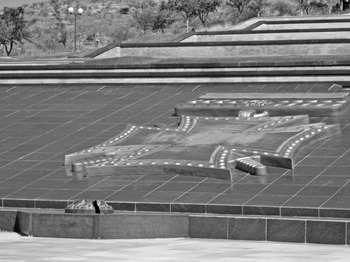
Not originally part of the North Korean plan was the inclusion of an eternal flame (Figure 3). However, the Namibian government insisted, and it was eventually lit by Nujoma during the inauguration ceremony. Quite possibly, the belated inclusion of the eternal flame as a central symbol of Namibia's national commemorative site reflects a wish to emulate the Zimbabwean national monument and its official symbolic commemorative system, the original inspiration of the Namibian ‘copy’.
Heroes’ Acre: eternal flame and graves (Photo: H. Becker)

No mourning site
The Namibian Heroes’ Acre, with its symbolic system of the statue of the ‘unknown soldier’, the eternal flame, and the commemorative mural panels, encapsulates the notion of nationalist modernity that accompanied the emergence of these symbols with the post-First World War memorials in Europe (Werbner Reference Werbner and Werbner1998b: 72). Namibian nationalist symbolism and rhetoric draws on these images, manifest in the visual arts components that were produced in the socialist realism version of nationalist monumentalism and imported from North Korea. The award of medals for living and deceased liberation heroes, which took up a substantial part of the August 2002 inauguration ceremony, is part of the same nationalist repertoire. In terms of space and practice, the Swapo government has clearly embraced this particular symbolic system of commemoration. In contrast to the obvious genealogy of this approach, however, the rhetoric surrounding the Heroes’ Acre site attempts to reappropriate the monumental display of heroism as inherently ‘African’. During the inauguration, Nujoma emphasized that the construction of the monument was done ‘in the true African tradition of bestowing honour to our forefathers and foremothers’ (The Namibian, 27 August 2002).
As Namibia's primary space where the official historical discourse of agency – vested in the armed struggle directed from exile – is performed in commemorative practices, and where heroism has been symbolized in stone, Heroes’ Acre is a site for the staging, display and narration of power in the post-colonial era. So far, this is rather unsurprising: as Werbner (Reference Werbner and Werbner1998b) reminds us, throughout Western modernity powers that be have made use of sets of visual and iconic signifiers to point to their fallen. In Africa, too, ‘new’ nation states routinely make use of visualized symbolic signifiers to imagine the nation according to their respective visions when establishing memorials and ceremonies to commemorate the dead.
However, a comparison of recent ‘new’ nation states points to significant variations. Namibia adopted the Zimbabwean modernist realist symbolism of that country's national commemoration site, which, as Werbner (Reference Werbner and Werbner1998b) details, closely followed the patterns developed in the modernist construction of nineteenth- and early twentieth-century European war monuments. A century later this particular version of modernist nationalism arrived in post-colonial Southern Africa in its incarnation as North Korean Stalinist realism, as testified by the Zimbabwean and Namibian Heroes’ Acres.
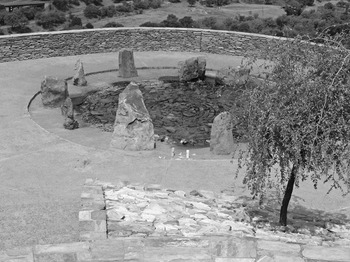
This particular aesthetics gives expression to a version of nationalist imagination which has dominated Zimbabwe's recent historiography, dubbed ‘patriotic history’ by Terence Ranger (Reference Ranger, Carvalho and Gemenne2009); it also dominated Namibia's public history for at least the first decade and a half after 1990. Some memory sites in other ‘new’ African nations, however, embrace an aesthetics that contrasts with the distinctly masculinized, phallic and militaristic imagery of the Windhoek memorial. Sites such as South Africa's Freedom Park near Pretoria (Figure 4) or Rwanda's Kigali Memorial Centre at GisoziFootnote 10 strike the visitor as working with distinctly different sets of visual and iconic signifiers. They are thus located in a post-modernist emblematic aesthetics that incorporates spiritual moments of contemplation and other symbolical attempts at rupture. Both these sites make abundant use of water features and plants to set off rock and marble structures.Footnote 11 The narratives they present do not appear seamless.
Freedom Park (Pretoria): Isivivane (Photo: H. Becker)

The visual and iconic signification of Namibia's Heroes' Acre, however, establishes it as a space to enact and create consensus. Heroes' Acre is both a physical, topographical space for the spatialization of sanctified memory and a social space which, remarkably, is scaping social memory into a fixed form. Neither the narrative nor the monumental forms provide room for multivocal and fragmented memories. While ostensibly it is a burial ground, the site and the ceremonies for which it provides a physical and social space do not facilitate mourning the dead as a process of identification. Instead, the monument imposes a narrative of triumphalist victory.
Contesting Heroes' Acre
From the time of its erection, the aesthetics of the site and its symbolic system were contested. So was the selective official recognition of ‘heroes’. Several issues emerged, first from a series of interviews that I conducted with Windhoek residents in September 2002, just over a month after the site's inauguration. Related concerns have been mentioned frequently during my regular visits to Windhoek since then, in informal conversations with friends, acquaintances and former students and colleagues from the University of Namibia (UNAM), as well as in discussions (some conducted on site) with professionals working in the heritage sector, most recently in September 2008.
Allegations that the monument expresses a ‘personality cult’ have been made frequently. From the very first sightings of what The Namibian newspaper at the time somewhat snappishly described as ‘artwork which is heroic in subject and message’ and ‘reminiscent of the style of socialist monuments’ (The Namibian, 5 July 2002), Namibian visitors to the Heroes' Acre, then still under construction, commented that the massive statue of the heroic PLAN soldier – the centrepiece of the site – bears President Nujoma's facial features. In response government officials stated repeatedly, but to little avail, that the statue did not resemble anyone in particular (The Namibian, 27 August 2002). UNAM students I spoke to unanimously laughed off the official notion of the ‘unknown soldier’. ‘It's clearly the President’, they said and, further, that this was not surprising since Nujoma, ‘like most African presidents, just gives to his own people’, which they understood to mean his political as well as his ‘tribal’ affiliates.
As to party political association, everyone with whom I have discussed the site has agreed that Heroes' Acre was ‘for Swapo Heroes only’, although their opinions on the matter differed enormously. For older and middle-aged Oshiwambo-speaking labourers, with whom I held a discussion in September 2002, it was self-evident that only loyal Swapo members could be ‘recognized’ as heroes and receive a burial at the Acre; they earnestly pondered the doubtful hero status of certain former Swapo politicians who had fallen out with the ruling party in the years following independence.Footnote 12
At the same time, in letters to the press, Heroes' Acre was linked to the festering issues of SWAPO's human rights violations in exile.Footnote 13 To those letter writers, the site reproduced, sanctioned and thus reactivated relations of power and repression – in other words, it promoted division instead of the national unity that the official political discourse celebrated (The Namibian, 24 and 27 August 2002).
Not only those who have been concerned with the Lubango saga have been opposed to the notion that ‘there are only Swapo heroes’; a group of articulate UNAM students, from different regional and linguistic backgrounds, perceived this as a despicable form of self-privileging by ‘the ruling class’ and ‘[Cabinet] Ministers’. The students linked this to a wider dissatisfaction with the concept of heroism that informed the selection of Namibia's first official heroes, and openly questioned the ways in which the official liberation narrative privileged the armed struggle and exile politics. One young woman felt that, ‘there is too much emphasis on those who went to exile to fight. … There is no acknowledgement of those women and men who stayed behind and looked after cattle and children.’ Furthermore, visitors to Heroes’ Acre expressed disquiet about the fact that the notion of heroism carried a heavy gender bias, which played down the contributions of women during the war.
In contrast to the high visibility of women in post-colonial Namibia (Becker Reference Becker1995), female features are largely absent from the visual signifiers encoded in the site. The statue of the ‘unknown soldier’ is a symbol of a very martial masculinity. The scenes engraved in the mural also depict agency generally as male. Women are represented, for the most part, in stereotypically feminine roles – nursing wounded male heroes, for example. Only in the mural's last panel do women feature among the victorious soldiers. A few figures are identified as female because they wear earrings alongside military uniforms. Other than that, their only female attributes are surprisingly small breasts on muscular, lean bodies. An onlooker, especially someone who shares the dominant local ideas of female bodies as imbued with generous shapes, might well miss these female physical attributes. The then Secretary General of the Swapo Women's Council, not known as an outspoken critic of the party's leadership, was reportedly hugely upset when she first viewed the Heroes’ Acre, then still under construction, in July 2002 – because, Eunice Iipinge protested, the sacrifices of ‘heroines’ had been unfairly omitted from the official pictorial narrative chiselled in marble and bronze.Footnote 14
What has concerned many of my interlocutors most, however, is the memorial's association with ethnicity and regionalism. It appears that the turn to the recent guerrilla war has not been able to establish national symbols that would enjoy national legitimacy and be able to foster a national identity; the site fails to resonate with Namibians from the central and southern regions of the country who had little direct experience of the armed struggle. Whether or not the statue depicts Nujoma, the ‘unknown soldier’ certainly corresponds with how Namibians imagine ethnic Owambo features. This alienates many Namibians from the southern and central regions, who harbour perceptions that they have been marginalized by the hegemonic politics of Swapo, which they equate with an ethnic Owambo domination (Becker and Bruhns Reference Becker and Bruhns1998: 12–13). On innumerable occasions I have been told that, ‘the Heroes’ Acre is only for the people from the North’.Footnote 15 In April 2003, for instance, the leadership of the /Khomanin section of the Damara people complained that the government had been one-sided in its selection of official heroes. They provided a list of Damara ‘heroes’ whom they wanted to be honoured at Heroes’ Acre (The Namibian, 15 April 2003). This incident exemplifies the widespread understanding that the site celebrates an ethnic-based heroism, perceived to bolster Owambo domination in post-colonial Namibia. However, boundaries of inclusion and exclusion are multi-dimensional, and certainly not limited to ethnic ‘communities’; as I have shown above, the politics of recognition of the role of Owambo civilians during the liberation war equally demarcates inclusion and exclusion in the ‘new nation’.
Issues of inclusion and exclusion on the basis of regionalism and ethnicity, political affiliation, and gender have been discussed often in private but rarely in public. Most of the public debate has revolved around the selection of heroes. Who will be declared a hero? Who receives a hero's (state) funeral at the site? And who selects the heroes?
Even before the site's inauguration, the Swapo government appeared to have been divided on how to address the matter of selection. A high-level Cabinet sub-committee on Heroes’ Acre, which had been assigned the task of identifying candidates for the status of official hero, could not agree on suitable ‘heroes and heroines’ from the recent nationalist war. The committee was continuously engrossed in heated debates, while arguments leaned towards local or regional identifications with potential official ‘heroes’ along the line: ‘He's a hero; I know him – he's from my village.’Footnote 16 When the Committee could not reach consensus on the recognition of heroes from the recent liberation war, it only named nine official heroes (including one woman); none of these first official heroes had been participants in the recent nationalist struggle.Footnote 17
Since its inauguration only a small number of prominent Swapo politicians have been laid to rest at Heroes’ Acre. In some instances, prominent politicians and their families made it clear that they did not wish to be buried at Heroes’ Acre, but preferred a burial ‘at home’. More significantly, decisions about the hero status of prominent deceased continue to be controversial,Footnote 18 which indicates rather widespread critical perceptions of the dominant form that the objectification of liberation war commemoration has taken at Heroes’ Acre.
Perhaps the most striking sensory impression made during my numerous visits to Heroes’ Acre since 2002 is the emptiness of the vast space. Visitors are sparse. Even on a specifically advertised ‘open day’ in September 2008, we found the site deserted. It appears that the Swapo government itself has withdrawn its earlier intentions of making the site the central space of national commemorations. From 2005 the annual celebrations of Namibia's political liturgical year reverted to a rotational calendar, according to which the annual days are celebrated in different regions around the country. Less than a decade after its inauguration, the national Heroes’ Acre, having been established as a geographically and politically central space to legitimize a selected historical narrative, that ‘SWAPO brought us liberation through the barrel of a gun’, appears to have lost much of the impetus it had when first launched by the Swapo government.
NORTHERN LANDSCAPES OF MEMORY
The contested reception of the Heroes’ Acre site indicates that the relationship between social acts of remembrance, political ritual and space is much more complex than the site's iconic narrative and visual form suggest. This becomes clear when one looks at some of the spaces in which Owambo residents mourn the dead of the war.
The landscapes of northern Namibia are dotted with sites which recall the liberation war. Some of these sites were left behind by the former colonial forces, who thus retain a physical presence; others are fixtures to mark the new Namibian state and the now ruling party's triumph, such as the massive tombstone, declared a national monument in 2004, which was put up by Swapo in 1999 in Ondeshifiilwa, to the west of Engela, where twenty-two PLAN combatants died on 2 April 1989. The memorial's inscription reads ‘21 Namibian Heroes Rest Here. 1 April 1989. The aim was independence’, flanked by the silhouette of an armed fighter and SWAPO's symbol of a man with his right fist pointing upwards.
This design became the blueprint for attempts by Swapo at inscribing a uniform, hegemonic form of local commemoration through identical visual markers. The ruling party commissioned the manufacturing of tombstones for individual graves of fallen combatants, such as the site I visited at Onengali east of Oshikango in 2004, which was inscribed: ‘1 Hero is resting here. The aim was independence’. The ruling party's signature graces the bottom part of the tombstone, informing the onlooker that this is a SWAPO (or, today, Swapo Party) initiative.
Apart from official physical inscriptions, local people have embarked on initiatives that have inscribed their individual and community memories in the land. At least until very recently, most of these sites have remained absent from Namibia's official memory map. The invisibility of local people's sites of remembrance appears to be in line with the nationalist master narrative, which was constituted soon after the country's independence and evolved further over the following years. A new memorial site at Eenhana in Owambo, however, indicates significant recent shifts in Namibian memory politics.
EENHANA HEROES’ MEMORIAL SHRINE
In November 2005, a construction team working on new sewerage ponds for the town of Eenhana, about 110 km north-east of Oshakati, made a gruesome discovery. They stumbled across a mass grave, where their mechanical diggers uncovered hundreds of bones. After the discovery, the construction project was briefly suspended; the police were called in and the bones were taken away for examination. Shortly thereafter, a second grave was found only fifty metres from the first. President Hifikepunye Pohamba visited the site and led a tribute to those who were buried at Eenhana.
Today, Eenhana is a fast-growing town of about 24,000 inhabitants, the administrative centre of the densely populated (by Namibian standards) Ohangwena Region. During the war for Namibian independence, however, it was the location of the main South African military base in the Oukwanyama District, which was one of the bloodiest theatres of the war.
Following calls by the government for the local population to come forward with information about other burial sites, many of the individual graves where PLAN guerrillas had been buried by local people in Owambo were brought to the attention of the Namibian public for the first time. Until then, as I had found during fieldwork in Ondonga in 2003 and in western Oukwanyama in 2004, most of these graves had been recognized only by local residents who had buried the bodies. In some instances, the dead had been known to those who had buried them, whereas in other instances, their identities – even their assumed war names – remained a mystery. Previously, only a small number of the graves had drawn the attention of local politicians, and in rare instances a uniform, anonymous tombstone – supplied by Swapo – had been erected.Footnote 19
After the discoveries at Eenhana, the graves of hundreds of fallen PLAN fighters, which lay scattered across the former war zone, entered the mind of the Namibian public. Following a national outcry, the Namibian government decided to build a memorial at the site where the first grave had been found. It was resolved that the site should become a national ‘shrine’ and that the Namibian National Heritage Council was to direct the project. A special Technical Committee on the Eenhana Shrine Project was set up, chaired by the Permanent Secretary for Youth, National Services, Sport and Culture, the ministry under which heritage projects fall. The site was constructed by the China Construction Engineering Corporation – but, unlike the Heroes’ Acre in Windhoek, whose aesthetics were devised in North Korea, the Memorial Shrine was designed by a Namibian architectural firm.Footnote 20
When the Shrine was unveiled in 2007 before a thousand-strong audience, the new site's visual and iconic signifiers indicated major shifts in the material form of anchoring liberation war memory in the Namibian landscape. So did the commemorative events that marked its inauguration on Heroes’ Day (26 August). These commenced with the reburial of the human remains found in the shallow graves at Eenhana and nearby villages. The altered material-social articulation of liberation war remembrance pointed towards a shift both in the historical narrative of political resistance, and in the reinvention of culture and nationalism.
The high-level participation in the inauguration demonstrated that the Eenhana Shrine was conceived as a key site for the production of social memory. President Pohamba, who formally unveiled it, was joined by former President Nujoma, Prime Minister Nahas Angula, the Speakers of both Houses of Parliament, the country's Chief Justice, the Chief of the Namibian Defence Force, as well as the Queen of Oukwanyama and the Dean of the Diplomatic Corps in a solemn ceremony of re-interment and wreath laying. Although Pohamba's speech still gave the nod to the ‘armed struggle for Namibia's freedom and independence [which] was at the centre of our struggle to terminate the foreign occupation of our motherland’, recognition was given to all ‘the people of Namibia [who] waged the noble struggle for national liberation … both at home and in exile’ (Republic of Namibia 2007).
The acknowledgement of two sets of contributions – those made by the PLAN combatants and those that were provided by the civilians – is visually recognizable in the site. The centrepiece of the memorial is a two-metres-high bronze statue of a female combatant holding a Namibian national flag. A comparatively small mural element (1.8 metres high) depicts PLAN combatants looking out at an enemy target. These components have been complemented – remarkably – by another bronze sculpture (also 1.8 metres high) which portrays three civilians taking ammunition and food to the combatants. According to the chairperson of the committee responsible for the construction of the site, this statue, the first one to represent the agency of civilians, was included to symbolize the courage and provision of essential services by local ‘communities’ during the liberation struggle. He explained that the design of the new site had been motivated by a strong recommendation, presented during on-site research preceding the construction of the memorial, that the history of the liberation struggle be displayed in its multi-dimensional aspects. It had been recommended explicitly that the memorial should acknowledge the courage not only of the PLAN combatants but also of the civilian population who supported them by providing food, clothing, medicine and information. Women had played an important part in these endeavours, as had young people, such as herdboys who drove cattle or goats over the tracks left by PLAN combatants and thus prevented the ‘security forces’ from pursuing them. Therefore, he said, ‘the community’ had suggested that the Shrine should depict women taking food and medicines to combatants in the bush (Thomas Reference Thomas2007).
The visual recognition of the agency of civilians is a notable shift in the official Namibian memory culture, particularly as the creation of this site reinterprets the received historical narrative by anchoring memory in the landscape. Yet the Memorial Shrine integrates two more astonishing significations of the shifting entanglements of memory, nationalism and culture in post-colonial Namibia.
First, the site is visually framed by five-metres-high structures in the shape of mopane tree leaves, which the designers describe as ‘a symbol for the Namibians who lost their lives during the struggle during the war. When in hiding, the civilians used mopane leaves to hide themselves’ (Marley Tjitjo Architects website). Besides the restatement of the significance of the civilian contribution, the casting of mopane leaves at a key memory site also references decidedly local aesthetics and ‘culture’. These symbolic references are accentuated even more by another component of the shrine. A seventy-centimetres-high bronze-relief sculpture of a gravedigger depicts various ‘traditional’ utensils and weapons used in the war zone. This, according to the project committee, was incorporated to symbolize the ‘collective, cultural heritage left by the war victims for future generations’ (Thomas Reference Thomas2007).
MEMORY, CULTURE AND NATIONALISM, 1990–2010
When the Eenhana Shrine was inaugurated in 2007, local residents were full of praise for the decision to build a memorial site of national importance in their town; this, they said, was a major achievement for the Ohangwena Region as a stage of the liberation war. Special praise was given to the fact that the new site accommodated and dignified ‘all Namibians who have contributed to the liberation of the country’ (Mbangula Reference Mbangula2007; my emphasis). Some residents suggested that because the Shrine was more inclusive than the Windhoek Heroes’ Acre, it could provide a fitting burial site for people ‘who deserve to be buried heroically but could not be brought to Heroes’ Acre’ (ibid.), such as the late Anglican Bishop James Kauluma, whose burial at his Owambo home in May 2007 had raised critical questions as to who ‘qualified’ as a ‘hero’ in post-colonial Namibia.
The new site's visual and iconic signifiers leave no doubt that remarkable shifts have taken place in the country's memory politics during independent Namibia's second decade. On the other hand, the same North Koreans who built the Heroes’ Acre are currently constructing the Independence Memorial Museum in downtown Windhoek, which according to the visualizations presented closely follows the Acre's aesthetic patterns. The changes, thus, do not amount to a complete about-turn – but they certainly have opened up spaces for the official recognition of previously untold aspects of the liberation war.
The reasons for the emergence of a more inclusive liberation war memory discourse are multi-faceted. It is certainly true, as Kössler (Reference Kössler2007) suggests with reference to commemorations in southern Namibia, that the succession of Nujoma by Hifikepunye Pohamba as the country's President in 2005 played a part in this development. Even though Nujoma continues to wield considerable influence in Swapo and by an act of Parliament has been proclaimed the ‘Founding Father of the Namibian Nation’, the new incumbent's different personal and political style certainly has eased the tight grip of the hegemonic form of authoritarian and militaristic nationalism for which Nujoma has stood and continues to stand in Namibian public discourse.
Beyond the change of guard in State House, however, the Eenhana Shrine also signifies shifts in Namibian politics and public culture, which have not entirely replaced earlier forms but have become gradually more influential from the mid-1990s. These are moments associated with the second register of anti-colonial nationalism in the Namibian post-colony: the cultural reinvention in the ‘new nation’. Aspects include, first, the increasing culturalization of nationalism, and, second, a concomitant commodification of liberation struggle memory as ‘heritage’; together these present a modified entanglement of liberation war memory, nationalism and cultural heritage.
Culturalization of nationalism
In 1990, the promotion of cultural heritage and cultural (broadly understood as ethnic) diversity certainly was not regarded as a significant item on the new nation state's agenda. On the contrary, an iconic unified nationhood was held up as the aim of the newly independent country.Footnote 21 The Namibian Constitution acknowledged every person's right ‘to enjoy, practise, profess, maintain and promote any culture, language, tradition or religion’ but this was subject not only to the terms of the Constitution itself, but more specifically ‘further subject to the condition that the rights protected by this article do not impinge upon the rights of others or the national interest’ (Article 19; my emphasis). This was resonant of the document's preamble, which emphasized ‘the dignity of the individual and the unity and integrity of the Namibian nation’.
This liberalist conception of the subordination of cultural ‘rights’ to individual citizenship in a unified nation should be understood, in part, from a specific Southern African perspective. Namibia under South African occupation had been ruled in line with the apartheid vision. From the 1960s onwards, the Odendaal Commission's recommendations had been implemented in the territory of ‘South West Africa’, resulting in the carving out of ethnically based homelands, particularly in the northern parts of the country, each complete with its own administration, flag, parliamentary mace, and explicit attempts at politicizing ethnic difference into nationhood.Footnote 22
Unsurprisingly, pre-independence nationalist rhetoric emphasized that the liberation struggle was the birthplace of a new nation. In 1981, SWAPO published a quasi-official history of the country entitled, To Be Born a Nation: the liberation struggle for Namibia. According to Peter Katjavivi, then SWAPO's Secretary for Information and Publicity, this title had been appropriated from a saying of the Mozambican liberation struggle, which articulated that the aim was ‘to die a tribe and be born a nation’ (SWAPO of Namibia 1981: ii).
The post-colonial Namibian state, having come forth through the nationalist struggle against the colonial apartheid state, was initially wary of the discourse of ‘culture’, as it denoted division. A commentator in the government's newspaper wrote: ‘In the past culture was misused and this has left the impression that talking about culture means talking about invaluable things aimed at separating people’ (Denis Nandi in New Era, 27 January–2 February 1994, quoted in Fairweather Reference Fairweather2001: 137). Like Nandi, in 1990 most SWAPO politicians, as well as the small circles of Namibian intellectuals, shunned the notion of ‘cultures’ as distinctive ways of life of different ‘peoples’. Educated women activists, with whom I worked in the course of my doctoral research in the early 1990s, frequently told me about their abhorrence of the notion of ‘different cultures’ and their eagerness to leave behind those confining practices they called ‘traditions’, ‘now that we are free’. This notion seemed to be shared rather widely. Across the country, rural women expressed the need to do away with ‘harmful traditional practices’, which were regarded as detrimental to women (Becker Reference Becker1995). When women at an International Women's Day rally in Windhoek in 1991 carried a placard which read ‘Abolish Humiliating Customary Laws Now’, it captured eloquently the spirit of the time.Footnote 23
A few years ‘into independence’ (to espouse common Namibian parlance), however, the discourses of culture and nationalism began to change. Among the first signs of this in the early 1990s were attempts by sections of several ethnic groups to re-establish kings and kingdoms, which made front-page news in the Namibian press (Murray Reference Murray1993: 17). Swapo politicians were divided as to how to address these unexpected developments. At a seminar on ‘Ethnicity, Nation Building and Democracy’ in October 1993, organized by the German Konrad Adenauer Foundation, two leading members of Swapo's (then) younger generation argued about the foundations of the nation. Mose Tjitendero, the first Speaker of the National Assembly, upheld the notion that the Namibian Constitution had been drawn up to protect the rights of the country's citizens as ‘free-flowing individuals’; he emphasized that the supreme law ‘was designed to achieve not a sectional, not a tribal, not a regional and not a provincial, but a national programme’ (Tjitendero Reference Tjitendero1993: 58–9). Prime Minister Hage Geingob, however, presented a very different point of departure: before we set about discussing issues of ethnicity, nation building, and democracy, he said, we first of all need to ‘recognize certain facts’, namely ‘that Namibia is a multicultural, multi-ethnic nation’ (Geingob Reference Geingob1993: 13).
It appears that by 1993 the global discourses of multiculturalism had arrived at Namibia's shores. Over the next few years, while ritual chants of ‘One Namibia – One Nation’ continued to resound at political rallies and commemorations, gradually the notion of a national Namibian culture, which supposedly had been forged through the nation's joint struggle against oppression and colonialism, and which was to complement the expressions of nationalism through the new nation's flag, coat of arms, and national anthem, was replaced by a new principle of ‘unity in diversity’. The emphasis was shifted to the idea of a ‘gallery of cultures’ (Kirshenblatt-Gimblett Reference Kirshenblatt-Gimblett1998, as cited by Fairweather Reference Fairweather2006), each one distinct but all harmoniously coexisting. National identity was no longer to be defined through the common history of the liberation struggle but through the tolerant accommodation of cultural difference. As Enid Schildkrout (Reference Schildkrout1995: 66) observed, in post-colonial Namibia ethnic cultural symbols and practices, including those deemed indigenous as well as those that had originated in the colonial encounter, were redefined as ‘apolitical signs of egalitarian multiculturalism’.
‘Roots’, tourism and the commodification of cultural heritage in Owambo
Living in Windhoek, and visiting Owambo several times every year throughout the 1990s, I could not fail to notice that, from around 1996, disputes over the values that pull the national and local community together began to change; increasingly they embraced notions of ‘culture’ and ‘heritage’, which previously had been largely absent from the national public discourse. Political debates revolved around invocations of culture in order to structure and enforce human behaviour, which generally imagined culture as ethnically and/or territorially bounded (‘in our culture’). In the state-owned electronic media, too, an effervescent discourse on ‘culture’, understood as heritage, burst into public presence.Footnote 24
Whereas residents of the former war zone had previously called for the abolition of what they considered harmful traditions, they now started speaking about ‘our culture’ in appreciative terms. From the mid-1990s onwards, a vocal discourse emerged in the northern regions about the ‘loss of culture’ that Owambo had supposedly experienced because of the ‘suppression of culture’ by Christianity – that is, by the missionaries and the communities of believers that they had established.
This was evidently in the first place a discourse of local elites. Among the most vocal proponents of the ‘culture loss’ discourse were leading Owambo clerics – who were outspoken in their criticism of what they saw as their churches’ responsibility for the decline of cultural heritage – teachers, businesspeople and students at the University of Namibia, who were eager to reconstruct an ‘authentic’ Owambo culture. Well-heeled young couples from the urban Owambo diaspora returned to their rural homes for purportedly ‘traditional’ weddings (Fairweather Reference Fairweather2003); schools founded cultural groups and participated in the newly established state-sponsored cultural festivals. The most ambitious Owambo heritage project, however, was launched by the Lutheran Church, which set up the Nakambale MuseumFootnote 25 in the old mission church at Olukonda near Ondangwa in 1995. This prominent venture not only displayed ‘traditional’ material culture in its exhibitions; it also reconstructed an Owambo homestead, where visitors could sample local dishes, watch ‘traditional’ dancing, and even book into huts for sleepovers.
The flurry of cultural heritage enterprise was partly directed at the salvage of an ostensibly ‘lost’ local culture in the light of post-colonial identity construction. Equally, and increasingly so, however, these ventures were geared to participation in an emerging cultural tourism market, which the Ministry of Environment and Tourism, non-governmental community tourism initiatives, and local elites hoped to create in Owambo with the aim of marketing Namibia's cultural (= ethnic) diversity to complement the country's natural and wildlife attractions.
CONCLUDING REMARKS: LIBERATION WAR MEMORY IN THE TWENTY-FIRST CENTURY
Fairweather (Reference Fairweather2006: 721) argues that the Namibian cultural tourism strategy of development required the articulation of local identities with reference to a global tourism market that was interested in constructing post-colonial subjects in a homogenized traditional past. Evidently, sites which anchored the hegemonic nationalist master narrative of political resistance in the Namibian landscape were of little interest to this emerging market. Attempts at including the Heroes’ Acre in Windhoek in tourist itineraries proved rather unsuccessful; visitors felt rather ‘awkward’ when faced with the monument's Stalinist realism features and its militaristic message (see Heroes’ Acre Monument Namibia website in References).
The Eenhana Shrine with its visual and iconic references to decidedly local aesthetics and cultural heritage may be more successful in this regard. One-and-a-half years after the site's inauguration, the Mayor of Eenhana claimed that tourism activities in the town had been picking up since the erection of the site, which, she said, had become a prominent tourist attraction and landmark. She added that a high-end hotel (known locally as a ‘lodge’) and a shopping mall were under construction in close proximity to the Shrine (Heita Reference Heita2009). It remains to be seen whether these high expectations of Eenhana's ‘massive marketing drive’ (ibid.) will be fulfilled.
Nonetheless, they are an interesting indication of the repositioning of liberation war memory in the light of cultural reinvention in post-colonial northern Namibia. As I have shown, while Heroes’ Acre appears as a cast-in-stone remnant of a nationalist master narrative, which was aimed at homogenizing the multi-faceted agencies of Namibians during the liberation war, the Eenhana Shrine expressly recognizes the heterogeneity of war-time experiences in the northern war zone. It also gives visual expression to the particular Namibian versions of unity-in-diversity discourses and heritage politics, which have over the past two decades modified the prevalent ideational foundations of what constitutes ‘national culture’ in post-colonial Namibia.
ACKNOWLEDGEMENTS
I am indebted to the journal's anonymous reviewers, and to seminar and conference participants in Mainz, Amsterdam and Cape Town for helpful suggestions. Special thanks are due to Christian Williams for his thoughtful comments. I gratefully acknowledge the funding provided by the UWC Arts Faculty research fund and the Wenner-Gren Foundation for Anthropological Research, which facilitated fieldwork in 2001 and 2008 and in 2002–4 respectively.