Introduction
Mangos (Mangifera indica L.) have high social and economic impacts on tropical and subtropical regions of Mexico (Ramos, Reference Ramos2003). The main problems of mango production are poor control of tree development, irregular fruit production throughout the tree and susceptibility to freezing, pests and diseases. One or more of those factors frequently reduces fruit yield and quality (Chávez et al., Reference Chávez, Veja, Tapia and Miranda2001). Breeding of mangos in Mexico has not been constant, and currently mango farmers request bred germplasm from countries such as the USA, as well as open-pollinated trees that are commonly produced through Mexico. The use of open-pollinated trees to replace dead trees in mango orchards has increased the genetic diversity of mangoes growing in Mexico. Moreover, open-pollinated trees frequently show better phenotypic attributes compared with landraces or cultivars and must be used as parents for further breeding works. Genetic and phenotypic analyses of native mango germplasm of Mexico could be useful for determining the genetic relationships and diversity among and within landraces generated by open pollination, and for defining the relationships with breed germplasm introduced to the country.
Genetic relationships among breed mango accessions have previously been conducted based on biochemical markers such as isozymes (Degani et al., Reference Degani, El-Batsri and Gazit1990, Reference Degani, Cohen, El-Batsri and Gazit1992; Gálvez-López et al., Reference Gálvez-López, Adriano-Anaya, Villarreal-Treviño, Mayek-Pérez and Salvador-Figueroa2007) and molecular markers such as random amplified polymorphic DNA (RAPDs; López-Valenzuela et al., Reference López-Valenzuela, Martínez and Paredes-López1997; Barboza and da Costa, Reference Barboza and da Costa2004), amplified fragment length polymorphisms (AFLPs; Eiadthong et al., Reference Eiadthong, Yonemori, Kanzaki, Sugiura, Utsunomiya and Subhadrabandhu2000; Hernández-Delgado et al., Reference Hernández-Delgado, Becerra-Leor, González-Paz and Mayek-Pérez2005) microsatellites [simple sequence repeats (SSRs); Duval et al., Reference Duval, Bunel, Sitbon and Risterucci2005, Reference Duval, Bunel, Sitbon, Risterucci, Calabre and Le Bellec2006; Honsho et al., Reference Honsho, Nishiyama, Eiadthong and Yonemori2005; Schnell et al., Reference Schnell, Olano, Quintanilla and Meerow2005] and inter-SSRs (Pandit et al., Reference Pandit, Mitra, Giri, Pujari, Patil, Jambhale and Gupta2007). Based on informativeness and robustness, the use of AFLPs and SSRs has been preferred to determine the genetic relationships and dissemination paths in some plant species (Riek et al., Reference Riek, Calsyn, Everaert, Van and Loose2001; Rivera-Ocasio et al., Reference Rivera-Ocasio, Aide and McMillan2002). The aims of this work were to analyse, based on AFLP and SSR markers, the genetic relationships among mango landraces of Mexico and to compare them with breed mangos.
Materials and methods
Germplasm
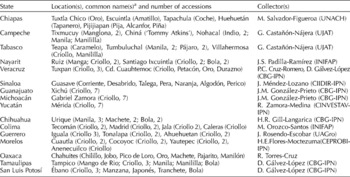
Twenty young leaves from each of 112 mango trees from 16 states of Mexico (seven plants per state) were collected during 2006–2007. Sites of collection included orchards, home gardens, woodlands and land near roads (Table 1). Three mango cultivars (Ataulfo, Manila and Tommy Atkins) from the Germplasm Bank of the Instituto Nacional de Investigaciones Forestales Agropecuarias (INIFAP) located in Cotaxtla, Veracruz, México, as well as one Mangifera odorata accession were included as controls.
Sites of collection, common names and collectors of mango landraces throughout 16 states of Mexico

a Number in brackets indicates the number of accessions per local name.
Genetic analyses
Genomic DNA was isolated by the cetyltrimethylammonium bromide method (Doyle and Doyle, Reference Doyle and Doyle1987). Germplasm was analysed by using AFLP markers where four AFLP oligonucleotide combinations (EcoRI-ACA/MseI-AGT, EcoRI-ACA/MseI-ACC, EcoRI-ACA/MseI-AGA and EcoRI-ACA/MseI-AGG) were used. Combinations were selected after the pre-evaluation of eight oligonucleotide combinations in five selected accessions (Vos et al., Reference Vos, Hogers, Bleeker, Reijans, van de Lee, Hornes, Frijters, Pot, Peleman, Kuiper and Zabeau1995). Electrophoresis of AFLP products was conducted in one semi-automated sequencer model LICOR IR2 (Lincoln, NE, EUA) using 6.5% acrylamide gels. Then six SSR loci generated in M. indica (Supplementary Table S1, available online only at: http://journals.cambridge.org; Duval et al., Reference Duval, Bunel, Sitbon and Risterucci2005) were used to characterize all germplasm. The six SSR loci were pre-selected from ten loci based on amplification patterns and polymorphisms in five selected accessions. Polymerase chain reaction amplification conditions for each SSR locus were described by Duval et al. (Reference Duval, Bunel, Sitbon and Risterucci2005). Amplified fragments were separated by electrophoresis in 6% acrylamide gels and revealed by silver staining (Promega®). Molecular weights of each amplified band were estimated by extrapolation based on the molecular weight of a 25-bp ladder and using a photo-documentation system.
Data analysis
AFLP data
AFLP bands were numbered according to their migration on the gel. One matrix of zeros and ones was constructed and then used to estimate the simple-matching coefficients among accessions (Nei and Li, Reference Nei and Li1979). One dendrogram based on the neighbour-joining method was constructed using averaged genetic similarity among 16 mango populations (Felsenstein, Reference Felsenstein2006). Cluster analysis was performed with the software programs Phylip, NJ-Plot and Tree View 1.6.6 (Perrière and Gouy, Reference Perrière and Gouy1996; Felsenstein, Reference Felsenstein2006). Average genetic diversity within populations was estimated by calculation of heterozygosity values (H) using Excel Version 2000. The matrix of similarities used for cluster analysis was also used for analysis of molecular variance (AMOVA; Huff et al., Reference Huff, Peakall and Smouse1993; Excoffier et al., Reference Excoffier, Laval and Schneider2005) using Arlequin 2.0 (Schneider et al., Reference Schneider, Kueffer, Roessli and Excoffier1997). The number of permutations for AMOVA's significance tests was 1000 in all cases (Felsenstein, Reference Felsenstein2004). Bootstrap analysis of AFLP data was performed as described in Felsenstein (Reference Felsenstein2004) and the number of permutations for significance tests was 1000.
SSR data
The molecular weight of each SSR band was used to construct two dendrograms based on neighbour-joining method. One dendrogram including the 16 mango populations was performed as described above. Allele diversity analysis was performed with the software Cervus 2.0 (Marshall et al., Reference Marshall, Slate, Kruuk and Pemberton1998), and the number of observed alleles and allele frequencies per locus was calculated, along with the number of analysed accessions and the number of homozygote and heterozygote individuals as well as the values of observed (H O) and expected (H E) heterozygosities (Duval et al., Reference Duval, Bunel, Sitbon and Risterucci2005). Finally, one AMOVA analysis was performed as been described by AFLP data. Bootstrap analysis of SSR data was performed as described in Felsenstein (Reference Felsenstein2004) and the number of permutations for significance tests was 1000.
Results
AFLP analysis
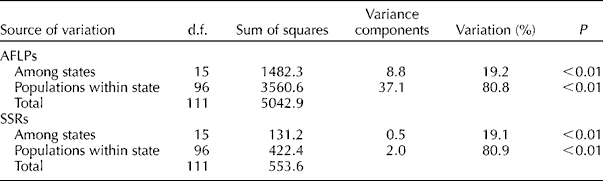
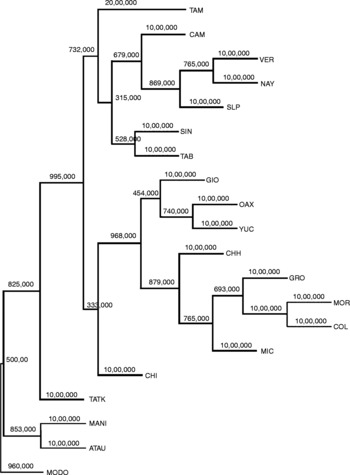
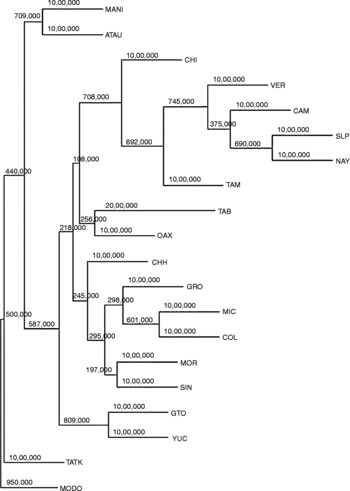
AFLP analysis produced 308 amplified products, 269 of which were polymorphic (87.3%; data not shown). AMOVA detected significant differences among hierarchies (states of Mexico, populations within states). The highest rate of molecular variance was found in populations within states (80.79%). The fixation index for each hierarchy (F ST = 0.1921) indicated high genetic differentiation among and within populations (Table 2). Cluster analysis showed two major groups (Fig. 1). One group included mango populations from Tamaulipas, Campeche, Veracruz, Nayarit, San Luis Potosí, Sinaloa and Tabasco, while the other group included mangos from Guanajuato, Oaxaca, Yucatán, Chihuahua, Guerrero, Morelos, Colima, Michoacán and Chiapas. Cultivars Manila, Ataulfo and Tommy Atkins as well as M. odorata were separated from Mexican mangos.
Analysis of molecular variance of amplified fragment length polymorphism (AFLP) and simple sequence repeat (SSR) data obtained for mango germplasm from Mexico

F ST = 0.1921 (AFLPs), 0.1911 (SSRs). NS = no significative (P < 0.05), ** = significative (P < 0.01). d.f., degrees of freedom.
Bootstrap analysis of 16 mango populations from Mexico based on AFLP markers.

SSR analysis
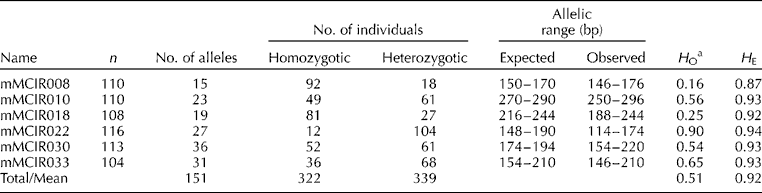
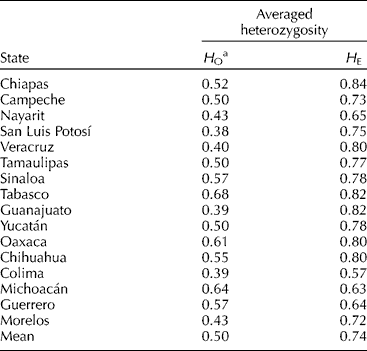
Microsatellite analysis produced 151 alleles (Table 3) and cluster analysis grouped germplasm in two major groups (Fig. 2). One group included populations from Chiapas, Veracruz, San Luis Potosí, Nayarit, Campeche, Tamaulipas, Tabasco and Oaxaca and the other group included that from Chihuahua, Guerrero, Michoacán, Colima, Morelos, Sinaloa, Guanajuato and Yucatán. Cultivars Manila, Ataulfo and Tommy Atkins as well as M. odorata were clearly different to Mexican mangos. AMOVA detected significant differences among hierarchies. The highest ratio of molecular variance corresponded to populations within states. The fixation index for hierarchies (F ST = 0.19 110) indicated high genetic differentiation among populations (Table 2). H E values ranged from 0.546 to 0.841. All amplified SSR loci were polymorphic. Heterozygote individuals per locus ranged from 18 to 104, while homozygote individuals varied from 12 to 92 (Table 3). H O values were from 0.381 to 0.678 and the highest values were found in mangos from Tabasco, Michoacán and Oaxaca (Table 4). The robustness test indicated that 67 and 40% of AFLP and SSR dendrogram nodes were as consensus dendrogram at least 70% of 1000 permutations, respectively, although both marker systems produced essentially the same mango populations grouping with the exception of populations from Chiapas, Oaxaca and Sinaloa (Figs 1 and 2).
Simple sequence repeat data generated from the analysis of mango germplasm from Mexico

a H O, observed heterozygosity; H E, expected heterozygosity; bp, base pair.
Bootstrap analysis of 16 mango populations from Mexico based on SSR markers.

Heterozygosity in 16 mango populations from Mexico obtained based on simple sequence repeat marker data

a H O, observed heterozygosity; H E, expected heterozygosity.
Discussion
Both AFLP and SSR analyses indicated high genetic similarity among mango populations from two clear groups: mangos from Veracruz, Campeche, San Luis Potosí, Nayarit, Tamaulipas and Tabasco (most from the Gulf of Mexico coastline) and mangos from Chihuahua, Guerrero, Michoacán, Colima, Morelos, Guanajuato and Yucatán (most from Pacific Ocean coastline and locations far away from the sea). Both marker systems produced similar mango clustering with the exception of those from Chiapas, Oaxaca and Sinaloa. Polymorphism percentages are higher than those reported by López-Valenzuela et al. (Reference López-Valenzuela, Martínez and Paredes-López1997), Eiadthong et al. (Reference Eiadthong, Yonemori, Kanzaki, Sugiura, Utsunomiya and Subhadrabandhu2000) and Hernández-Delgado et al. (Reference Hernández-Delgado, Becerra-Leor, González-Paz and Mayek-Pérez2005) due to the fact that they used mango germplasm from banks with high percentages of cultivars and high ratios of parentage. Significant differences among populations by state indicated a high genetic variation in Mexican mango germplasm and relative reproductive isolation, with differentiated patterns of recombination due to the genetic recombination and segregation in each agroecological environment; in addition, we found relative differentiation among original mango populations introduced to Mexico from Asia. Former genetic structure delimits genetic differences that could be increased by the reproductive isolation. Mono- and poly-embryonic mangos were introduced to Mexico, although it remains unclear which types were introduced at each original point of introduction. After that, mangos were naturally and artificially dispersed through Mexico by seeds (Eiadthong et al., Reference Eiadthong, Yonemori, Kanzaki, Sugiura, Utsunomiya and Subhadrabandhu2000). High genetic differentiation values indicated the probable fixation of new alleles in specific populations as well as recombination and segregation and selection of the best genes by open pollination of genetically different mangos (Rivera-Ocasio et al., Reference Rivera-Ocasio, Aide and McMillan2002). Mango cultivars were different from all native mangos due to genetic recombination, segregation and selection of better genotypes in the former introduced mangos, which produced genetically different mango lineages compared with mango cultivars (Hernández-Delgado et al., Reference Hernández-Delgado, Becerra-Leor, González-Paz and Mayek-Pérez2005). However, data indicated that former mango introductions could be highly heterozygote and/or high levels of natural/induced recombination may have happened (Honsho et al., Reference Honsho, Nishiyama, Eiadthong and Yonemori2005). Further work should take into account germplasm provenances in order to estimate genetic variability that can be detected in the analysed material (Rivera-Ocasio et al., Reference Rivera-Ocasio, Aide and McMillan2002). An extensive phylogenetic study using mtDNA might be able to reveal the precise parentage and phylogeny among Mexican mango populations (Moritz, Reference Moritz1994).
The allelic range found in our SSR analysis was broader than that reported by Duval et al. (Reference Duval, Bunel, Sitbon and Risterucci2005), who worked with breed germplasm and provided evidence that high recombination and/or migration and gene flux has occurred in Mexican mangos. Our data suggest that locus mMiCIR022 could be used for mango germplasm analysis due the high polymorphic content that can be detected in Mexican mangos. Despite a heterozygote range that ranged from low to moderate, no heterozygote deficits were found and mango germplasm showed significant genetic differences due to random crossing among landraces (Schnell et al., Reference Schnell, Olano, Quintanilla and Meerow2005). Honsho et al. (Reference Honsho, Nishiyama, Eiadthong and Yonemori2005) reported heterozygote ranges from 0 to 0.83 after analysing mangos from Thailand. The SSR values were lower than that reported in this research, mainly due to the fact that the germplasm analysed by these authors was obtained from a Germplasm Bank and was genetically bred, with high levels of parentage. Schnell et al. (Reference Schnell, Olano, Quintanilla and Meerow2005) reported heterozygosity values of 0.241–0.712 after analysing mango cultivars from Florida, USA, using SSRs. Germplasm analysed in this work was also highly related and was subjected to constant selection and clonal propagation, which may have reduced genetic diversity. Duval et al. (Reference Duval, Bunel, Sitbon and Risterucci2005) found heterozygosity values from 0.059 to 0.857 in mangos from one Germplasm Bank located in Guadalupe, although they did not mention the origin of the germplasm. Our highest heterozygosity values were detected in mango populations from Tabasco, Michoacán and Oaxaca, which suggests high levels of natural or induced recombination.
AFLP markers have been assessed and confirmed as a robust strategy to establish differentiation degrees, identification of genotypes and precise genetic relationships in a broad diversity of plant species (Mueller and Wolfenbarger, Reference Mueller and Wolfenbarger1999; Eiadthong et al., Reference Eiadthong, Yonemori, Kanzaki, Sugiura, Utsunomiya and Subhadrabandhu2000; Rivera-Ocasio et al., Reference Rivera-Ocasio, Aide and McMillan2002). In addition, SSRs are very sensitive for genetic variability characterization, genotype and individual identification, and parentage definition among single individuals, as compared with dominant marker strategies such as AFLPs or RAPDs. One advantage of SSRs over dominant markers is that co-dominant markers can determine the population genetic structure and identify shared alleles among individuals (Sun et al., Reference Sun, Díaz, Salomón and Bothmer1999). Bootstrap analyses of both AFLP and SSR data indicated that AFLPs are more robust than microsatellites for Mexican mango germplasm genotyping. For the establishment of genetic relationships and estimation of genetic diversity in mango germplasm, AFLP markers supply statistically reliable and robust information, although SSRs are a reliable marker strategy to determine parentages and ancestors among mango genotypes (Duval et al., Reference Duval, Bunel, Sitbon and Risterucci2005; Honsho et al., Reference Honsho, Nishiyama, Eiadthong and Yonemori2005; Schnell et al., Reference Schnell, Olano, Quintanilla and Meerow2005).
Acknowledgements
The authors are grateful to the Instituto Politécnico Nacional for financial support (Grant CGPI-20050084) for this work. We also are grateful to all people who helped us to collect mango germplasm throughout Mexico. D. Gálvez-López appreciates the CONACYT-Mexico (scholarship no. 169661), Programa de Formación de Investigadores-IPN, Club Rotario Reynosa A.C. and COTACYT-Gobierno del Estado de Tamaulipas (Grant TAMPS-2003-C02-09) for support of her M.Sc. thesis. S. Hernández-Delgado and N. Mayek-Pérez are EDI-IPN and S.N.I. scholarships; N.M.-P. had one COFAA-IPN fellowship.