Wild oat is the most economically detrimental weed in western Canada (Beckie et al. Reference Beckie, Francis and Hall2012), with more than Can$500 million spent on herbicides each year for its control (Leeson et al. Reference Leeson, Thomas and O’Donovan2006). Due to the repeated use of herbicides, wild oat populations have evolved resistance to several herbicide sites of action (Heap 2015). Cross-resistance, resistance to more than one herbicide by a single mechanism of resistance, and multiple resistance by two or more target-site mutations or target-site mutations and enhanced metabolism have also been reported (Beckie and Tardif Reference Beckie and Tardif2012). As resistance incidence increases, there is a need for new chemical and integrated management solutions for wild oat. The soil-applied herbicide pyroxasulfone is being investigated as an alternative control option for wild oat in western Canada.
Pyroxasulfone, a very-long-chain fatty-acid biosynthesis inhibitor (Group 15/K3), offers pre-emergent control of several grasses and small-seeded broadleaves with acceptable tolerance in corn (Zea mays L.), soybean [Glycine max (L.) Merr.], spring and winter wheat (Triticum aestivum L.), sunflower (Helianthus annuus L.), and field pea (Pisum sativum L.) (Tanetani et al. Reference Tanetani, Fujioka, Kaku and Shimizu2011). Pyroxasulfone has a low water solubility of 3.49 mg L−1 at 20 C, and there is a strong correlation between soil binding, reduced herbicide dissipation, and increased soil organic matter content (Westra et al. Reference Westra, Shaner, Westra and Chapman2014). Higher rates of pyroxasulfone were required to achieve similar control of wild oats and false cleavers (Galium spurium L.) at locations in Alberta and Saskatchewan as soil organic matter increased (Tidemann et al. Reference Tidemann, Hall, Johnson, Beckie, Sapsford and Raatz2014). Szmigielski et al. (Reference Szmigielski, Johnson and Schoenau2014) measured pyroxasulfone bioactivity across 25 different prairie soils and reported decreased activity in soils with low pH, although Westra et al. (Reference Westra, Shaner, Westra and Chapman2014) observed no correlation between soil adsorption and soil acidity. Pyroxasulfone is nonionizable, and therefore soil pH does not affect dissociation. However, soil pH may influence bioactivity due to fewer negative charges on organic and clay surfaces in soils with lower pH (Szmigielski et al. Reference Szmigielski, Johnson and Schoenau2014).
Reduced tillage has been widely adopted across the Canadian prairies and is typically characterized by increased soil moisture content, vertical water movement (Arshad et al. Reference Arshad, Franzluebbers and Azooz1999; Blevins et al. Reference Blevins, Smith, Thomas and Frye1983), soil organic matter content, microbial activity, stable surface-soil aggregates (Azooz and Arshad Reference Azooz and Arshad1996; Blevins et al. Reference Blevins, Smith, Thomas and Frye1983; Locke and Bryson Reference Locke and Bryson1997; Reicosky et al. Reference Reicosky, Kemper, Langdale, Douglas and Rasmussen1995; Wu et al. Reference Wu, Swan, Paulson and Randall1992), and soil acidity (Dick Reference Dick1983; Levanon et al. Reference Levanon, Meisinger, Codling and Starr1994) relative to intensively tilled soils. Generally, reduced tillage results in higher adsorption of herbicides to soils and, for water-soluble herbicides, increased leaching (Chauhan et al. Reference Chauhan, Gill and Preston2006; Locke and Bryson Reference Locke and Bryson1997).
In the absence of tillage, weed seeds are distributed within the top 5 cm of the soil profile (Chauhan et al. Reference Chauhan, Gill and Preston2006; Clements et al. Reference Clements, Benoit, Murphy and Swanton1996). A survey of cropland in western Canada showed wild oat seedlings being recruited from 1.5 cm deeper in the soil profile in intensive vs. reduced or no-till management (du Croix Sissons et al. Reference du Croix Sissons, Van Acker, Derksen and Thomas2009). Vertical placement of weed seeds in the soil profile will determine the portion(s) of the seedling (leaves, coleoptile, crown node, or rooting zone) that intercepts a concentrated layer of a soil-applied herbicide and thus may affect efficacy. Herbicides with low water solubility and strong soil binding, like pyroxasulfone, tend to remain near the soil surface (Locke and Bryson Reference Locke and Bryson1997). Westra et al. (Reference Westra, Shaner, Westra and Chapman2014) reported >90% of pyroxasulfone and S-metolachlor remained in the top 7.5 cm of the soil profile at two field sites in Colorado over the growing season.
Due to a relatively large seed size and mesocotyl elongation, wild oats can germinate from depths up to 20 cm, as well as on the soil surface (Beckie et al. Reference Beckie, Francis and Hall2012). Medd (Reference Medd1990) compared tillage effects on wild oat population growth in wheat and reported the largest wild oat population increase in intensive tillage compared with zero or minimal tillage. Increased persistence of the wild oat seedbank with burial depth could partially account for this population increase (Banting Reference Banting1966; Mohler Reference Mohler1993; Wilson and Cussans Reference Wilson and Cussans1975).
Soil-applied herbicides have been used to control wild out populations in the past. Triallate is a thiocarbamate, soil-applied, fatty-acid biosynthesis inhibitor (Group 8/N) used across western Canada for selective control of wild oat since the 1960s, and has similar physical–chemical properties as pyroxasulfone (Shaner Reference Shaner2014). Decreased control of wild oat by triallate was reported as depth between incorporated herbicide layer and seed increased (Banting Reference Banting1967). Studies looking at wild oat interception with soil-applied thiocarbamate herbicides, such as triallate, diallate, and EPTC, showed greatest emerging seedling sensitivity occurring when the coleoptile came in contact with the herbicide layer (Banting Reference Banting1967; Friesen et al. Reference Friesen, Banting and Walker1962; Hannah et al. Reference Hannah, Hamm and Selleck1960; Knake et al. Reference Knake, Appleby and Furtick1967). Friesen et al. (Reference Friesen, Banting and Walker1962) noted that sensitivity to diallate was greatest during either the initial 1.2 cm of coleoptile growth or later during initiation of the crown node.
Comparisons of pyroxasulfone efficacy in tilled and no-till fields in Ontario showed increased control on velvetleaf (Abutilon theophrasti Medik.) (20%), pigweed (Amaranthus sp.) (33%), common ragweed (Ambrosia artemisiifolia L.) (26%), and lambsquarters (58%) in tilled vs. no-tilled soils (Mahoney et al. Reference Mahoney, Shropshire and Sikkema2014). Weed control differences were attributed to increased binding and/or degradation by increased soil organic matter and microbial activity in no-till fields, which reduced herbicide phytotoxicity.
Interaction of tillage effects on soil properties, wild oat seed position, and herbicide interception may all influence efficacy. To isolate these effects, we conducted a series of greenhouse and field trials. The objectives of this study were to (1) determine the effect of wild oat seed depth on control by pyroxasulfone and triallate, (2) determine effective site of interception of pyroxasulfone for control of wild oat, (3) quantify leaching of pyroxasulfone in the soil after a simulated rainfall event, and (4) determine pyroxasulfone and triallate control on tilled and untilled soil with deep- and shallow-seeded wild oats under field conditions.
Materials and Methods
Soil and Plant Material
Wild oat seeds, susceptible to fatty-acid biosynthesis inhibitors, were collected from the University of Alberta Ellerslie Research Farm in 2011 (2011, 53.41°N, 113.54°W) and Edmonton Research Station in 1988 (1988, 53.49°N, 113.54°W) (Mangin et al. Reference Mangin, Hall and Beckie2016). Soil (Orthic Black Cherozem) used in greenhouse trials was collected from the University of Alberta Kinsella Research Farm (53.05°N, 111.56°W) in the fall of 2013, and was moistened and homogenized in a soil mixture before use. Kinsella soil texture was sandy loam (58% sand, 30% silt, 12% clay) with an organic matter content of 6% and a pH of 7.
Effect of Seed Depth on Herbicidal Control
To isolate the effect of wild oat seed depth on control by pyroxasulfone and triallate, a greenhouse experiment was conducted to reduce microclimatic and soil variations that would normally be present across different tillage systems. Experimental design was a randomized split plot, the main factor being herbicide type and rate with seeding depth as the split plot. The trial had four replicates, and the entire trial was conducted twice with S2011 and S1988. Pots (8.25 cm diameter) were filled either to 6 cm or 0.5 cm from the top with Kinsella field soil, and 15 wild oat seeds were placed on the soil in each pot. The pots were then filled to the top with soil to simulate either a shallow (0.5 cm) or deep seeding (6 cm). After planting, pots were sprayed with either pyroxasulfone (85% WG) (150 or 300 g ai ha−1) or triallate (480 g L−1 EC) (1,672 or 3,344 g ai ha−1). Untreated controls were included for comparison. Herbicides were applied using a custom-built moving-track cabinet sprayer calibrated for 200Lha−1 at 207 kPa using an Air Bubble Jet 110015 nozzle (ABJ Agri Products, Brandon, MB, Canada). One pot of each seeding-depth treatment was placed in a tray and sprayed simultaneously for each herbicide treatment, and pots were then placed in a greenhouse. Natural light was supplemented with 16 h of artificial light (275 mmolm−2s−1) at a temperature of 21C. Pots were top watered to saturation and rotated on greenhouse benches daily to avoid positional effects. Seedling emergence per pot was recorded on a weekly basis for 4 wk. Destructive sampling occurred 28 d after treatment (DAT), and shoot length, root length, and shoot fresh weight were measured per plant. An ANOVA was conducted using the statistical software R (v. 0.98.1091) on untransformed data, as transformations did not improve distribution or variance. Data were fit to a linear mixed model and subjected to ANOVA in the ‘nlme’ package, and lsmeans analysis in the ‘lsmeans’ package of R (v. 0.98.1091; R Core Team Reference R2014). Fixed factors included herbicide treatment, seeding depth, and the interaction between herbicide treatment and seeding depth, with trial and replicate as random factors. Contrasts of interest were completed with a 0.95 confidence level using the cld() function in the ‘lsmeans’ package, and P-values were adjusted when necessary using Tukey’s Honest Significant Difference (HSD) method for multiple comparisons.
Effective Pyroxasulfone Interception Site
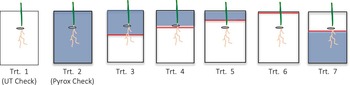
A randomized complete block experiment with four replicates was conducted to determine the effects of site of interception of pyroxasulfone on wild oat control. A thin layer (1 to 2 mm) of activated charcoal (Fisherbrand #05-690A, 50-200 mesh, Suwanee, GA) was used as a barrier to isolate herbicide contact with specific parts of the wild oat seedling (Blair Reference Blair1978) in Kinsella soil. At the time of seeding, 12 wild oat seeds (S1988) were placed 2 cm from the soil surface, and an activated charcoal layer was placed either 1 cm below seed level (Trt. 3), at seed level (Trt. 4), 1 cm above seed level (Trt. 5), or 2 to 3 mm below the soil surface (Trt. 6) for surface-applied pyroxasulfone, and at seed level after herbicide application (Trt. 7) (Figure 1). Pyroxasulfone was applied at 150 gaiha−1, as described previously. Two controls were present, untreated (Trt. 1) and treated with pyroxasulfone (Trt. 2) in the absence of activated charcoal, emulating a typical application of pyroxasulfone followed by dissipation. All pots were placed in a greenhouse for 11 d. Natural light was supplemented with 16 h of artificial light (275 mmolm−2s−1) at a temperature of 21 C. Trays were top watered with a sprinkler can to saturation and rotated on greenhouse benches daily to avoid positional effects. Plants were uprooted and washed to quantify shoot length, root length, and shoot fresh weight per plant. Each pot was considered an experimental unit, and the trial was replicated three times. The statistical software R (v. 0.98.1091; R Core Team Reference R2014) was used to complete the ANOVAs and derive least-squares mean estimates for each treatment in the nlme and lsmeans Tukey’s HSD pairwise comparisons were used to determine treatment differences using shoot length and root length as response variables with a confidence level of 0.95.
Illustration of treatments (Trt.) to determine effective site of interception of pyroxasulfone. The solid line indicates the position of the activated charcoal layer and the shaded area indicates the position of the pyroxasulfone (Pyrox) with respect to the seedling. UT, untreated.

Pyroxasulfone Leaching
To reveal how pyroxasulfone could be redistributed in the soil profile from precipitation, a soil bioassay was conducted to determine the downward movement of pyroxasulfone in potted soil with and without a simulated rainfall event. Trays (450 cm2 by 12 cm deep) were filled to the top with moistened, homogenized Kinsella soil in 2.5-cm-deep intervals. A thin plastic mesh layer was used to separate depth intervals to allow for easy separation but not obstruct water infiltration or herbicide movement. Trays were then sprayed with pyroxasulfone at 150 gaiha−1, as described earlier. After herbicide application, trays were placed in the greenhouse for 24 h, after which one tray was subjected to a 2.54 cm rainfall simulation applied to the soil surface and one tray did not receive any rainfall. Trays were retained for 1 wk without further water and then were divided into individual 2.5 cm depth increments. Soil from each depth was placed in paper bags and oven- dried at 45 C for 7 d. Samples were then transferred to plastic bags and transported to the University of Saskatchewan for completion of the soil bioassay. The soil bioassay was conducted using the bioassay technique for pyroxasulfone as described in Szmigielski et al. (Reference Szmigielski, Johnson and Schoenau2014).
Soil samples from each layer were hand mixed and divided into five subsamples for each of the four replicates. Subsamples were then transferred to 59 ml (2 oz) WhirlPak® bags (VWR International, Mississauga, ON, Canada). Soil in each bag was gently packed to form a layer approximately 8 cm high, 6 cm long, and 1 cm wide. Six canola (Brassica napus L.) (Invigor ‘LibertyLink® 154’) seeds were planted at a 2 mm depth in the WhirlPak® bags and the soil surface was covered with a 5 mm layer of plastic beads to reduce soil drying. Plants were grown in the laboratory under fluorescent lights that had photosynthetic photon-flux density of 16 μmolm−2s−1 at plant level, and plants were watered daily to 100% field capacity by adding water to a predetermined weight. At harvest time, intact plants were recovered from soil after the WhirlPak® bags were opened, and soil was washed away with tap water. Canola shoot length was measured with a ruler. The trial had four replicates, and subsamples within each replicate were averaged. Two-sample t-tests in R (v. 0.98.1091; R Core Team Reference R2014) were used to determine significance between the two treatments at each depth.
Effect of Tillage, Seed Depth, and Herbicide in the Field
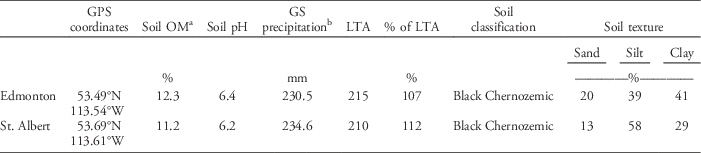
To explore the potential influencing factors associated with tilled and untilled soil on pyroxasulfone and triallate control of shallow and deep wild oat seeds, field trials were established in Alberta, Canada, at the Edmonton Research Station and the St. Albert Research Station on eluviated Black Chernozemic soils (Udic Boroll) (AGRASID 2015) during the spring of 2014. Organic matter content, pH, soil texture, and seasonal rainfall were similar at both sites (Table 1). Spring soils were dry at seeding, although growing season precipitation was similar to long-term averages. Trials were designed as a split-split plot with four replicates, in which main plot was tillage, the first split was herbicide type and rate, and the second split was wild oat seeding depth. In the spring of 2014, soil was either cultivated or was left undisturbed. Cultivation was performed to a depth of approximately 8 to10 cm by a single pass of 10-cm-wide A-shaped shovels mounted on a custom-built 2-m-wide plot seeder. Tillage was performed on May 7 and May 9 at Edmonton and St. Albert, respectively, and wild oat was seeded the next day at both sites. Wild oat was hand seeded (50 per plot) either shallowly (0.5 cm) or deeply (5 cm) in microplots (0.25 m2) using a 5 by 10 cm grid-seeding pattern. Shallowly planted seeds were placed on the soil surface and covered with a thin layer of soil, while deep-seeded wild oat seeds were placed down narrow 5-cm-deep holes established with a screwdriver prior to seeding. Two sub-microplots of each depth were established in each tillage (herbicide) treatment. After seeding, plots were treated with pyroxasulfone (85% WDG), applied at 150 g ai ha−1 or 300 g ai ha−1, or triallate (480 g L−1 EC), applied at 1170 g ai ha−1, or left untreated. Herbicide application was performed using a 2-m-wide CO2 backpack sprayer with 100 L ha−1 water volume with Air Bubble Jet (110015) nozzles and a screen mesh size of 100. Herbicide treatments were applied on May 8 and May 13 at Edmonton and St. Albert, respectively. Bromoxynil/MCPA mixture was applied on May 23 at 553 g ai ha−1 for control of broadleaf weeds across the entire trial at the St. Albert research station, and no broadleaf herbicide was applied at Edmonton Research Station. Each tillage (herbicide by depth) treatment was an individual experimental unit.
Soil properties and precipitation data for field trial locations.

a Abbreviations: OM, organic matter; GS, growing season; LTA, long-term average.
b GS precipitation recorded from May 1 to August 1, 2015.
The number of wild oats that emerged was quantified weekly. At 42 DAT, destructive sampling was used to measure each individual plant’s aboveground, belowground, and seed-to-soil lengths. Fresh weight data were recorded for each microplot, and plants were placed in paper bags and put in a drier at 42 C for 7 d to obtain dry weights.
Data were fit to a linear mixed model in R with fixed factors of tillage, herbicide, seeding depth, tillage:herbicide interaction, tillage:seeding depth interaction, herbicide:seeding depth interaction, and the three-way interaction of tillage:herbicide:seeding depth. Due to the absence of an interaction with location, location and replicate were considered to be random factors. Contrasts of interest were completed with a 95% confidence level using the cld() function in the ‘lsmeans’ package in R (v.0.98.1091; R Core Team Reference R2014), and P-values were adjusted when necessary using Tukey’s method for multiple comparisons.
Results and Discussion
Effect of Seed Depth on Herbicidal Control
When wild oats were seeded shallowly (0.5 cm) or deeply (6 cm) and treated with pyroxasulfone or triallate, there was a significant effect on shoot length of herbicide, seeding depth, and herbicide:seeding depth interaction (P<0.05). There was no interaction with wild oat population; therefore, results from trials were combined. Due to the interaction between seeding depth and herbicide, the effect of seeding depth was compared within herbicide treatments, and herbicide effects were examined within a particular seeding depth.
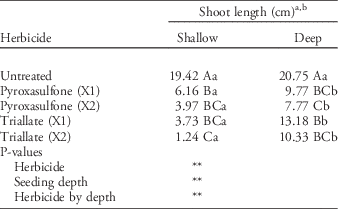
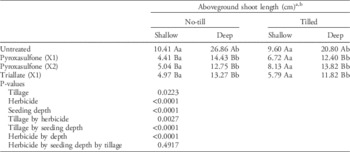
Herbicide efficacy, as indicated by shoot length, of both pyroxasulfone and triallate was reduced (P<0.05) in deep-seeded compared with shallow-seeded wild oats (Table 2). Shoot length was decreased an additional 3.6 and 9.4 cm in shallow-seeded compared with deep-seeded plants, respectively, when treated with the recommended field rates of pyroxasulfone and triallate. The effect of depth on herbicidal activity indicates that when wild oats are deeper in the soil profile, they are less susceptible to both triallate and pyroxasulfone. The decreased activity on deep-seeded wild oat is most likely due to the physical–chemical herbicide interaction with the soil, as well as wild oat site of uptake of these herbicides (Knake et al. Reference Knake, Appleby and Furtick1967). With similar low water solubility values of pyroxasulfone (3.49 mg L−1 at 20 C) and triallate (4.0 mg L−1 at 20 C), both herbicides have been reported to strongly bind to the soil and remain near the soil surface unless incorporated (Beestman and Deming Reference Beestman and Deming1976; Westra et al. Reference Westra, Shaner, Westra and Chapman2014). This would result in different part of a wild oat seedling intercepting the concentrated herbicide layer when recruited from various depths in the soil profile. These results are consistent with a previous research by Banting (Reference Banting1967) that reported increased shoot length of wild oat with increased distance between wild oat seeds and triallate-treated soil.
Average aboveground shoot length of shallow-seeded (0.5cm) and deep-seeded (6cm) wild oat seedlings when treated with the soil-applied herbicides pyroxasulfone and triallate.

a Means within a column for depth of seeding followed by the same uppercase letters are not significantly different at a 0.05 level of significance using Tukey’s HSD pairwise comparisons with a confidence level of 0.95. (SE=1.34).
b Means within a column for depth of seeding followed by the same lowercase letters are not significantly different at a 0.05 level of significance using Tukey’s HSD pairwise comparisons with a confidence level of 0.95.
**P<0.05 (SE=1.34).
There was no difference between the average shoot lengths of shallow- or deep-seeded wild oats that were untreated. This result was expected due to large seed size and mesocotyl elongation that allows wild oat to be recruited from varying depths (Blair Reference Blair1978; Boyd and Van Acker Reference Boyd and Van Acker2003; Sharma and Born Reference Sharma and Born1978). Within each depth, the recommended field rates of pyroxasulfone and triallate reduced (P<0.05) wild oat shoot length compared with the untreated controls (Table 2). In shallow-seeded wild oats, average shoot length was reduced by 13.3 cm and 15.7 cm by the recommended field rates of pyroxasulfone and triallate, respectively. Deep-seeded wild oats treated with pyroxasulfone (150 gaiha−1) had an average shoot length reduction of 10.0 cm, while triallate reduced shoot length by 7.6 cm. Within each depth, there was no difference (P>0.05) between triallate and pyroxasulfone at the recommended field rates or between rates of pyroxasulfone or triallate.
Effective Pyroxasulfone Interception Site
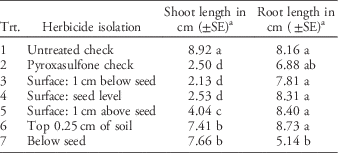
Data were combined for the three trials after ANOVA results indicated no significant effect of trial. Inhibition of wild oat varied, depending on what portion of the wild oat seedling came in contact with the pyroxasulfone-treated soil. When pyroxasulfone was applied to the soil surface in the absence of active charcoal (Trt. 2), shoot length was reduced by 6.4 cm (Table 3). When pyroxasulfone was allowed to reach wild oat seed level (Trt. 4) and 1 cm below seed level (Trt. 3), similar herbicidal symptoms to the pyroxasulfone application without an isolation zone were observed. When pyroxasulfone was isolated either to the soil surface or rooting zone below the seed (Trt. 6 and 7, respectively), there was little effect of pyroxasulfone on wild oat shoot length (reductions of only 1.51 and 1.26 cm, respectively). Although pyroxasulfone dissipation is limited, sufficient pyroxasulfone reached the sensitive portion of the seedling to reduce shoot length. The critical point of pyroxasulfone seedling interception is either the seed itself or within the first 1 cm of shoot growth. Roots are not affected when pyroxasulfone is applied to the soil surface and allowed to dissipate (Trt. 2) (Table 3). Only when pyroxasulfone was applied before seeding and isolated to the rooting zone (Trt. 7) was there a decrease in root length (3.02 cm) compared with the untreated check (P<0.05).
Shoot length and root length of wild oat with isolated pyroxasulfone exposure.

a Means within a column followed by the same letter are not significantly different using Tukey’s HSD pairwise comparisons with a confidence level of 0.95; shoot length SE=0.28; root length SE=0.64.
Banting (Reference Banting1967) investigated the effect of depth of seed placement on control of wild oat when treated with triallate and diallate and observed an increase in wild oat shoot length as the distance between triallate- or diallate-treated soil layer and wild oat seed increased. This was attributed to a longer period of shoot development before the stem apex reached the herbicide layer. Friesen et al. (Reference Friesen, Banting and Walker1962) reported that either the initial 1.5 cm of coleoptile growth or the initiation of the crown node to be the most sensitive growth stages of wild oat and diallate interception. Our results suggest that when wild oats are being recruited from deep in the soil profile, the critical site of interception may not come in contact with the concentrated herbicide layer, allowing seedlings to avoid herbicidal effects.
Pyroxasulfone Leaching
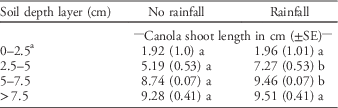
When comparing pyroxasulfone leaching after a single rainfall event with no rainfall in a canola shoot bioassay, data indicated that for both treatments, most of the pyroxasulfone activity was localized in the top 2.5 cm of soil with no difference of shoot inhibition at this depth (P>0.05) (Table 4). In the 2.5 to 5 cm and 5 to 7.5 cm depths the canola grown in soil subjected to a rainfall event had greater shoot length (P<0.05). This would suggest that there is more bioactive pyroxasulfone available in the soil that did not receive any rainfall after application. The effect of rainfall contradicts what would be expected, possibly due to rapid movement of unbound pyroxasulfone away from the soil with the rainfall event. Westra et al. (Reference Westra, Shaner, Westra and Chapman2014) looked at vertical movement of pyroxasulfone in field soils and reported the majority of pyroxasulfone remained in the top 7.5 cm of the soil profile throughout the growing season. Our bioassay results suggest that with or without a single rainfall event, most of bioactive pyroxasulfone is present in the top 2.5 cm of the soil profile. This supports the results of the depth of seeding and interception experiments indicating that deep-seeded wild oats are escaping herbicidal effects because the critical point of interception, the seed/shoot just above the seed, is below the concentrated herbicide layer in the soil profile.
Soil bioassay results with canola shoot length indicating distribution of bioactive pyroxasulfone in the soil profile after application with and without a simulated rainfall event.

a Means between columns followed by the same lowercase letters are not significantly different at a 0.05 level as determined by two-sample t-tests.
Effect of Tillage, Seed Depth, and Herbicide in the Field
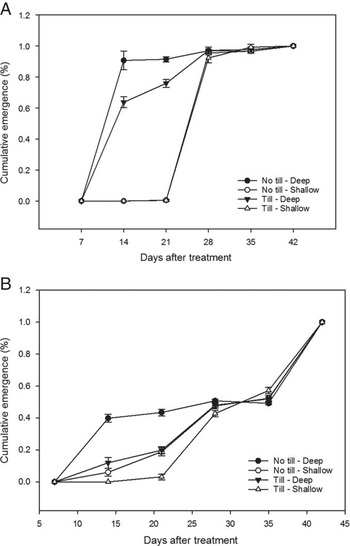
With uniform moisture, it would be expected that shallow-seeded wild oat would emerge before shallow-seeded wild oat. However, deep-seeded wild oats emerged earlier than shallow-seeded wild oats in both Edmonton and St. Albert (Figure 2). Wild oat seeded in no-till emerged earlier in deep-seeded (Edmonton) and in both shallow- and deep-seeded (St. Albert) conditions. We attribute the difference in time of emergence to drier soil in the upper soil profile and increased soil moisture availability when seeds are placed deep, and slower soil drying in no-till compared with tilled soil (Chauhan et al. Reference Chauhan, Gill and Preston2006; Roberts Reference Roberts1984).
Cumulative wild oat emergence following pyroxasulfone treatment at Edmonton (A) and St. Albert (B). Data points are the means of two experiments with four replications, with bars indicating the standard error of the mean.

Aboveground plant length was most sensitive to treatment effects and was used to compare treatments. There were no significant differences between sites, and sites were combined. Tillage (P=0.0223), herbicide (P<0.0001), seed depth (P<0.0001), tillage:herbicide interaction (P=0.0027), tillage:seed depth interaction (P<0.0001), and herbicide:seed depth interaction (P<0.0001) were all significant, while the three-way interaction between tillage, seed depth, and herbicide was not (P=0.4917). Due to interactions, treatment effects were examined within an individual depth and tillage combination.
Wild oat aboveground shoot length was reduced (P<0.05) when seeded shallowly vs. deeply in all herbicide and tillage treatments, including the untreated control (Table 5). In the absence of herbicides, mean shoot length was 16.4 cm shorter in shallow-seeded wild oat compared with deep-seeded wild oat in no-till soil, and shallow-seeded wild oat was 11.23 cm shorter than deep-seeded wild oat in tilled soil. The difference was attributed to a drier upper soil profile and delayed emergence of the shallow-planted wild oat.
Wild oat aboveground shoot length measured from the soil surface when seeded shallowly (0.5 cm) or deeply (5 cm) in tilled and untilled soil and treated with pyroxasulfone or triallate.

a Means down columns followed by the same uppercase letters are not significantly different at a 0.05 level as determined LSMEANS.
b Means across rows within a tillage treatment followed by the same lowercase letters are not significantly different at a 0.05 level as determined LSMEANS (SE=1.34).
Herbicide treatments all reduced (P<0.05) wild oat shoot length in each tillage and depth treatment, except for shallow-seeded wild oats in tilled soil (Table 5). The lack of herbicidal activity on shallow-seeded wild oats in tilled soil may be attributed to the absence of moisture for herbicidal activation (Walker Reference Walker1971) due to soil drying by tillage. Pyroxasulfone and triallate applied at the recommended rates to shallow- and deep-seeded wild oats in no-till soil and to deep seeded wild oats in tilled soil all decreased (P<0.05) wild oat shoot length compared with the untreated control in that seeding depth/tillage treatment. Similar to the effect of seed depth experiment, there were no significant differences in shoot inhibition between pyroxasulfone rates or between the recommended rates of pyroxasulfone and triallate.
Within depth and herbicide combinations, tillage alone did not affect wild oat shoot length (P>0.05) (Table 5). However, the effect of a single tillage pass should not be equated to differences between fields in different tillage systems. By comparing adjacent treatments with or without a single tillage event, we minimized differences in soil properties, such as organic matter content, and isolated tillage effects on soil moisture temperature but did not duplicate the conditions of a tilled field. An established no-till field will generally have slower soil drying and cooler soil temperatures but also increased soil organic content and microbial activity (Blevins et al. Reference Blevins, Smith, Thomas and Frye1983; Locke and Bryson Reference Locke and Bryson1997; Reicosky et al. Reference Reicosky, Kemper, Langdale, Douglas and Rasmussen1995; Wu et al. Reference Wu, Swan, Paulson and Randall1992), which can additionally influence the efficacy of a soil-applied herbicide. Differences in control of velvetleaf, pigweed, common ragweed, and lambsquarters by pyroxasulfone and flumioxazin between tilled and no-tilled systems have been reported previously (Mahoney et al. Reference Mahoney, Shropshire and Sikkema2014).
Deep-seeded wild oats were affected by herbicides but emerged early and survived pyroxasulfone and triallate treatments. In tilled fields with wild oat at various depths in the soil profile, deep-seeded wild oat will survive, while shallow-seeded wild oat will be inhibited, resulting in poor control. In no-till fields where wild oat will be primarily at the soil surface or shallow in the soil profile, pyroxasulfone and triallate will be more effective. The efficacy of soil-applied herbicides is influenced by edaphic and climatic factors along with the position of weed seeds relative to the herbicide-treated layer. Herbicides with low water solubility, like pyroxasulfone, have limited ability to penetrate the soil profile. High organic matter will reduce efficacy (Tidemann et al. Reference Tidemann, Hall, Johnson, Beckie, Sapsford and Raatz2014). For adequate control, wild oat seeds need to germinate either in the concentrated herbicide layer or within 1 cm below it to allow for effective herbicide interception by the seedling. Tillage influences many edaphic factors and weed seed position within the soil profile. Soil moisture is required to allow pyroxasulfone to partition into the seedlings and for seed germination and emergence, but it varies with depth and tillage. Efficacy of pyroxasulfone on wild oat is likely to be variable between years and sites, but pyroxasulfone is likely to be more effective in no-till fields.
Acknowledgments
We thank L. Raatz, J. Irving, K. Topinka, A. Szmigielski, and a number of seasonal workers for technical support, and J. Pinzon for assistance with statistical analysis throughout the project. We also acknowledge funding support from Natural Sciences and Engineering Research Council of Canada and FMC Chemical Company allowing for completion of this project.